

By Isaki Kasahara, a Japanese arborist pruning, assessing and caring for Japan’s trees and gardens · Updated November 18, 2026
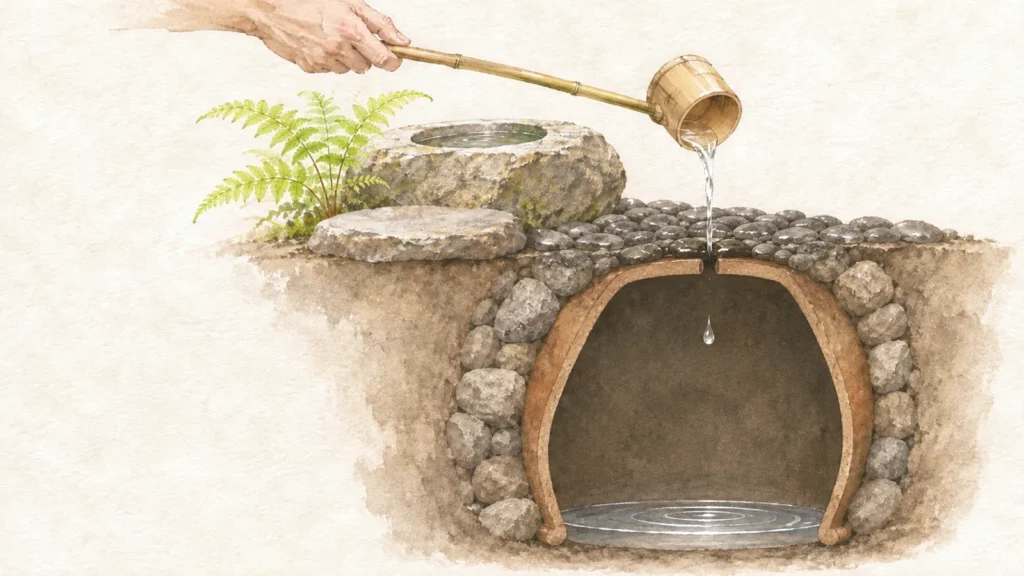
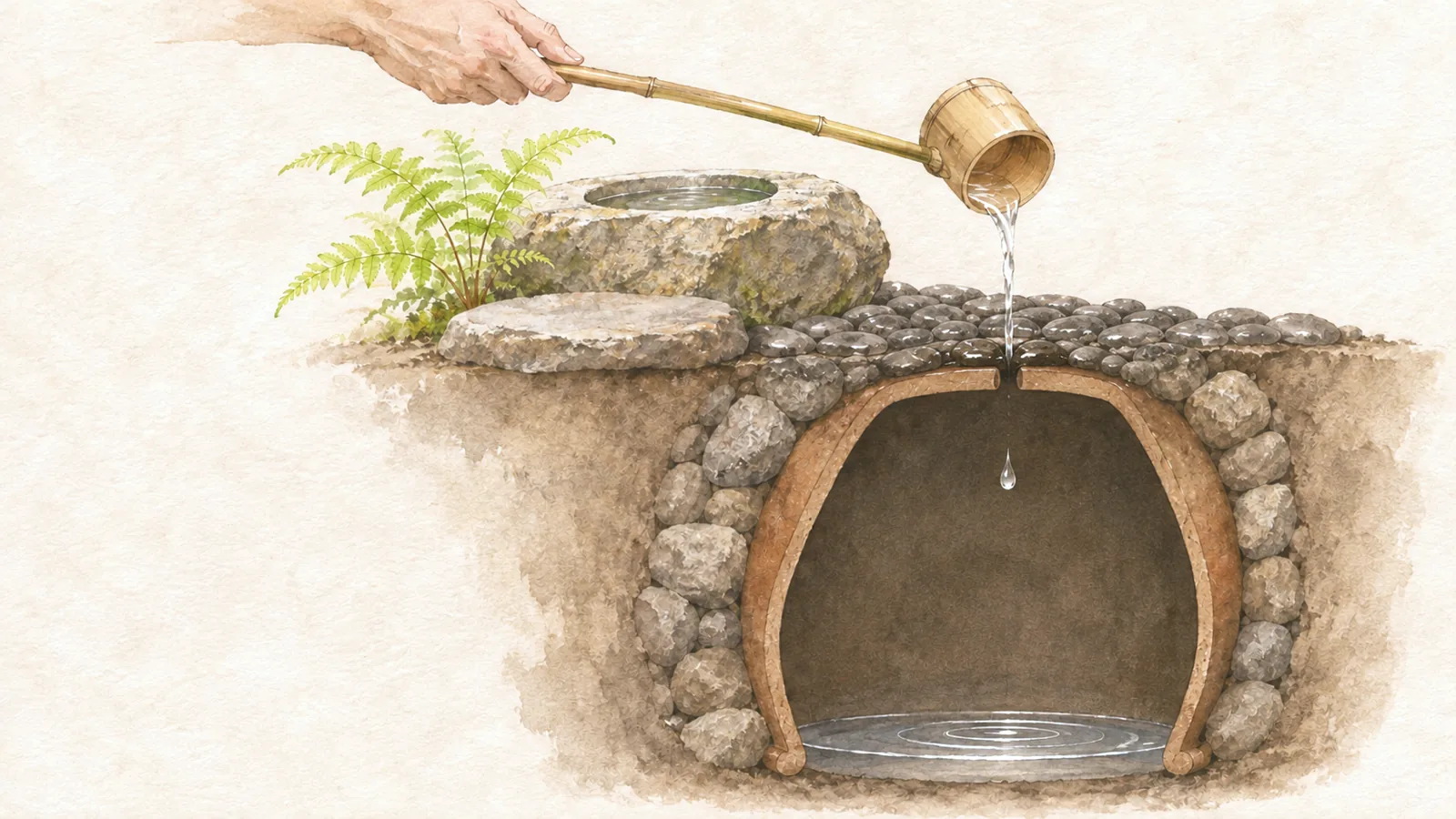
The sound under a Japanese garden basin comes from a suikinkutsu (水琴窟) — typically a ceramic jar buried upside down beneath the basin’s drain, with a small hole in its raised base and a shallow pool of water at the bottom of the hollow. Water from the basin seeps down, falls through the hole drop by drop, and each drop strikes the pool; the air inside the jar answers with a short, clear, bell-like note that rises back up through the gravel.
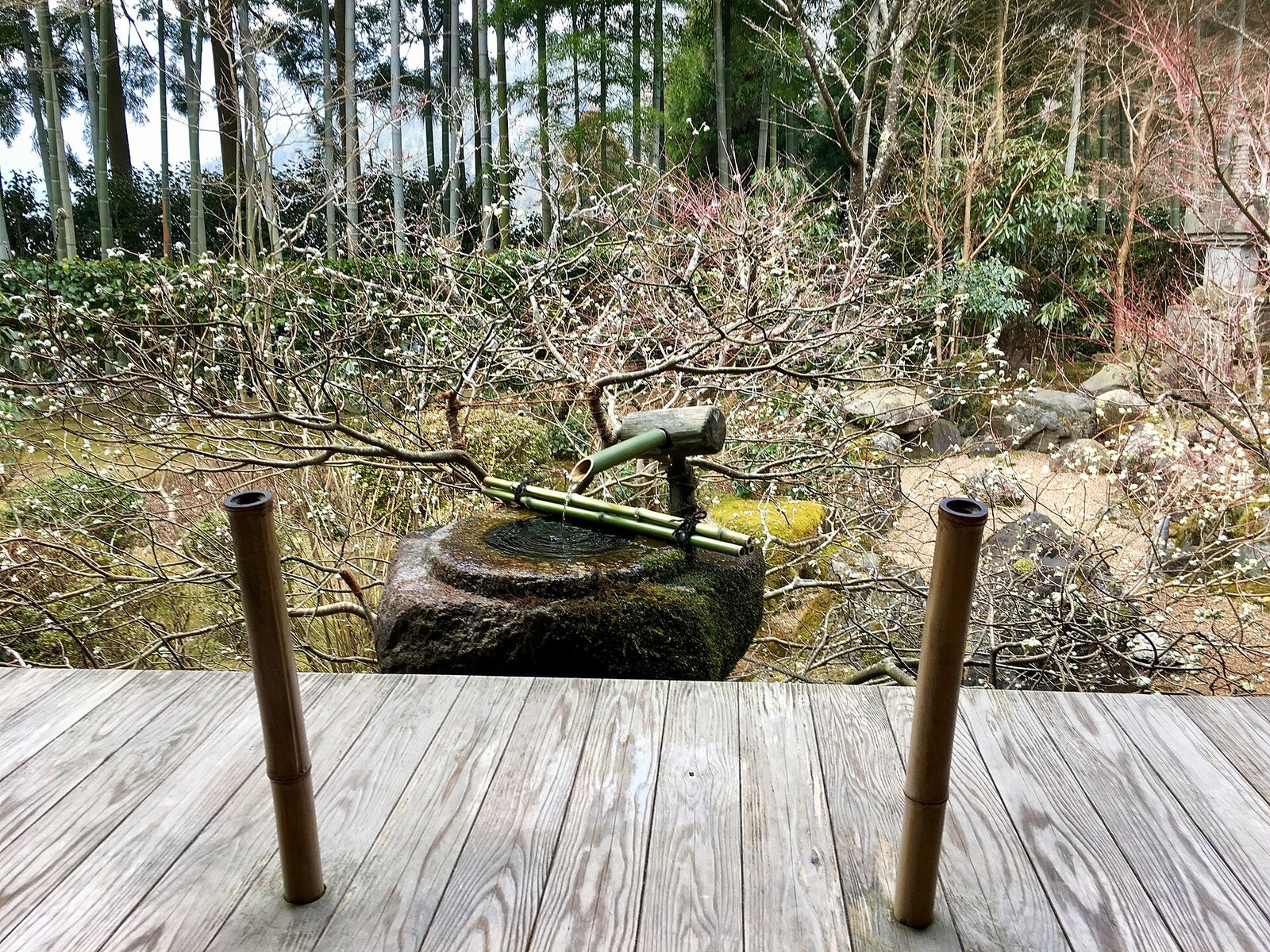
An ear on a bamboo pole — the jar rediscovered at a Tokyo museum
At the Shinagawa Historical Museum in Tokyo, a suikinkutsu sits in the garden that once belonged to the Yasuda Zensuke residence. The museum’s own exhibit guide says it was rediscovered in 1980, when the museum was being built — “昭和55年(1980)、品川歴史館建設の際に再発見されました” — and it tells visitors how to hear it: hold a bamboo tube to your ear, “竹筒を耳にあてて”.
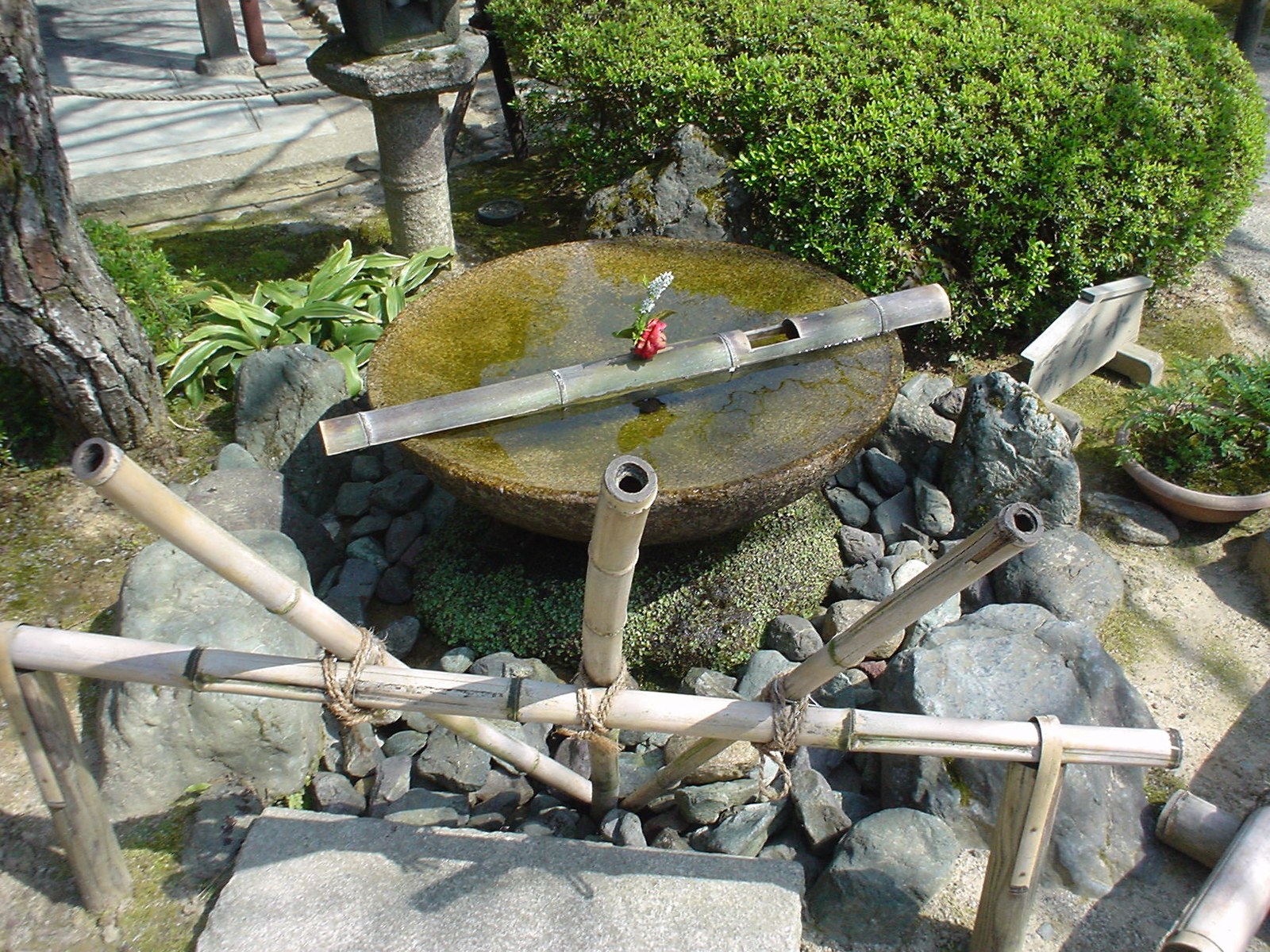
The device itself is out of sight. At the surface there is only gravel, a basin and, at gardens like this one, a length of bamboo that carries the sound up to the listener’s ear.
Why “rediscovered” is the right word
Two decades earlier the device had been described as nearly lost. In 1959 the landscape researcher Hirayama Katsuzō published a paper on garden suikinkutsu in the journal of the Japanese Institute of Landscape Architecture and wrote that they were “今日では殆ど壊滅に瀕しており” — today almost on the verge of extinction. His paper measured one surviving example in a private garden in Shinagawa Ward and recorded its dimensions. Whether that is the same suikinkutsu the museum rediscovered in 1980 is not established by the sources used here; the two are treated separately below.
What you are actually listening to
Japanese acoustic and landscape researchers have studied three parts of that sound: a drop of water hitting water, the bubble a drop can drag under the surface, and the hollow of air that lets some frequencies ring. Before getting to the hollow, it helps to look at the basin that feeds it, because in the traditional arrangement the suikinkutsu is built into the basin’s drain.
Tsukubai — the crouching basin that feeds the jar
A suikinkutsu is sometimes confused with the basin above it. The basin and its stones are the tsukubai; the suikinkutsu is something that may or may not be built beneath them.
Not just a bowl — a set of stones
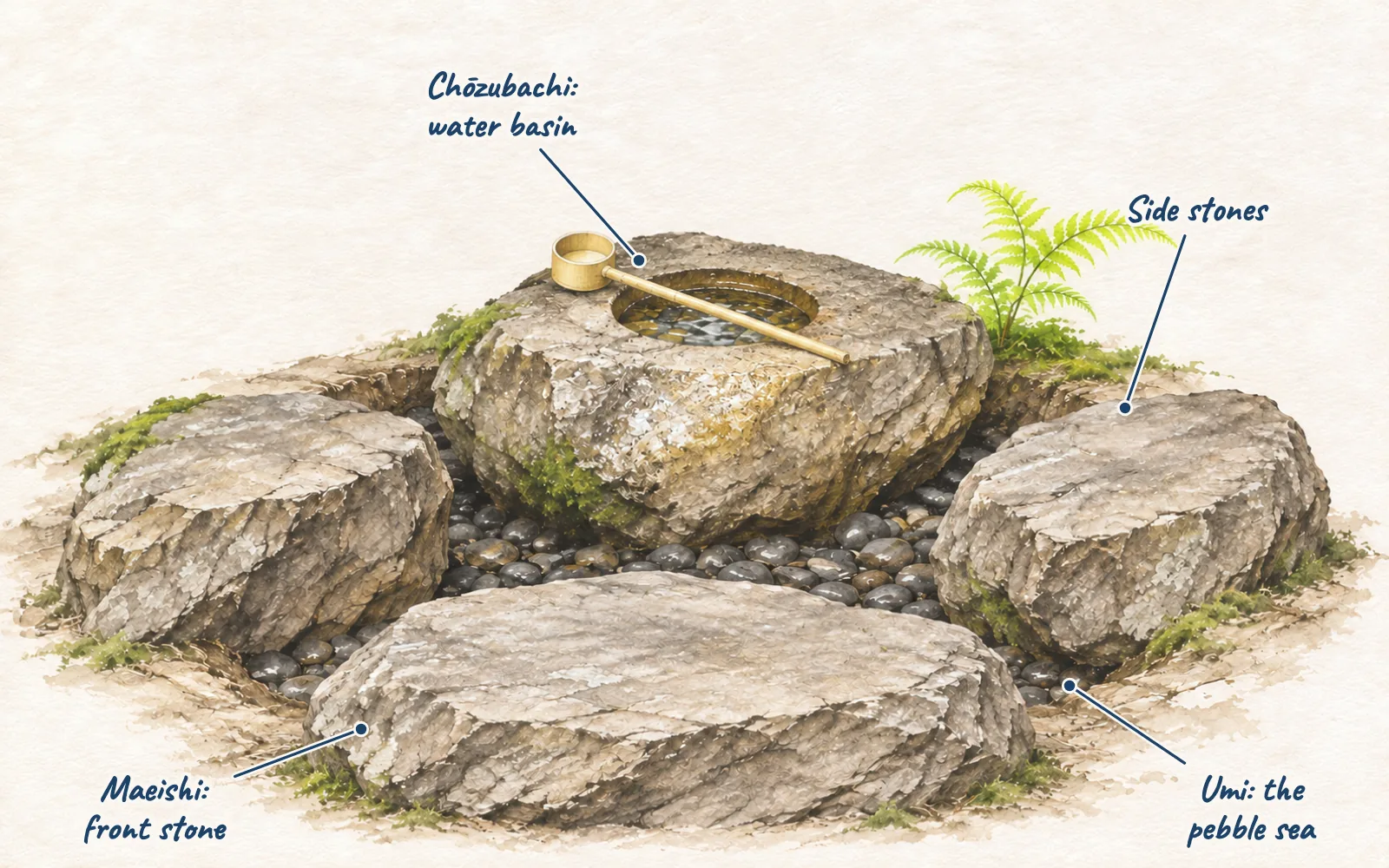
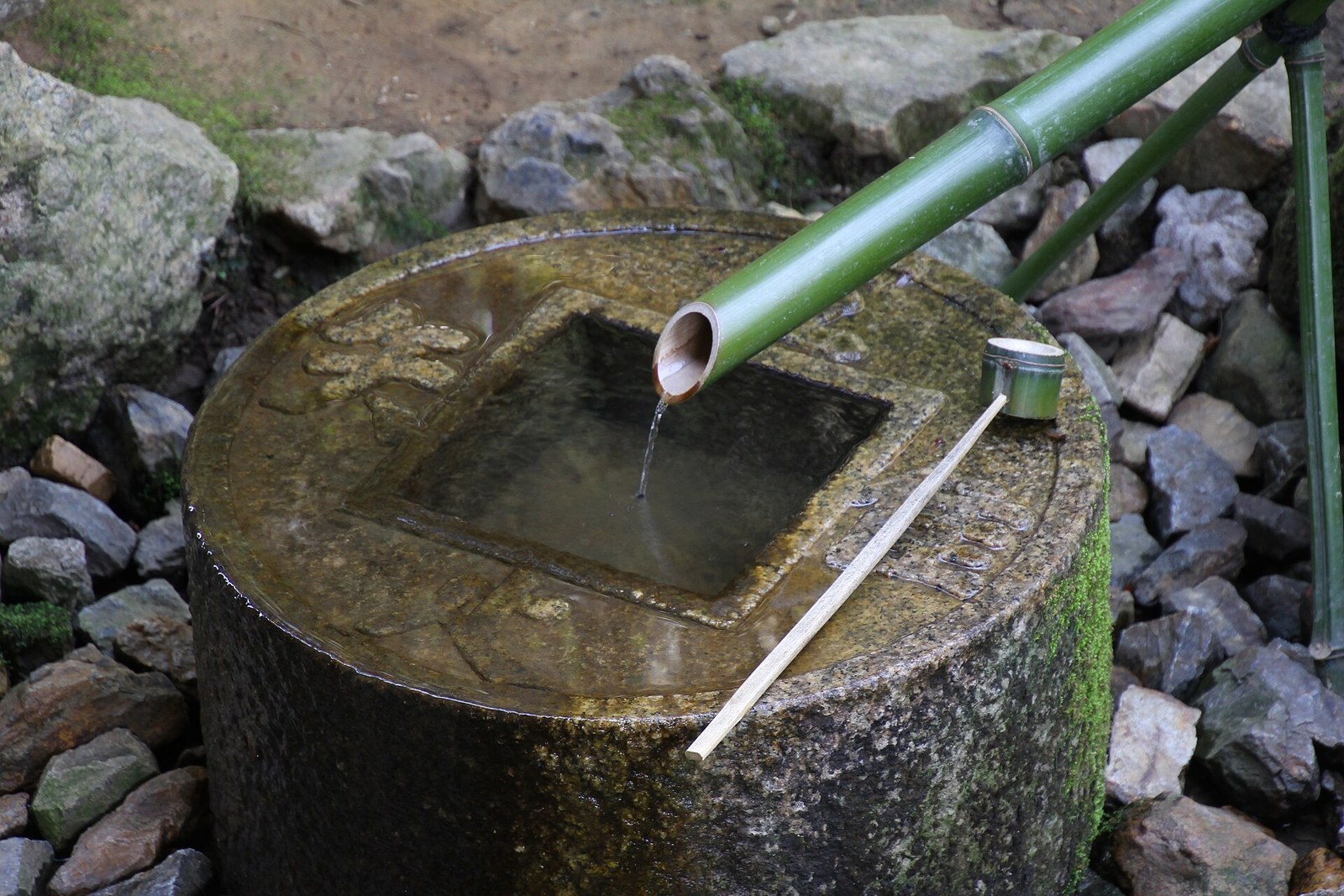
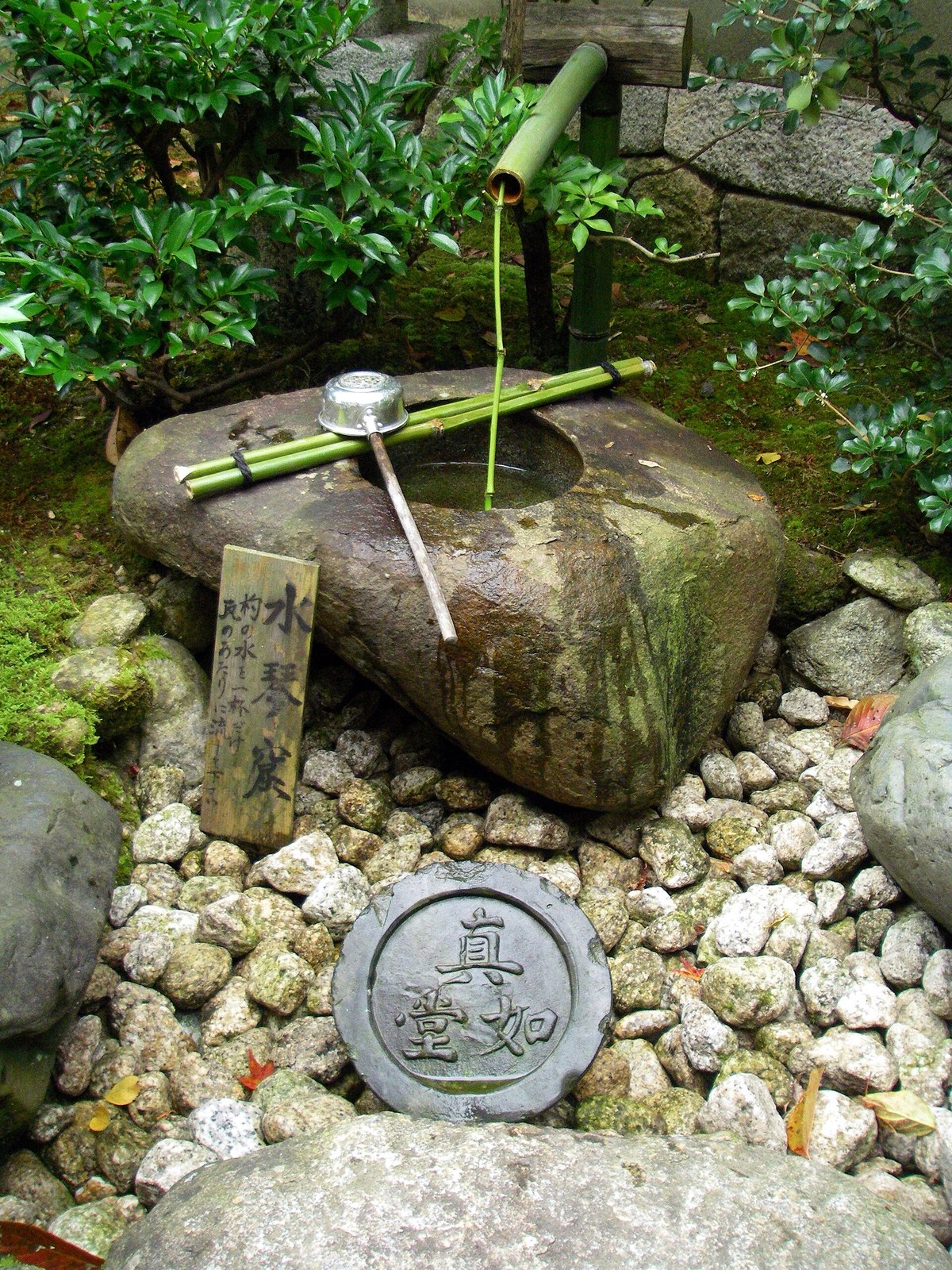
A tsukubai is not a single stone but a group: a low water basin, the chōzubachi, with its supporting stones. The Shimane Museum of Ancient Izumo, in a 2023 public lecture handout on gardens, describes its basin as one used to purify body and mind at a tea gathering — “茶事の際に心身を清めるための手水鉢”. The Nara National Research Institute for Cultural Properties (Nabunken), in its Japanese Garden Dictionary, adds the point that gives the arrangement its name: the basin “is supposed to be used in a crouched position”, which is why it sits much lower than the basins placed at the edge of a veranda.
| Part | Japanese | What it does |
|---|---|---|
| Water basin | Chōzubachi (手水鉢) | The stone that holds the water; the centre of the group |
| Front stone | Maeishi (前石) | The stone you step onto to use the basin |
| Hot-water vessel stone | Yuoke-ishi (湯桶石) | A flat stone for a vessel of hot water at winter tea gatherings |
| Candlestick stone | Teshoku-ishi (手燭石) | A stone for a candlestick or lantern when tea is held after dark |
| Sea | Umi (海) | The low, gravel-covered catch area around the basin that takes the spilled water away |
Sources: Shimane Museum of Ancient Izumo (2023); Nabunken Japanese Garden Dictionary; A. Stephen Gibbs, Kansai University (2012).
Why you crouch
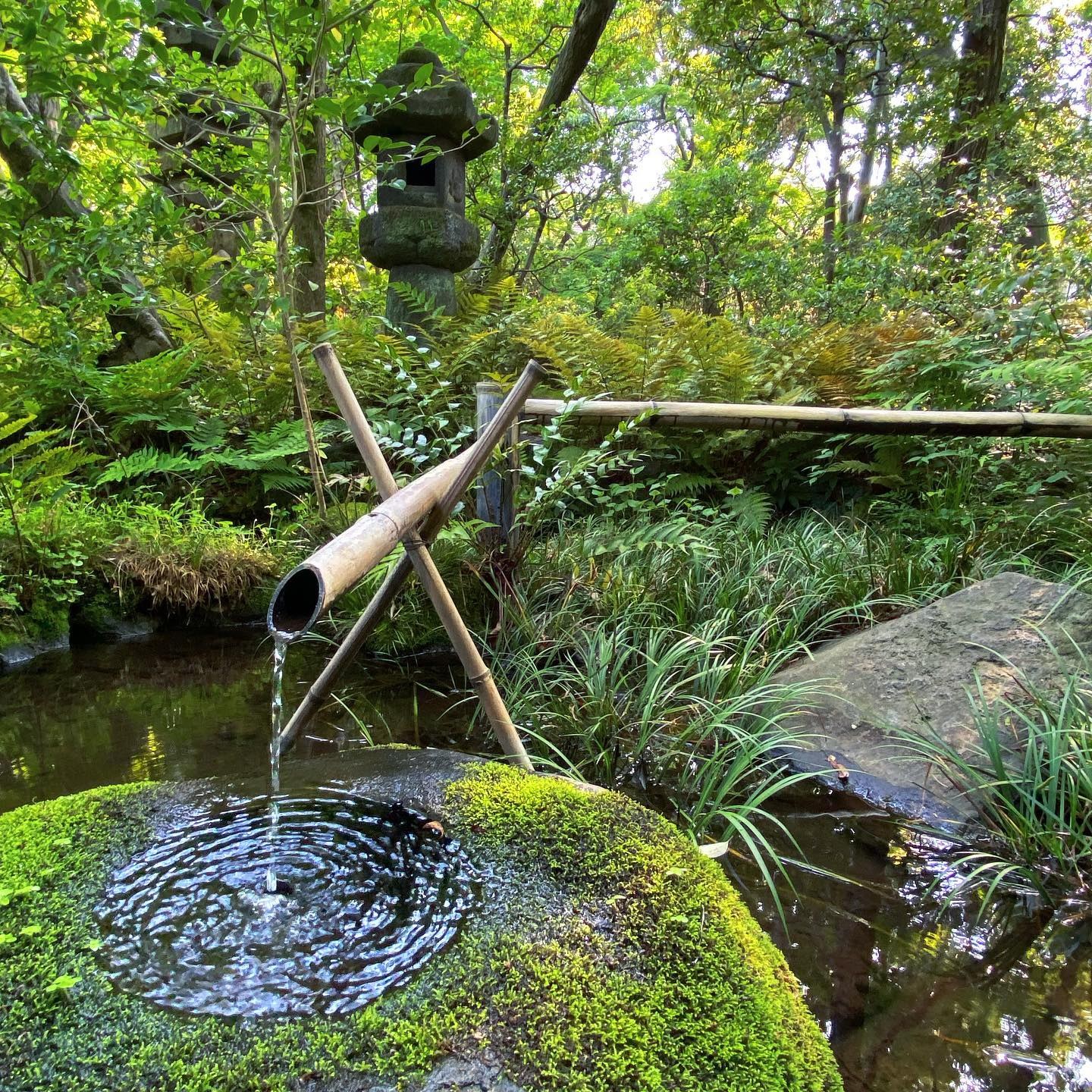
Suita City Museum in Osaka explains that the name is said to come from the way tea guests use it, crouching — “つくばう(うずくまる)ように使うことから”. The museum presents this as a traditional explanation of the name. The function is not in doubt. Before entering the tea room, the guest lowers the body, takes water with a ladle, and rinses hands and mouth.
A basin that was once something else
Some basins reuse older stone objects. At the former Nishio family residence in Suita, beside the Sekisui-an tea room, the museum records a granite bowl-shaped basin 60 cm (23.6 in) across and 49 cm (19.3 in) high, with a water hollow 27 cm (10.6 in) wide and 11 cm (4.3 in) deep. The museum identifies it as a mitate-mono (見立てもの), a “seen-as” object: the water ring of a five-tier gorintō (五輪塔) stone pagoda, turned upside down and reused — “五輪塔の水輪をひっくり返して利用した”.
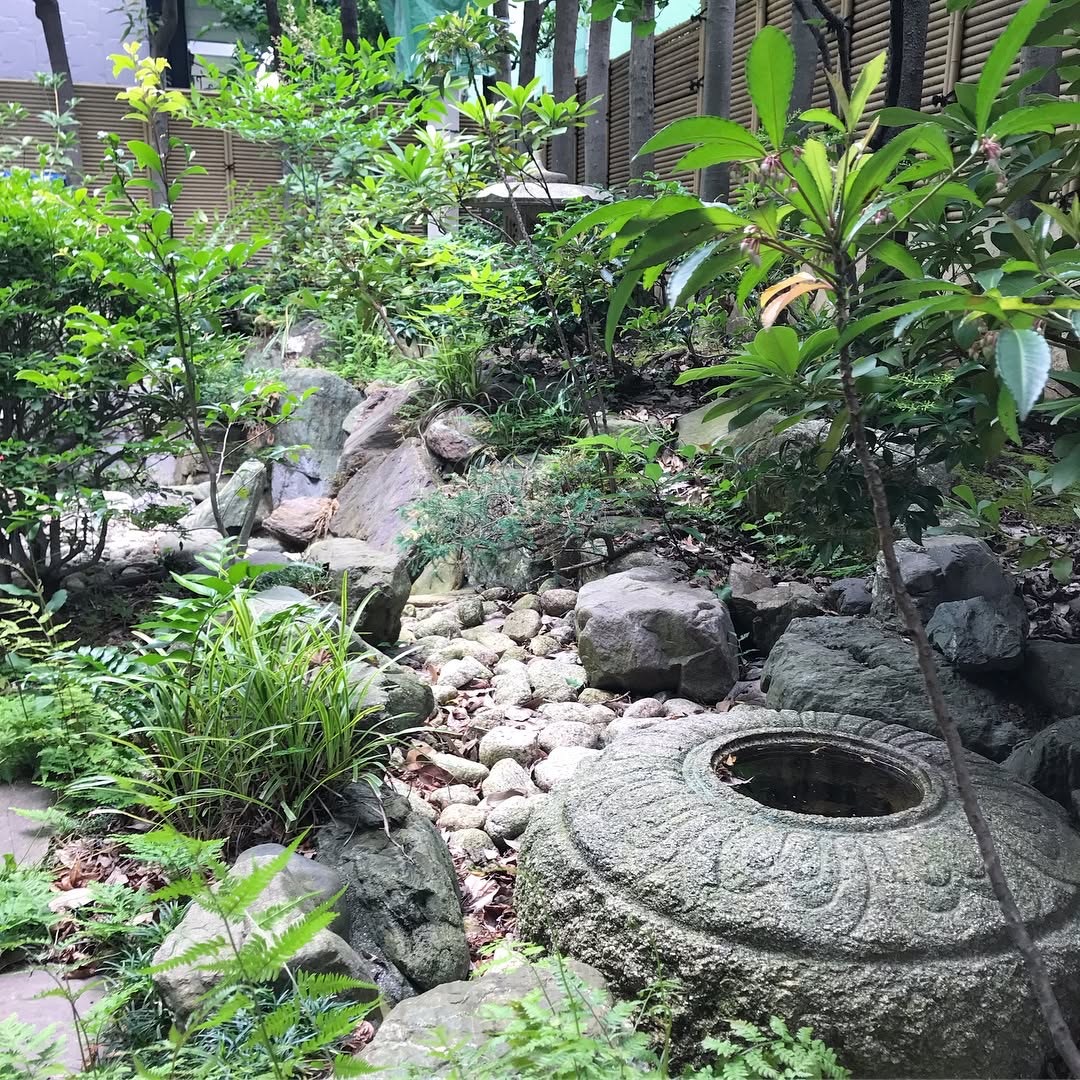
The tsukubai at Ryōan-ji in Kyoto plays a different game. The City of Kyoto’s guide describes its square central hollow serving as the character 口 shared by four surrounding characters, so the basin reads 吾唯足知 — “I only know contentment.” Neither of these basins needs a suikinkutsu to be complete. What a basin in use does need is somewhere for the water to go.
The “sea” — where the spilled water goes
Umi and suimon
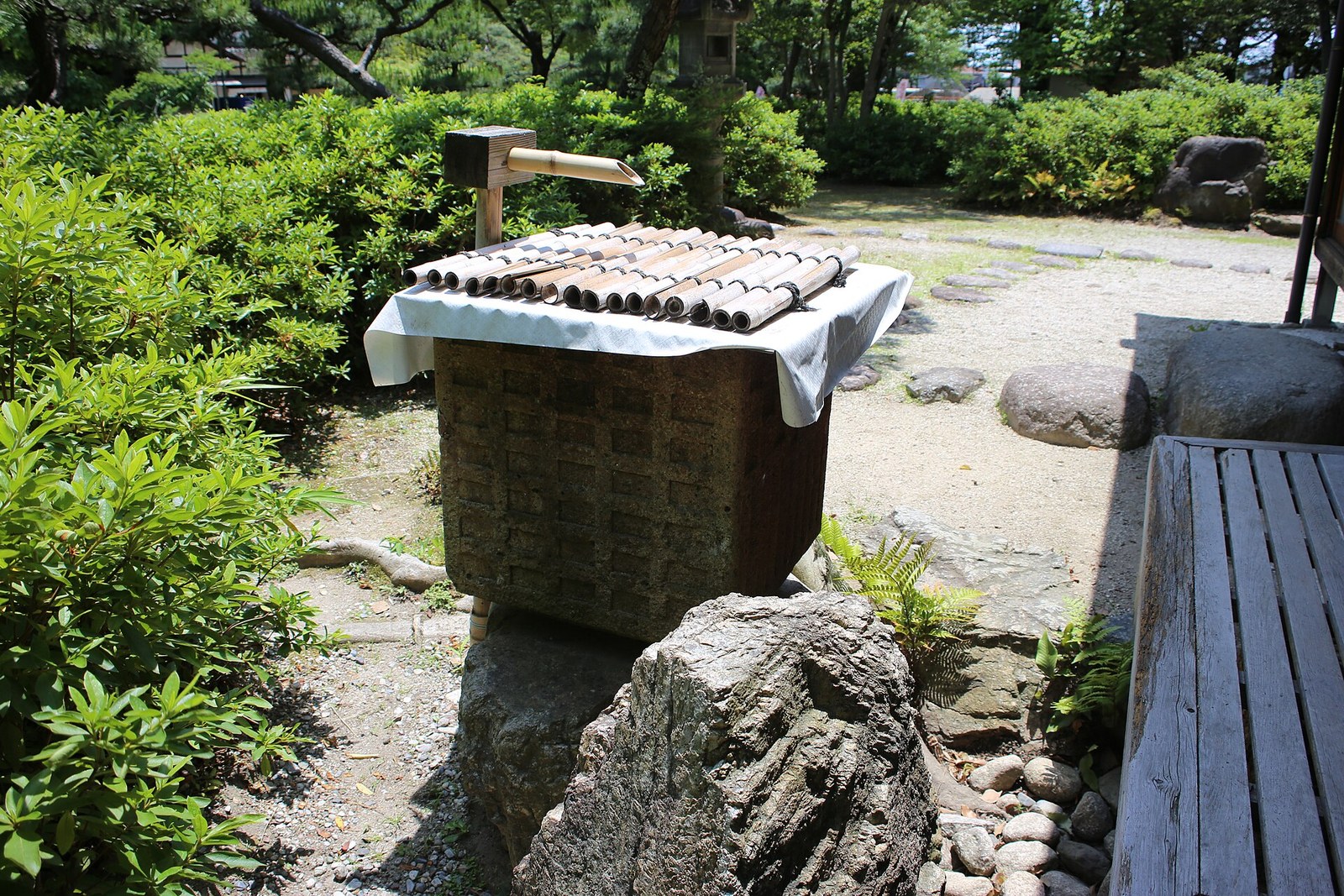
In the vocabulary of the Enshū school of tea, the translator and scholar A. Stephen Gibbs describes the umi as “a large, shallow, sunken sink”, covered with white gravel, with a drain. Nabunken’s dictionary lists suimon (水門), literally “water gate”, as a term used for the water-receiving and drainage part of a basin group, and notes, “There is a drain hole at its center.” The two terms overlap; different glossaries draw the line between them in different places.
A drain that also sounds
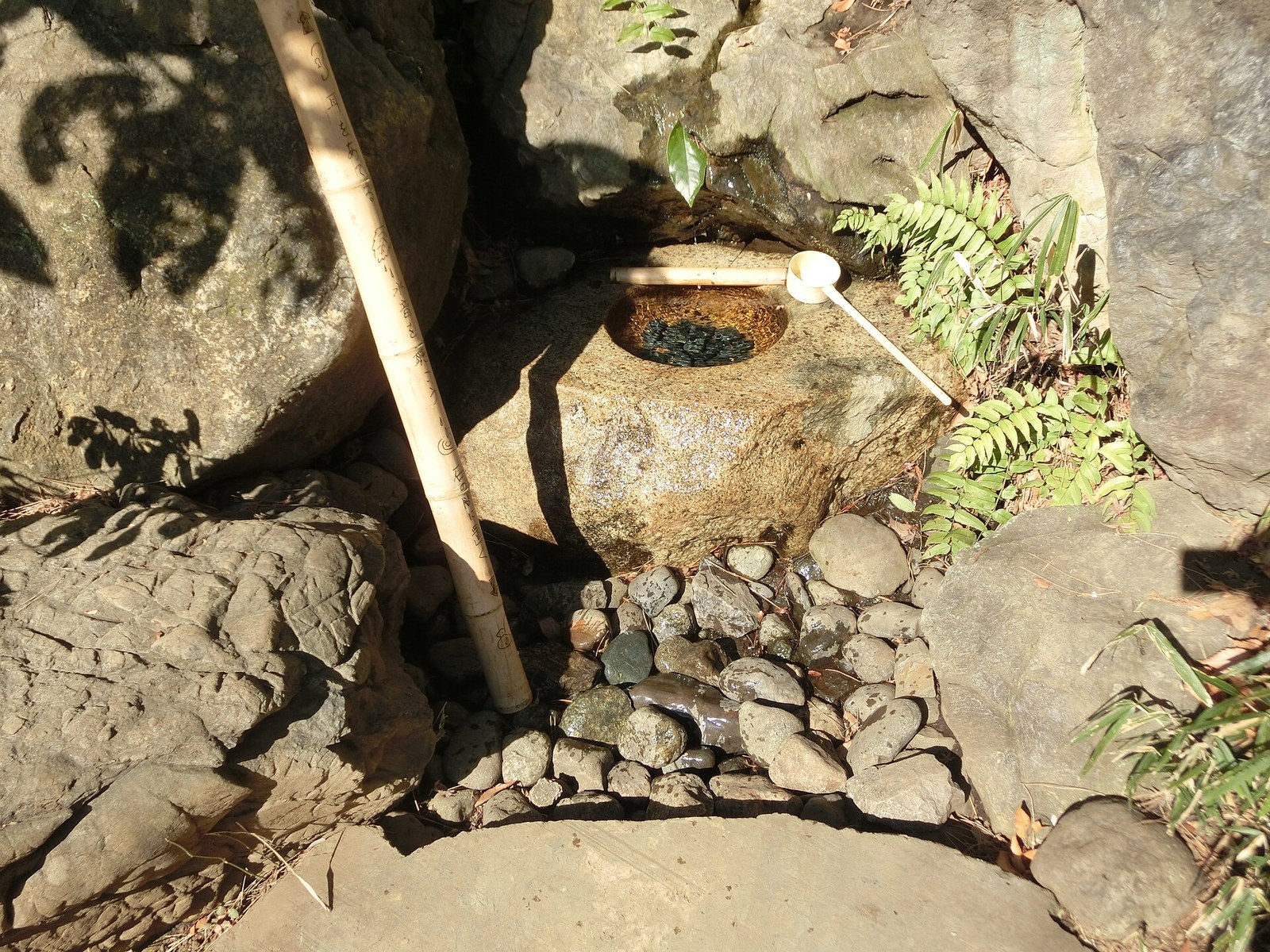
In the traditional arrangement, the water spilled at the basin already runs down through the gravel of the umi. A suikinkutsu makes that water pass through a closed hollow on its way. Nabunken defines it in exactly these terms: a jar “buried upside down” with a small hole in its base, a drainage device in which drops falling inside can be heard echoing. It drains and it sounds at once; modern freestanding versions exist, but the classic form is part of the basin’s drain.
Inside the jar — the anatomy of a suikinkutsu
The jar is turned over
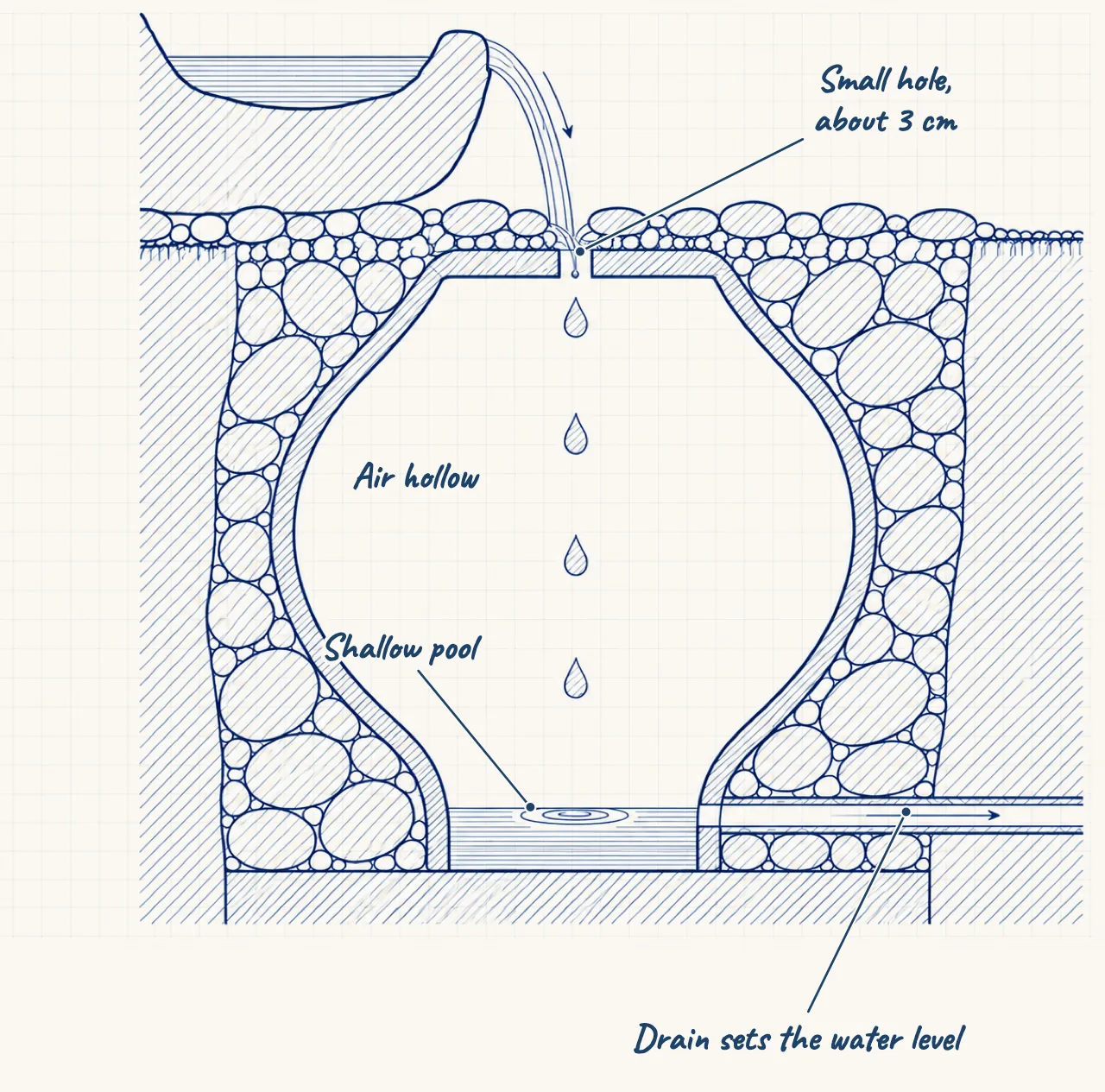
The detail that confuses most first descriptions is which way up the jar sits. A storage jar has its mouth at the top and its base at the bottom. In a suikinkutsu the jar is inverted: the mouth faces down, and the original base — with a hole drilled or punched through it — faces up, just under the gravel of the drain. The water that drips through that hole falls into the dark hollow and lands on a pool trapped at the bottom.
Eikandō, a temple in Kyoto, describes its own suikinkutsu in exactly these terms: a jar “set up-side down on the pan with water”, so that drops falling through the hole sound inside it.
Measured examples
There is no single standard size. What exists are measurements of particular chambers, jars and pits, made by researchers and archaeologists. They are worth reading side by side — with one caution. Hirayama’s Shinagawa example was not a single pottery jar: according to his paper, its top was ceramic while the body and base were built of stone. His figures describe the hollow and the water inlet, not a jar on its own.
| Example | What was measured | Size |
|---|---|---|
| Shinagawa Ward, Tokyo — built chamber (Hirayama, 1959) | Diameter of the hollow | 30 cm (11.8 in) |
| Depth of the hollow | 39 cm (15.4 in) | |
| Inner diameter of the water tube | 3 cm (1.2 in) | |
| Depth of the standing water | 3 cm (1.2 in) | |
| Saga domain warehouse-residence site, Nishitenma, Osaka (excavation report) | Tokoname-ware jar, mouth diameter | 42.0 cm (16.5 in) |
| Jar height | 44.5 cm (17.5 in) | |
| Hole made in the base after firing | 3.2 cm (1.3 in) | |
| Former Teramachi area, Kyoto (excavation report, 2016) | Pit dug for the jar | 0.85–1.0 m (2.8–3.3 ft) across; 0.5 m (1.6 ft) deep below the excavated surface |
| Packing around the jar | Stones 3–15 cm (1.2–5.9 in) |
Sources: Hirayama (1959), Journal of the Japanese Institute of Landscape Architecture 22(3); Saga-han Kurayashiki-ato excavation report, p. 91; Kodai Bunka Chōsakai (2016), p. 8.
What the numbers tell you
Three patterns stand out. First, the opening is small: about 3 cm in both Hirayama’s Shinagawa chamber and the jar excavated in Osaka. A small opening favours drops over a stream, though the flow itself depends on how much water is poured in. Second, the pool is shallow. Hirayama recorded 3 cm of standing water in a hollow 39 cm deep, which leaves most of the chamber as air. Third, in the Kyoto excavation the jar was packed in stone: an inverted Shigaraki-ware jar, “信楽焼の甕を俯せて置き”, with stones of 3 to 15 cm around and over it while the inside stayed hollow. That packing may have helped surplus water drain away, though the report records the arrangement, not its function.
The Osaka jar adds one more detail: the report notes that its hole was made after firing.
How the water level is held
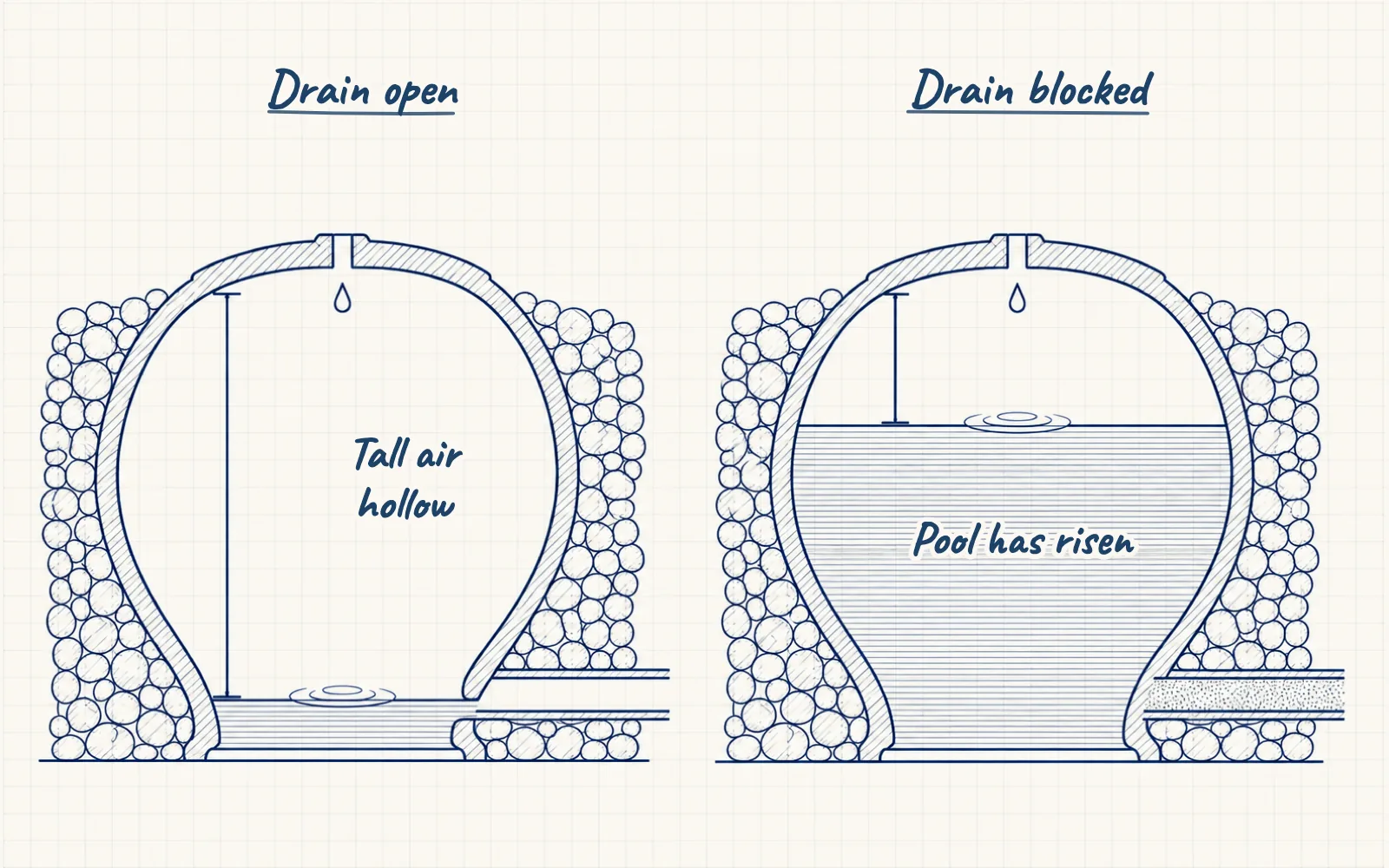
A pool at the bottom of an inverted jar will rise until something lets it out, so every design needs a path for surplus water. Hirayama’s paper describes the outlet arrangements of the example he studied, with a drain for surplus water. In a 1995 Japanese patent for a suikinkutsu, the inventor instead set the water level with an overflow hole and gave the embodiment’s water depth as anything from a few millimetres to over ten centimetres — “数mm〜十数cmの水深”. That is a design range for one invention, not a rule for every jar, but it shows a variable a builder controls: how much air is left above the water.
What actually makes the sound — drop, bubble and hollow
The drop and the bubble
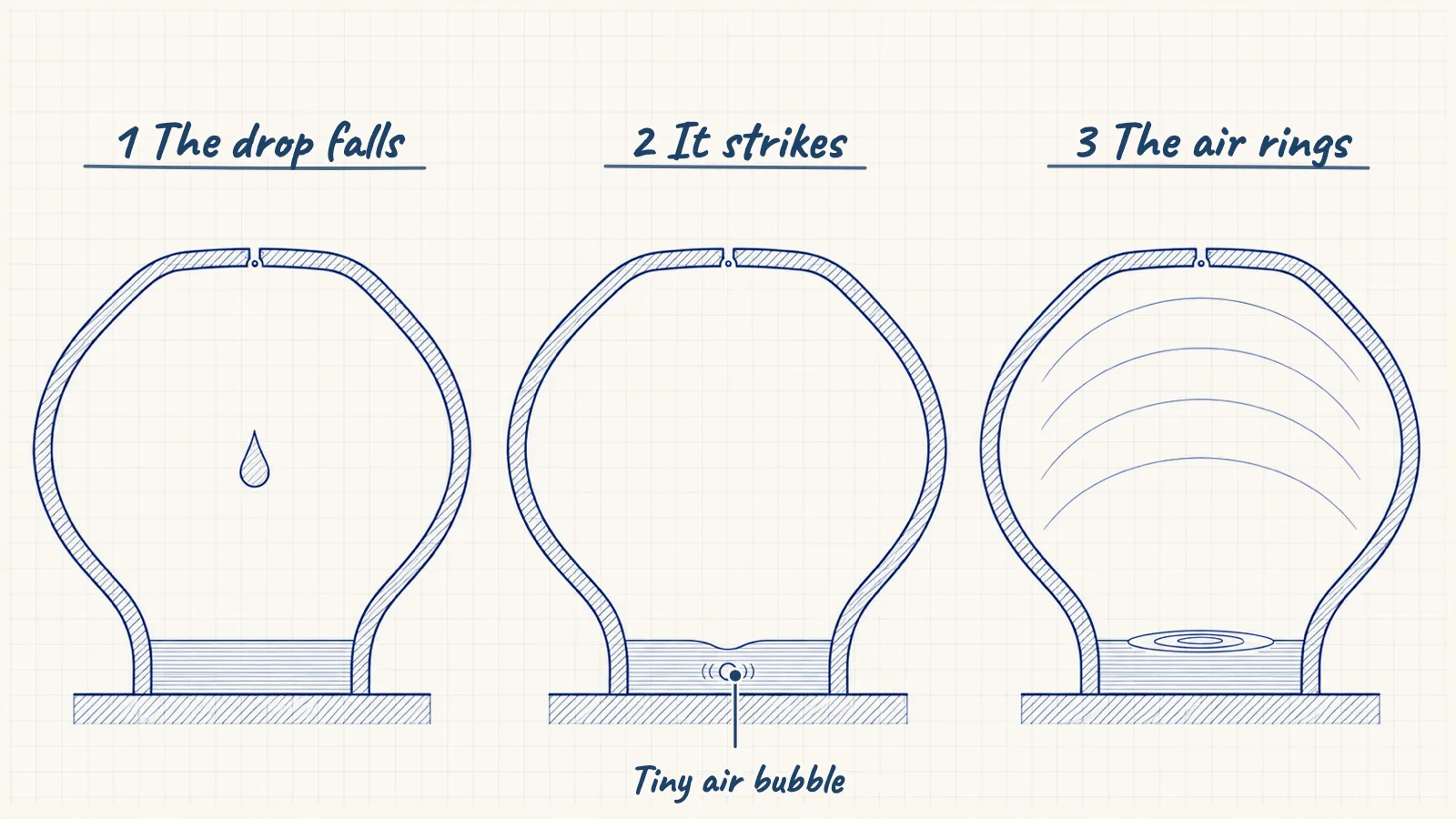
The first source of sound is not the jar at all. When a drop hits still water, it can drag a tiny pocket of air under the surface, and that bubble vibrates. Tomita Yukio, Kasai Toshiyasu and Miura Shin’ya studied this in 2002 for the Visualization Society of Japan, describing “oscillation of air bubbles entrained by the drop impact”. In one regular case — a drop 3.7 mm across falling 150 mm (5.9 in), producing a bubble 0.35 mm in radius — theory predicted 9.4 kHz and they measured 10.1 kHz.
Those are frequencies in the water, in a laboratory. They were measured under laboratory conditions, and the studies do not say how much of the bubble’s sound reaches the ear in a garden. What the bubble experiment suggests is that a drop can deliver a sharp, high, short impulse; the hollow appears to be what shapes it into a tone.
The hollow decides the note
That something is the air in the jar. Kishizuka Masaaki of Tokyo University of Agriculture analysed ten suikinkutsu with FFT spectrum analysis and reported a fundamental frequency of roughly 800 to 1,000 Hz — “800~1000Hz” — and found that the measured values corresponded to the natural vibration modes of the cavity. (The printed issue of the journal carries 1992; the J-STAGE record lists 1991.)
He also tested a common explanation: that the jar is a Helmholtz resonator, like air humming across the mouth of a bottle. Using a hole 3 cm across, a tube 12 cm long and a volume of 50,240 cm³ (about 50 litres), the Helmholtz formula gave 18.6 Hz — “f₀=18.6Hz”. The measured sound was near 1,000 Hz. For the dimensions Kishizuka examined, the calculated Helmholtz frequency did not explain the measured peaks, and he did not adopt it.
The jar itself rings too
In 2004 Watanabe Yoshio of Tokai University published an analytical study of the suikinkutsu’s acoustic mechanism in the Japanese Journal of Applied Physics. According to the paper’s abstract, “The body of the suikinkutsu also has its own natural frequencies,” which work together with the vibration of the air inside to shape the tone. The ceramic, in other words, is not a neutral container. (Only the abstract has been checked for this article; the paper’s equations and values are not reported here.)
Measured in a real garden
Iwase Teruo of Niigata University analysed a suikinkutsu in Maki town, Niigata, together with a commercial CD recording. The sounds contained components from 800 Hz to 5 kHz, with many sharp peaks between 1 and 3 kHz — “特に1~3kHzで鋭いピーク”. In the 1 to 5 kHz band, reverberation lasted from 1.5 to just over 2 seconds. Near the opening of that installation, the A-weighted sound level peaked at 54 dB and averaged 42 to 43 dB.
| Study | What was measured | Result |
|---|---|---|
| Izumiyama Masami, Tokai University (1986) | How long one drop’s sound stays audible, 10 suikinkutsu | 0.35–0.74 s |
| Kishizuka Masaaki, Tokyo University of Agriculture (1991/92) | Fundamental frequency, 10 suikinkutsu | about 800–1,000 Hz, matching cavity modes |
| Kishizuka (same paper) | Helmholtz resonance, calculated | 18.6 Hz — does not match |
| Iwase Teruo, Niigata University (2000) | Spectra of the Maki installation and a CD recording | 800 Hz–5 kHz, sharp peaks at 1–3 kHz |
| Iwase (same paper) | Reverberation, 1–5 kHz band | 1.5 to just over 2 s |
| Iwase (same paper) | Sound level near the opening, Maki | average 42–43 dB(A), maximum 54 dB(A) |
| Tomita, Kasai and Miura (2002) | Bubble from a falling drop, in the lab | 9.4 kHz predicted, 10.1 kHz measured |
The measures differ: Izumiyama’s figure is how long a listener hears one drop; Iwase’s is band reverberation time. Do not compare them as one number.
Putting the three together
Combining these studies: a drop and its bubble can give a sharp attack; the hollow of air above the pool, shaped by the vessel and the water level, picks out frequencies from roughly 800 hertz upward and lets them ring; and the vessel adds resonances of its own.
Water level — how the pool changes the sound
Kishizuka’s model
If the note depends on the shape of the air, then the depth of the pool, which sets how much air remains, should change the note. Kishizuka tested this with a model, changing the water level in 1 cm steps and checking how the length of the air column — “中の空洞長で規定される固有振動数” — related to the natural frequencies of the radiated sound.
No magic number
What his experiment does not give is a universal “correct” depth. The research found a relationship within a given form; it did not find a figure that holds for every jar. Statements that circulate online, such as “the water must always be 5 cm deep” or “raising the water always raises the pitch”, are not supported by the studies cited here. A builder works with the jar in hand.
Why a flooded jar falls silent
The logic also explains failure. If the drain beneath the jar clogs, the pool rises and the air shrinks; if silt builds up inside, the pool and the hollow change shape. The excavators of the Osaka jar recorded one such case: “内部に泥が堆積しており音は鳴らなかった” — mud had built up inside, and it made no sound. The report does not test whether mud alone was the cause, so treat it as an observation, not an experiment. It is still the clearest picture of what a silent suikinkutsu looks like from the inside.
Horasuimon to suikinkutsu — what history can prove
The older name
Nabunken’s dictionary states that the device “was originally called horasuimon” — 洞水門, a “cave water gate”, the same 水門 used for the basin’s drain. That is a modern scholarly summary; for this article the Edo-period garden manuals themselves have not been checked, so whether every horasuimon was built exactly like a modern suikinkutsu remains open.
The Kobori Enshū story
The device is often credited to Kobori Enshū (小堀遠州), the tea master and garden designer. The chronology published on the website of the Kobori Enshū memorial society places the moment in Bunroku 5 (1596): “洞水門(水琴窟)の発案にて師織部を驚かす” — he devised the horasuimon (suikinkutsu) and surprised his teacher Oribe. No contemporary letter, tea record or building record confirming it was found for this article. It is best read as what it is: a tradition kept by the people who honour Enshū.
Documented historical examples
Firmer ground comes later. At Eiunsō in Hōfu, Yamaguchi Prefecture, the multilingual explanation published by the Japan Tourism Agency describes a suikinkutsu made in the 1780s, sounded by ladling water onto a black stone beside the veranda. The Osaka jar appears in the section of its excavation report that covers remains dated from the early 19th century to the end of the Edo period — an archaeological context, not a date for the jar itself — and the Kyoto Teramachi jar was found in an excavation of the old temple district.
Decline and the name “suikinkutsu”
Hirayama, in 1959, wrote that suikinkutsu “seem to have been widely used” in the Meiji era (“盛に取扱われたようであるが”) — a hedged recollection, not a count. By his own day they were nearly gone. His paper already uses the name 水琴窟, “water-koto cave”; who first used it, and when, is not settled. Iwase, the acoustic researcher, explains the name as coming from the impression of a plucked koto, while noting that in his measurements the spectra of koto and suikinkutsu are not the same.
The 1980s revival
The Shinagawa museum dates its rediscovery to 1980. Separately, Kishizuka’s paper lists Asahi Shimbun articles dated 25 September 1982, 9 April 1983, 28 July 1983 and 9 August 1983 among its references. Their contents have not been checked here, and claims that a particular television programme triggered a national revival could not be traced to a primary source. What can be said is that by the early 1990s the device was again being built, recorded and studied.
| Date | Event | Status |
|---|---|---|
| Bunroku 5 (1596) | Enshū is said to have devised the horasuimon | Tradition (memorial society chronology) |
| 1780s | Suikinkutsu at Eiunsō, Hōfu | Japan Tourism Agency explanation |
| Early 19th c.–end of Edo (archaeological context) | Tokoname jar with a hole made in its base, Saga domain warehouse-residence site, Osaka | Excavation report |
| Meiji era | “Seems to have been widely used” | Hirayama’s hedged recollection |
| 1959 | Hirayama: “almost on the verge of extinction” | Journal paper |
| 1980 | Rediscovered at the Shinagawa Historical Museum site | Museum guide |
| 1982–83 | Asahi Shimbun articles cited by Kishizuka | Cited; contents not checked |
Where you can hear one — gardens that name it
Many gardens in Japan have a suikinkutsu; the list below keeps only places whose own operator, or a public body, names it. Dates of installation are given only where the source states one.
| Place | Where | What the source says |
|---|---|---|
| Enkō-ji (圓光寺) | Sakyō, Kyoto | The temple names the suikinkutsu as part of its Jūgyū-no-niwa garden |
| Eikandō | Sakyō, Kyoto | Inverted jar over a pan of water, described on the temple’s own guide |
| Taizō-in, Myōshin-ji | Ukyō, Kyoto | Kyoto tourism federation: a suikinkutsu at the tsukubai in the Yokōen garden |
| Shirotori Garden | Atsuta, Nagoya | A suikinkutsu that “plays three tones” |
| Shinagawa Historical Museum | Shinagawa, Tokyo | Rediscovered 1980; pour water, listen at the bamboo pole |
| Eiunsō | Hōfu, Yamaguchi | Made in the 1780s; ladle water onto a black stone |
How to listen
Be patient and quiet. Pour a little water, not a bucketful: the device needs drops, not a stream. Wait for the water to work through the gravel. Where there is a bamboo pole, put your ear to it rather than bending close to the stones. Follow the instructions at each site.
Beyond Japan — the jar abroad
Somerset
The suikinkutsu has travelled. The Newt in Somerset, in England, announced its Bonsai Garden on 25 October 2021 with a tsukubai entrance and, in its own words, “Concealed below the sea of pebbles lies a suikinkutsu”, built with an inverted ceramic jar.
Brisbane
In Australia, the University of Queensland announced a Sound Garden at Roma Street Parkland in Brisbane using a “Japanese water harp, also known as a suikinkutsu”, announcing an opening on 30 January 2009 and plans for a permanent installation. Whether it still sounds today was not checked.
What the comparison shows
These examples show the device built away from Japan — at The Newt together with a tsukubai entrance. No evidence was found for this article of the same buried-jar drain arising independently elsewhere. Built abroad, it works as it does in Japan, but like other Japanese garden forms it reads best with its setting — a point that also runs through niwaki and topiary. If you are interested in the way Japanese gardens make one element stand for another, the same idea runs through shakkei, the art of borrowing scenery.
Keeping it singing — maintenance in Japanese practice
A public park’s specification
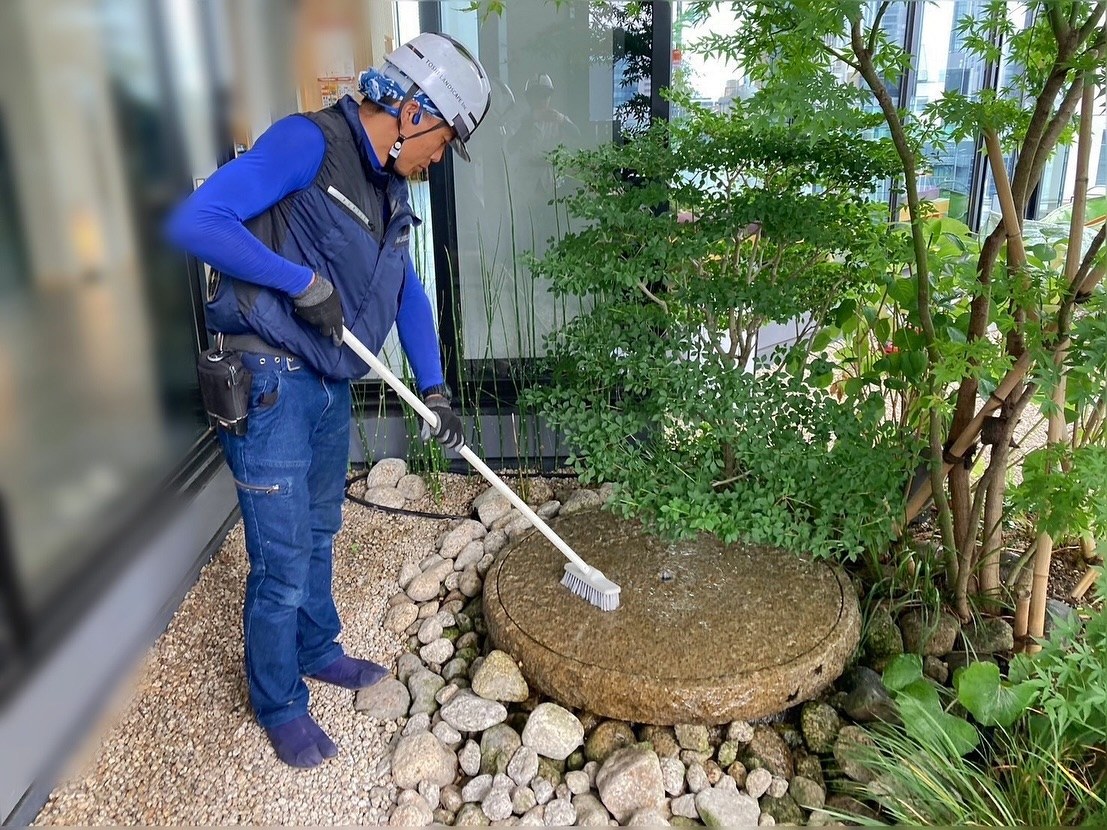
Japanese public gardens treat a suikinkutsu as something to maintain, not just install. Osaka Prefecture’s management manual for Ōizumi Ryokuchi park tells contractors to keep the sound in good condition by adjusting the water and topping up the gravel — “水量等を調整し、砂利の補充も行ってください”. The manual’s annual work table lists cleaning the suikinkutsu once a year — “年間1回”. That is one park’s plan, not a national standard, but it shows the two variables practitioners watch: the water, and the gravel through which it reaches the jar.
What goes wrong
The table below is not taken from any manual. It applies the mechanism described above to possible faults, so read it as reasoning, not as a tested diagnosis.
| Symptom | Possible cause inferred from the mechanism | What to look at |
|---|---|---|
| No sound at all | Silt inside the jar or a blocked hole; pool too deep | Clear the drain gravel; check whether water is reaching the hole as drops |
| Dull sound, no ring | Too little air left above the water | Whether surplus water is draining away beneath the jar |
| A splash rather than a note | Water entering as a stream | The amount poured; the gravel above the hole |
| Sound that fades over seasons | Fine soil and leaves washing into the gravel | The gravel above the jar (the Ōizumi manual calls for topping it up) |
Followed in order, that reasoning gives a simple sequence for a silent suikinkutsu: first, check that water is being poured in small amounts; second, check that it reaches the opening as drops rather than a stream; third, check whether surplus water is draining away below, or whether the pool has risen and filled the air space. Only the Ōizumi manual’s two tasks — adjusting the water and topping up the gravel — and its annual cleaning are written practice; the sequence is an inference from the studies above.
When the basin sits under trees
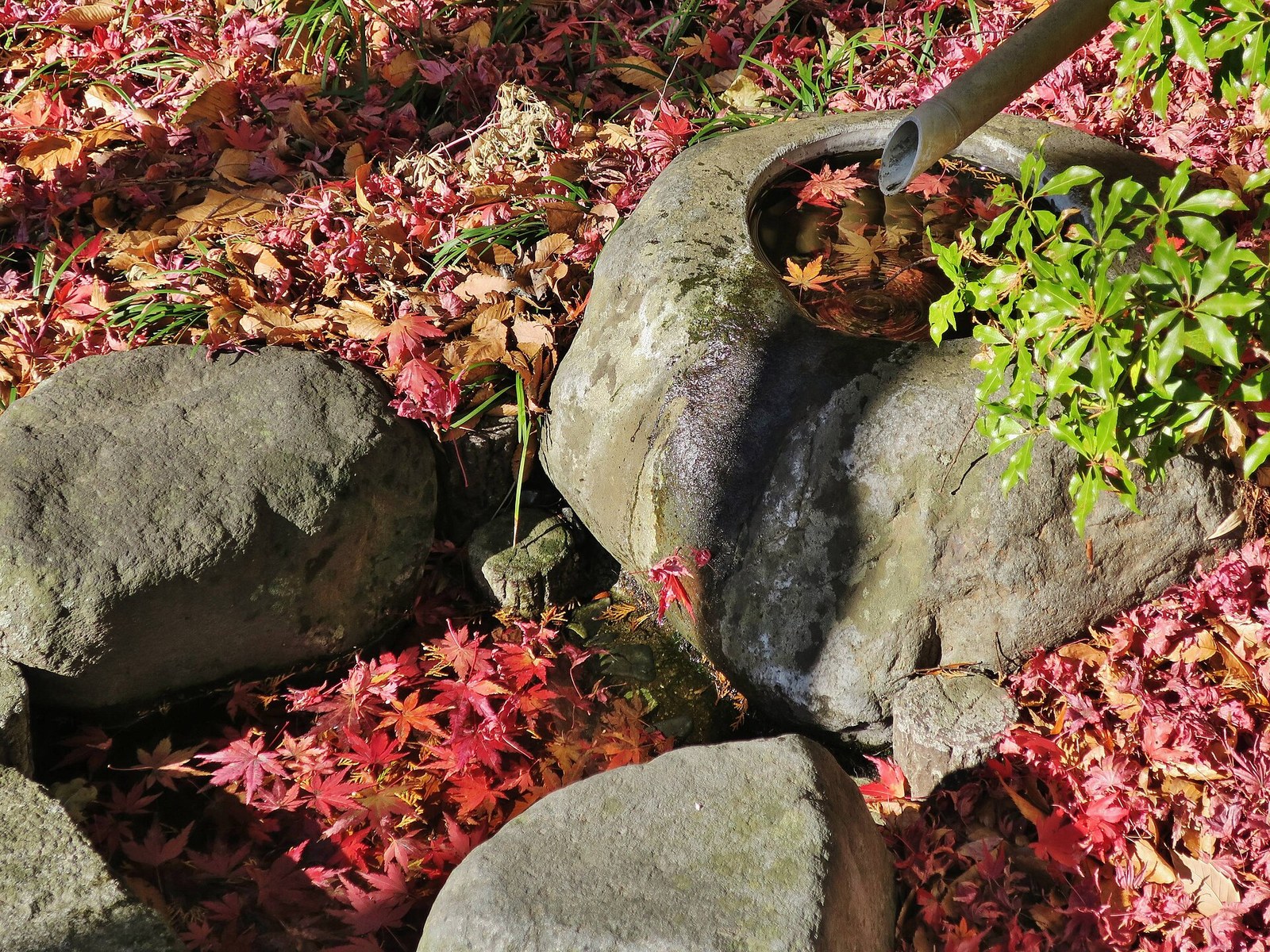
Where a tsukubai stands under trees, falling leaves can collect in the umi. It is reasonable to keep them out of the gravel above the jar, much as the Ōizumi manual asks for the gravel to be kept topped up; temple gardens do similar leaf work across the season, as described in Kyoto’s maple gardens before the crowds. This is a practical suggestion, not a documented cause of failure.
Modern jars
The 1995 patent mentioned earlier proposes making the vessel from porcelain, glass, earthenware, metal or hard synthetic resin as well as pottery — “陶器、磁器、ガラス、土器、金属、硬質合成樹脂” — with design examples from 20 to 100 cm tall and 10 to 80 cm in inner diameter. A patent is a proposal, not proof that such products are sold or perform well. The traditional examples recorded by Hirayama and the archaeologists are mostly fired clay; the Shinagawa example, for instance, had a ceramic upper part over a stone body.
Common misunderstandings
“A tsukubai is a suikinkutsu”
They are two things. The tsukubai is the low basin and its stones; the suikinkutsu is an optional jar beneath the drain. Ryōan-ji’s basin is celebrated for its characters, not for a sound.
“It’s a Helmholtz resonator”
For the dimensions in Kishizuka’s paper, a Helmholtz resonance works out at 18.6 Hz, far below the measured note near 1,000 Hz. The studies point instead to the air in the hollow, the drop-and-bubble impulse and the vessel’s own resonances.
“There is a correct water depth”
No study cited here gives one figure for all jars. Depth matters because it changes the air, and the right depth depends on the jar.
Frequently asked questions
What is a suikinkutsu?
A suikinkutsu (水琴窟) is, typically, a ceramic jar buried upside down beneath the drain of a garden water basin. Water drips through a small hole in its raised base onto a shallow pool inside, and the hollow of air turns each drop into a clear, bell-like note.
Why does the sound come from under the tsukubai?
Because the jar sits in the tsukubai’s drain, the umi or “sea”. The water you spill while washing is the water that drips into the jar. The basin feeds the instrument.
What frequency is the sound?
In Kishizuka’s analysis of ten suikinkutsu, the fundamental was about 800 to 1,000 Hz. Iwase’s analysis of the Maki suikinkutsu and a CD recording found components from 800 Hz to 5 kHz, with sharp peaks between 1 and 3 kHz.
Who invented the suikinkutsu?
Tradition credits Kobori Enshū in 1596, as recorded in his memorial society’s chronology. No contemporary document confirming this was found. A dated example from the 1780s survives at Eiunsō in Hōfu.
Why do some suikinkutsu stop working?
Possible causes, inferred from how it works, include mud inside the jar, a clogged drain that floods the hollow, or water entering as a stream instead of drops. At one excavated site, a jar with mud built up inside made no sound.
Can you build a suikinkutsu outside Japan?
Yes. The Newt in Somerset, England, introduced a Bonsai Garden with one in 2021, and the University of Queensland announced a sound garden using one at Roma Street Parkland in Brisbane in 2009.
Sources
– Nara National Research Institute for Cultural Properties, Japanese Garden Dictionary, “Suikinkutsu” (checked 2026-11-17): https://www.nabunken.go.jp/org/bunka/jgd/pages/Suikinkutsu.html – Nabunken, Japanese Garden Dictionary, “Crouching water basin” (checked 2026-11-17): https://www.nabunken.go.jp/org/bunka/jgd/pages/CrouchingWaterBasin.html – Nabunken, Japanese Garden Dictionary, “Hot-water vessel stone” (checked 2026-11-17): https://www.nabunken.go.jp/org/bunka/jgd/pages/HotWaterVesselStone.html – Nabunken, Japanese Garden Dictionary, “Candlestick stone” (checked 2026-11-17): https://www.nabunken.go.jp/org/bunka/jgd/pages/CandlestickStone.html – Nabunken, Japanese Garden Dictionary, “Water gate” (checked 2026-11-17): https://www.nabunken.go.jp/org/bunka/jgd/pages/WaterGate.html – Shimane Museum of Ancient Izumo, public lecture handout on gardens, 2023 (Japanese; checked 2026-11-17): https://www.izm.ed.jp/tenpu/haruka2%28garden%29.pdf – A. Stephen Gibbs, Kansai University Faculty of Foreign Language Studies bulletin 6, 2012 (checked 2026-11-17): https://www.kansai-u.ac.jp/fl/publication/pdf_department/06/017gibbs.pdf – Suita City Museum newsletter no. 54, 2013 (Japanese; checked 2026-11-17): https://www.city.suita.osaka.jp/_res/projects/default_project/_page_/001/031/161/tayori054.pdf – City of Kyoto, Kyoto Saihakken-chō, Ryōan-ji (Japanese; checked 2026-11-17): https://www.city.kyoto.lg.jp/sankan/cmsfiles/contents/0000335/335056/saihakkenntyo.pdf – Hirayama Katsuzō, “Teien no suikinkutsu ni tsuite”, Journal of the Japanese Institute of Landscape Architecture 22(3), 1959 (Japanese; checked 2026-11-17): https://www.jstage.jst.go.jp/article/jila1934/22/3/22_3_14/_pdf – Kishizuka Masaaki, “An experimental study on the acoustic structure of suikinkutsu”, Journal of the Japanese Institute of Landscape Architecture 55(5) (Japanese; checked 2026-11-17): https://www.jstage.jst.go.jp/article/jila1934/55/5/55_5_133/_pdf – Iwase Teruo, “Sounds of traditional devices — the suikinkutsu”, Noise Control 24(3), 2000 (Japanese; checked 2026-11-17): https://www.jstage.jst.go.jp/article/souonseigyo1977/24/3/24_3_198/_pdf – Izumiyama Masami, Journal of the Acoustical Society of Japan 42(10), 1986 (Japanese; checked 2026-11-17): https://www.jstage.jst.go.jp/article/jasj/42/10/42_KJ00001454012/_pdf/-char/ja – Tomita, Kasai and Miura, Journal of the Visualization Society of Japan 22 Suppl. 1, 2002 (Japanese; checked 2026-11-17): https://www.jstage.jst.go.jp/article/jvs1990/22/1Supplement/22_1Supplement_305/_pdf – Watanabe Yoshio, “Analytical Study of Acoustic Mechanism of ‘Suikinkutsu’”, Japanese Journal of Applied Physics 43, 2004 — abstract via CiNii (checked 2026-11-17): https://cir.nii.ac.jp/crid/1390282681242668800?lang=en – Saga-han Kurayashiki-ato (Nishitenma, Osaka) excavation report, p. 91 (Japanese; checked 2026-11-17): https://sitereports.nabunken.go.jp/files/attach/67/67184/66297_1_%E4%BD%90%E8%B3%80%E8%97%A9%E8%94%B5%E5%B1%8B%E6%95%B7%E8%B7%A1%E7%99%BA%E6%8E%98%E8%AA%BF%E6%9F%BB%E5%A0%B1%E5%91%8A.pdf – Kodai Bunka Chōsakai, Teramachi kyūiki / Hōjōji-ato excavation report, 2016, p. 8 (Japanese; checked 2026-11-17): https://sitereports.nabunken.go.jp/files/attach/34/34777/69834_1_%E5%AF%BA%E7%94%BA%E6%97%A7%E5%9F%9F%E3%83%BB%E6%B3%95%E6%88%90%E5%AF%BA%E8%B7%A1.pdf – Japanese patent JPH07117839B2, “Suikinkutsu”, 1995 (Japanese; checked 2026-11-17): https://patents.google.com/patent/JPH07117839B2/en – Shinagawa Historical Museum, exhibit guide 3_01_02 “水琴窟” (Japanese; checked 2026-11-17): https://www.city.shinagawa.tokyo.jp/jigyo/06/historyhp/en/pdf/kaisetsu_multi/tagengo_jpn/PDF_jpn/3_01jpn.pdf – Eikandō, temple precinct guide (checked 2026-11-17): https://www.eikando.or.jp/mobile_en/mb_keidaizu_en.html – Enkō-ji, precinct (Japanese; checked 2026-11-17): https://www.enkouji.jp/grounds/ – Kyoto Prefecture Tourism Federation, Myōshin-ji Taizō-in (Japanese; checked 2026-11-17): https://www.kyoto-kankou.or.jp/info_search/9519 – Nagoya City Greenery Association, Shirotori Garden (Japanese; checked 2026-11-17): https://www.nga.or.jp/park/shirotori-html/ – Japan Tourism Agency, multilingual explanation, Eiunsō garden, suikinkutsu and Kagetsurō (Japanese; checked 2026-11-17): https://www.mlit.go.jp/tagengo-db/H30-01048.html – Kobori Enshū memorial society, chronology (Japanese; checked 2026-11-17): https://www.koborienshu.org/timeline/%E6%B4%9E%E6%B0%B4%E9%96%80%EF%BC%88%E6%B0%B4%E7%90%B4%E7%AA%9F%EF%BC%89%E3%81%AE%E7%99%BA%E6%A1%88/ – Osaka Prefecture, Ōizumi Ryokuchi management manual (Japanese; checked 2026-11-17): https://www.pref.osaka.lg.jp/documents/141985/kanrimanualoizumi.pdf – Osaka Prefecture, Ōizumi Ryokuchi management manual, appendix, table 9-3 (Japanese; checked 2026-11-17): https://www.pref.osaka.lg.jp/documents/141985/kanrimanualoizumisiryo.pdf – The Newt in Somerset, “Introducing our NEW Bonsai Garden”, 25 October 2021 (checked 2026-11-17): https://thenewtinsomerset.com/journal/post/introducing-our-new-bonsai-garden/ – University of Queensland, “Eco-art opens at Roma Street Parkland”, 29 January 2009 (checked 2026-11-17): https://news.uq.edu.au/2009-01-29-eco-art-opens-roma-street-parkland