

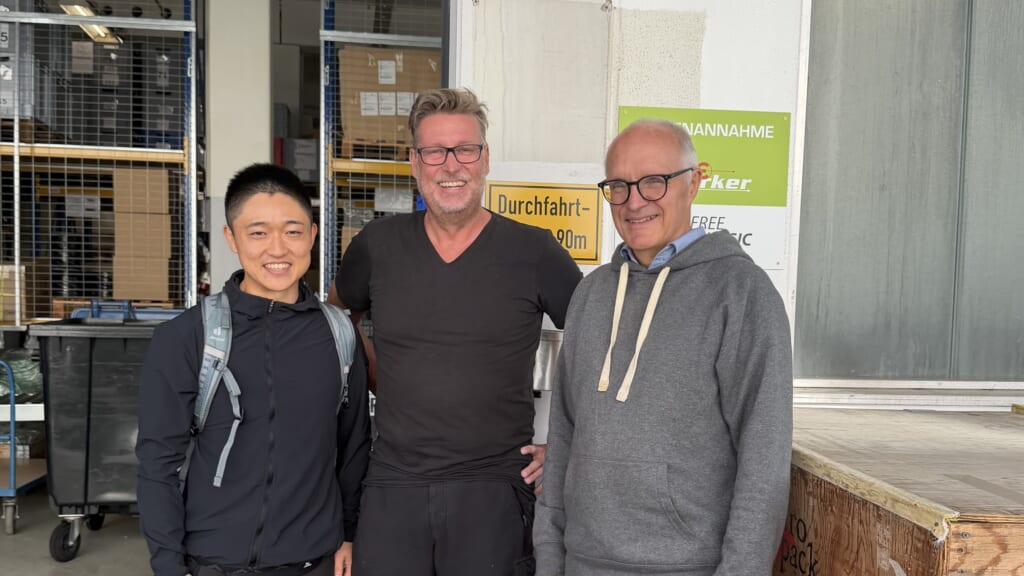
Freeworker is a specialist dealer for tree-care and rope-climbing equipment in Gilching, near Munich, and for years I knew it only as a company I ordered from: from Tokyo, I have ordered from them many times. In September 2026 I finally walked through its door, brought there by Ingo von Wurmb, who supports the Arbocare tree-care team near Munich, and was shown round by Holger Fink, Freeworker’s COO (the head of operations). I came away with three lessons — logistics is the foundation, a good supplier advises and trains as well as sells, and the choice of tool decides the quality of the work — — and with thanks to the people on both sides who made the visit possible.
This is the story of that visit: a customer from Japan meeting the company he had ordered from, what they showed me in the shop and the warehouse, and what I carried home.
Ordering from Tokyo — how I knew Freeworker before I saw it
For an arborist in Japan, much of the specialist climbing and rigging equipment we rely on is designed and sold in Europe. Some of it reaches us through importers; some of it we order directly. Freeworker has been one of the names I order from, again and again, from Tokyo.
What ordering from outside the EU looks like
Ordering from Japan is not a click-and-wait purchase. Freeworker’s shipping page says that online orders from addresses outside the EU are treated as a request for a quotation, with shipping and customs costs given individually. Inside the EU, the standard carrier is DPD, and free-shipping thresholds are set country by country — goods worth more than €500 net for Germany, more than €750 net for Austria or France.
Over many orders, Freeworker had become familiar to me long before I met anyone there.
Why I wanted to go in person
A shop you order from many times becomes a kind of colleague. You learn its catalogue — Freeworker publishes a printed German catalogue for 2026, free on request, plus a PDF edition — but you rarely meet the people. When I planned a trip of about two weeks through Germany, Switzerland and Italy in September 2026 — mostly a personal journey, to which I added visits to see tree work on the ground — Gilching went on the Germany leg.
| Ordering situation | What Freeworker’s official pages say |
|---|---|
| Outside the EU (Japan included) | Online order treated as a request for a quote; shipping, customs priced individually |
| Inside the EU | DPD is the standard carrier |
| Free shipping, Germany | Goods value over €500 net |
| Free shipping, Austria or France | Goods value over €750 net |
| Returns | Buyer pays return shipping; Freeworker pays to send an exchange item |
| Catalogue | Freeworker Katalog 2026, printed German edition free on request, PDF also offered |
Arriving with Arbocare — a day arranged by Ingo von Wurmb
The visit happened because of Arbocare. Ingo von Wurmb, a former BMW engineer who supports Arbocare, contacted me before I left Japan and gave a whole day to showing me sites and facilities around Munich. Arbocare, run by Moritz von Wurmb, works in tree care, tree inspection, expert reports and tree inventories from Freising, north of Munich. Freeworker was one of the places Ingo brought me to that day.
Being introduced, not just arriving
Ingo brought me to Freeworker, where Holger Fink showed us round. Without that day, the visit would not have happened.
I will write about the Arbocare day itself — the team, their work in Freising, and what it showed me about how Germany manages trees — in a separate article. Here, I want to record what Ingo made possible in Gilching.
Into the shop — a rebuild in progress
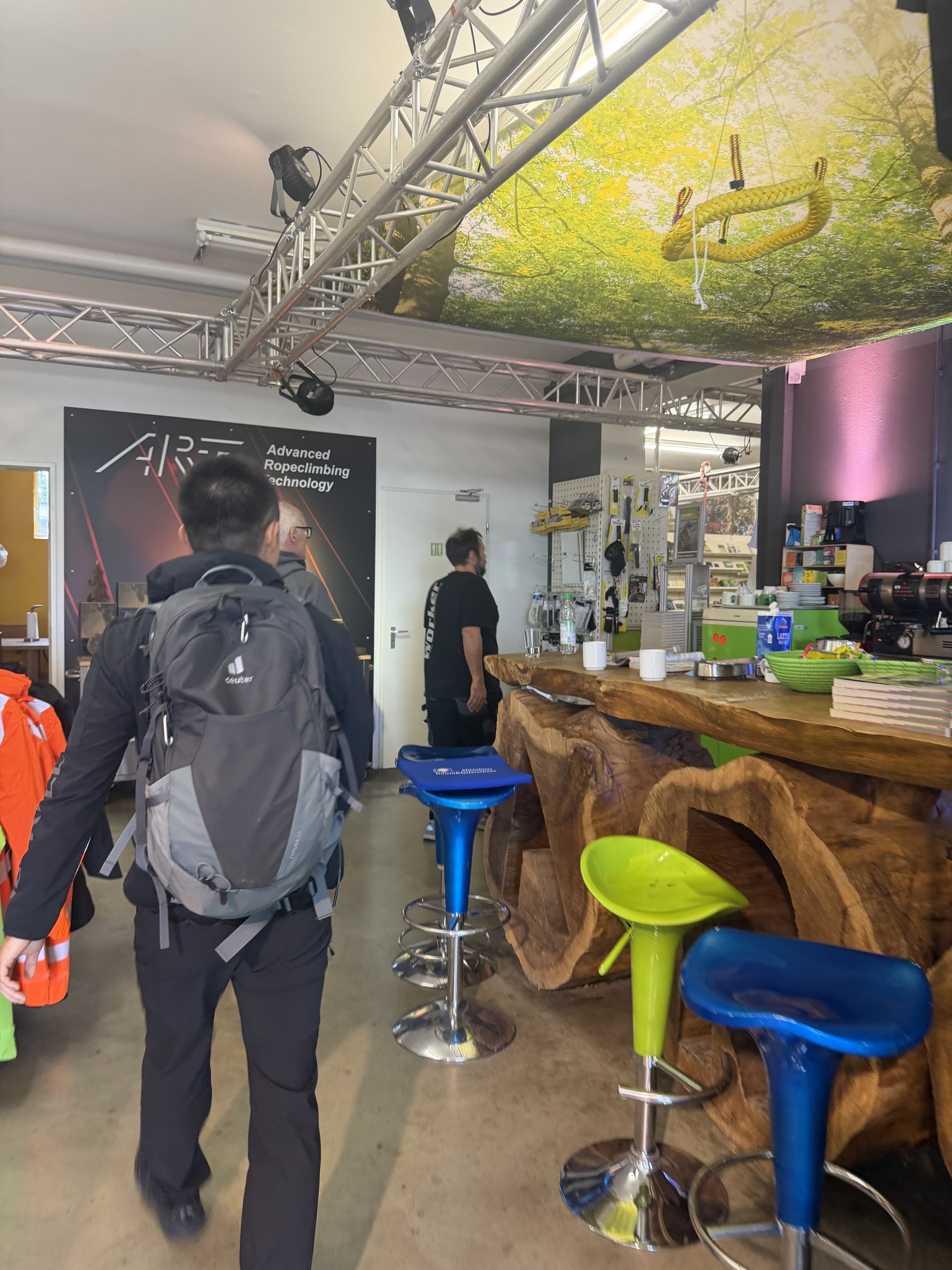
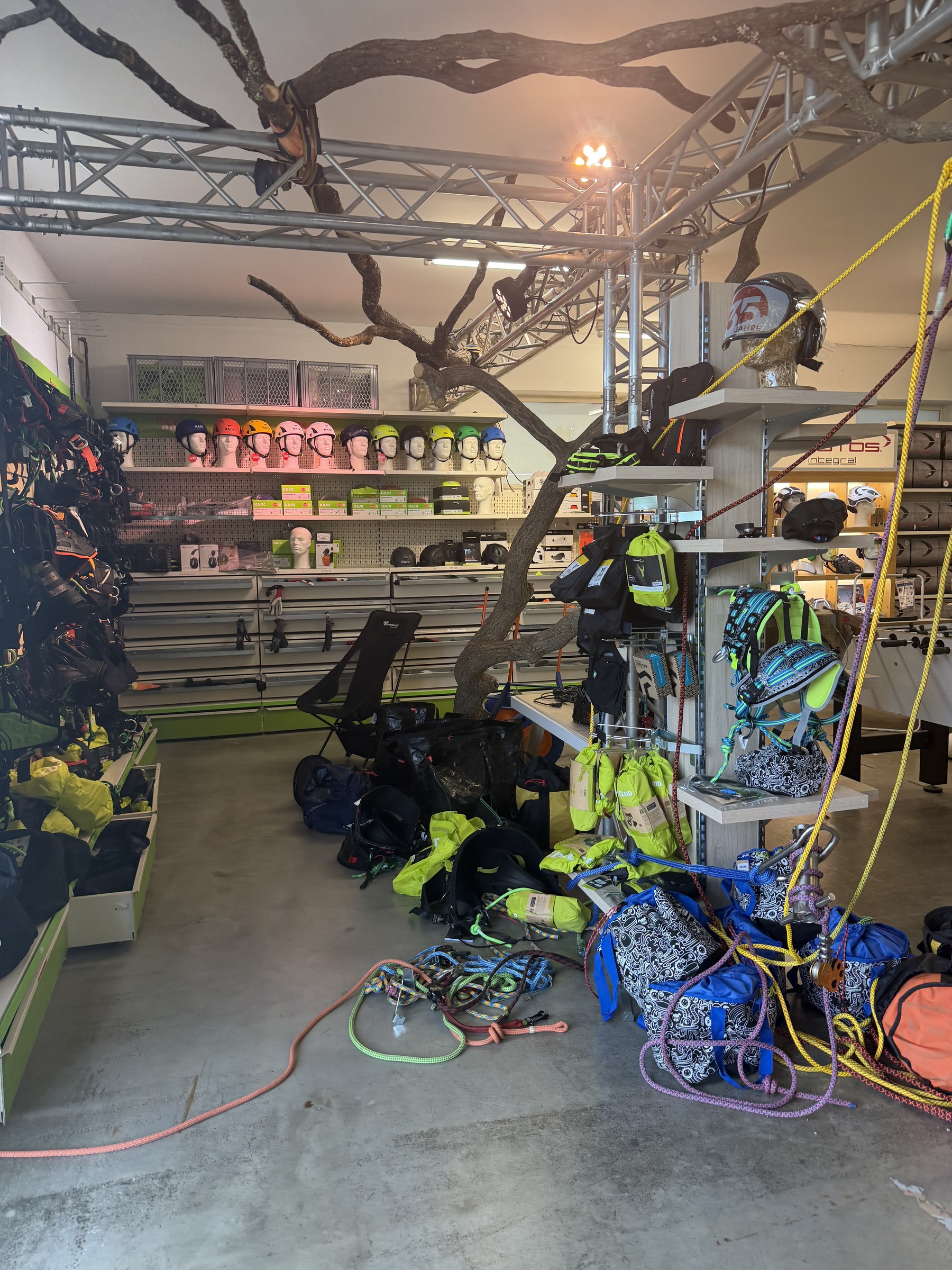
The shop was being renovated when we arrived. In a finished shop, gear sits in neat displays and the work of the business disappears behind them. In a shop halfway through a rebuild, boxes and bags of equipment sat on the floor beside the displays, while a section of real branch hung from the ceiling truss as a fixture for climbing gear.
The company behind the green wall
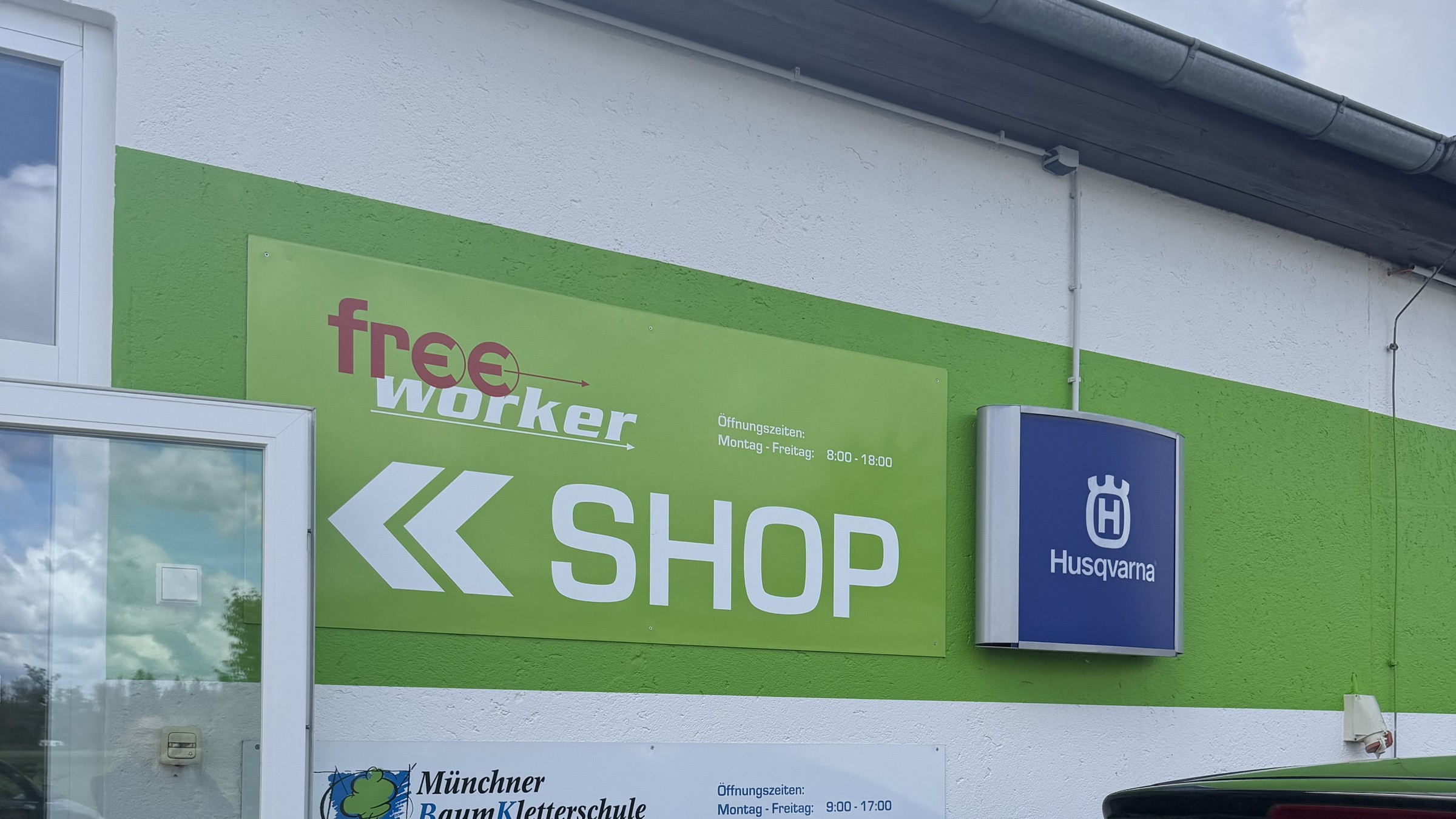
Freeworker describes its mission plainly: since 1999, it has supplied the “green industry” with climbing equipment and tree-care accessories. It calls itself one of the largest specialist dealers for tree care and rope-climbing technique in Europe — one of the largest, not the largest — and gives a staff of around 50 people. Its listed address is St. Gilgen 15, Gilching, and the managing director named in its legal notice is Johannes Bilharz.
Two other names belong to the same story. According to Freeworker’s company history, the Münchner Baumkletterschule (Munich tree-climbing school) was founded at the same time as the shop, with Bilharz involved in both, and the school lists the same address. The school’s privacy policy names three companies together: Freeworker GmbH, Freelogic GmbH & Co. KG, and MBKS GmbH & Co. KG, which runs the school. A shop, a training school and a third company, Freelogic, sit side by side in one group.
| Part of the group | What it is | Why it matters to a customer |
|---|---|---|
| Freeworker GmbH | Specialist dealer for tree-care, rope-climbing gear, founded 1999 | Range, advice, catalogue, online shop |
| MBKS GmbH & Co. KG (Münchner Baumkletterschule) | Tree-climbing school at the same address | Training that connects the gear to safe technique |
| Freelogic GmbH & Co. KG | Third company in the same group | Its exact role is not described on the public pages I checked |
Meeting Holger Fink and the team
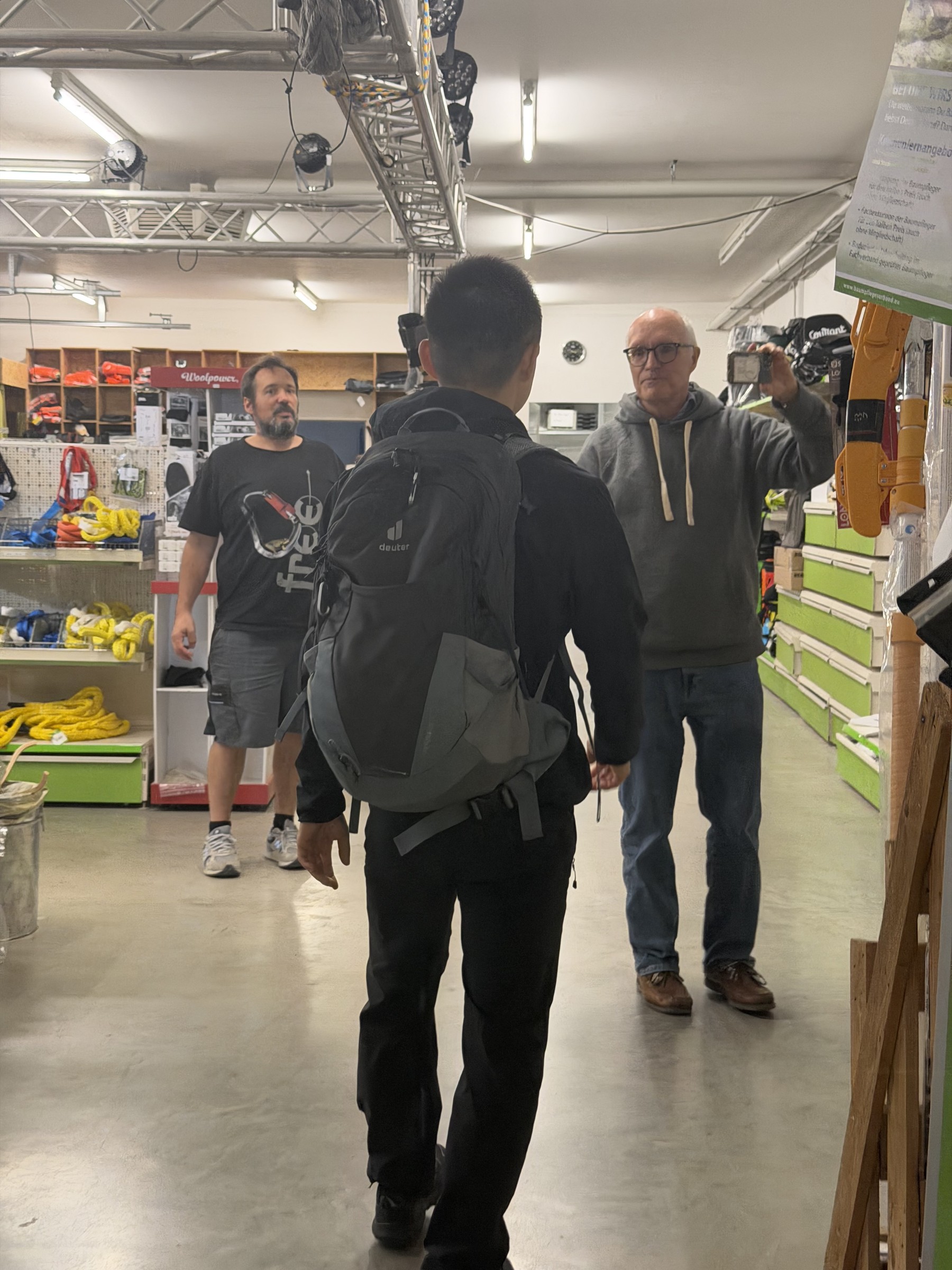
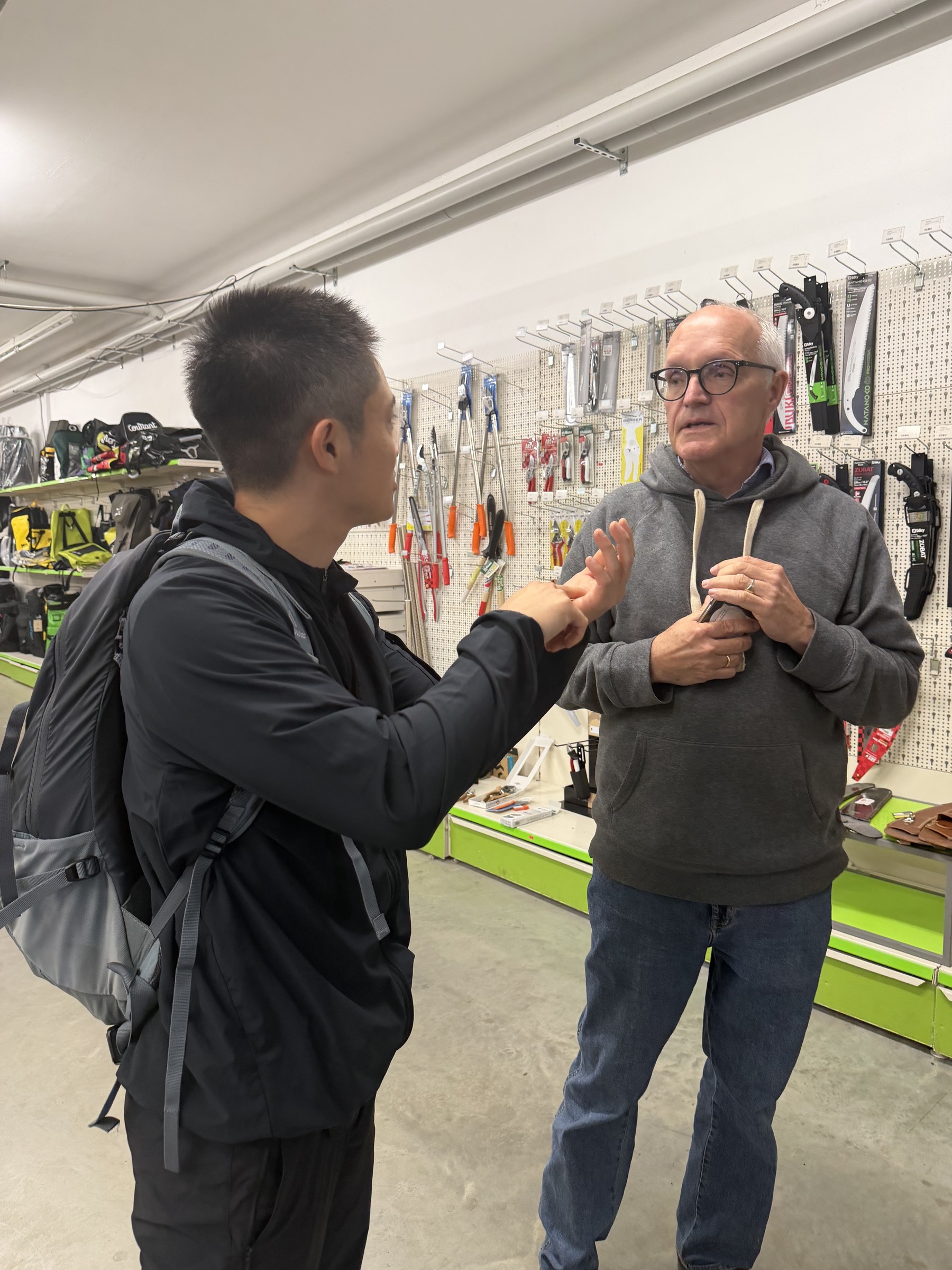
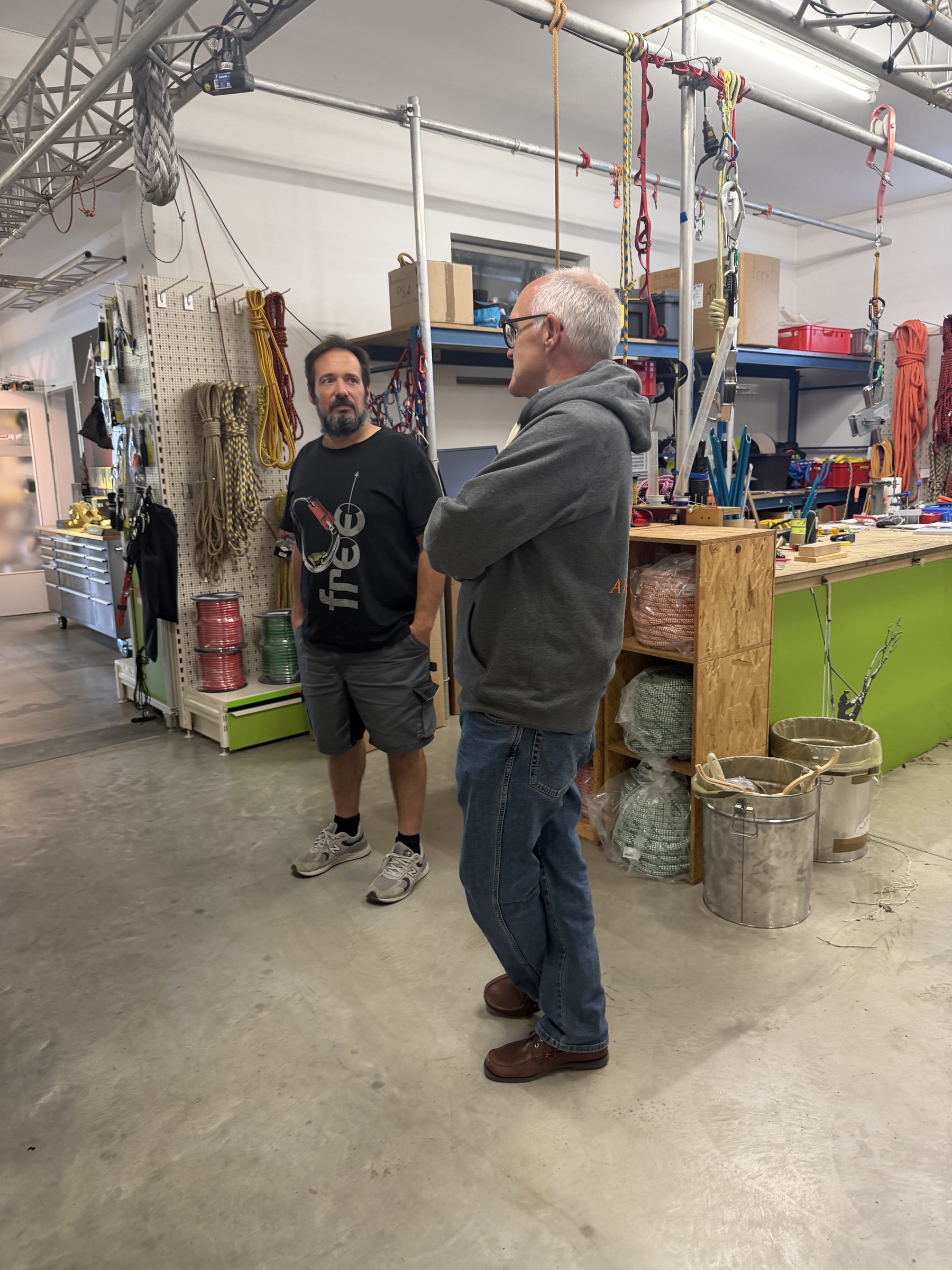
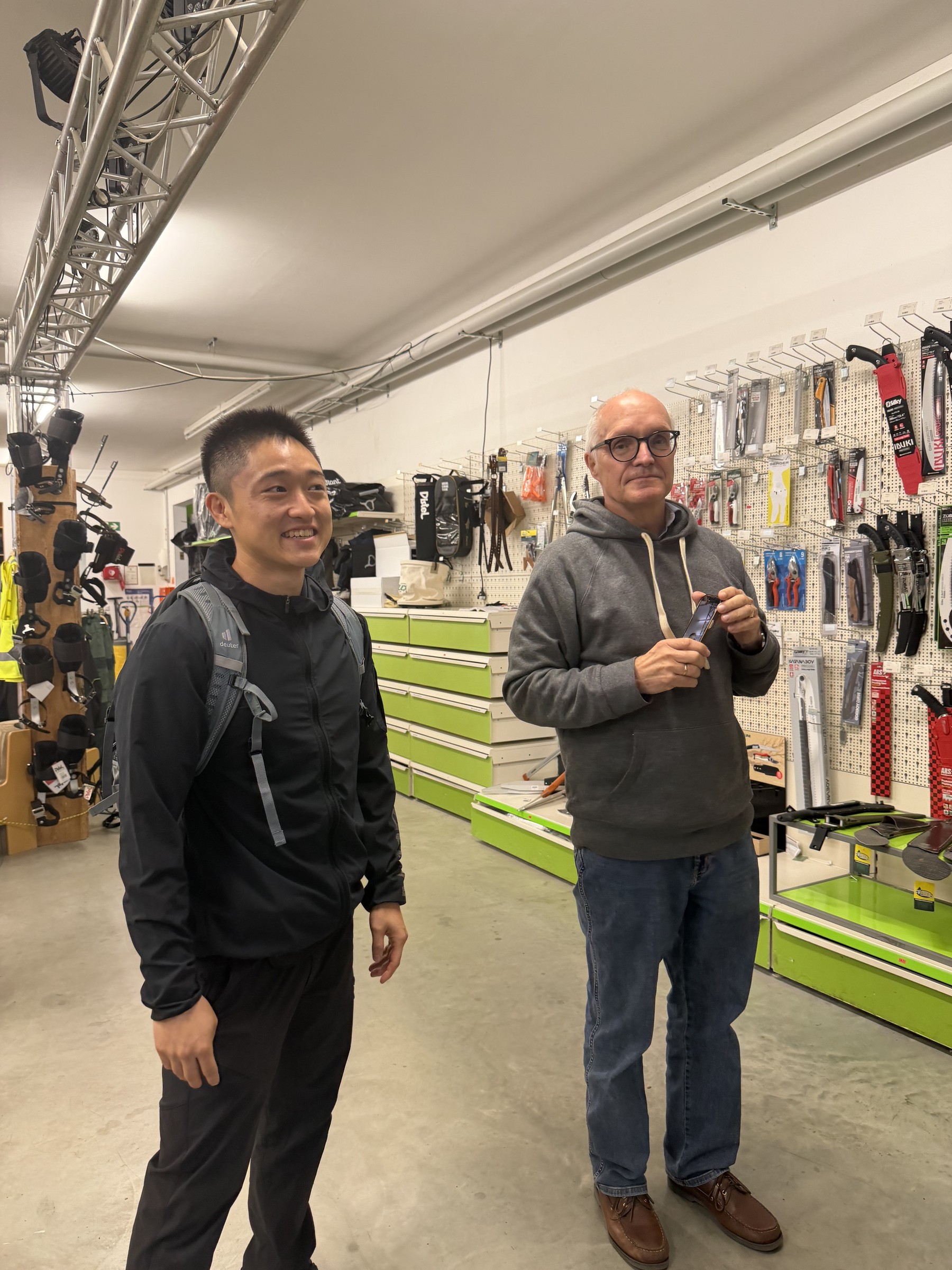
Holger Fink, Freeworker’s COO (the head of operations), showed us round. He took us through the shop, then through the warehouse and dispatch area. On the shop floor we met people in the shop, one of them in a Freeworker T-shirt.
What I came away with
The visit gave me what an order form never can: time in person at a company whose supply chain I depend on. What I took away is summed up in the three lessons in this article. I do not want to put words in anyone’s mouth, so what follows is what I took away, not a transcript of what was said.
The shop floor through a customer’s eyes
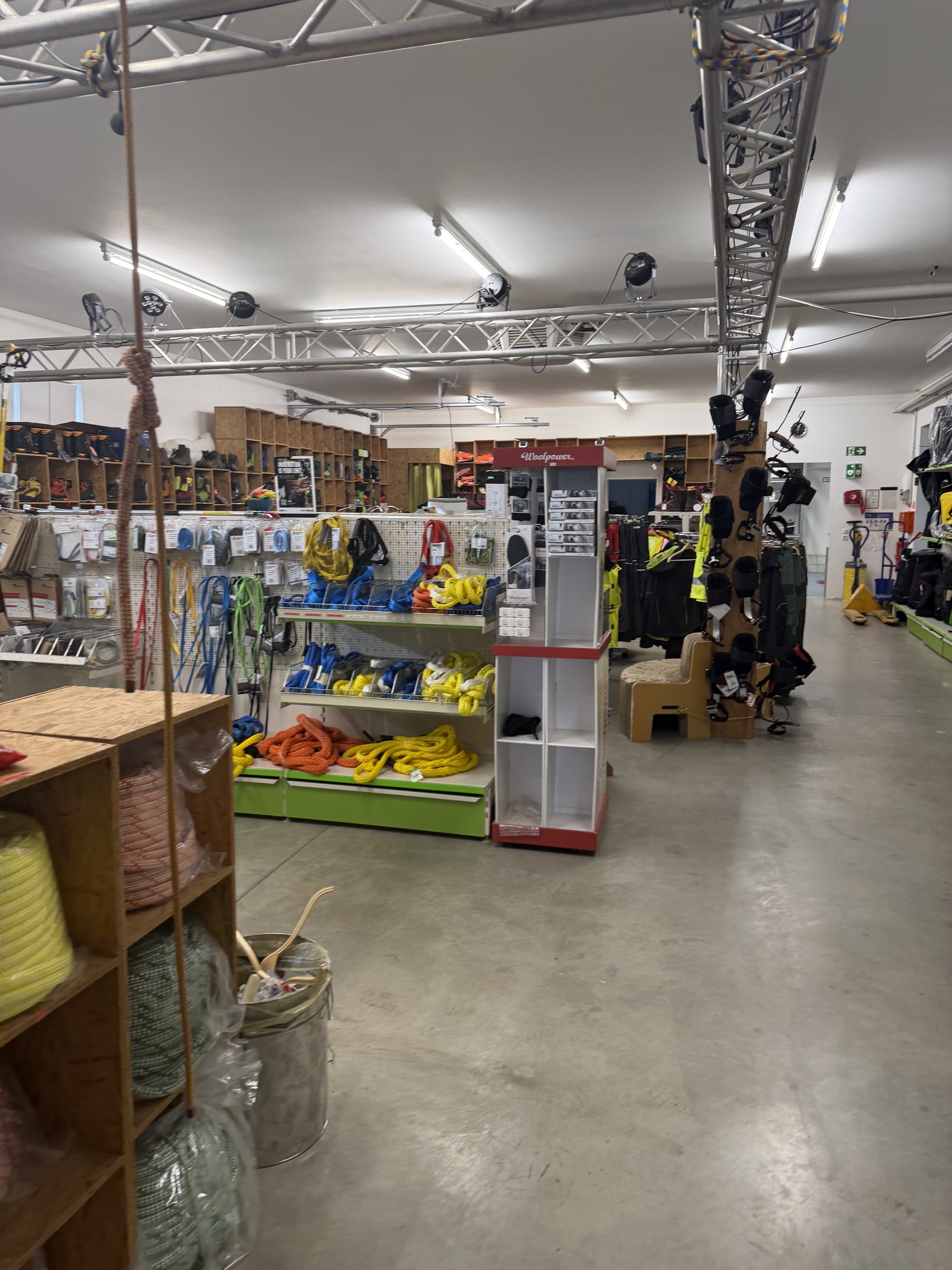
Rope does not come in quiet shades: orange, yellow, blue and green coils fill the lower shelves, with slings and lanyards on pegboard above. There is a long wall of hand tools — folding saws, pole saws, secateurs, scabbards — a wall of wooden cubbies with cut-protection boots, shelves of helmets, and a corner of rigging hardware.
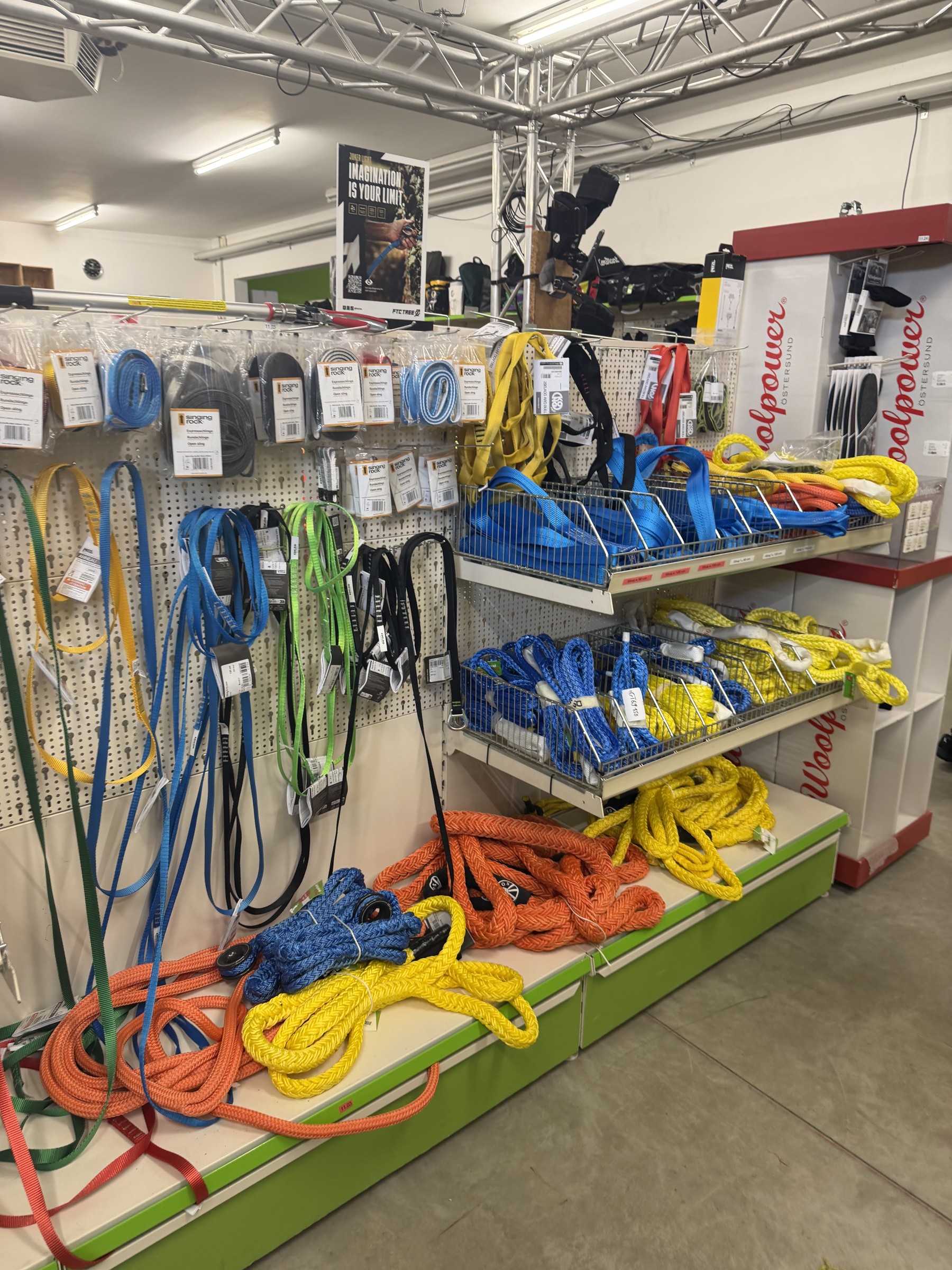
Rigging — lowering heavy pieces of a tree under control — has its own corner of pulleys, friction devices and cases of hardware. These are items where a wrong choice can have serious consequences, because the loads are high. And there is a full shelf of books on trees and tree work; among them a German handbook on tree statics. A shop that sells a book on tree mechanics next to the rope is making a quiet statement: the gear only makes sense inside a body of knowledge.
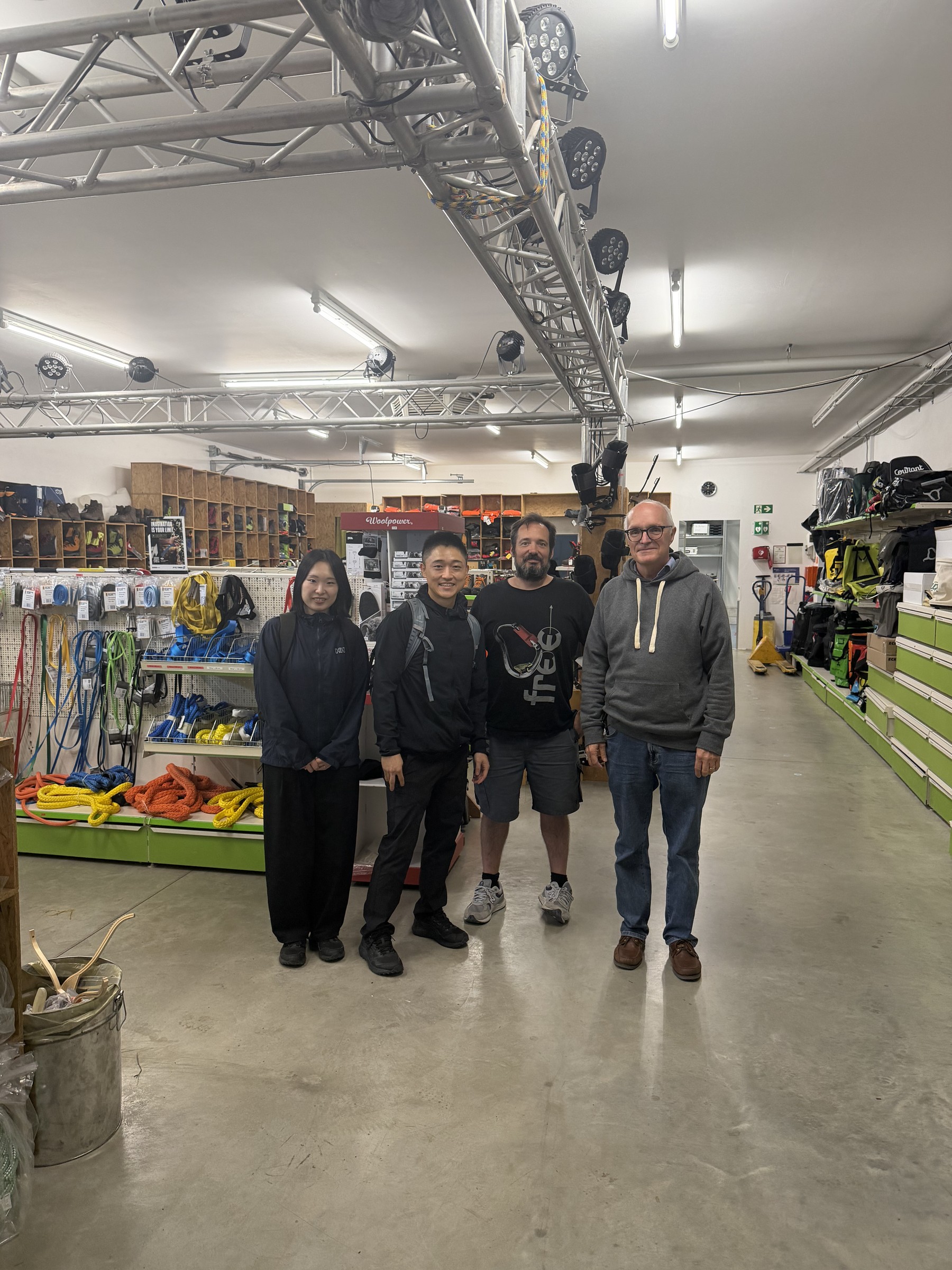
We also stood together for a photo on the shop floor.
Behind the shop — the warehouse I could not photograph
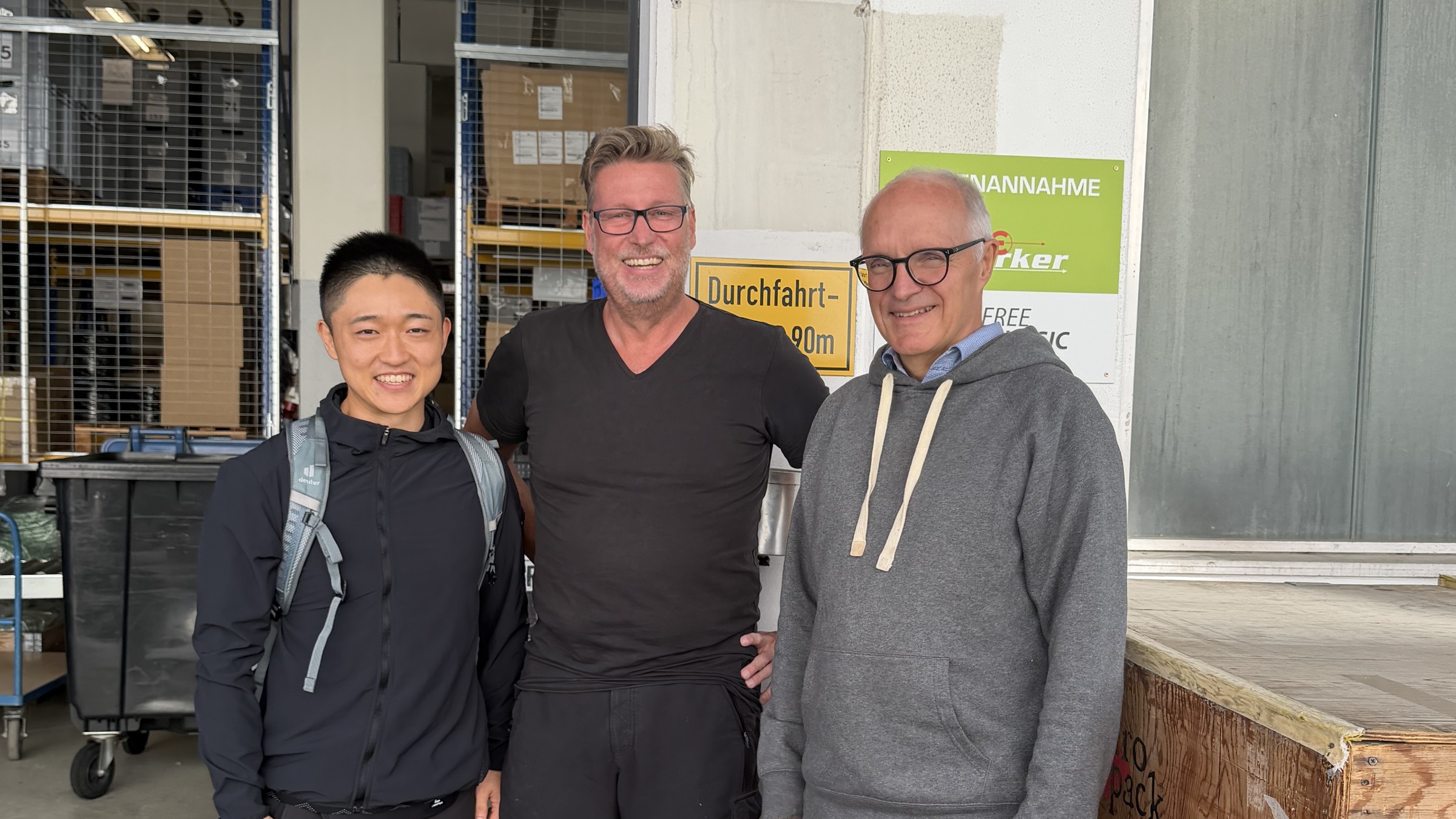
The first lesson came from the part of the visit that has no pictures. Holger took us through the warehouse and dispatch area. Photography is not allowed inside, and I respected that. The photo at the top of this article was taken outside, at the goods-receiving entrance — the Warenannahme — where Holger Fink, Ingo von Wurmb and I stood together for a picture; the open gate behind us is the only glimpse of the warehouse here.
Logistics is the foundation
What I took away was simple: logistics is the foundation. An arborist rarely shops for pleasure. A rope is retired after an inspection, a saw breaks on a job, a crew takes on a removal that needs extra rigging gear — and the work cannot wait. For the buyer, the decisive question is not “Does this shop list the product?” but “Will it be in my hands in time?”
From Tokyo, a customer sees only the end of that chain: a quotation, a parcel. A specialist range is only useful if the item can actually be shipped when a crew needs it.
More than a shop — advice, training, competitions
The second lesson: a good supplier does not only sell; it supports the trade with advice, training and competitions.
Advice at the shelf
In the shop, I photographed a reel of rope held up from its stack, and the label of a crown-securing sling. That label is worth a closer look. It names the product as a sling for crown securing, gives the breaking force in the system as 40 kN, the material as polyester (PES), the length as 1.50 m — and has a field for the installation date.
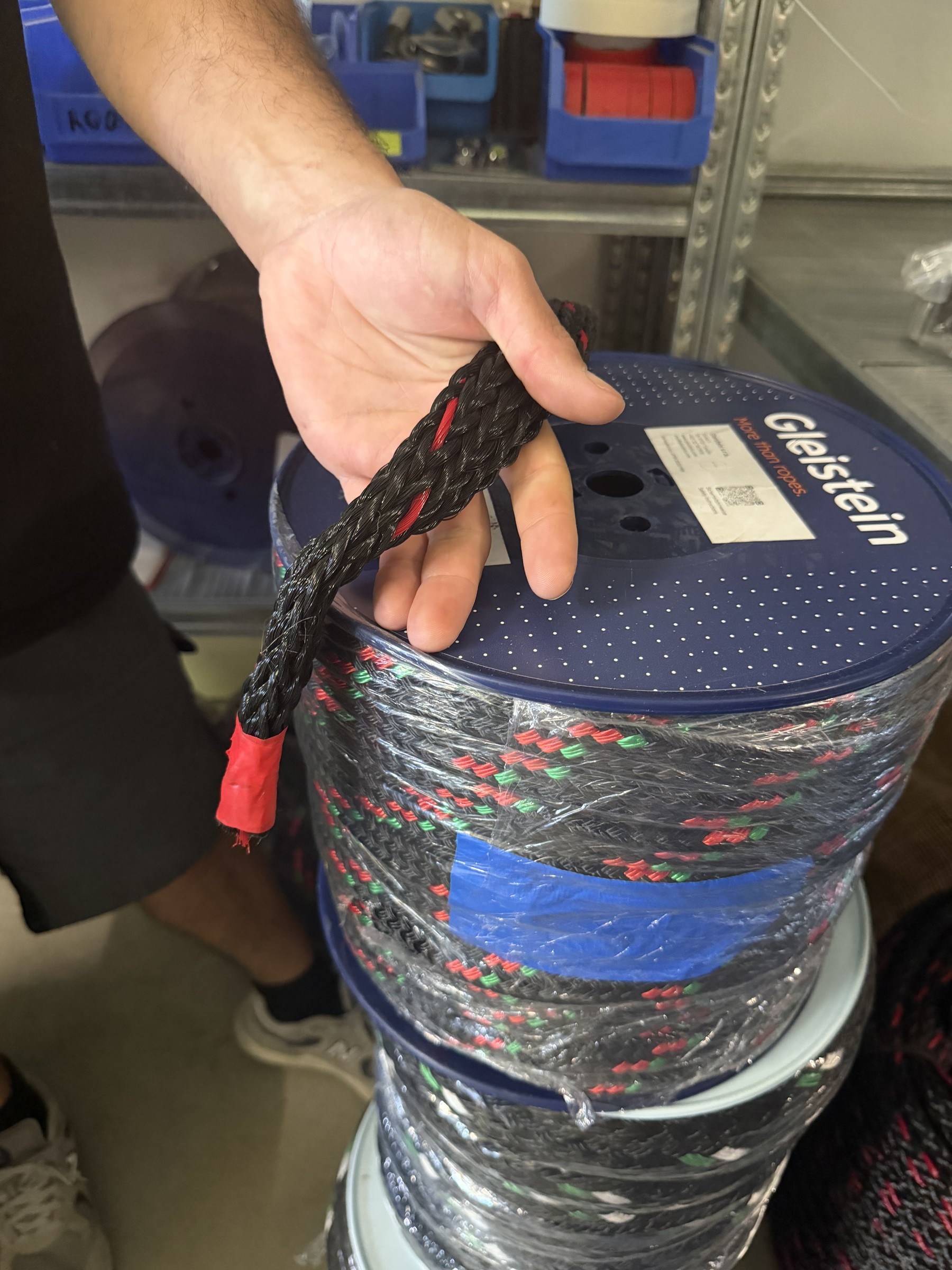
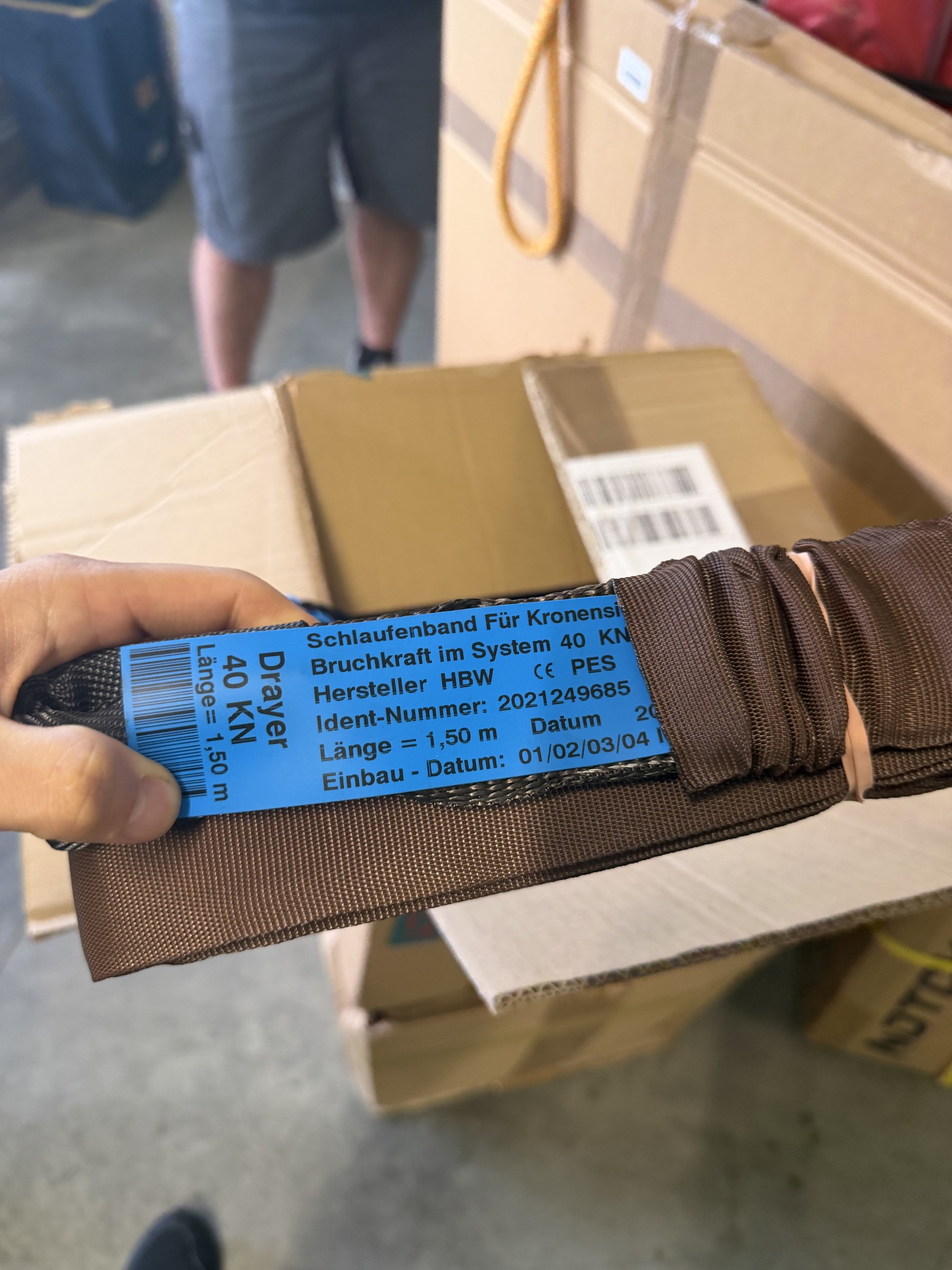
A label with a space for the date of installation says a lot about how the product is meant to be used. It assumes someone will come back to inspect it, and that they will need to know how long it has been in the tree.
The climbing school at the same address
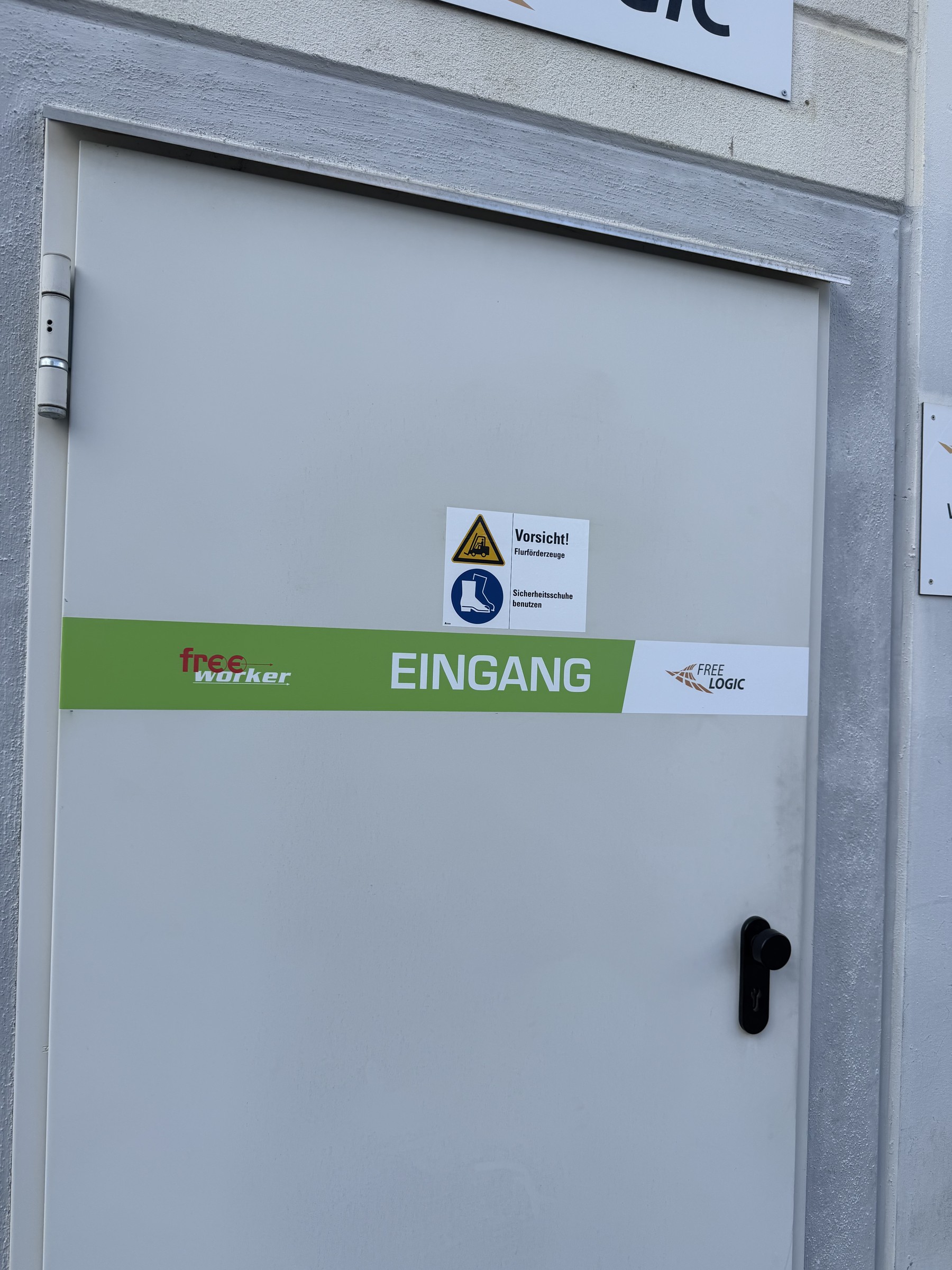
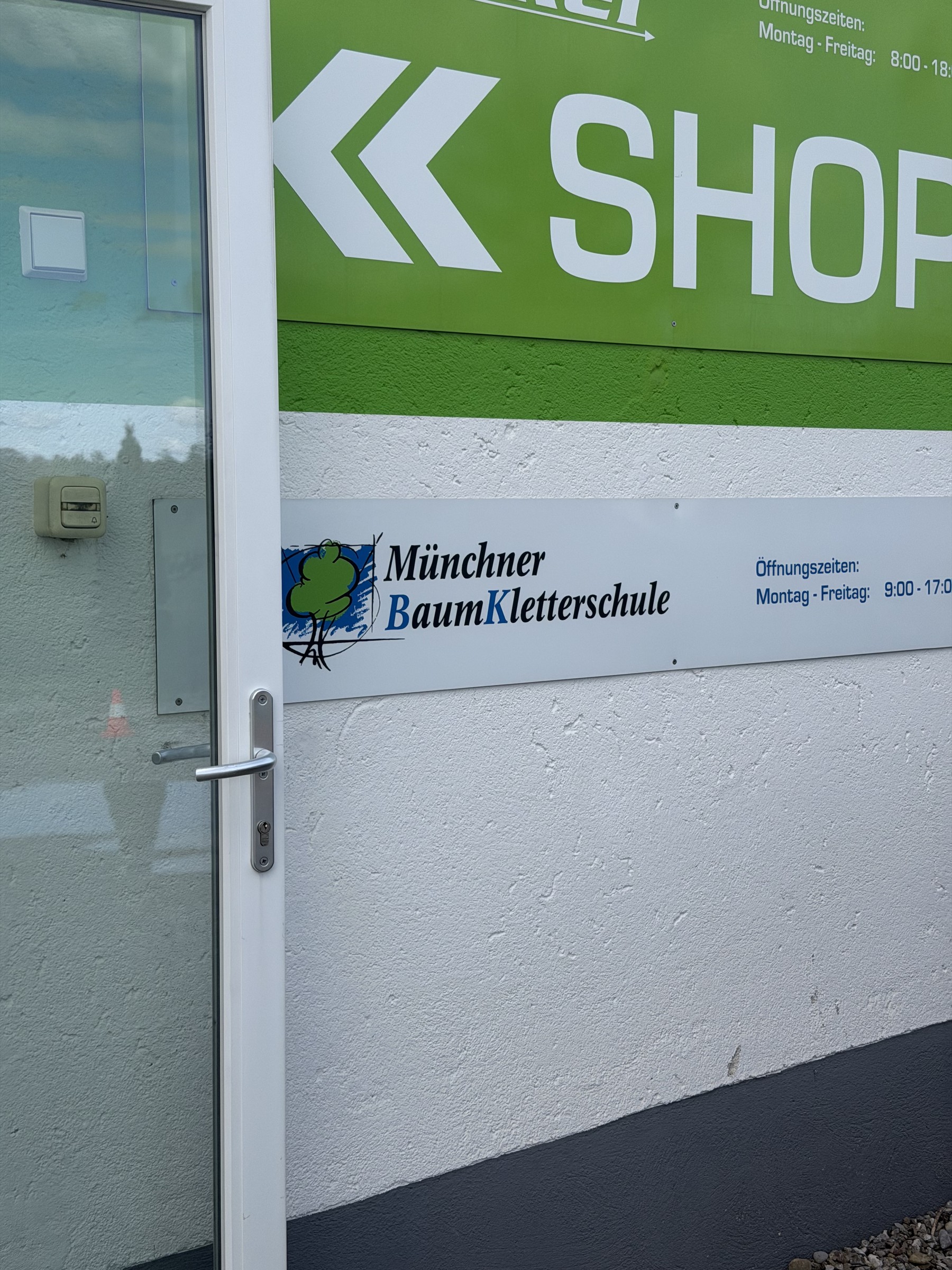
The plate under the shop sign is the clearest sign of the training side. The Münchner Baumkletterschule shares the address, was founded at the same time as Freeworker, and belongs to the same group. Training and retail sit at one address.
Workshops, sponsorship, competitions
Freeworker’s own blog records joint climbing workshops with Petzl, and support for the German champions who went to the International Tree Climbing Championship (ITCC) in 2018. A supplier that backs workshops and competitions is investing in the skills of the people who use its equipment.
What they showed me about crown securing
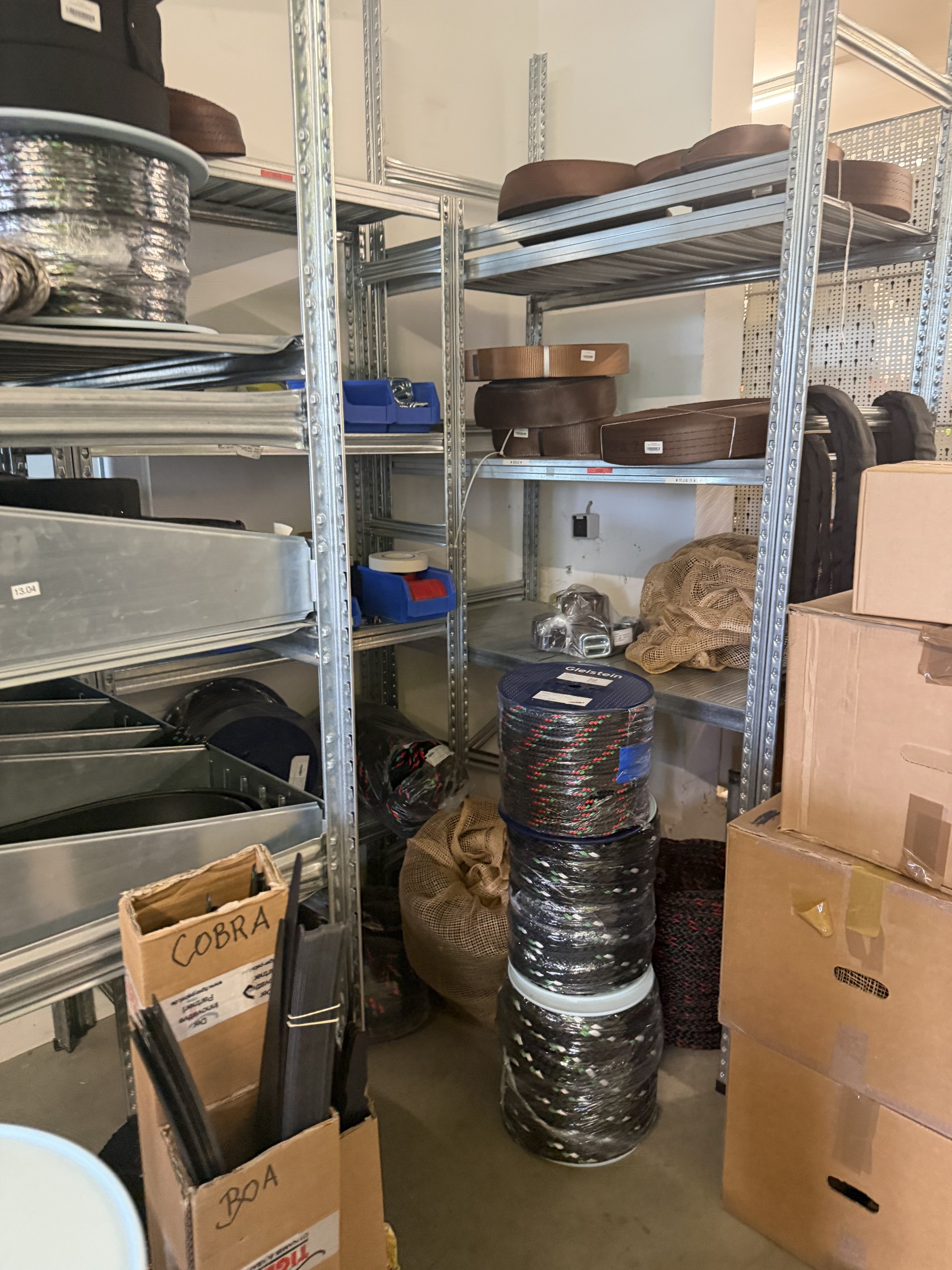
The third lesson: the choice of tool decides the quality of the work. It became concrete when the visit turned to Kronensicherung, crown securing — linking parts of a tree’s crown, such as co-dominant stems, so that one part cannot swing far enough to fail. At Freeworker, I was shown four crown-securing systems, and I was allowed to photograph the products in the shop.
Four systems, as the makers describe them
All four are textile systems. Here is what each maker states, in brief.
– cobra (pbs Baumsicherungsprodukte GmbH): on the market since 1993. The 2 t, 4 t and 8 t variants use hollow-braided polypropylene rope, with a shock absorber in the dynamic configuration. The maker gives a functional life of 12 years for 2 t and 4 t, and 8 years for 8 t, and its instructions call for fixing the link at least two-thirds of the way along the limb being secured, and strongly recommend documenting an installation. – boa (arboa): after 12 years of experience, the inventor developed the technology further in 2005. Polypropylene hollow rope, an EPDM shock absorber, the same components for all three rope strengths (2 t, 4 t, 8 t), and a guaranteed service period of 12 years. – treeSave (DRAYER): holding slings combined with hollow rope. On the sling with an overload indicator, a red signal flag appears once the load has exceeded 75 percent of the system’s breaking load, and the maker says the system keeps holding. The 20 kN indicator sling is a 50 mm polyester band with a stated service life of 8 years. – GEFA: hollow ropes in polyester and polyamide at 2, 4, 7, 8 and 10 t, and in Dyneema at 12 and 20 t. Break-indicator threads tear at about 80 percent of the maximum breaking force, except on Dyneema ropes. GEFA recommends replacing belts and hollow ropes after 8 years.
The periods are not the same kind of figure — a functional life, a guarantee, the life of one sling, a replacement recommendation — so they are best compared only after reading what each maker means.
| System | Maker | Load classes (maker) | Overload sign | Period stated by the maker |
|---|---|---|---|---|
| cobra | pbs Baumsicherungsprodukte | 2 t, 4 t, 8 t | — | Functional life 12 years (2 t, 4 t), 8 years (8 t) |
| boa | arboa | 2 t, 4 t, 8 t, same components | — | Guaranteed service period 12 years |
| treeSave | DRAYER | e.g. 2 t, 4 t (Light) | Red flag above 75% of system breaking load | Service life 8 years (20 kN indicator sling) |
| GEFA | GEFA | PES, PA 2–10 t; Dyneema 12, 20 t | Indicator threads tear at about 80% (not Dyneema) | Replacement of belts, ropes recommended after 8 years |
Dynamic first — what I was told
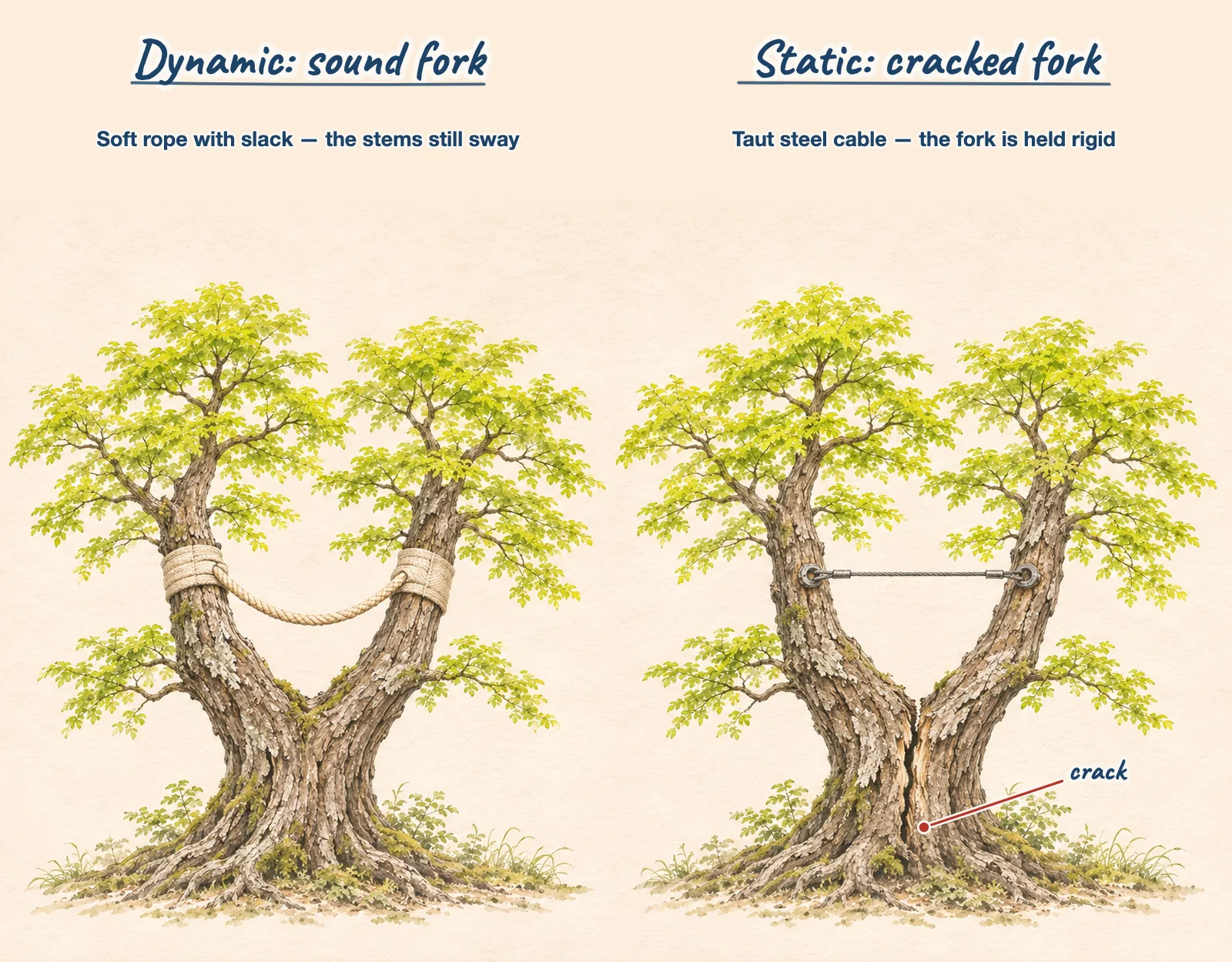
What tied the four systems together, as it was explained to me in Gilching, was a principle: crown securing should be dynamic as a rule, and I was told this is how ZTV-Baumpflege, Germany’s guideline for tree care, sees it. The idea, as I understood it, is that a tree should keep moving so that it can keep strengthening itself; a dynamic system allows normal movement in wind and limits excessive movement.
The publicly available parts of the 2017 edition of ZTV-Baumpflege do not confirm that wording. The Forschungsgesellschaft Landschaftsentwicklung Landschaftsbau (FLL) lists that edition as current. Its public table of contents does show a clause on installing crown securing and a separate clause on examining and maintaining it. So the principle stays here as what I was told on site. What the makers say in their own words is consistent with it: cobra’s maker writes that a dynamic system is used in most cases and a static one where a fork is already cracked, and arboa writes that a V-shaped fork that has already split should no longer move.
What the guideline and the makers confirm
ZTV-Baumpflege — additional technical contract conditions and guidelines for tree care — has a long history. The FLL names earlier editions from 1981, 1987, 1993, 2001 and 2006, and states that the 2017 edition replaces the 2006 one. The makers refer to it directly: pbs labels cobra as conforming to ZTV-Baumpflege 2017, GEFA describes its range as covering dynamic and static securing and as ZTV-compliant, and DRAYER states that treeSave meets the technical requirements of ZTV-Baumpflege. These are the makers’ own statements, not certifications by the FLL.
For a fork that has already split, cobra describes a two-level arrangement: a static breakage securing at a quarter of the height, and a dynamic securing at two-thirds, so that the crack is held still while the crown above can still move.
Three jobs a crown link can do
The makers’ pages also show that “crown securing” covers more than one job. arboa distinguishes a dynamic breakage securing with a shock absorber from a static breakage securing and a holding system, both without one. The purpose of the holding type, in arboa’s words, is that nothing reaches the ground: if part of the crown breaks, the link catches it.
| Type (German term) | Shock absorber (arboa) | Job |
|---|---|---|
| Dynamic breakage securing (dynamische Bruchsicherung) | Yes | Allows normal movement, limits excessive movement of a sound crown |
| Static breakage securing (statische Bruchsicherung) | No | Keeps a cracked fork from moving |
| Holding securing (Trag-, Haltesicherung) | No | Stops a broken crown part from reaching the ground |
Public practice is cautious about all of these. Berlin’s handbook on the care of public green space says technical crown securing on park trees can be used in justified individual cases — an exception that has to be justified, not a routine fitting.
Reading an overload
Two of the four systems answer a hard question: has this link already taken a heavy load? A textile link high in a crown may go years without being seen up close, and after a storm a rope that was barely touched can look the same from the ground as one pulled close to its limit. treeSave answers with a red flag on its indicator sling once the load has passed 75 percent of the system’s breaking load; GEFA answers with indicator threads that tear at about 80 percent of the maximum breaking force. For treeSave, DRAYER states that the system keeps holding after the flag appears; an opened indicator is a prompt for a professional inspection of the tree.
Why the choice of tool matters
Put these together and the third lesson becomes practical. Whether the fork is sound or cracked decides dynamic or static; the limb decides the load class; the maker decides where the link is fixed; and the label — with its rating and its installation date — decides whether the next inspector can tell what is in the tree. A supplier who can explain those differences at the shelf is part of the quality of the work.
What I took home to Japan
How Japan describes the same idea
In Japan, the general idea appears in public guidance as kēburingu (ケーブリング, cabling). A street-tree document from the National Institute for Land and Infrastructure Management (NILIM) describes it as connecting trunks or branches with wire cable to reduce danger, and adds that cabling does not fundamentally resolve the defect, so the condition has to be observed afterwards.
The NILIM text speaks of wire cable. The four systems I was shown in Germany are all textile, with shock absorbers (cobra in its dynamic configuration, boa) or overload signs (treeSave, GEFA). One difference, then, is not in how much care is taken, but in what the tool is designed to let the tree do. For a Japanese example of a textile system on a heritage tree, see our article on the Higashine great zelkova, which describes cobra on that hollow giant.
Three notes for my own practice
The three lessons translate into three practical points for work in Japan:
- Plan orders from Europe like logistics, not shopping. A quote, customs, lead time — the supply chain is part of the job.
- Use the supplier’s knowledge. The people who sell the equipment see how it is used across many crews; ask them.
- Record what goes into the tree. The rating, the length, the date of installation — the label already asks for it. A close look from the rope helps here too; see how we inspect trees from the rope at a Tokyo temple.
In Japan, where typhoons put whole districts of trees under load in a single night, an overload sign that can be read after a storm is a detail worth considering; see our notes on typhoon-proofing trees in Japan.
Differences in context, not in skill
None of this means Germany does tree work “better” than Japan. The contexts differ: Germany has ZTV-Baumpflege, a guideline revised since its first edition in 1981, and specialist suppliers within Germany itself. In Japan, much of this equipment reaches us through orders like mine from Gilching. What I can do as an Arborist is bring the principles home. For why that matters as Japan’s postwar plantings age, see Japan’s falling trees crisis.
Thank you — to Freeworker and to Arbocare
A visit like this depends on people giving their time. Holger Fink and the people at Freeworker showed a customer from Japan the shop, the warehouse and the crown-securing systems. Ingo von Wurmb contacted me before the trip, gave me a whole day, and brought me to Gilching; I also met Moritz von Wurmb and the Arbocare team in Freising.
To all of them: thank you. For years, Freeworker was a company I ordered from. Now I have met the people there, and Arbocare is the reason I did.
Frequently asked questions
What is Freeworker? Freeworker GmbH is a specialist dealer for tree-care and rope-climbing equipment listed at St. Gilgen 15 in Gilching, near Munich. It has supplied the green industry since 1999, describes itself as one of the largest specialist dealers of its kind in Europe, and has around 50 staff.
Can I order from Freeworker outside the EU, for example from Japan? Yes. According to Freeworker’s shipping page, online orders from addresses outside the EU are handled as quotation requests, with shipping and customs costs given individually. Inside the EU, DPD is the standard carrier.
Who showed you round Freeworker? Holger Fink, Freeworker’s COO (the head of operations), showed us through the shop, then the warehouse and dispatch area. I was brought to Gilching by Ingo von Wurmb, who supports the Arbocare tree-care team near Munich and gave me a whole day of visits around the city.
What is the Münchner Baumkletterschule? It is a tree-climbing school at the same address as Freeworker, St. Gilgen 15 in Gilching. According to Freeworker’s company history it was founded at the same time as the shop, and the school’s privacy policy lists it, through MBKS GmbH & Co. KG, alongside Freeworker GmbH and Freelogic GmbH & Co. KG.
Can visitors photograph the Freeworker warehouse? No. Photography is not allowed in the warehouse; the photos in this article were taken in the shop, at its entrances and in the yard.
Which crown-securing systems did you see at Freeworker? Four textile systems: cobra (on the market since 1993), boa (refined by its inventor in 2005), treeSave by DRAYER (red overload flag above 75 percent of the system breaking load) and GEFA (polyester, polyamide at 2–10 t, Dyneema at 12, 20 t; indicator threads at about 80 percent, except on Dyneema ropes).
What is the difference between dynamic and static crown securing? A dynamic system allows normal movement in wind and limits excessive movement. A static system holds the parts still; the makers describe it for forks that are already cracked or split.
Sources
– Freeworker — company page (founding, staff, self-description, climbing school): https://www.freeworker.de/unternehmen/freeworker/ (checked 2026-11-13) – Freeworker — contact (address): https://www.freeworker.de/unternehmen/kontakt/ (checked 2026-11-13) – Freeworker — legal notice (managing director): https://www.freeworker.de/impressum/ (checked 2026-11-13) – Münchner Baumkletterschule — privacy policy (group companies): https://baumkletterschule.de/cms/datenschutzerklaerung/ (checked 2026-11-13) – Freeworker — winter catalogue 2024/25 extract (climbing school address): https://www.freeworker.de/wp-content/uploads/2024/10/Freeworker-Winter_2024-2025_part.pdf (checked 2026-11-13) – Freeworker — Petzl workshop: https://www.freeworker.de/2021/06/24/zweiter-petzl-freeworker-kletterworkshop/ (checked 2026-11-13) – Freeworker — sponsoring, ITCC 2018: https://www.freeworker.de/tag/sponsoring/ (checked 2026-11-13) – Freeworker shop — shipping: https://shop.freeworker.de/shipping (checked 2026-11-13) – Freeworker shop — catalogue 2026: https://shop.freeworker.de/freeworker-katalog-de.html (checked 2026-11-13) – Freeworker shop — FAQ (returns): https://shop.freeworker.de/faq (checked 2026-11-13) – pbs Baumsicherungsprodukte — cobra, on the market since 1993: https://pbs.ownerp.app/ (checked 2026-11-13) – cobra — multilingual manual 2021: https://d347awuzx0kdse.cloudfront.net/lsm/content-file/cobra_2021_multilingual_manual.pdf (checked 2026-11-13) – cobra — Kronensicherungen (load classes, functional life, dynamic-static use): https://www.cobranet.de/kronensicherungen (checked 2026-11-13) – cobra — installation instructions (two-thirds rule, documentation): https://www.cobranet.de/web/content/57572?download=true&unique=d5f6437a567e5ce3d0692122c2b218db36af (checked 2026-11-13) – arboa — boa: https://www.arboa.com/de/boa.html (checked 2026-11-13) – DRAYER — treeSave: https://drayer.de/eigenmarken/treesave/ (checked 2026-11-13) – DRAYER — treeSave sling 20 kN with overload indicator: https://drayer.de/treesave-schlaufe-20-kn-mit-ueberlastanzeige (checked 2026-11-13) – GEFA — Kronensicherung: https://www.gefafabritz.de/wissenbereich/kronensicherung.html (checked 2026-11-13) – FLL — Bäume und Gehölze (ZTV-Baumpflege, 2017 edition, earlier editions): https://www.fll.de/fachgremien/baeume-und-gehoelze/ (checked 2026-11-13) – FGSV Verlag — ZTV-Baumpflege 2017, public preview (contents): https://www.fgsv-verlag.de/pub/media/pdf/20021.i.pdf (checked 2026-11-13) – DRAYER — treeSave Light: https://drayer.de/treesave-light-schutzschlauch (checked 2026-11-13) – DRAYER — treeSave and ZTV-Baumpflege: https://drayer.de/treesave/ (checked 2026-11-13) – pbs — cobra, ZTV Baumpflege 2017 konform: https://www.cobranet.de/ (checked 2026-11-13) – FLL shop — ZTV-Baumpflege 2017 (replaces the 2006 edition): https://shop.fll.de/en/ztv-baumpflege-zusaetzliche-technische-vertragsbedingungen-und-richtlinien-fuer-baumpflege-2017-broschuere.html (checked 2026-11-13) – Senate of Berlin — Handbuch Gute Pflege: https://www.berlin.de/sen/uvk/_assets/natur-gruen/stadtgruen/pflegen-und-unterhalten/handbuch-gute-pflege/handbuch-gute-pflege_berlin.pdf (checked 2026-11-13) – NILIM — street-tree material on cabling: https://www.nilim.go.jp/lab/bcg/siryou/tnn/tnn0669pdf/ks066910.pdf (checked 2026-11-13)
Related reading
This story is one of the exchanges on the Worldwide map, where I collect the arborists I have met, hosted and worked with.