

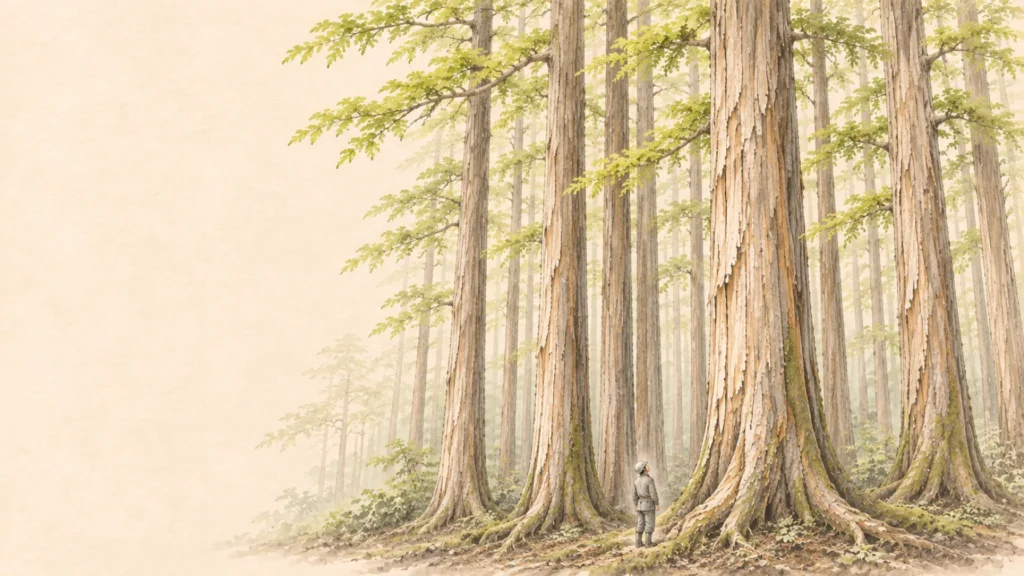
Ise Jingu grows cypress for shrines that will not be built for generations because its sanctuaries are rebuilt in fresh hinoki every twenty years, and suitable timber became hard to obtain from its own mountains centuries ago. In 1923 the shrine adopted a forest management plan for the Kyuikirin, its forest of about 5,500 hectares, mostly in the upper Isuzu River basin, with a goal of growing hinoki to 200 years old — at least 60 centimetres in diameter for ordinary timber candidates and at least one metre for large-tree candidates — so that one day every rebuilding can be supplied from its own forest again. “200 years” is both the age of the trees and the horizon of the plan; it does not mean the forest is already 200 years old.
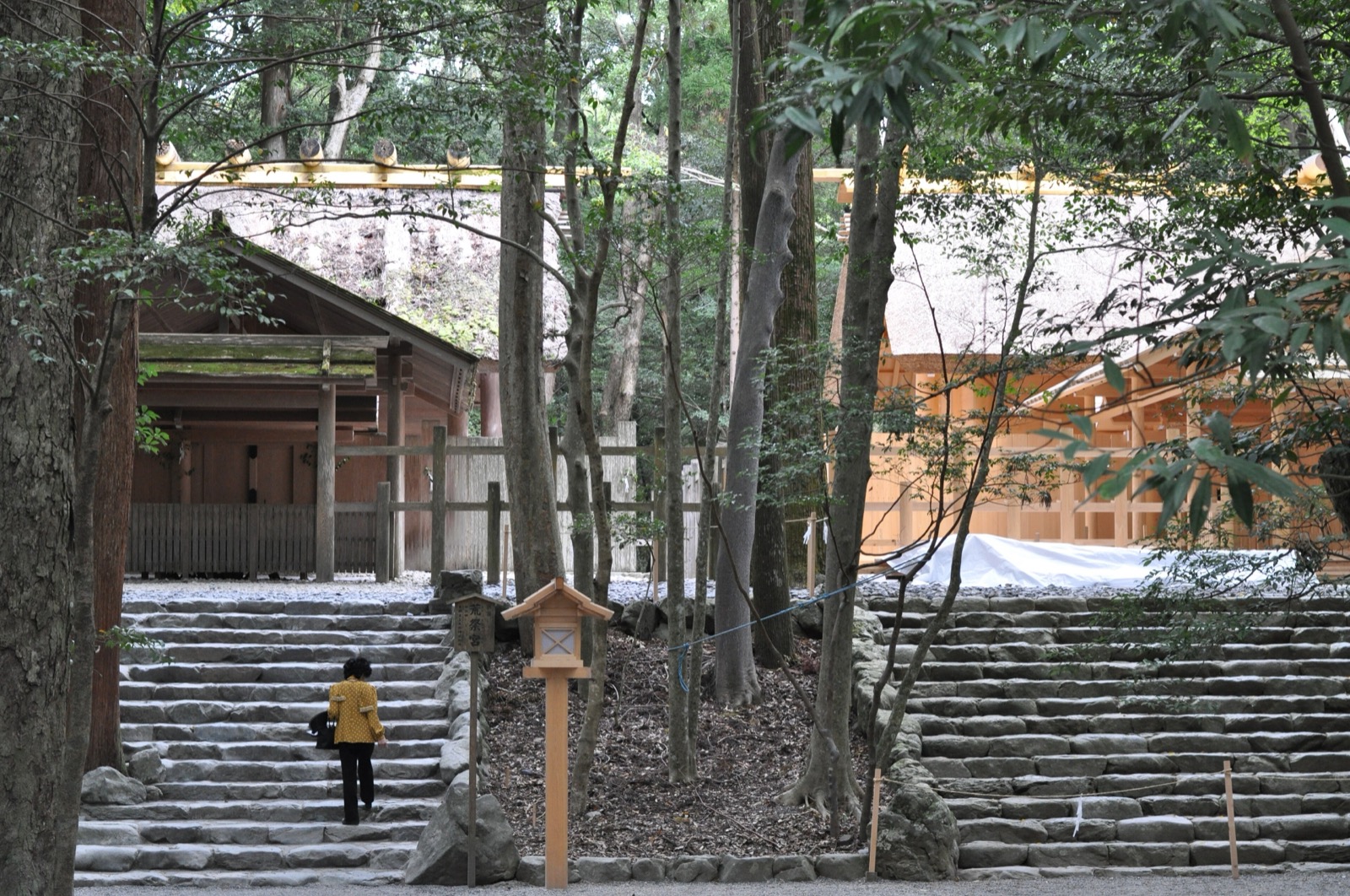
Picture a forest clearing at Naiku in October 2013: a brand-new sanctuary of pale, unpainted cypress standing beside the grey one it is about to replace. The wood in the new building came partly from the shrine’s own forest, a supply Jingu describes as revived after about 700 years. This article follows the plan that made that possible, from the bridge at the shrine’s entrance to the hauling festival of 2026 and the next rebuilding, scheduled for autumn 2033.
From Uji Bridge — The Forest Behind the River
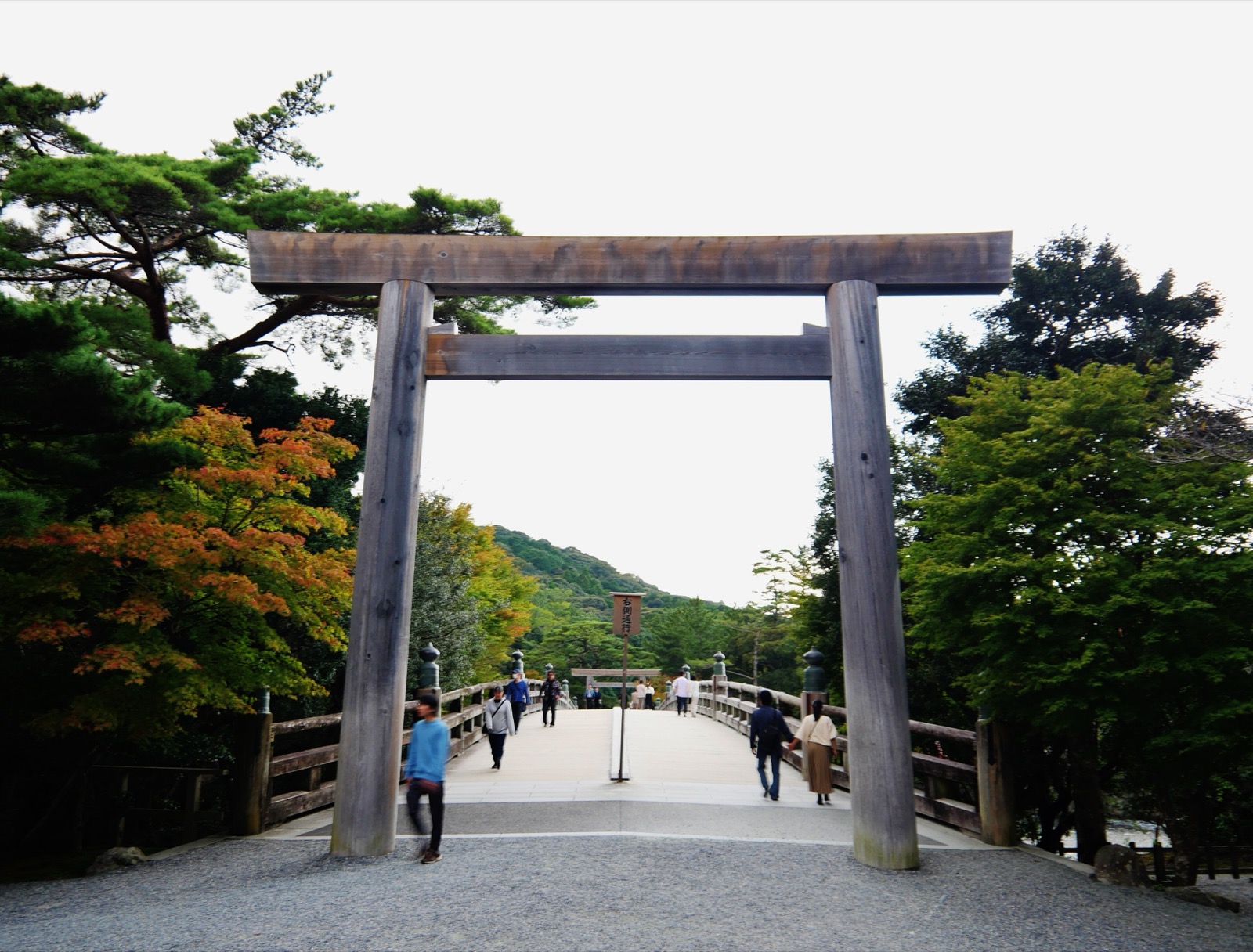
A gate made from a retired pillar
Most visitors meet Ise Jingu’s inner shrine, Naiku, at Uji Bridge. You pass under a plain wooden torii, cross the Isuzu River on wooden planks, and pass under a second torii on the far side. Jingu’s own explanation of the Shikinen Sengu states that the ridge-supporting pillars of the former main sanctuaries are reused as the torii of Uji Bridge (宇治橋の鳥居として再利用). Some of the wood you walk under has already served a term at the heart of the shrine.
Look upstream
Stop halfway across and look upstream. The river comes out of a valley of wooded hills, and those hills are the subject of this article. Jingu’s page on its forest describes the Kyuikirin as about 5,500 hectares. A 2007 forestry document names the mountains in it: Kamijiyama and Shimajiyama in the Isuzu catchment, and Maeyama in the catchment of the Miya River.
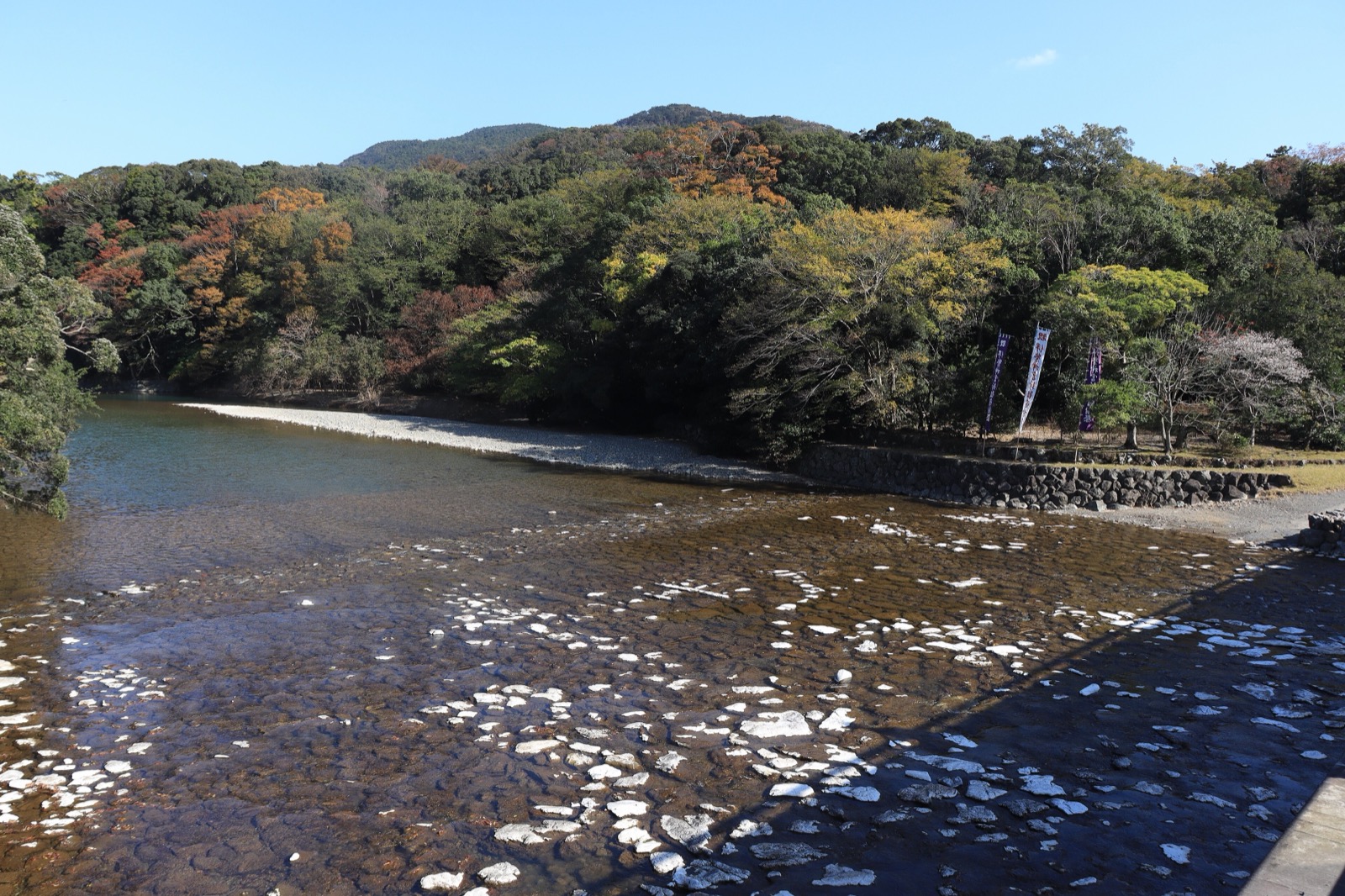
From the bridge, the forest looks like a natural backdrop to a shrine. Parts of it are also managed to grow future shrine timber, with a target date in the twenty-second century.
Twenty Years, 8,500 Cubic Metres — What the Sengu Consumes
A rebuilding on a fixed cycle
The Shikinen Sengu (式年遷宮, “the transfer to a new shrine at the appointed year”) renews the shrine buildings, the sacred apparel and the treasures once every twenty years. Jingu dates the first to 690, the fourth year of Empress Jitō’s reign. Jingu’s English website records that the most recent, in 2013, was the sixty-second. For the sixty-third, Jingu gives autumn 2033 (令和15年秋) as the time of the central ceremony, the Sengyo, when the deity is moved to the new sanctuary.
That is the scene in the photograph at the top of this article: for a time, the new sanctuary and the old one can be seen together.
How much wood
The quantities depend on which document you read, and they are worth setting out side by side rather than blending into one figure.
| Figure | What it measures | Source |
|---|---|---|
| About 8,500 m³ | Timber required for the Shikinen Sengu (Jingu’s current explanation) | Ise Jingu, “What is Shikinen Sengu” |
| About 10,000 m³, about 14,000 logs | Timber for one rebuilding (logs, not standing trees) | Forestry Agency, 2007 award document |
| About 10,000 cypress trees | Requirement per rebuilding, as the local committee describes it | Ise Sengu Committee, “Okihiki” |
None of the documents states its counting scope — which rebuilding, raw logs or processed timber, which buildings — so I do not convert one figure into another. Volume and tree counts are different measures.
Why hinoki, and why unfinished
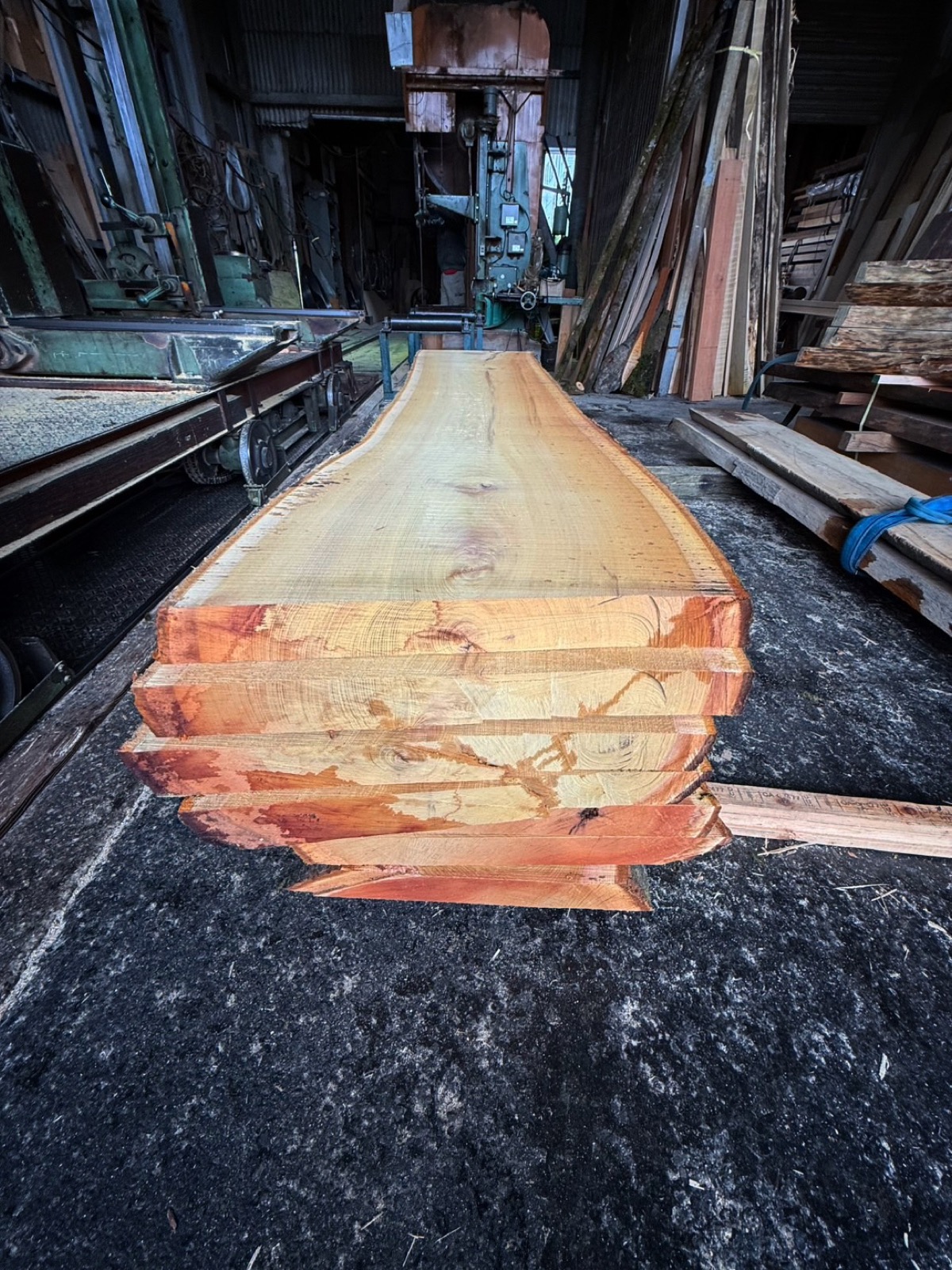
Hinoki is Japanese cypress, Chamaecyparis obtusa. Jingu describes its architecture as using unfinished hinoki (檜の素木) in a straight-lined style that brings out the beauty of bare wood. The Forestry Agency’s seed-and-seedling reference describes the species in general terms: straight grain, a characteristic lustre and fragrance, good workability and high resistance to decay. Jingu’s own text speaks of the beauty of bare wood, not of decay resistance, so I keep the two apart.
Not wasted
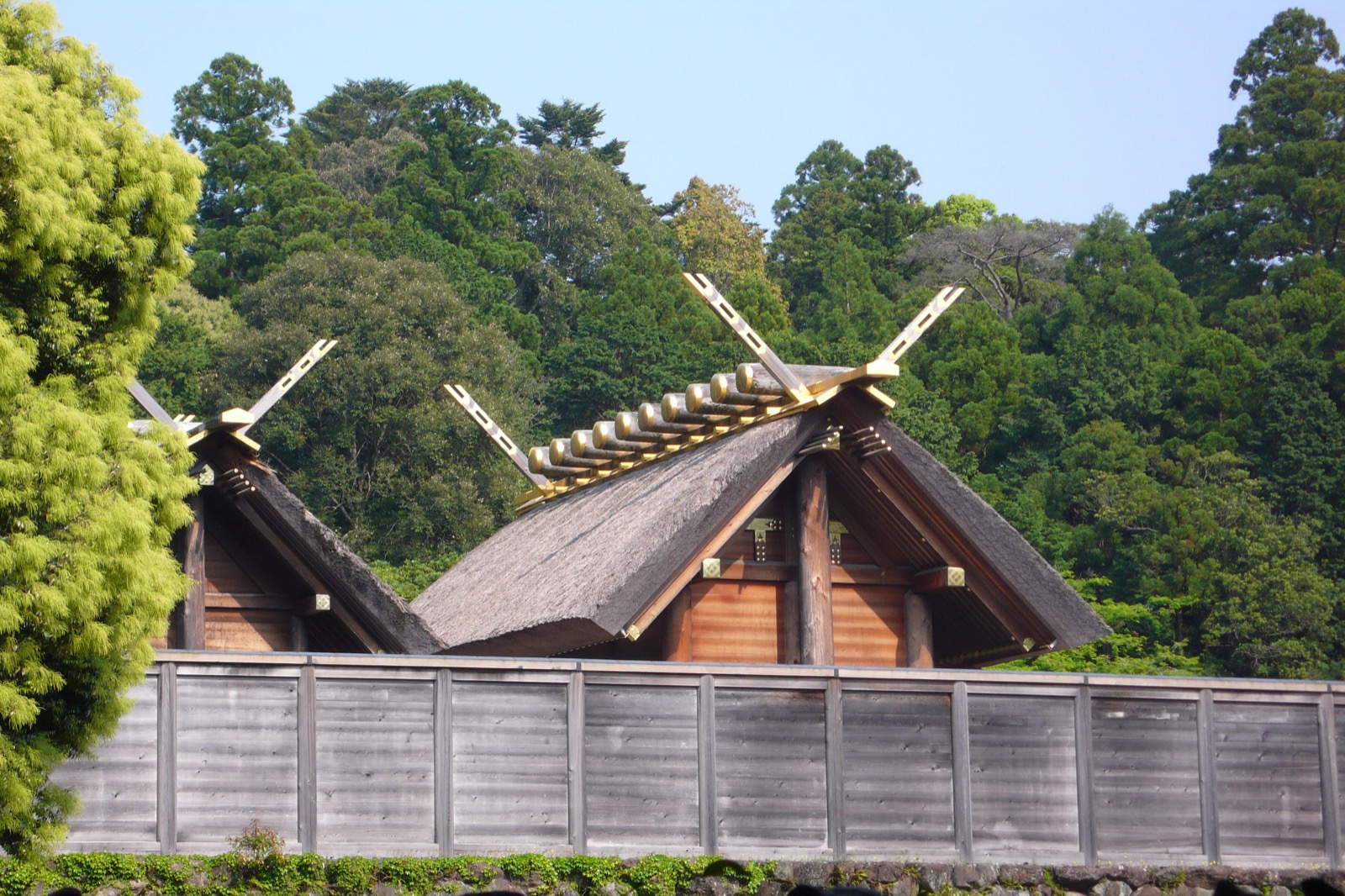
The old timber is not simply discarded. Besides the pillars that become the torii at Uji Bridge, dismantled shrine buildings are reused at shrines across Japan, including shrines damaged by earthquakes (地震などで被害を受けた全国の神社). The twenty-year cycle consumes timber; it also sends timber out.
When the Mountain Ran Out — The Long Trip to Kiso
The original timber mountains
The forest you saw from the bridge was the shrine’s first timber source. Jingu’s forest page says the mountains that now form the Kyuikirin originally served as the Misomayama (御杣山), the mountains designated to supply timber for the Shikinen Sengu.
That arrangement did not last. A 2025 panel exhibition catalogue from the Sengukan, the shrine’s own museum, records that in 1304, for a temporary rebuilding of Naiku, suitable timber had to be obtained from Emayama because the supply at Kamijiyama was exhausted. (That was a temporary rebuilding, not one of the regular twenty-year ones, but it shows the pressure.) The same catalogue records that from the 47th Shikinen Sengu, in 1709, the Misomayama shifted to Kiso, in the mountains of present-day Nagano and Gifu, after extracting timber from the steep Ōsugiyama mountains had become impracticable.
Reserves in the Kiso forests
Kiso hinoki became the shrine’s timber. The Forestry Agency’s Chubu office records that in 1906 Jingu timber reserves were established within Kiso’s imperial forests. A Sengukan catalogue from 2017 describes two kinds: eikyū birin (永久備林), protected for future supply, and rinji birin (臨時備林), temporary reserves meant to supply timber in the century in between. The same catalogue states that the reserve system ended in 1947, when the imperial forests became national forests (神宮備林制度はなくなりました).
The supply did not end with the system. The Chubu office states that timber for the Sengu still comes from the Kiso valley today (現在も、木曽谷から).
Felling ceremonies in 2025
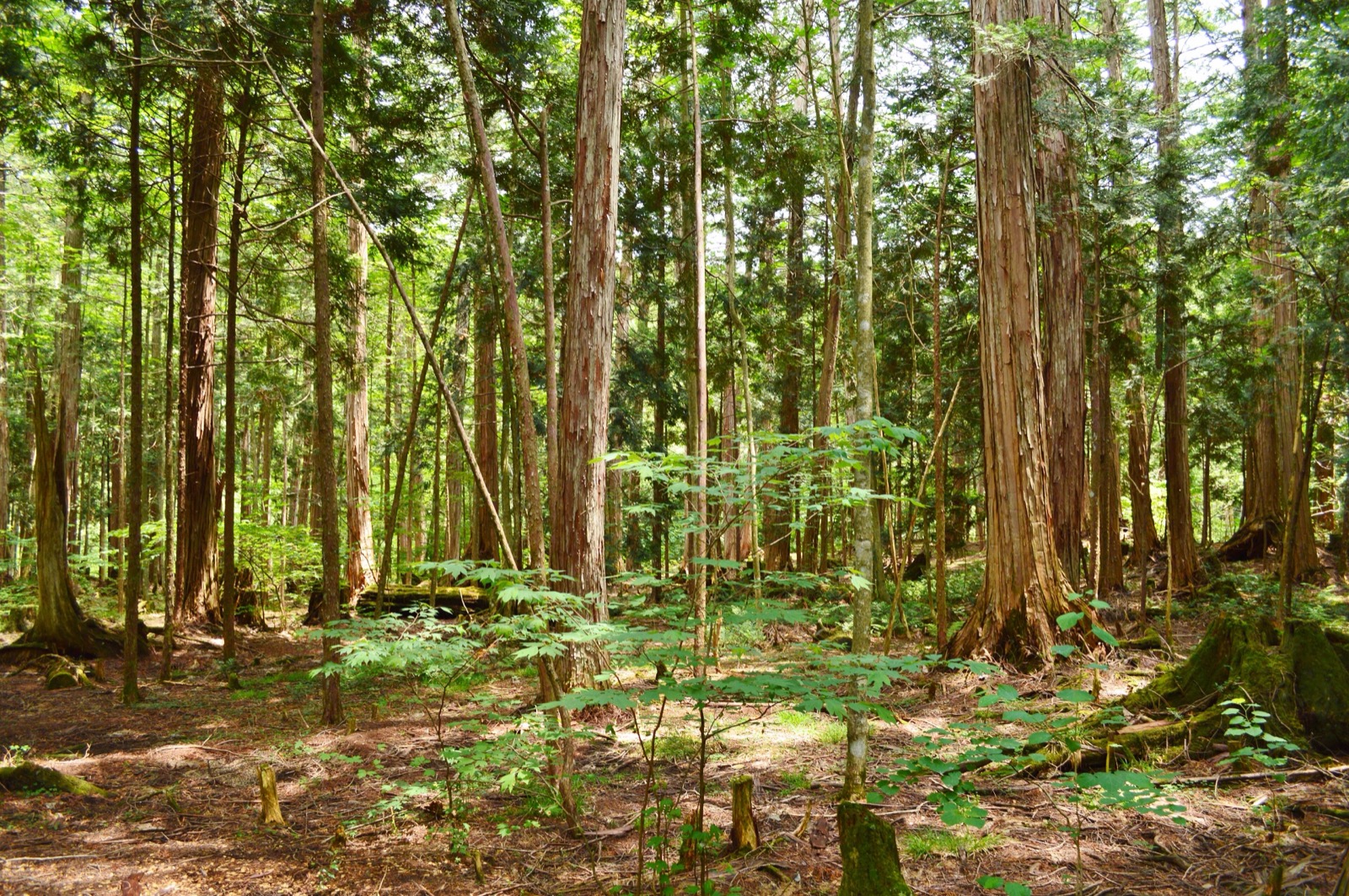
Jingu’s published schedule assigned the 2025 felling ceremonies to the Kiso valley national forest in Agematsu, Nagano, and the Ura-Kiso national forest in Nakatsugawa, Gifu. Jingu scheduled the Misomahajimesai (御杣始祭), the ceremony that opens felling on the timber mountain, for 3 June 2025, and a felling ceremony in Ura-Kiso for 5 June. The ceremonies concern the mihishirogi (御樋代木), cypress felled to make the vessels that hold the sacred symbols. Felling a tree with ritual is not unique to Ise; I wrote about the wider custom in why Japan blesses a tree before cutting it down.
Since 1709 the shrine has depended on cypress from Kiso. The 1923 plan was an attempt to bring the supply home.
1923 — A Flood, a Committee and a Plan
The flood of 1918
The plan did not start with timber. The 2025 Sengukan catalogue records severe flooding downstream in 1918 (大正7年), which made restoring the watershed a pressing concern. The hills above the shrine form part of the Isuzu River’s catchment.
Who drew it up
Jingushicho, the Jingu Administration Office, formed a committee on protecting the forest that included forestry specialists, among them Seiroku Honda and Zentarō Kawase, according to the 2007 Forestry Agency document. The document does not say Honda wrote the plan alone, so I won’t either. Honda’s name will be familiar to readers of this journal from the planted forest at Meiji Jingu, where the shrine itself names him among the forestry specialists who chose its main trees. Both shrines asked the same generation of foresters to design something that would outlast them.
Three purposes
Jingu’s forest page lists three purposes for its forest management: protecting the Isuzu watershed (水源の涵養), enhancing the landscape (風致増進), and producing future shrine timber. The timber plantation sits inside a forest that is also managed for water and for the view behind a shrine.
The original numbers
The 2007 document gives the plan’s original scale: planting 60 hectares a year for 50 years, to restore about 3,000 hectares of mixed forest dominated by cypress. Those are the plan’s starting figures, not a record of what was planted each year.
| Item | Figure | Note |
|---|---|---|
| Plan adopted | 1923 | Ise Jingu, “Eternal forest” |
| Whole forest | about 5,500 ha | 5,446 ha in the 2007 document |
| First Kyuikirin | about 1,100 ha | Felled only when needed for landscape or tree growth |
| Second Kyuikirin | about 4,400 ha | Watershed, landscape and timber |
| Original planting target | 60 ha a year for 50 years, about 3,000 ha | Plan figure, 2007 document |
| Cypress plantations for shrine timber | about 2,300 ha | Sengukan |
Two Clocks — What “200 Years” Actually Means
The age of a tree
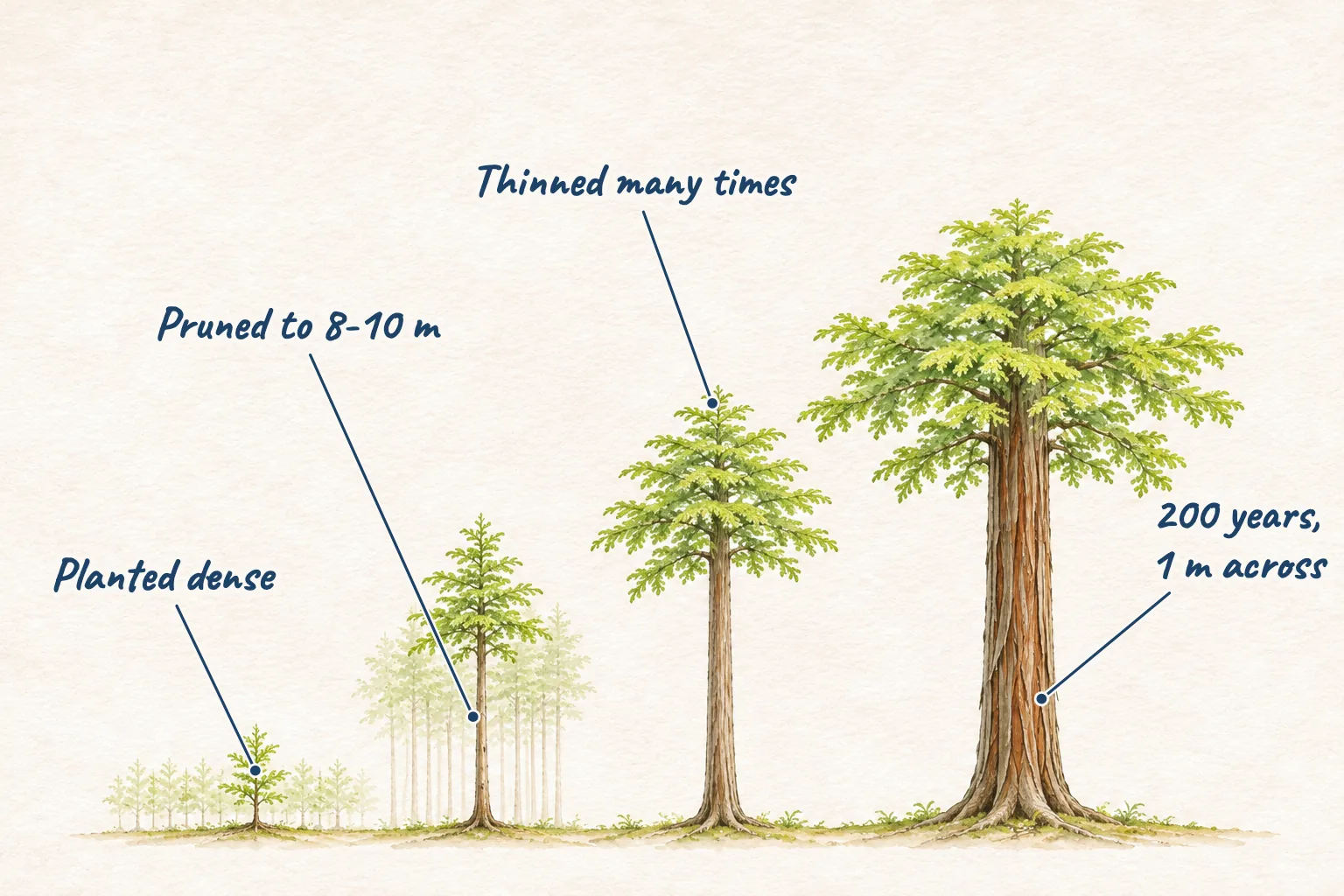
Jingu’s forest page is explicit that the target is cypress 200 years old (200年生の檜). The Sengukan gives the size that age is meant to deliver, measured 1.2 metres above the ground: at least 60 centimetres (about 24 inches) in diameter for ordinary shrine-timber candidates, and at least one metre (about 39 inches) for large-tree candidates.
The horizon of a plan
Jingu’s page on the Shikinen Sengu also describes the project as a plan begun in 1923 to reach self-sufficiency in timber 200 years later (200年後には). So the number works on two clocks at once. One is biological: how long a single hinoki takes to reach the size the shrine needs. The other is institutional: how long the shrine expects to wait before the forest as a whole can carry the full load.
Why the clocks matter for readers
Put the two clocks next to the Sengu calendar and the scale becomes clear. A tree planted in the 1920s would turn 200 in the 2120s. In that time, if the cycle holds, the shrine will have been rebuilt about ten times. Many of the people working on the plan will not see its 200-year target reached.
| Common reading | What the sources actually say |
|---|---|
| “The forest is 200 years old.” | The plan dates from 1923. Two hundred years is the target age of the trees and the plan’s horizon. |
| “Ise already grows all its own timber.” | The stated aim is 100% supply from the Kyuikirin. In 2013 the forest supplied part of it. |
| “Every tree is grown for the Sengu.” | About 2,300 ha of plantations are for shrine timber; about 1,100 ha are protected forest. |
| “Each rebuilding needs exactly 10,000 trees.” | Sources give about 8,500 m³, about 10,000 m³ or about 10,000 trees, without stating the same scope. |
The protected core
Not all of the Kyuikirin is cut. The Sengukan divides it into the First Kyuikirin, about 1,100 hectares around the shrine and the views from it, where living trees are felled only when needed for the landscape or for the growth of other trees, and the Second Kyuikirin, about 4,400 hectares, where watershed and landscape protection are combined with growing shrine timber.
Growing a 200-Year Tree — The Work, Stage by Stage
The forest management is laid out most clearly in a 2012 article by Takayoshi Satō and Ayumi Watanabe in Shinrin Kagaku (Forest Science), the Japanese Forest Society’s journal, and in the Sengukan’s own description. Put together, the work runs in a clear order.
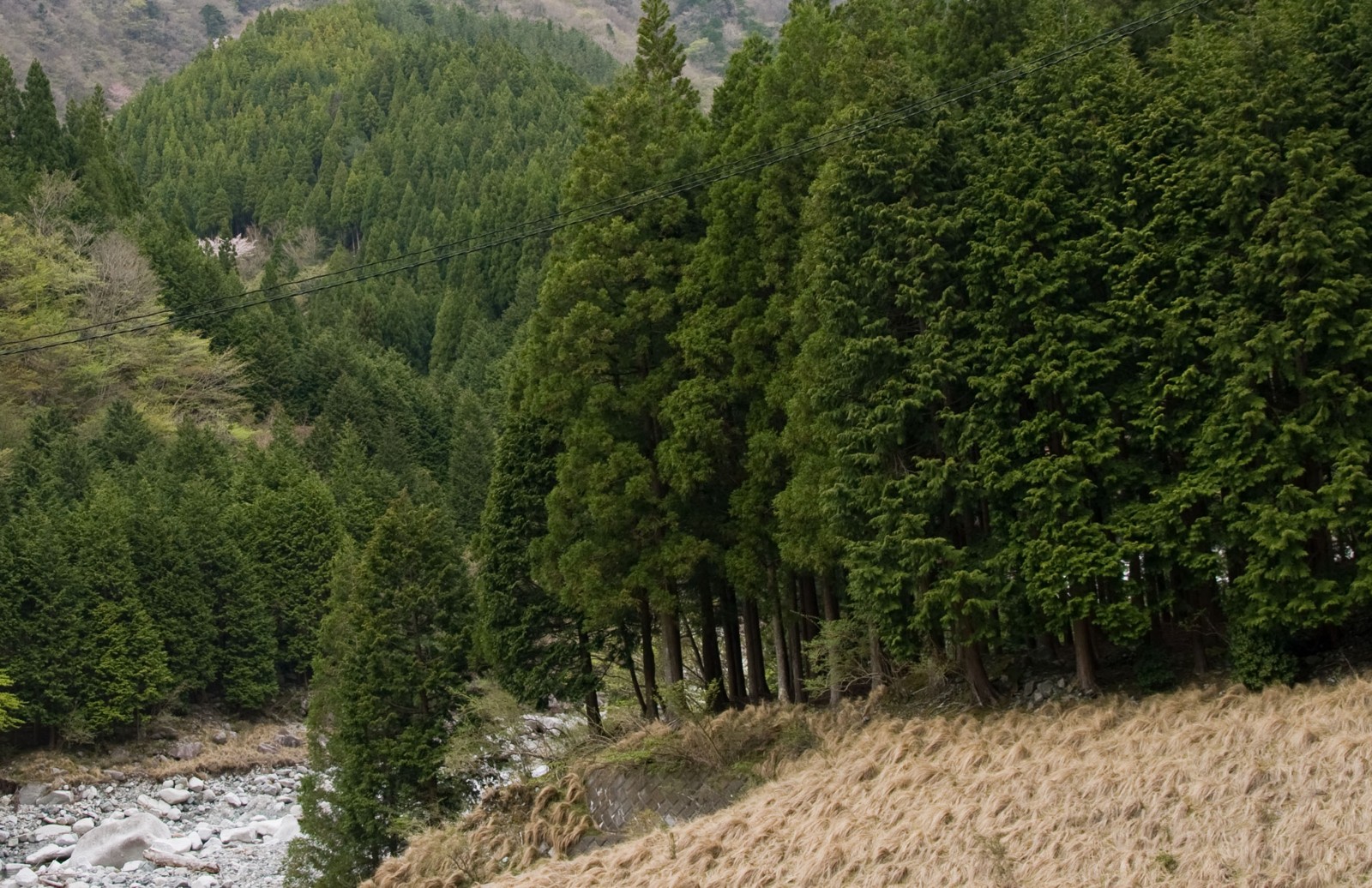
Stage 1 — Planting dense
The 2012 article describes an initial planting density of 4,000 hinoki seedlings per hectare. That is the starting point from which every later thinning is counted.
Stage 2 — Pruning to eight or ten metres
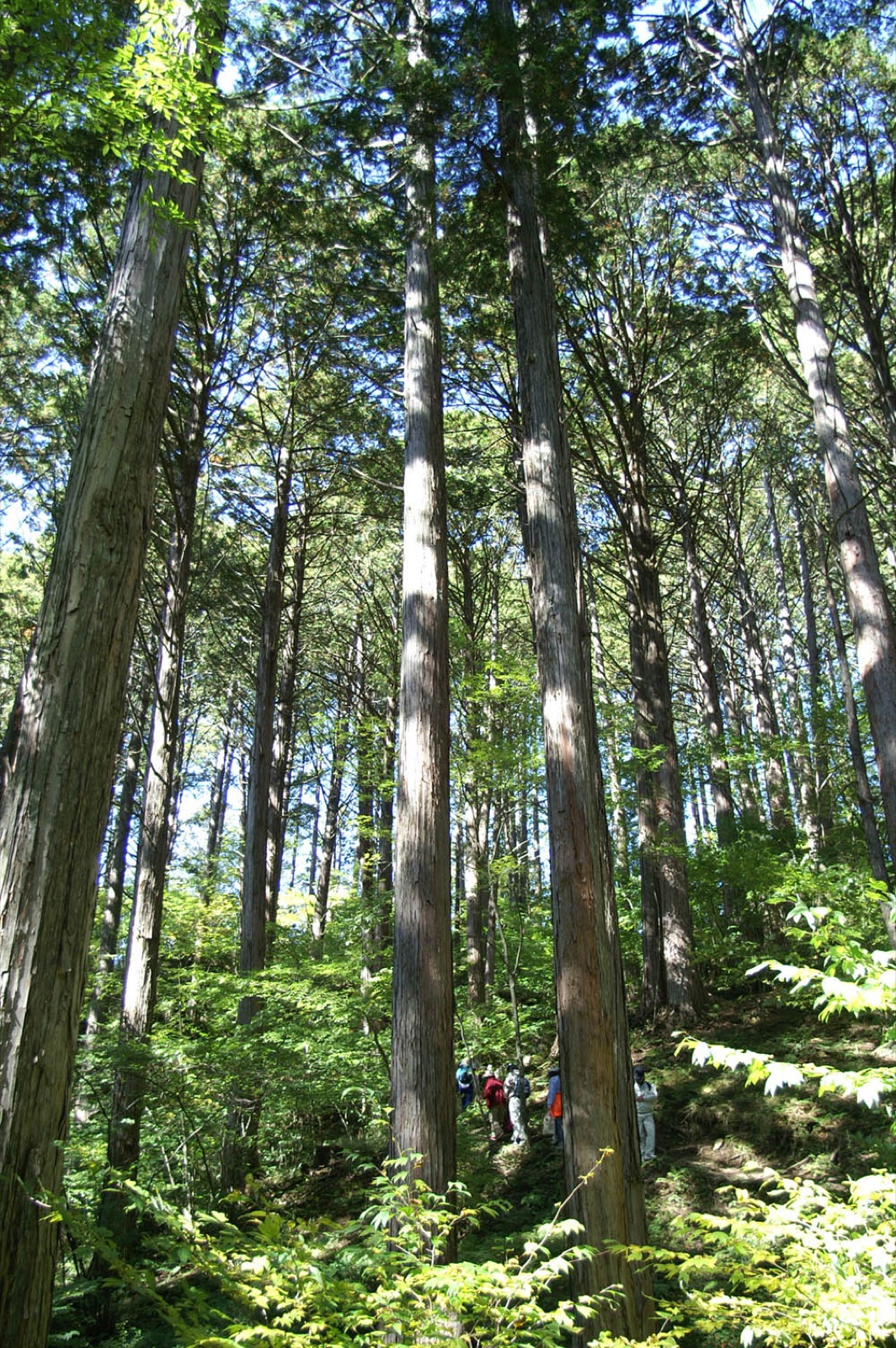
The same article describes pruning the trunk to a height of 8 to 10 metres (about 26 to 33 feet). The pruning is aimed at the trunk, the part that becomes timber, rather than at the shape of the crown. For bare-wood architecture, where nothing will be painted over, the lower trunk is the part that counts.
Stage 3 — Thinning, again and again
The article describes repeated thinning at intervals of 8 to 15 years, all the way to 200. Each thinning removes some trees to give the remaining ones room. The figures come from two different documents: the 2012 article gives the planting density of 4,000 per hectare, and the Ministry of the Environment’s 2011 white paper gives a long-term target of about 100 large trees per hectare after 200 years (200年で単位面積(ha)あたり100本程度).
Stage 4 — Choosing and marking the candidates
At some point a tree stops being one of many and becomes a candidate. The Sengukan describes how candidates are marked: large-tree candidates with two rings of white paint around the trunk (白色のペンキで二重巻き表示), ordinary shrine-timber candidates with one (一重巻き表示). By 2014 about 30,000 large-tree candidates and about 28,000 ordinary candidates had been chosen. These are counts of selected trees, not of trees planted.
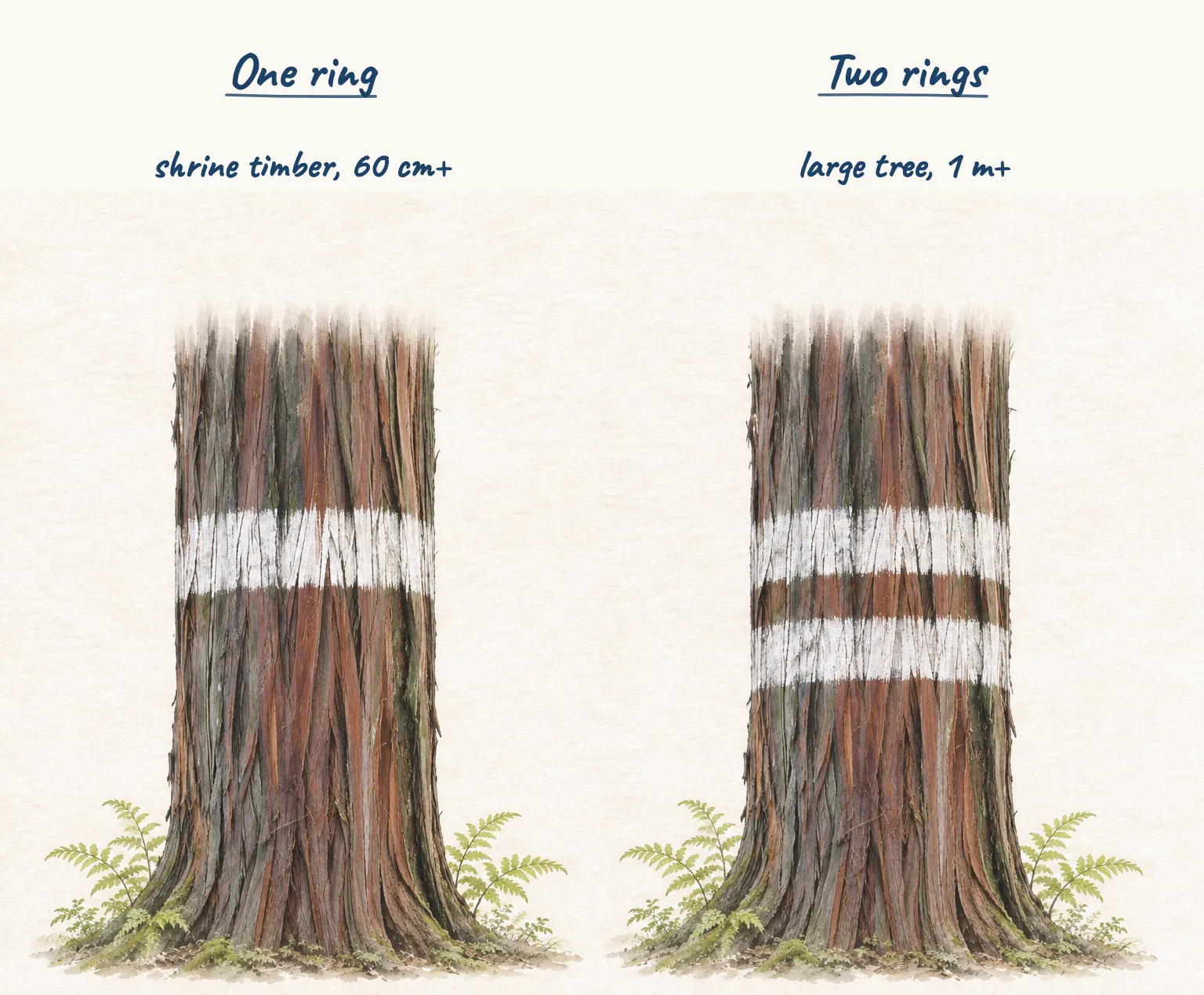
One detail is worth flagging. The 2012 article describes the ordinary candidates’ mark as a double paint ring (二重ペンキ印), which does not match the Sengukan’s one ring. I follow the Sengukan, as the managing body’s own description; whether the article is a slip or the practice changed, I cannot say from the documents.
Stage 5 — Giving the chosen tree light
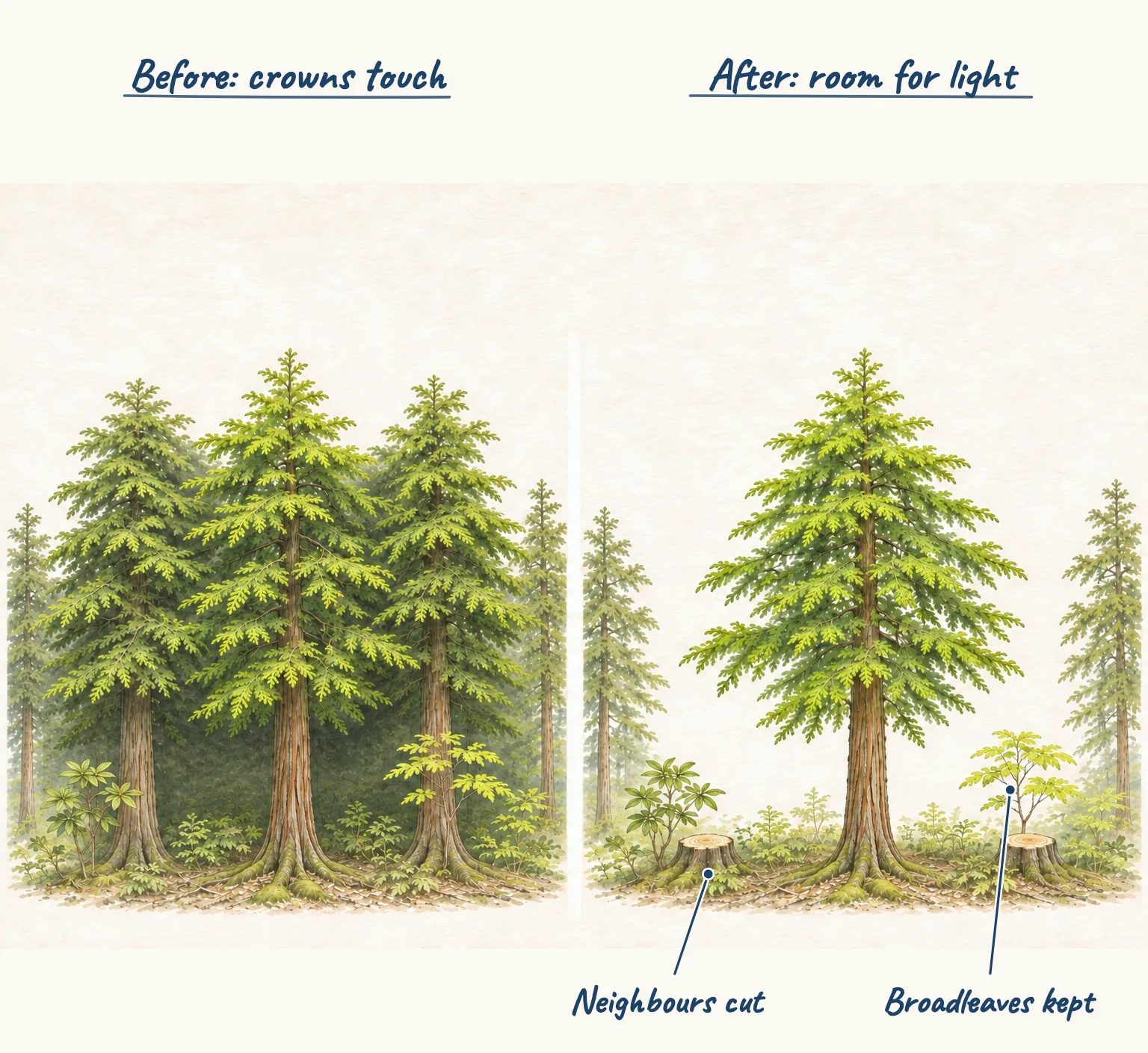
Once a candidate is chosen, the foresters work around it. The 2012 article describes removing neighbouring trees whose branch tips touch the selected candidate, to let in light and speed its growth in diameter — 受光伐, literally “felling for light.” A tree’s diameter growth depends on the size of its crown, and a crown hemmed in by neighbours stays small.
Stage 6 — Letting broadleaves in
The plantation is not meant to stay pure cypress. The Sengukan states that broadleaf trees that come into the plantations are kept alongside the cypress to develop mixed conifer–broadleaf forest (針広混交林). That keeps the plantation closer in character to the rest of the shrine forest.
Who does it
The 2025 Sengukan catalogue states that Jingushicho’s forestry department maintains the mountains with specialist staff (専門の職員が山の維持管理). The documents I read do not describe their daily inspection or record-keeping, so I leave it there.
The Typhoon and the Long Patience
Ise Bay, 1959
A plan this long has to absorb disasters. Masao Kimura, a former head of Jingu’s forestry department, said in a lecture summarised by the Shasō Gakkai (Society for Shrine Forests) that the forest’s growing stock stalled between 1955 and 1965, and attributed this to damage from the Ise Bay Typhoon (これは伊勢湾台風の被害で). A 1995 forestry journal records the typhoon year, 1959, and a change to the management plan because of it. I could not find a figure for the area damaged or trees lost, so I won’t give one.
Recovery measured in stock
In the same lecture Kimura reported that the total growing stock of the forest had recovered to about 730,000 cubic metres by the 2005 survey (全林の蓄積は73万立方). That is the volume of the whole forest, not the amount regrown after the storm.
2013 — The First Harvest in About 700 Years
Thinnings, not giants
The 2013 rebuilding, the 62nd Sengu, was the first to use timber grown under the 1923 plan. A 2017 Sengukan catalogue describes what went in: cypress thinnings, cut in the course of growing large trees (大径木を得るために伐られた間伐材). Jingu describes this as a revival after about 700 years (約700年ぶり).
These were thinnings, not trees documented as having reached the 200-year target: trees removed so that the large trees could grow — a by-product of thinning carried out to grow larger trees. The plan had started paying out long before its main crop was ready.
How much
Here again the documents differ, and the difference is instructive.
| Source | Figure | Kind of figure |
|---|---|---|
| Forestry Agency, 2007 award document | about 20% (全体の2割程度) | Forecast, before 2013 |
| Japan Tourism Agency, “Ise Jingu’s Sacred Forest” | about 25% | Description after 2013; basis not stated |
| Forestry Agency, 2007 award document | 100% from the Kyuikirin | Long-term objective, not yet reached |
I have not found Jingu’s own tally of the 2013 timber by volume or by count, and I have not found a published target for 2033. After a long interruption, the forest supplied a share in 2013; full supply remains the long-term goal.
Long Rotations Elsewhere — How Europe Grows Big Trees
The oaks of Tronçais
Ise is not the only forest managed for trees that take centuries. One European example is the oak forest of Tronçais in central France. The French national forest office, the ONF, traces its protection and restoration to the forest ordinance of 1669 promoted by Jean-Baptiste Colbert, part of a wider policy of securing timber for the navy. (It is often said that Colbert planted the oaks himself; the ONF account describes a policy, not a planting, and I have not found a source for the personal story.)
The current management summary for Tronçais, dated January 2026, sets harvest ages by subdivision. For the normal sessile-oak subdivision of the first series, it is 250 years with a target diameter of 85 centimetres. A designated subdivision is grown to 300 years and 100 centimetres. Other compartments are harvested at 200 years and 75 centimetres.
| Ise Jingu, Kyuikirin | Tronçais, France | |
|---|---|---|
| Species | Hinoki, Chamaecyparis obtusa | Sessile oak |
| Origin of long-term policy | Forest management plan, 1923 | Colbert’s forest ordinance, 1669 |
| Target age | 200 years | 200, 250 or 300 years, by subdivision |
| Target diameter | 60 cm; 1 m for large-tree candidates | 75, 85 or 100 cm, by subdivision |
| Policy context | Watershed, landscape, shrine timber | Colbert’s policy of securing timber for the navy |
The two forests answer different needs on different species, so the numbers are not a contest. What they share is the structure: a written target age, a written target size, and an institution expected to outlive everyone who wrote them down.
Future trees, marked in paint
The Ise foresters’ working method also has close European relatives. Central European forestry speaks of Zukunftsbäume, “future trees,” or Z-trees. A demonstration stand run by the Bavarian forestry administration describes removing the neighbouring trees that press on selected Z-trees (Bedränger) to give them room to build their crowns — the same idea as Ise’s felling for light. Austria’s federal forest research centre, writing about oak, makes the link to diameter explicit: crown expansion must be kept up by repeated release until harvest.
British guidance says the same in plainer terms. The Forestry Commission’s continuous-cover handbook advises releasing selected trees from competition and, as a general rule, removing the two main competitors. Forest Research’s description of its Clocaenog research area in Wales notes that frame trees there were marked with white paint bands. In Hesse, the state forest service says Z-trees usually receive three or four blue dots.
Where Ise differs
So the white rings of Ise would be readable to a forester in Wales or Hesse. Three things make the Ise forest different. The end use is fixed and religious: the timber has a single customer, on a fixed calendar, with a defined form. The broadleaf trees are kept deliberately inside the plantation, because the forest is also managed to protect the watershed and the landscape. And the forest sits upstream of the shrine that will use the timber, and is managed in part for its watershed.
2026 — Bringing the Timber into Town
The Okihiki
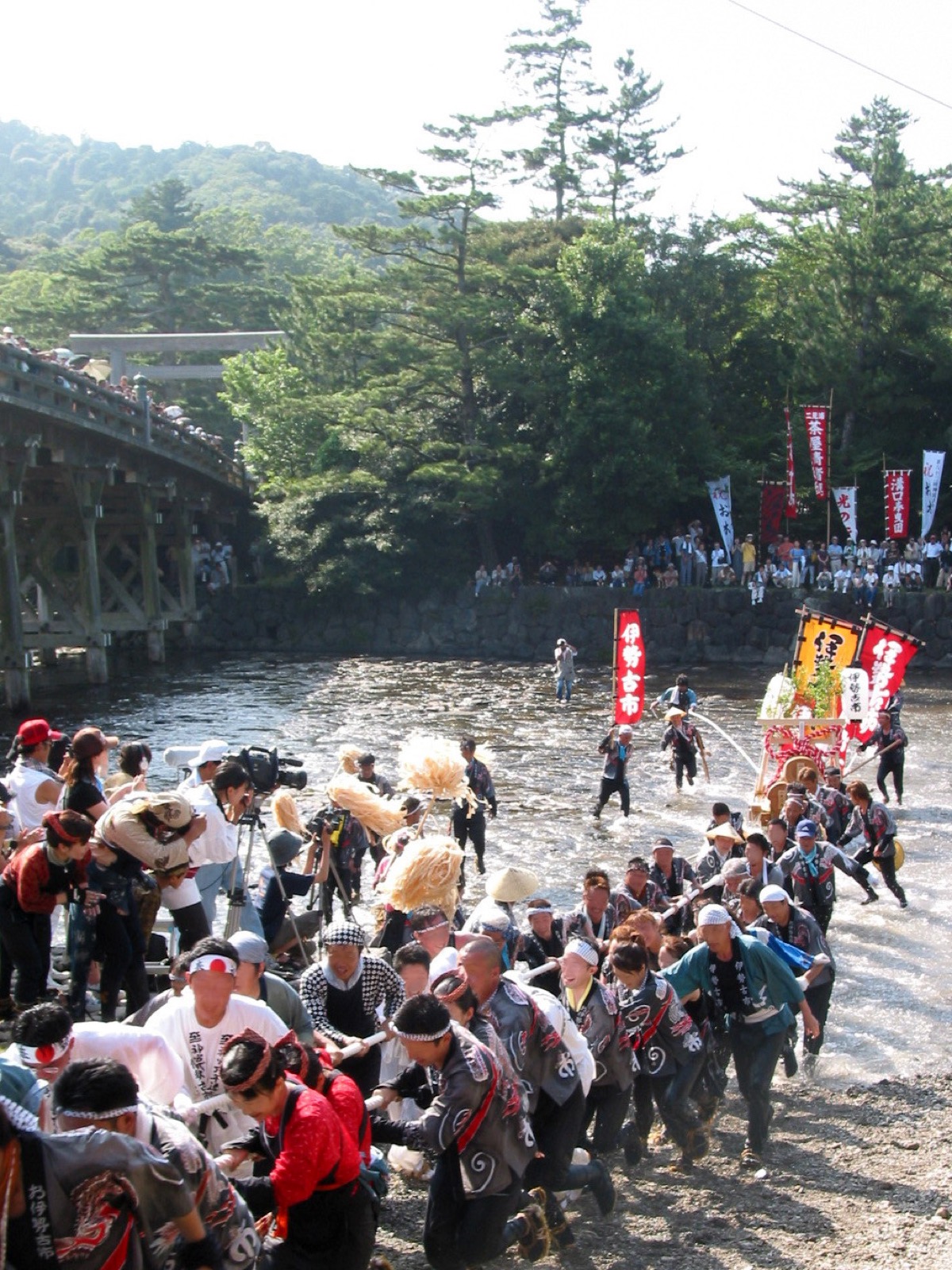
The timber does not simply arrive at the shrine on a truck. The Okihiki (御木曳, “pulling the sacred timber”) brings it in by hand, pulled by local hauling groups and invited participants. Jingu describes the division: timber for Naiku is hauled up the Isuzu River (川曳, kawabiki), and timber for the outer shrine, Geku, is pulled overland on ceremonial carts (陸曳, okabiki).
What happened this year
The first round for the 63rd Sengu took place in 2026. Ise City’s reports give the dates. The opening hauling ceremony, the Okihikizomeshiki, took place on 12 and 13 April. Land hauling took place over 15 days between 9 May and 13 June. River hauling took place on 25 and 26 July and on 1 and 2 August. The round closed with a thanksgiving shrine visit on 9 August.
The numbers are a measure of how much of the city this involves. The local Sengu committee reported 37,900 local participants and 20,000 tokubetsu shinryōmin — “special shrine people,” a separate participant category — in the land hauling. Ise City reported about 14,800 people in the river hauling and about 72,700 across both. The special-participant scheme traces back to the “one-day shrine people” scheme that arose from the Oshiraishimochi event of 1973. For the first round in 2026, the city noted, there was no general public call for special participants.
| Date (2026) | Event | Source |
|---|---|---|
| 12–13 April | Okihikizomeshiki, the opening hauling | Ise City report |
| 9 May – 13 June (15 days) | Land hauling, first round | Ise City report |
| 25–26 July, 1–2 August | River hauling, first round | Ise City report |
| 9 August | Thanksgiving visit closing the first round | Ise City report |
What comes next
The second round of land hauling is scheduled between 8 May and 12 June 2027, and river hauling for 24–25 and 31 July and 1 August 2027. Jingu’s provisional timetable places the Chinchisai, the ground-calming ceremony, in April 2028 and the ceremony reopening Uji Bridge in November 2029, and the Sengyo in autumn 2033. Jingu notes that the later dates follow the precedent of the previous rebuilding, so treat them as a plan rather than a fixed calendar.
What an Arborist Takes From It — Reading the Plan as Tree Work
A plan built on the biology of one tree
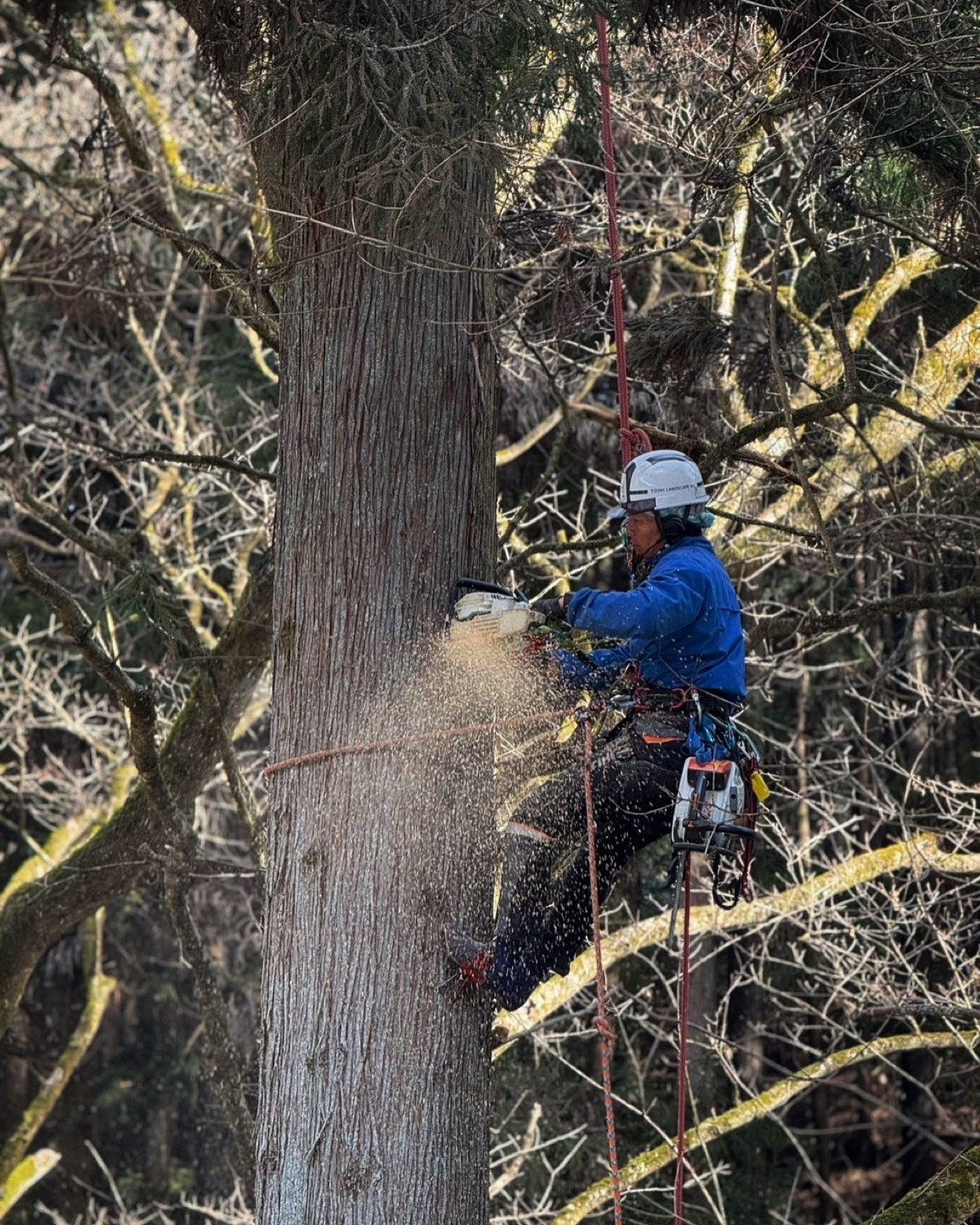
Strip away the ceremony and the plan is a set of decisions any forester or arborist would recognise. Choose the tree early. Mark it so the next generation can read your choice. Prune the lower trunk. Give its crown light by removing the neighbours that touch it. Let broadleaves come in. None of this is unique to Ise. What is unusual is the patience, and the willingness to write numbers down for people who are not yet born.
Where it overlaps with tree care in Japan
The Ise plan raises a different question from many urban tree-care decisions: how to give selected trees room to grow large over decades. The trees we prune today will be judged by whoever inherits them. If you want a sense of how long such trees can live once they are left to it, I wrote about why Japan’s ancient trees live for a thousand years.
Frequently asked questions
What happens in the twenty-year Shikinen Sengu? The buildings, sacred apparel and treasures are renewed; Jingu dates the first to 690. The 62nd took place in 2013; the central ceremony of the 63rd is scheduled for autumn 2033.
How much timber does one rebuilding need? Jingu’s current explanation gives about 8,500 cubic metres. A 2007 Forestry Agency document gives about 10,000 cubic metres, or about 14,000 logs, and the local Sengu committee describes about 10,000 cypress trees. The figures do not state the same scope.
What is the Kyuikirin? Ise Jingu’s forest of about 5,500 hectares, mostly in the upper Isuzu River basin. It is divided into a protected core of about 1,100 hectares and about 4,400 hectares where watershed and landscape protection are combined with growing shrine timber.
Is the Ise Jingu forest 200 years old? No. The forest management plan dates from 1923. “200 years” is the target age for the hinoki grown there — at least 60 centimetres in diameter, or a metre for large-tree candidates — and the plan’s horizon for full self-sufficiency in timber.
Does Ise Jingu use its own cypress yet? Partly. In 2013, thinnings from the Kyuikirin supplied part of the timber, which Jingu describes as a revival after about 700 years. The Japan Tourism Agency puts the share at about 25 percent. Kiso in Nagano and Gifu continues to supply Sengu timber.
What are the white rings painted on the trees? They mark candidate trees. According to the Sengukan, large-tree candidates get two rings of white paint and ordinary shrine-timber candidates get one.
Sources
– Ise Jingu, “Eternal forest” (永遠の森) (accessed 2026-11-06): https://www.isejingu.or.jp/sengu/forest.html – Ise Jingu, “What is Shikinen Sengu” (式年遷宮とは) (accessed 2026-11-06): https://www.isejingu.or.jp/sengu/the63rd/about.html – Ise Jingu, Sengu schedule (遷宮予定年表) (accessed 2026-11-06): https://www.isejingu.or.jp/sengu/the63rd/schedule.html – Ise Jingu, announcement of 2025 ceremonies, 27 February 2025 (accessed 2026-11-06): https://www.isejingu.or.jp/topics/vrlmzeqe.html – Ise Jingu, Okihiki (御木曳行事) (accessed 2026-11-06): https://www.isejingu.or.jp/sengu/the63rd/k0o9woxc.html – Ise Jingu, Shrine architecture (社殿の建築) (accessed 2026-11-06): https://www.isejingu.or.jp/about/architecture/ – Ise Jingu, Shikinen Sengu for beginners (accessed 2026-11-06): https://www.isejingu.or.jp/first/beginner_sengu.html – Ise Jingu, Rituals and Ceremonies (English) (accessed 2026-11-06): https://www.isejingu.or.jp/en/ritual/index.html – Sengukan, “The work of the forest and the mountain” (森そして山の営み) (accessed 2026-11-06): https://www.sengukan.jp/special_03/ – Sengukan, 2025 panel exhibition catalogue (accessed 2026-11-06): https://www.sengukan.jp/wp/wp-content/themes/sengukan/media/pdf/record/r7/20250417-zuroku.pdf – Sengukan, 2017 exhibition catalogue “Mirai e” (accessed 2026-11-06): https://sengukan.jp/wp/wp-content/themes/sengukan/media/pdf/record/h29/20170630-zuroku.pdf – Sengukan, announcement of Sengu ceremony dates (accessed 2026-11-06): https://www.sengukan.jp/news/2464/ – Forestry Agency, 2007 Midori Culture Award document (accessed 2026-11-06): https://www.rinya.maff.go.jp/puresu/H19-4gatu/0427midori-bunkasho.pdf – Forestry Agency Chubu Regional Office, History of the Kiso valley forests (accessed 2026-11-06): https://www.rinya.maff.go.jp/chubu/kiso/morigatari/rekishi.html – Forestry Agency, seed and seedling reference, “Hinoki” (accessed 2026-11-06): https://www.rinya.maff.go.jp/j/kanbatu/syubyou/attach/pdf/syubyou-59.pdf – Satō Takayoshi and Watanabe Ayumi, “Jingu Kyuikirin and the Shikinen Sengu,” Shinrin Kagaku 64 (2012) (accessed 2026-11-06): https://www.forestry.jp/content/images/2021/10/64.pdf – Ministry of the Environment, White Paper 2011 (accessed 2026-11-06): https://www.env.go.jp/policy/hakusyo/h23/html/hj11010201.html – Shasō Gakkai newsletter 109, lecture by Masao Kimura (accessed 2026-11-06): https://www.shasou.org/news/chinju_109.pdf – Ringyō Gijutsu, May 1995 (accessed 2026-11-06): https://www.jafta-library.com/pdf/mri638.pdf – Japan Tourism Agency, “Ise Jingu’s Sacred Forest” (accessed 2026-11-06): https://www.mlit.go.jp/tagengo-db/en/R2-00749.html – Ise Sengu Committee, Okihiki (accessed 2026-11-06): https://www.isesengu.jp/okihiki.html – Ise Sengu Committee, land hauling report (accessed 2026-11-06): https://www.isesengu.jp/html/news_list.php?cate=%E7%AC%AC%E4%B8%80%E6%AC%A1%E3%81%8A%E6%9C%A8%E6%9B%B3%E8%A1%8C%E4%BA%8B%EF%BC%88%E9%99%B8%E6%9B%B3%EF%BC%89 – Ise Sengu Committee, special shinryomin souvenir proposal guidelines (accessed 2026-11-06): https://www.isesengu.jp/upload/20250819-142633.pdf – Ise City, report on the 2026 land hauling, 9 July 2026 (accessed 2026-11-06): https://prtimes.jp/main/html/rd/p/000000105.000079832.html – Ise City, report on the 2026 river hauling, 7 September 2026 (accessed 2026-11-06): https://prtimes.jp/main/html/rd/p/000000109.000079832.html – Ise City, announcement of 23 April 2026 (accessed 2026-11-06): https://prtimes.jp/main/html/rd/p/000000096.000079832.html – ONF, “L’ordonnance de Colbert en 1669 : la gestion forestière en forêt de Tronçais” (accessed 2026-11-06): https://www.onf.fr/onf/recherche/%2B/ff6::la-grande-histoire-des-forets-episode-ordonnance-de-colbert-en-1669-la-gestion-forestiere-en-foret-de-troncais.html – ONF, management summary for the Forêt de Tronçais, 2026 (accessed 2026-11-06): https://www.onf.fr/%2B%2Bamgt%2B%2BA007444H/%2B%2Bzfiles%2B%2B617c7ef0 – Bavarian State Forestry Office (AELF), demonstration stands for young spruce thinning (accessed 2026-11-06): https://www.aelf-rs.bayern.de/forstwirtschaft/waldbesitzer/294682/index.php – BFW / waldwissen.net, oak species in Austria (accessed 2026-11-06): https://www.waldwissen.net/de/lebensraum-wald/baeume-und-waldpflanzen/laubbaeume/eichenarten-in-oesterreich – HessenForst, “Was bedeutet die Farbe an den Bäumen?” (accessed 2026-11-06): https://www.hessen-forst.de/was-bedeutet-die-farbe-an-den-baeumen – Forestry Commission, Managing Continuous Cover Forests (2008) (accessed 2026-11-06): https://cdn.forestresearch.gov.uk/2008/07/fcogb7_v3_july2008.pdf – Forest Research, Background to the Clocaenog CCF Research Area (2013) (accessed 2026-11-06): https://cdn.forestresearch.gov.uk/2022/02/background_clocaenog_ccf_research_area.pdf – Meiji Jingu, The forest and highlights (accessed 2026-11-06): https://www.meijijingu.or.jp/midokoro/