

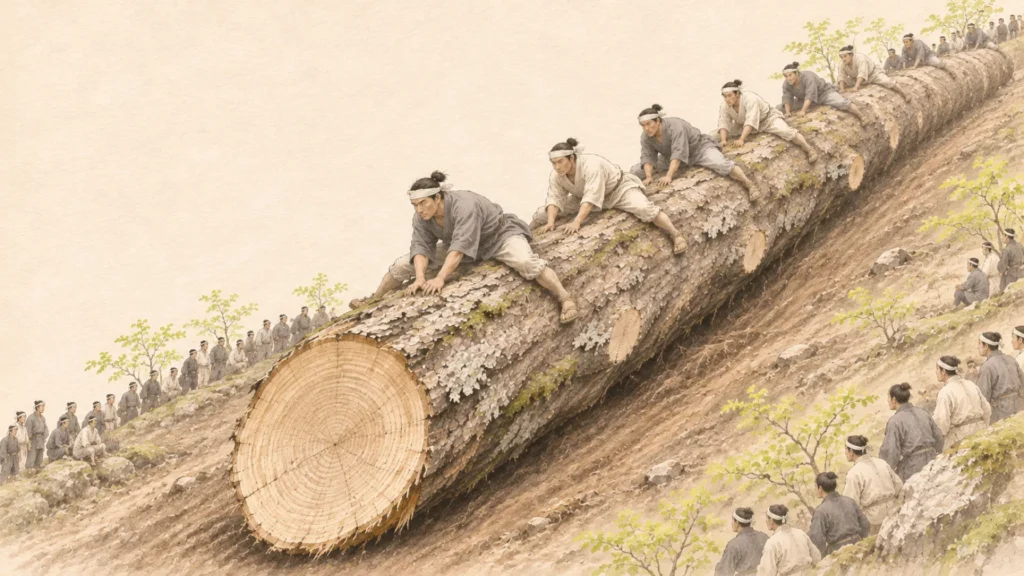
The Onbashira festival is how Suwa Taisha, a group of four shrines around Lake Suwa in Nagano, replaces the sixteen pillars at the corners of its sanctuaries, in each Year of the Tiger and Year of the Monkey, six years apart — the next is in 2028. Each pillar is a single fir trunk: a straight tree with no decay inside, provisionally chosen two or three years ahead, marked with ritual axe strokes before it is felled, and then hauled to the shrine by hand by the parishioners themselves — riding the log down a slope of 27 degrees at the Upper Shrine and up to 35 degrees at the Lower Shrine is part of that hauling. When the old pillars come down, a ritual returns them to ordinary wood, and they are reused — today as shrine amulets and nameplates.
This article follows the festival from the tree’s perspective: which firs are chosen, how they are cut, how they travel, and what happens to them after six years of standing.
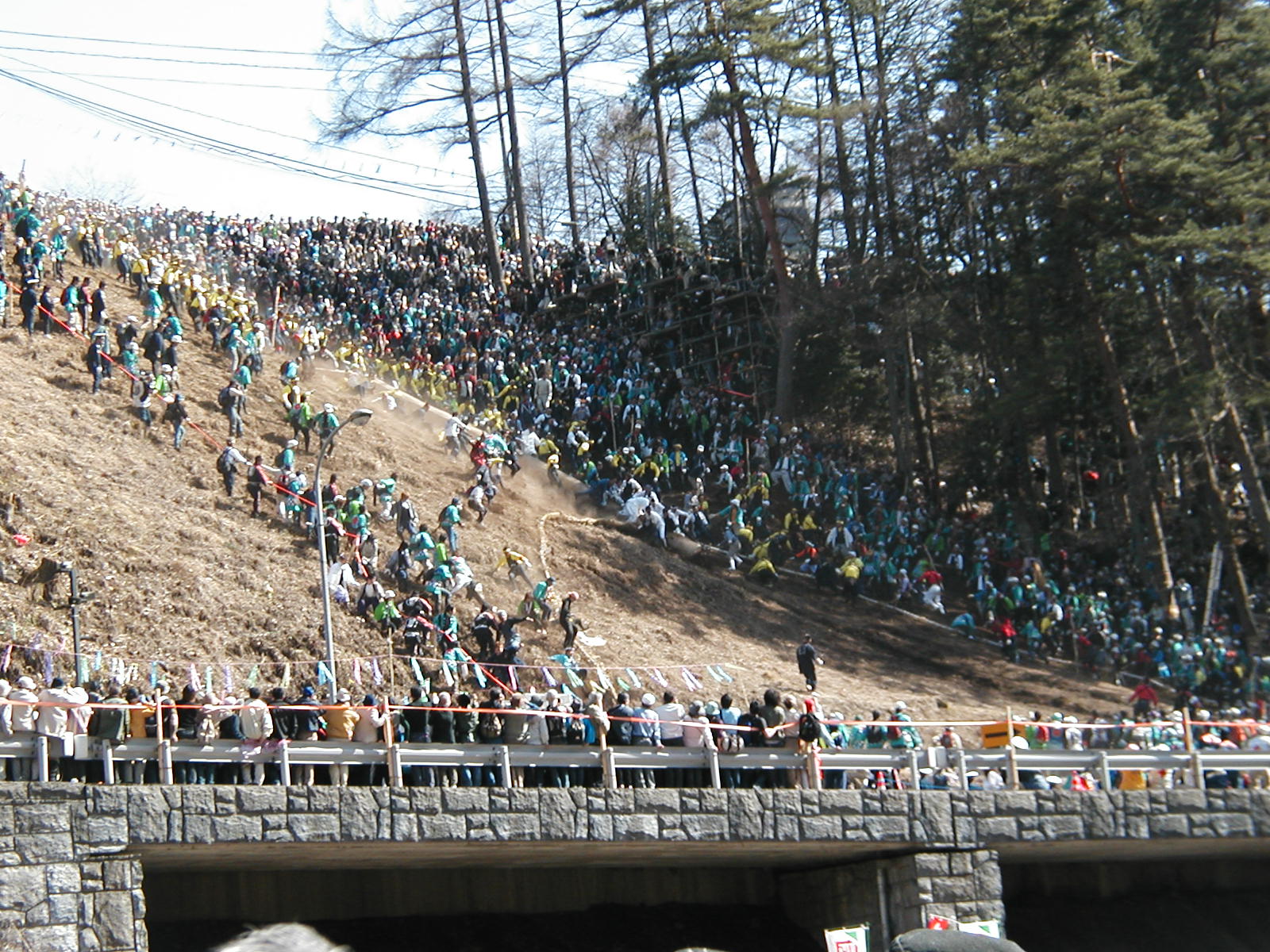
The slope at Shimosuwa — a fir log, a crowd, and 35 degrees
Stand at the bottom of the Kiotoshi (木落し, “dropping the tree”) slope in Shimosuwa in April of a festival year and the first thing you notice is not the log. It is the angle. The official festival site describes the slope used by Suwa Taisha’s Lower Shrine (Shimosha) as about 100 metres long with a maximum inclination of 35 degrees. On a dry day, the bank is bare earth; on a festival day it is lined, top to bottom, with people.
What is coming down the hill
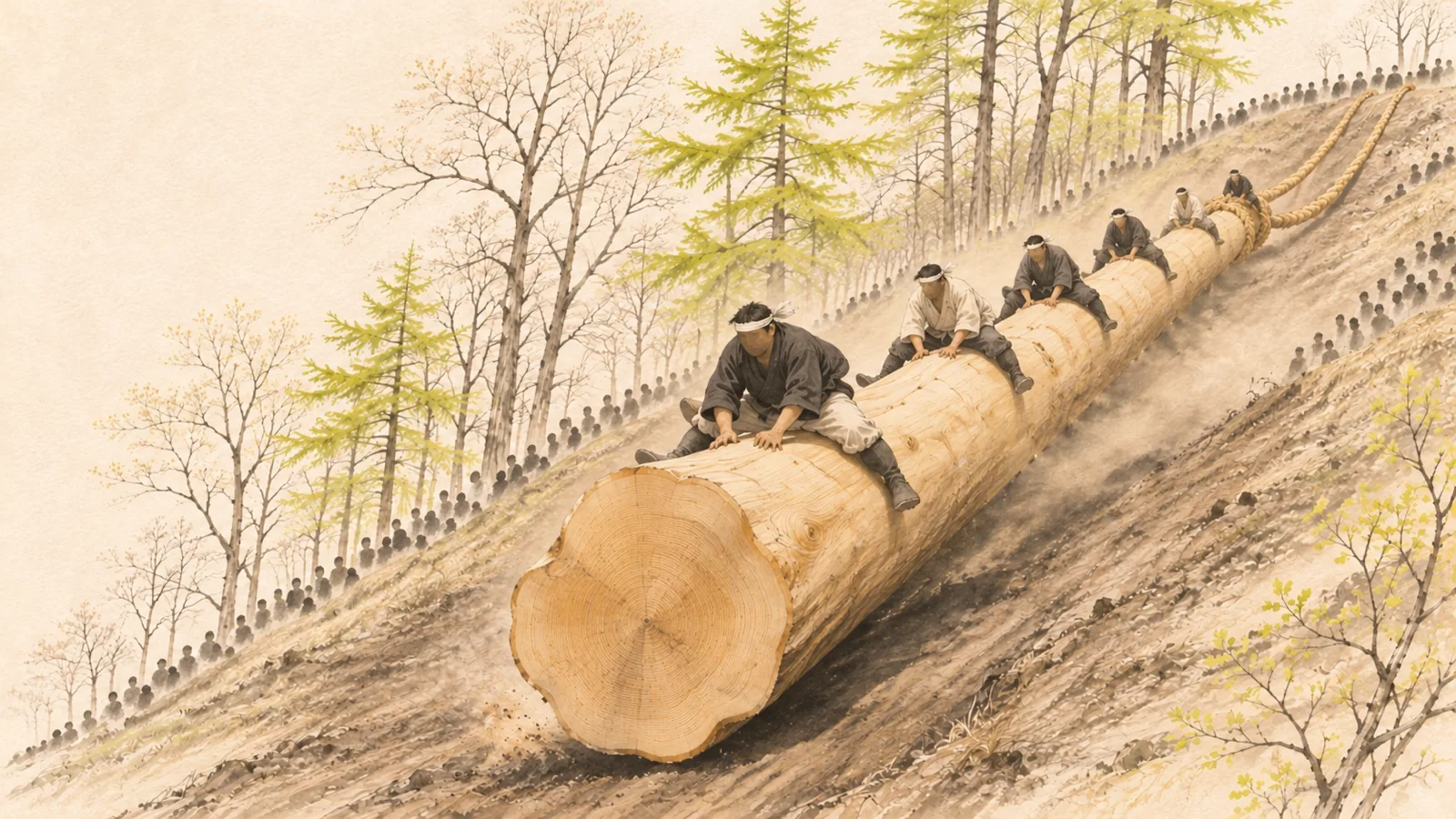
At the top sits a debarked fir log — a pillar-to-be — with young men astride it and ropes running from it back up the hill. Then the log tips over the lip and goes, riders and all.
That descent is the middle of the story. It begins in a forest, with trees that took more than a century to grow.
Sixteen pillars, four shrines — what the firs are for
Suwa Taisha is not one shrine but four. The Upper Shrine (Kamisha) has two sites, Honmiya and Maemiya; the Lower Shrine (Shimosha) has Harumiya and Akimiya. The festival FAQ states that four pillars stand at each site, sixteen in total. The official Japanese name of the whole event is 式年造営御柱大祭 — roughly, “the great festival of the pillars for the periodic rebuilding” — and Suwa Taisha describes the pillars as standing at the four corners of the shrine buildings (社殿の四隅).
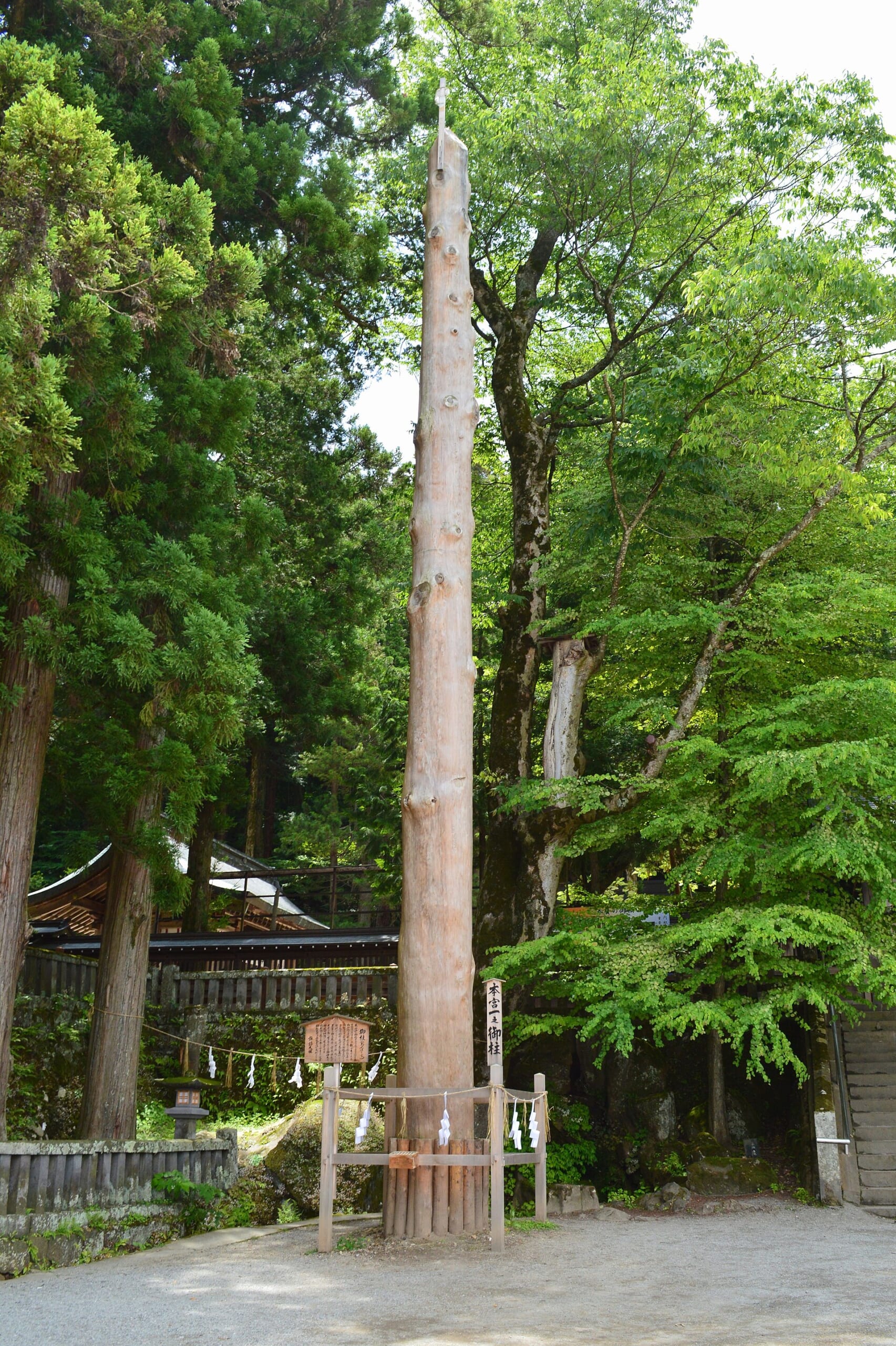
Every Tiger and Monkey year
The Forestry Agency’s Chubu office describes the cycle as “数えで7年目ごとの寅年と申年” — every seventh year by inclusive counting, in the years of the Tiger and the Monkey. In plain arithmetic that is every six years. The previous festival was held in 2022. The official festival website has already announced the next: “西暦2028年 和暦令和十戊申年” — 2028, a Monkey year. If you are reading this in late 2026, there is no Onbashira this year.
How old is the custom?
The festival’s history page is careful here. It names the Muromachi-period Suwa Daimyōjin Ekotoba (諏訪大明神画詞) as the earliest written record, and says plainly that the festival’s origins “are not known in detail” (その起源や由緒などは詳らかでありません). The FAQ mentions the reign of Emperor Kanmu (781–806), but that connection reaches us through the later medieval account, so it is best read as tradition rather than as a record from his reign.
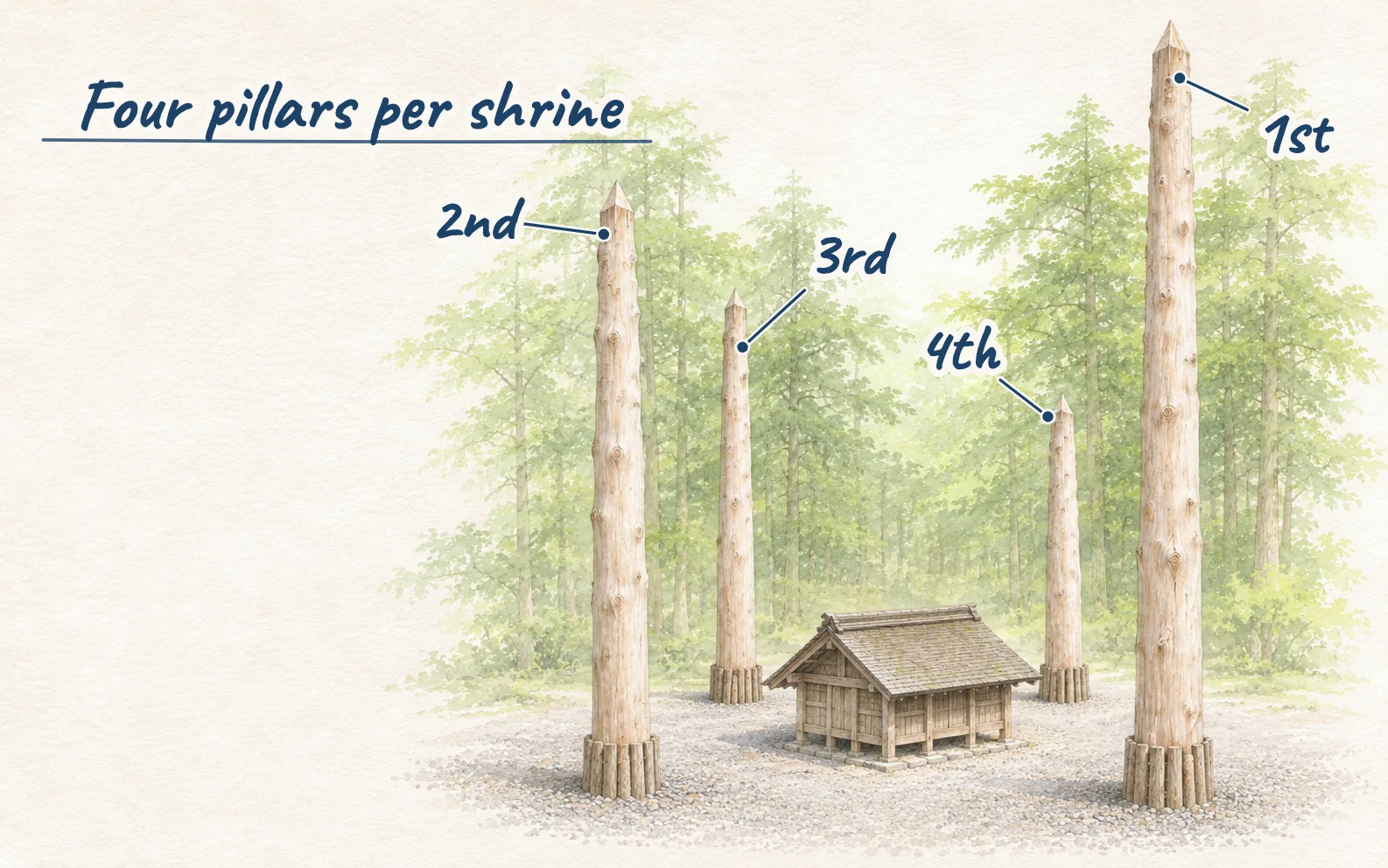
How big is a pillar? The sources disagree
Read the primary sources side by side and the numbers do not match. Shimosuwa Town lists the first pillar as 5 jō 5 shaku and gives its length as 16.5 m (about 54 ft); each following pillar is shorter by 5 shaku, which the town gives as 1.52 m (about 5 ft). The other figures, from the shrine and the festival site, are in the table; the FAQ notes that pillars vary.
| Source | Length | Weight | Diameter |
|---|---|---|---|
| Shimosuwa Town | First pillar 5 jō 5 shaku (16.5 m); each next one 1.52 m shorter | — | — |
| Suwa Taisha | Nearly 17 m (large pillars) | About 13 t | — |
| Festival FAQ | About 19 m | About 7.5 t | About 1 m |
| Festival site, Yamadashi page | — | Shimosha pillars over 12 t | — |
The sources do not explain why their figures differ. What they agree on is the order of magnitude: a single fir log well over ten metres long, weighing many tonnes.
Which fir? Momi, urajiro-momi, and why the species name matters
The festival website calls the timber “モミの大木” — great momi trees. Momi is the Japanese name for Abies firma, and in casual English the pillars are usually described as “fir.” That is correct, but it hides a detail a forester would care about.
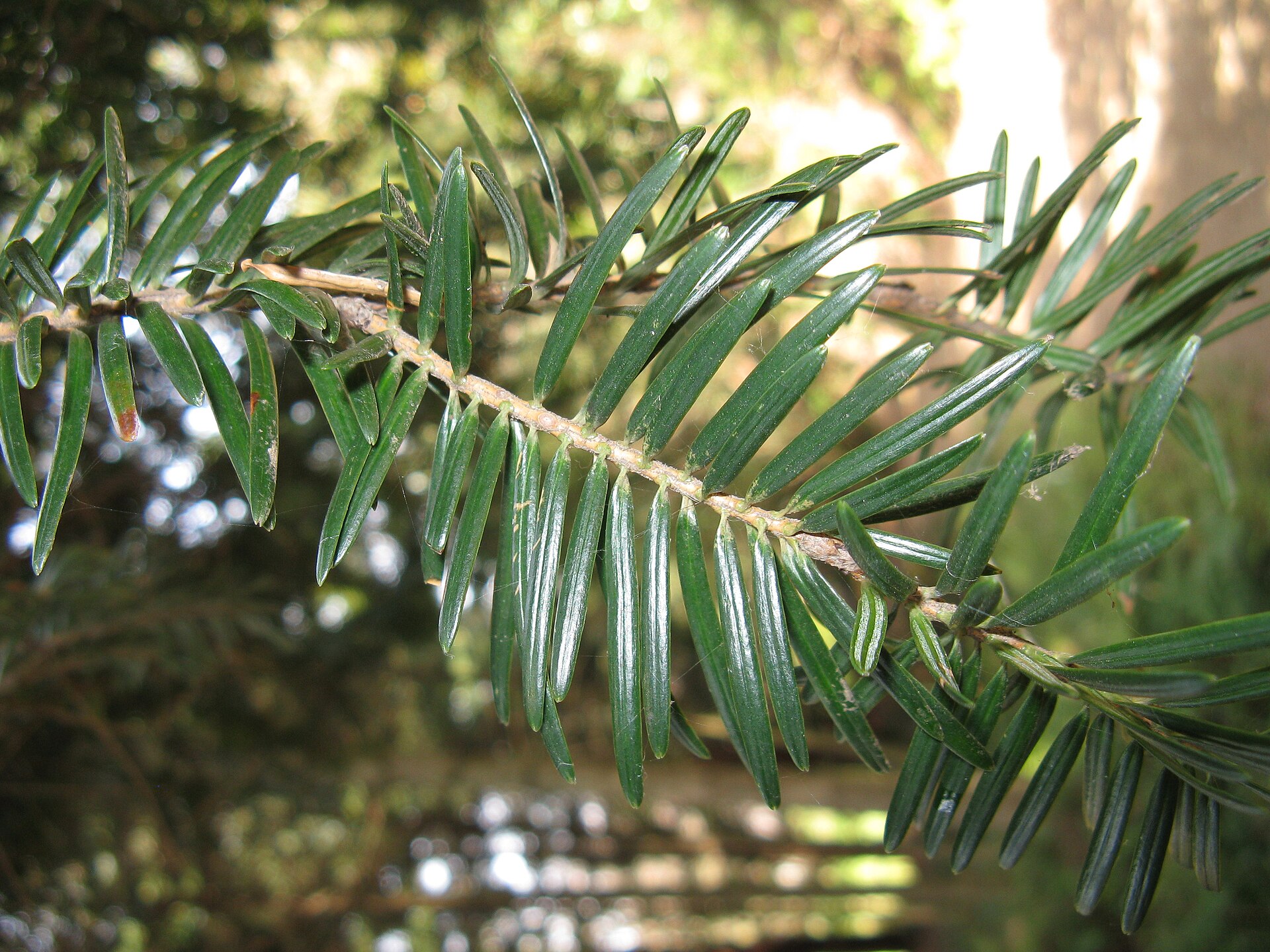
Two firs, not one
A technical report from the Forestry Agency’s Nanshin office, from fiscal 2004, says that “in recent years, urajiro-momi has been used” (近年では、ウラジロモミが使用されています). A Shinshu University publication says that both urajiro-momi and momi (ウラジロモミやモミ) are used. Urajiro-momi is Abies homolepis, the Nikko fir. So “fir” is right in English; a more precise description is that both momi and urajiro-momi have been reported in use.
The two are close relatives with different homes. Urajiro-momi is also endemic to Japan, and the University of Tokyo’s Nikko Botanical Garden places it at roughly 1,000–2,000 m (3,300–6,600 ft) above sea level. The Forestry and Forest Products Research Institute gives the field marks: turn a needle over and two white lines stand out on the underside (葉を裏返すと白い2本線が目立ちます) — urajiro means “white underside” — and the same source notes hairless young twigs as a way to tell it from momi.
What momi is, as a tree
A Japanese Forest Society abstract describes Abies firma as an evergreen conifer of the pine family, “endemic to Japan” (日本固有種). Nara University of Education gives its height as up to 30–40 m (about 100–130 ft). The Forestry and Forest Products Research Institute’s Kansai branch notes that the wood is pale and easy to work, and has been used for boxes and coffins.
None of the sources I found say why fir was chosen for the pillars, so I will not offer a reason. What they do make clear is that both species grow tall and straight, which is the first thing a pillar needs.
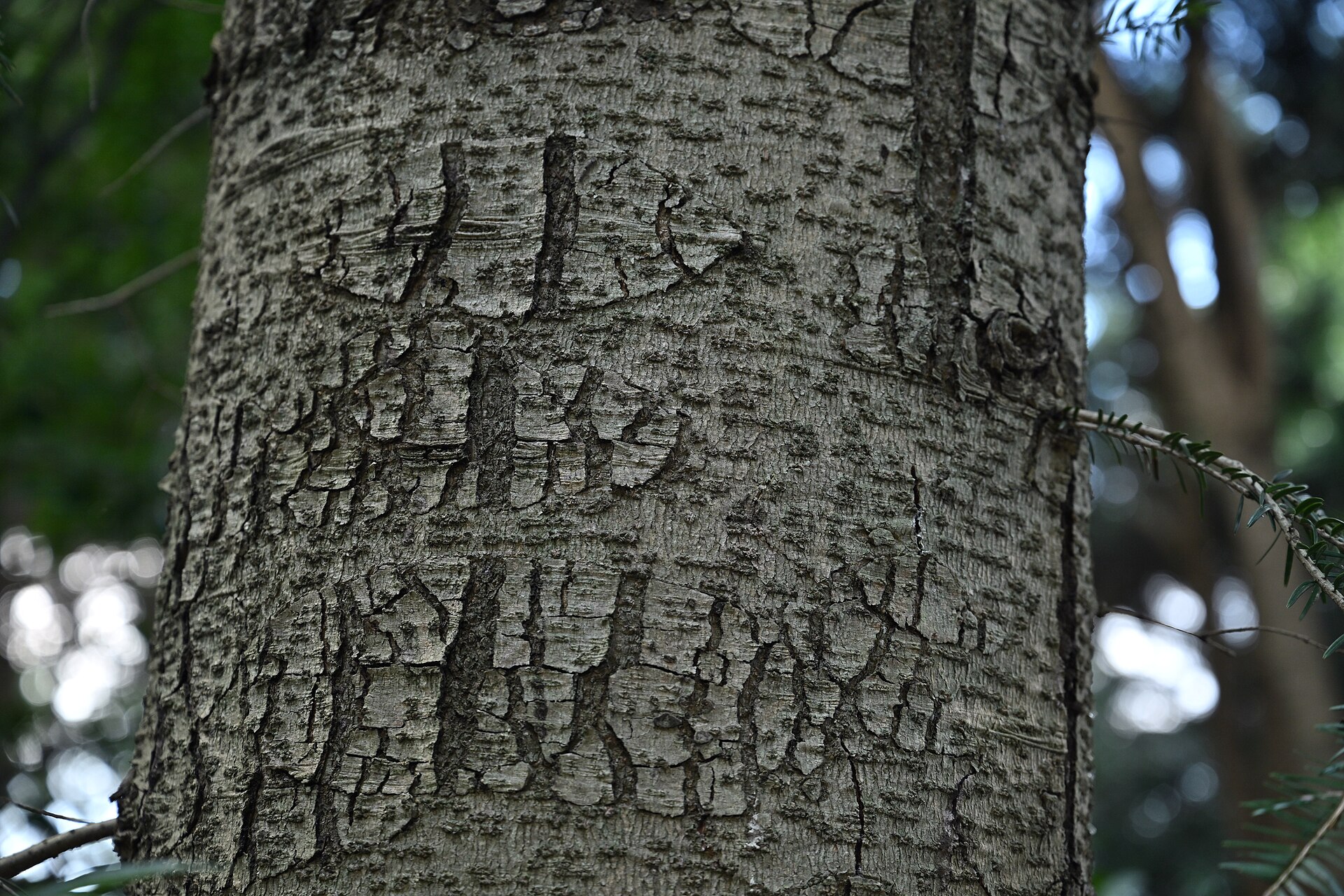
Choosing the tree — years ahead, in the forest
Trees are normally selected well before the festival year. The festival’s interview with the senior parishioner representatives (daisōdai, 大総代) lays out the timetable.
The timetable of mitate
Selection is called mitate (見立て, “seeing and choosing”). At Kamisha, a provisional selection (仮見立て) usually happens two years before the festival and the final selection (本見立て) one year before. At Shimosha the whole process starts a year earlier: provisional selection three years before, final selection two years before.
| Step | Kamisha (Upper Shrine) | Shimosha (Lower Shrine) |
|---|---|---|
| Provisional selection (kari-mitate) | About 2 years before | About 3 years before |
| Final selection (hon-mitate) | About 1 year before | About 2 years before |
| Felling (customary) | March of the festival year | The year before |
| Debarking | Mostly between Yamadashi and Satobiki | At felling, then rested about one year |
| Who hauls which pillar | Lottery on 15 February of the festival year | Fixed in advance; no lottery |
| Traditional timber source | Shrine forest on Mount Okoya (Yatsugatake foothills) | Higashimata National Forest near Kirigamine |
At the Kamisha final selection, Suwa Taisha explains, a sacred nagikama (薙鎌), a sickle-shaped object believed to hold divine spirit, is driven into the chosen tree. From that moment it is recognised as a sacred tree for the festival.
Who walks the forest
The 2028 cycle is already under way. On 18 May 2026, according to the local Shinshu Shimin Shimbun, eight candidate trees for Kamisha were provisionally selected in privately owned forest in the Fujisawa area of Takato, Ina City. The party included shrine priests, daisōdai, and the yamazukuri (山作り) — the forest custodians who have looked after Kamisha’s mountain for generations.
Note where that forest is. It is not Mount Okoya, the shrine’s own forest. Where Kamisha’s pillars come from has moved more than once, which I will come back to.
What makes a pillar tree
An academic study by Shunsuke Ishikawa at Nagoya University describes the requirement simply: the tree must be “upright, with no decay inside” (直立した、内部に腐食のないもの).
Both halves of that sentence are harder than they sound. Upright is easy to judge with the eye, standing back from the trunk. Sound inside is not: internal decay can be present in a trunk that shows little on the outside.
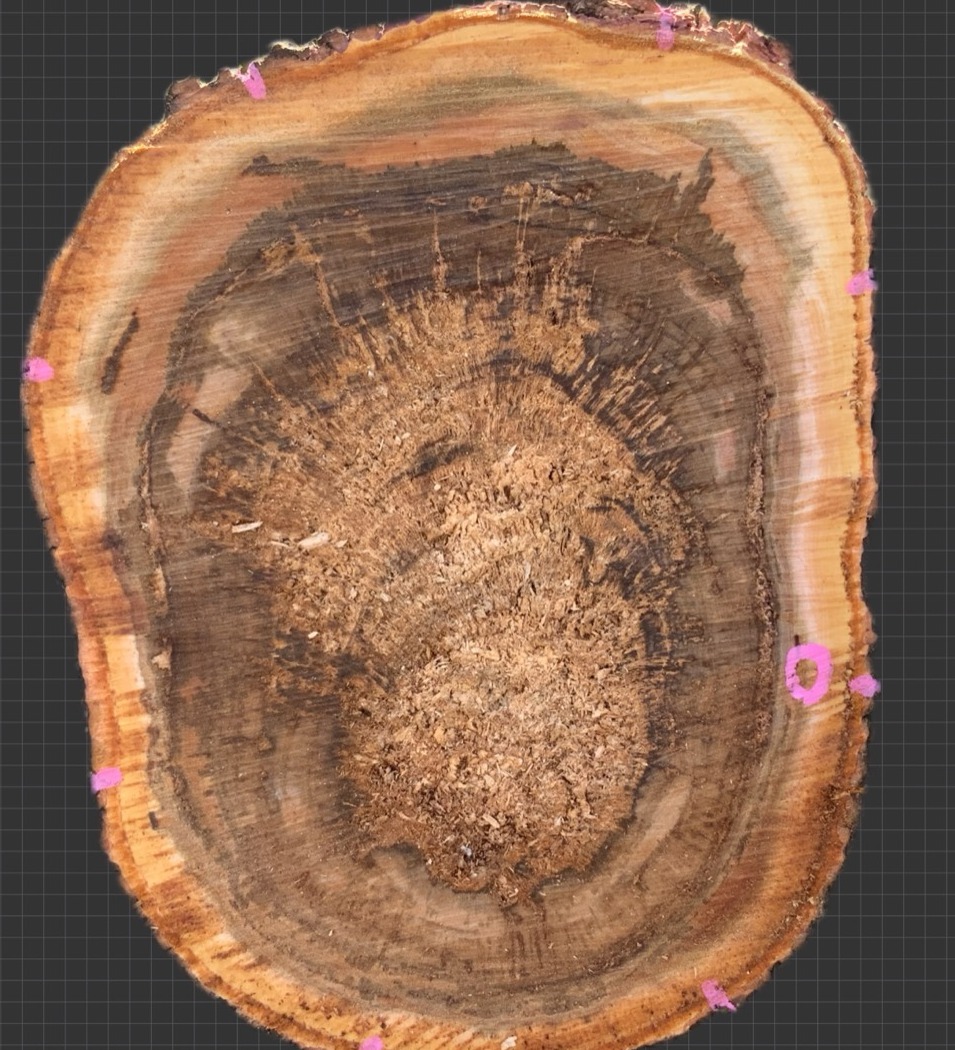
In tree-risk work in Japan, that is a central question: a trunk that looks fine may carry rot inside. The photo above is a cross-section examined at a tree-diagnosis workshop — not a fir, but it shows what “decay inside” means. A pillar with a hidden core of decay would be a dangerous thing to send down a 35-degree slope with people on top, or to raise upright with people climbing it. The sources I found do not say how the selection parties check for internal decay; what is clear is that “no decay inside” is written into the requirement.
Felling — a sacred axe, a chainsaw, and a rope
The first cut belongs to the yamazukuri
Suwa Taisha describes the custom at Kamisha: felling takes place in March of the festival year, and the yamazukuri who have managed Mount Okoya for generations make the first stroke with a sacred axe that has a vermilion handle. A Forestry Agency report on the 2016 festival records the same idea — ritual cuts with a “sacred axe” (神斧) and with a saw before the trees came down. I wrote about the wider custom of purifying a tree before felling it in Why Japan Blesses a Tree Before Cutting It Down.
When tradition meets snow
The customary calendar is not a rule of nature. For the 2016 Kamisha festival, the same Forestry Agency report records that felling was brought forward to September–October 2015, because winter snow and freezing would make work on the steep slopes of Yokokawa National Forest too difficult (冬期は降雪及び凍結により作業が困難). The customary schedule was adjusted to avoid snow and freezing conditions.
Chainsaws and directional felling
For the 2022 festival, Shimosha’s eight trees were felled in 2021. The Forestry Agency’s regional magazine reports that chainsaws were used to shorten time on site, as a COVID-19 precaution (感染防止対策として、チェンソーを使用し).
The most useful description of the felling itself comes from Ishikawa’s field study of the 2010 Kamisha felling. He records a directional notch (受け口) on the side the tree is to fall, a back cut (追い口) from the other side, wedges, and a rope tied high on the stem and pulled by parishioners to guide the fall (用材の上部にはロープが結ばれており).
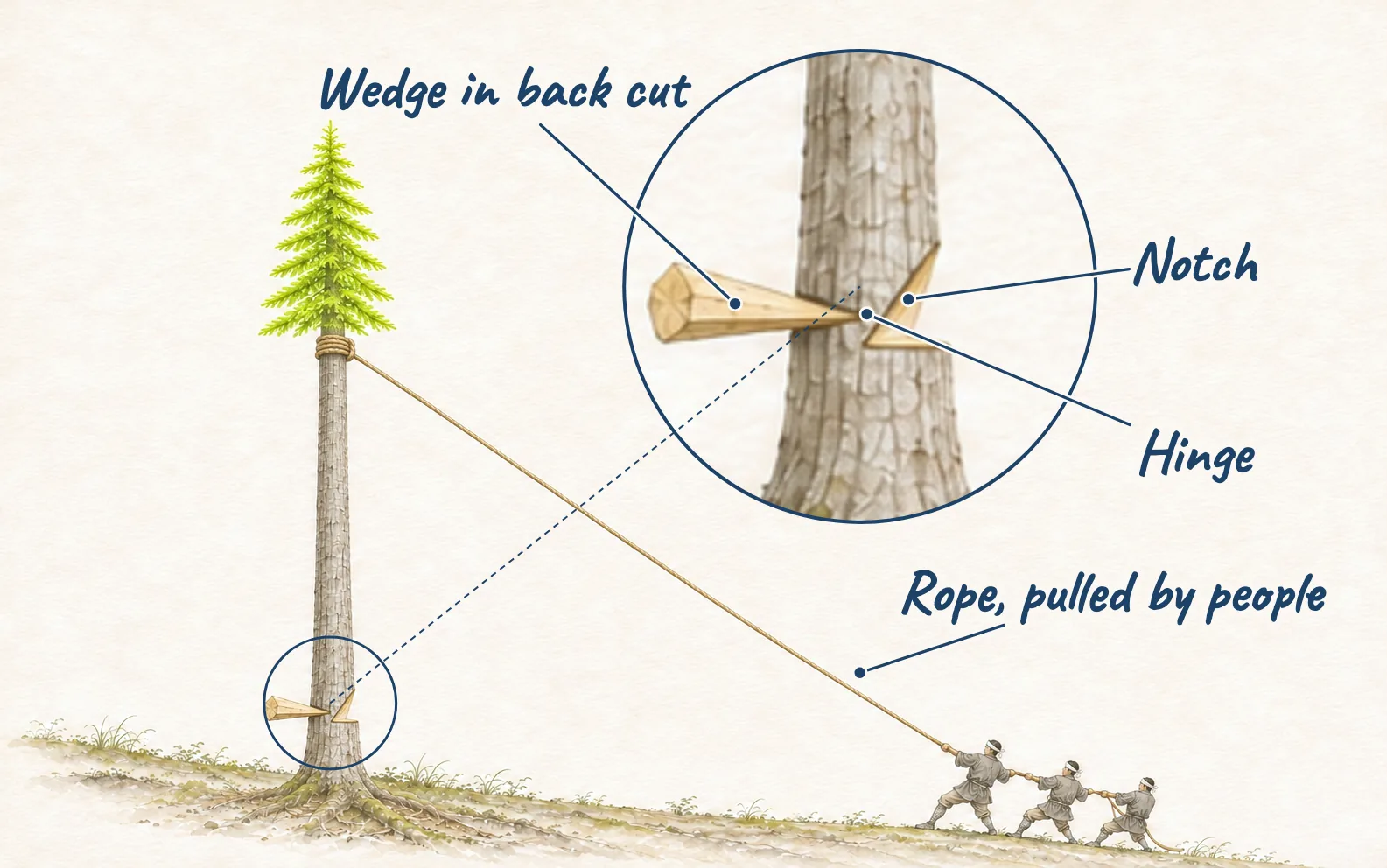
Why the fall matters
Notch, back cut, wedges, a pulling rope: these are the elements of directional felling that arborists and forest workers learn everywhere, including in Europe and North America. What stands out at Onbashira is the reason the fall must be controlled. Damage on impact can make a tree unusable as a pillar. Ishikawa makes exactly this point: “even if there is no rot, the tree may be damaged by the shock of felling” (たとえ腐りがなくても、伐採の衝撃で損傷する可能性もある). Guiding a tall fir onto a slope as gently as possible is the first act of preserving it.

Getting the log out of the forest
What happens between the stump and the festival route is less romantic. For the 2016 Kamisha timber, the Forestry Agency report records that yarders and grapples (集材機及びグラップル等) brought the logs up to the forest road. Machines handle the stretch no one sees; parishioners then take over the hauling.
Debarking and resting — the log waits
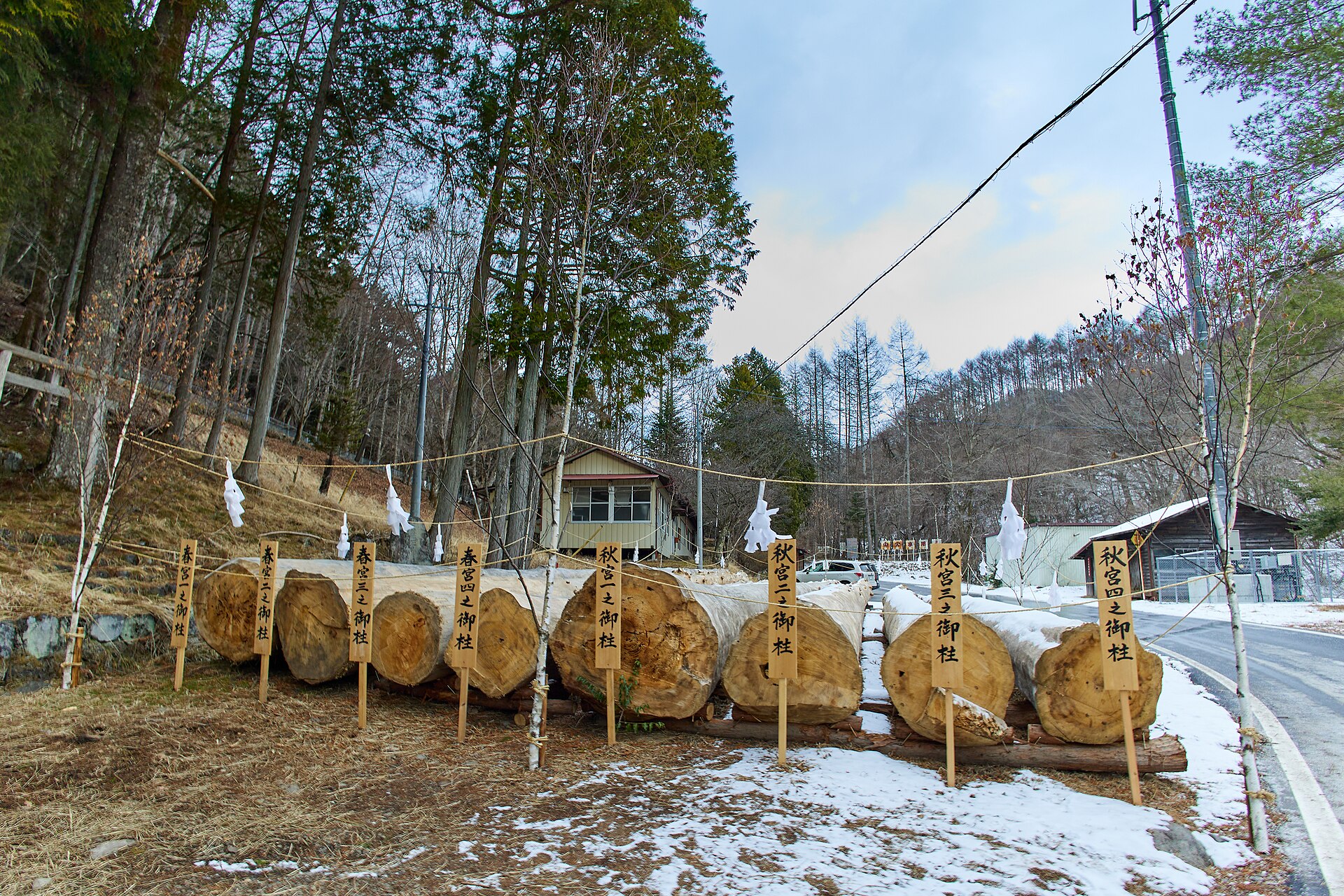
Shimosha: debark, then rest a year
At Shimosha, the daisōdai interview says, the felled trees are debarked and left to rest for about a year (皮を剥いて約1年間寝かします). The photo below shows exactly that stage: eight logs for the Harumiya and Akimiya pillars, lying in their storage yard at the end of December 2021, waiting for the 2022 festival.
Kamisha: bark comes off on the road
Kamisha is different. The festival FAQ explains that its logs are generally debarked between Yamadashi (the mountain hauling in April) and Satobiki (the village hauling in May), with exceptions for the Konami and Nakasu districts. So most Kamisha logs make their ride down the mountain still wearing bark.
The sources do not explain why the two shrines differ.
Yamadashi — the mountain run
Yamadashi (山出し, “out of the mountain”) is the April stage, when parishioners haul the logs from the forest edge toward the shrines. It contains the two scenes everyone has seen.
Kiotoshi — riding the drop
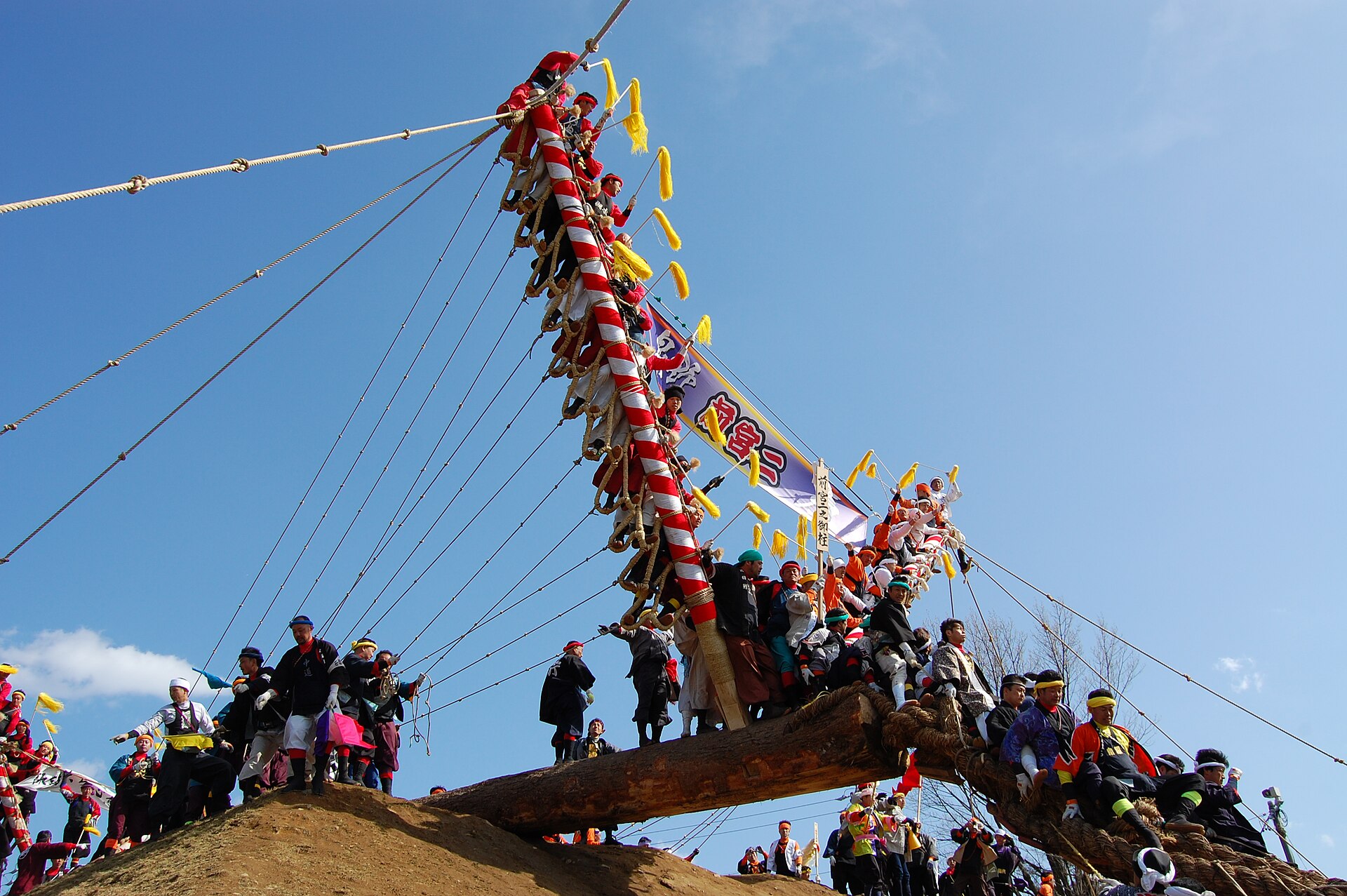
The Shimosha Kiotoshi slope, as noted, is about 100 m long with a maximum gradient of 35 degrees. Kamisha has its own descent, at what is now Kiotoshi Park in Chino City, on a slope the official site gives as 27 degrees. Kamisha pillars carry medodeko (目度梃), long timber “horns” fixed to front and rear, and the official site describes the pillar going down the slope with many young men still riding them. The festival FAQ is explicit that Shimosha pillars have no medodeko. So the two styles are easy to tell apart in photographs: Shimosha riders sit on the log itself; Kamisha riders cling to the horns.
Kawagoshi — washing the log in snowmelt
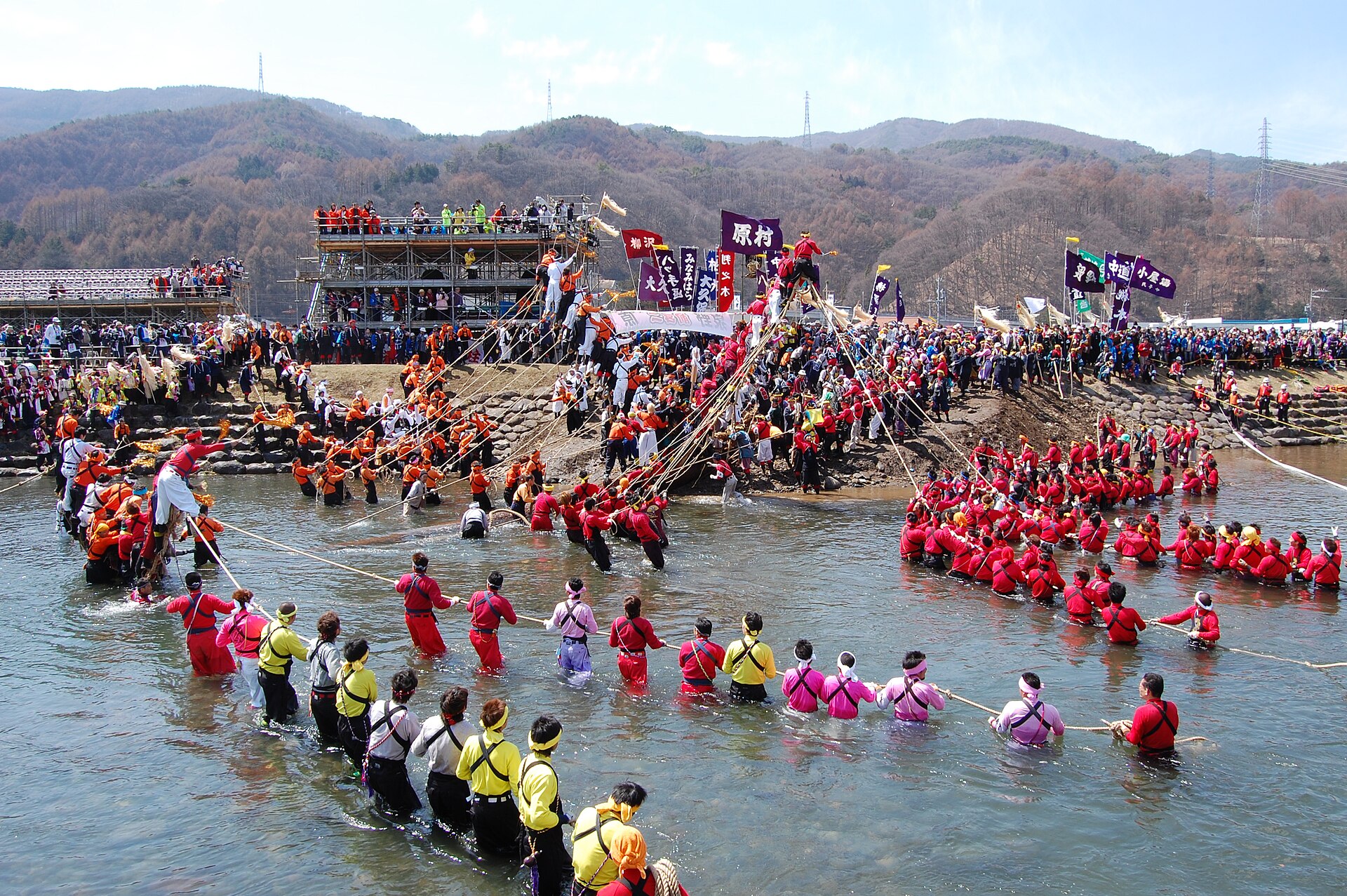
Kamisha’s pillars then cross the Miyagawa River. The official site describes this Kawagoshi (川越し, “river crossing”) as purifying the pillars in the river’s snowmelt water (宮川の雪解け水で洗い清める). For the log, it is a passage through cold river water after its descent.
2022 — the year the trees went by truck
In 2022, with COVID-19 still circulating, the festival changed something it had never changed. Chino City’s official page reports that Kamisha’s Yamadashi used trailers for the first time instead of human hauling (初めてトレーラーでの搬送となりました). The official 2022 attendance release records that Shimosha’s Yamadashi was also done by vehicle, over two days.
The same release gives the 2022 crowd: 99,500 parishioners and 74,500 spectators, 174,000 in total. The release counts attendance, not tourists. Suwa Taisha itself speaks of a parishioner community of 200,000 people across the Suwa region.
Satobiki and raising — the tip is cut, the pillar goes up
Satobiki (里曳き, “village hauling”) takes place in May, when the pillars are drawn through the towns to the shrines in procession.
Kanmuri-otoshi — giving the pillar its point
Before a pillar is raised, its top is cut into a triangular pyramid. The official Satobiki page calls this kanmuri-otoshi (冠落とし, “dropping the crown”) and describes it as cutting the tip into a triangular-pyramid shape (先端を三角錐状に切り落として). It is a separate operation from debarking. You can see the result on every standing pillar: a sharp, three-faced point instead of a flat saw cut.
Tate-onbashira — raising by hand
Then comes Tate-onbashira (建御柱), the raising. At Kamisha, the official site says, the pillars are pulled upright gradually by human power, using wire cables and ropes (ワイヤーやロープを使い、人力で). Parishioners ride the pillar as it rises.
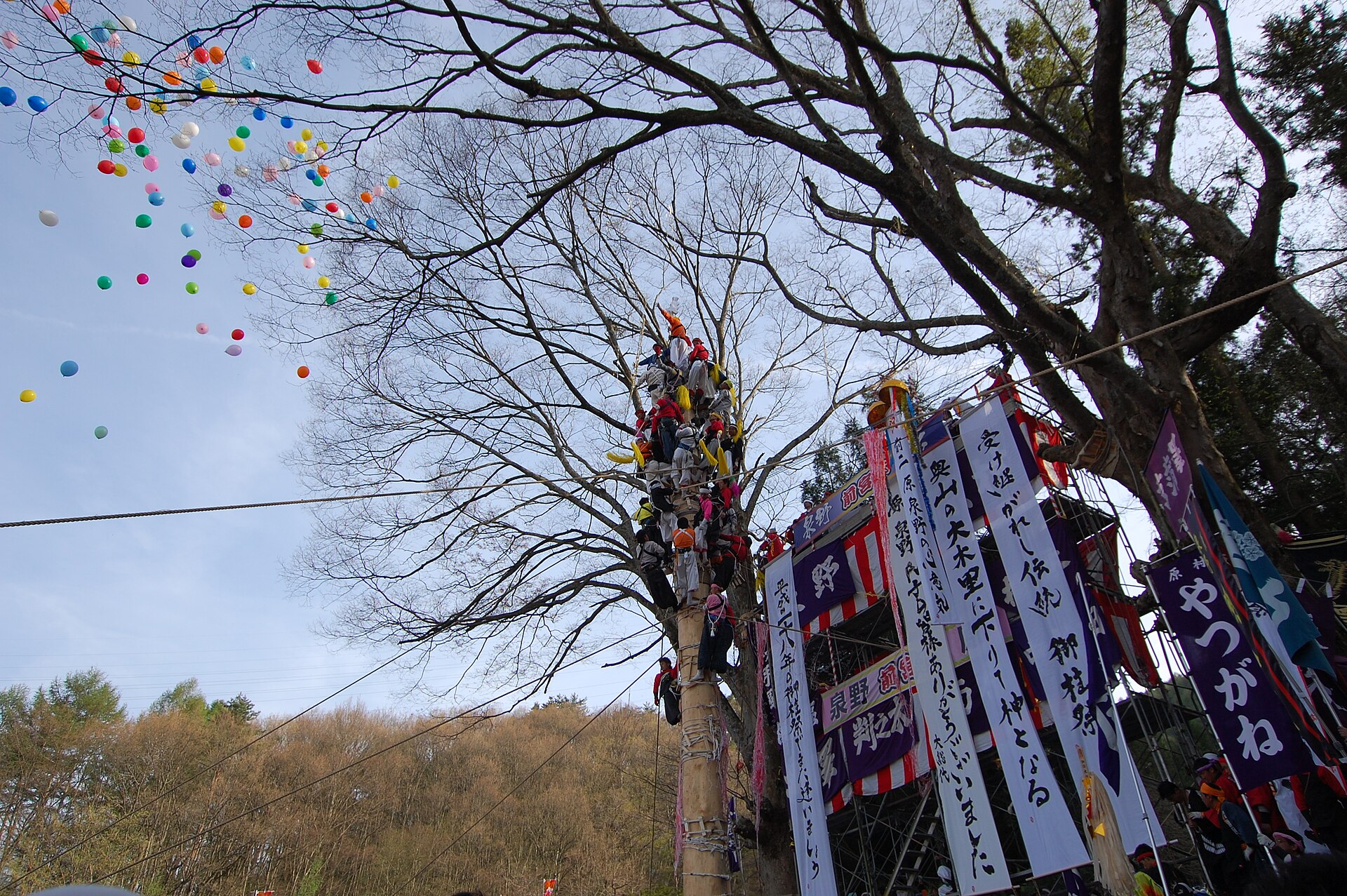
There are risks here too. On 8 May 2010, during the Tate-onbashira, three parishioners fell from a pillar and two died, as J-CAST News later reported. That was a raising accident, not a Kiotoshi accident — a distinction worth keeping, since the slope gets most of the attention.
Six years standing — what the pillar does, and what we do not know
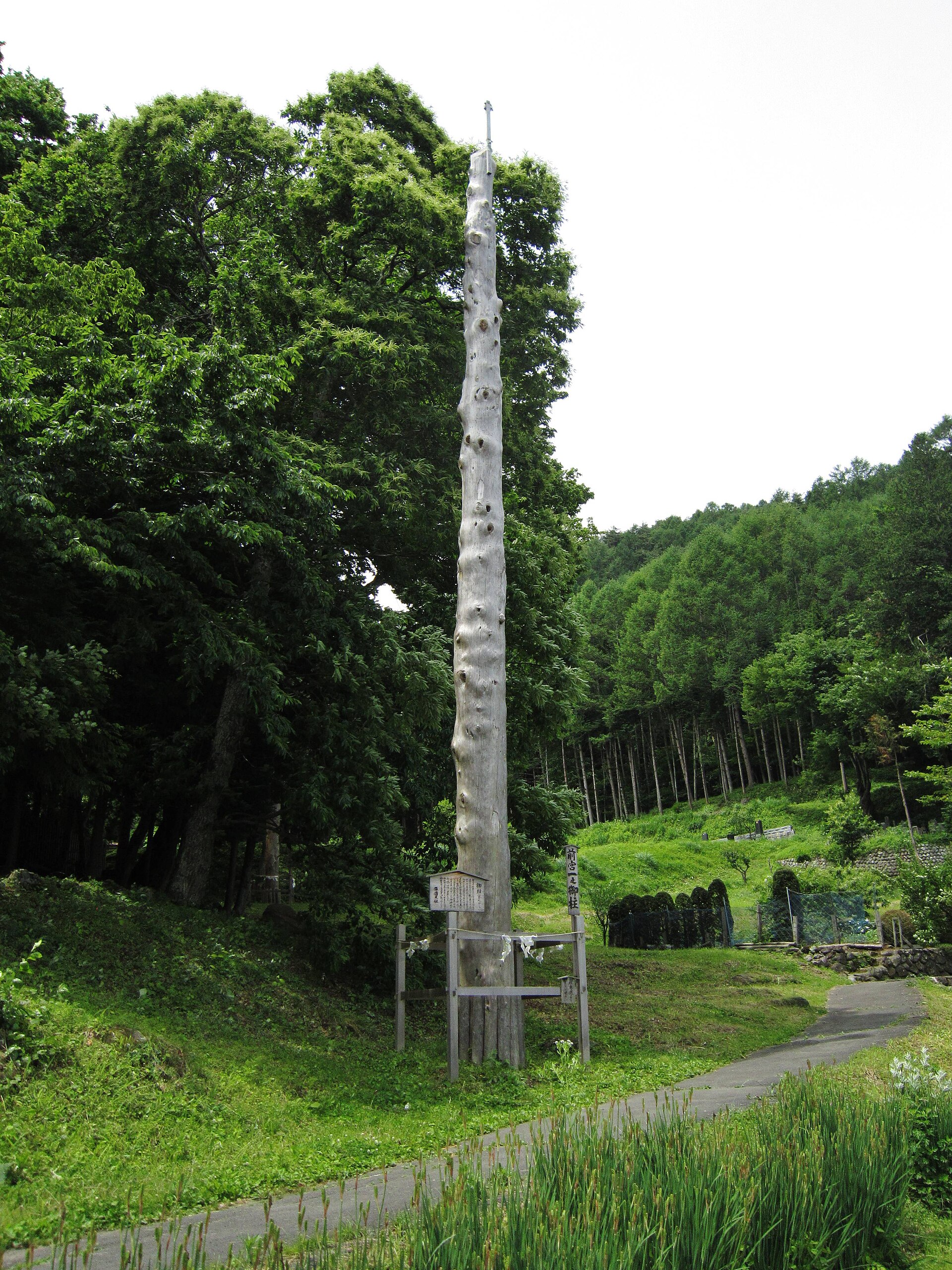
Once raised, a pillar stands for six years at the corner of the sanctuary. It is tempting to say that the pillars are replaced because they rot. I looked for a published study that tracks the condition of standing Onbashira pillars — decay, checking, drying, treatment — and did not find one. So I will not claim that the six-year cycle is a technical replacement interval. It is a ritual interval.
Europe has a close cousin to this rhythm. In Bavaria, villages raise a Maibaum (maypole) — Munich’s official city portal describes a spruce or fir being limbed and debarked for it (Die Fichte oder Tanne wird entastet und entrindert). The municipality of Ismaning describes its church-square maypole as a little over 30 m tall and replaced on schedule every five years, with occasional exceptions. Two cultures, both taking a tall conifer, stripping it, standing it in the middle of the community, and replacing it on a cycle of a few years. In both cases, the sources describe the cycle as a custom; neither gives decay as the reason.
If I were inspecting a debarked log standing in the open, the base, where it meets soil and moisture, is where I would look first. That is my working habit with wooden posts, not an observation of these pillars.
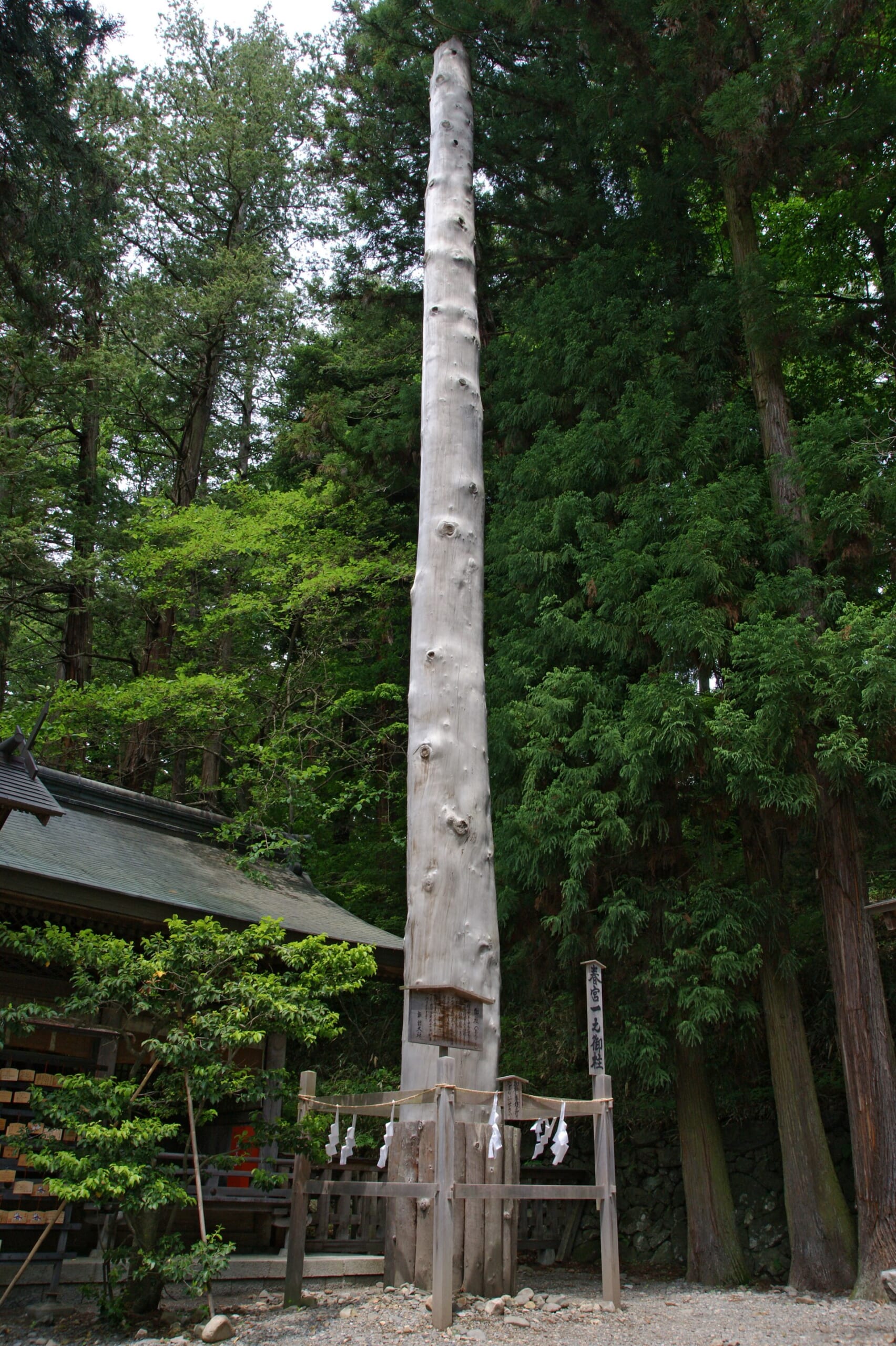
Onbashira-yasume — where the old pillars go
The end of a pillar’s life is the least-photographed part of the story.
Taking the pillars down
At Kamisha, the festival’s interview with those responsible explains that the Nakakaneko district takes down the old pillars and carries them away as part of Onbashira-yasume (御柱休め, “resting the pillars”). A ritual at a shrine named 八立神社, they say, returns the old pillars to “ordinary wood” (普通の木に戻ります) before they are passed on.
What the wood becomes
The same interview says that, historically, retired pillars were used locally as material for the district’s storehouse and for bridge repairs. The festival FAQ adds that the wood of old pillars is made into Suwa Taisha amulets (お守り) and nameplates (表札).
| What the old pillar became | Source |
|---|---|
| Material for a district storehouse (historically) | Festival site, Onbashira-yasume interview |
| Bridge repair timber (historically) | Same |
| Shrine amulets | Festival FAQ |
| Nameplates | Festival FAQ |
There is something quietly practical about that list. A pillar that was a sacred tree for six years becomes ordinary timber again — historically, material for a storehouse or a bridge repair; today, shrine amulets and nameplates.
Growing the next pillars — the forest side of the festival
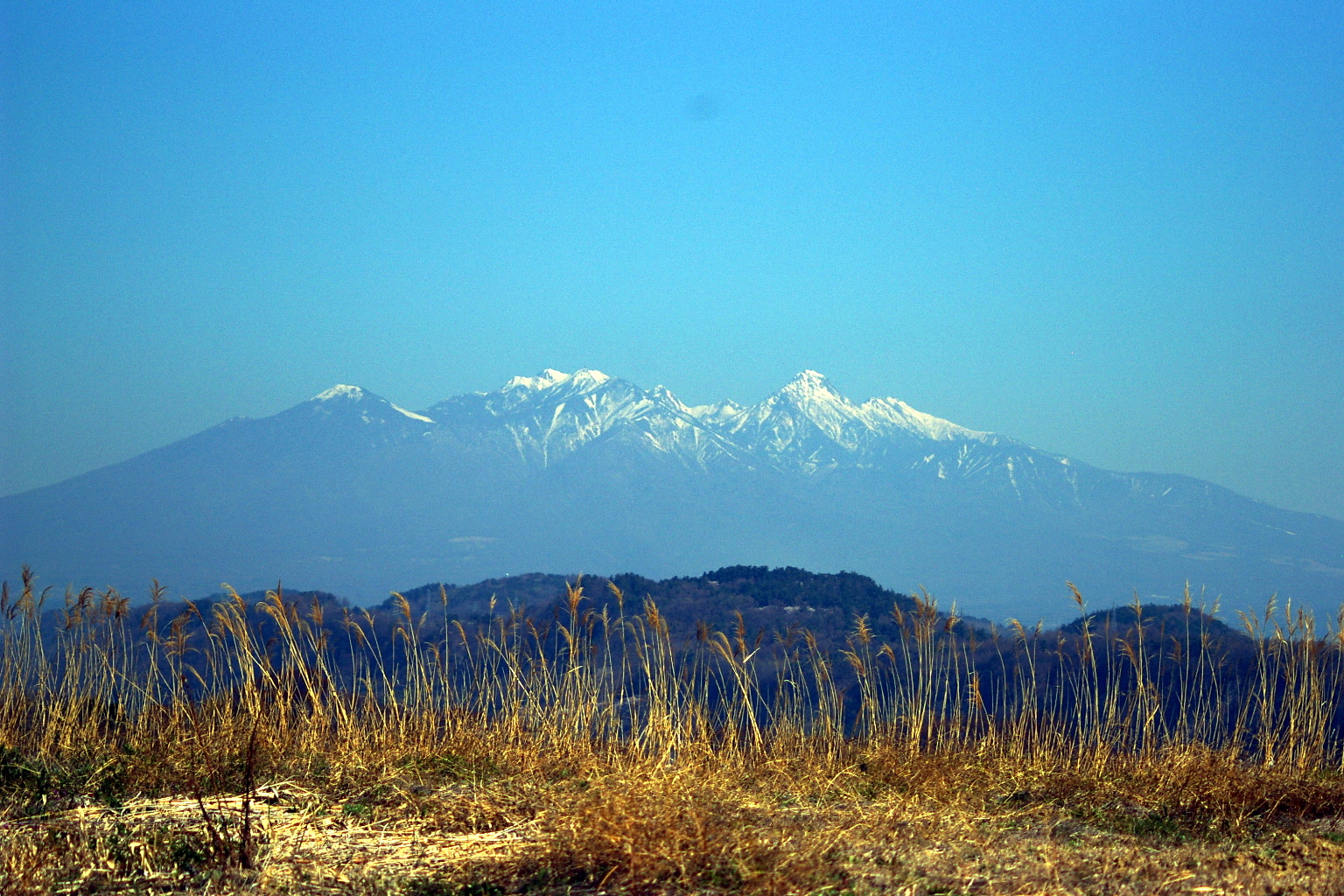
Mount Okoya — thirty years away, and back
Suwa Taisha names Kamisha’s traditional timber source as the shrine-owned forest on Mount Okoya (御小屋山), in the Yatsugatake foothills. A study published by the Chino City Yatsugatake Museum records that the upper part of that forest was devastated by the Isewan Typhoon on 26 September 1959 and has since recovered naturally, and that during a December 2013 visit there was thinning under way “to grow pillar timber” (御柱用材育成の間伐). A Forestry Agency report connects the same typhoon’s windthrow to the difficulty of finding suitable trees there.
Ishikawa’s study states the problem plainly: securing fir timber suitable for Kamisha pillars became difficult (御柱となる樅の用材の確保が困難). His thesis and the Forestry Agency’s records let you trace where Kamisha’s pillars came from instead:
| Festival | Source of Kamisha’s pillar timber | Source |
|---|---|---|
| Up to 1992 | Mount Okoya (shrine forest) | Ishikawa thesis |
| 1998 | Higashimata National Forest | Nanshin Forest Management Office |
| 2004 | Tateshina Town municipal forest | Ishikawa thesis |
| 2010 | Municipal and national forests in Tateshina Town | Ishikawa thesis |
| 2016 | Yokokawa National Forest, Tatsuno Town | Chubu Regional Forest Office |
| 2022 | Mount Okoya — all eight pillars, “for the first time in 30 years” | Chino City mayor’s address, June 2022 |
| 2028 | Candidates provisionally chosen in a private forest in Takato, Ina City | Shinshu Shimin Shimbun, May 2026 |
The 2022 line is the one I find moving. Chino City’s mayor, opening the city assembly in June 2022, spoke of “eight pillars cut from Mount Okoya for the first time in 30 years” (30年ぶりに御小屋山から切り出された8本の御柱). From 1998 to 2016 Kamisha’s pillars came from other forests; in 2022 all eight came home to Mount Okoya. For 2028, the provisional choice is in a private forest in Ina City.
A tree that takes a century and a half
Ishikawa writes that a tree suitable for a pillar is considered to be 150 to 200 years old (用材として妥当な木は、樹齢150~200年とされる), which is exactly why replacing them is hard. The Forestry Agency’s Chubu office gives the time needed to grow usable pillar timber as 100 to 150 years. The festival’s own pages say 150 years (homepage) or around 200 years (FAQ). These are not measurements of every tree; they are a sense of scale.
The local paper’s reports on the 2022 timber give a sense of girth. Before the festival, the Honmiya and Maemiya first-pillar logs were each reported at 18.2 m long with a circumference of about 3 m at eye level; at Shimosha, the Akimiya first-pillar log measured 3.62 m round and the Harumiya first-pillar log 3.33 m.
That is why this festival is a forestry problem as much as a cultural one. A six-year ritual needs sixteen trees of a kind that typically takes a century or more to grow, and the forest that supplies them must be managed on the scale of the tree, not the festival. I wrote about why some Japanese trees reach great age in Why Do Japan’s Ancient Trees Live for a Thousand Years?
Onbashira no Mori — a national forest set aside for pillars
Shimosha’s pillars come from Higashimata National Forest near Kirigamine, which belongs to the state rather than the shrine. For the 2022 festival, the Forestry Agency reports, eight pillars were cut there, and fir seedlings were then planted where the timber had been felled.
Part of that forest has a name. The Forestry Agency’s Chubu office lists Onbashira no Mori (御柱の森, “the Onbashira forest”) in Higashimata, Shimosuwa Town: 383.46 hectares (about 950 acres), under an agreement that began on 26 November 2002 between the Nanshin Forest Management Office and a local council for building the Onbashira forest (御柱の森づくり協議会). On 16 May 2004 that council planted 700 large fir seedlings there. The agency’s 2016 white paper adds that the work includes maintaining netting against browsing animals (食害防止ネットの整備).
A second, smaller forest followed: Onbashira no Kokoro o Tsunagu Mori (御柱の心をつなぐ森, “the forest that carries the spirit of Onbashira forward”), 14.36 hectares in Yokokawa National Forest — the same forest that supplied Kamisha in 2016 — under an agreement dated 2015. Both are described as including the planting of momi.
| Forest | Location | Area | Agreement from |
|---|---|---|---|
| Onbashira no Mori | Higashimata National Forest, Shimosuwa | 383.46 ha | 26 Nov 2002 |
| Onbashira no Kokoro o Tsunagu Mori | Yokokawa National Forest, Tatsuno | 14.36 ha | 2015 |
What this means for a festival in 2028 — and 2128
Netting against browsing is the detail I would underline. A fir seedling planted after the 2022 felling may take, by the Forestry Agency’s estimate, 100 to 150 years to reach pillar size, and it will not get there at all if animals eat it while it is still knee-high. The quiet work that keeps Onbashira alive is the work of keeping seedlings alive.
The same long horizon shapes other sacred forests in Japan. Meiji Jingu’s forest in Tokyo was planted by hand on a long-range plan, which I described in Meiji Jingu Forest: Planted by Hand on a Century-Long Plan. Onbashira shows a different purpose for the same long-range thinking: forests, in several places, managed to keep supplying suitable pillar trees for a ritual held every six years.
Frequently asked questions
When is the next Onbashira festival?
The next festival is in 2028, a Year of the Monkey. The official festival website has announced it as “西暦2028年.” Onbashira is held every Tiger and Monkey year, six years apart; the previous one was in 2022. Yamadashi is normally in April and Satobiki in May; check the official site for exact dates.
What kind of tree is used for the Onbashira pillars?
Fir. The festival calls them great momi trees (Abies firma, a fir endemic to Japan). A Forestry Agency report notes that urajiro-momi (Abies homolepis, the Nikko fir) has been used in recent years, and a Shinshu University publication says both species are used.
How big are the pillars?
Sources differ: Shimosuwa Town gives the first pillar’s prescribed length as 16.5 m, Suwa Taisha says nearly 17 m and about 13 tonnes, and the festival FAQ says about 19 m and 7.5 tonnes. All agree on a whole tree, many tonnes.
What happens to the old pillars?
At Kamisha, the old pillars are taken down and ritually returned to ordinary wood before reuse. Historically the wood went into a district storehouse and bridge repairs; today it also becomes shrine amulets and nameplates.
Where do the trees come from?
Traditionally, Kamisha’s from the shrine forest on Mount Okoya in the Yatsugatake foothills, and Shimosha’s from Higashimata National Forest near Kirigamine. In practice Kamisha’s source has moved: other forests supplied it from 1998 to 2016, Mount Okoya supplied all eight pillars in 2022 for the first time in 30 years, and the 2028 candidates were provisionally chosen in a private forest in Ina City.
Sources
– Onbashira official website (諏訪地方観光連盟), “About Onbashira,” “History,” “FAQ,” “Yamadashi,” “Satobiki,” daisōdai interview, Onbashira-yasume interview, next-festival notice, 2022 attendance release — https://onbashira.jp/ (checked 2026-11-06) – Suwa Taisha, 式年造営御柱大祭 — https://suwataisha.or.jp/events/onbashira/ (checked 2026-11-06) – Shimosuwa Town, 諏訪大社の御柱祭 — https://www.town.shimosuwa.lg.jp/www/contents/1001000000739/index.html (checked 2026-11-06) – Chino City, 上社山出し ムービー (2022) — https://www.city.chino.lg.jp/site/2022onbashira/onbashira-movie-yamadashi.html (checked 2026-11-06) – Forestry Agency Chubu Regional Forest Office, 森林資源の循環利用と御柱祭 (12 December 2022) — https://www.rinya.maff.go.jp/chubu/koho/mailmaga/backnumber/R4/1212.html (checked 2026-11-06) – Forestry Agency Chubu Regional Forest Office, 技術と普及の窓 No. 7 — https://www.rinya.maff.go.jp/chubu/gijyutu/pdf/gigutsufukiunana.pdf (checked 2026-11-06) – Forestry Agency Chubu Regional Forest Office, 中部の森林 June 2021 — https://www.rinya.maff.go.jp/chubu/koho/koho_si/attach/pdf/r03-3.pdf (checked 2026-11-06) – Nanshin Forest Management Office, 地域伝統文化を支える森づくり — https://www.rinya.maff.go.jp/chubu/gijyutu/pdf/pdf/h16_058.pdf (checked 2026-11-06) – Forestry Agency, FY2016 Annual Report on Forest and Forestry, Case V-16 — https://www.rinya.maff.go.jp/j/kikaku/hakusyo/28hakusyo_h/all/chap5_5.html (checked 2026-11-06) – Forestry Agency, 木の文化を支える森 — https://www.rinya.maff.go.jp/j/kokuyu_rinya/kokumin_mori/katuyo/kinobunka_kojimori/kibunka.html (checked 2026-11-06) – Ishikawa Shunsuke, 諏訪大社御柱祭の文化人類学的研究 (doctoral thesis), Nagoya University — https://nagoya.repo.nii.ac.jp/record/19521/files/k10906_thesis.pdf (checked 2026-11-06) – Ishikawa Shunsuke, 「伝統行事」を支えるプロセス — https://nagoya.repo.nii.ac.jp/record/21124/files/41-8.pdf (checked 2026-11-06) – Chino City, mayor’s opening address to the June 2022 city assembly — https://www.city.chino.lg.jp/site/mayorroom/20220602.html (checked 2026-11-06) – Chino City, 木落し公園 — https://www.city.chino.lg.jp/soshiki/toshikeikaku/1406.html (checked 2026-11-06) – Suwa Taisha, 上社本宮 — https://suwataisha.or.jp/about/miyamori/kamishahonmiya/ (checked 2026-11-06) – Chubu Regional Forest Office, 木の文化を支える森 (list) — https://www.rinya.maff.go.jp/chubu/sidou/kinobunkawosasaerumori.html (checked 2026-11-06) – Chubu Regional Forest Office, 中部の森林 June 2004 — https://www.rinya.maff.go.jp/chubu/koho/koho_si/attach/pdf/h19-22.pdf (checked 2026-11-06) – University of Tokyo Nikko Botanical Garden, ウラジロモミ — https://nikko-bg.jp/nikko-old/5_jokyo/species/Abies_homolepis.html (checked 2026-11-06) – Forestry and Forest Products Research Institute, Shikoku Research Center, ウラジロモミ — https://www.ffpri.go.jp/skk/kenkyushokai/sikokudoshokubutu/uragiromomi.html (checked 2026-11-06) – Awaji Landscape Planning and Horticulture Academy, ウラジロモミ — https://www.awaji.ac.jp/alphagarden/migoro/bn2016/m01/no1 (checked 2026-11-06) – Shinshu Shimin Shimbun, 大祭の主役 圧巻の御用材8本 (30 October 2021) — https://www.shimin.co.jp/archives/5233 (checked 2026-11-06) – Shinshu Shimin Shimbun, 主役の巨木8本間近に (4 November 2021) — https://www.shimin.co.jp/archives/5245 (checked 2026-11-06) – City of Munich, Maifeste, Maibäume und weitere Traditionen — https://www.muenchen.de/veranstaltungen/1-mai-muenchen-2027-maifeste-maibaeume-und-weitere-traditionen (checked 2026-11-06) – Municipality of Ismaning, Unsere Maibäume – Tradition und Brauchtum — https://ismaning.de/2026-unsere-maibaeume-tradition-und-brauchtum/ (checked 2026-11-06) – Natori Akira, 八ヶ岳、御小屋尾根、御柱神社林の年輪解析による遷移について, Bulletin of the Chino City Yatsugatake Museum No. 22 — https://www.city.chino.lg.jp/uploaded/attachment/14169.pdf (checked 2026-11-06) – Shinshu University, 環境科学年報 Vol. 28 — https://www.shinshu-u.ac.jp/group/env-sci/Backnumber/Vol28/28-12.pdf (checked 2026-11-06) – Fujii et al., 分子データから推定されるモミ天然林の歴史的変遷, Japanese Forest Society — https://www.jstage.jst.go.jp/article/jfsc/122/0/122_0_470/_pdf/-char/en (checked 2026-11-06) – Forestry and Forest Products Research Institute, Kansai Research Center, モミ — https://www.ffpri.go.jp/fsm/business/jumokuen/07_ma/momi.html (checked 2026-11-06) – Nara University of Education, モミ — https://www.nara-edu.ac.jp/cnee/plants_of_NUE/ichiranhyou/syokubutsupage/momi.htm (checked 2026-11-06) – Shinshu Shimin Shimbun, 御柱祭の上社御用材候補8本決定 (19 May 2026) — https://www.shimin.co.jp/archives/13082 (checked 2026-11-06) – J-CAST News (27 May 2016) — https://www.j-cast.com/2016/05/27268059.html?p=all (checked 2026-11-06)