

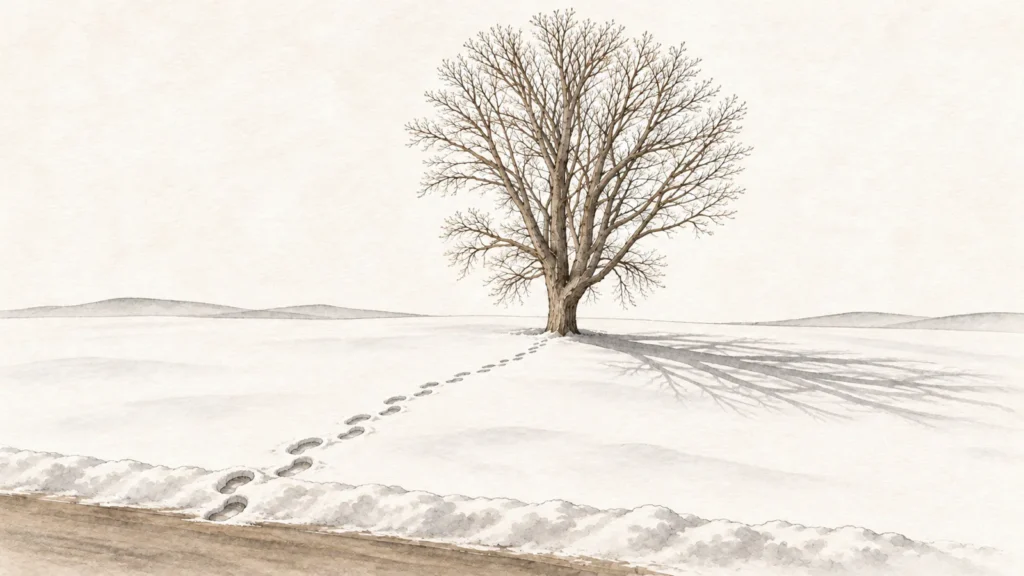
Biei’s “Philosophy Tree” (哲学の木, Tetsugaku no Ki), a lone poplar made famous by photographs, was cut down by the farmer who owned it on 24 February 2016. Reporting at the time gave two reasons that belong together: tourists kept walking into his field to reach the tree, and he feared the old tree could fall and damage his crops or injure the people trespassing beneath it. Under Japan’s Civil Code, a tree rooted in land generally belongs to the landowner, subject to rights others have legally established.
Snow covers a Biei field. Beneath it, wheat or other crops may still be growing. At the Philosophy Tree, contemporary reports described visitors trampling private farmland to reach a photographic landmark, and in the end the man who farmed that land took the landmark away.
A Tree on the Crest of a Field — How It Became a Landmark
What stood beside Panorama Road
The Philosophy Tree stood along Panorama Road in the south of Biei, a farming town of rolling hills in Hokkaido. Reports called it an Italian poplar (イタリアポプラ). It was not in a park or a shrine. It stood on working farmland.
What set it apart was its posture. A Japanese web magazine described it as leaning in the opposite direction to the slope beneath it, like someone lost in thought: the reason given for its name.
Photographers made the image travel
The photographer Toshiki Nakanishi has said that his own pictures and those of other photographers helped spread the tree’s image. Kyodo News reported that the tree had been planted in the 1960s; we could not find a planting record to confirm the date, or any record of why it was planted.
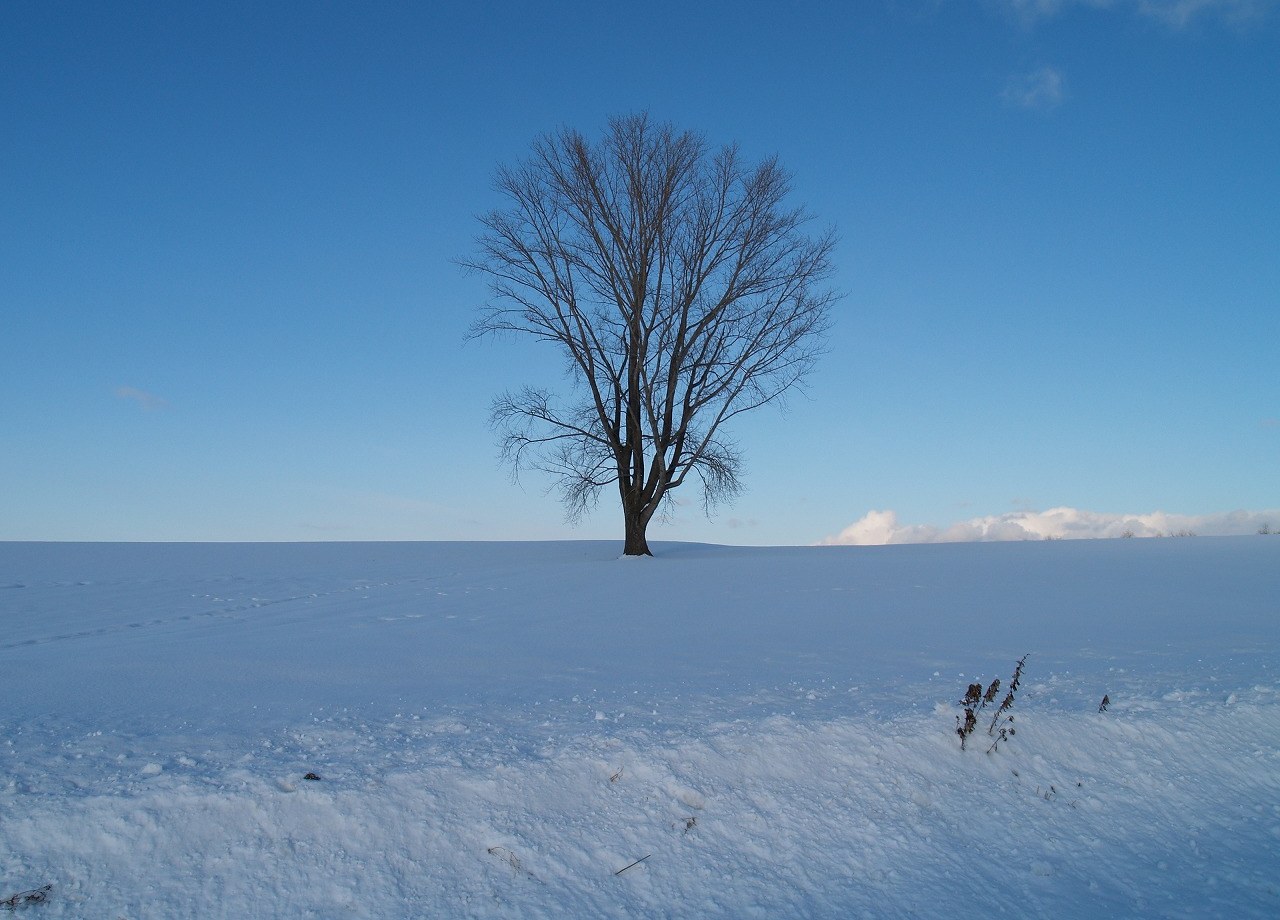
The winter picture above shows what the photographs offered: one dark tree on a white crest, no fence, no sign. A field that looks empty in January is still a farm.
The Felling — 24 February 2016
What was reported
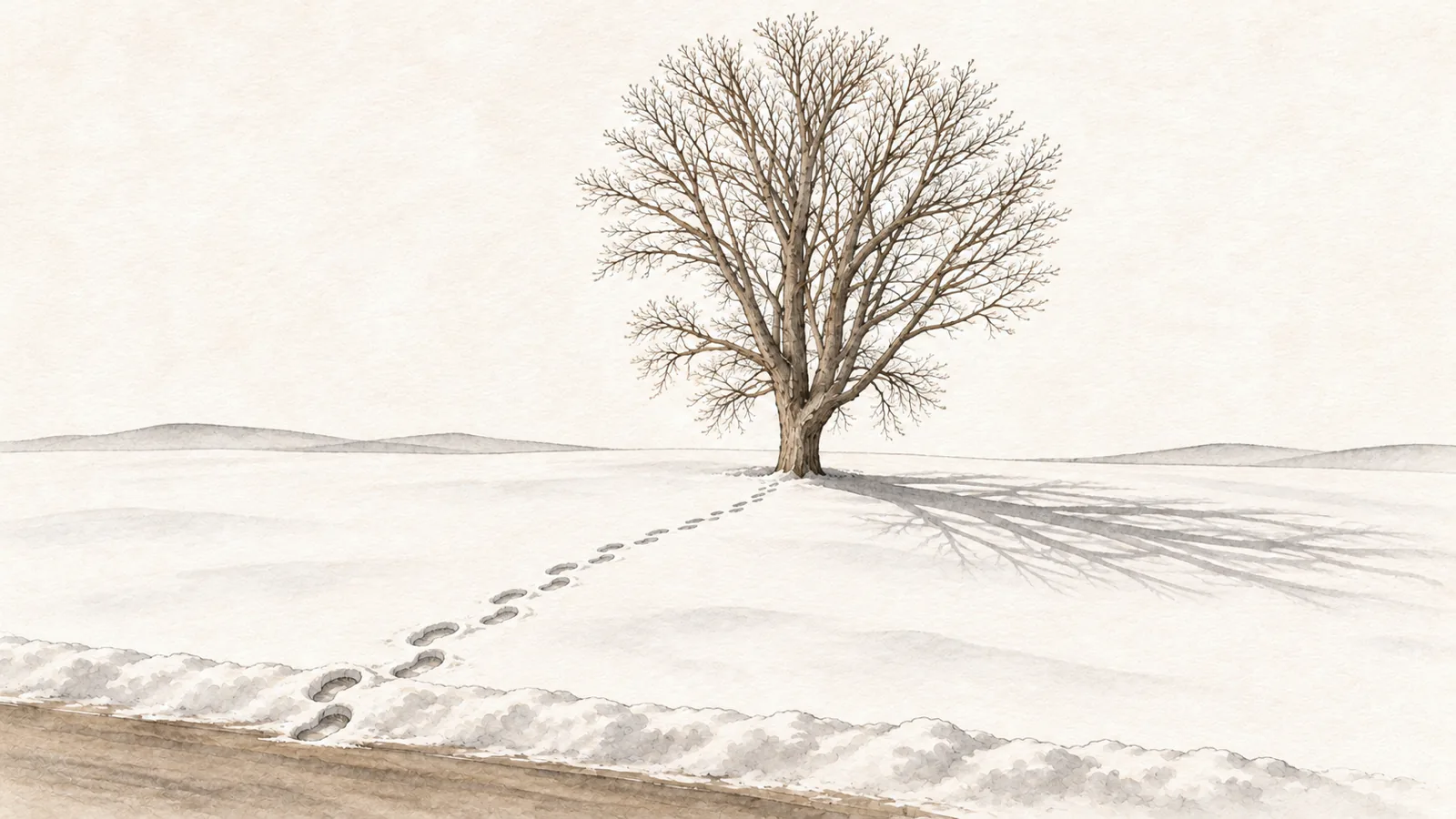
On 24 February 2016, the tree was felled by the farmer who owned it. Japanese outlets reported it the next day. Kyodo News described the tree as standing on private farmland and the owner as fed up with tourists who kept trampling his fields.
According to Nakanishi, quoted the day after the felling, photographing the tree had already been prohibited the previous year. The ban had not solved the problem.
Two reasons, not one
The story is easy to shorten to “tourists ruined it”. The contemporary Kyodo report gave two concerns. The first was trespass: visitors walking through the field to reach the tree. The second was the tree itself: the owner feared the old tree could fall naturally, damaging crops or injuring tourists who had entered the field without permission.
Ten years later, Nakanishi recalled the owner telling him that the tree “could fall at any time” (いつ倒れてもおかしくないし) and that the tourists were a nuisance (観光客も迷惑だし). That is a photographer’s memory, written in 2026, not a transcript from 2016, but it matches the two concerns in the contemporary report. The public saw a landmark. Its owner still had a field to farm, and a tree he believed could come down.
Why the town could not call the police for every trespass
A Biei town official told Kyodo: “We cannot call the police each time a tourist steps into the fields.”
What a Footstep Does to a Hokkaido Field — The First Reason
Crops under the snow
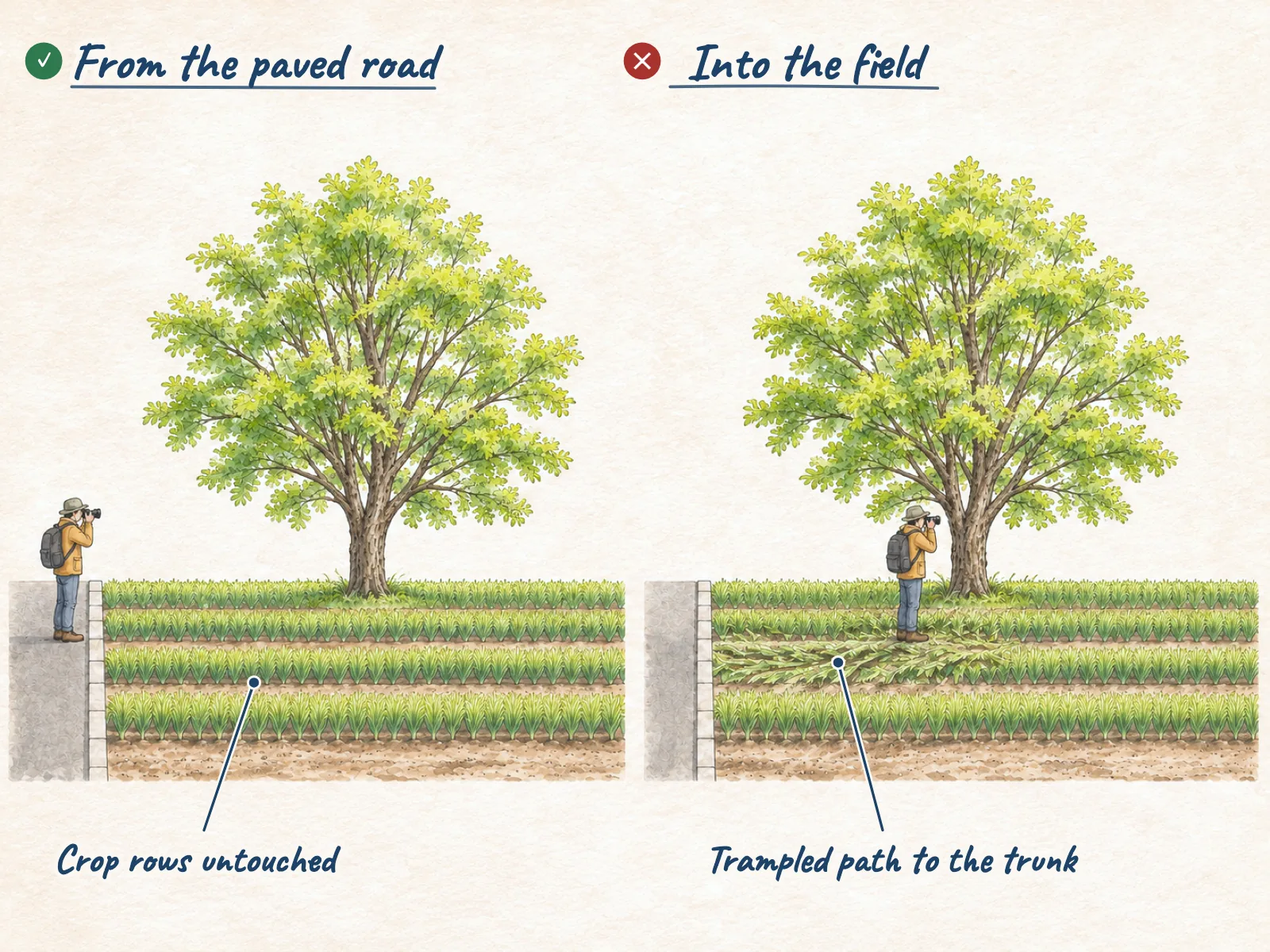
Biei’s published visitor guidance explains the rule against entering fields in agricultural terms. The town tourism association tells visitors that wheat and other crops are growing beneath the snow-covered fields, and asks them not to enter. A white field in February may be a sown field.
Japanese television has documented tourists trampling Biei’s fields in search of “photogenic” pictures (映える写真). Visitors walking through growing crops can trample and damage them, and a famous tree concentrates that walking on one path.
What travels on a boot
The less visible risk is soil-borne. Japan’s agriculture ministry warns that soil on clothing and shoes can carry pests that are hard to control, including cyst nematodes, into farmland. Biei Town’s visitor page says the same in plainer words: pathogens and pests (菌・病害虫) on the soles of shoes that step into a field can affect the crops. Hokkaido’s agricultural department notes that potato cyst nematodes can survive in soil for more than ten years and are difficult to eradicate once introduced, and its guidance for visitors keeps them off farmland and unpaved farm roads as a basic rule.
None of this proves that visitors brought a pest into that particular field; we found no record linking them to any outbreak, and our sources do not quantify the risk per visit. What a farmer weighs is soil from many places, carried to one spot in a crop.
Winter viewing and roadside access
In winter, the tourism association asks visitors to photograph only from snow-cleared areas, and from paved areas at other times. Biei Town also warns against long roadside parking, because it can obstruct farm vehicles.
| Season | What the field holds | What the guidance asks |
|---|---|---|
| Snow season | Wheat and other crops under snow (tourism association) | Stay on snow-cleared areas; do not enter snow-covered fields |
| Growing season | Rows of growing crops | Stay on paved areas; do not walk into the rows |
| All year | Soil that can receive pests such as cyst nematodes | Keep off farmland and unpaved farm roads (MAFF, Hokkaido) |
| Roadside | Farm roads used by farm vehicles | Avoid long roadside parking (Biei Town) |
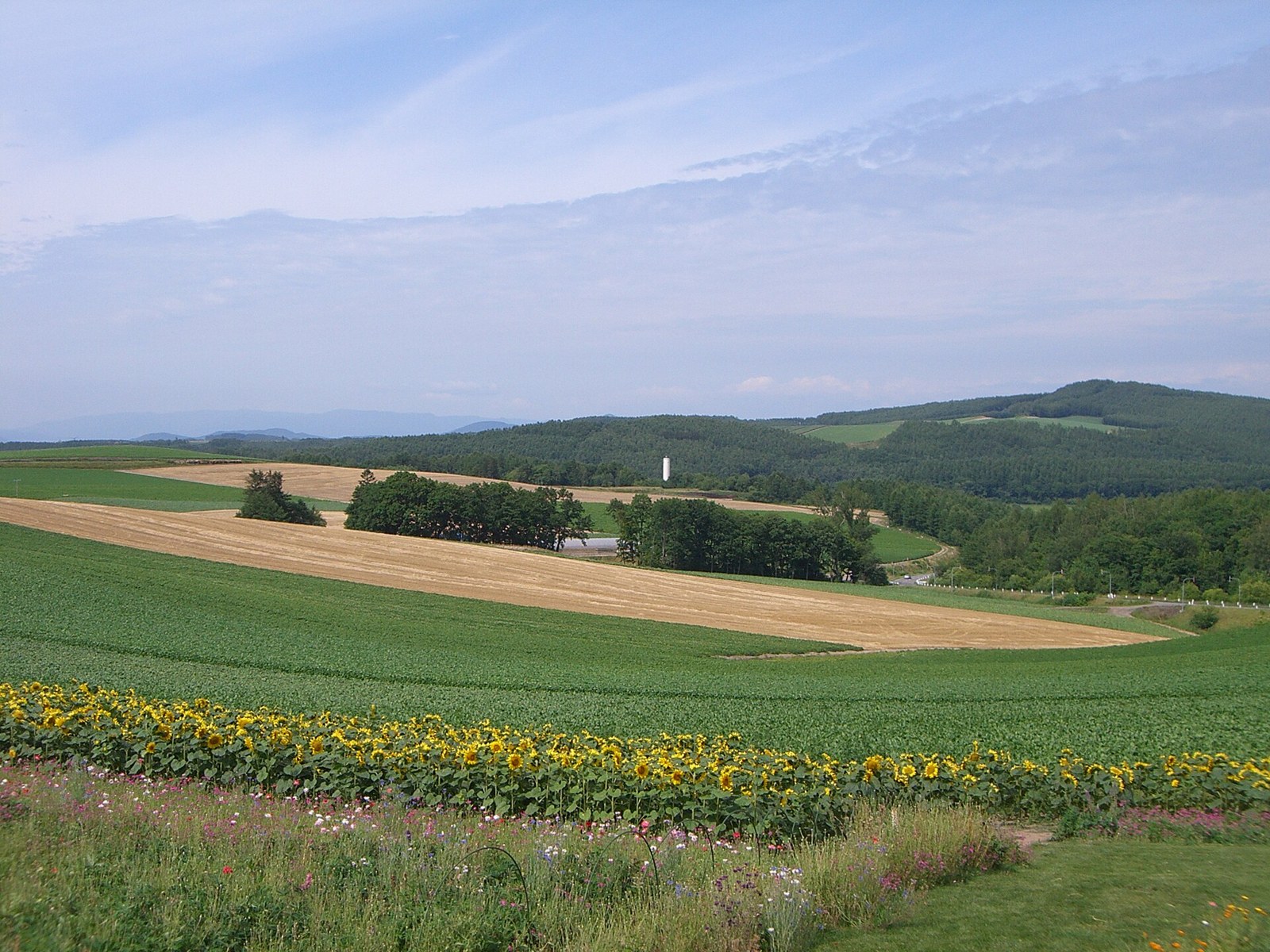
Biei’s Other Famous Field Trees — Who Owns Them
The Ken and Mary Tree, the Seven Stars Tree and their neighbours
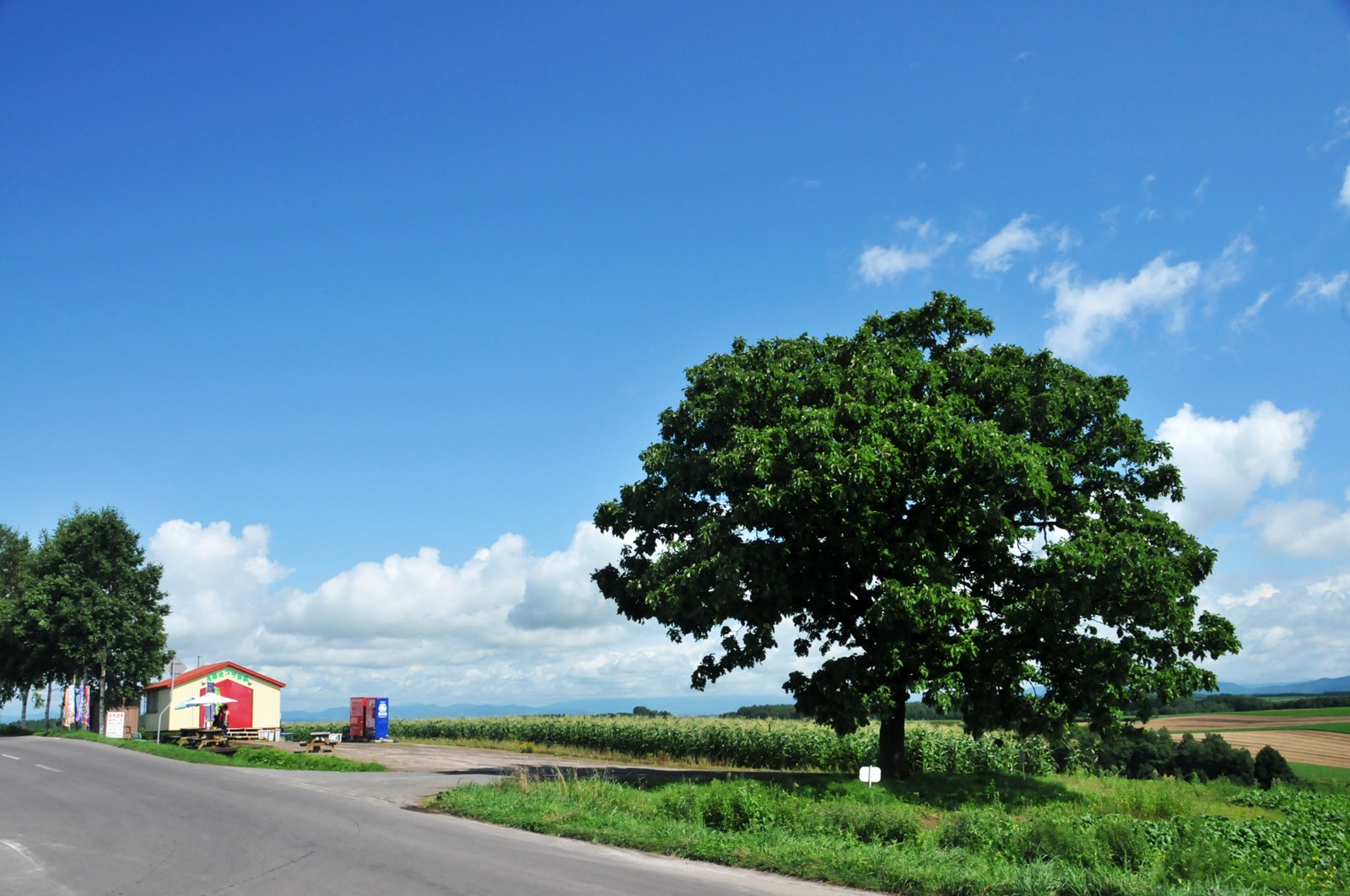
The Philosophy Tree was one of several Biei trees made famous by images. The Ken and Mary Tree (ケンとメリーの木), a poplar, became a landmark through a 1972 Nissan Skyline television commercial; Nissan dates the tree’s planting to 1923. The Seven Stars Tree (セブンスターの木), a kashiwa oak, takes its name from a cigarette brand: Hokkaido’s tourism organisation says it appeared on a cigarette package in 1976, while the town tourism association’s current page credits a commercial instead. We could not settle that difference from primary sources, so we report both.
Others include the Parent and Child Trees (親子の木), three kashiwa oaks, and the Christmas Tree (クリスマスツリーの木), a lone spruce.
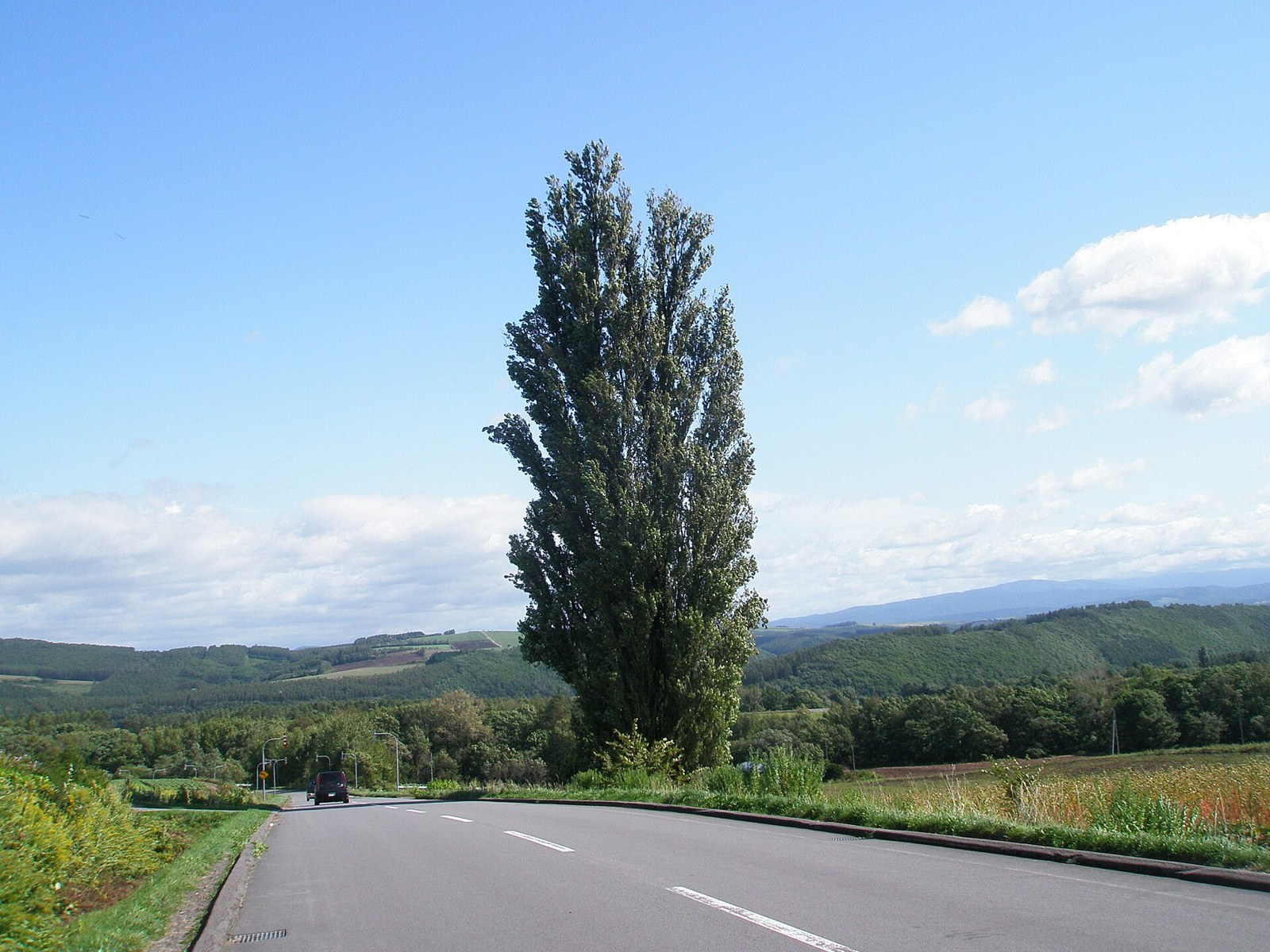
Private trees on private land
Biei’s own photographic record of its landscape trees labels three of them in brackets as privately owned (個人所有): the Seven Stars Tree, the Parent and Child Trees, and the Christmas Tree. The association’s tree pages prohibit entry onto adjacent private land, while its general guidance asks visitors to use paved and snow-cleared areas and never to enter fields, pastures or snow-covered land.
The Ken and Mary Tree shows one alternative to felling. A 2024 assessment report published by the town notes that conservation subsidies are paid to the tree’s owner (所有者には保全のための補助金が支払われている). The report does not say when the arrangement began, and we could not confirm who owns the tree today.
| Tree | Species | How it became famous | Ownership on record | Visitor rule |
|---|---|---|---|---|
| Philosophy Tree (felled 2016) | Poplar (“Italian poplar” in reports) | Photographers’ images | Private farmland (Kyodo) | Photography banned in 2015, per Nakanishi |
| Ken and Mary Tree | Poplar | 1972 Nissan Skyline commercial | Owner receives conservation subsidies (2024 report) | Do not enter the fields |
| Seven Stars Tree | Kashiwa oak | 1976 cigarette package (or commercial) | Privately owned (town record) | Adjacent private land off-limits |
| Parent and Child Trees | Three kashiwa oaks | Shape like a family | Privately owned (town record) | View from paved areas |
| Christmas Tree | Spruce | Lone tree on a hillside field | Privately owned (town record) | Never enter fields, pastures or snow |
The Second Reason — What Is Known About the Tree’s Condition
What the record says
The second reason in the 2016 reporting was the owner’s fear that the old tree could fall. Here the record is thin. In the sources we reviewed, we found no published tree assessment, decay survey or post-felling examination of the Philosophy Tree.
So this article does not say the tree was rotten. Without an individual assessment, the owner’s concern cannot be evaluated from the tree’s reported age or type alone.
What is known about poplars
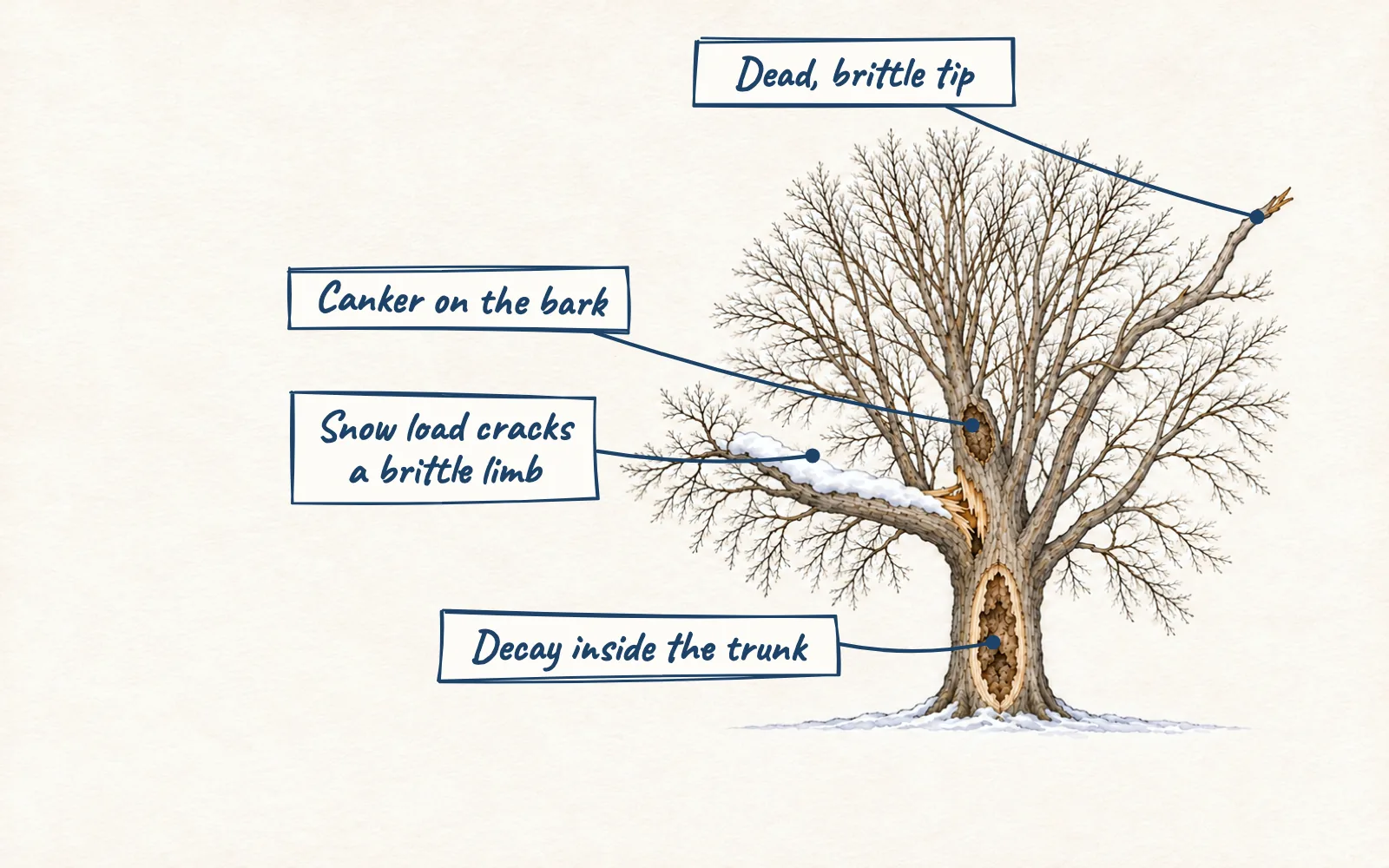
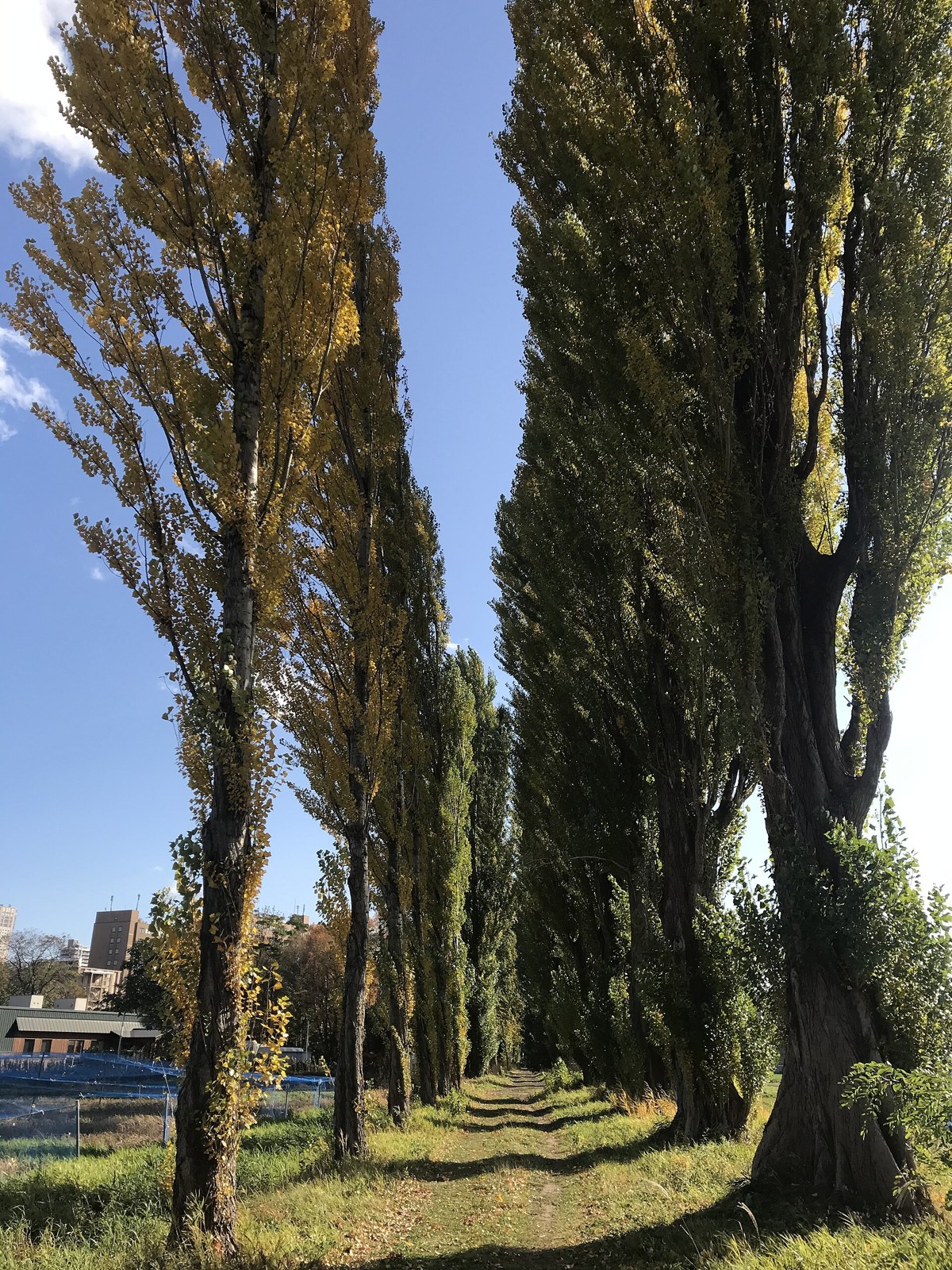
Hokkaido University gives about 100 years as a rough lifespan for poplars, adding that it varies widely with conditions. Extension sheets from American universities describe the Lombardy poplar (Populus nigra ‘Italica’, セイヨウハコヤナギ) as fast-growing but short-lived, with soft, weak wood prone to breakage. A University of Kentucky guide to tree failure lists the Lombardy poplar’s typical defects as brittle branches, failure under snow and ice loading, internal decay and cankers.
We could not confirm the Philosophy Tree’s exact species or hybrid. These findings describe Lombardy poplar; they cannot establish the condition of the Philosophy Tree.
A cautionary record from Sapporo
Hokkaido has a documented example of what wind can do to old poplars. Hokkaido University’s poplar avenue dates its first small planting to 1903. In September 2004, Typhoon No. 18 toppled nearly half of the avenue’s poplars. Those were tended campus trees, not a lone field tree; the record shows only that large Hokkaido poplars have failed in storms.
Could an Assessment Have Settled It? — The Judgement the Farmer Faced
What the evidence does and does not show
Could an assessment have clarified the danger? Perhaps, but no assessment of this tree was found, and our sources do not establish whether one was commissioned or required in this case. For this tree, the documented evidence is the owner’s reported concern. The sources do not provide a measured failure probability, or any comparison of options such as fencing, pruning or felling.
The two reasons were linked. Even without visitors, a falling tree could damage crops; with visitors at the trunk, it could also fall on people.
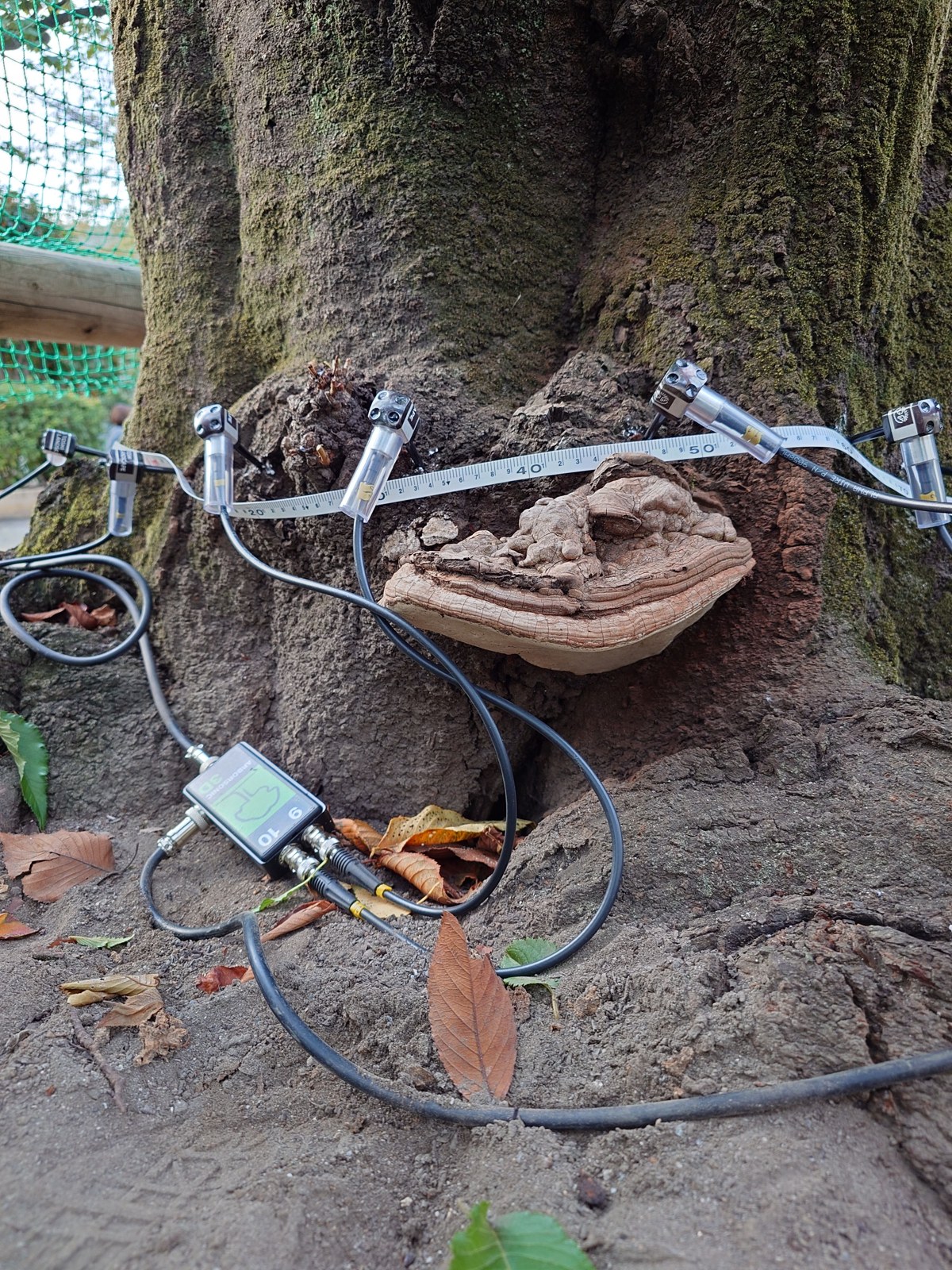
What assessors look for
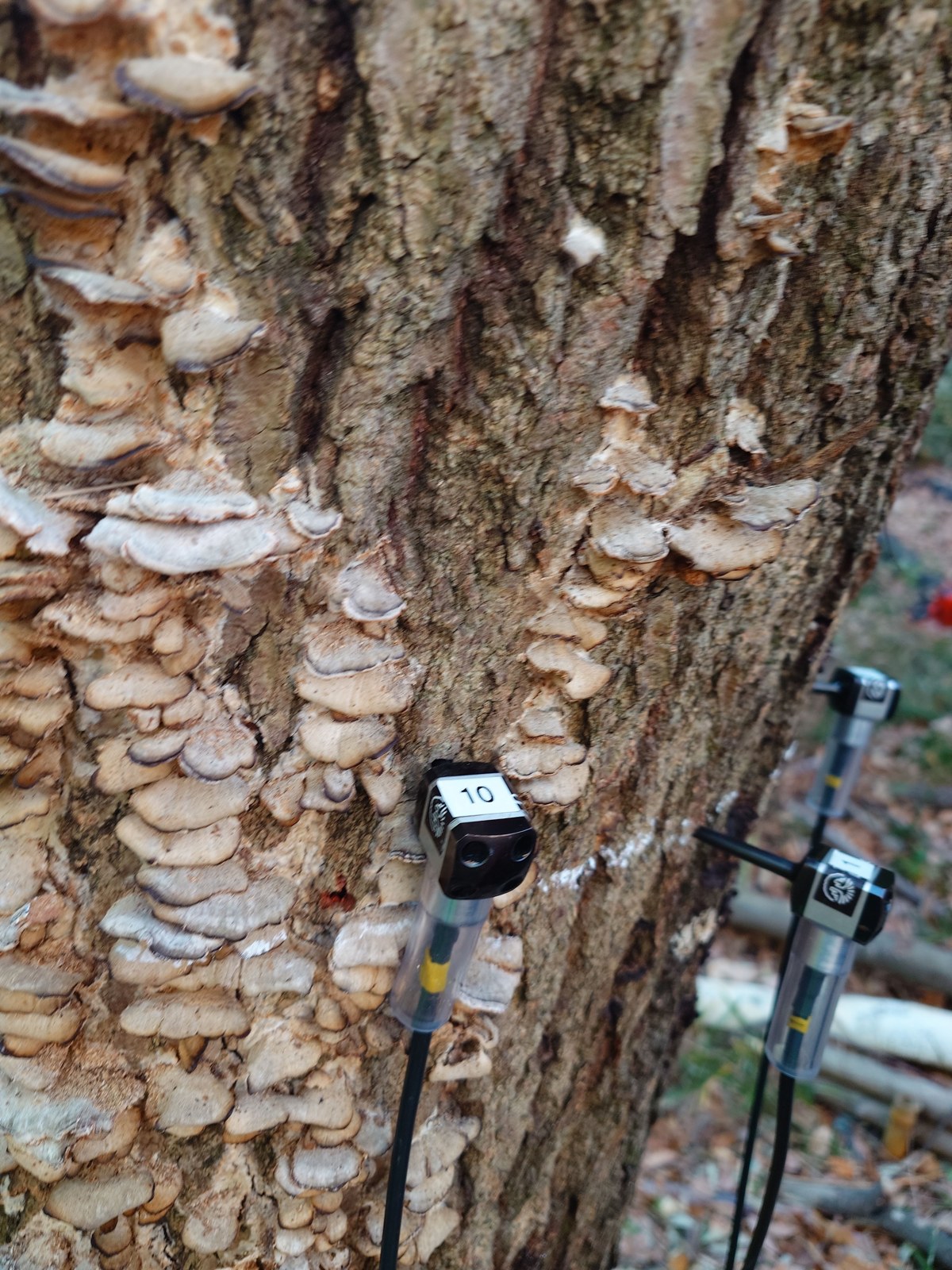
Fungal fruiting bodies can prompt further investigation; alone they do not show how much sound wood is left. See our articles on VTA and jumoku-i and reading tree decay without technology.
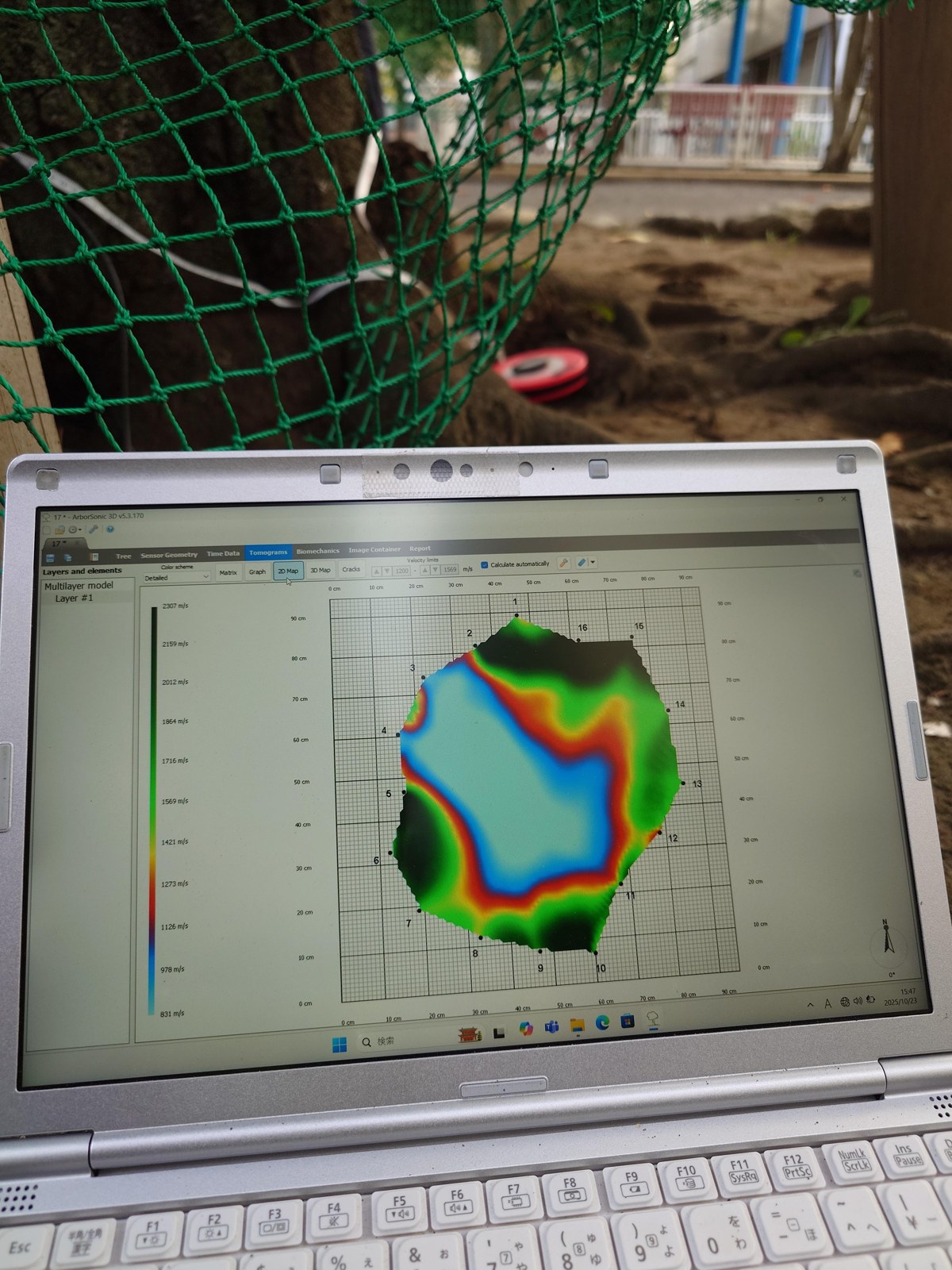
When the outside is not enough, instruments are used. A sonic tomogram maps estimated sound velocities across a trunk section. The manufacturer’s manual notes that slower areas may indicate decay, cavities or other structural features such as cracks, and need to be interpreted alongside other findings. We explain the method in how sonic tomography works.
After the cut
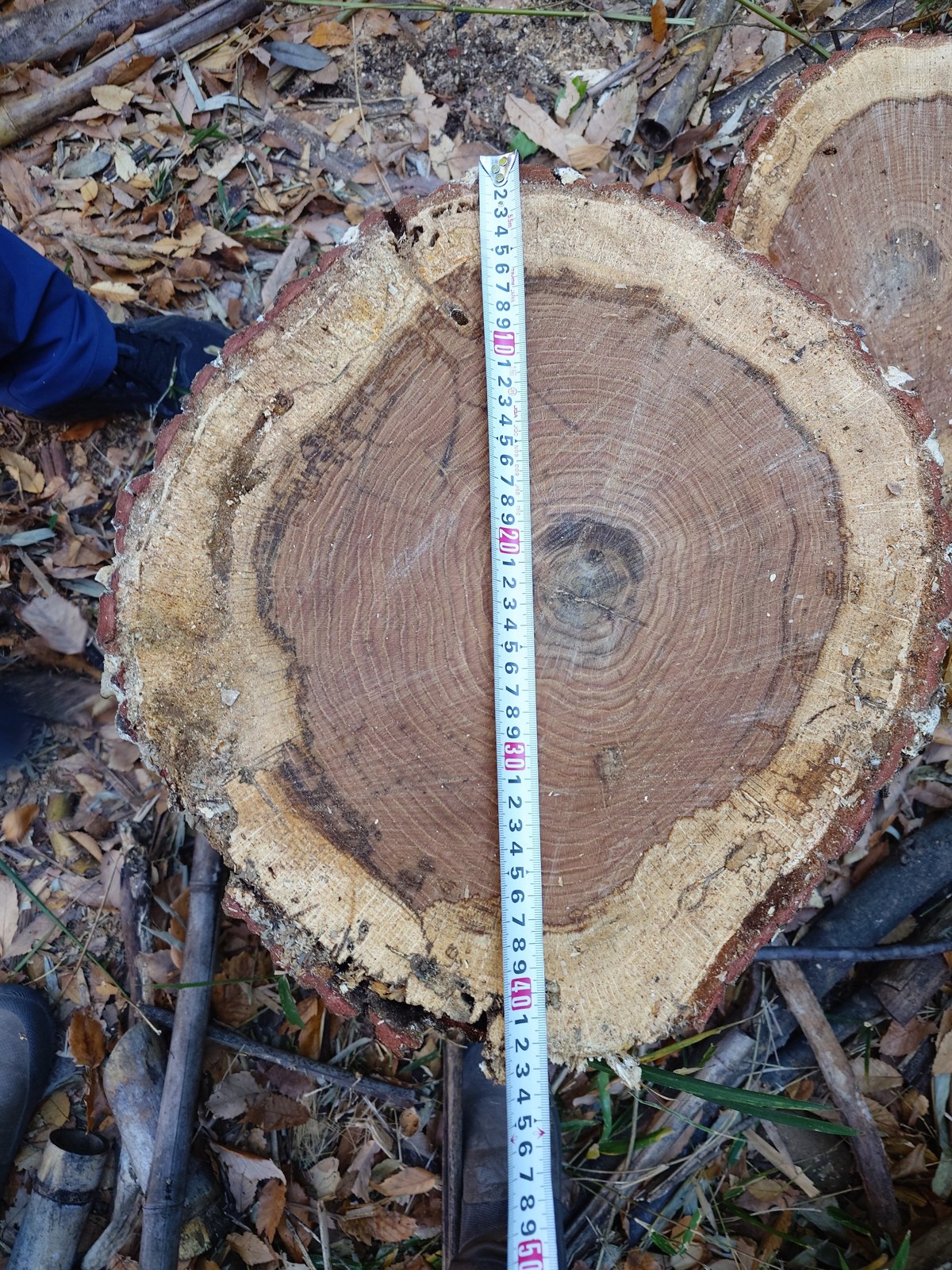
A cut cross-section can be compared with pre-felling findings, and that comparison is how assessors check their own readings. We found no published comparison of this kind for the Philosophy Tree, which is why this article keeps the tree’s condition in the column of things the owner believed, not things that were measured.
Who Owns a Famous Tree in Japan — The Law Behind the Choice
The tree belongs to the land
Japan’s Civil Code treats land and things permanently attached to it as immovable property (Article 86). Under Article 242, the owner of land generally acquires ownership of things attached to it, subject to rights others have legally established. Article 206 gives an owner the right to use and dispose of their property within the limits set by law. A tree growing in a farmer’s field is, in the ordinary case, part of the farmer’s land.
Fame does not change who owns a tree. Nor does ownership settle every felling requirement.
When restrictions apply
Restrictions can attach to a designated tree, to the land, to forest rules or to local ordinances. We could not confirm which, if any, applied at this site in 2016.
| System | What it does | When it applies |
|---|---|---|
| Act on Preservation of Trees for Maintaining the Scenic Beauty of Cities, Art. 2 | Lets municipalities designate preserved trees (保存樹) | Designated trees, under the Act’s conditions |
| Cultural Properties Protection Act, Art. 125 | Altering a natural monument generally needs permission from the Commissioner for Cultural Affairs | Designated natural monuments |
| Urban Green Space Act, Art. 14 | Felling in a special green conservation district generally needs permission | Inside such districts |
| Hokkaido Ordinance on Conservation of the Natural Environment, Arts. 23 and 28 | Hokkaido designates commemorative protected trees; changing one needs advance notice to the municipality | Designated trees |
| Forest felling notification (Forestry Agency) | Advance notice 90 to 30 days before felling | Forest land covered by the system |
Fame alone does not establish protection. Biei’s later records show two responses: conservation support, as with the Ken and Mary Tree, and rules for visitors.
Biei After the Philosophy Tree — More Visitors, More Rules
The numbers behind the crowds
The tree came down in a period of fast growth in visitors. Biei’s tourism master plan says the town’s visitor count rose from about 800,000 in fiscal 1990 to 1.79 million in fiscal 2014.
Numbers fell during the pandemic, recovered to 2,685,900 in fiscal 2024, then declined to 2,603,800 in fiscal 2025. The table reproduces Biei’s reported counts.
| Fiscal year | Reported tourist count for Biei | Source |
|---|---|---|
| 2014 | 1.79 million | Biei tourism master plan |
| 2018 | 2,261,700 | Biei town profile 2024 |
| 2019 | 2,419,200 | Biei town profile 2024 |
| 2020 | 1,295,300 | Biei town profile 2024 |
| 2021 | 1,062,400 | Biei town profile 2024 |
| 2022 | 1,819,400 | Biei town profile 2024 |
| 2023 | 2,387,200 | Biei town profile 2024 |
| 2024 | 2,685,900 (up 12.5%) | Hokkaido Kamikawa statistics |
| 2025 | 2,603,800 (96.9% of the previous year) | Hokkaido Kamikawa statistics |
International overnight guests in Biei rose from 20,148 in fiscal 2023 to 46,993 in fiscal 2025, and the town reported a marked rise in winter inbound visitors in fiscal 2024: the season when crops lie under the snow.
The birch avenue, 2025
Nine years after the Philosophy Tree, a similar decision was made beside the Seven Stars Tree. On 14 January 2025, landowners felled a popular avenue of white birches there. Reporting linked the decision to unauthorised entry into fields and to tourists spreading across the road to take photographs; another report added that crops shaded by the birches were growing poorly.
For the 2025 proposal, the town published its landscape council members’ opinions, which accepted the felling as unavoidable (やむを得ない). Like 2016, it had more than one reported reason.
Rules, signs and volunteers
Biei’s current photography rules tell visitors not to enter farmland even where there is no warning sign. The Biei Town Ordinance for a Sustainable Tourism Destination took effect on 1 April 2023; Article 7(2) says no one may enter another person’s private land without permission (他人の私有地に無断で立入りをしてはなりません). Resident volunteers patrol as tourism advisers, and the town has installed no-entry signs in four languages.
Japan’s national overtourism package of 18 October 2023 names Biei among the places supported in providing real-time congestion information.
Sycamore Gap and Wānaka — Famous Trees, Different Circumstances
A crime in Northumberland
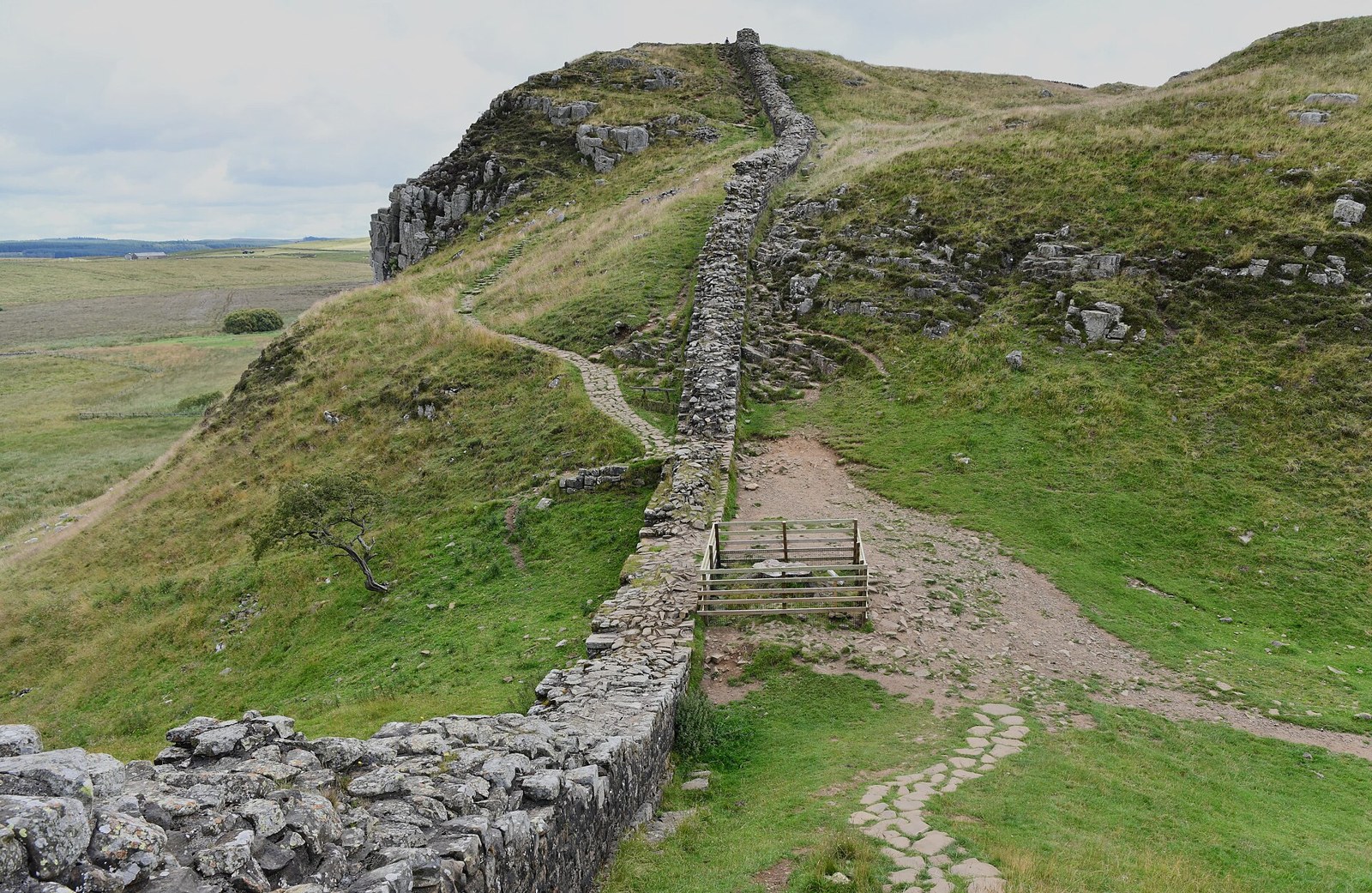
England’s Sycamore Gap tree, in Northumberland National Park, was felled on 28 September 2023. It was owned by the National Trust, and the felling, by two men who did not own it, was prosecuted as criminal damage. On 15 July 2025, Daniel Graham and Adam Carruthers were each sentenced to four years and three months in prison. The National Trust fenced the stump and kept seeds and cuttings.
Branches cut in Wānaka
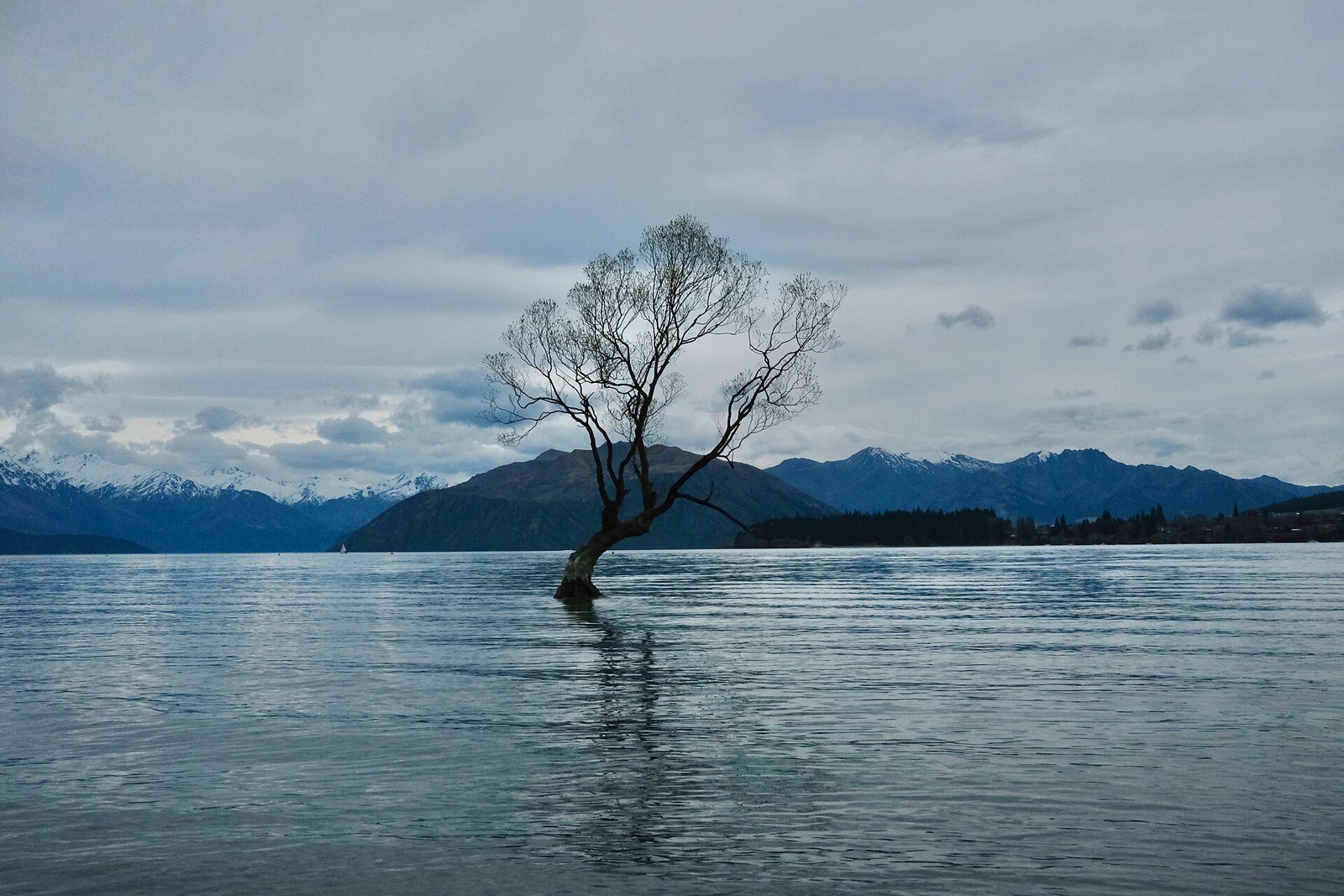
New Zealand’s “That Wānaka Tree”, a lone tree standing in the water at Wānaka, was damaged in March 2020 when several large branches were removed without authorisation; police investigated. Visitors had earlier broken thin limbs by climbing it; the police release did not identify who cut the branches.
What the comparison shows
These cases illustrate different ownership and authorisation circumstances, not national attitudes toward trees. Biei involved an owner’s decision about his own tree; Sycamore Gap involved criminal damage to another owner’s tree; Wānaka involved unauthorised branch removal, not the loss of the whole tree.
| Philosophy Tree (Biei) | Sycamore Gap (England) | That Wānaka Tree (NZ) | |
|---|---|---|---|
| Who owned it | A farmer, on his own farmland | The National Trust | Not covered in our sources |
| Who cut it | The owner | Two men without permission | Unknown; police investigated |
| Legal character | An owner’s decision about his own tree | Criminal damage, prosecuted | Unauthorised removal of branches |
| Visitors’ role | Trespass on crops; people under a tree feared to fall | No visitor-related cause in the cited sources | Climbing broke thin branches earlier |
| Afterwards | Town rules on entry; later an ordinance | Stump fenced; seeds and cuttings kept | 2020 release describes branch removal only |
In Biei, the owner who felled the tree also farmed the land the visitors crossed.
Common Misunderstandings About the Philosophy Tree
“It was rotten and about to fall”
We found no published assessment in the sources reviewed. The owner feared it could fall; that is the documented evidence, not a measured diagnosis.
Frequently asked questions
Why was the Philosophy Tree in Biei cut down?
Its owner, a farmer, had it felled on 24 February 2016. Reporting gave two reasons: tourists kept walking into his fields to reach it, and he feared the old tree could fall, damaging crops or injuring trespassers.
Can I still see the Philosophy Tree?
No. The original tree was felled in 2016. At other Biei tree sites, use permitted paved viewing areas and never enter the fields.
Can I visit the Ken and Mary Tree or the Seven Stars Tree?
View them from permitted paved areas, staying out of fields and keeping clear of traffic; in winter, remain on snow-cleared ground. The trees stand on or beside private land.
Why does walking into a field matter in winter?
Wheat and other crops may be growing beneath the snow, and soil on footwear can carry pests, including cyst nematodes. Hokkaido’s guidance says potato cyst nematodes can survive in soil for more than ten years.
Is it illegal to enter farmland in Biei?
Since 1 April 2023, Biei’s tourism ordinance has said that no one may enter another person’s private land without permission. The town’s photography rules apply even where no sign is posted.
Sources
– ITmedia NEWS, Philosophy Tree felled, 25 Feb 2016 — https://www.itmedia.co.jp/news/article/1602/25/1160225135/ (checked 2026-10-30) – Kyodo News, “Famous tree in Hokkaido cut down by owner fed up with rude tourists”, in The Global New Light of Myanmar, 26 Mar 2016, p. 15 — https://uzo.sakura.ne.jp/burma/nlm/nlm_data/gnlm_2016/gnlm_03_2016/gnlm_26_03_2016.pdf (checked 2026-10-30) – grape, report on the felling with Toshiki Nakanishi’s account, 25 Feb 2016 — https://grapee.jp/147607 (checked 2026-10-30) – BuzzFeed Japan, interview with Toshiki Nakanishi — https://www.buzzfeed.com/jp/eimiyamamitsu/tetsugaku-no-ki (checked 2026-10-30) – Toshiki Nakanishi, “Ten years since the Philosophy Tree was lost”, 7 Apr 2026 — https://note.com/toshikinakanishi/n/nf278767a80c0 (checked 2026-10-30) – Nissan, Biei Blue Project release, 11 Jan 2024 — https://global.nissannews.com/ja-JP/releases/240111-01-j (checked 2026-10-30) – Biei Tourism Association, tree pages and visitor requests — https://www.biei-hokkaido.jp/ja/facility/ken-merry-tree ; https://www.biei-hokkaido.jp/ja/facility/seven-stars-tree ; https://www.biei-hokkaido.jp/ja/facility/christmas-tree ; https://www.biei-hokkaido.jp/ja/9291 ; https://www.biei-hokkaido.jp/ja/bieikankou-manner110 ; https://www.biei-hokkaido.jp/ja/5402 ; https://www.biei-hokkaido.jp/ja/10712 (checked 2026-10-30) – HOKKAIDO LOVE!, Seven Stars Tree — https://www.visit-hokkaido.jp/spot/detail_10370.html (checked 2026-10-30) – JAPAN 47 GO, Parent and Child Trees — https://www.japan47go.travel/ja/detail/af325321-6800-4022-a4f3-4aa6cefcba93 (checked 2026-10-30) – Biei Town, landscape trees photographic record — https://town.biei.hokkaido.jp/files/00005500/00005598/20230731101659.pdf ; assessment report 2024, p. 9 — https://www.town.biei.hokkaido.jp/files/00000800/00000834/r6shikakushinsa_report.pdf (checked 2026-10-30) – Biei Town, landscape council opinions on the birch avenue — https://town.biei.hokkaido.jp/files/00005500/00005598/2412keikanshingi_kekka.pdf (checked 2026-10-30) – HBC / TBS NEWS DIG, birch avenue felled, 14 Jan 2025 — https://newsdig.tbs.co.jp/articles/-/1666563 ; FNN, 16 Jan 2025 — https://www.fnn.jp/articles/-/814644 ; Chiba Nippo (Kyodo), 14 Jan 2025 — https://www.chibanippo.co.jp/newspack/20250114/1360219 (checked 2026-10-30) – Biei Town, photography rules — https://www.town.biei.hokkaido.jp/industry/kanko/rule.html ; visitor rules — https://www.town.biei.hokkaido.jp/tourism/ ; tourism ordinance — https://town.biei.hokkaido.jp/industry/kanko/comment.html ; full text — https://town.biei.hokkaido.jp/files/00004900/00004956/joureiall.pdf (checked 2026-10-30) – Jalan Research Center, Tourimakashi 79, Mar 2025 — https://jrc.jalan.net/wp-content/uploads/2025/02/e2862ca5db2f96cba3d146abbfba83ba.pdf (checked 2026-10-30) – Biei Town, tourism master plan summary — https://town.biei.hokkaido.jp/files/00004600/00004655/mpgaiyou.pdf ; town profile 2024 — https://town.biei.hokkaido.jp/files/00000100/00000147/R6%E7%94%BA%E5%8B%A2%E8%A6%81%E8%A6%A7.pdf ; administrative report FY2024 — https://town.biei.hokkaido.jp/files/00000000/00000062/r6_gyouseihoukoku.pdf (checked 2026-10-30) – Hokkaido Kamikawa Bureau, tourism statistics FY2024 — https://www.kamikawa.pref.hokkaido.lg.jp/fs/1/2/6/7/6/0/4/2/_/%E2%98%85%E4%BB%A4%E5%92%8C6%E5%B9%B4%E5%BA%A6%E4%B8%8A%E5%B7%9D%E7%AE%A1%E5%86%85%E8%A6%B3%E5%85%89%E5%85%A5%E8%BE%BC%E5%AE%A2%E6%95%B0%E8%AA%BF%E6%9F%BB%E5%A0%B1%E5%91%8A%E6%9B%B8.pdf ; FY2025 — https://www.kamikawa.pref.hokkaido.lg.jp/fs/1/3/1/7/6/8/8/3/_/%E2%98%86%E4%BB%A4%E5%92%8C7%E5%B9%B4%E5%BA%A6%E4%B8%8A%E5%B7%9D%E7%AE%A1%E5%86%85%E8%A6%B3%E5%85%89%E5%85%A5%E8%BE%BC%E5%AE%A2%E6%95%B0%E8%AA%BF%E6%9F%BB%E5%A0%B1%E5%91%8A%E6%9B%B80707%E2%98%86.pdf (checked 2026-10-30) – Hokkaido Government, Data Book 2017 — https://www.pref.hokkaido.lg.jp/ss/tkk/databook/2017/0307.html ; tourism report FY2025 — https://www.pref.hokkaido.lg.jp/fs/1/3/2/0/8/5/3/4/_/%E5%8C%97%E6%B5%B7%E9%81%93%E8%A6%B3%E5%85%89%E5%85%A5%E8%BE%BC%E8%AA%BF%E6%9F%BB%E5%A0%B1%E5%91%8A%E6%9B%B8%28R7_%E6%9C%AC%E7%B7%A8%29.pdf (checked 2026-10-30) – MAFF eMAFF, notes on visiting farmland — https://map.maff.go.jp/Content/HowToNavigate.pdf ; Hokkaido Agriculture Department, chapter 4 — https://www.pref.hokkaido.lg.jp/fs/4/9/8/2/1/1/2/_/benricyou4.pdf (checked 2026-10-30) – NTV / STV documentary, 21 Sep 2025 — https://www.ntv.co.jp/document/backnumber/articles/1894nrixjujmeshpha49.html (checked 2026-10-30) – Hokkaido University, plant checklist — https://hosho.ees.hokudai.ac.jp/tsuyu/top/plt/flora-misc.html ; CoSTEP on poplar lifespan — https://costep.open-ed.hokudai.ac.jp/like_hokudai/article/6778 ; poplar avenue — https://www.hokudai.ac.jp/bureau/news/jihou/jihou0611/fukei.htm (checked 2026-10-30) – Oregon State University, Populus nigra ‘Italica’ — https://landscapeplants.oregonstate.edu/plants/populus-nigra-italica ; Utah State University Extension — https://extension.usu.edu/treebrowser/catalog/poplar-lombardy ; University of Kentucky, ID-253 — https://publications.ca.uky.edu/sites/publications.ca.uky.edu/files/ID253.pdf (checked 2026-10-30) – Fakopp, ArborSonic 3D user manual — https://files.fakopp.com/arborsonic3d/arborsonic3d_manual.pdf (checked 2026-10-31) – e-Gov, Civil Code — https://laws.e-gov.go.jp/law/129AC0000000089 ; Act on Preservation of Trees — https://laws.e-gov.go.jp/law/337AC1000000142 ; Cultural Properties Protection Act — https://laws.e-gov.go.jp/law/325AC0100000214 ; Urban Green Space Act — https://laws.e-gov.go.jp/law/348AC0000000072 (checked 2026-10-30) – Hokkaido Government, commemorative protected trees — https://www.pref.hokkaido.lg.jp/ks/skn/kouen/266520.html ; Forestry Agency, felling notification — https://www.rinya.maff.go.jp/j/keikaku/todokede/batsuzoutodokede.html (checked 2026-10-30) – Japan Tourism Agency, overtourism measures — https://www.mlit.go.jp/kankocho/seisaku_seido/kihonkeikaku/jizoku_kankochi/jizokukano_taisei/overtourism.html ; package — https://www.mlit.go.jp/kankocho/content/810002893.pdf ; 2025 programme — https://www.mlit.go.jp/kankocho/content/001884909.pdf (checked 2026-10-30) – Courts and Tribunals Judiciary, R v Graham and Carruthers, sentencing remarks — https://www.judiciary.uk/wp-content/uploads/2025/07/Sentencing-Remarks-R-v-Graham-and-Carruthers-Final.pdf ; Associated Press, 15 Jul 2025 — https://apnews.com/article/britain-sycamore-gap-tree-trial-sentencing-chainsaw-28a6db1552e6acea118aa7e8bcf69ecb ; National Trust statement — https://www.nationaltrust.org.uk/who-we-are/news/our-statement-on-the-felling-of-the-sycamore-gap-tree (checked 2026-10-30) – New Zealand Police, Wanaka tree, 19 Mar 2020 — https://www.police.govt.nz/news/release/police-investigate-damage-wanaka-tree ; The Guardian, 18 Mar 2020 — https://www.theguardian.com/world/2020/mar/18/wanakas-famous-instagram-tree-attacked-with-a-saw (checked 2026-10-30)