

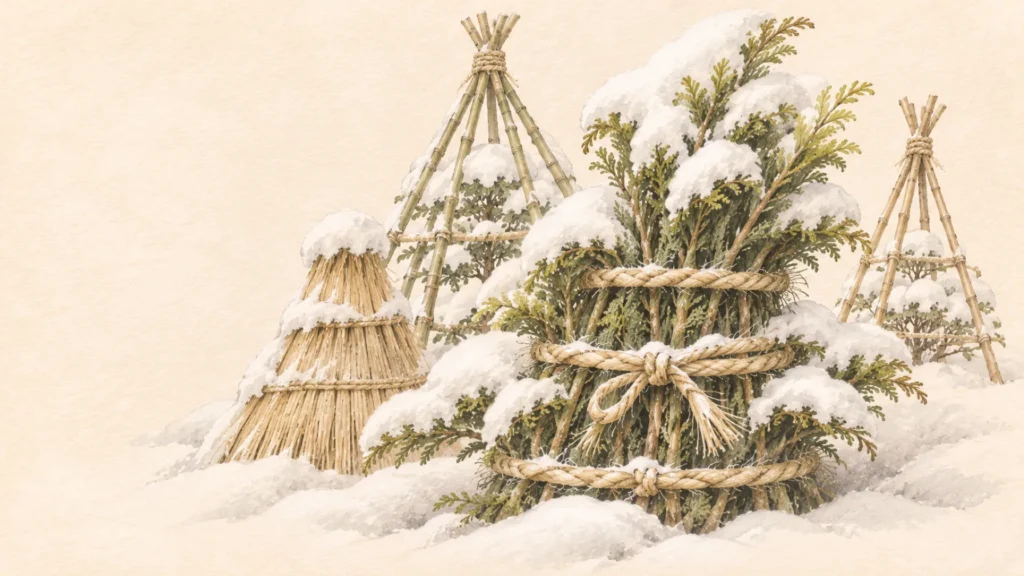
Fuyugakoi (冬囲い) is the winter enclosure that gardeners in Japan’s snow country build around shrubs, hedges and young trees each autumn, before the lasting snow. They do it because deep snow does not simply sit on a buried shrub: as the snowpack settles, it drags the branches down with a force far larger than the weight of the snow directly above them, while dry winter wind over frozen ground strips water from evergreen leaves. Gathering the branches with straw rope and enclosing them in bamboo, straw mats or boards can reduce that damage. Below: one season of the work in Sapporo and beyond, what the snow does to a shrub, the forms and materials, how one enclosure is built, and how it compares with North American practice.
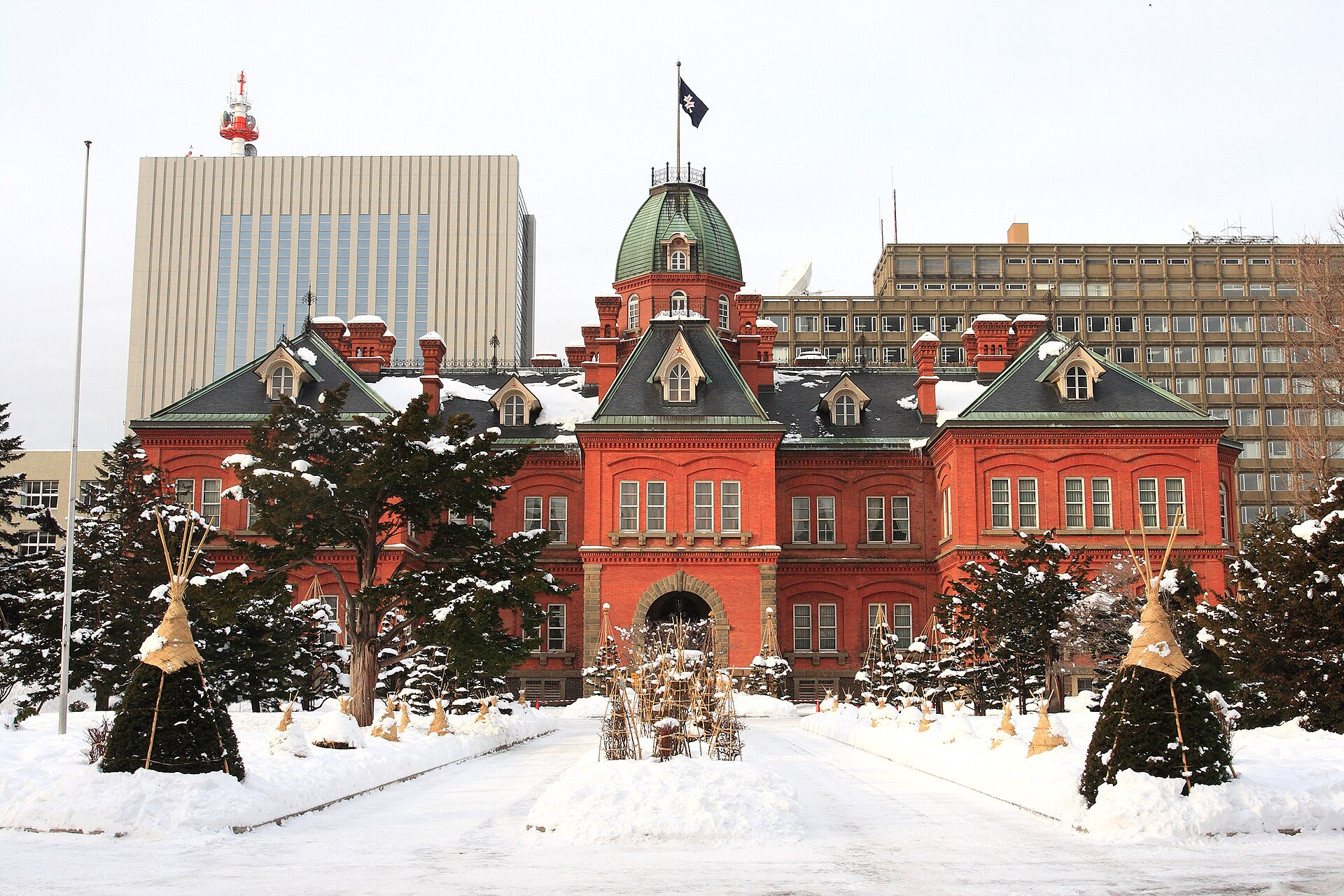
A park dressed for winter — Sapporo in November
Odori Park changes its clothes
On 5 November 2025, the winter enclosure work at Sapporo’s Odori Park began in the park’s Nishi 1-chome block. The park’s own staff describe fuyugakoi as the park’s fuyu no fūbutsushi (冬の風物詩), a “seasonal sight of winter”, and in a 2022 post they called the same job a change of clothes for the coming season. That year the crews wrapped about 2,300 plants — azaleas, Japanese yews, lilacs and roses — using bamboo and mushiro (筵) straw mats, and they planned roughly two weeks to work their way down the park, finishing each plant “one by one, carefully and briskly”.
When the Odori Park job was done in November 2025, the same workers moved straight on to Sōseigawa Park. That is a northern gardener’s November: one park after another, each shrub tied before the lasting snow.
The same month, all along the snow belt
Sapporo is not unusual. In Hirosaki, in Aomori Prefecture, the city’s park staff begin enclosing the trees of Hirosaki Park around 20 November, depending on the weather, using logs and boards of hiba (Japanese thujopsis) “as if building a simple house” around each tree. At Takada Castle Site Park in Jōetsu, Niigata Prefecture, crews were already enclosing about 5,000 trees and shrubs, including satsuki and other azaleas, with bamboo and rope by 21 October 2026. Farther south, the management rules for a sports park near Toyama city list yukigakoi (雪囲い) once a year, in November or December, as a fixed line in the gardeners’ annual contract.
A word for the season
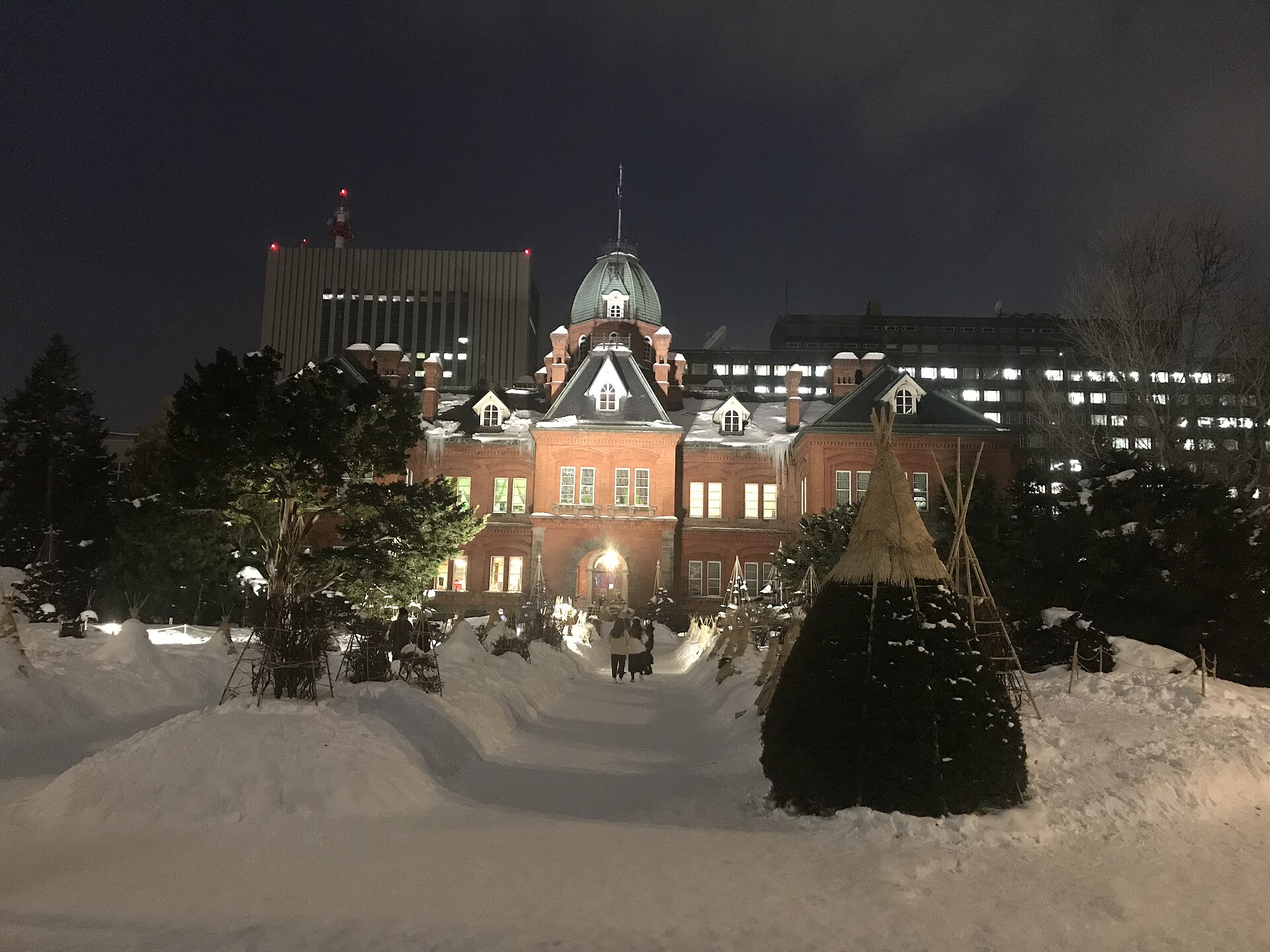
The practice has entered the poetic calendar. In the Kigosai saijiki, the reference list of seasonal words for haiku, yukigakoi is a winter season word for all three months of winter, and fuyugakoi is listed beside it as one of its companion terms, together with yukigaki (snow fence) and yukigomo (snow mat).
Why snow breaks shrubs — settling, not just weight
Snow that keeps sinking
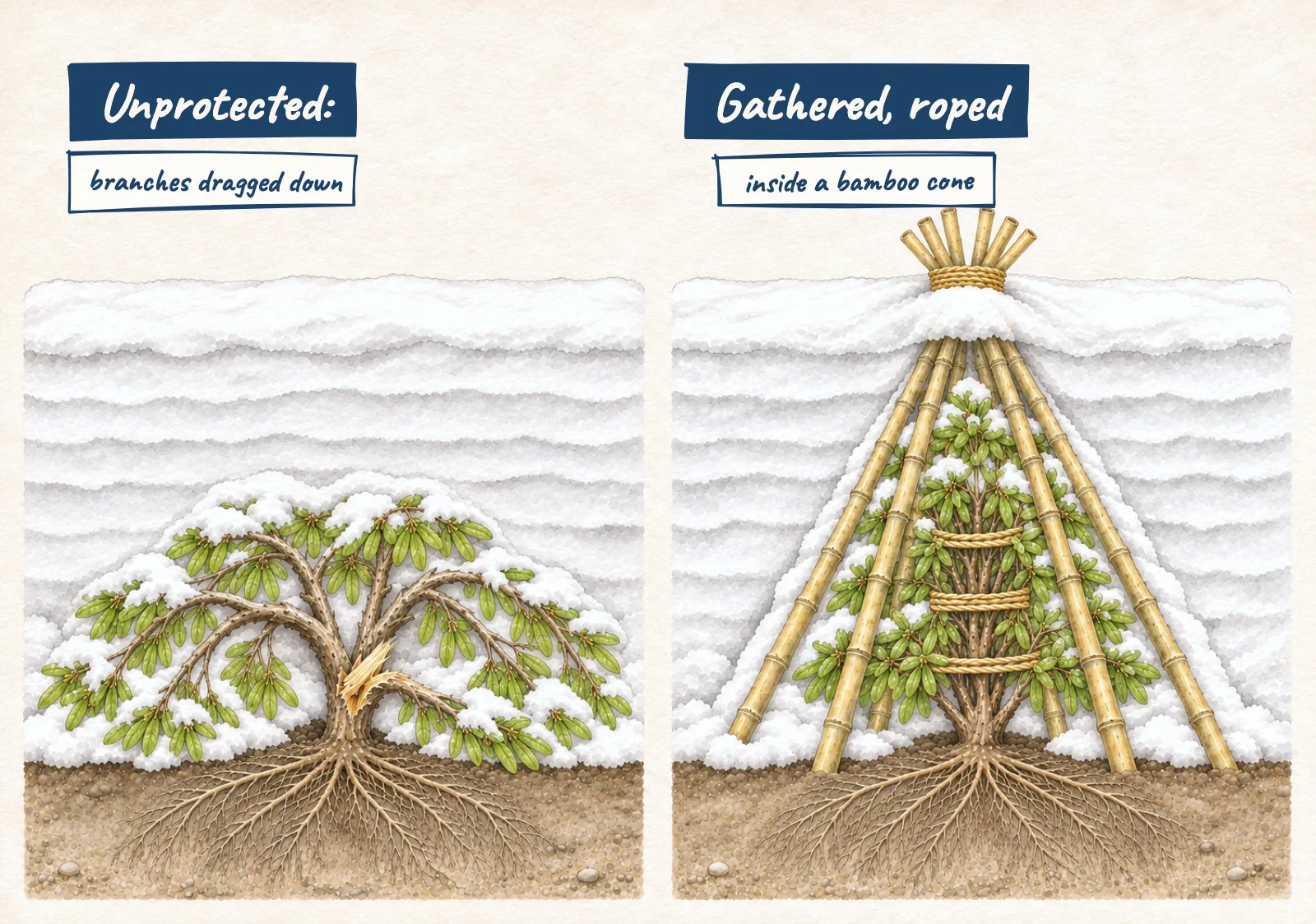
The problem is what happens after the snow lands. Japan’s Forestry and Forest Products Research Institute (FFPRI) explains that a snowpack keeps shrinking and sinking under its own weight with time, “even if the air temperature is below zero”. Because the snow grains bond to one another, a branch buried inside that sinking layer is not loaded only by the column of snow sitting on top of it. The institute says the downward settling force on the branch is “far larger than the weight of the snow above the branch’s horizontal projected area” — the snow on either side is effectively hanging from the branch as it sinks.
Prolonged settlement can drag branches downward and sometimes tear them from the trunk. A study for the Hokkaido Regional Development Bureau on forest belts planted to control blowing snow noted that under long, slow settlement by snow compaction, branches may not break at all; in some cases “the branch is pulled out of the trunk”.
Wet snow, heavy snow
The Sea of Japan side of the country gets its snow from the winter monsoon. The Japan Meteorological Agency explains that the cold northwest wind picks up moisture as it crosses the relatively warm Sea of Japan, building snow clouds that unload on the coast and mountains. In Nagaoka, Niigata, the National Research Institute for Earth Science and Disaster Resilience (NIED) notes that snow falls at temperatures close to melting, so wet, water-bearing snow is a characteristic local condition.
Settled snow can also be dense. NIED’s public snow-load guidance gives a reference weight of 300–500 kg per cubic metre for granular (zarame) snow, and measurements by the Civil Engineering Research Institute for Cold Region in the Jōzankei Dam basin outside Sapporo found late-season granular snow stabilising at around 0.4–0.5 g/cm³.
How much snow is “snow country”?
| City | Normal annual snowfall (1991–2020) | Normal annual maximum snow depth |
|---|---|---|
| Aomori | 567 cm (223 in) | 101 cm (40 in) |
| Sapporo | 479 cm (189 in) | 97 cm (38 in) |
| Kanazawa | 157 cm (62 in) | 32 cm (13 in) |
| Niigata | 139 cm (55 in) | 32 cm (13 in) |
Source: Japan Meteorological Agency normals, 1991–2020.
Aomori City’s own snow-management plan describes it as one of the snowiest cities in the world for its size of around 300,000 people. With a normal maximum depth near one metre, an ordinary winter in Aomori or Sapporo buries a waist-high shrub completely.
Where snow ropes stop and enclosures start
The cone of ropes hung over a pine in a Japanese garden, yukitsuri, is mainly about snow sitting on the long limbs of a tall tree. Fuyugakoi is mainly about plants that end up inside the snowpack — azaleas, yews, roses, hedges and young trees — though the terms and techniques overlap: a Hokkaido national park specifies branch gathering with straw rope as a winter enclosure for tall trees.
The second enemy — wind over frozen ground
Winter drought
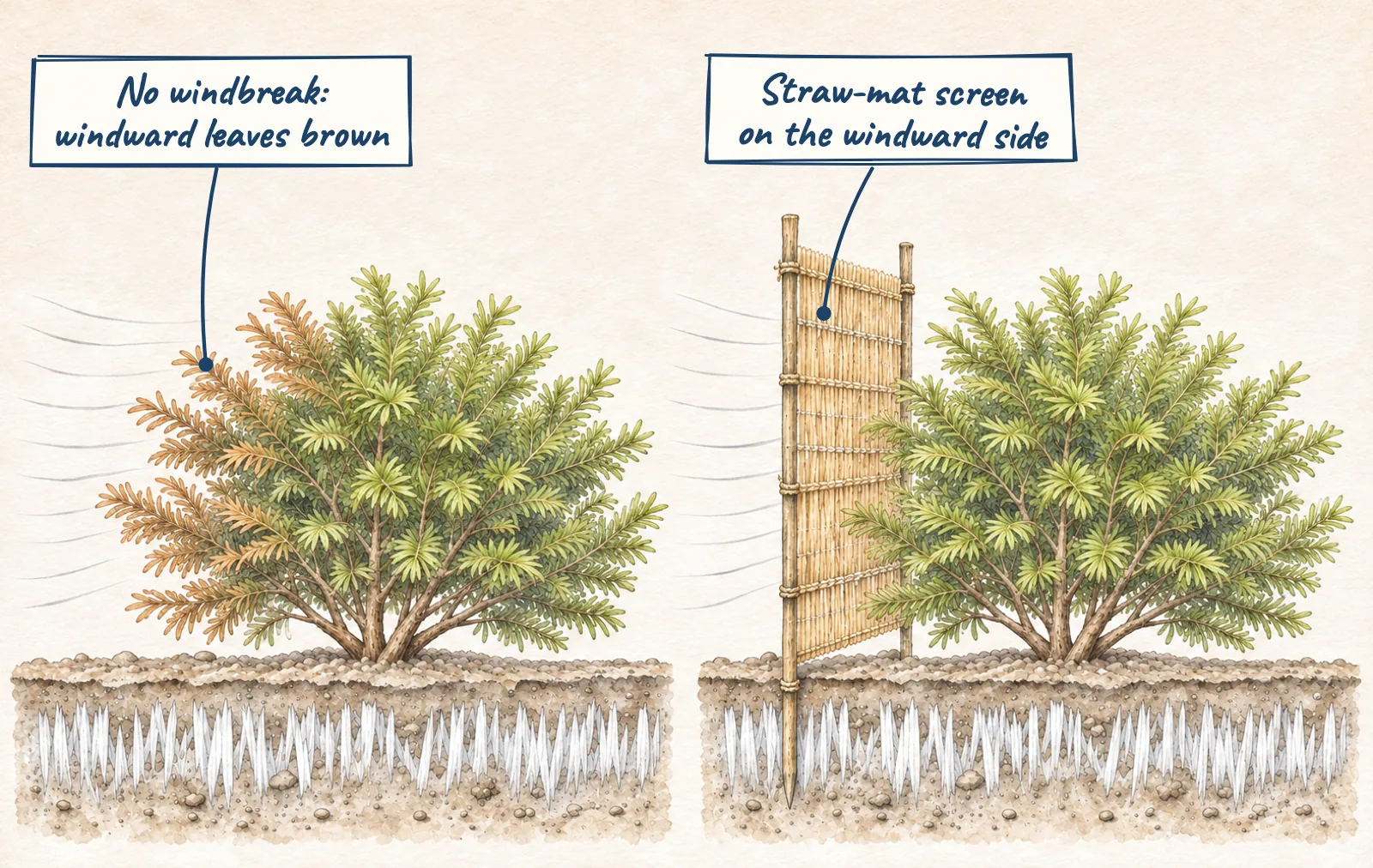
Snow is not the only reason for the mats. The Hokkaido Forestry Research Institute defines winter desiccation injury as damage that occurs when the upward movement of water is held back — by frozen soil or frozen stems — while the tree is exposed to drying wind. The roots cannot replace the water the leaves are losing. Freezing injury, by the same institute’s definition, is a separate problem: damage that happens when plant tissue is cooled below the temperature it can tolerate.
Evergreen conifers are vulnerable to the first problem. The Civil Engineering Research Institute for Cold Region’s guidance on roadside planting in Hokkaido notes that evergreen conifers, because they do not drop their leaves, are “prone to forced dehydration from the leaf surface by strong wind even while dormant”. That is why its planting guidance recommends a winter enclosure for evergreen conifers planted in late autumn, to protect them from strong wind.
Mats against wind, rope against snow
The materials divide the work. The Hokkaido Forestry Research Institute’s homeowner leaflet on garden-tree enclosures pairs the problem “frozen soil and dry wind” with the answer “reduce wind exposure with mushiro mats”. Sapporo’s park association, in its gardening newsletter, pairs the snow problem with stakes and rope: “to protect trees from branch breakage and branch splitting caused by snow, we put up stakes and wrap them with rope”.
Sapporo’s guidance adds two details. Less cold-hardy flowering shrubs such as tree peonies, satsuki and the azalea hinode-tsutsuji get a straw komo cover as well. And where the edges of a windbreak net or a komo wrap overlap, the seam should face south, away from the cold wind.
The words and the materials — bamboo, straw, rope and boards
Fuyugakoi or yukigakoi?
Japanese uses two words, and they overlap. The Shogakukan Digital Daijisen dictionary defines yukigakoi (雪囲い) as surrounding garden trees with mushiro or straw “to protect them from snow and frost”, and also as the enclosure built around a house in snow country to keep out wind and snow. The Nihon Kokugo Daijiten gives fuyugakoi (冬囲い) as an equivalent of yukigakoi. In practice, the Sapporo park association observes that people tend to say fuyugakoi when the object is trees and flowering shrubs, and yukigakoi for measures that cover a wider range of things, buildings included. This article uses fuyugakoi for the garden version.
Nemagaridake — the bamboo of the north
The bamboo in the Hokkaido examples below is not tall timber bamboo but nemagaridake (根曲竹), the “bent-root bamboo”, which the Hokkaido Forestry Research Institute identifies as the Hokkaido name for the dwarf bamboo Chishima-zasa, Sasa kurilensis. Sapporo’s Hiraoka Tree Art Center teaches its introductory fuyugakoi course using “nemagari bamboo and straw rope”.
The garden of the Hokkaido Government’s main office specification lists 219 locations for winter protection with 7-shaku (about 2.1 m, 7 ft) nemagari bamboo plus komo wrapping, plus 75 locations with the same bamboo wrapped in rope only.
Straw, in two thicknesses
| Material | Japanese | What it is | Job in the enclosure |
|---|---|---|---|
| Nemagari bamboo | 根曲竹 | Thin canes of Sasa kurilensis | Poles of the cone |
| Straw rope | わら縄 | Rope twisted from rice straw | Gathering branches; tying poles |
| Mushiro | 筵 | Woven mat of straw, rush, sedge or bamboo | Thick wrap against wind |
| Komo | 菰・薦 | Coarse mat, once of makomo, now mostly straw | Thin wrap around a plant |
| Logs | 丸太 | Peeled sugi, hinoki or larch | Frames for hedges, lean-to roofs |
| Boards | 板 | e.g. hiba boards in Hirosaki | Walls and roofs of a box enclosure |
| Shuro rope | シュロ縄 | Palm-fibre rope | Ties; sold for winter protection |
The difference between the two mats is thickness. A 2024 technical report by the Japanese Institute of Landscape Architecture on traditional garden craft states that the thick mat used spread underneath is called mushiro, and the thinner one wrapped around trees is called komo. The Digital Daijisen adds that komo was originally a coarse mat of makomo (Manchurian wild rice), though straw is now usually used. The Hokkaido Museum lists straw rope and mushiro among the everyday things made from rice straw left after threshing.
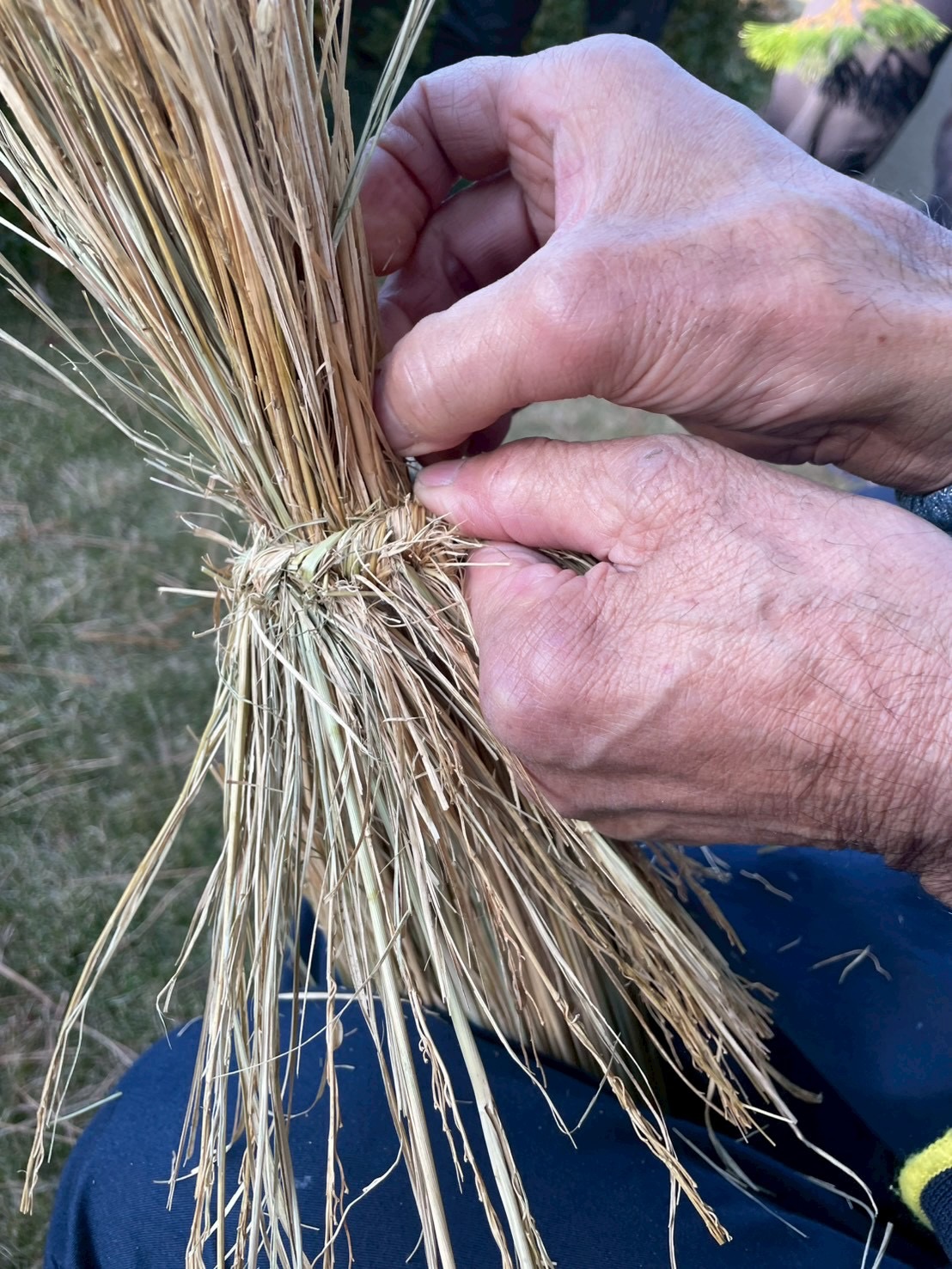
The national park-works specification allows peeled sugi, hinoki or larch logs for frames, and a Japanese home-improvement chain sells mushiro, straw rope, komo and shuro rope side by side for winter protection.
The forms — a gardener’s vocabulary
From one loop of rope to a small house
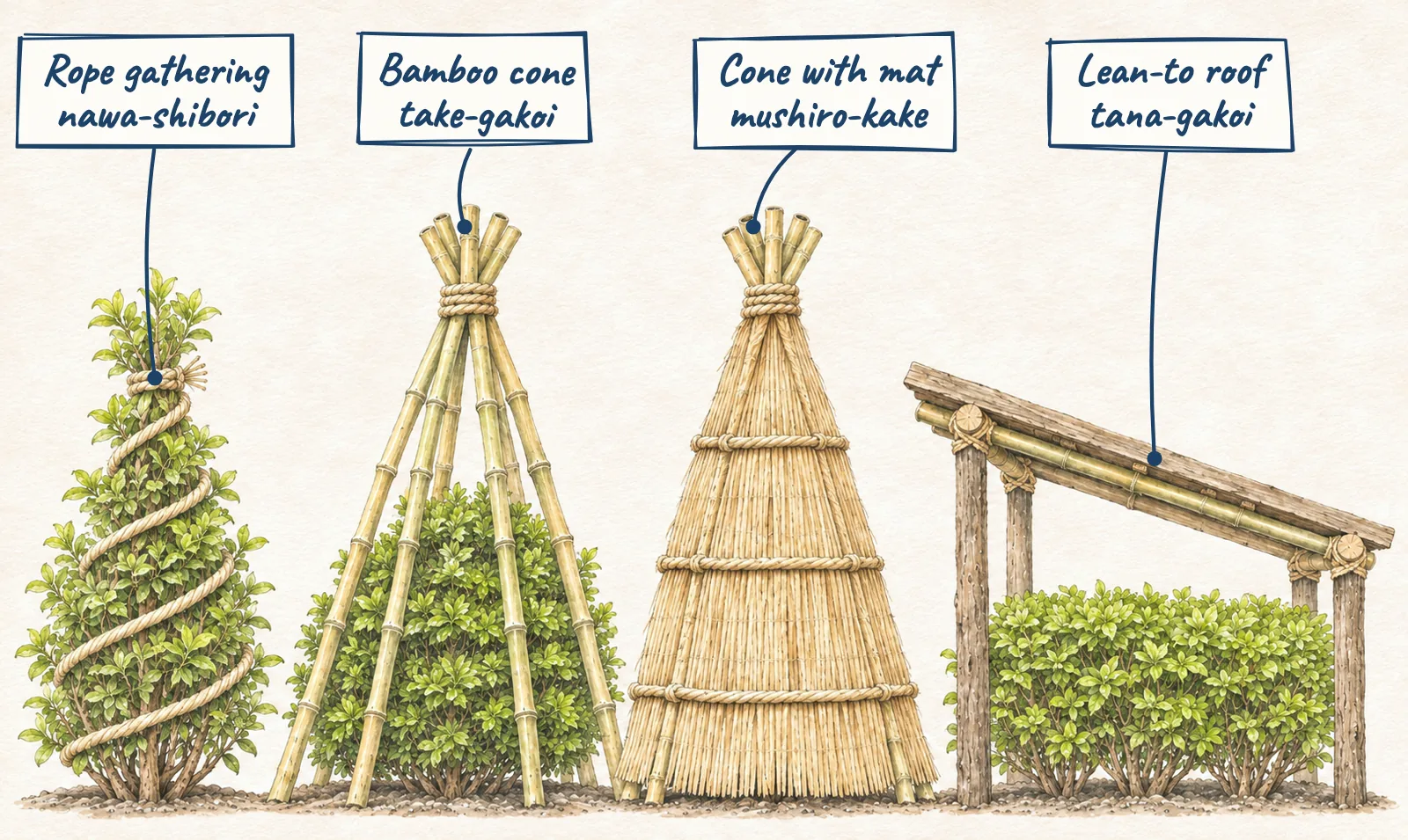
Fuyugakoi is a family of forms, chosen by the plant’s size, shape and exposure. The landscape-architecture report lists gathering (shibori), hanging (tsuri) and the A-frame gasshō type as techniques that stop small and medium trees from splitting or being crushed under snow, and describes a single-slope tana-gakoi, a shelf “made of logs and bamboo” over the plants.
Which plant gets which form
| Form | Japanese | How it is made | Documented example |
|---|---|---|---|
| Rope gathering | 縄しぼり | Outward branches lifted, tied with straw rope at 2–3 points | Azaleas, Akita City glass studio |
| Single rope wrap | 縄1回巻き | One wrap of rope round the gathered crown | Tsuge and dodan-tsutsuji, Sapporo parks |
| Branch gathering on trees | 枝しおり | Branches drawn in with straw rope | Taller trees, Takino Suzuran Hillside Park |
| Bamboo cone | 竹囲い | Nemagari bamboo around the plant, tied at the top | Roses, Nakajima Park (3 canes) |
| Bamboo cone plus mat | 竹囲い+むしろ掛け | Six canes plus one mushiro | Shrubs, Sapporo type G |
| Woven bamboo and mats | 晒竹編み・筵掛け | Woven bamboo with mushiro coverings | Hinode azaleas, Sapporo City University |
| Log frame | 丸太囲い | Logs over a hedge or set in a cone | Hedges, Hokkaido Forestry Research Institute |
| Board enclosure | 板囲い | Logs and boards built like a hut | Trees in Hirosaki Park |
These are assignments from real specifications, not universal rules. Read together, they suggest the questions a gardener asks: Is the plant small and flexible enough to gather (the Akita azaleas)? Will it be buried, so it needs a frame (Sapporo’s bamboo cones)? Is it a tender flowering shrub that also needs a komo cover (Sapporo’s satsuki and peonies)? Is it an evergreen conifer planted late in autumn, exposed to strong wind (the cold-region roadside guidance)? Or is it a hedge that cannot be drawn into a point? The Hokkaido Forestry Research Institute says of its own hedges simply: “we build frames of logs to protect the hedge from the weight of the snow”. For one hedge plant that is grown in cold parts of Japan, see our article on Japanese holly as a boxwood alternative.
Why the cone
The cone is functional. The snow science society’s Hokkaido branch notes, in a report on snow damage, that log enclosures can deal with the problem: “by standing logs up in a cone, snow damage can be reduced”. The report does not spell out the mechanics; a reasonable reading is that a steep cone gives settling snow less to hold on and puts more of the load on poles set in the ground rather than on the branches.
Building one — a bamboo cone, step by step
The sequence below is simplified from the specifications and guidance quoted above; real crews adapt it to each plant.
Before you start: wait for the cold
One mistake is starting too early. The Hokkaido Forestry Research Institute advises letting trees meet natural cold first, so they develop full cold hardiness, before enclosing them in mushiro or komo. Sapporo’s park association warns that while the plant still carries plenty of leaves “it is still too early” — tie it up then and moisture can be trapped inside.
Step 1 — Gather the branches
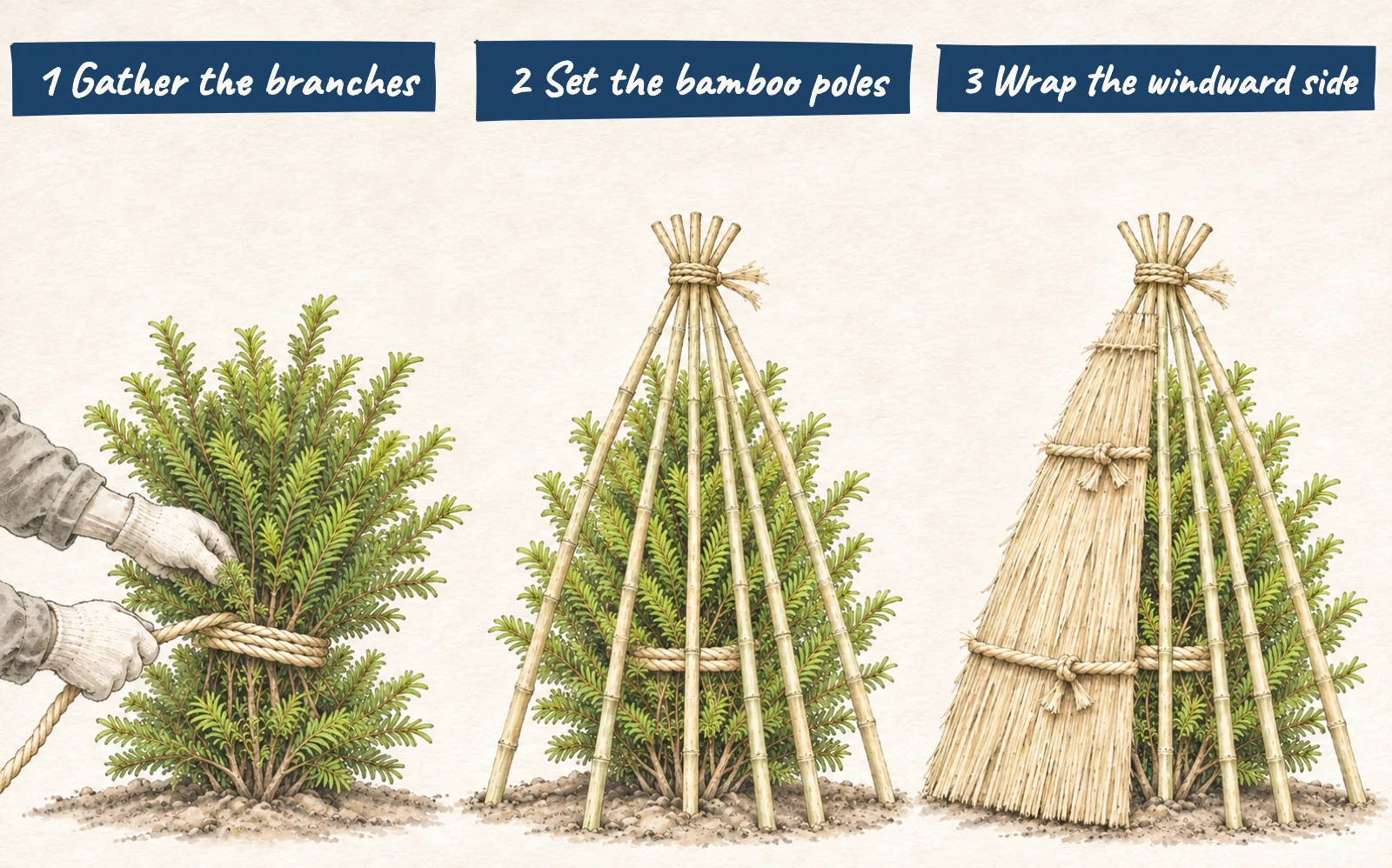
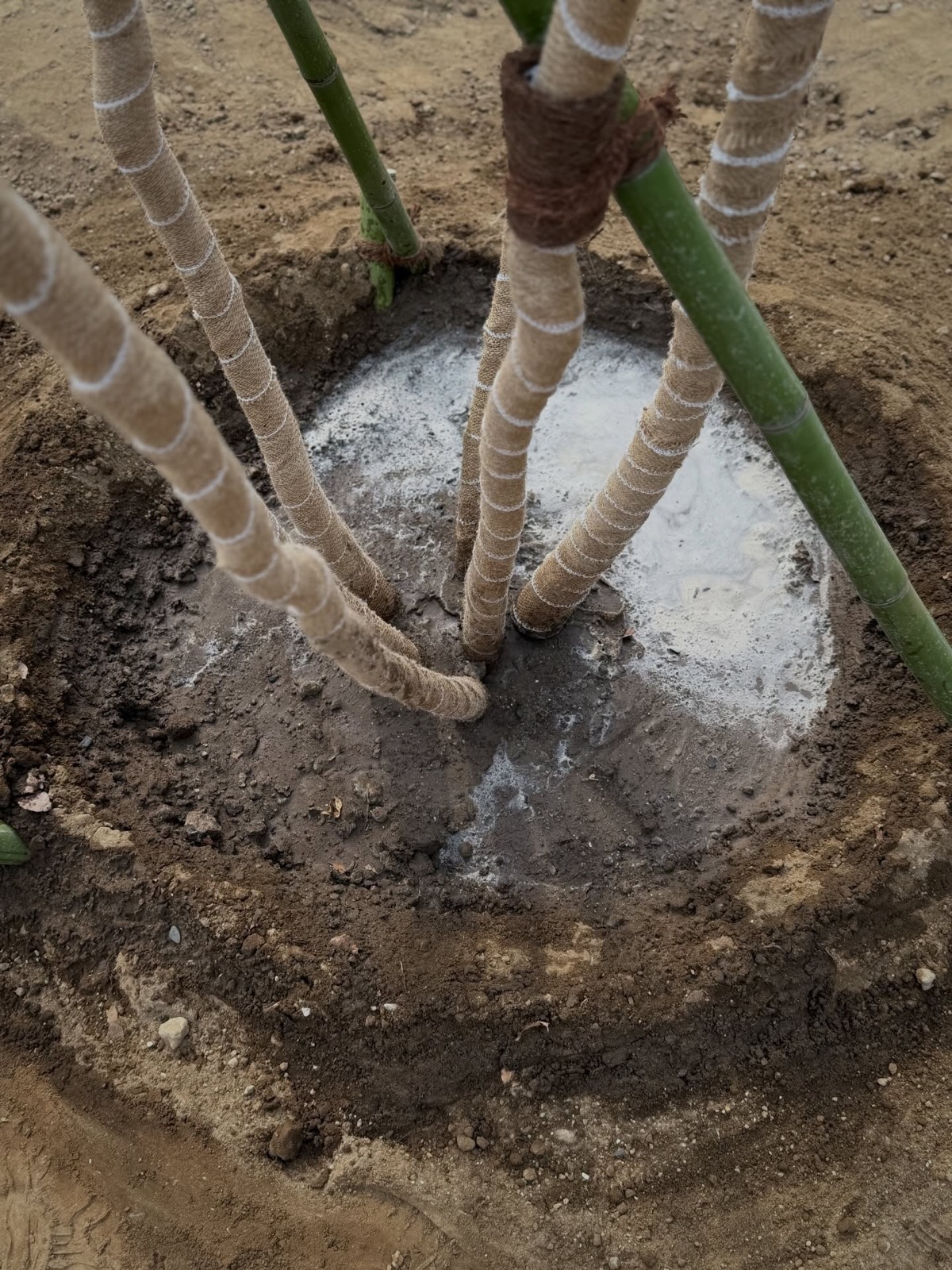
Lift the outward-spreading branches toward the centre and tie them. Akita City’s maintenance specification for azaleas puts it in one sentence: the enclosure is “rope gathering”, the outward branches are “lifted up” and “fixed with straw rope at about two or three places”. The landscape-architecture report describes the same move for larger shrubs as drawing the branches toward the trunk and winding the rope upward. The aim is a narrow, upright bundle with no branch sticking out sideways for the snow to catch.
Step 2 — Set the poles
Set the bamboo canes around the gathered plant and bring the tops together. Sapporo’s standard shrub enclosure, type G, uses six nemagari canes; a single rose at Nakajima Park gets three, with coarse straw rope wound up them. Tie the tips together firmly with straw rope.
Step 3 — Wrap where the wind comes from
If the site is exposed or the plant is tender, wrap a mushiro or komo around the cone and tie it on — Sapporo type G is six canes plus one mushiro. Where a cover overlaps, Sapporo’s guidance is to face the seam south.
Step 4 — Check again before the snow
The Asahikawa park association reminds gardeners to re-inspect enclosures before snow accumulates, and to redo any spot where a rope has loosened or come off.
This is a skill Sapporo still teaches in public. On 11 October 2016, participants at the Hiraoka Tree Art Center learned how to put on the rope and how to insert the nemagari canes, then each enclosed one tree themselves. For 4 October 2026 the same center advertised a full-day practical course on enclosing shrubs and trees, and Toyohira Park’s Green Center scheduled a two-hour class with 20 places, at ¥500 each, called “Fuyugakoi, starting with rope knots”.
The calendar — when it goes up, when it comes off
November in, April out
| Place | Goes up | Comes off |
|---|---|---|
| Odori Park, Sapporo | From 5 Nov (2025) | From 3 Apr (2026) |
| Hokkaido Government office garden | Nov–Dec | April |
| Sapporo City University | Early Nov (planned, 2024) | Early May (planned, 2024) |
| Hirosaki Park, Aomori | Around 20 Nov | — |
| Araya Glass Studio, Akita | Late Nov to mid-Dec, before snow | From mid-March, after snowmelt |
| Takada Castle Site Park, Niigata | Under way by 21 Oct (2026) | From 5 Mar (2026, previous winter) |
| Sports park near Toyama | Nov–Dec | — |
The years differ, so read the table as examples, not one season. Within Sapporo alone, removal ranges from Odori Park’s start on 3 April 2026 to the early May planned by Sapporo City University in 2024.
Taking it off slowly
Removal has its own rule. The Toyohira Park Green Center advises taking enclosures and snow ropes off once the soil has dried, and opening a komo wrap gradually so the plant gets used to the air before the wrap comes off entirely. Sapporo’s tree-planting fund puts it more precisely: first open part of the komo to let air through, and once it has turned warm, take it off “on a cloudy day”.
Tokyo’s version — warabocchi, when there is little snow
Winter scenery by design
South of the snow belt, similar straw forms are used for frost protection, for decoration, or both, rather than mainly to resist deep settling snow. Tokyo rarely gets enough snow to crush a shrub, but its historic gardens still put up snow ropes and frost covers. The Tokyo Metropolitan Park Association says of Rikugien plainly: “in Tokyo, where little snow accumulates, we carry out snow ropes and frost protection to create a winter landscape”. Tokyo’s official 2026 guide to its Japanese gardens lists snow ropes, frost covers and komo wrapping at Hama-rikyū as a November-to-February feature.
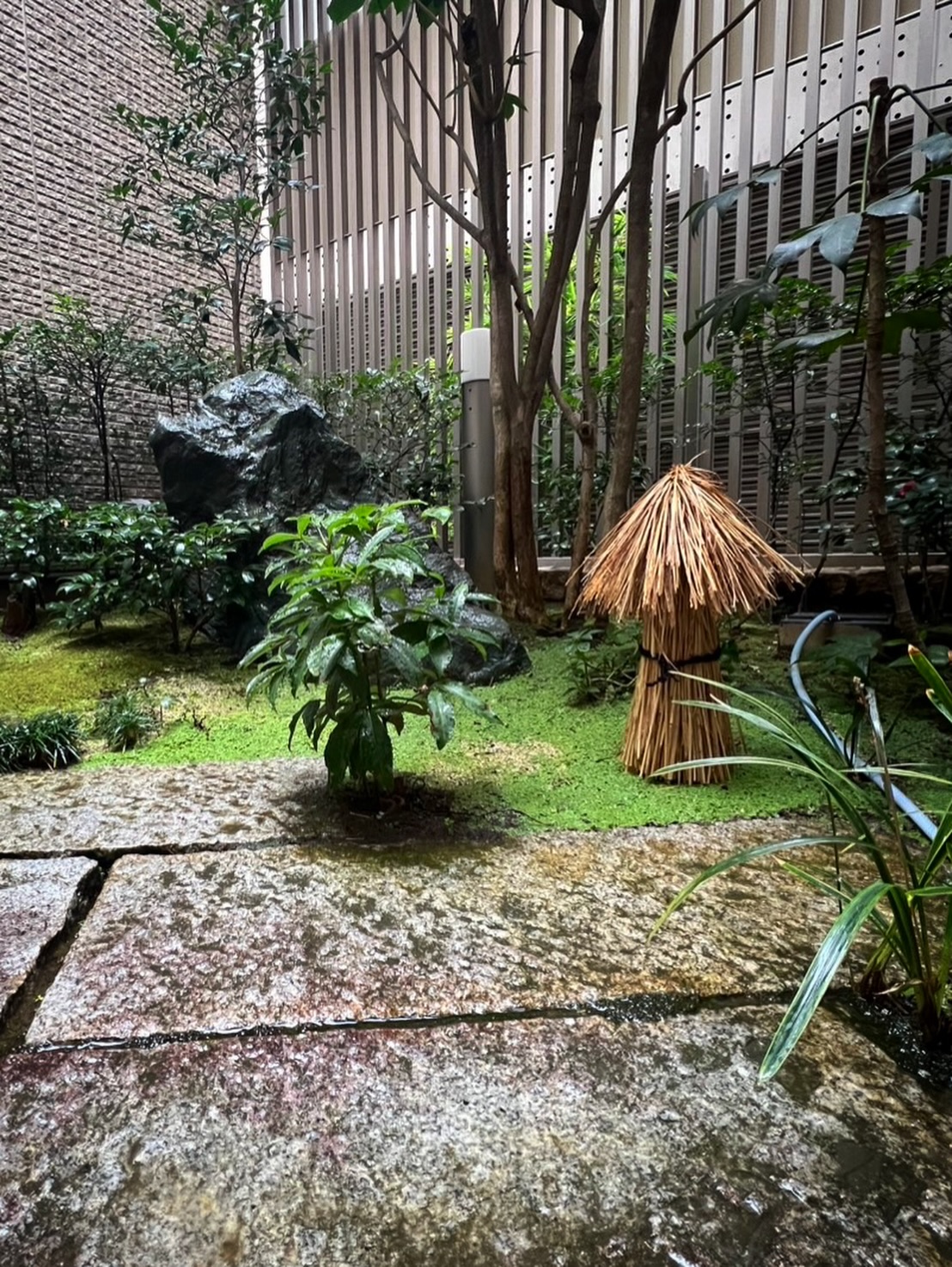
What a warabocchi is
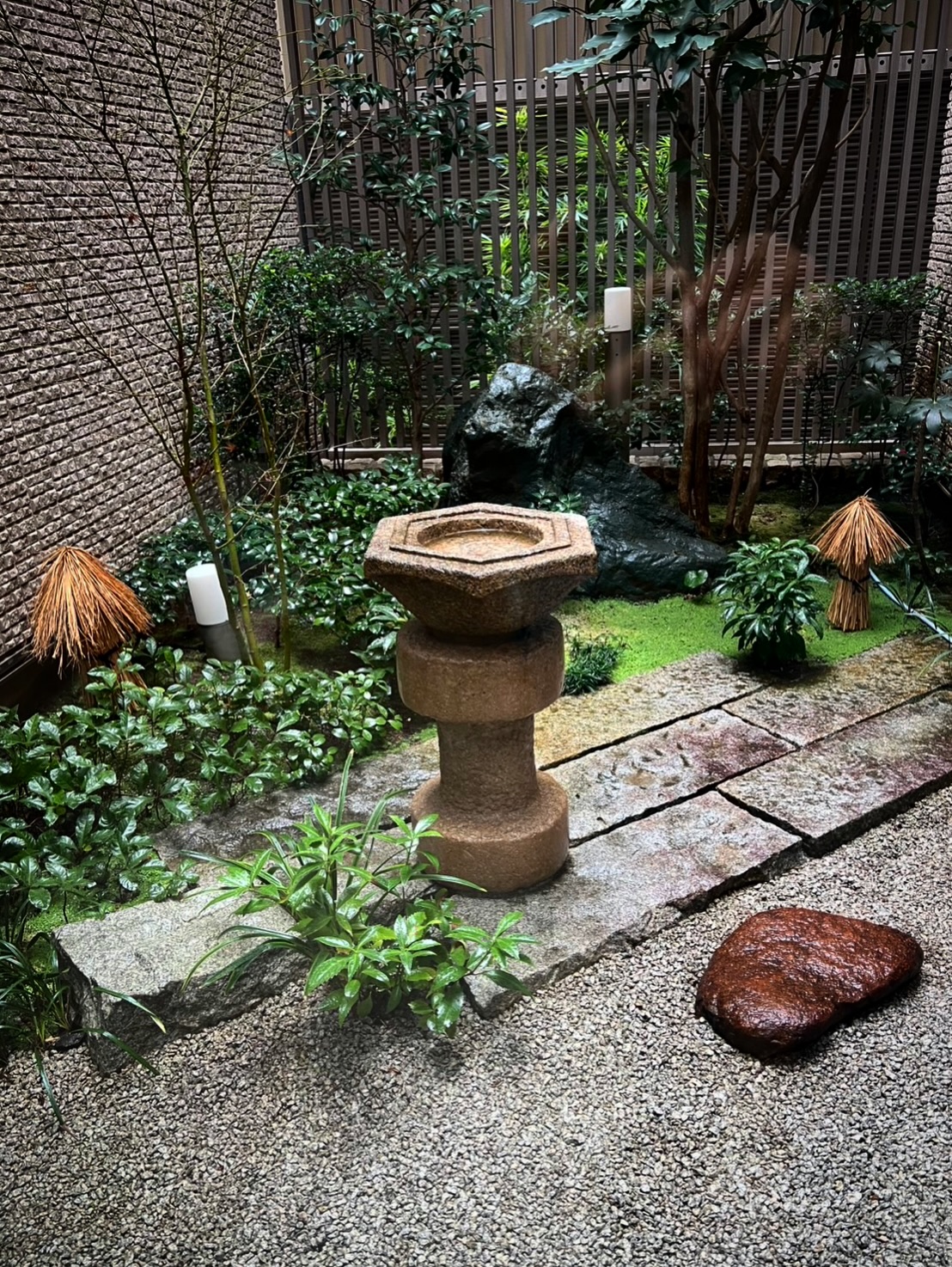
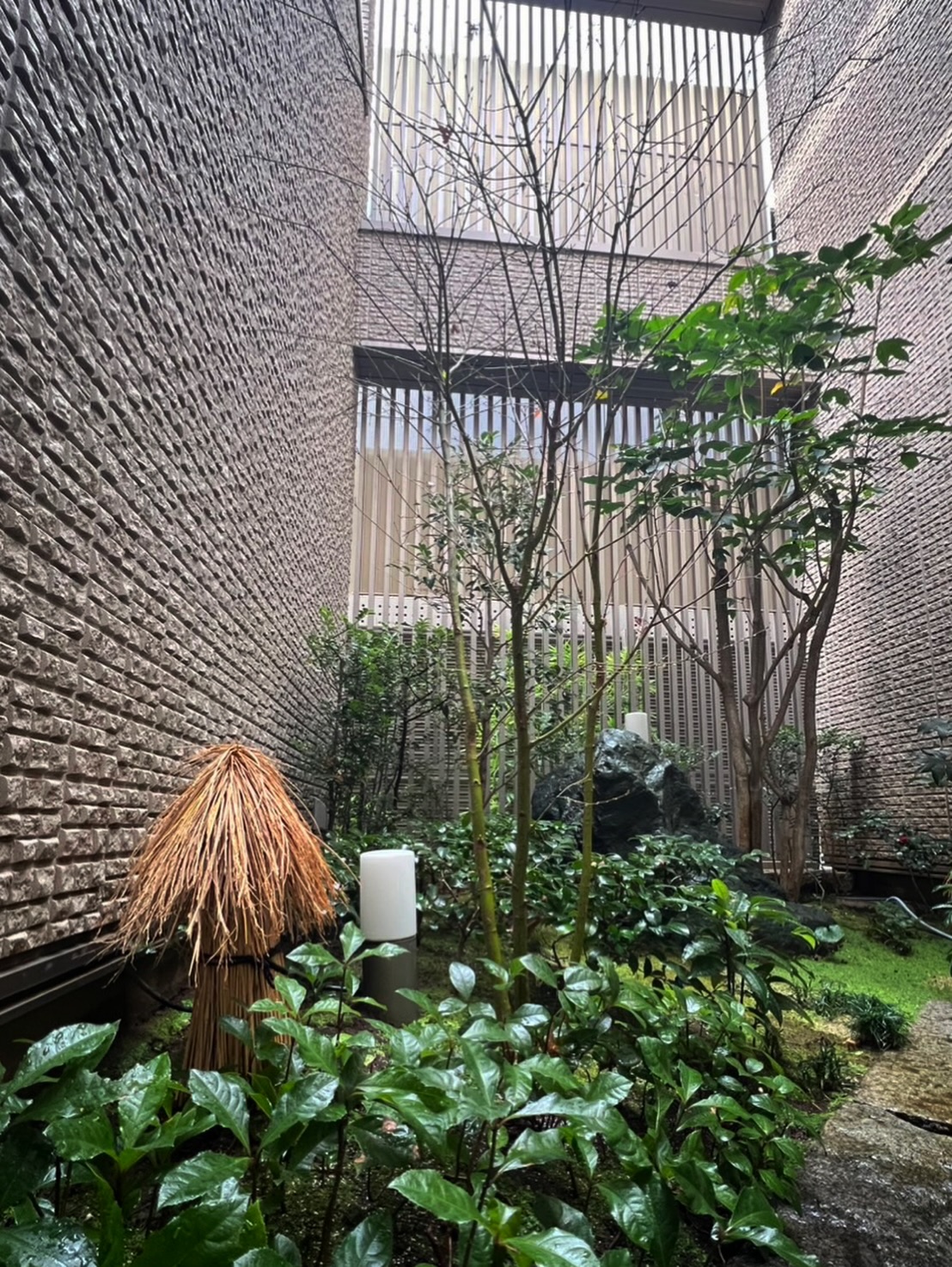
The straw cone in those gardens has its own name. The Tokyo Metropolitan Park Association defines warabocchi (藁ぼっち) as “an enclosure woven from straw and placed over a plant, for both cold protection and decoration”. At the peony garden of Ueno Tōshōgū, winter-flowering peonies bloom under rows of “frost-protecting warabocchi”, which the garden also calls waragakoi, straw enclosures. At Koishikawa Kōrakuen, the garden notes that its warabocchi are ornamental, with straw built around a post. Cycads, which dislike cold, get a frost cover at Kyū-Shiba-rikyū from December through February, and Kyoto Botanical Gardens starts wrapping its cycads in komo each December to protect them from cold and freezing injury.
Our crew’s winter work
Our own work is in Tokyo, and the courtyard photographs here were taken by our team. A Tokyo warabocchi rarely has to hold off a metre of settling snow; it serves, as the park association puts it, both cold protection and decoration. Visually, its cone and straw ties echo the northern enclosures on a courtyard scale.
Not the same as komomaki
One thing a visitor can easily confuse: the straw band around the trunk of a pine. The Shukkeien garden in Hiroshima makes the distinction itself: “even with the same komo-maki, the purpose differs between pine and cycad: for pines it is pest control, for cycads it is protection from cold”. The trunk band is not fuyugakoi. Fuyugakoi encloses the plant; the pine band is a separate tradition we will look at in its own article.
How North American winter protection compares
Burlap, fences and frames
Gardeners in cold parts of North America face the same two problems. University of Minnesota Extension recommends building a barrier “of burlap or similar material” on the south, southwest and windward sides of vulnerable evergreens. Michigan State University Extension suggests barriers of burlap or wooden or plastic snow fence to cut exposure to the prevailing winter wind. University of New Hampshire Extension notes that “placing wooden frames over plants can keep them from getting crushed” by heavy snow, and that compact evergreens such as arborvitae can be wrapped completely in burlap. Cornell Cooperative Extension suggests plywood “tents” where snow sliding off a roof could break branches.
| Problem | Northern Japan | North American extension advice |
|---|---|---|
| Heavy snow on a shrub | Gather branches with straw rope; bamboo cone | Wooden frame over the plant |
| Shelter over low plants | Log and bamboo lean-to (tana-gakoi) | Plywood “tent” against roof slides |
| Dry wind over frozen soil | Mushiro mat on the windward side, seam to the south | Burlap barrier on south, southwest and windward sides; snow fence |
| Whole-plant cover | Mat-wrapped cone | Burlap wrap round the whole plant |
| Sprays | Not mentioned in the Japanese sources cited here | Anti-desiccants: not effective (Minnesota); can help or harm depending on use (New Hampshire) |
Same physics, different starting points
The two sets of advice address the same problems. In the Japanese examples cited here, gathering the branches before building around them is prominent; Japanese gardens are also full of shrubs already clipped into tight, rounded forms, as in karikomi, which suits that approach. The North American guidance concentrates on barriers, frames and wraps around the plant. On sprays, Minnesota’s extension service states that anti-desiccant sprays “are not effective” and New Hampshire’s that they can be ineffective or even damaging if misused; the Japanese sources cited here describe physical protection only.
Common mistakes and misreadings
Four ways it goes wrong
- Wrapping too early. A plant enclosed in full leaf, before natural cold has hardened it, can trap moisture under the mat.
- Leaving branches outside the cage. Every branch left out is a lever for the settling snow. Gather first, then build.
- Unwrapping all at once. Open the mats in stages, then remove them on a cloudy day once the soil has dried.
- Copying the look only. Koishikawa Kōrakuen describes its warabocchi as ornamental; in Sapporo or Jōetsu the enclosure is there for the snow. A northern-style cone is meant to work, not just to be seen.
What it does not do
Fuyugakoi is not one remedy but a set of measures against several problems — snow settlement and load, drying wind over frozen soil, and cold injury to less hardy plants — and the right form depends on the plant and the site. It cannot replace choosing plants suited to the local climate.
Frequently asked questions
What is fuyugakoi? Fuyugakoi (冬囲い) is the winter enclosure Japanese gardeners build around shrubs, hedges and young trees in snowy regions, from straw rope, bamboo, straw mats, logs or boards, against settling snow and drying wind.
How is fuyugakoi different from yukitsuri? Yukitsuri mainly supports the limbs of tall trees with ropes from above. Fuyugakoi mainly encloses smaller plants that will be buried in the snowpack, gathering their branches and framing them against settling snow. The terms and techniques overlap.
When is fuyugakoi put up and taken down? In the examples cited here, enclosures go up between October and December, before the lasting snow. Removal runs from March to early May; Sapporo’s guidance is to wait until the soil has dried.
What materials are used? Straw rope, thin nemagari bamboo (Sasa kurilensis), mushiro and komo straw mats, peeled logs, boards such as hiba, and sometimes shuro rope or windbreak netting.
Why are the enclosures shaped like cones? Hokkaido snow researchers note that logs stood in a cone reduce snow damage; a steep cone likely gives settling snow less to grip and puts more of the load on poles set in the ground.
What is a warabocchi? A warabocchi (藁ぼっち) is a woven straw cover placed over a plant for both cold protection and decoration. Tokyo gardens use them, for example over winter peonies at Ueno Tōshōgū.
Sources
– Civil Engineering Research Institute for Cold Region, Technical guidance on roadside greening in Hokkaido, chapter 4 — https://scenic.ceri.go.jp/pdf_manual/greenery/greenery_04planting.pdf (checked 2026-10-30) – Civil Engineering Research Institute for Cold Region, chapter 6 (winter enclosures) — https://scenic.ceri.go.jp/pdf_dl/p6/class/class.log.php (checked 2026-10-30) – Japanese Institute of Landscape Architecture, 2022 research material on Japanese garden craft — https://researchpromotion.jila-zouen.org/wp-content/uploads/2022/05/1b3fa24ac90f8bc58bd430b496ea8c0e.pdf (checked 2026-10-30) – Hokkaido Development Bureau, Takino Suzuran Hillside Park management documents — https://www.hkd.mlit.go.jp/sp/keiyaku_kikaku/shiryou.pdf (checked 2026-10-30) – University of New Hampshire Extension, “How do I protect my trees and shrubs from winter damage?” — https://extension.unh.edu/blog/2019/09/how-do-i-protect-my-trees-shrubs-winter-damage (checked 2026-10-30) – Forestry and Forest Products Research Institute, “Forest environment Q7” — https://www.ffpri.go.jp/qa/environment/qa-env7.html (checked 2026-10-30) – Hokkaido Regional Development Bureau, study on snow-control forest belts — https://www.hkd.mlit.go.jp/ky/jg/gijyutu/slo5pa000001a6ux-att/slo5pa000001a78i.pdf (checked 2026-10-30) – Japanese Society of Snow and Ice, Hokkaido Branch, Hokkaido no Seppyo 32 — https://hokkaido.seppyo.org/prev/journal/j32/2013_snowhokkaido32_13_Saito.pdf (checked 2026-10-30) – Japan Meteorological Agency, climate normals 1991–2020 (Sapporo, Aomori, Kanazawa, Niigata) — https://www.data.jma.go.jp/stats/etrn/view/nml_sfc_ym.php?prec_no=14&block_no=47412&view=a4 (checked 2026-10-30) – Japan Meteorological Agency, “Rain and snow” FAQ — https://www.jma.go.jp/jma/kishou/know/faq/faq1.html (checked 2026-10-30) – NIED, Snow and Ice Research Center outline — https://www.bosai.go.jp/seppyo/about/o6cq9700000000vo-att/abstract_sirc.pdf (checked 2026-10-30) – NIED, snow-weight guidance — https://xview.bosai.go.jp/products/snow-weight/ (checked 2026-10-30) – Aomori City, Basic Plan for Snow Countermeasures — https://www.city.aomori.aomori.jp/kurashi_kankyo/kitaguni/1002456/1002457/1002458.html (checked 2026-10-30) – Hokkaido Forestry Research Institute, Report No. 9 on cold injury — https://www.hro.or.jp/forest/research/fri/koho/kanko/kenpo61/kenpo09.html (checked 2026-10-30) – Hokkaido Forestry Research Institute, Green Mail No. 10, garden-tree enclosures — https://www.hro.or.jp/upload/3487/grmail10.pdf (checked 2026-10-30) – Hokkaido Forestry Research Institute, hedge management Q&A — https://www.hro.or.jp/forest/research/fri/database/qandaitiran/iji.html (checked 2026-10-30) – Odori Park (Sapporo), news posts on winter enclosures, 2022–2026 — https://odori-park.jp/news/%E5%86%AC%E5%9B%B2%E3%81%84%E4%BD%9C%E6%A5%AD%E3%82%92%E9%96%8B%E5%A7%8B%E3%81%97%E3%81%BE%E3%81%97%E3%81%9F/ (checked 2026-10-30) – Sapporo Park and Greenery Association, Toyohira Park Green Center newsletters (2018, 2021, 2025) — https://www.sapporo-park.or.jp/toyohira/control-panel/wp-content/uploads/2025/10/85174f77f9dcbeac329649b5bd6c55c7.pdf (checked 2026-10-30) – City of Sapporo, park maintenance specifications (enclosure types D and G) — https://www.city.sapporo.jp/atsubetsu/sonota/keiyaku/documents/r8kyoutsuushiyousho.pdf (checked 2026-10-30) – Hokkaido Government, garden maintenance procedures (main office) — https://www.pref.hokkaido.lg.jp/fs/1/3/0/7/4/4/3/8/_/05-02_%E6%A5%AD%E5%8B%99%E5%87%A6%E7%90%86%E8%A6%81%E9%A0%98%28%E5%BA%AD%E5%9C%92%E6%9C%AC%E5%BA%81%E8%88%8E%29.pdf (checked 2026-10-30) – Hirosaki City, “Hirosaki Park’s snow enclosures” — https://www.hirosakigurashi.jp/2024/0112/9494/ (checked 2026-10-30) – Araya Glass Studio (Akita City), tree maintenance specification — https://www.araya-glass.akita.jp/uploads/contents/news_0000000321_00/03_siyou.pdf (checked 2026-10-30) – Japanese Institute of Landscape Architecture, 2024 report on Japanese garden craft — https://researchpromotion.jila-zouen.org/wp-content/uploads/2025/05/2024_nihonteien_seikahoukoku.pdf (checked 2026-10-30) – Kigosai, “Yukigakoi” — https://kigosai.sub.jp/001/archives/2833 (checked 2026-10-30) – Tokyo Metropolitan Park Association, winter highlights and Rikugien notice — https://www.tokyo-park.or.jp/special/migoro/winter.html (checked 2026-10-30) – Ueno Toshogu Peony Garden, winter peonies — https://uenobotanen.com/schedule/winter/ (checked 2026-10-30) – Shukkeien, “The people who support the garden” — https://shukkeien.jp/hitobito/ (checked 2026-10-30) – University of Minnesota Extension, “Protecting trees and shrubs in winter” — https://extension.umn.edu/planting-and-growing-guides/protecting-trees-and-shrubs-winter (checked 2026-10-30) – University of New Hampshire Extension, “Do my new evergreen shrubs need winter protection?” — https://extension.unh.edu/blog/2018/11/do-my-new-evergreen-shrubs-need-winter-protection (checked 2026-10-30) – Michigan State University Extension, “Tips for preparing landscape trees and shrubs for winter” — https://www.canr.msu.edu/news/tips_for_preparing_landscape_trees_and_shrubs_for_winter (checked 2026-10-30) – Cornell Cooperative Extension Tompkins County, “Prepare your garden for winter Q&A” — https://ccetompkins.org/resources/prepare-your-garden-for-winter-q-a (checked 2026-10-30)