

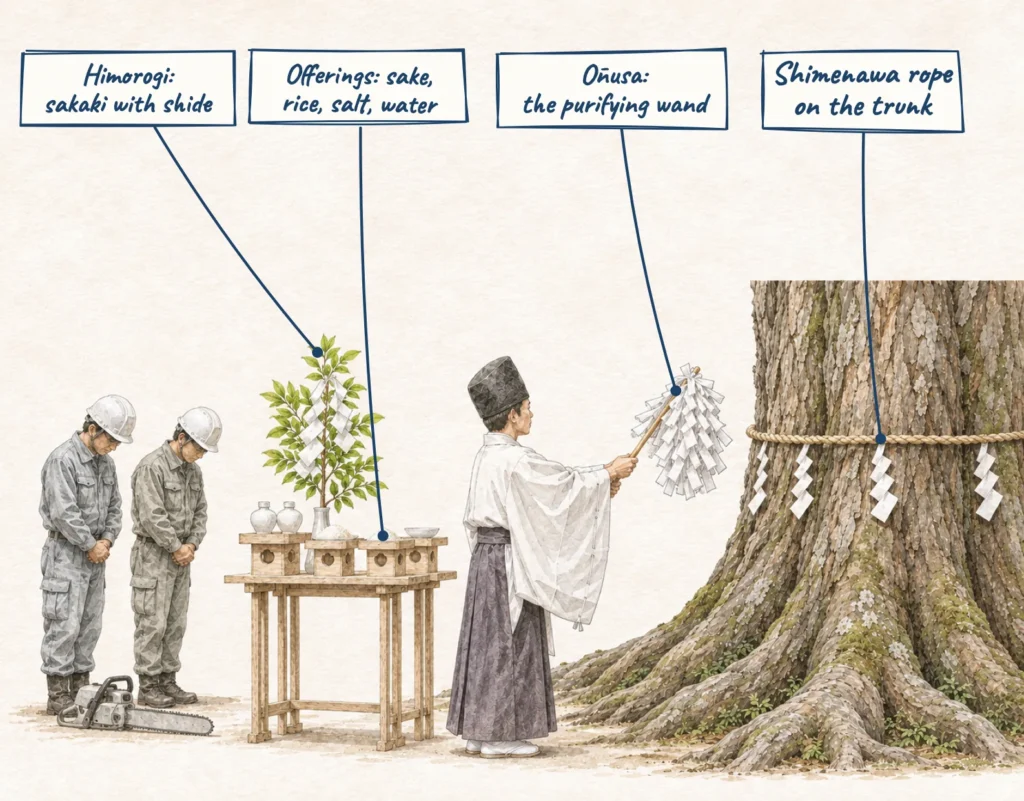
In Japan, a large or old tree may be blessed before it is cut because Shinto treats trees as places where kami and tree spirits can dwell. Before the first cut, a Shinto priest can perform a short tree felling ritual, which several shrines call bassai kiyoharai (伐採清祓, “felling purification”), to tell the local deity and the tree deity what is about to happen, to thank the tree, and to pray that nobody is hurt. The same idea runs from the cypress forests that supply Ise Jingū to forestry crews in the mountains and to a single garden tree behind a house.
In the Japanese Alps in 2025, white-clad woodsmen brought down two cypress trees about 300 years old while Shinto priests watched. In Nagano Prefecture, a woodcutter pushed the tip of a freshly felled tree into another freshly cut stump, and the woodcutters prayed and bowed together. This article starts from that scene and follows the rite through its Shinto roots, the forestry customs around it, and its place on a Japanese work site today.
Two Cypresses in Kiso — The Scene That Answers the Question
What the reporters saw
The scene above comes from an Associated Press report published on 23 September 2025 under an Ise dateline, by Foster Klug and Akaya Mcgill. It covers the Shikinen Sengū of Ise Jingū, the rebuilding of the shrine on a 20-year cycle whose history spans more than a millennium. The process begins with trees.
The AP specifies that the tip of a felled tree is placed in another freshly cut stump: “woodcutters then pray and bow together.” It is the visible end of a set of beliefs about what a tree is — beliefs that also bring a priest to an ordinary site before a crew takes down a garden tree.
The ceremonies behind the felling
Ise Jingū publishes the schedule of rites for its 63rd rebuilding. Two of them come before a single tree is cut. Yamaguchi-sai (山口祭) prays to the deity “at the mouth of the mountain” — the entrance to the timber forest — for safety in felling and hauling the timber out. Konomoto-sai (木本祭) worships the deity that dwells “at the base of the tree” chosen for the sacred central pillar, the shin-no-mihashira, which stands beneath the floor of the main sanctuary.
Then comes Misoma-hajime-sai (御杣始祭), the ceremony that opens the felling. According to the shrine, two hinoki cypresses standing side by side in the timber forest are selected as mihishirogi (御樋代木), and they are felled using an old method called mitsuo-giri (三ツ緒伐).
The timber forests themselves were chosen on 15 January 2025: the Kiso Valley national forest in Agematsu, Nagano, and the Urakiso national forest in Nakatsugawa, Gifu. The shrine office announced that Yamaguchi-sai and Konomoto-sai would be held on 2 May 2025, Misoma-hajime-sai on 3 June in Agematsu, and the Urakiso felling ceremony on 5 June in Nakatsugawa.
What the scene tells us
Read in order, these ceremonies point to three ideas that recur through this article: the mountain has a deity, addressed at its entrance; the tree has a deity at its base, addressed before the cut; and something of the tree is returned once it is down.
Bassai Kiyoharai — What Happens in a Felling Purification
The names
The cited shrines use several names for the rite:
– Bassai kiyoharai (伐採清祓) or jumoku bassai kiyoharai (樹木伐採清祓) — “tree-felling purification”, used by several of the shrines cited here – Ki-barai (木祓い) — “tree purification”; Komagabayashi Shrine defines it as “a purification performed before felling a tree” – Batsuboku-sai (伐木祭) — “tree-felling festival”, the term Tanashi Shrine uses for felling a garden tree – Jumoku bassai hōkoku-sai (樹木伐採奉告祭) — “tree-felling notification rite”, used by Ikebukuro Mitake Shrine
The word hōkoku (奉告, “respectful report”) is a clue to what the rite is for. The shrines cited here describe reporting the planned felling, offering thanks or an apology, and praying for safety.
Who it is addressed to
Ōsaki Shrine describes its jumoku bassai kiyoharai in one sentence: before felling trees on a home or factory site, the priest reports the plan to the ubusuna-gami (産土神, the tutelary deity of the land) and to the tree deity, and prays that the felling is carried out safely.
The Fukushima Prefecture shrine association goes further. When trees in a shrine forest, or large trees on a house plot, have to be felled for unavoidable reasons, a priest performs a purification “to thank the kodama (木霊, the spirit dwelling in a tree) and to ask it to settle.”
Horiide Shrine puts the emphasis on gratitude: when an old or large garden tree is cut, the prayer offers thanks to the tree as a living thing.
The order of the rite
Kamegaike Hachimangū publishes the sequence it follows for well and tree purifications. The eight steps below are items 2 to 9 of its list:
| Step | Japanese | What happens |
|---|---|---|
| 2 | Shubatsu (修祓) | Purification |
| 3 | Kōshin (降神) | Calling down the kami |
| 4 | Kensen (献饌) | Presenting the offerings |
| 5 | Norito sōjō (祝詞奏上) | Reading the prayer |
| 6 | Kirinusa sanmai (切麻散米) | Scattering kirinusa with rice |
| 7 | Tamagushi hōten (玉串奉奠) | Offering tamagushi |
| 8 | Tessen (撤饌) | Removing the offerings |
| 9 | Shōshin (昇神) | Sending the kami back |
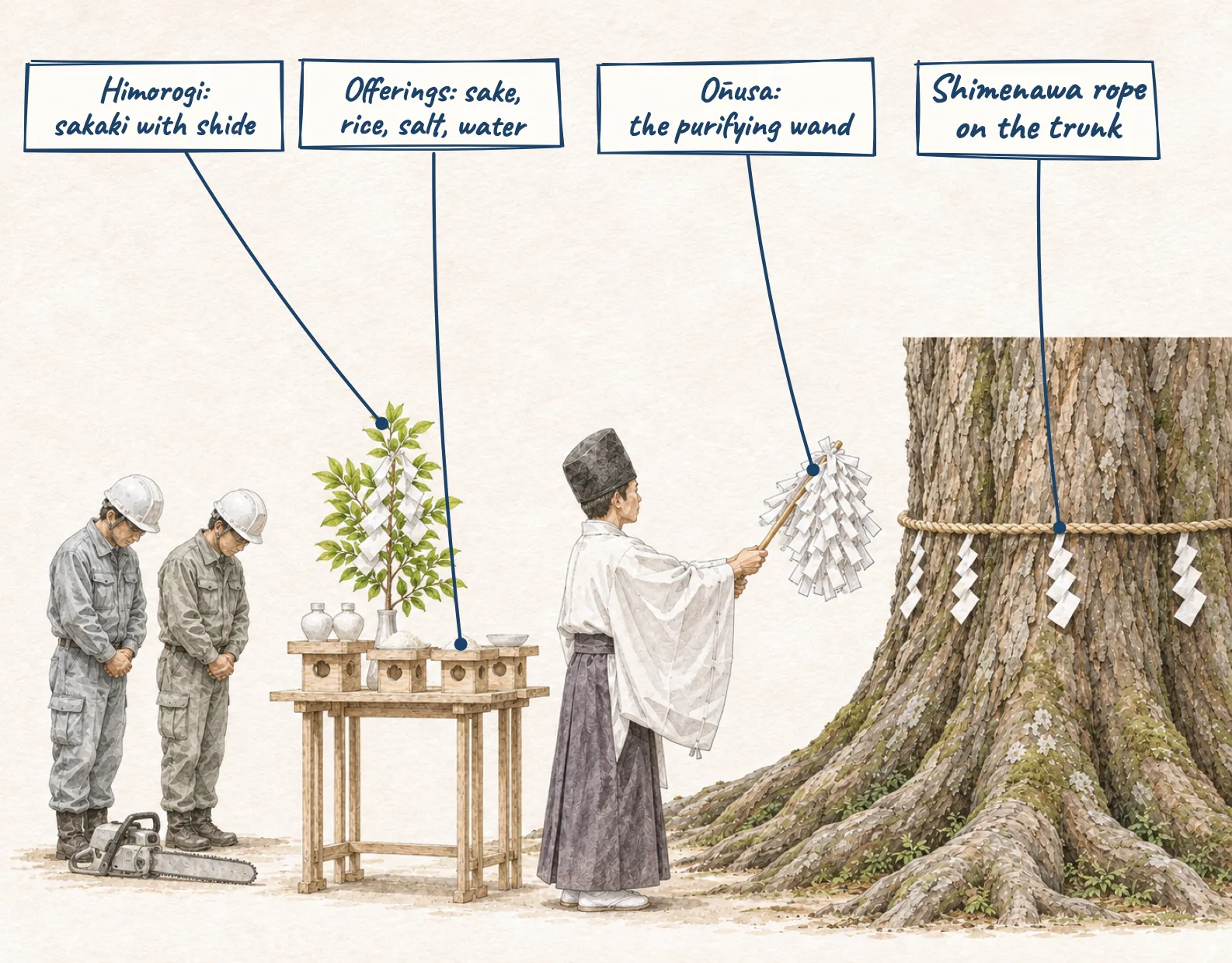
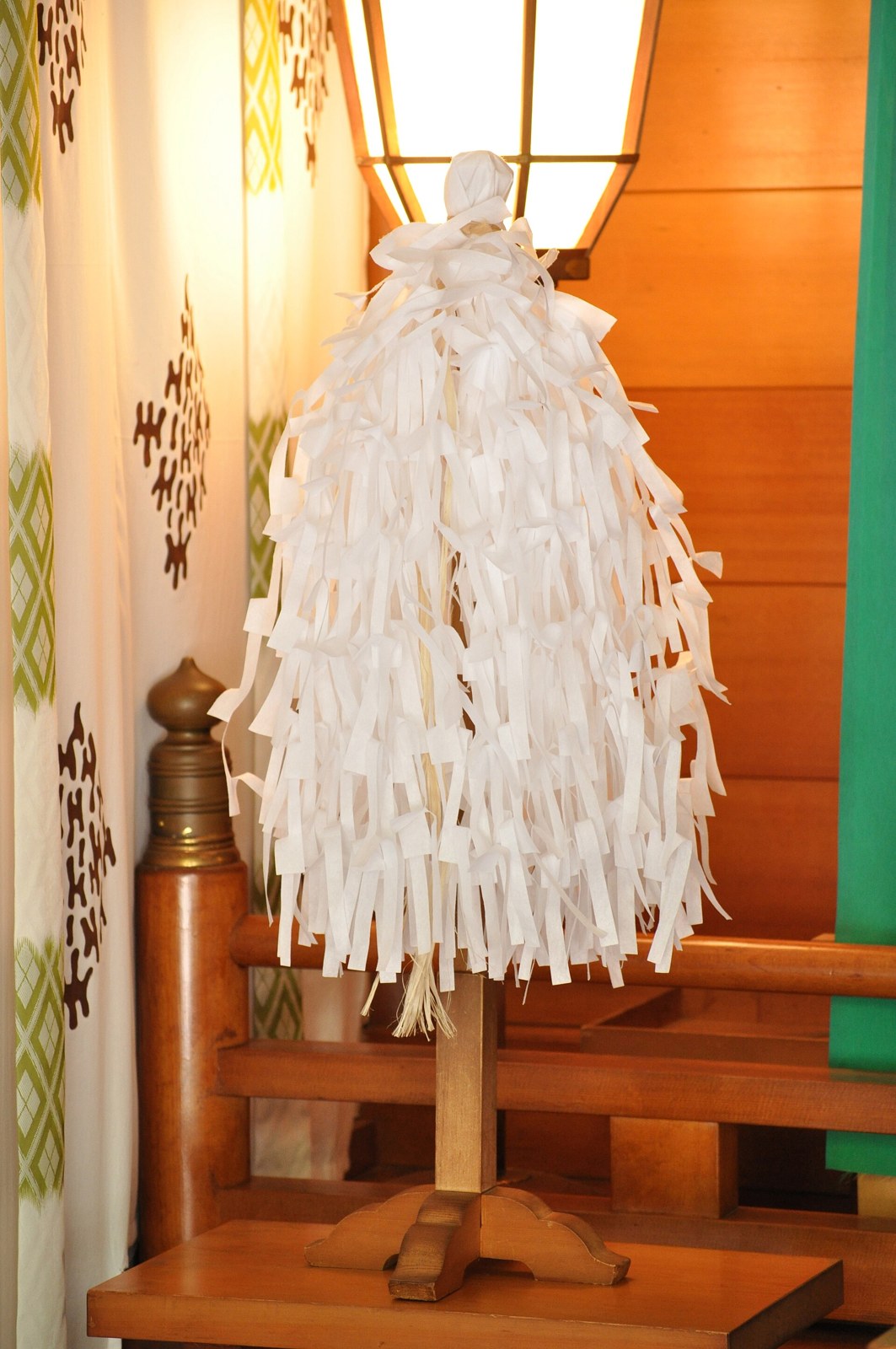
The purification wand shown below is an ōnusa (大幣), fitted with white paper streamers called shide (紙垂), like those seen on a sacred tree’s rope.
What is offered, how long it takes
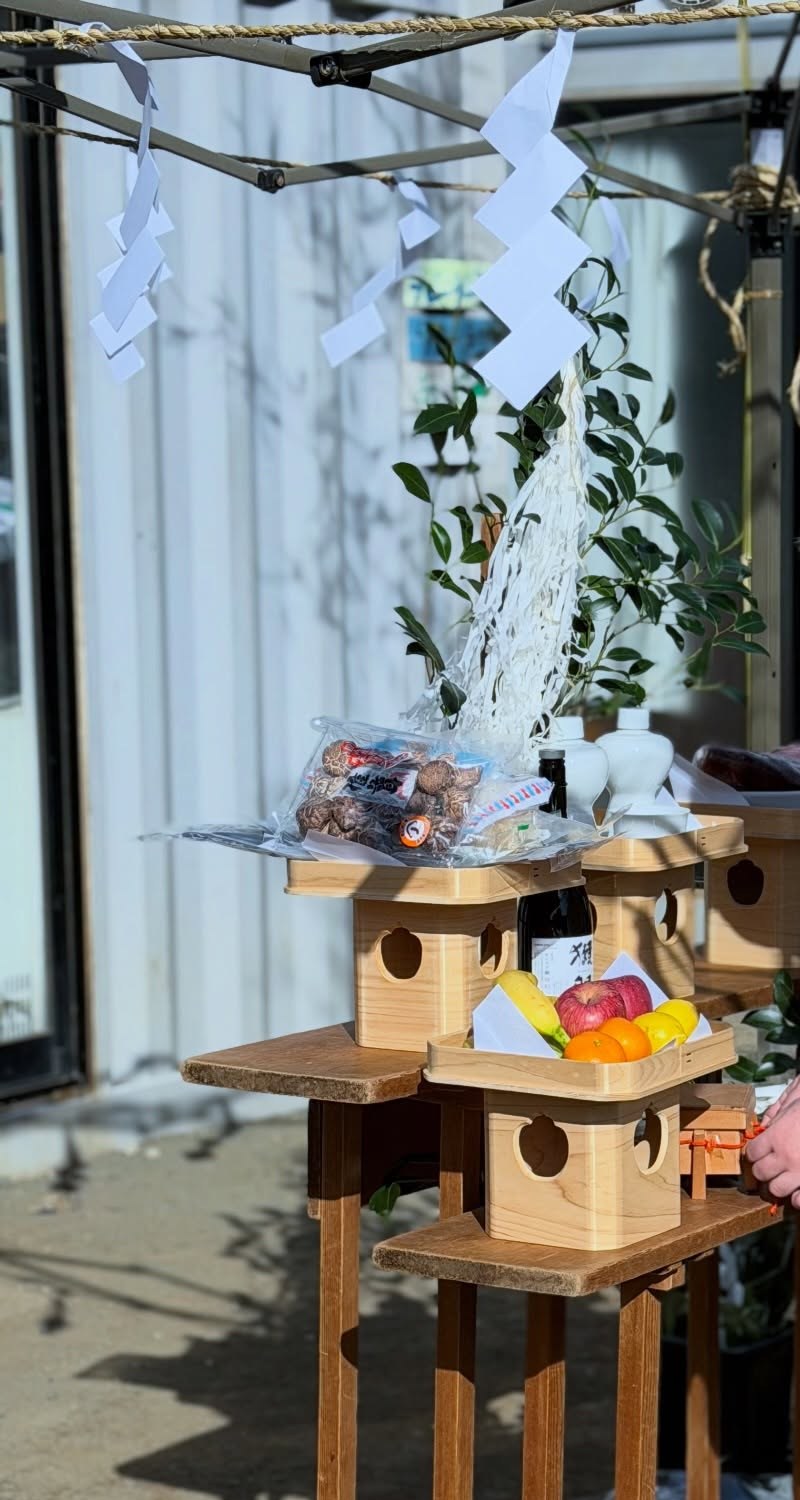
For its well and tree purifications, Kamegaike Hachimangū asks clients to provide about one gō (合, about 180 ml) each of rice, salt and water, a 1.8-litre bottle of sake, and two or three kinds each of seafood, dried foods, vegetables and fruit. The altar in the first photo of this article shows the same pattern: fruit, vegetables, a sake bottle, white vessels.
Komagabayashi Shrine estimates 20 to 30 minutes for the ceremony itself, adjusted for scale, plus about 30 minutes to set up and 15 minutes to clear away. Including setup and clearing, the estimate totals about 65 to 75 minutes, which a crew has to plan into the day.
A Tree as a Dwelling — The Belief Behind the Blessing
Shinboku, himorogi, yorishiro
Kokugakuin University’s Encyclopedia of Shinto gives the vocabulary that explains why a tree should be addressed at all.
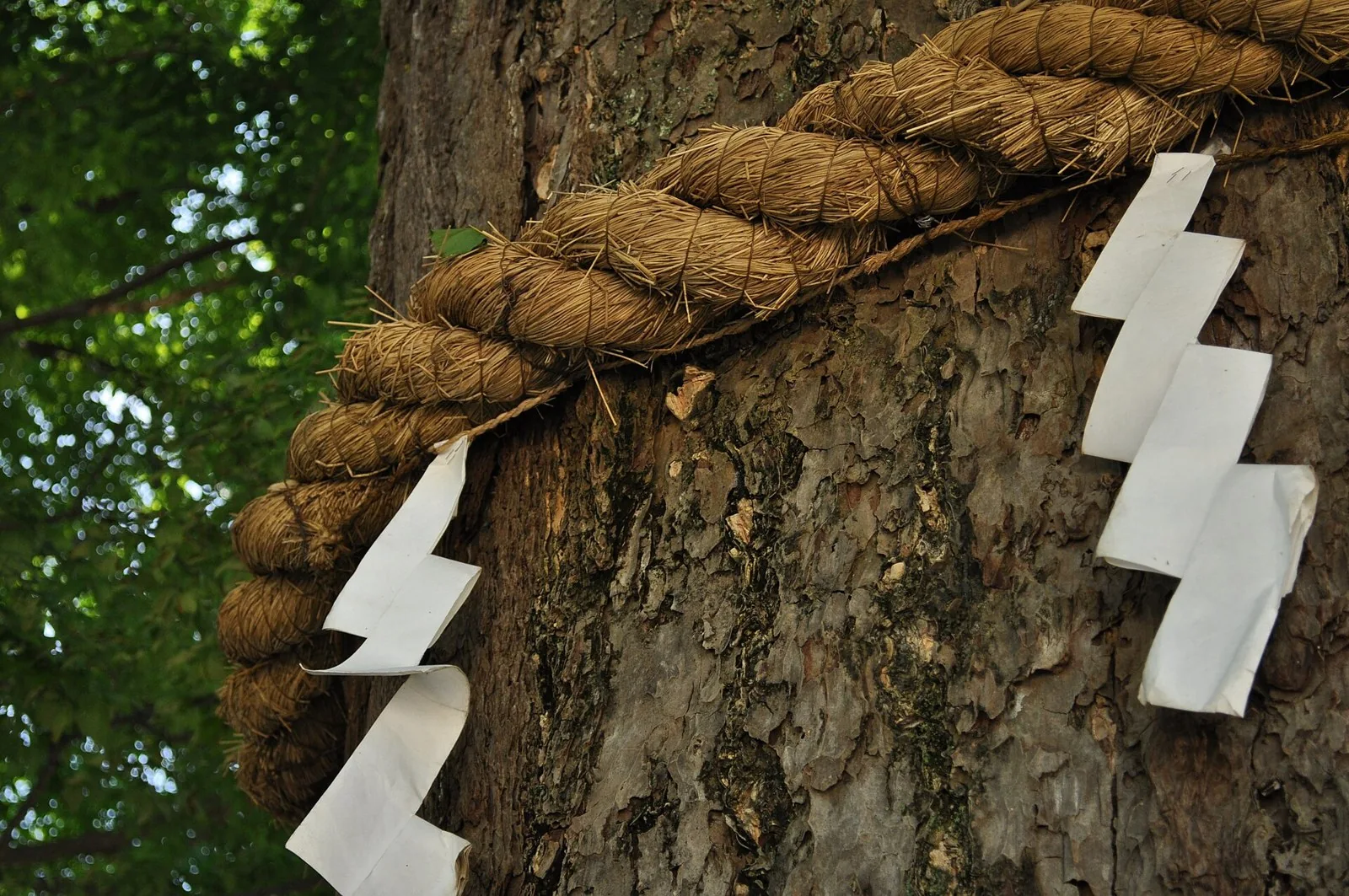
– Shinboku (神木), a sacred tree: “a tree regarded as sacred, as the symbol of sacred territory or a place in which the kami dwell.” – Yorishiro (依代): “the place (or object or person) inhabited by a kami’s spirit when it descends for a religious ceremony.” – Himorogi (神籬): “a temporarily erected sacred space or ‘altar’ used as a locus of worship” . – Shimenawa (注連縄): “a straw rope hung before or around a site to demarcate sacred or pure space.”
Put together, the definitions explain why felling needs words at all: a tree can be a place where a kami dwells, and a rope can mark the space around it as sacred.
A god of trees in the oldest books
The idea has a written pedigree. Kokugakuin’s database of the Kojiki (古事記) identifies Kukunochi (久々能智神) as the god of trees, born when the creator pair Izanagi and Izanami brought forth the gods, together with the gods of wind, mountains and fields. The Nihon Shoki (日本書紀) calls Kukunochi “the ancestor of trees” (木の祖).
One variant account in the Nihon Shoki goes further and gives specific trees a divine origin. The god Susanoo pulls out his beard and scatters it, and it becomes sugi (杉, Japanese cedar). His chest hair becomes hinoki (檜, Japanese cypress), the hair of his buttocks becomes maki (柀), and his eyebrows become kusu (櫲樟, camphor). He then assigns them uses: cedar and camphor for boats, hinoki for building palaces.
For arborists, the passage is suggestive: it assigns practical uses to trees at their creation. We read this as placing the use of timber within the divine story.
Thanks, and an apology
The Okayama Prefecture shrine association is the most direct of the sources on this point. Its Q&A advises that when a tree has to be felled, people should “apologise to the tree deity” and, so that no worker is injured, ask a priest to perform a felling notification and purification.
Base and Top for the Mountain God — The Engishiki
The Engishiki’s carpenters
The Engishiki (延喜式), a code of court procedure, preserves a detailed ritual description of timber felling. In its prayer for the ceremony called Ōtono-hogai (大殿祭, blessing of the great hall), the timber for the palace is described like this: trees standing in the large and small valleys of the deep mountains are felled with the sacred axe of the Inbe priests; the base and the top are offered to the mountain god; and the middle section is carried out.
The sentence offers a parallel to the later stump custom: the useful middle goes to the builder, and — in our reading — the two ends go back to the mountain.
Asking at the mountain’s mouth
The Engishiki also preserves the prayer for Kinensai (祈年祭), the spring prayer for the year’s harvest. One section addresses the deities dwelling at the mountain entrances (山口) of Asuka (飛鳥), Iware (石村), Osaka (忍坂), Hatsuse (長谷), Unebi (畝火) and Miminashi (耳無), in connection with cutting the great and small trees of the far and near mountains and bringing them to build the sovereign’s sacred dwelling.
The idea is close to Ise’s Yamaguchi-sai: the deity at the mountain’s mouth is addressed in connection with felling.
What we can and cannot say about continuity
It is tempting to draw a straight line from these texts to a priest on a site in 2026. The sources checked for this article do not support that. Each source shows one piece: the myths give a god of trees and trees made for use; the Engishiki gives base and top offered to the mountain god; the Kiso record gives the treetop in the stump; modern shrines give the report, the thanks and the prayer for safety. The sources do not document an unbroken chain between them. The honest description is a family resemblance.
Yama no Kami — The Forestry Crews’ Side of the Story
Worship before work
Shinto priests are not the only keepers of the custom. Japan’s forestry workers had their own, centred on yama no kami (山の神), the mountain deity.
The Chūbu Regional Forest Office of Japan’s Forestry Agency publishes a commentary on the Kiso-shiki batsuboku unzai zue (木曽式伐木運材図会), an illustrated record of how timber was felled and moved in the Kiso Valley. It says that the people who worked in the mountains were devout: they built a hut, worshipped the mountain deity before starting work, and prayed for safety. Each month they also set a “mountain deity day”, stopped work, received a ration of one gō of sake, and worshipped the deity.
The day you stay out of the forest
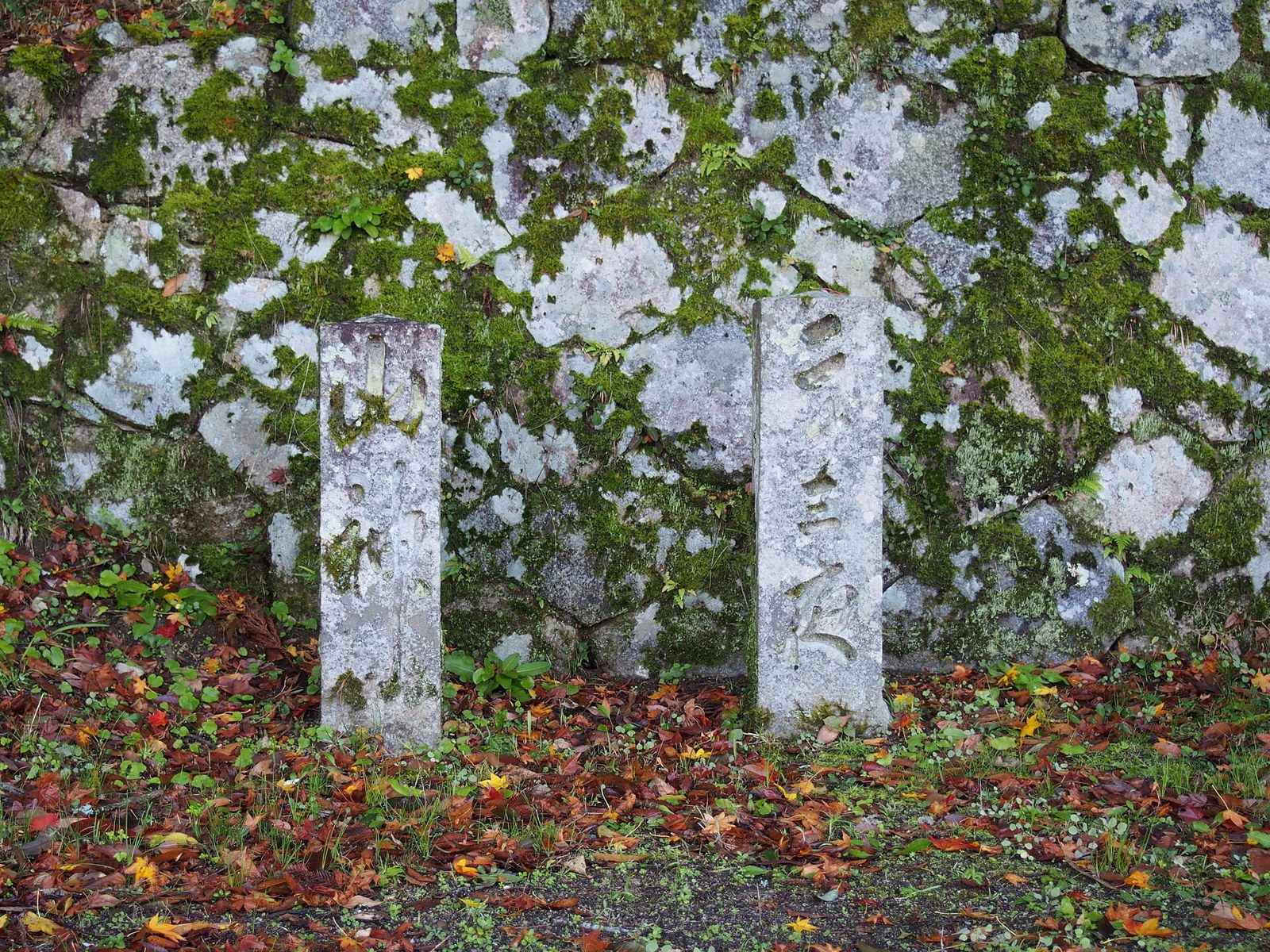
The best-known rule is negative: on the mountain deity’s festival day, you do not go into the mountain. The Encyclopedia of Shinto gives the folk reason — on that day “the kami counts the mountain’s trees.”
The rule is not only folklore. A 2016 study in Chūbu Shinrin Kenkyū surveyed forestry cooperatives in the Chūbu region. Of the 123 cooperatives that supplied data, 73 held a mountain deity festival or related observance, and 48 kept a taboo against entering the mountains on the festival day — just under two-thirds of the cooperatives that held a festival.
The date varies from place to place, which is part of why the rite has no single national form:
| Place / source | Mountain-deity day or rite |
|---|---|
| Fukuoka Prefecture timber association | “Generally 12 December, 12 January, etc.” — entering the mountain is forbidden on the festival day |
| Kiso Valley (Forestry Agency commentary) | A fixed day each month: work stopped, sake issued, deity worshipped |
| Tano Field, University of Miyazaki | Safety prayer normally on the 16th day of the 9th lunar month (moved to November in one year) |
| Sekigata, Yaizu City, Shizuoka | Mountain deity festival every 8 February |
Salt, rice, sake at the entrance
When a crew starts on new ground, the offerings are simple. A study for the Forestry Agency’s Kagoshima office, based on 21 interview sessions with 39 people in Kagoshima and Kumamoto prefectures, recorded the custom of scattering salt, rice and sake near the entrance of a new mountain worksite.
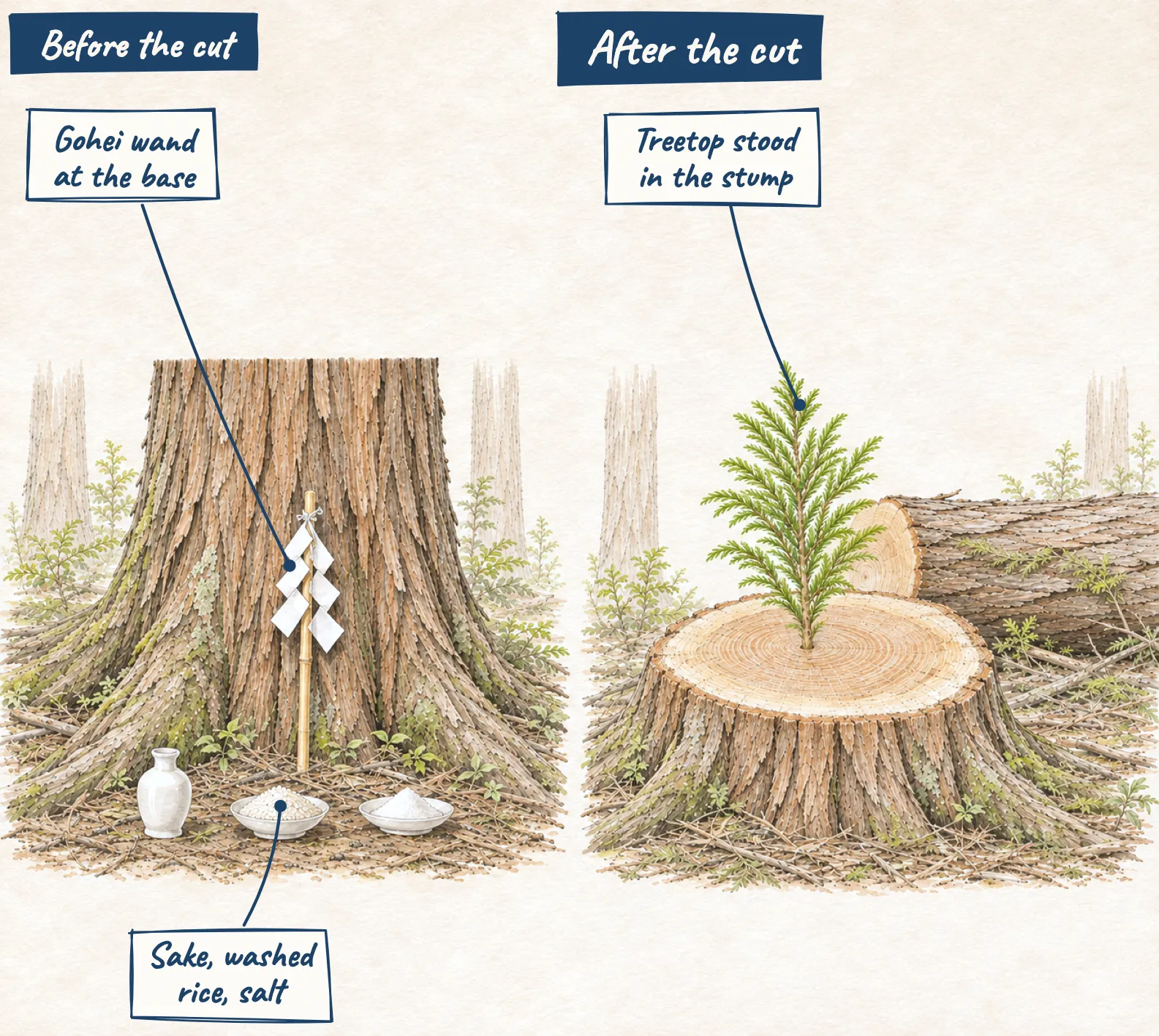
A 2023 field note from Ryūkoku University describes the same three things in Kutsuki: a gohei (御幣, a paper-streamer wand) placed at the base of a thick cedar at the entrance of a cedar plantation, with an explanation that sake, washed rice and salt are offered to purify the place and give thanks for the mountain’s blessings.
Kabumatsuri — What Happens After the Tree Is Down
The treetop in the stump
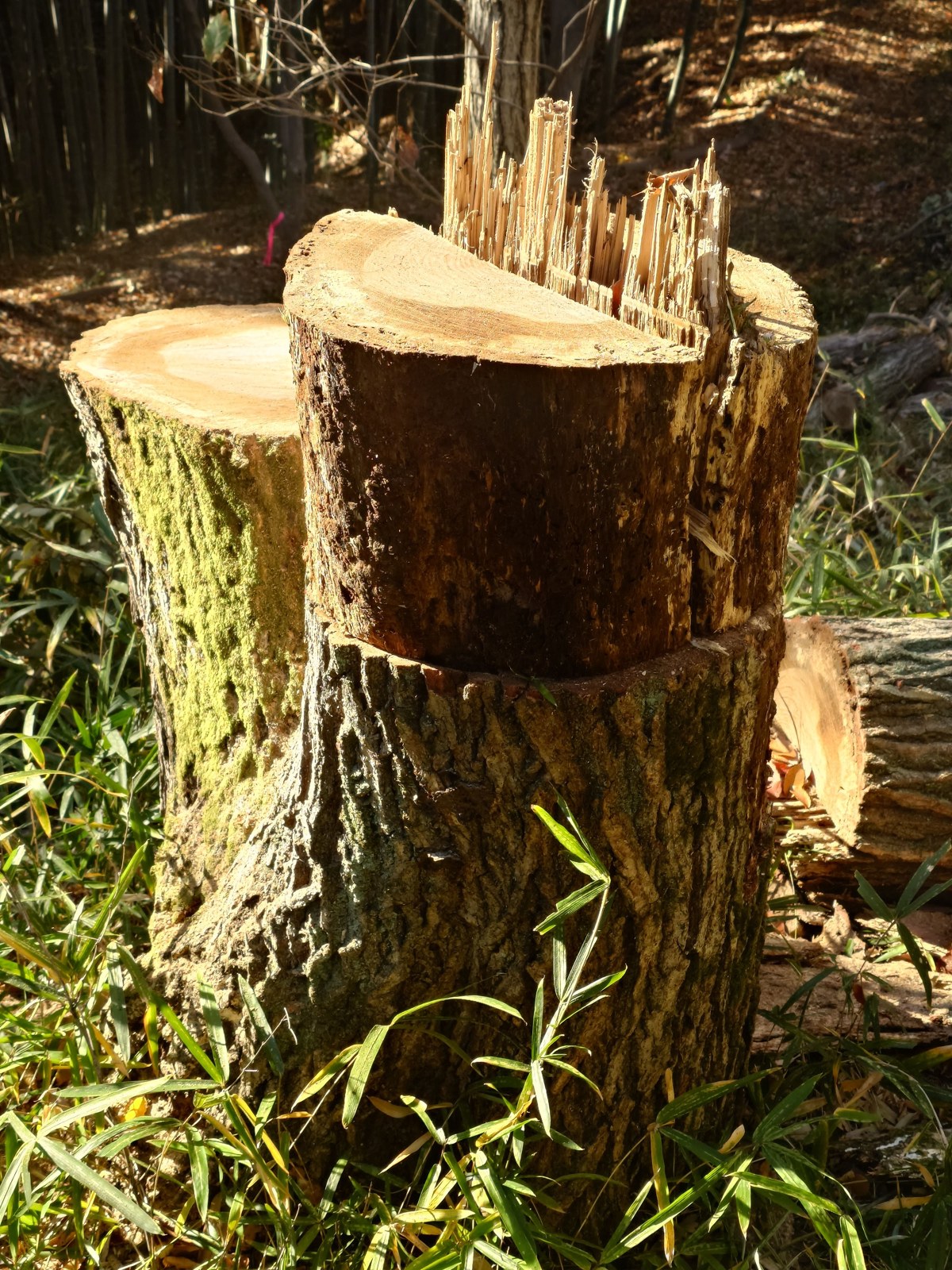
The gesture the AP saw in Nagano resembles a custom with a name. The Forestry Agency’s Kiso commentary calls it kabumatsuri (株祭, “stump festival”): inserting the top of the felled tree into its stump to thank the mountain deity and the tree spirit. It is, the commentary notes, one of the best-known scenes in the Kiso illustrations.
The Gifu Academy of Forest Science and Culture, a prefectural forestry school, describes a similar practice as tobusa-tate (鳥総立て). Its 2023 report on a mitsuo-giri demonstration in Kawaue, Nakatsugawa, describes it exactly: an axe cut is made in the centre of the stump, and the tip of the tree is stood in it. The report gives the meaning, too. The people take the part between the tip and the base for their use, with the wish that the tree will grow back afterwards.
When a Sacred Tree Has to Come Down — Recent Cases
Shrine trees at the end of their lives
The rite is most visible when a shrine’s own goshinboku (ご神木, revered sacred tree) dies or becomes dangerous. In the three recent cases below, public records show a ceremony before the felling.
| Year | Shrine | Tree | Why it came down | The rite |
|---|---|---|---|---|
| 2022 | Fuda Tenjin Shrine, Chōfu | Zelkova, about 500 years old | Weakened by a fire in 2003; died in 2021 | Felling purification on 10 May; felling and removal from 11 May |
| 2023 | Kurihara Shrine, Zama | Shirakashi oak, about 500 years old, about 20 m (66 ft) tall | Dead; hollow trunk; weakened roots; risk of collapse | A rite to remove the tree’s spirit on 22 March, then felling |
| 2025 | Suga Shrine, Akitakata | Two cedars from a group over 700 years old; the sacred great cedar was reported at over 40 m (130 ft) | Trunk hollowing; risk of collapse | Pre-felling ceremony from 8 a.m. on 14 October |
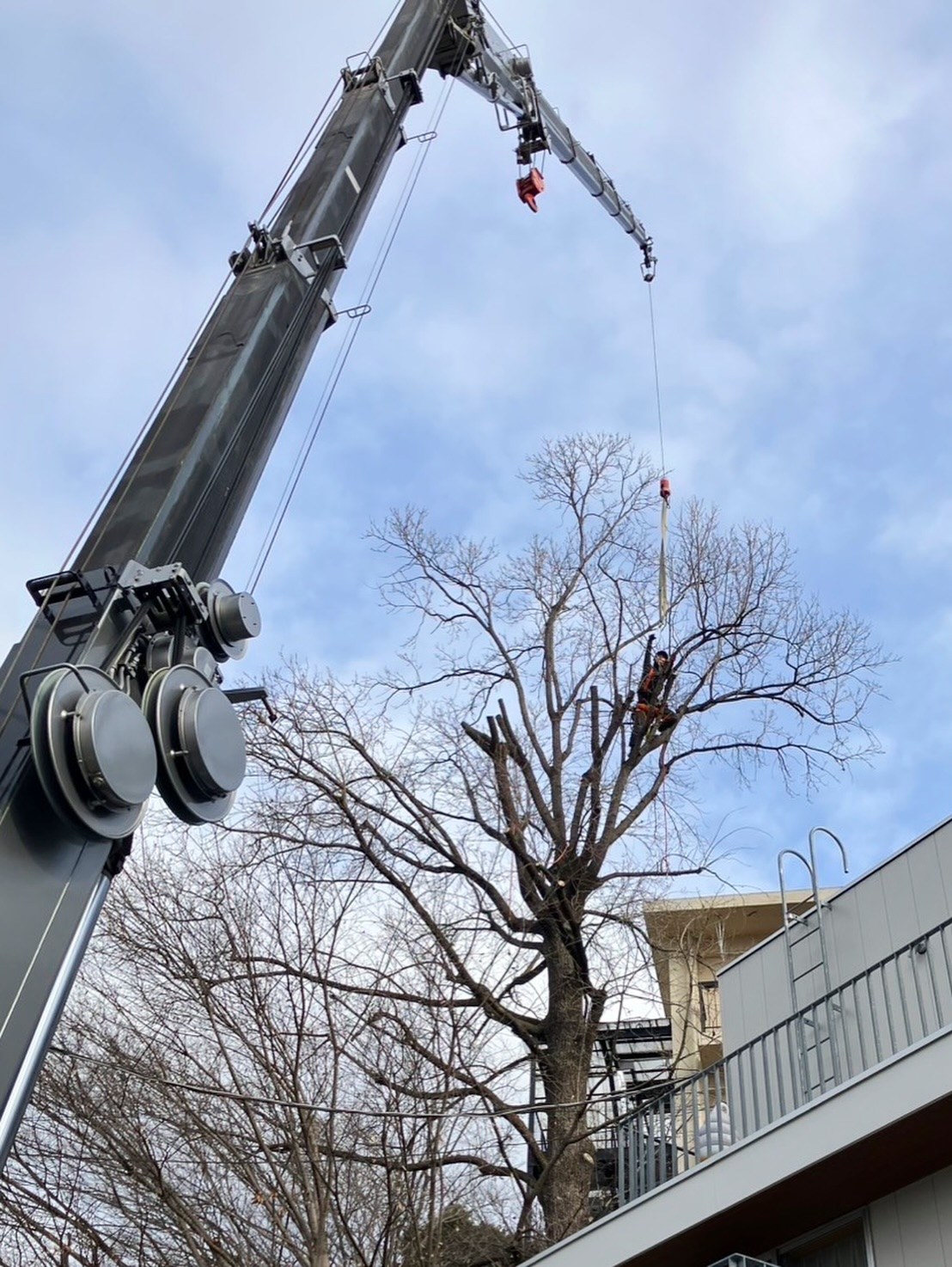
At Kurihara, the local paper reported that a jumoku-i (樹木医, tree doctor) had diagnosed the tree as dead standing in March 2023; on the 22nd a rite to take out the tree’s spirit (御霊を抜く) was performed, and the tree was felled as people connected with the shrine watched. The city’s board of education minutes give the reason in plain risk language: hollowing of the trunk and weakening of the roots had progressed, creating a danger of the tree falling. (For how Japan’s tree doctors are trained and certified, see our explainer on the jumoku-i system.)
The tree that did not wait
Not every sacred tree is given the chance. Tsurugaoka Hachimangū in Kamakura records that its great ginkgo, the shrine’s sacred tree that had watched over Kamakura’s history, fell in strong winds before dawn on 10 March 2010.
The loss illustrates why assessing the condition of old trees matters; whether to remove one is a separate judgement. Japan’s ageing trees are a theme we have covered from the risk side in Japan’s falling trees crisis; the felling rite is the cultural side of the same decision.
New timber for sacred buildings
The rite is also performed when trees are cut for a shrine. Nara Prefecture reports that in December 2014 a Misoma-hajime-sai was held in Kawakami Village before the first timber was cut for Meiji Jingu’s replacement First Torii. The east pillar of the new torii used a Yoshino cedar about 280 years old, the west pillar one about 260 years old.
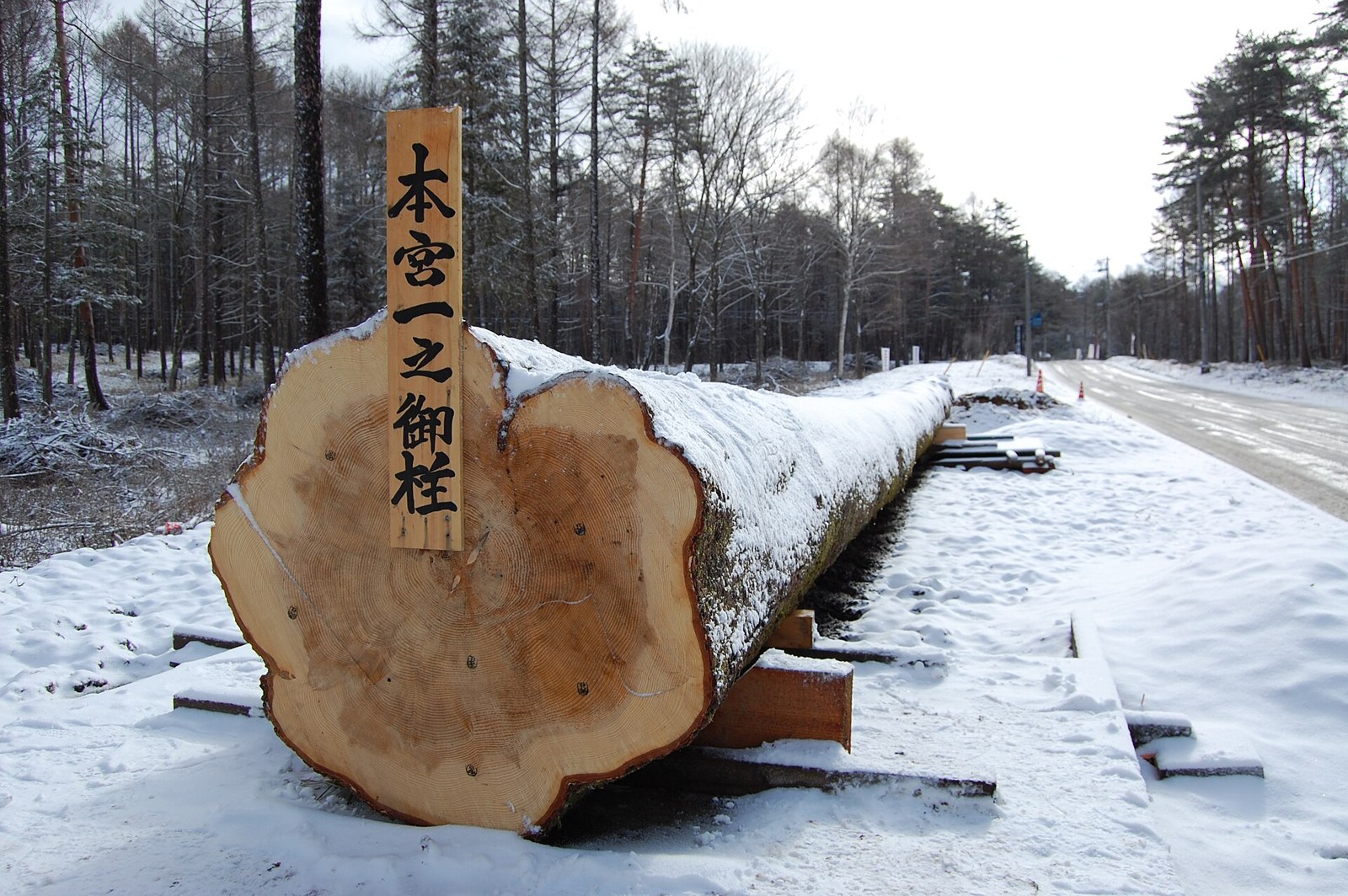
At Suwa Taisha, the great Onbashira festival replaces the shrine’s sacred pillars with huge firs. The shrine explains that at the Upper Shrine, a sacred nagikama (薙鎌, a ritual sickle believed to hold divine spirit) is driven into a selected tree, and that marks it as a sacred tree for the festival. By custom, the yamazukuri (山作衆) — who have managed the shrine’s Mount Mikoya over generations — make the first cut with a sacred axe with a vermilion handle. When the national forest supplied firs in fiscal 2021 for the spring 2022 festival, the Forestry Agency recorded that the mountain deity was worshipped and a Shinto rite held to pray for safe felling before parishioners felled the firs.
How many trees are we talking about?
Japan’s Ministry of the Environment counts giant trees, generally defined as trees with a trunk circumference of at least 300 cm (about 10 ft) at about 1.3 m (4 ft 3 in) above the ground, with exceptions for some smaller-growing species. Its survey of 1988–1989 recorded 55,798 giant trees; the follow-up of 1999–2000 raised the total to 64,479. In the ownership breakdown of 2001 — which left out municipal records that had not been updated — shrines and temples owned 57 percent, or 21,262 trees.
That number is about ownership, not location, and it covers temples as well as shrines. Among the records in that 2001 calculation, shrines and temples owned more than half of the giant trees, and the cases above show shrines holding rites before removing their own. We look at why so many of these trees survive so long in why Japan’s ancient trees live for a thousand years.
On a Japanese Work Site Today — Where the Rite Fits
Not only shrine trees
Felling purifications are also offered for trees outside shrine grounds. Shrine websites list them alongside other site ceremonies. Minatogawa Shrine calls these shutchō-sai (出張祭), ceremonies in which a priest visits the client’s home or site, and lists tree-felling purification next to the rite for filling in an old well. Ikebukuro Mitake Shrine groups the tree-felling notification rite with rites for demolition and for filling in wells, and states the shared purpose: so that the work does not bring misfortune later.
The closest relative is the jichinsai (地鎮祭), the groundbreaking ceremony. The Hyogo Prefecture shrine association defines it as greeting the deity of the land before construction, purifying the land, and praying for the safety of the work and continued protection. The two rites share an emphasis on reporting to the deities and praying for safe work.
Who calls the priest, and when
The shrine pages describe requests from the tree’s owner: Ōsaki Shrine mentions trees on home or factory sites, and Tanashi Shrine describes felling a garden tree because of an extension or rebuilding of a house. Shirahata Shrine, for example, records that its chief priest performed a felling purification at Saba Shrine, which he also serves, at 9 a.m. on 23 January 2025.
The rite comes before the felling, while the tree is still standing; at Fuda Tenjin, felling began the day after it.
What the crew actually does
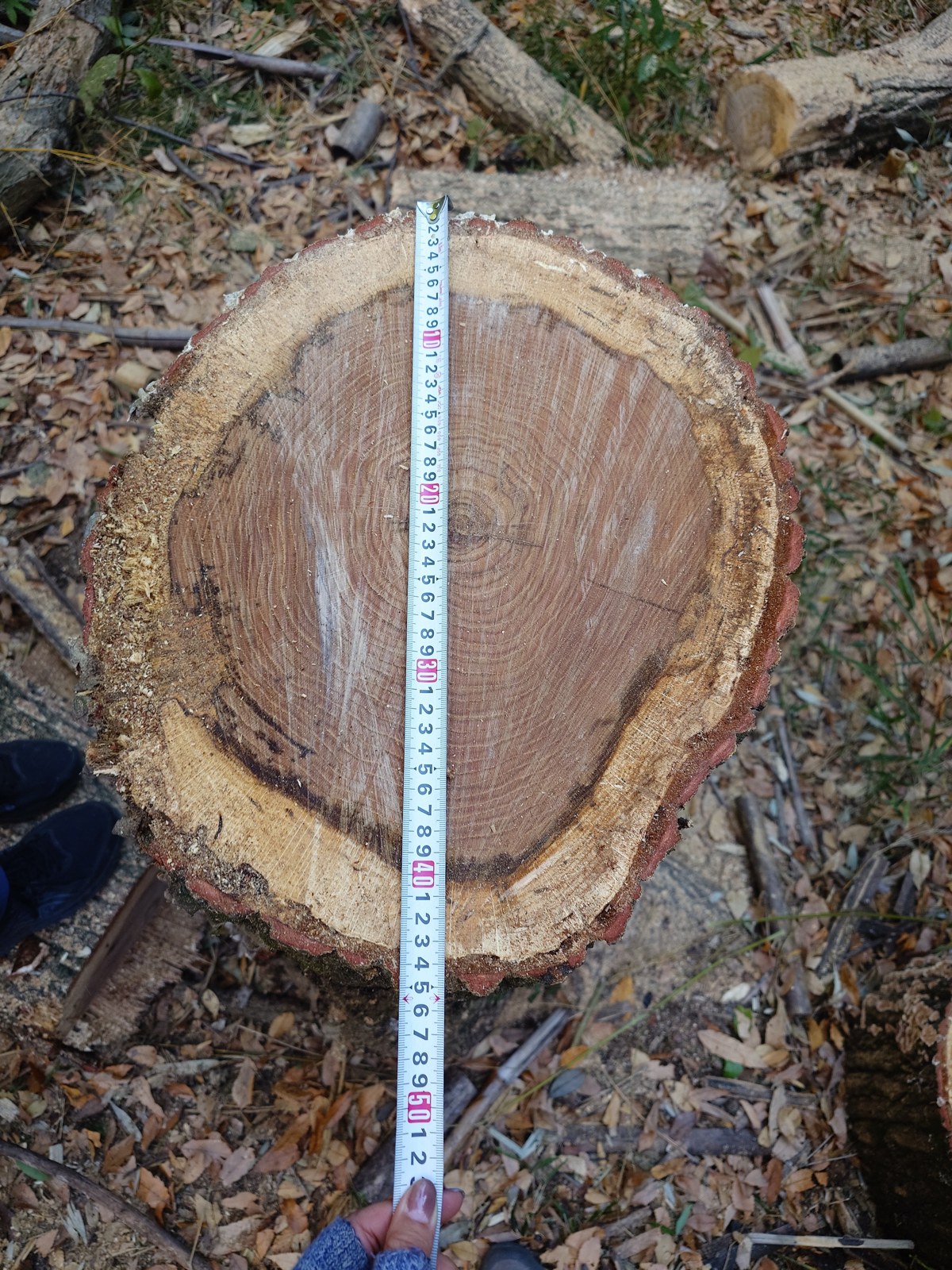
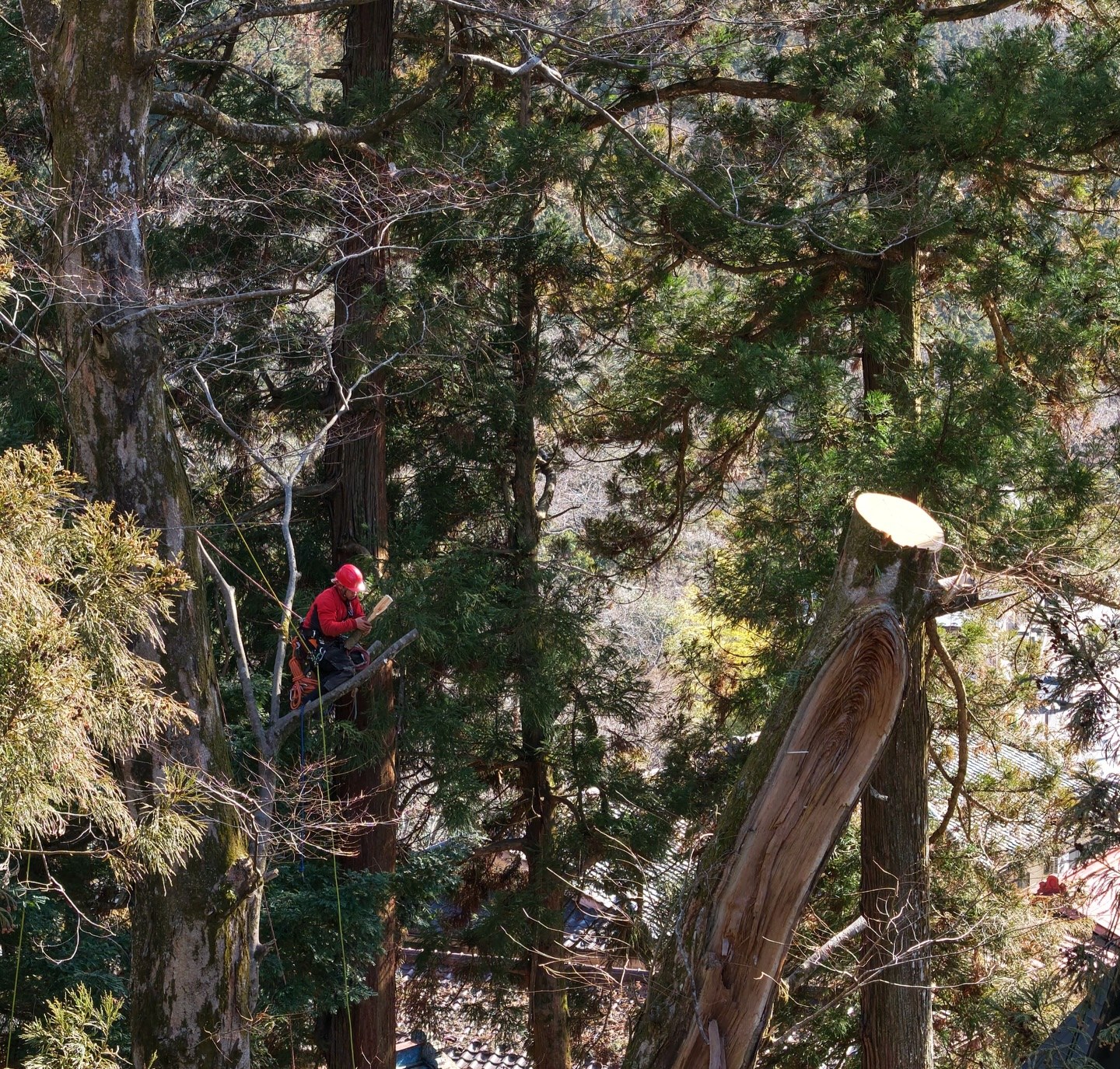
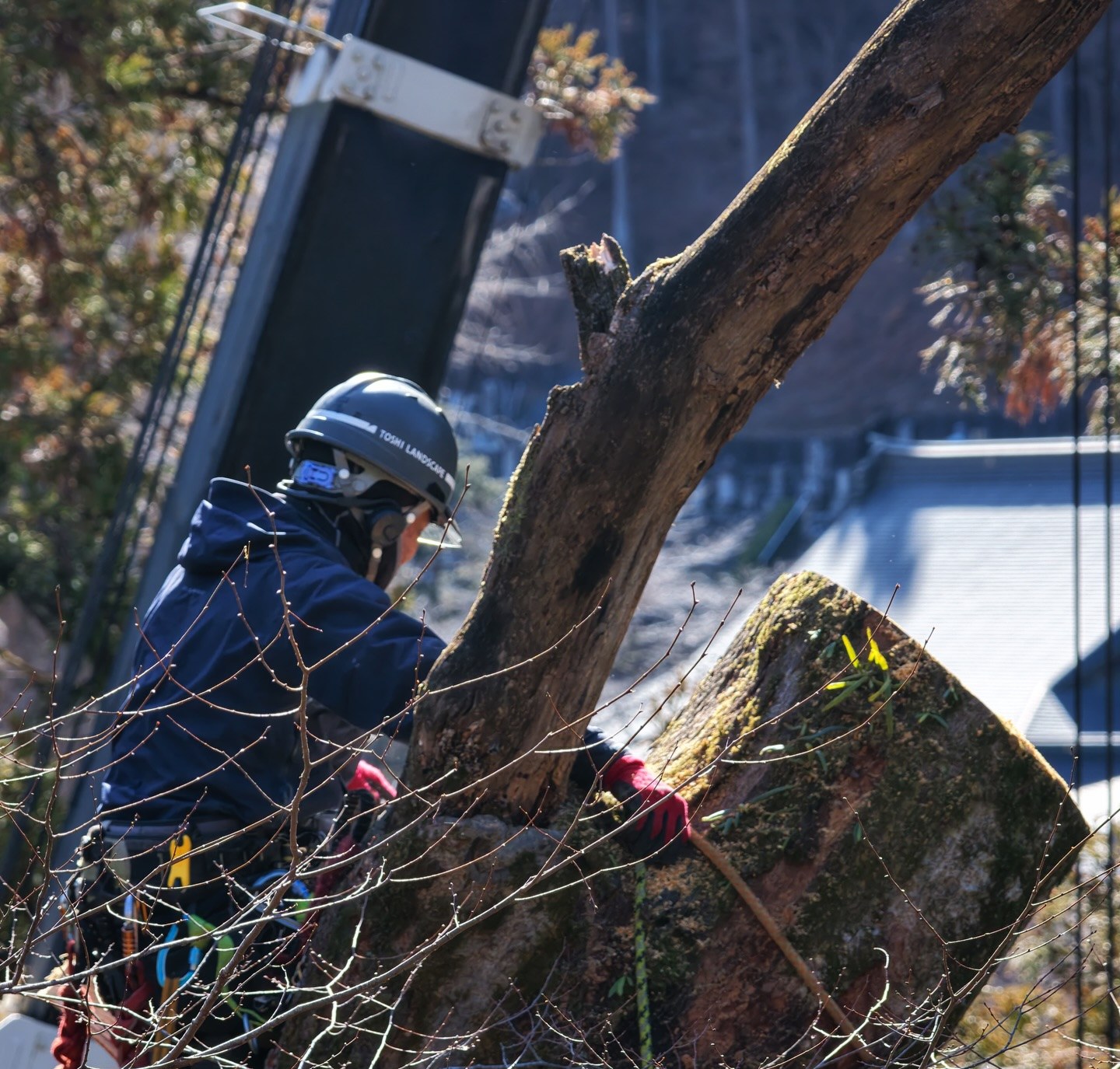
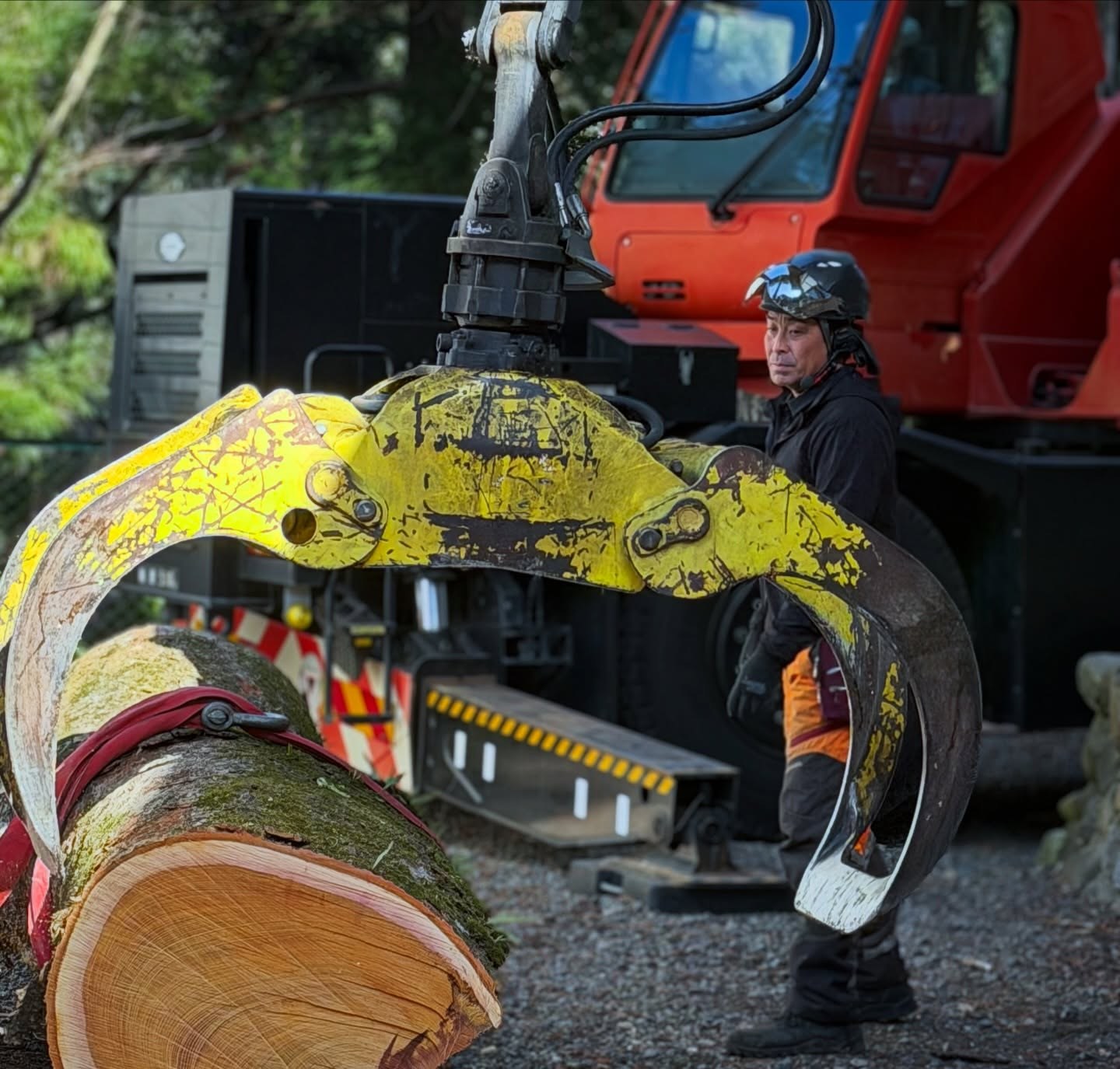
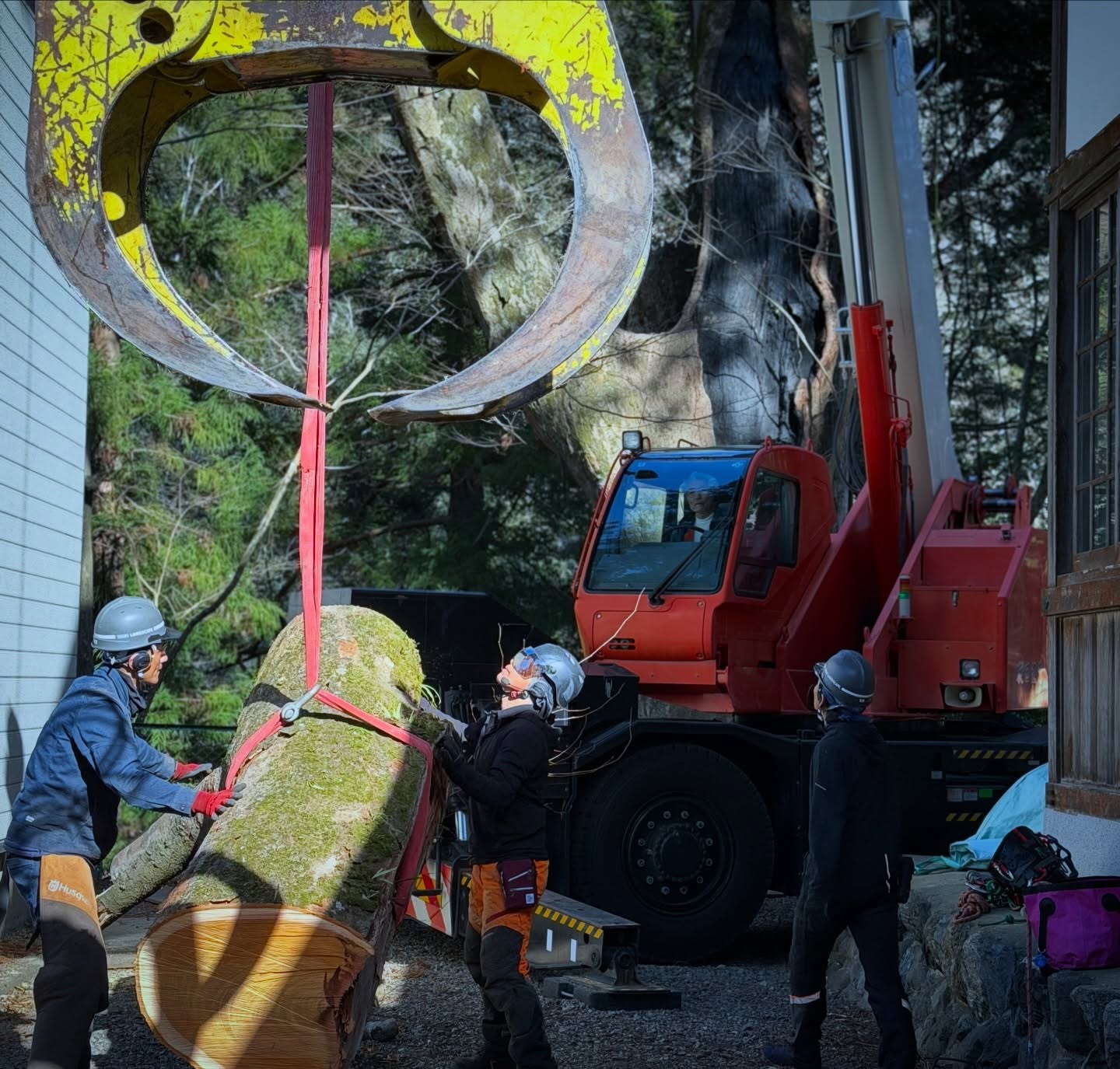
Where there is no room to drop a big tree whole, Japanese crews take it down in sections, as in the photos here: a climber or an aerial lift removes the crown, the trunk is cut in lengths from the top, and a crane or grapple lowers each piece. Nothing in the shrine sources suggests the ceremony changes any of that.
Japan and the West — Different Questions Before the Same Cut
What England’s rules and ISA advice ask
England’s tree rules and the ISA’s advice address legal and technical questions before felling; the Japanese rites discussed here add a religious dimension alongside technical judgement. In England, a Tree Preservation Order generally prohibits the felling of a protected tree “without the local planning authority’s written consent”, with an exemption for “work urgently necessary to remove an immediate risk of serious harm.” The International Society of Arboriculture describes removal as “a last resort”, recommended when a tree “is dead, dying, or considered irreparably hazardous.”
The reasons recorded in the Japanese cases — a dead tree, a hollow trunk, weakened roots, a risk of collapse — fit the ISA’s description closely. At Kurihara Shrine, a tree doctor’s diagnosis came first and the rite came after it: the rite sits alongside the technical judgement rather than replacing it.
A side-by-side
| Japan (felling purification) | England’s TPO guidance and ISA advice | |
|---|---|---|
| The question asked | Has the tree, and the land, been told and thanked? | Is removal justified, and is it permitted? |
| Addressed to | The land deity, the tree deity, the tree’s spirit | The local planning authority (England) |
| Who leads it | A Shinto priest, at the owner’s request | The tree owner, seeking written consent |
| When removal is justified | Not addressed — the rite follows the decision | Dead, dying or irreparably hazardous (ISA); urgent risk exemption (TPO) |
| Stated aim | Gratitude, safety of the workers, no misfortune afterwards | Removal as “a last resort” (ISA) |
Neither column is a better version of the other: one is a legal and technical judgement about the tree, the other a social and religious acknowledgement of it.
Common Misunderstandings About the Rite
“They are asking the tree for permission”
The shrine sources describe a report (hōkoku), thanks, sometimes an apology, and a prayer for safety. None of those cited here describes asking the tree whether it may be cut.
“Only sacred trees get a ceremony”
Shrines advertise the rite for garden trees, trees on factory sites and trees cleared for building. The tree does not need a shimenawa to be blessed.
“The rite is the same everywhere”
The names differ from shrine to shrine, and the mountain-deity days differ from region to region. The sources checked here show local examples, not a national standard procedure, time or calendar.
“Removing the spirit makes the tree safe to work on”
The rite at Kurihara Shrine to remove the tree’s spirit came after a tree doctor’s diagnosis and was followed by normal felling. Nothing in the sources suggests the ceremony changes how the tree is cut, rigged or lowered. The safety it prays for still has to be delivered by the crew.
The other outcome
Preservation is the other possible outcome; see the camphor of Kinomiya Shrine.
Frequently asked questions
What is the Japanese ceremony before cutting down a tree called? Shrines use bassai kiyoharai (伐採清祓) or jumoku bassai kiyoharai, “tree-felling purification”, and also ki-barai (木祓い), batsuboku-sai (伐木祭) and jumoku bassai hōkoku-sai (樹木伐採奉告祭).
Why do Japanese people bless a tree before cutting it? In Shinto, a tree can be the dwelling of a kami or a tree spirit. The rite reports the felling to the land and tree deities, thanks the tree and prays that no one is hurt.
Who performs the ritual, and how long does it take? A Shinto priest from a local shrine, at the tree owner’s request. One shrine estimates 20–30 minutes for the ceremony, plus about 45 minutes for setup and clearing.
What is offered at a tree-felling ceremony? One shrine’s list: rice, salt, water, sake, plus two or three kinds each of seafood, dried foods, vegetables and fruit. In forestry custom, salt, rice and sake are also scattered or offered at the entrance to a new worksite.
What does putting a treetop in a stump mean? The Forestry Agency’s Kiso commentary calls it kabumatsuri: the treetop is stood in the stump to thank the mountain deity and tree spirit. A Gifu forestry school describes a similar tobusa-tate, made with the wish that the tree grows back.
Is the felling ritual required by law in Japan? No source checked for this article describes it as a legal requirement. It is a customary rite that owners request; technical checks such as a tree doctor’s diagnosis are separate.
Sources
– Associated Press, “Japan’s most sacred Shinto shrine has been rebuilt every 20 years for more than a millennium”, 23 Sept 2025 — https://www.ap.org/news-highlights/spotlights/2025/japans-most-sacred-shinto-shrine-has-been-rebuilt-every-20-years-for-more-than-a-millennium/ (checked 2026-10-30) – Ise Jingū, schedule of rites for the 63rd rebuilding — https://www.isejingu.or.jp/sengu/the63rd/schedule.html (checked 2026-10-30) – Sengūkan, ceremony dates announcement, 15 Feb 2025 — https://www.sengukan.jp/news/2464/ (checked 2026-10-30) – Sengūkan, exhibition catalogue on the timber forests (2025) — https://www.sengukan.jp/wp/wp-content/themes/sengukan/media/pdf/record/r7/20250417-zuroku.pdf (checked 2026-10-30) – Fukushima Prefecture Shrine Association, “Jinja monoshiri jiten” — https://fukushima-jinjacho.or.jp/monoshiri/pc/section6.html (checked 2026-10-30) – Okayama Prefecture Shrine Association, Shrine Q&A — https://www.okayama-jinjacho.or.jp/shinto/qa/ (checked 2026-10-30) – Hyogo Prefecture Shrine Association, building rites — https://www.hyogo-jinjacho.com/faq/faq03.html (checked 2026-10-30) – Kamegaike Hachimangū, well and tree purification — https://kamegaike.jp/kito/idojumoku.php (checked 2026-10-30) – Komagabayashi Shrine, purification before tree felling — https://komagabayashi.jp/tree-purification/ (checked 2026-10-30) – Ōsaki Shrine, prayers and visiting ceremonies — https://oosakijinja.com/prayer (checked 2026-10-30) – Horiide Shrine — https://niitsu-horiide.com/pray ; Tanashi Shrine — https://www.tanashijinja.or.jp/prayer/ ; Minatogawa Shrine — https://www.minatogawajinja.or.jp/worship/shutcho/ ; Ikebukuro Mitake Shrine — https://mitakejinjya.sakura.ne.jp/voice.html ; Shirahata Shrine — https://www.shirahata-jinja.jp/blog/%E3%81%8A%E7%A5%93%E3%81%84/%E6%A8%B9%E6%9C%A8%E4%BC%90%E6%8E%A1%E6%B8%85%E7%A5%93-13/ (all checked 2026-10-30) – Kokugakuin University, Encyclopedia of Shinto: Shinboku, Himorogi, Shimenawa, Yorishiro, Yamanokami — https://d-museum.kokugakuin.ac.jp/eos/ (checked 2026-10-30) – Kokugakuin University, Kojiki deity database, Kukunochi — https://kojiki.kokugakuin.ac.jp/shinmei/kukunochinokami/ (checked 2026-10-30) – Nihon Shoki, book 1, section 8, variant 5 (transcription) — https://miko.org/~uraki/kuon/furu/text/syoki/syoki01.htm (checked 2026-10-30) – Engishiki, book 8, Ōtono-hogai (transcription) — https://miko.org/~uraki/kuon/furu/text/rituryou/engi/engi08.htm ; Kinensai text, Kokugakuin — https://d-museum.kokugakuin.ac.jp/jinja/001201_52924/dummy.html (checked 2026-10-30) – Forestry Agency, Chūbu Regional Forest Office, commentary on the Kiso-shiki batsuboku unzai zue — https://www.rinya.maff.go.jp/chubu/koho/attach/pdf/kisosikibatuboku-1.pdf (checked 2026-10-30) – Forestry Agency, FY2021 national forest management report, case 15 — https://www.rinya.maff.go.jp/j/rinsei/attach/pdf/220905-11.pdf (checked 2026-10-30) – Forestry Agency, Kagoshima office, interview survey — https://www.rinya.maff.go.jp/kyusyu/kagosima/attach/pdf/siryou_kan-12.pdf (checked 2026-10-30) – Gifu Academy of Forest Science and Culture, field reports — https://www.forest.ac.jp/academy-archives/mitsuogiri20230414/ ; https://www.forest.ac.jp/academy-archives/forestry_0511/ (checked 2026-10-30) – Yanagida, Matsumoto and Iwaoka, Chūbu Shinrin Kenkyū 64 (2016) — https://nagoya.repo.nii.ac.jp/record/2013090/files/chufr_64_73.pdf (checked 2026-10-30) – Fukuoka Prefecture Timber Association, Wood Q&A, Q14 — https://fukuoka-kenmokuren.com/qanda/ (checked 2026-10-30) – University of Miyazaki, Faculty of Agriculture, mountain-deity safety prayer — https://www.miyazaki-u.ac.jp/agr/news/information/post-270.html (checked 2026-10-30) – Yaizu City Museum of History and Folklore, Yama no kami festival — https://www.city.yaizu.lg.jp/museum/rekimin/bunkazai/shitei/minzoku/c04.html (checked 2026-10-30) – Ryūkoku University, Wakita Ken’ichi lab field note, Sept 2023 — https://www.soc.ryukoku.ac.jp/~wakita/?entry=entry230913-142612 (checked 2026-10-30) – Chōfu Keizai Shimbun, Fuda Tenjin Shrine zelkova — https://chofu.keizai.biz/headline/3745/ (checked 2026-10-30) – Zama City Board of Education minutes, April 2023 — https://www.city.zama.kanagawa.jp/_res/projects/default_project/_page_/001/007/412/kaigi_5_4.pdf ; Town News — https://www.townnews.co.jp/0402/2023/04/21/675248.html (checked 2026-10-30) – Akitakata City, Suga Shrine cedars — https://www.akitakata.jp/ja/shisei/section/kyouiku/shisekibunkazai/cultural_asset/tennen_shi/sugi/ ; RCC — https://newsdig.tbs.co.jp/articles/rcc/2227801?display=1 (checked 2026-10-30) – Tsurugaoka Hachimangū, precinct guide — https://www.hachimangu.or.jp/sightseeing/keidai/ (checked 2026-10-30) – Nara Prefecture, Meiji Jingu torii timber report — https://www.pref.nara.lg.jp/site/naranoki/magazine/use/nara_report_meiji-jingu.html (checked 2026-10-30) – Suwa Taisha, Onbashira festival — https://suwataisha.or.jp/events/onbashira/ (checked 2026-10-30) – Ministry of the Environment, giant tree survey results (2001) — https://www.env.go.jp/press/2887.html ; survey history — https://kyoju.biodic.go.jp/?_action=gtother&_command=bigtreesurvey (checked 2026-10-30) – GOV.UK, Tree Preservation Orders and trees in conservation areas — https://www.gov.uk/guidance/tree-preservation-orders-and-trees-in-conservation-areas (checked 2026-10-30) – International Society of Arboriculture, Mature Tree Care — https://www.treesaregood.org/Portals/0/TreesAreGood_Mature%20Tree%20Care_0321.pdf (checked 2026-10-30)