

By Isaki Kasahara, a Japanese arborist pruning, assessing and caring for Japan’s trees and gardens · Updated November 18, 2026
The Sakuteiki (作庭記), a Japanese garden manual from the late 11th or early 12th century, does not fix where each stone goes; it sets down a way of deciding. Set one main stone first and place the others in relation to it, read the site’s natural landscape, and arrange stones in answering pairs: one that flees and one that chases, one that leans and one that supports. Japanese researchers still describe these ideas as the basis of garden-making today, which is why a book more than 900 years old keeps returning whenever people ask where a garden stone should stand — and this article follows one stone, the book’s history and its rules to see how far that claim holds.
The standing stone at Mōtsū-ji — where the book meets a real pond
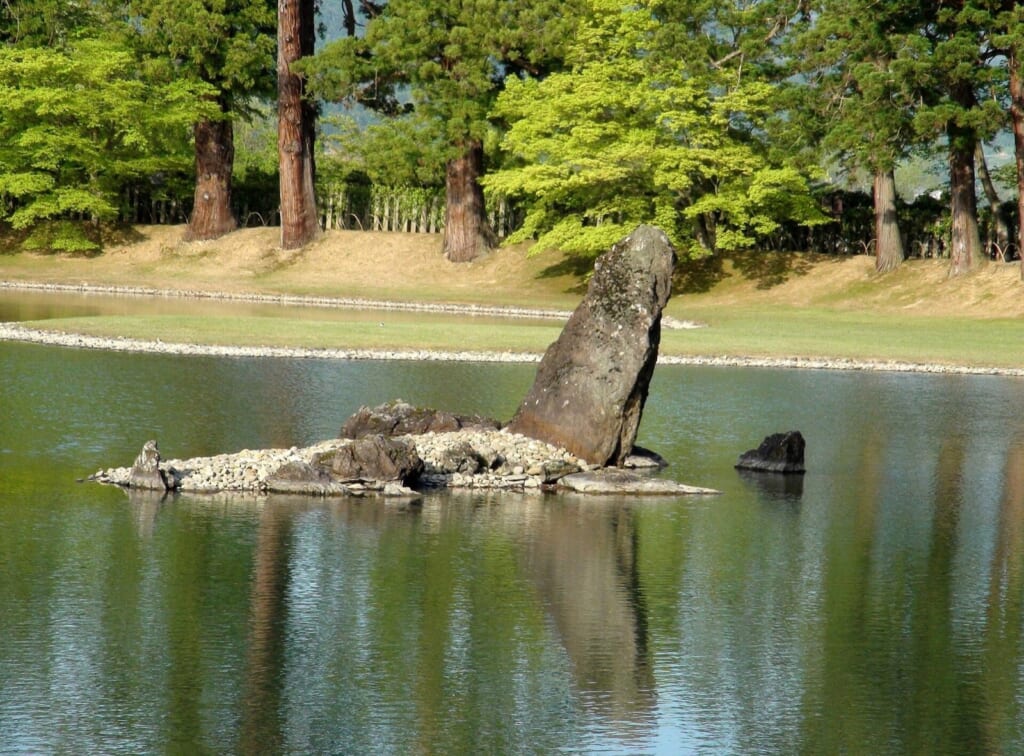
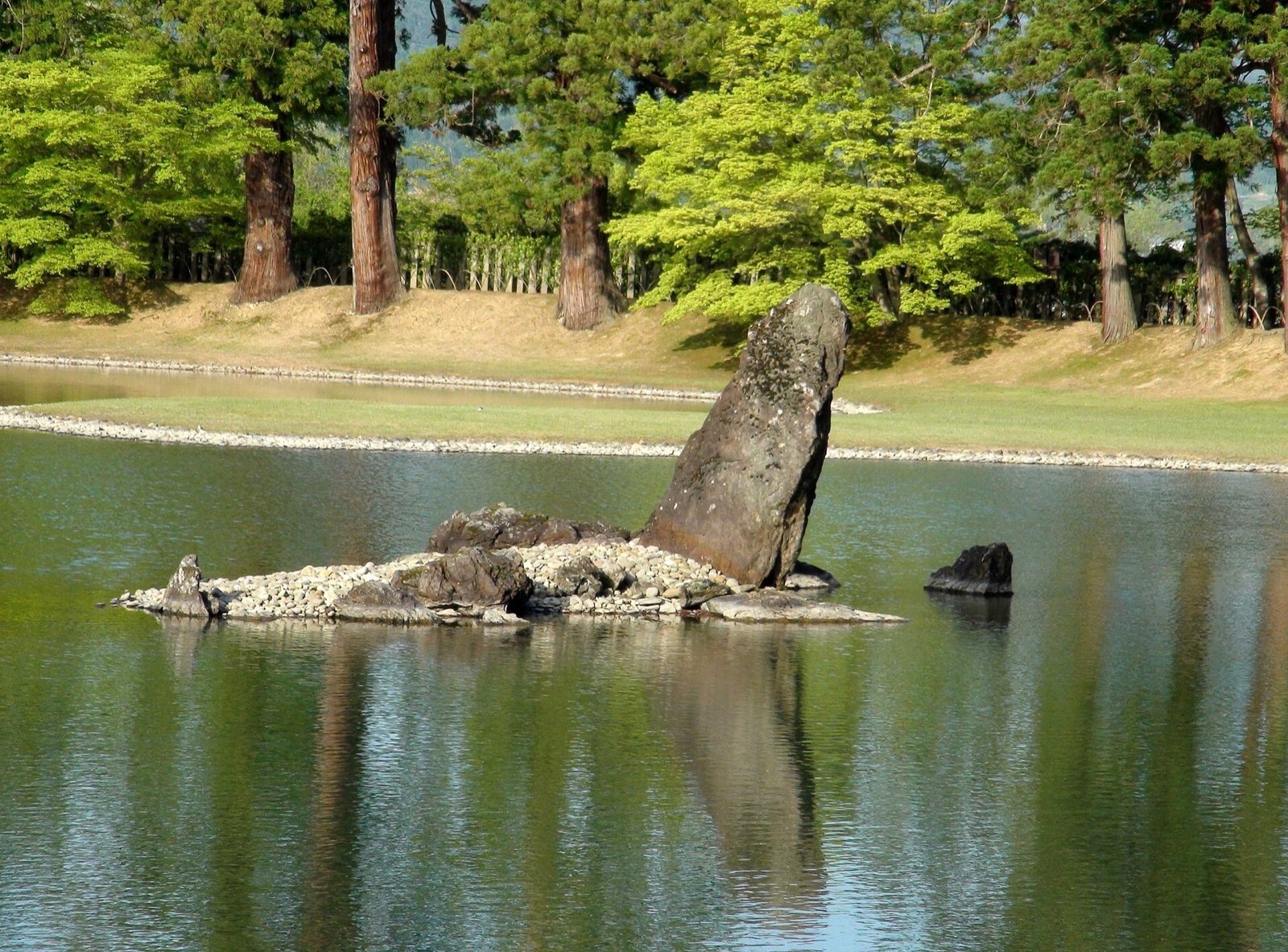
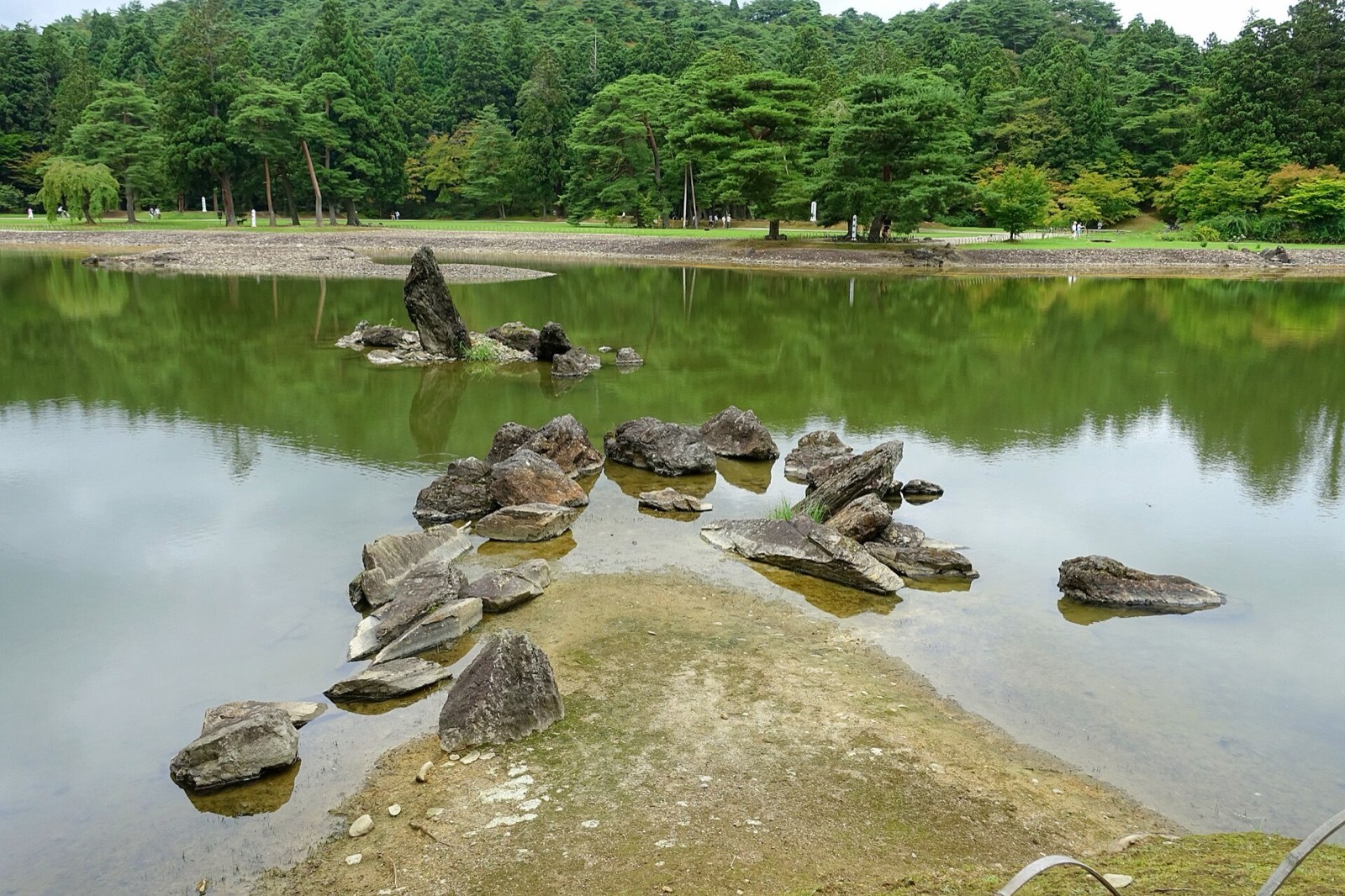
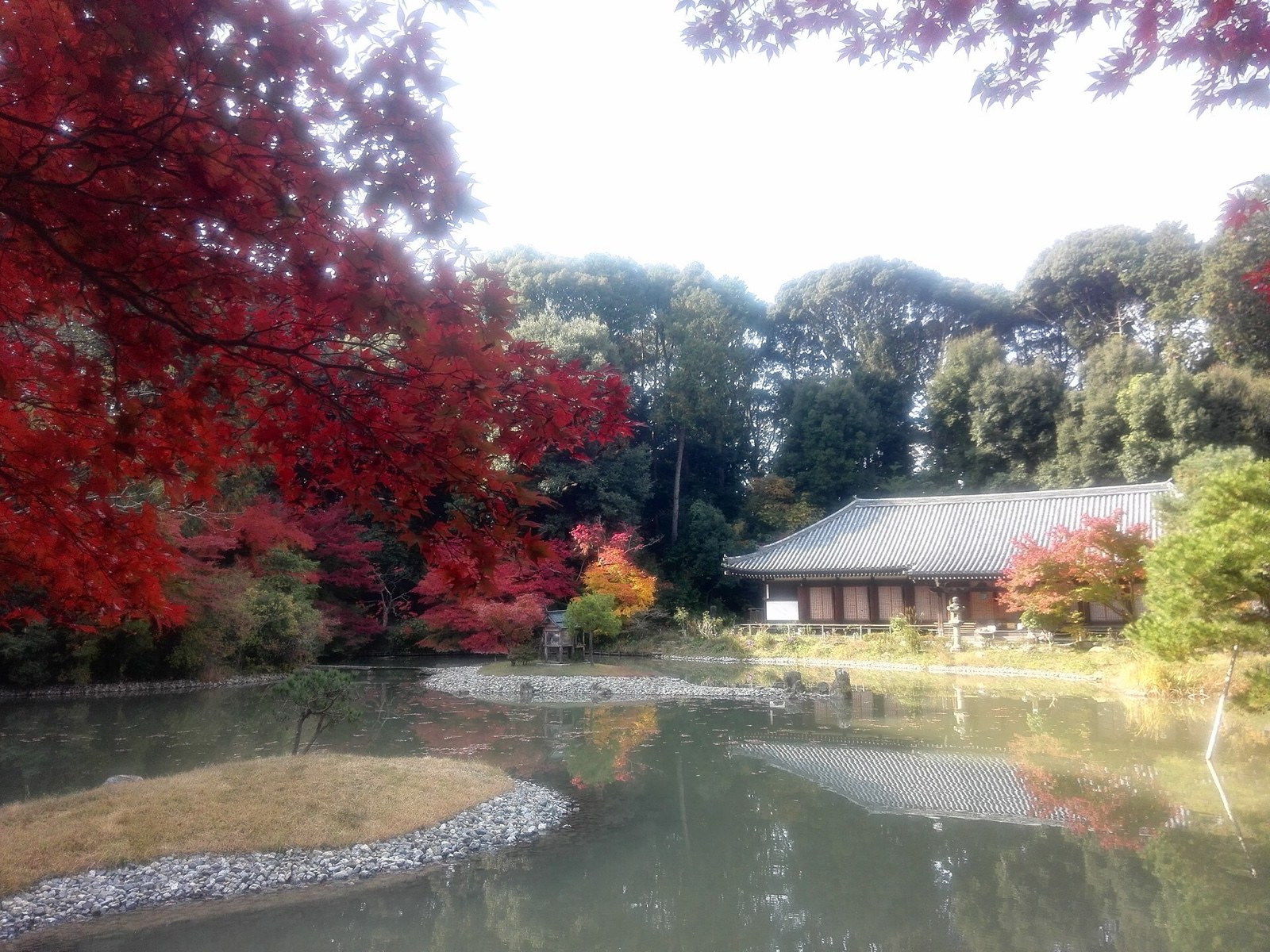
On the south-east shore of Ōizumi-ga-ike, the large pond at Mōtsū-ji temple in Hiraizumi, Iwate Prefecture, a spit of land runs out into the water. Its stones are set to suggest a rough, rocky coast, and at its centre stands a single stone about 2 metres (6.5 ft) tall. That is how the Iwate prefectural guide to Hiraizumi describes it: a peninsula representing a rocky seashore, built around a standing stone.
Mōtsū-ji describes its own garden as one that passes on “the thought and techniques of the Sakuteiki” to the present day. That is a strong claim for a temple to make about a book, and it leads straight to the question behind this article: can a text written more than 900 years ago still tell a gardener where a stone goes?
A rough coast in a pond
The Sakuteiki, as we will see, names several styles of pond, and the first on its list is the “ocean style.” The book names the “ocean style,” and I use Mōtsū-ji only as a visual comparison, without claiming a documented link to that passage: a stone-built rocky coast in a pond is a good place to picture what an ocean-style pond might mean.
Three gardens read alongside the book
Mōtsū-ji’s garden is protected twice. The garden itself is a Special Place of Scenic Beauty, designated on 23 May 1959. The temple precinct, with the site of its guardian shrine, is a separate Special Historic Site, designated on 22 November 1952. Both designations are recorded in the national database of the Agency for Cultural Affairs.
Two other early gardens serve as comparison cases for researchers. In 1938 the garden historian Mori Osamu related the layout of the Byōdō-in garden to the Sakuteiki‘s account of gardens for aristocratic mansions. At Jōruri-ji, the researcher Miharu Tatara examined how to interpret the book’s phrase about the “front of the island” (嶋のさき) and the position of the central island relative to the main hall, comparing several gardens including Jōruri-ji. None of these studies proves that a builder held the book in his hand. They use the gardens to test what the text means.
| Garden | Prefecture | National designation | Role in research on the Sakuteiki |
|---|---|---|---|
| Mōtsū-ji garden | Iwate | Special Place of Scenic Beauty (1959) | The temple says it passes on the book’s thought and techniques; a standing stone about 2 m tall on a “rocky coast” spit |
| Byōdō-in garden | Kyoto | Historic Site and Place of Scenic Beauty (1922) | Mori Osamu (1938) related its layout to the book’s account of mansion gardens |
| Jōruri-ji garden | Kyoto | Historic Site; Special Place of Scenic Beauty (special designation 1985) | One of the gardens Miharu Tatara compared when interpreting the island passage |
Who wrote the Sakuteiki — an attribution still argued
The author of the Sakuteiki is not settled. Most discussion centres on one man, and researchers disagree about his role.
Tachibana no Toshitsuna
Tachibana no Toshitsuna lived from 1028 to 1094. Kyoto City’s local history notes for Fushimi describe him as a son of Fujiwara no Yorimichi and record that he built a mountain villa at Fushimi in the Enkyū era (1069–74). A man at the top of court society, with a villa and garden of his own, fits the profile of someone who would set down what he knew about making gardens.
The case for, and another view
A 2024 paper by Koike Tatsunori and Ueda Hirofumi calls the attribution to Toshitsuna “the leading theory,” not a settled fact. The main evidence is a colophon in a related text, the Senzui-shō (山水抄), which says it was compiled from the records of “Toshitsuna of Fushimi, who was especially fond of this way.” The garden historian Ozawa Keijirō drew attention to this note and proposed Toshitsuna as the author. In 2026 the same two researchers re-examined a genealogy in another garden text and concluded that Toshitsuna “should be considered the author.”
Norio Hida, writing in 2023, reads the evidence differently. He dates the book to the late 11th or early 12th century, from the death dates of people it mentions, and suggests that one of Toshitsuna’s retainers put it together. A balanced summary keeps the researchers’ positions apart: Koike and Ueda support Toshitsuna’s authorship, while Hida proposes one of Toshitsuna’s retainers as the compiler.
“Oldest” — what each source says
The Sakuteiki is often called the oldest garden book in the world. The sources I checked say different things. A 2021 lecture by Professor Ono Kenkichi, reported by Wakayama University, calls it “Japan’s oldest garden book.” The library of Osaka Institute of Technology calls it the world’s oldest “secret manual” of gardens, but gives no comparison with texts from other countries. In this article I use the phrase I can support: Japan’s oldest garden book.
How the Sakuteiki got its name — and survived
According to Koike and Ueda, the book’s original title is unknown. The name we use today arrived centuries after it was written.
The Tanimura scrolls
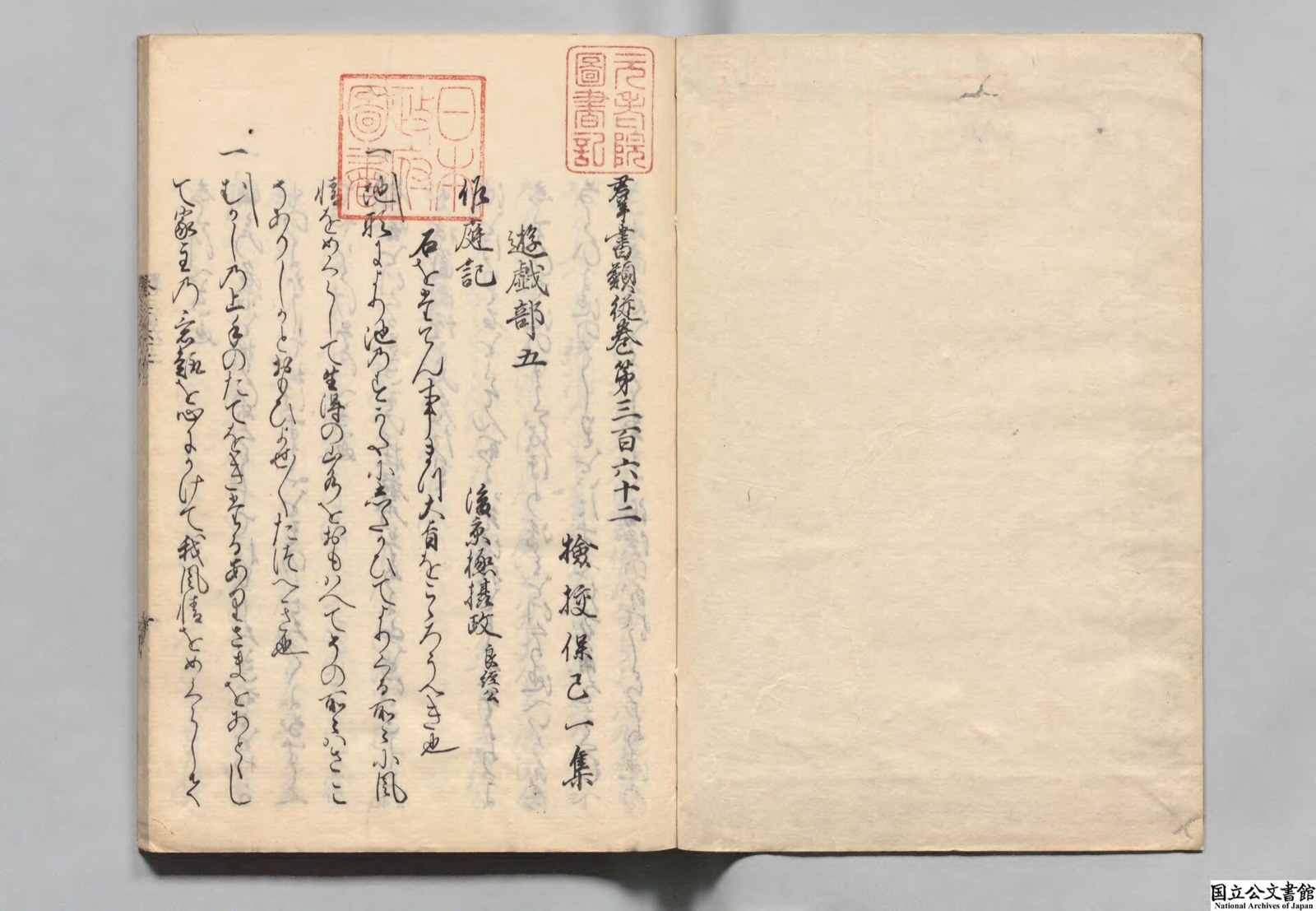
The oldest surviving manuscript is the Tanimura copy, two scrolls kept by the Tanimura family of Kanazawa. The national database lists it under the name “Sakuteiki,” two scrolls, Kamakura period, designated an Important Cultural Property on 6 May 1936, privately owned in Ishikawa Prefecture. A colophon records that someone “finished reading” the text in 1289. Researchers treat this as a reading note, not as the date of copying.
Senzai Hishō, Sakuteiki, Gunsho Ruijū
In the Edo period, scholars discussed Senzai Hishō (前栽秘抄, roughly “Secret Notes on Garden Planting”) as a candidate for the lost original name; a colophon by the court noble Konoe Motohiro, dated 1707, supports it. The name Sakuteiki is attested in a colophon by Noma Sanchiku dated 1666. It became the standard title after the text was printed in the great collection Gunsho Ruijū, published between 1793 and 1819.
A timeline, from compilation to English
| Year | Event | Source type |
|---|---|---|
| Late 11th–early 12th century | Book compiled (Iwate Prefecture: “late 11th century”; Hida: late 11th–early 12th century) | Prefectural guide; journal paper |
| 1289 | A reader’s note on the Tanimura scrolls | Manuscript colophon |
| 1666 | Title Sakuteiki attested (Noma Sanchiku) | Manuscript colophon |
| 1707 | Konoe Motohiro supports Senzai Hishō as the original title | Manuscript colophon |
| 1793–1819 | Gunsho Ruijū printed; the title Sakuteiki settles | Printed collection |
| 1936 | Tanimura scrolls designated an Important Cultural Property | National database |
| 1976 | English translation by Shigemaru Shimoyama, Sakuteiki: The Book of Garden | Library catalogue |
| 2001 | English translation by Jirō Takei and Marc P. Keane, Sakuteiki: Visions of the Japanese Garden (Tuttle) | National Diet Library record |
Where the wording matters below, I quote the Japanese as it appears in the research papers I checked and give my own plain English; the translations are mine.
“Ishi wo taten koto” — why a garden book starts with stones
The Sakuteiki opens: 「石をたてん事,まづ大旨をこころうべき也」 — “In setting stones, first understand the general principles.” It does not start with plants, water or buildings. It starts with stones, and with the order to think before acting.
Tateru: setting, not only standing
The verb is tateru (立てる), “to stand.” But the stone-setting the book describes is not only about upright stones. It discusses lying stones (臥石) and pairs a standing stone with a lying one. “Setting stones” is the safer English: the book covers every stone that goes into the garden, upright or flat.
The three general principles
The opening lists three principles. Each is a source of judgement rather than a rule about a particular stone.
| Principle | Japanese text (as quoted in research papers) | Plain meaning |
|---|---|---|
| 1. Follow the land | 「地形により,池のすがたにしたがひて」「生得の山水をおもはえて」 | Work with the lie of the land and the shape of the pond; keep natural scenery in mind |
| 2. Learn from earlier masters, serve the owner | 「むかしの上手のたてをきたるありさまをあとゝして,家主の意趣を心にかけて」 | Take the work of past masters as a model, and keep the owner’s wishes in mind |
| 3. Recall famous places | 「国々の名所をおもひめぐらして,おもしろき所々を,わがものになして」 | Think over famous landscapes around the country and make their best parts your own |
The third principle asks the maker to remember the shape of a famous coast or river and rebuild its essence on the site. That is a different idea from shakkei, the borrowing of a view that stays outside the garden.
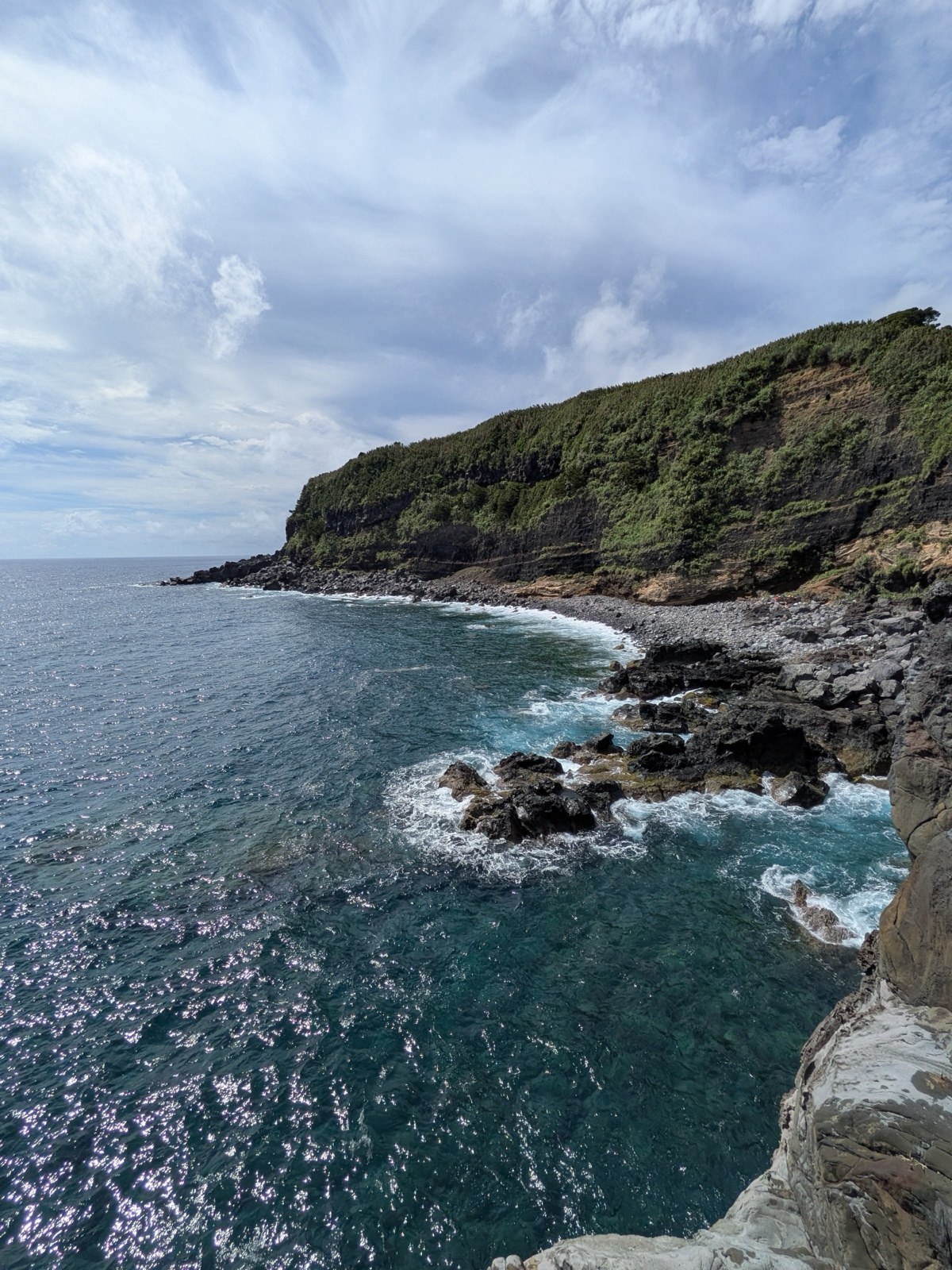
Taken together, the three principles place the decision in three things outside the stone itself: the ground, the tradition of earlier makers with the owner’s wishes, and the memory of real landscapes.
Follow the stone — the line everyone quotes, and the quarrel over one word
The most quoted sentence in the Sakuteiki is about the order in which stones are set.
The main stone first
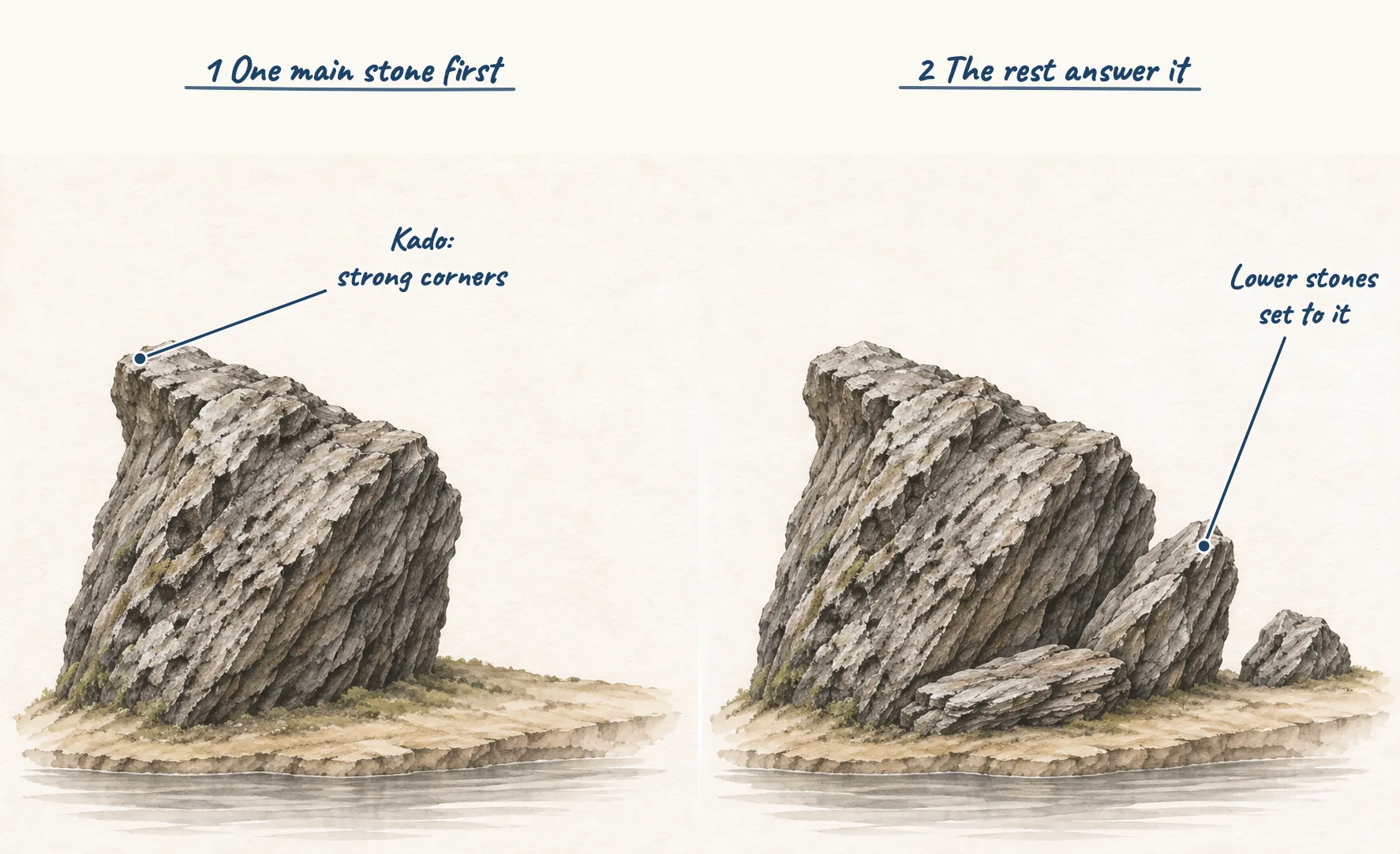
As quoted by Hida (2023), the text reads: 「石をたてんには,まづおも石のかどあるをひとつ立おおせて,次々のいしをば,その石のこはんにしたがひて立べき也」. In plain English: “When setting stones, first set one main stone that has kado, and then set the following stones kowan ni shitagaite — following that stone’s kowan.”
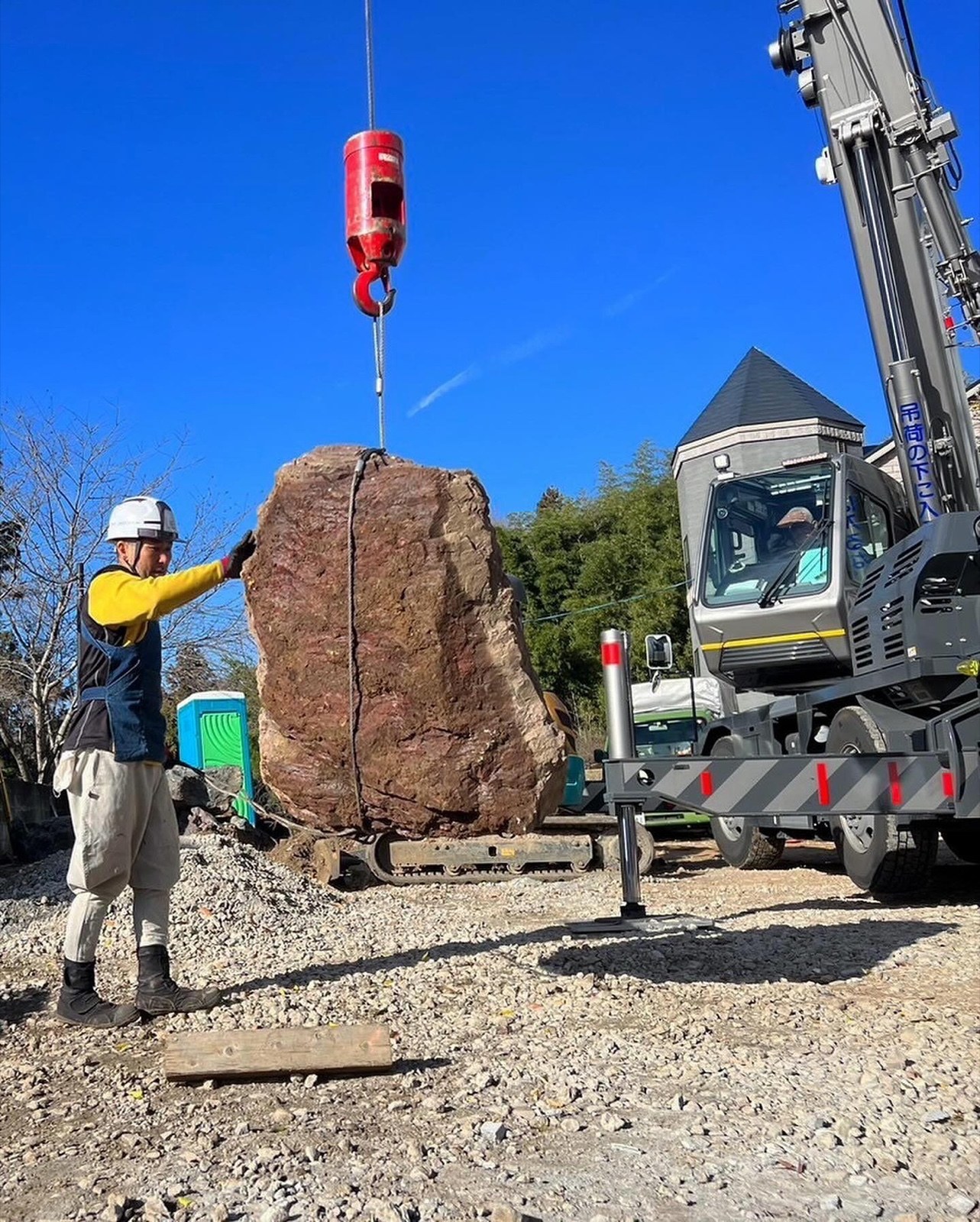
The order is clear even before we reach the difficult word. One stone comes first, the omo-ishi (主石), the main stone, one that has kado — literally “corners.” Everything after it is placed in relation to it. The garden grows outward from one decision.
Kowan: request, or quarter?
The difficulty is kowan (こはん). The garden historians Mori Osamu and Tamura Tsuyoshi read it as 乞はん, “what it requests.” The sentence then says: set the next stones as the first stone asks. This is the reading behind the phrase “follow the request of the stone.”

In 1967 the researcher Harigaya Shōkichi proposed a different reading. He argued that kohan is 小半, a measure meaning “a quarter,” and that the passage is about proportion rather than a stone’s wishes. He also suggested that in another passage often used to support the “request” reading, the character usually read as 乞 might be 色. I present both readings and do not choose between them.
What both readings share
Whichever reading you prefer, the structure is the same: one stone is set first, and the later stones are considered in relation to it. A second passage, on the stones of a garden stream, uses the same word: 「此所々に石をひとつ立て其石のこはむほとを多も少も立へき也」 — set one stone at each of these places, then set more or fewer according to that stone’s kohamu. On the “request” reading, the number of stones depends on what the first stone calls for; on Harigaya’s reading, it is a matter of proportion to the first stone. Either way, the count is not fixed before the first stone is in.
Put into a modern sequence — this is my summary of the book’s ideas, not its wording — the method runs:
- Read the site: the lie of the land, the pond, the natural scenery it suggests.
- Choose and set one main stone that has kado.
- Consider each following stone, and how many follow, in relation to the first.
- Arrange them in answering pairs (next section).
- Check the taboos of the day (later section).
The book describes a sequence of decisions rather than a fashion, and that is one reason it still reads as practical.
Stones in pairs — fleeing and chasing, leaning and supporting
If the main-stone passage tells you where to start, a second famous passage tells you how stones relate to each other.
The paired stones
The researcher Kojima Hirotsugu, presenting at the Kansai branch of the Japanese Institute of Landscape Architecture in 2020, quoted the passage from Tamura Tsuyoshi’s 1964 edition and called it a technique that “still applies to stone arrangement today.”
| Japanese (as quoted) | Stone A | Stone B | The relation in the picture |
|---|---|---|---|
| 逃る石あれば、追ふ石あり | A stone that flees | A stone that chases | Movement across the group |
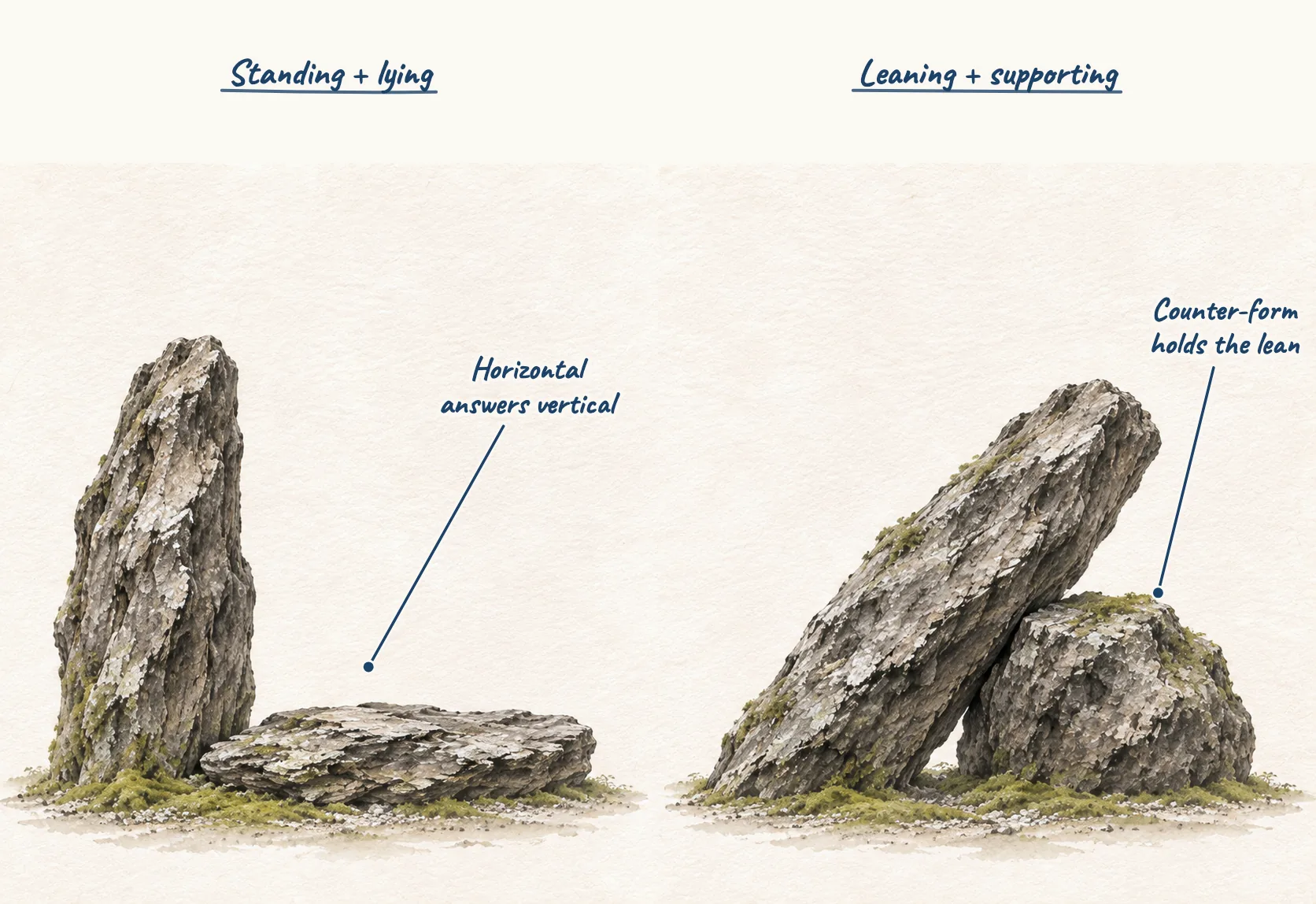
| 傾く石あれば、支ふる石あり | A stone that leans | A stone that supports | A lean answered by a counter-form |
| 踏まふる石あれば、受る石あり | A stone that presses down | A stone that receives | One stone appearing to rest on another |
| 仰げる石あれば、うつぶける石あり | A stone that looks up | A stone that looks down | Contrast of angle |
| 立る石あれば、臥る石あり | A standing stone | A lying stone | Vertical answered by horizontal |
One way to read the pairs
The Sakuteiki does not explain the pairs in modern terms, so what follows is one possible visual interpretation, not a quotation. A single upright stone on its own reads as an object. Add a low stone that leans toward it, or a flat stone at its foot, and the eye starts to move between them; the two read as one scene. On that reading, the pairs are a way of making stones look as if they belong to the same ground, rather than as if they had been set down one by one. The words “supports” and “receives” describe how the stones look together; they are not, in the text, an engineering claim.
The triad and the 品 stones
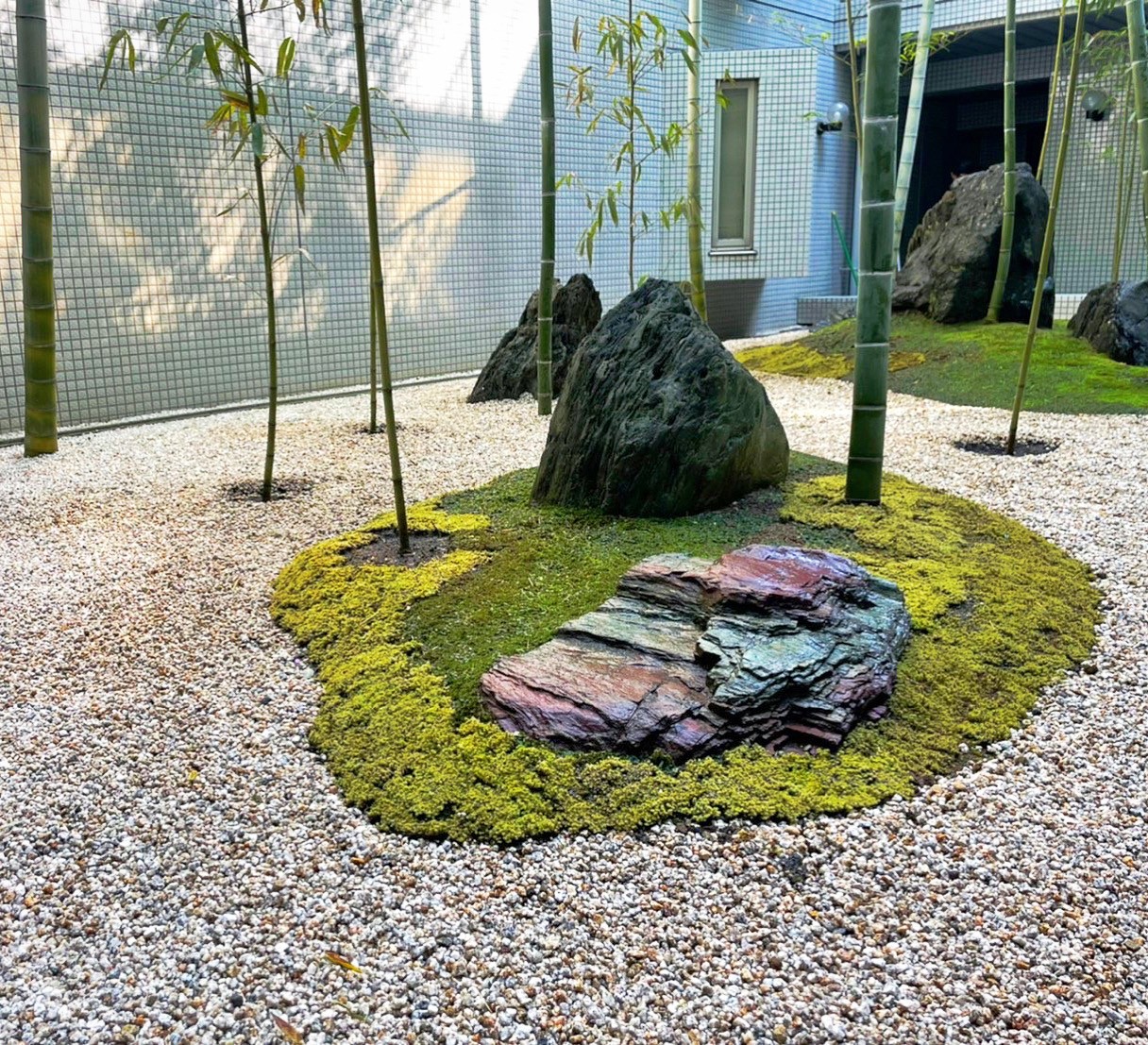
The book names some groups directly. As quoted by Kimura Saburō in 1983: 「石をたつるに三尊仏の石はたち品文字の石はふす常事也」 — “in setting stones, the stones of the Buddhist triad stand, and the stones of the character 品 lie; this is the usual practice.” The triad (sanzon, 三尊) takes its name from the Buddhist triad, and its stones stand. The 品 group takes its name from the character 品, and its stones lie low.
A further instruction, quoted in a 2017 paper by Okajima Naokata, concerns which way the triad faces: 「三尊仏の立石を,まさしく寝殿にむかふべからず。すこしき余方へむかふべし。」 — the triad’s standing stones should not face the shinden, the main residential hall, squarely, but should turn slightly in another direction.
Seas, rivers and marshes — matching stones to the kind of water
The Sakuteiki does not treat all ponds alike. It names types of water, of islands and of waterfalls.
Styles of pond
| Style (as quoted in Hida 2023) | Literal meaning of the name |
|---|---|
| 大海のやう | Great-sea style |
| 大河のやう | Great-river style |
| 山河のやう | Mountain-river style |
| 沼池のやう | Marsh-and-pond style |
| 葦手のやう | Ashide style (葦, reed) |
The list ties the stones to a kind of water rather than to a fixed pattern. It is the first principle — follow the land and the natural scenery — turned into a set of named models.
Islands and waterfalls
Islands also come in named types. Examples from the list Hida quotes include 山島,野島,杜島 — literally mountain island, field island and grove island — and further shapes named 雲形,霞形,洲浜形,片流,干潟,松皮, whose names refer to clouds, mist, a sandbar, a one-sided flow, a tidal flat and pine bark. Waterfalls have their own set of names for how water falls; examples include 向落,片落,伝落,離落, then 布落,糸落 (literally “cloth fall” and “thread fall”), and 左右落,横落. I give the Japanese names because the exact forms behind several of them need the book’s full descriptions to translate well.
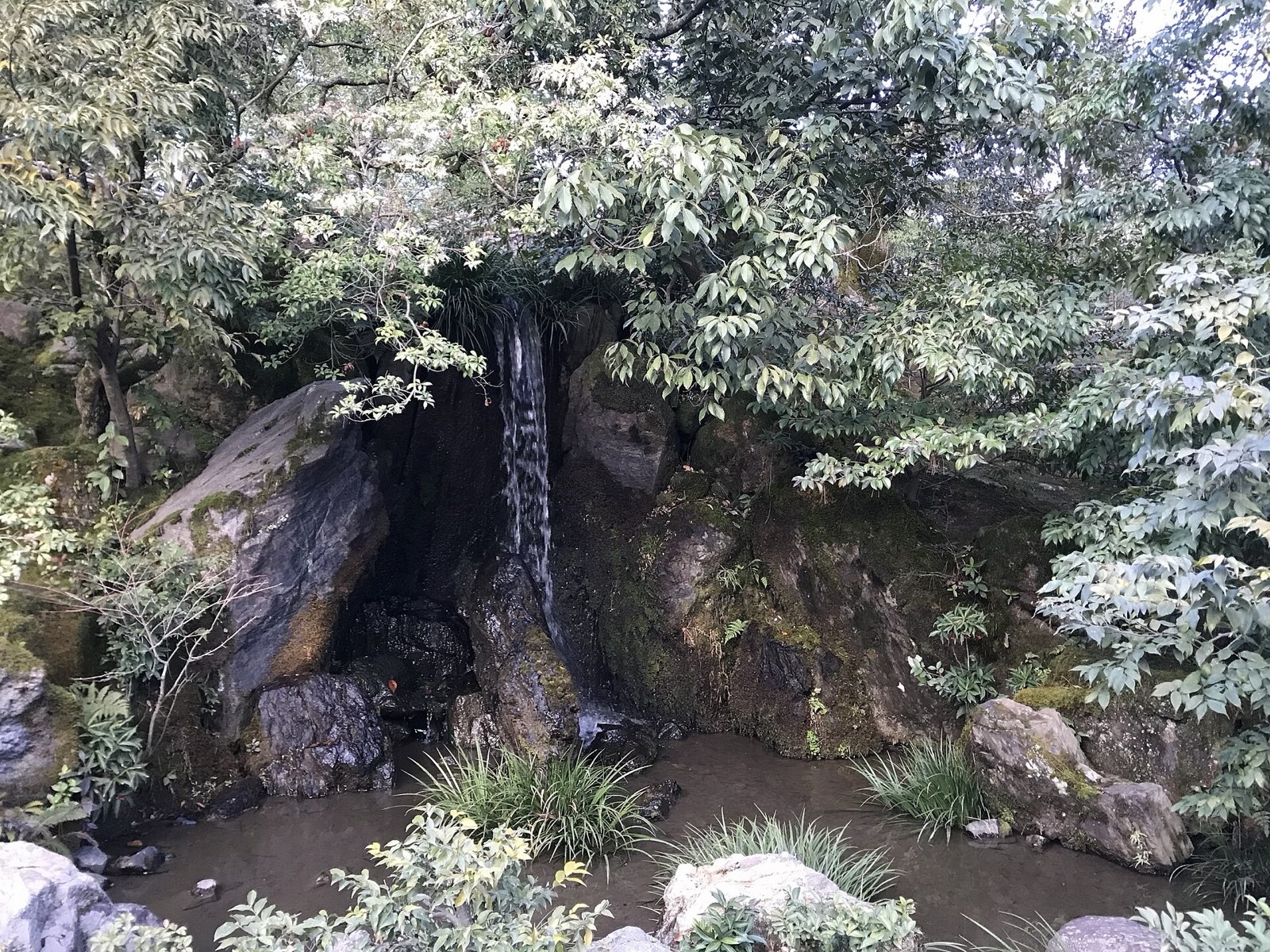
The stone over which water drops, the mizu-ochi-ishi (水落石), receives particular attention. The Japanese Institute of Landscape Architecture’s final report for fiscal 2024 (dated March 2025) notes that the book asks for a stone with an attractive face over which the waterfall flows (「面うるはしき」), and finds that what the book says about this stone is “content that connects to today’s craft.”
Yarimizu — the garden stream
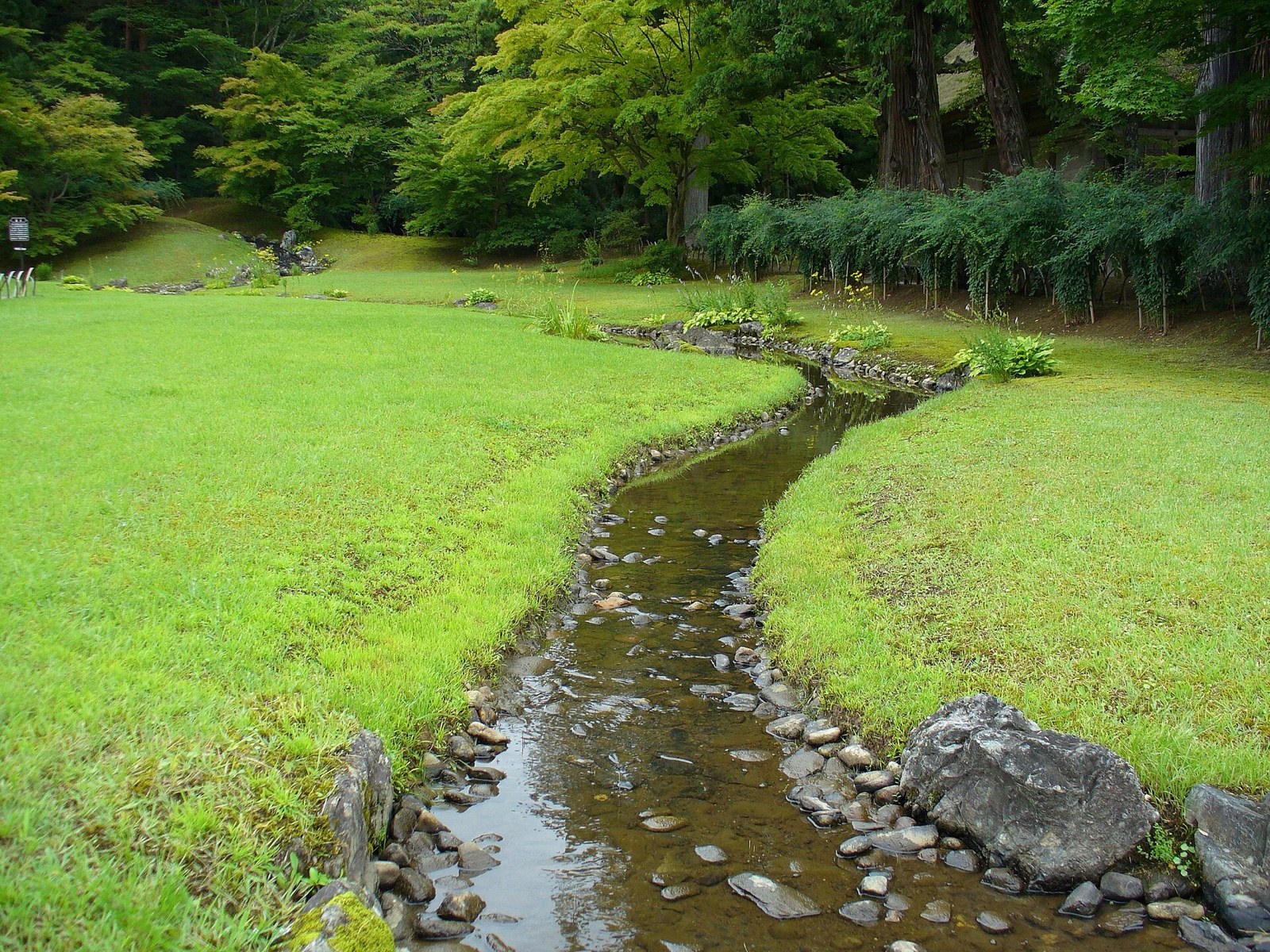
The yarimizu (遣水) is the stream that runs through these gardens. Harigaya quotes the instruction: 「遣水の石を立る事はひたわもてにしけくたてくたすことあるへからす」 — the stream’s stones should not be set densely over its whole length. Instead, at particular places one stone is set first, and then more or fewer, as the passage on kohamu above describes.
The taboos — curses, directions and how to read them
The Sakuteiki states openly: 「石をたつるにハ,おほくの禁忌あり。」 — “in setting stones there are many taboos.” Some concern direction, some the turning of a stone from its original position.
| Taboo (as quoted in Okajima 2017) | Plain meaning |
|---|---|
| 「もと立てたる石をふせ,もと臥る石をたてる也。」 | Laying down a stone that originally stood, or standing a stone that originally lay |
| 「その石かならず霊石となりて,たたりをなすべし。」 | (If you do) the stone will surely become a spirit-stone and bring a curse |
| 「高さ四尺五尺なりぬる石を,丑寅方に立べからず。」 | Do not stand a stone four or five shaku tall in the north-east (ushitora) |
| 「臥石を戌亥方にむかふべからず。」 | Do not turn a lying stone toward the north-west (inui) |
The shaku is the old Japanese unit of length.
Reading the taboos today
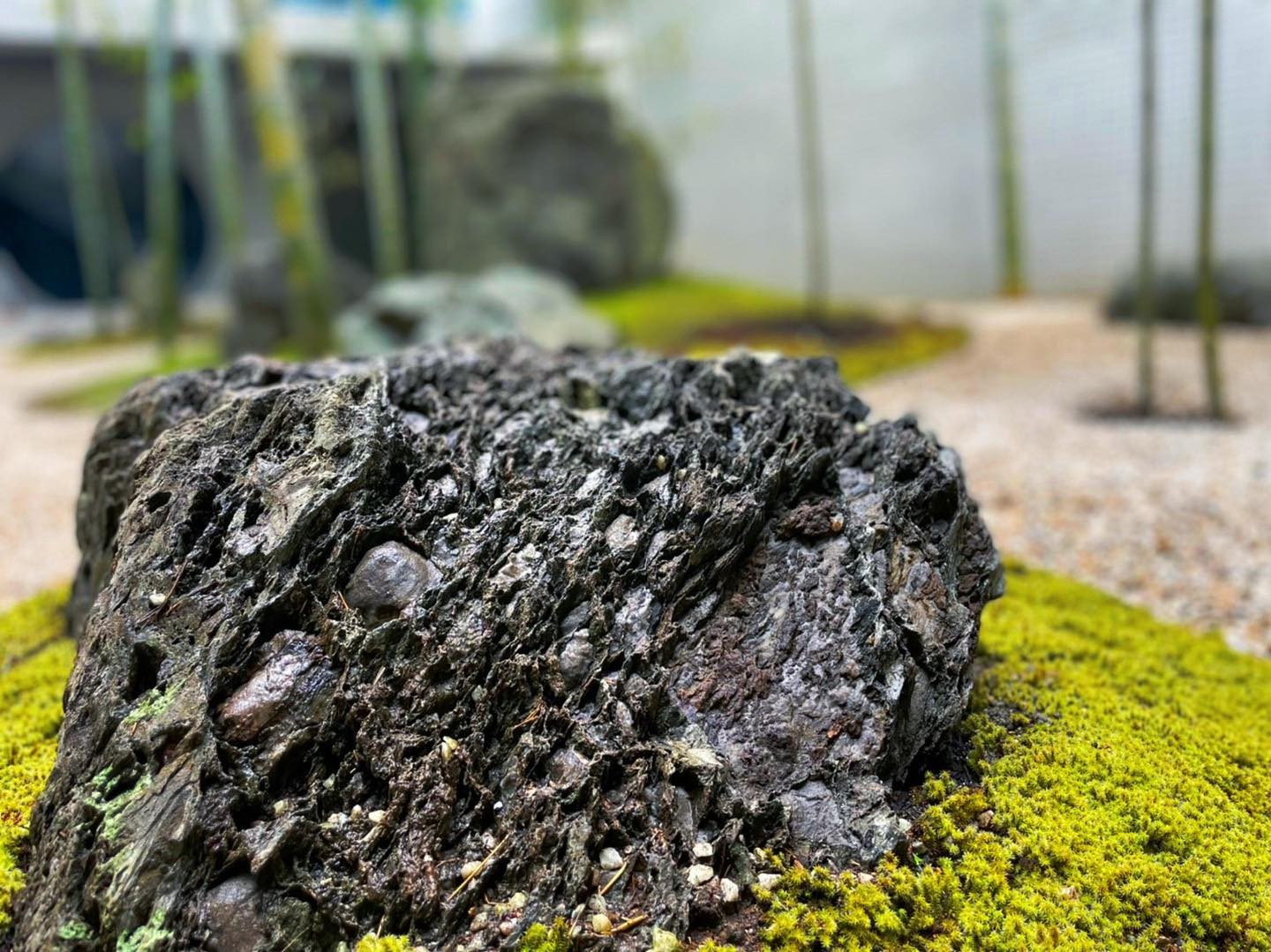
The curses are belief, not engineering, and I do not repeat them as fact. The first taboo can be read in a practical way — again, my interpretation, not the book’s wording: a stone found standing or lying has weathered in that position, so its surfaces may show which side was up. Reverse it and those surfaces end up where nature would not have put them. The book frames the rule as a spirit taking offence; the practical lesson I take from it is to respect the position in which a stone was found.
The directional taboos are best read as a record of how directions were understood when the book was written. They are a source for that history, not instructions for a modern site.
From kado to mitsuke — the Sakuteiki’s ideas in today’s vocabulary
Japanese garden work today distinguishes several faces and parts of a stone with precise terms.
Three working words
| Modern term | Meaning | Source |
|---|---|---|
| Mitsuke (見付) | The front side of a garden stone | Nara National Research Institute for Cultural Properties, Japanese Garden Dictionary |
| Tenba (天端) | The top surface of a garden stone or stone wall | Same dictionary |
| Neire (根入れ) | The part of a set stone that goes into the ground | Technical notes by Inoue Katsuhiro of the Kyoto Prefecture Landscape Cooperative, in the Japanese Institute of Landscape Architecture report (fiscal 2024, March 2025) |
Mitsuke and tenba are different faces: one is the front, one is the top. When the Sakuteiki asks for a waterfall stone with a fine face (面), it is concerned with how a stone’s surface is presented, the question these modern terms make precise.
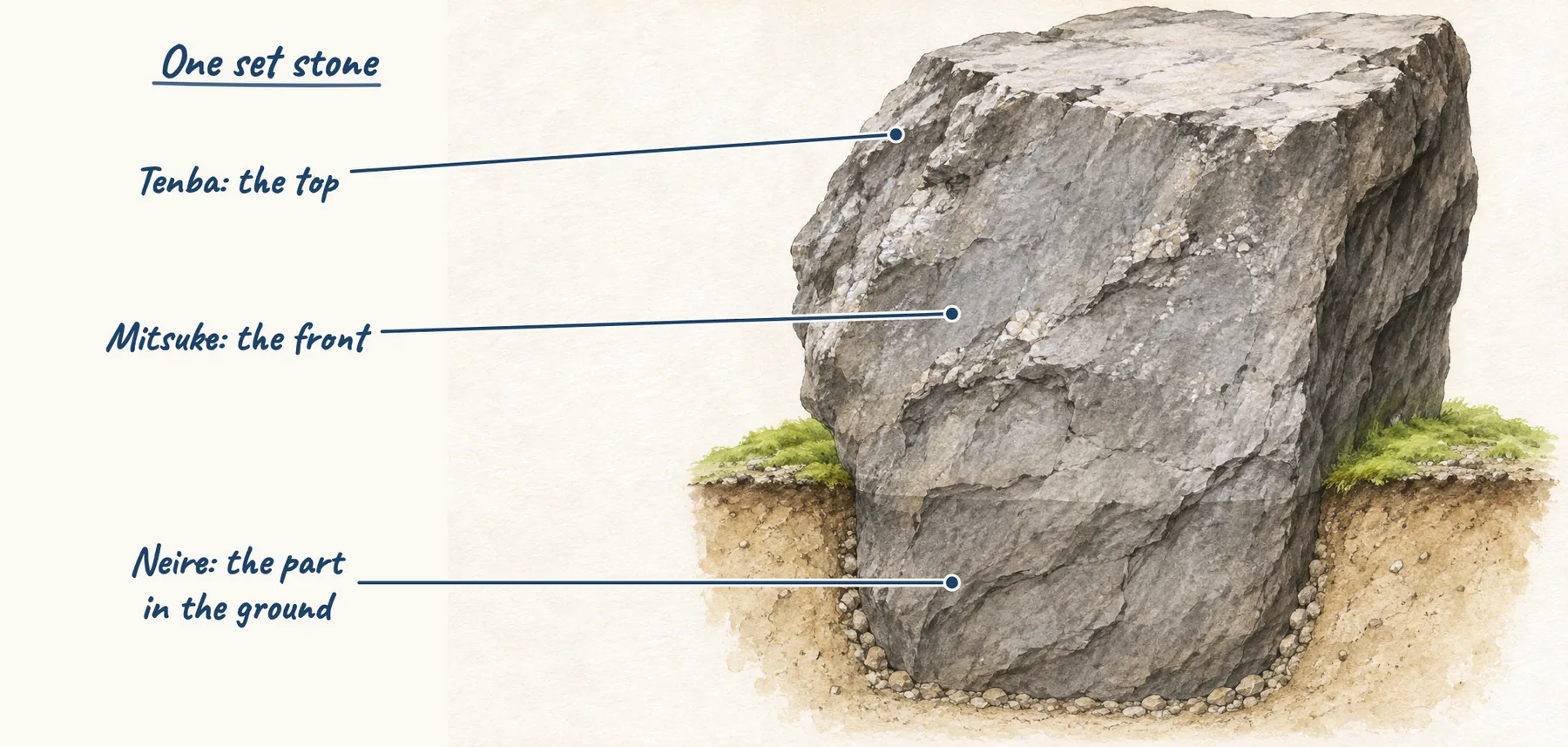
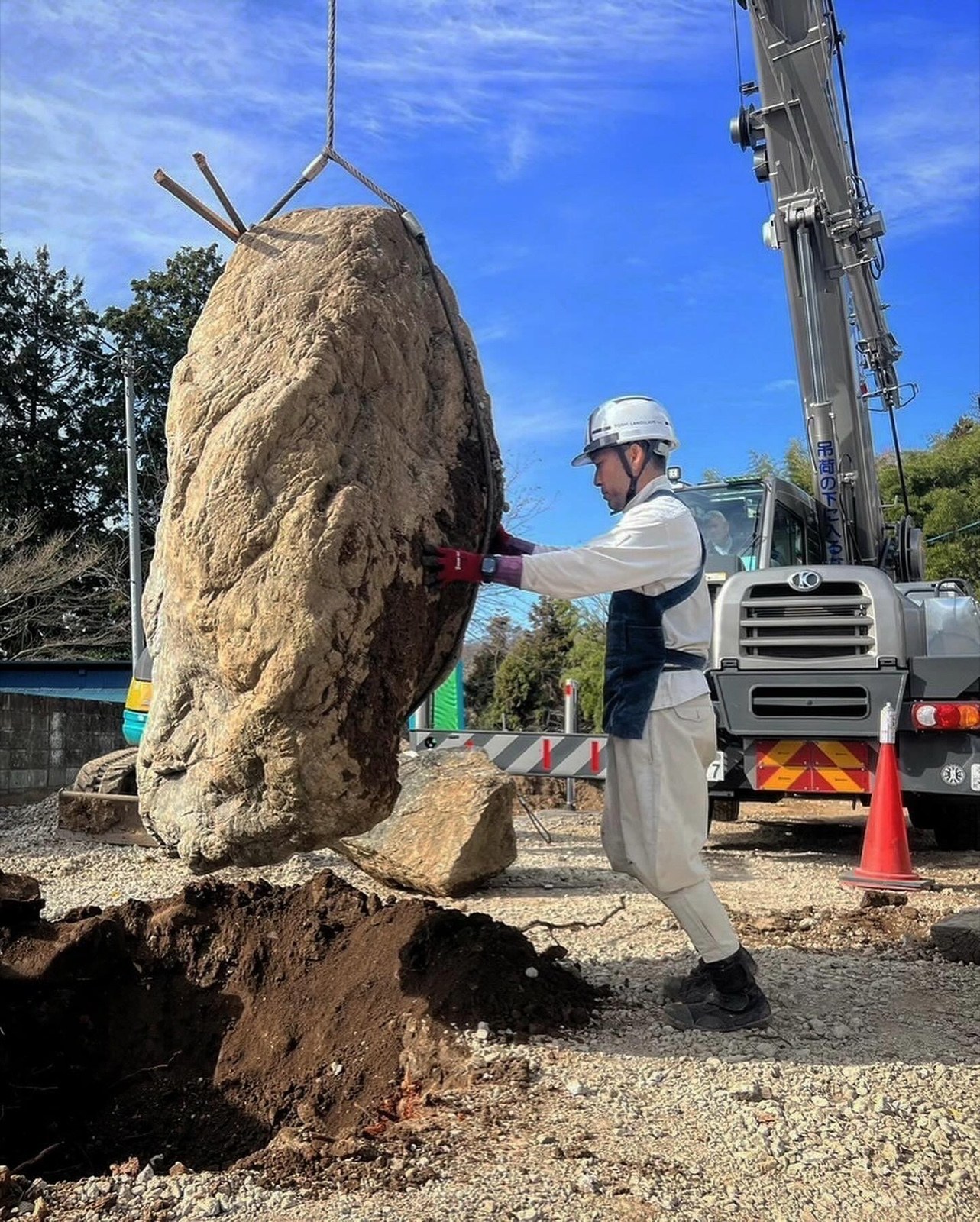
Neire names something the paired stones in a picture do not show: the part of each stone that is in the ground.
What researchers say carries over
Three Japanese sources make the link between the book and present-day work. Shigemori Chisao, introducing a 2025 lecture series at Bukkyo University, describes the Sakuteiki‘s content and ideas as “still the basis of garden-making today.” Kojima (2020) says the paired-stone technique “still applies to stone arrangement today.” The Japanese Institute of Landscape Architecture’s fiscal 2024 report finds that the book’s account of the waterfall stone connects to today’s craft.
What the sources do not show
None of these sources says that Japanese gardeners open the Sakuteiki on site to decide where each stone goes, and the sources I checked contain no survey of how often professionals consult it. What they support is narrower: researchers point to shared ideas and techniques between the book and present-day stone setting — the main stone first, the paired stones, the waterfall stone. On that evidence, the answer to this article’s question is that the Sakuteiki does not dictate where a stone goes today, but the way of deciding that it records is still recognised in Japanese garden work.
The English rock garden — the same instincts, a different purpose
Britain has its own tradition of placing rocks in gardens, and comparing it with the Sakuteiki shows shared instincts and a different purpose.
Reginald Farrer and the English rock garden
In 1919 Reginald Farrer published The English Rock Garden in two volumes, according to the Royal Botanic Garden Edinburgh, which holds his papers. The Royal Horticultural Society today treats rock gardening together with alpine plants; in that tradition, the rocks are there above all to give mountain plants a home.
Larger stones first, strata running together
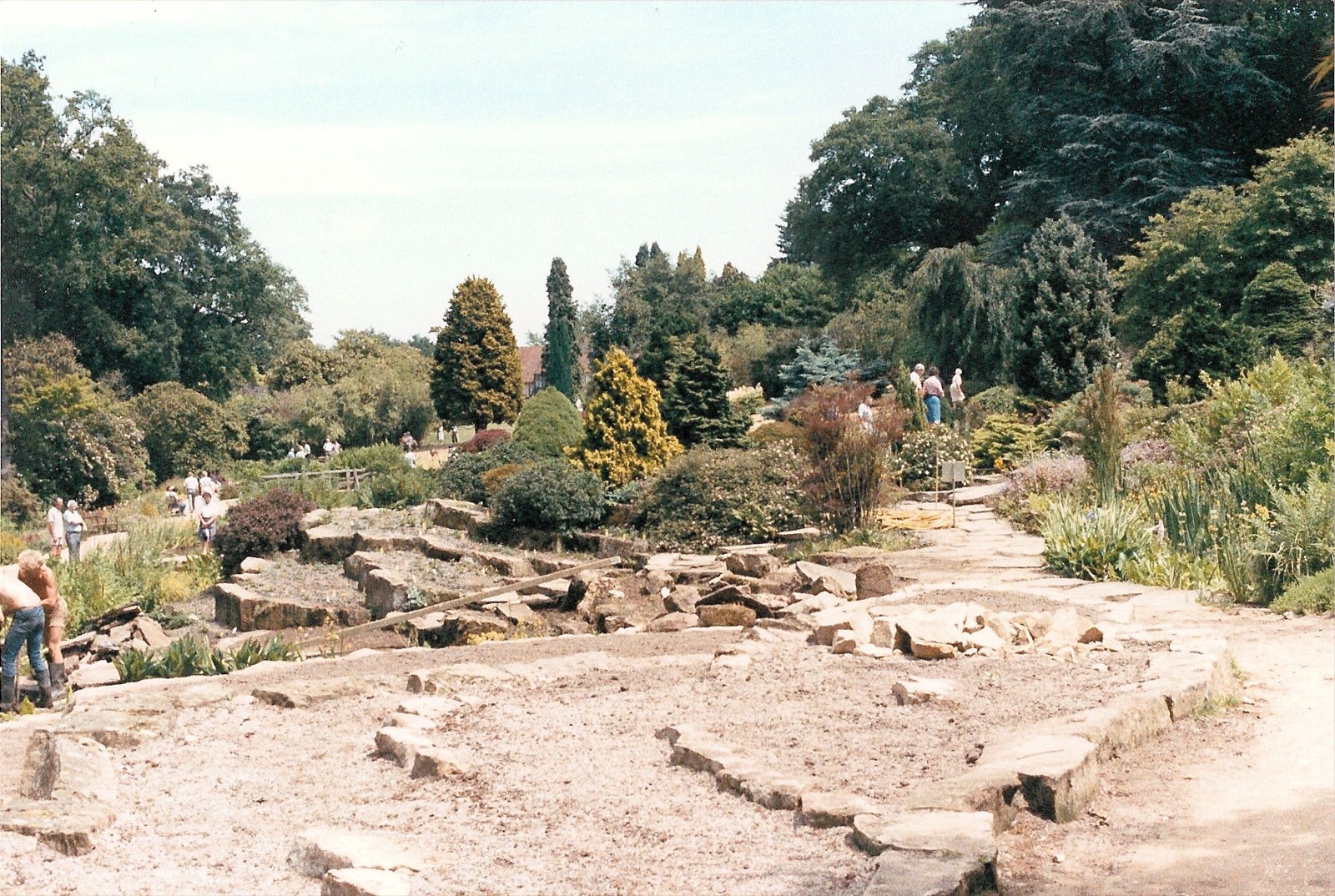
The RHS guidance on building a rock garden reads, in parts, much like the Sakuteiki. It says to “position the larger of these first and place the remaining ones so that the strata look natural.” It says that “the rocks should tilt backwards, with the strata running the same way,” and to “bury the stones up to a third of their depth, firming them in place.” Big stone first, the rest in relation to it; respect for how stone lies in nature; part of each stone below ground. The two traditions reach similar working rules.
| Sakuteiki | RHS alpine rock garden guidance | |
|---|---|---|
| Main purpose | Stones compose a garden scene viewed from a hall | Rocks create a home for alpine plants |
| Order of setting | One main stone first, the others in relation to it | Larger stones first, the rest placed so the strata look natural |
| Natural position | Do not reverse a stone’s original standing or lying position | Tilt rocks back, strata running the same way |
| Below ground | Not specified in the passages quoted here | Bury up to a third of each stone’s depth |
| Relations between stones | Named pairs: fleeing/chasing, leaning/supporting | Matching strata across the group |
The difference is one of premise, not quality. The RHS rock garden serves plants from the mountains; the Sakuteiki uses stones to compose a landscape. The same difference of purpose runs through the way Japanese gardens shape plants, discussed in niwaki and topiary compared.
Frequently asked questions
What is the Sakuteiki?
The Sakuteiki (作庭記) is a Japanese manual on garden making from the late 11th or early 12th century, described by Japanese scholars as Japan’s oldest garden book. It covers stone setting, ponds, islands, waterfalls, streams and taboos, and opens with the instruction to understand general principles before setting stones.
Who wrote the Sakuteiki?
The author is not settled. The leading theory attributes it to Tachibana no Toshitsuna (1028–1094), a son of Fujiwara no Yorimichi; Norio Hida suggests one of his retainers compiled it.
What does “follow the request of the stone” mean?
It comes from a line that says to set one main stone first and then set the others following that stone’s kowan. Mori Osamu and Tamura Tsuyoshi read kowan as “what it requests”; Harigaya Shōkichi (1967) read it as kohan, “a quarter,” a matter of proportion. Both readings make the first stone the reference for the rest.
Where can I see a garden linked to the Sakuteiki?
Mōtsū-ji in Hiraizumi, Iwate, says its garden passes on the book’s thought and techniques; its pond has a standing stone about 2 m tall on a rocky-coast spit. The gardens of Byōdō-in and Jōruri-ji are also studied alongside the text.
Is there an English translation of the Sakuteiki?
Yes. Jirō Takei and Marc P. Keane, Sakuteiki: Visions of the Japanese Garden (Tuttle, 2001), and an earlier translation by Shigemaru Shimoyama, Sakuteiki: The Book of Garden (1976).
Do Japanese gardeners still use the Sakuteiki?
Researchers describe its ideas as the basis of garden-making today, and its paired-stone and waterfall passages as matching present-day technique. The sources checked for this article contain no survey of how often professionals consult the text itself.
Sources
– Iwate Prefecture, “Mōtsū-ji” (Hiraizumi World Heritage guide): https://www5.pref.iwate.jp/~hp0252/hiraizumi/motsuji.html — checked 2026-11-17 – Mōtsū-ji, precinct guide: https://motsuji.or.jp/keidai/index.html — checked 2026-11-17 – Agency for Cultural Affairs, national database, “Mōtsū-ji garden”: https://kunishitei.bunka.go.jp/heritage/detail/401/158 — checked 2026-11-17 – Agency for Cultural Affairs, national database, “Mōtsū-ji precinct”: https://kunishitei.bunka.go.jp/bsys/maindetails/401/116 — checked 2026-11-17 – Agency for Cultural Affairs, national database, “Byōdō-in garden”: https://kunishitei.bunka.go.jp/heritage/detail/401/1642 — checked 2026-11-17 – Agency for Cultural Affairs, national database, “Jōruri-ji garden”: https://kunishitei.bunka.go.jp/heritage/detail/401/1721 — checked 2026-11-17 – Agency for Cultural Affairs, national database, “Sakuteiki” (Important Cultural Property): https://kunishitei.bunka.go.jp/heritage/detail/201/7604 — checked 2026-11-17 – Kyoto City, Fushimi Ward, “Tachibana no Toshitsuna’s villa”: https://www.city.kyoto.lg.jp/fushimi/page/0000013307.html — checked 2026-11-17 – Koike T. and Ueda H. (2024), Landscape Research Japan Online 17, pp. 61–72: https://www.jstage.jst.go.jp/article/jilaonline/17/0/17_61/_pdf/-char/ja — checked 2026-11-17 – Koike T. and Ueda H. (2026), Japanese Journal of Landscape Architecture 19(1): https://www.jstage.jst.go.jp/article/jjla/19/1/19_1/_article/-char/en — checked 2026-11-17 – Hida N. (2023), “The Sakuteiki as the origin of the Japanese garden,” Landscape Research Japan 87(2), pp. 112–115: https://www.jstage.jst.go.jp/article/jila/87/2/87_112/_pdf/-char/ja — checked 2026-11-17 – Harigaya S. (1967), on the meaning of kohan in the Sakuteiki, Journal of the Japanese Institute of Landscape Architects 30(4): https://www.jstage.jst.go.jp/article/jila1934/30/4/30_4_7/_pdf — checked 2026-11-17 – Kimura S. (1983), “Ishitate,” Journal of the Japanese Institute of Landscape Architects 46(5): https://www.jstage.jst.go.jp/article/jila1934/46/5/46_5_13/_pdf — checked 2026-11-17 – Okajima N. (2017), Landscape Research Japan 80(5), pp. 453–458: https://www.jila-zouen.org/wpdata/wp-content/uploads/2017/04/10.pdf — checked 2026-11-17 – Bulletin of Japanese Society for the Science of Design 51 (1985), p. 36: https://www.jstage.jst.go.jp/article/jssdj/1985/51/1985_KJ00007024222/_pdf/-char/ja — checked 2026-11-17 – Japanese Institute of Landscape Architecture, Kansai Branch, research presentation abstracts 2020, p. 17 (Kojima H.): https://www.kansai.jila-zouen.org/wp-content/uploads/2020/10/2020_kansai_youshishu.pdf — checked 2026-11-17 – Japanese Institute of Landscape Architecture, final report on the “spirit” and “craft” of Japanese gardens (fiscal 2024; March 2025), pp. 28–29, 89: https://researchpromotion.jila-zouen.org/wp-content/uploads/2025/05/2024_nihonteien_seikahoukoku.pdf — checked 2026-11-17 – Mori O. (1938), “A study of the Byōdō-in garden”: https://www.jstage.jst.go.jp/article/aijsaxxxx/9/0/9_KJ00001745524/_pdf — checked 2026-11-17 – Tatara M., Landscape Research Japan 61(5), pp. 369–372: https://www.jstage.jst.go.jp/article/jila1994/61/5/61_5_369/_article/-char/ja/ — checked 2026-11-17 – Nara National Research Institute for Cultural Properties, Japanese Garden Dictionary, “Front of a stone”: https://www.nabunken.go.jp/org/bunka/jgd/pages/FrontOfAStone.html — checked 2026-11-17 – Nara National Research Institute for Cultural Properties, Japanese Garden Dictionary, “Top of a stone”: https://www.nabunken.go.jp/org/bunka/jgd/pages/TopOfAStone.html — checked 2026-11-17 – Wakayama University, report of a lecture by Ono Kenkichi (2021): https://www.wakayama-u.ac.jp/kii-plus/news/2021100600042/ — checked 2026-11-17 – Osaka Institute of Technology Library, Tsukiyama Teizōden note 2: https://www.oit.ac.jp/japanese/toshokan/wp/static/collection/edojidainosakuteishototeienguide/tukiyamateizouden.html — checked 2026-11-17 – Bukkyo University, lecture introduction by Shigemori Chisao (2025): https://www.bukkyo-u.ac.jp/olc/pickup/20250513/28127.html — checked 2026-11-17 – National Diet Library, record for Takei and Keane, Sakuteiki: Visions of the Japanese Garden (2001): https://ndlsearch.ndl.go.jp/books/R100000001-I09111100309656 — checked 2026-11-17 – Edogawa University, foreign-book catalogue, p. 4 (Shimoyama translation, 1976): https://www.edogawa-u.ac.jp/img/media/15133.pdf — checked 2026-11-17 – Royal Botanic Garden Edinburgh, Reginald Farrer collection: https://atom-2.rbge.org.uk/index.php/reginald-farrer-collection — checked 2026-11-17 – Royal Horticultural Society, “Alpine and rock gardening”: https://www.rhs.org.uk/garden-design/alpine-rock-gardening — checked 2026-11-17