

In September 2026 I met Zeno Gasparri, an arborist from Verona who runs the tree-care business Fotosintesi, over dinner in Milan. We had first connected on Instagram and then traded books by post, so by the time we sat down we already knew each other’s shelves. What he told me came down to four things: start from how the species grows, take wind and root damage seriously, let an agronomo assess important trees before anyone cuts, and wear fluorescent clothing that people can see.
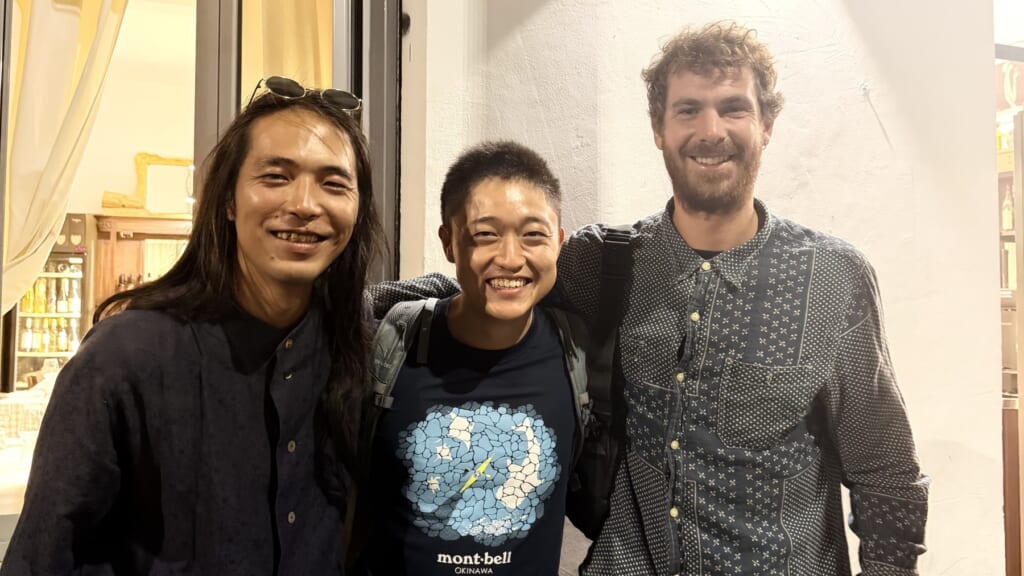
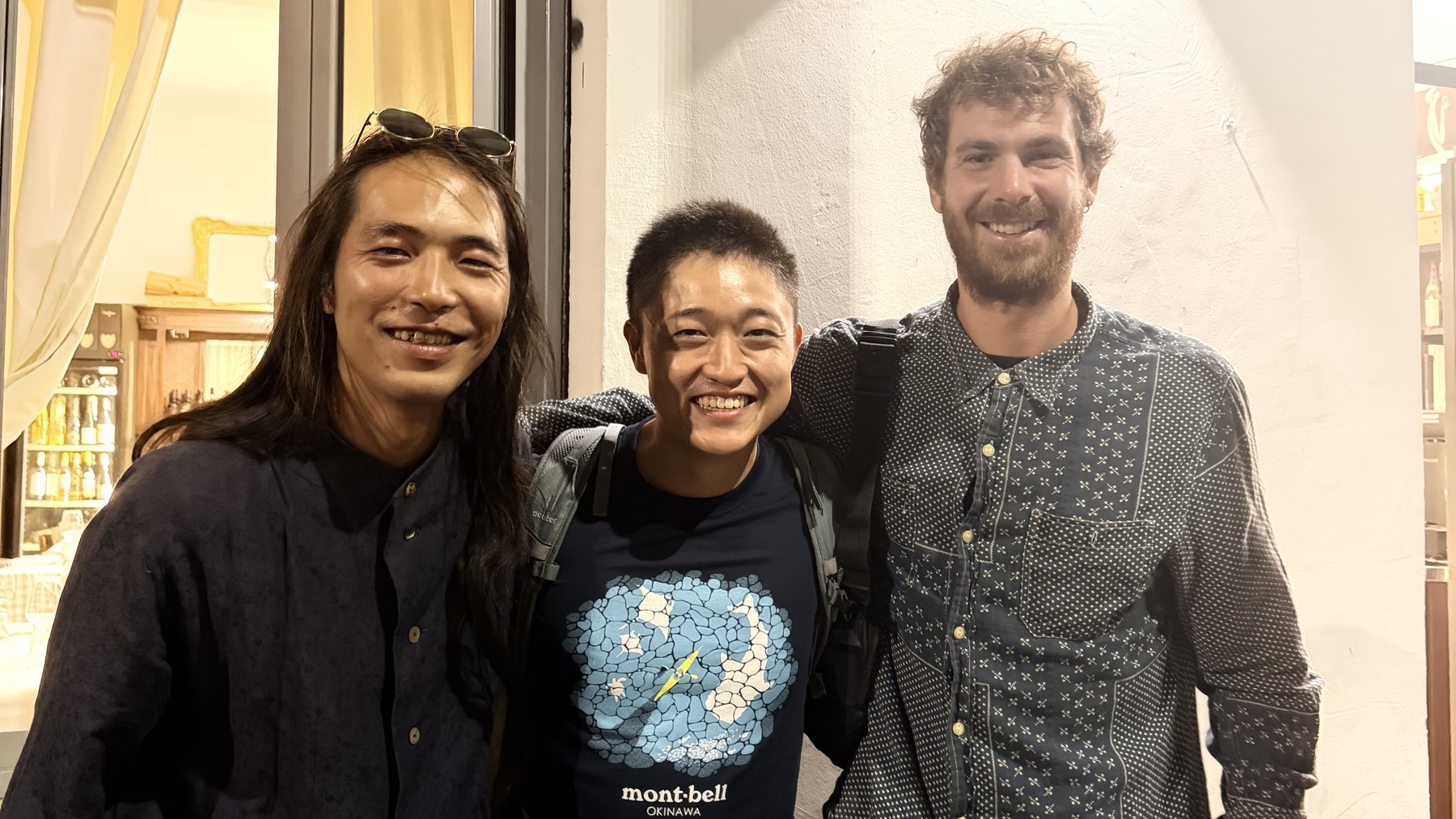
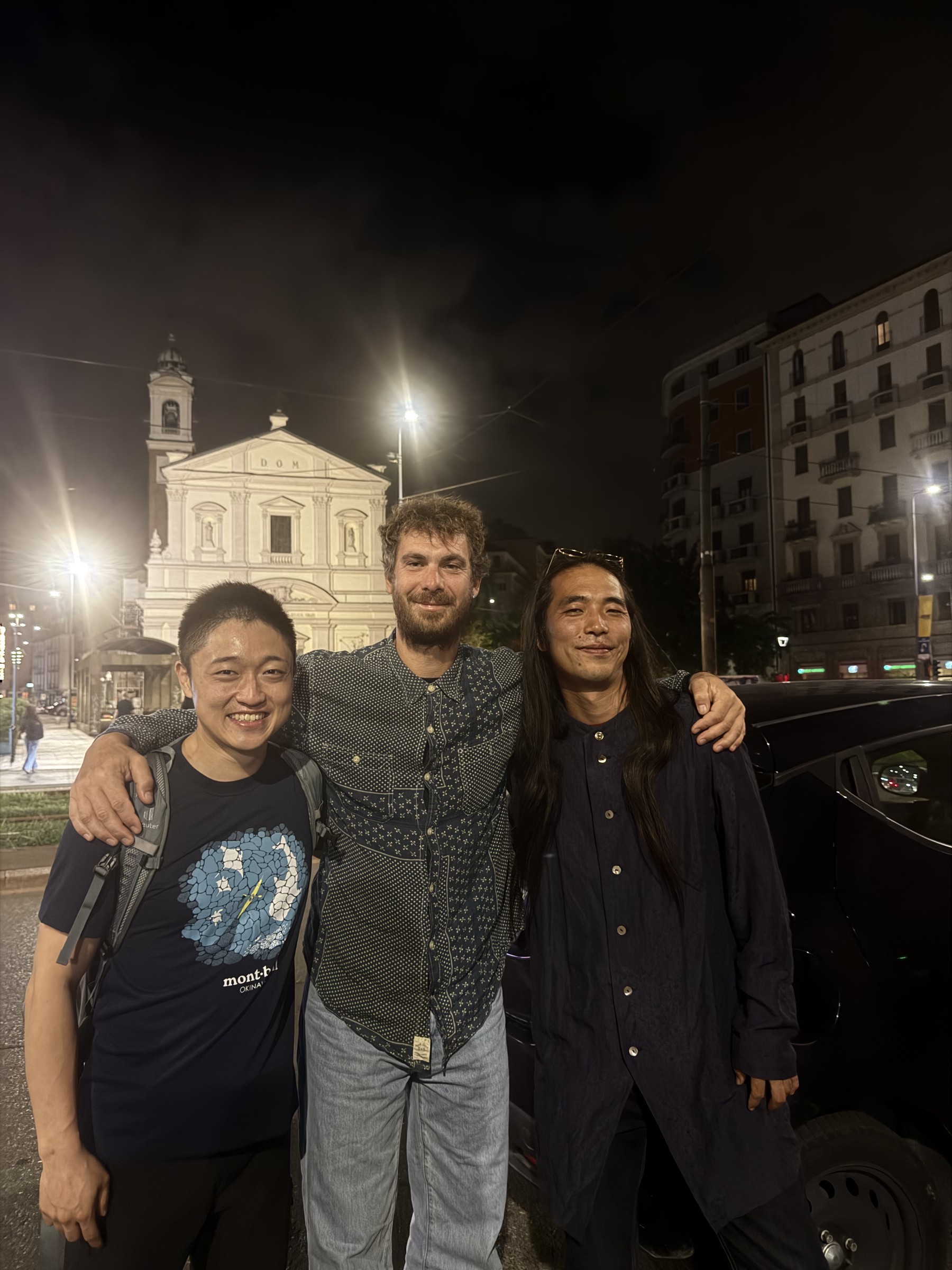
The evening ended on a lit street corner in Milan, three of us squeezed together for a photo. Getting there had taken months: an Instagram connection, then a parcel of European standards and Italian books sent to Tokyo. This article follows that path, then sets out the four points with the background I have since checked.
It began on Instagram — two arborists, one feed
A Verona tree-care business
Zeno Gasparri works in Verona, in north-east Italy. His business is called Fotosintesi, the Italian word for photosynthesis, and its website lists an address in Verona. The services are the everyday work of an arborist: felling and pruning, with pruning done using tree-climbing techniques, along with building gardens and green spaces, irrigation, and maintenance of shared residential gardens. For the stability assessment of trees, the site says plainly that he collaborates with dottori forestali and agronomi, the licensed forestry and agricultural professionals of Italy. That sentence turned out to be the key to one of the most useful conversations I had in Europe, and I will come back to it.
Zeno runs Fotosintesi together with a Japanese partner, Takahashi-san. So a Verona arborist, a Japanese colleague in Verona and a Japanese arborist in Tokyo already shared more than an interest in trees.
How two feeds became a correspondence
Zeno and I found each other on Instagram. I am an arborist at a landscape company in Tokyo, and our company’s feed shows Japanese pruning and tree diagnosis. The record does not say who sent the first message, so I will not invent one. What I can say is that the conversation moved from comments to something more concrete: books.
Photos show the finished cut. Books show the reasoning behind it, and trading them was a way to share that reasoning, not only the result.
A parcel from Italy — the standards, the books
The European Arboricultural Standards
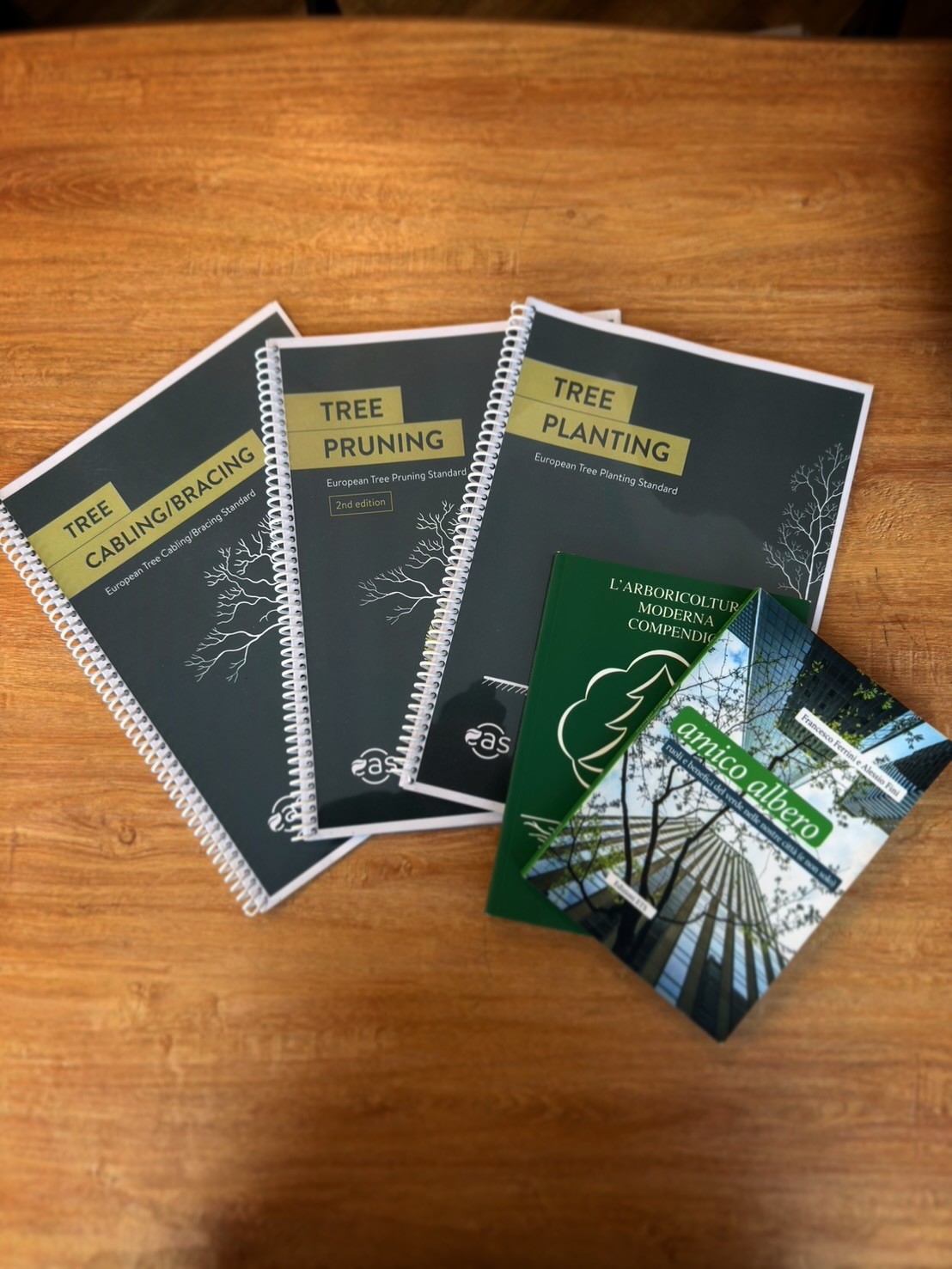
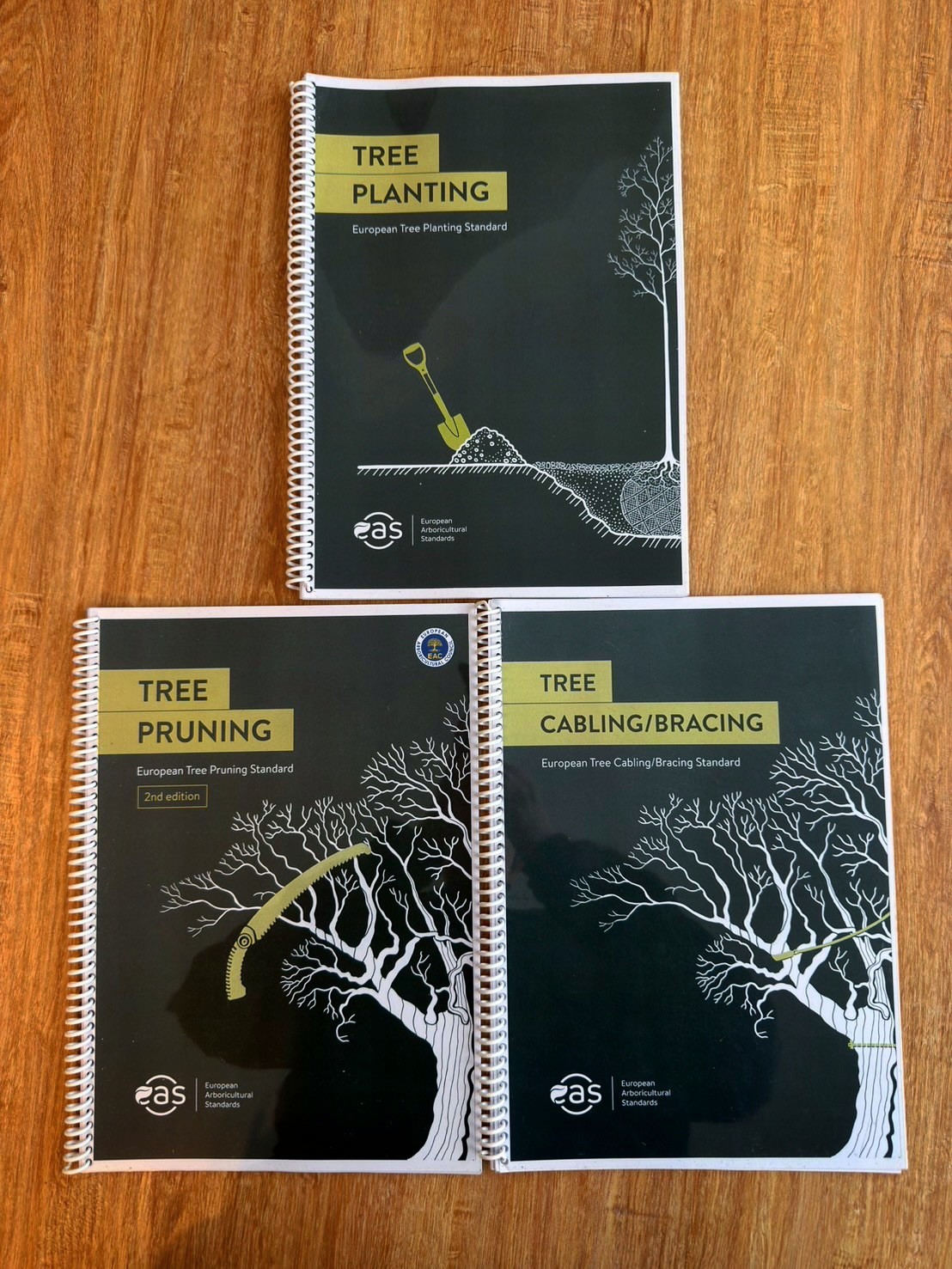
In January 2026 a parcel from Zeno reached our office in Tokyo. Our company recorded its arrival on 21 January 2026. Inside were three spiral-bound documents with black covers: the European Arboricultural Standards, usually shortened to EAS.
The EAS were written in a project called TeST, short for “Technical Standards in Tree Work”, an EU-funded project that ran from September 2019 to August 2022, with co-funding from the Erasmus+ programme. The aim was a set of standards that arborists in different European countries can share. Three documents came out of it:
– EAS 01, European Tree Pruning Standard. First edition dated June 2021. The copy Zeno sent us is the second edition, whose imprint is dated November 2024; the official site labels the current version February 2025. – EAS 02, European Tree Cabling/Bracing Standard. First edition, August 2022. – EAS 03, European Tree Planting Standard. Released in August 2022.
The official EAS site lists national translations, including Italian versions of all three. I could not find a Japanese version in that list. For a Japanese arborist, then, the English originals are the way in, and Zeno’s parcel put them on our office table.
Amico albero — an Italian argument for urban trees
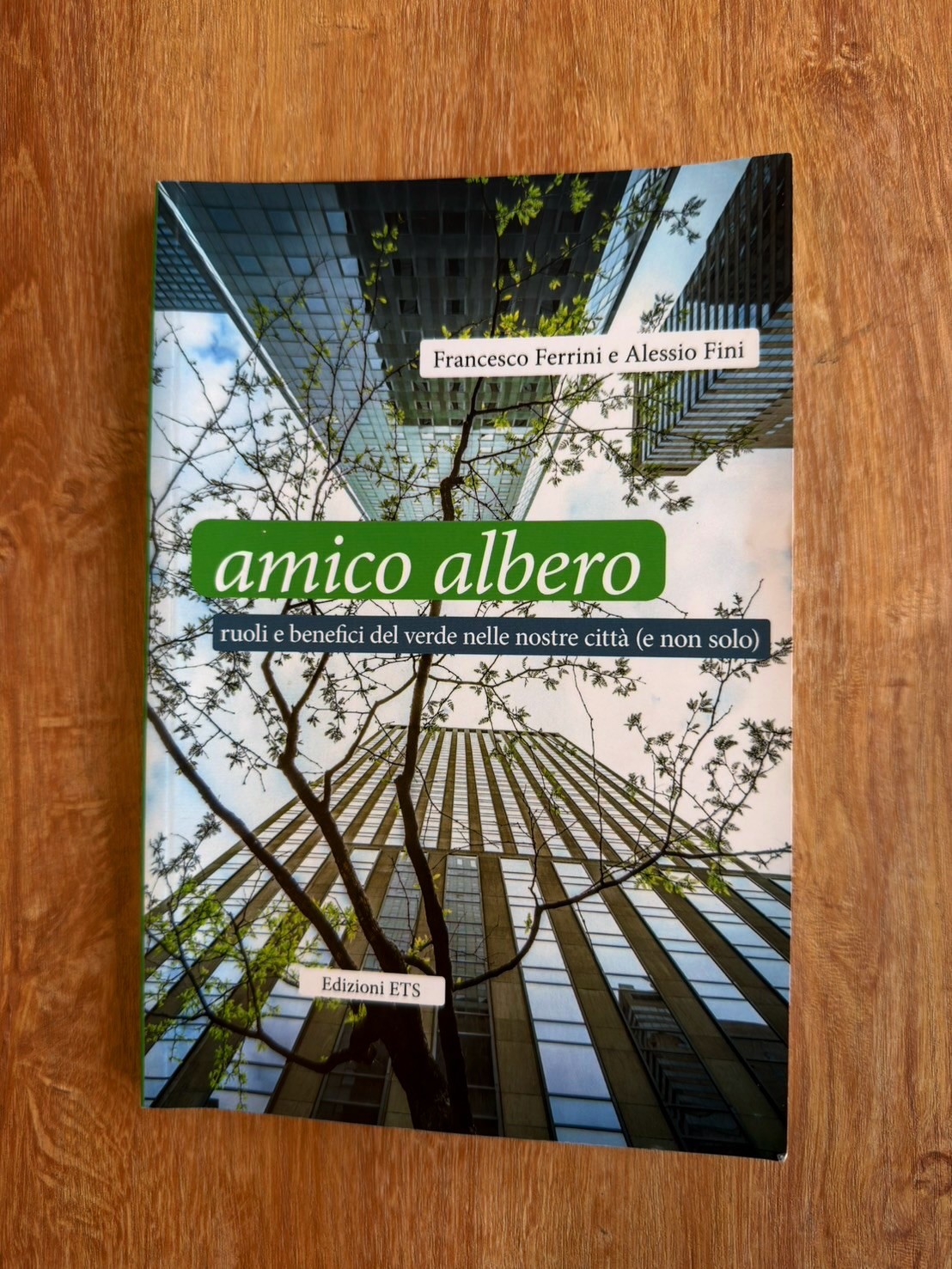
The second item was an Italian book, Amico albero: ruoli e benefici del verde nelle nostre città (e non solo), roughly “Tree friend: the roles and benefits of greenery in our cities, and beyond”. It is by Francesco Ferrini and Alessio Fini, published by Edizioni ETS in 2017; the publisher lists it at 140 pages. Francesco Ferrini is a full professor at the University of Florence, in its DAGRI department.
The cover shows a young tree in front of glass office towers, and the subtitle is about the roles and benefits of urban greenery. To me it reads as a book that argues for trees in the city, the same argument Japanese tree managers need when residents ask why a tree should stay.
Shigo, in Italian
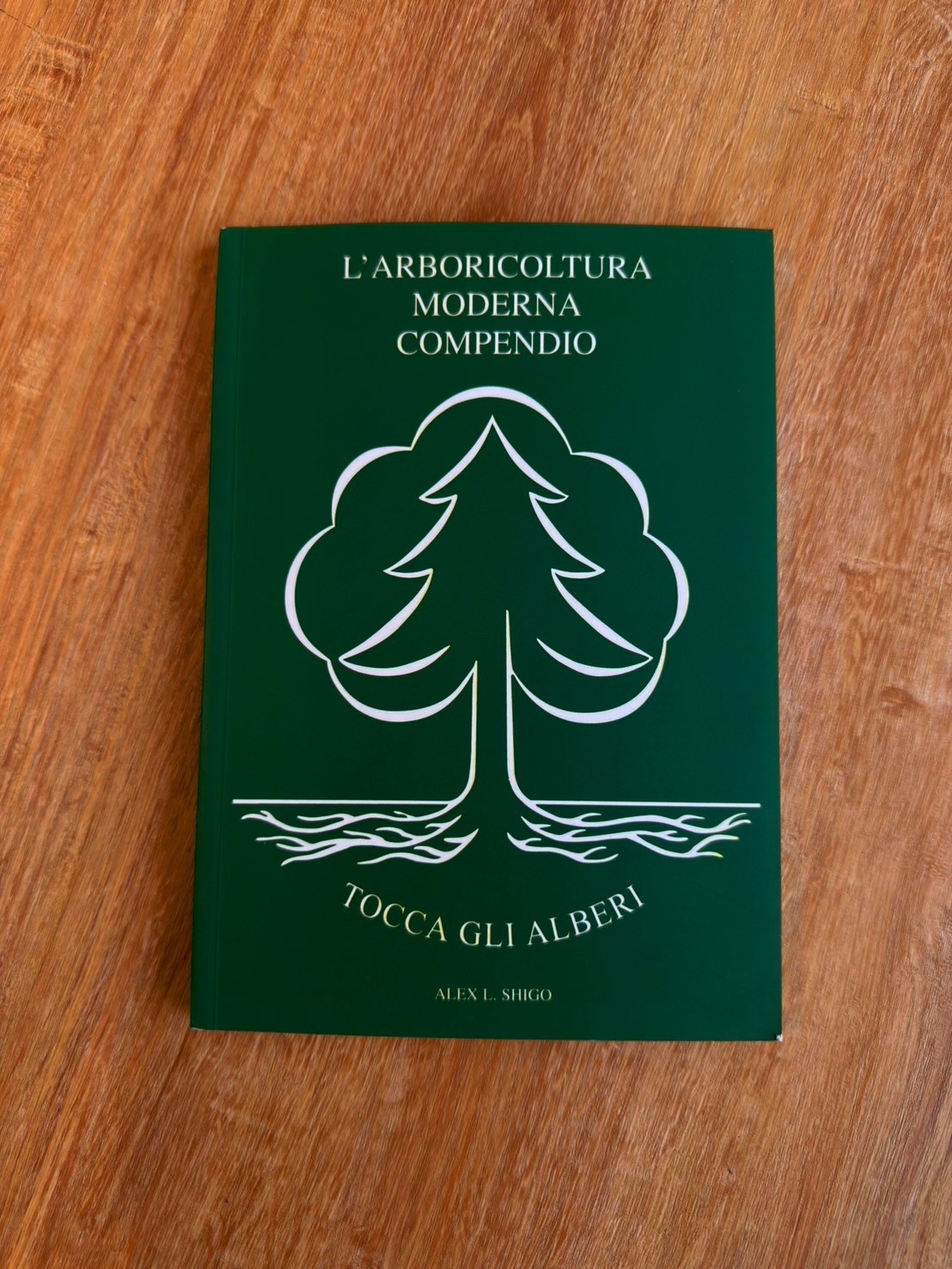
The third book was a surprise. Alex L. Shigo’s Modern Arboriculture was published in English by Shigo and Trees in 1991, and it shaped how a generation of arborists understand wounds, decay and the tree as a system. Zeno sent it to us in Italian: L’arboricoltura moderna – Compendio. The Italian Society of Arboriculture (SIA) lists this compendium as a 1995 SIA publication, and still names it as reading for its own arborist examinations.
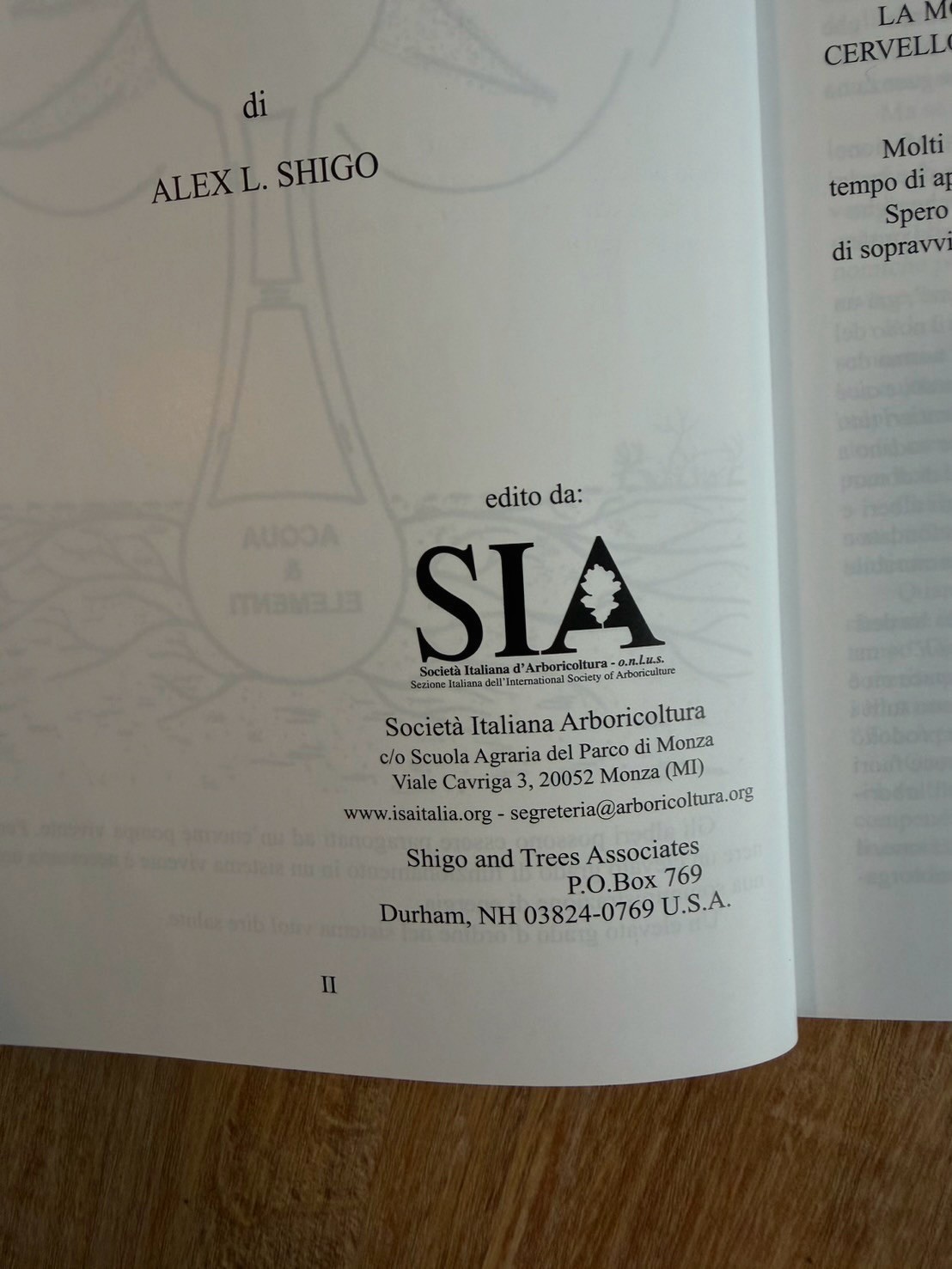
The imprint page names SIA, the Italian chapter of the International Society of Arboriculture, based at the Scuola Agraria del Parco di Monza, together with Shigo and Trees Associates in Durham, New Hampshire. The green cover carries the words “Tocca gli alberi”. Shigo’s own signature phrase, as his publisher presents it, was “Touch Trees”, and the Italian reads the same way.
A book first published in New Hampshire, issued in Italian by a society whose imprint names Monza, then sent from Italy to our office in Tokyo: that is a fair picture of how arboriculture travels.
What we sent back
In return our company sent Zeno several books from Japan on our pruning techniques and on the way Japanese tree specialists think about tree health. The titles were not recorded, so I will not name them here.
The table below sets out what crossed between Verona and Tokyo before we ever met.
| Item | What it is | Language | Why it matters to a Japanese arborist |
|---|---|---|---|
| EAS 01 (2nd edition) | European Tree Pruning Standard | English | A shared European reference for pruning cuts, crown reduction, practices to avoid |
| EAS 02 | European Tree Cabling/Bracing Standard | English | Cabling, bracing to support trees, as a European reference |
| EAS 03 | European Tree Planting Standard | English | Planting as the first step of long-term tree care |
| Amico albero (2017) | The roles, benefits of urban greenery (subtitle) | Italian | How an Italian academic explains trees to city residents |
| L’arboricoltura moderna – Compendio | Italian edition of Shigo’s Modern Arboriculture (SIA, 1995) | Italian | Shigo’s tree biology, as Italian arborists study it |
| Books from Japan | Japanese pruning, tree-care thinking | Japanese | Our side of the exchange |
Milan in September — dinner, at last
Why Milan
In September 2026 I spent about two weeks in Europe. It was mostly a personal trip: Germany first, from Munich, then Switzerland, then Italy, to Milan and Venice. I added one purpose to it, which was to see how trees are cared for on the ground and to meet the people who do that work. In Bavaria, Ingo von Wurmb showed me the work of the arborists at Arbocare, and in Zurich I walked the streets with an urban forester.
Zeno lives in Verona, but our route did not take me there. We met in Milan.
At the table
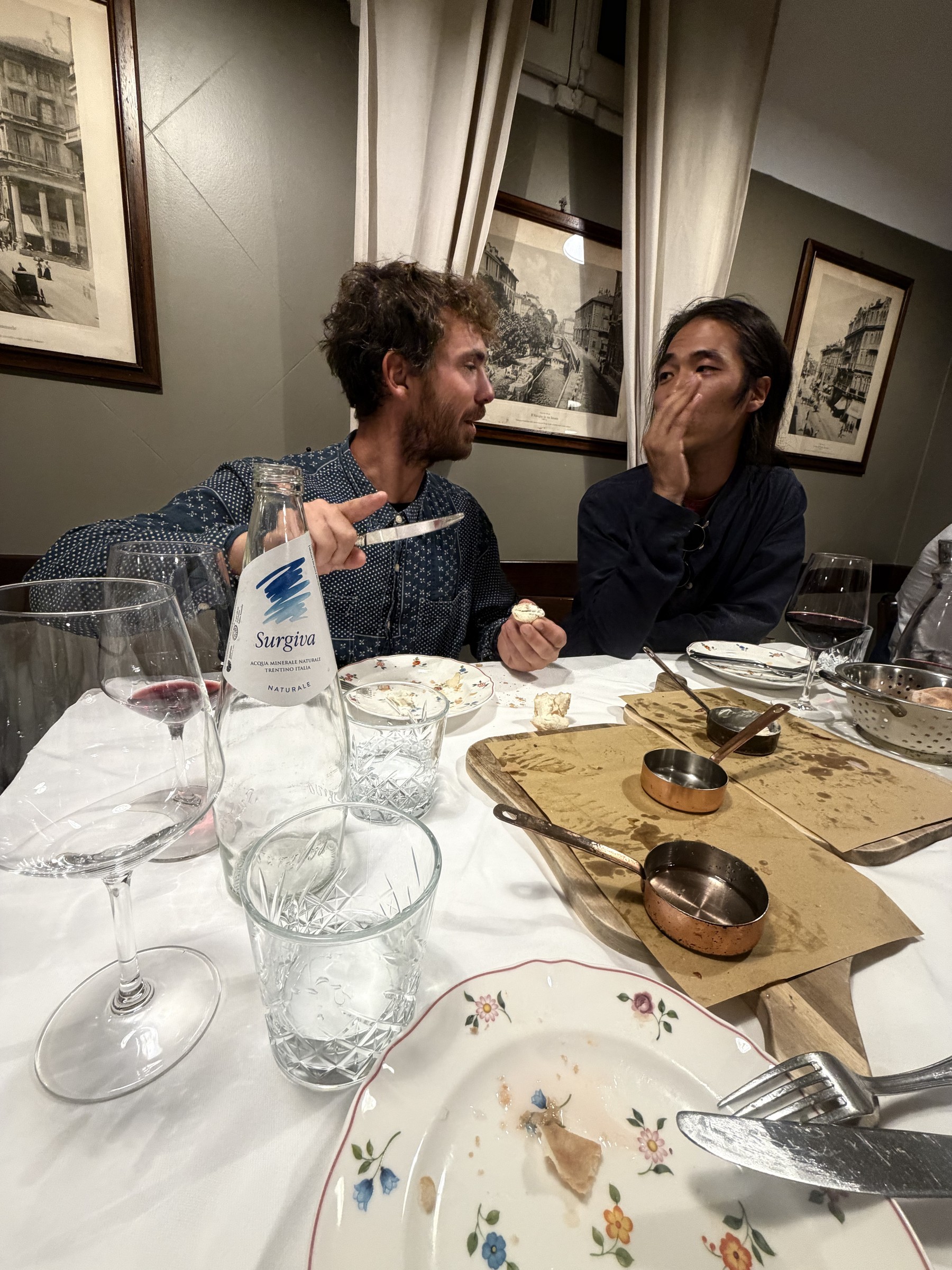
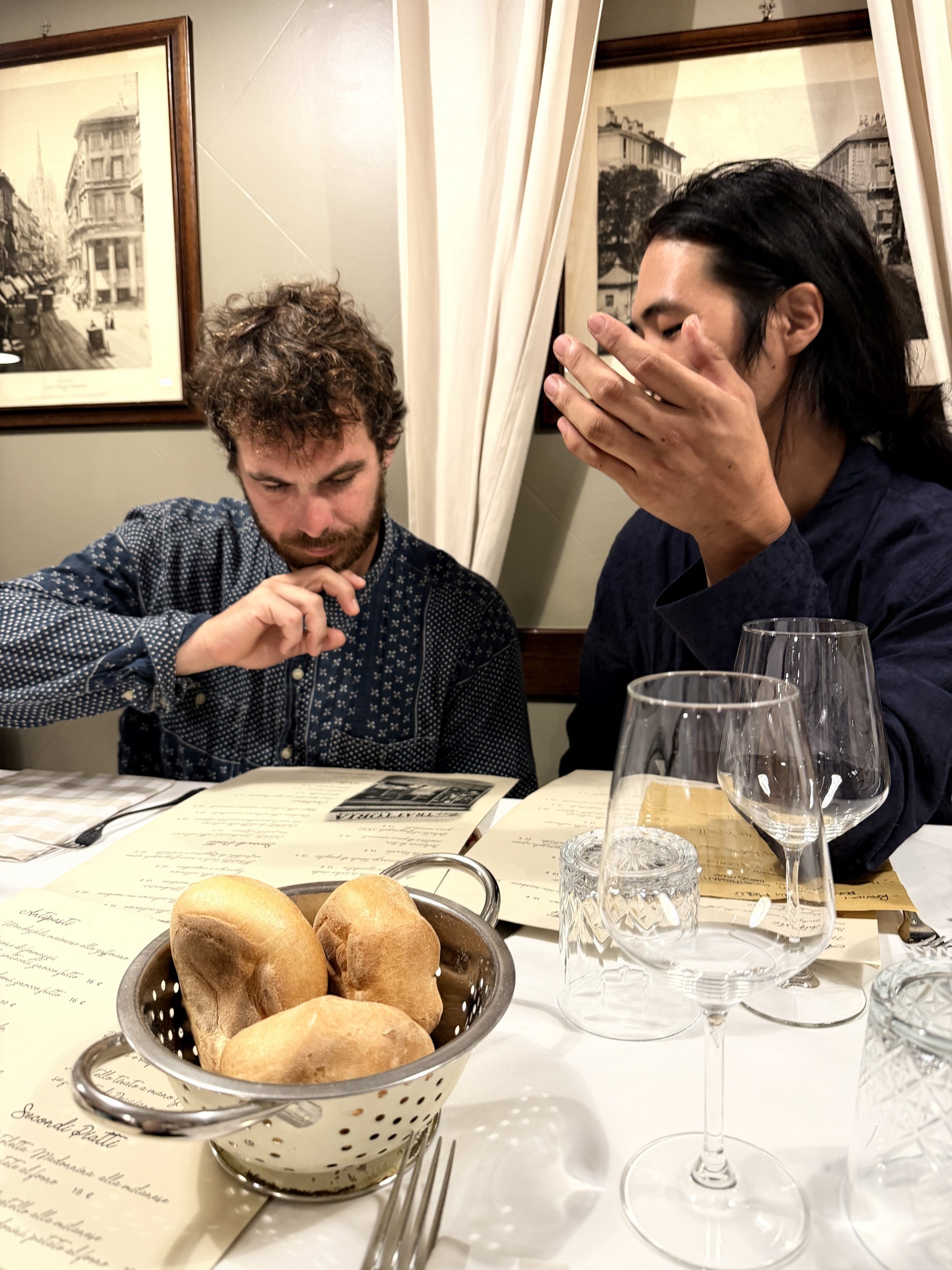
We ate together at a restaurant. My photos from that evening are not of trees: old black-and-white city prints on the wall, a basket of bread, glasses on a white cloth, and later empty plates with the conversation still going.
We talked about technique, but much of the evening was about judgment. When do you keep a branch? Why, as he sees it, are more conifers falling? Who decides that a tree is safe? What do you wear so a driver sees you? We also exchanged books again when we met.
Afterwards I summarised the main points in a LinkedIn post, and I will not put long quotations in Zeno’s mouth. What follows are those four points, with the background I have since checked.
First point — start from how the species grows
Keep the branches, lighten the load
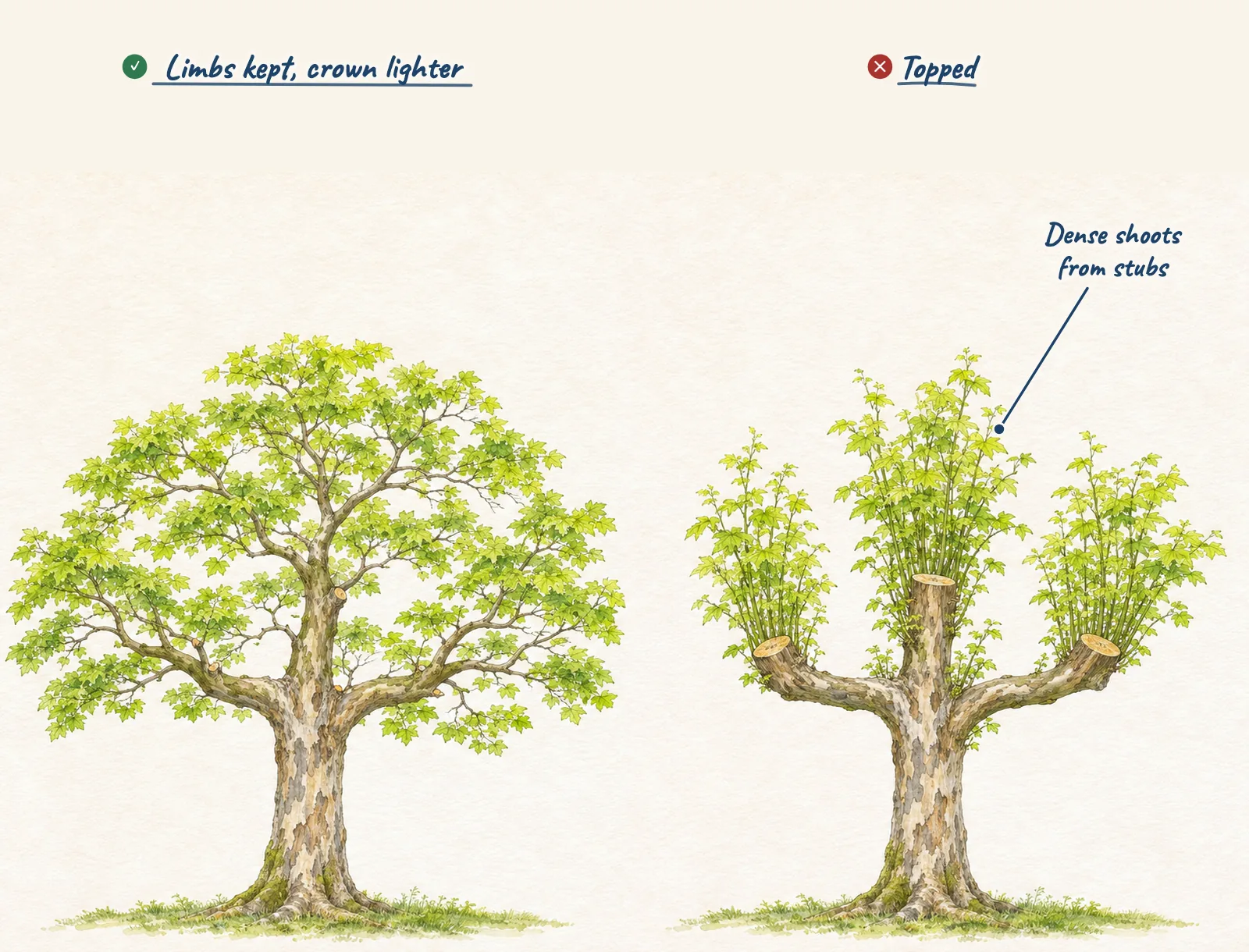
Zeno’s starting point for any pruning was the growth habit of the species. If a species naturally spreads its branches wide, he keeps those branches. When a tree has to be made safer, he removes other branches to make the crown lighter, rather than cutting the spreading limbs back. The goal is a tree with its branches extended, close to its natural shape.
It sounds simple, but it is a discipline. A client who is worried about a tree usually asks for it to be made smaller, and the quickest way to make a tree smaller is to cut its main limbs short. That leaves large stubs, and a topped tree typically answers with dense new shoots from them, losing the shape it had. That is why the European standard treats topping a mature tree as something to avoid, as the next section shows.
What the European standard says
The pruning standard Zeno sent us puts the same idea in writing. EAS 01 includes keeping a crown structure close to the natural tree shape among the goals of pruning. It names lion’s tailing, stripping out the inside of the crown so that foliage remains only at the branch ends, as a serious error. It says topping of semi-mature and mature trees, where there is no long-term plan for an artificial tree form, must be avoided at all times, and it separates this from pollarding that is planned from a young age. Lateral crown reduction works on the sides and lower crown and does not change the height; reducing the upper crown of a mature tree is reserved for exceptional circumstances.
So Zeno’s habit of keeping the spreading limbs is not a personal style. It is the practice his own continent’s standard describes.
How we prune in Japan
Japanese pruning starts from the same place. In our gardens and streets, the basic cut for a broadleaf tree is thinning: removing a branch at its union so that the crown becomes lighter and the remaining branches keep their direction. I have written about how Japanese pruning prepares trees for typhoons, and it follows the same logic: reduce the wind load by opening the crown, without shortening every limb.
Where Japan differs is that we also have a long tradition of shaped trees, niwaki (庭木), garden trees trained over decades. Those are planned forms, trained from a young age, which is a different thing from topping a mature tree. The difference between niwaki and topiary is exactly this: a form planned with the tree’s growth, not imposed on it after the fact. On a street or in a park, though, our aim is the same as Zeno’s.
Second point — stronger winds, falling conifers, damaged roots
Pines, conifers, the slender cypress
The second point was wind. Zeno said the wind has become stronger than it used to be, and that more pines and other conifers are falling, especially the slender cypresses. His answer, again, was to make the branches lighter.
The slender cypress is Cupressus sempervirens, the Mediterranean cypress, native from the eastern Mediterranean to Iran. Its best-known form, the Stricta Group, is narrowly columnar: a dark green column that defines the skyline of so many Italian roads and villas. I could not find a primary source showing that this species is especially prone to windthrow, so I will report Zeno’s observation as his field experience rather than as a measured fact.
North-east Italy also has a recent reference point for what wind can do. In late October 2018, the storm known as Vaia brought exceptional rain and wind to north-east Italy, including the Veneto, the region around Verona. A study published by the Italian Society of Silviculture and Forest Ecology (SISEF) gives initial national estimates of about 42,500 hectares of badly damaged forest and about 8.5 million cubic metres of fallen timber, with wind gusts above 200 km/h on 29 October. The Veneto region’s own figures, for the region alone, are about 18,000 hectares of forest and more than 15 million trees down.
Vaia was a forest disaster in the mountains, not a city event, but it shows the scale wind can reach in the region where Zeno works.
| Source | What it measured | Figure |
|---|---|---|
| SISEF study, national estimate | Badly damaged forest | about 42,500 ha |
| SISEF study, national estimate | Fallen timber | about 8.5 million m³ |
| SISEF study | Wind gusts on 29 October | above 200 km/h |
| Veneto region | Forest damaged in the region | about 18,000 ha |
| Veneto region | Trees down in the region | more than 15 million |
What is under the tree
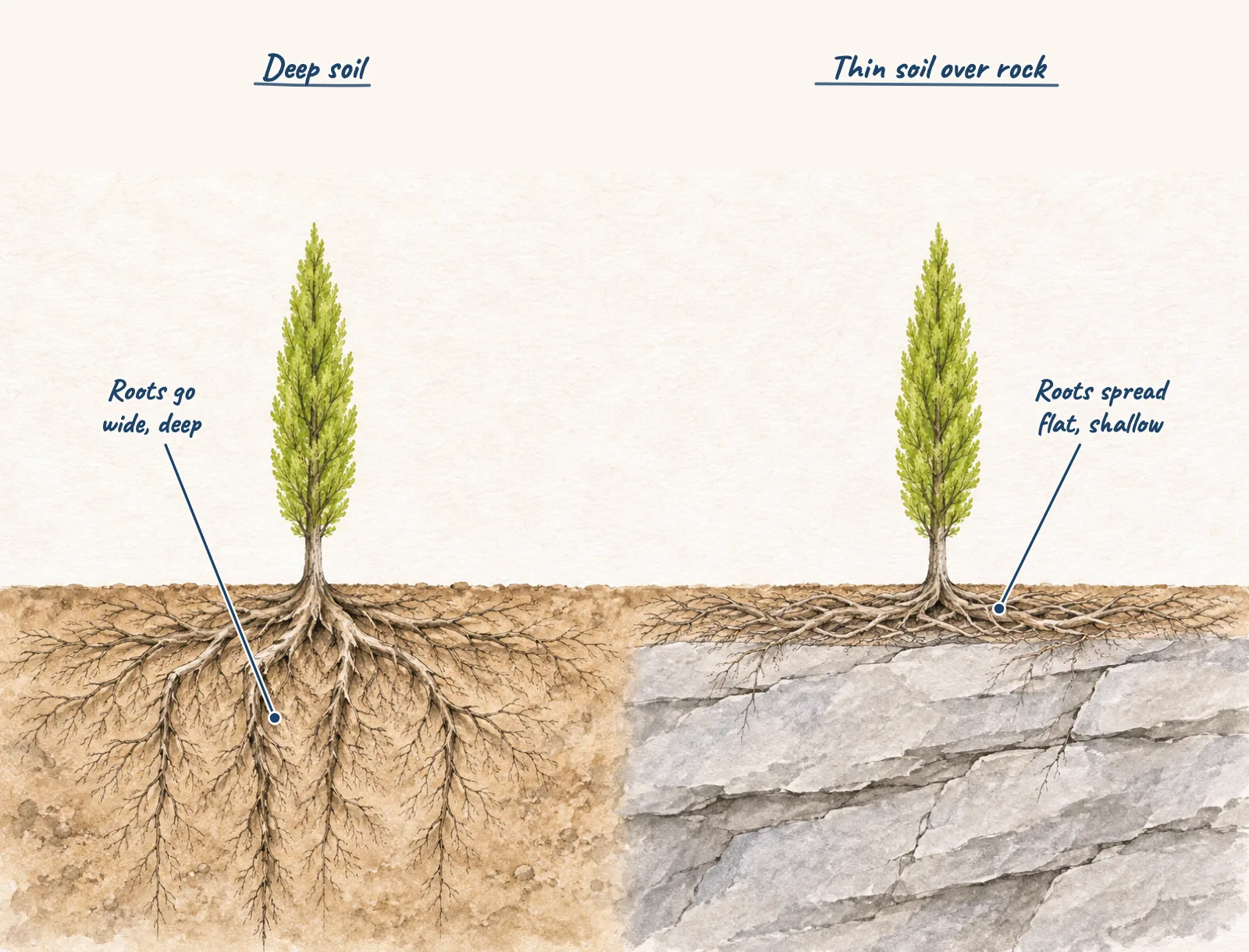
Zeno also said that a tree’s condition depends on what is under it: rock or soil. The illustration below shows the idea as I understood it: where a thin layer of soil lies over rock, roots have little room to go down and tend to spread near the surface; in deep soil they have room to go down as well as out. How roots actually spread on a given site has to be checked there, ground by ground and species by species.
For an arborist judging a tall, narrow tree, that means looking at the ground as well as the crown.
Roots under the excavator
The other root problem Zeno described will be familiar to any city arborist: excavation. In Italy, too, digging for works around a tree often damages its roots. A trench for a pipe or a cable can cut through the roots a tree depends on.
In Tokyo, the Bureau of Construction addresses this in its 2021 street-tree diagnosis manual. It defines a “construction care area” around street trees for public works. Within it, the area within 1 metre of the trunk centre of a tall tree is to be left out of the works wherever possible, and where excavation in the care area is judged necessary, it is done in the presence of a jumoku-i (樹木医), a registered Japanese tree specialist, or an equivalent expert. Zeno’s remark was a reminder that the same rule is needed wherever trees and trenches meet.
Heat, insects, cherries
Zeno also noted that damage from insects and other pests grows year by year, and he linked it to the heat. Two examples from Italian plant-health records fit what he described. Popillia japonica, the Japanese beetle, was first reported in continental Europe in summer 2014, in the Ticino valley between Piedmont and Lombardy, not far from Milan. Toumeyella parvicornis, a scale insect of pines, was first recorded in Italy in 2014 in Campania on urban stone pines, and was found in Rome in 2018.
There is an irony for a Japanese reader: a beetle named after Japan has become a pest in the region where I ate dinner. Zeno also said that cherry trees do poorly in the heat. That is his observation from his own work; the research I checked does not let me turn it into a general rule, so I leave it as his.
Third point — the agronomo assesses first, the arborist works after
Who decides that a tree is safe
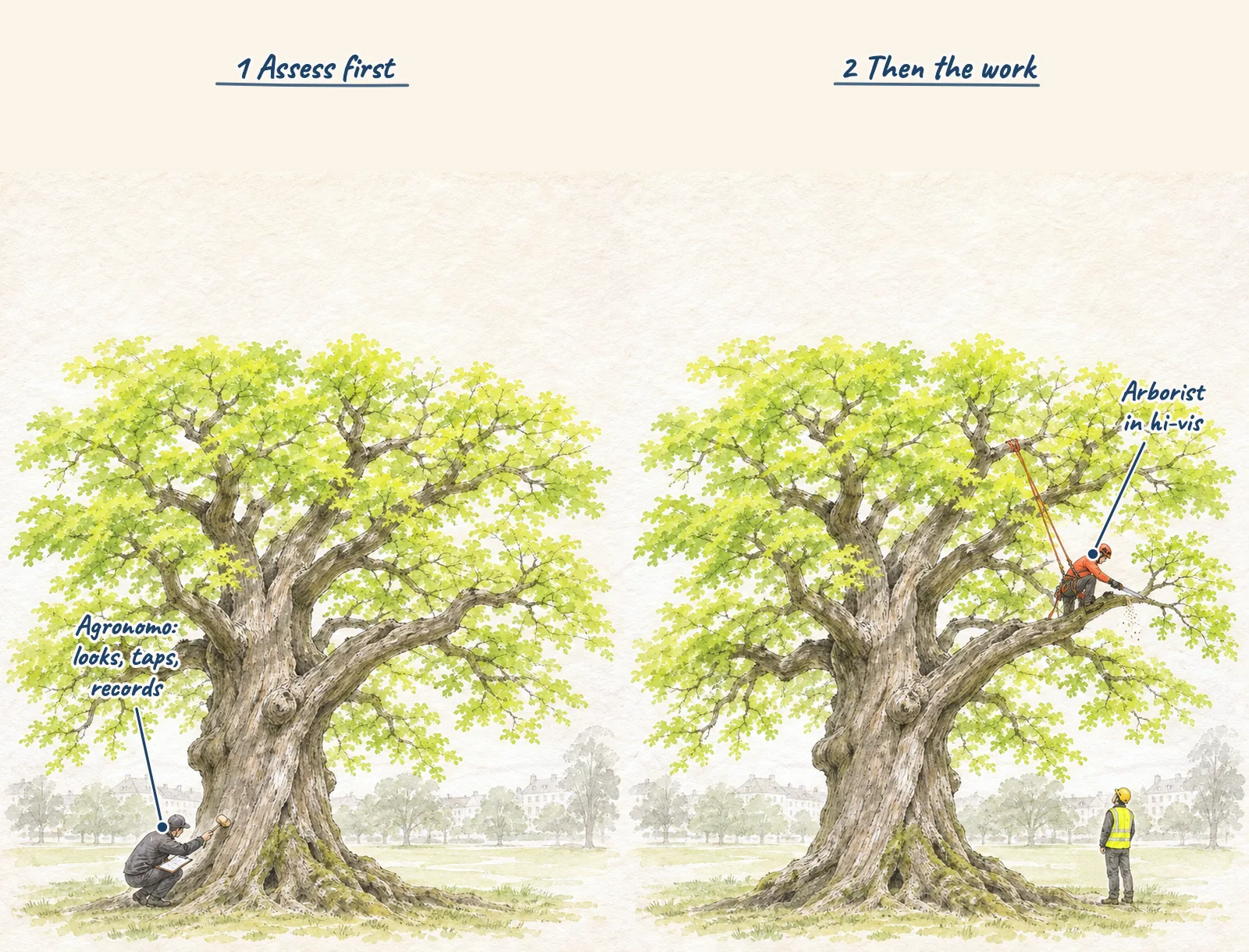
The third point was about who decides. For important trees, Zeno said, an agronomo first assesses the tree, and the work follows that assessment. The roles are separate: one professional diagnoses, another does the work.
In Italy, dottore agronomo and dottore forestale are regulated professions under Law no. 3 of 7 January 1976. To use the title, you need to qualify through a state examination and register with the professional order; the national council, CONAF, describes the exam as two written tests, one oral and one practical. The law includes design and supervision of works on public and private green spaces, parks and gardens among their professional activities, along with expert appraisal and arbitration.
On trees specifically, the federation of agronomists in Lombardy, the region around Milan, adopted guidelines in 2016 that place ordinary tree stability assessments with an agronomist or forester. CONAF’s national guidelines, published in 2026, treat a stability assessment as a tree risk assessment, to be carried out by experienced professionals registered with their orders. Fotosintesi’s own website, for its part, says Zeno collaborates with agronomists and foresters for stability assessments, and that matches what he told me at dinner.
How it compares with Japan
In Japan, the closest equivalent is the jumoku-i. To become one, you complete the training of the Japan Greenery Research and Development Center and pass its qualification examination, then register. The center’s report for fiscal 2025 counts 3,268 registered jumoku-i as of 31 March 2026. I am not a jumoku-i myself; my role is arborist. Our company has jumoku-i on staff, and a diagnosis can be a separate job from the pruning or felling that follows it. I have compared Western tree risk assessment with the jumoku-i system before; the Italian model adds a third pattern.
| Italy (as Zeno described it) | Japan (our practice) | |
|---|---|---|
| Who assesses an important tree | Dottore agronomo or dottore forestale, registered with a professional order | Jumoku-i, registered after training and examination by a national foundation |
| Legal basis of the title | Law no. 3 of 1976 | A qualification run by the Japan Greenery Research and Development Center |
| Who does the work | Arborists such as Zeno, following the assessment | Gardeners, arborists, landscape contractors |
| Written guidance | Regional (Lombardy 2016) and national (CONAF 2026) guidelines | Municipal manuals, such as Tokyo’s 2021 street-tree manual |
Explaining it to the client
Separating the roles does not make the conversation with the client easier. Zeno told me that explaining a tree to a client is hard, and that he sometimes repeats the same explanation up to four times. Some clients are afraid of their trees; some press for the work to be done sooner. The difficulty of explaining trees to clients, as I noted afterwards, is common to every country. He also told me that his work is roughly half felling and half pruning, and that he rarely uses cranes.
An assessment by a licensed agronomist gives the arborist something to point to: not a personal opinion, but a written assessment. In Japan, a jumoku-i’s report does the same job, and I think we could use it more deliberately in the conversation with owners.
Fourth point — fluorescent orange that people can see
Why Italian arborists wear bright colours
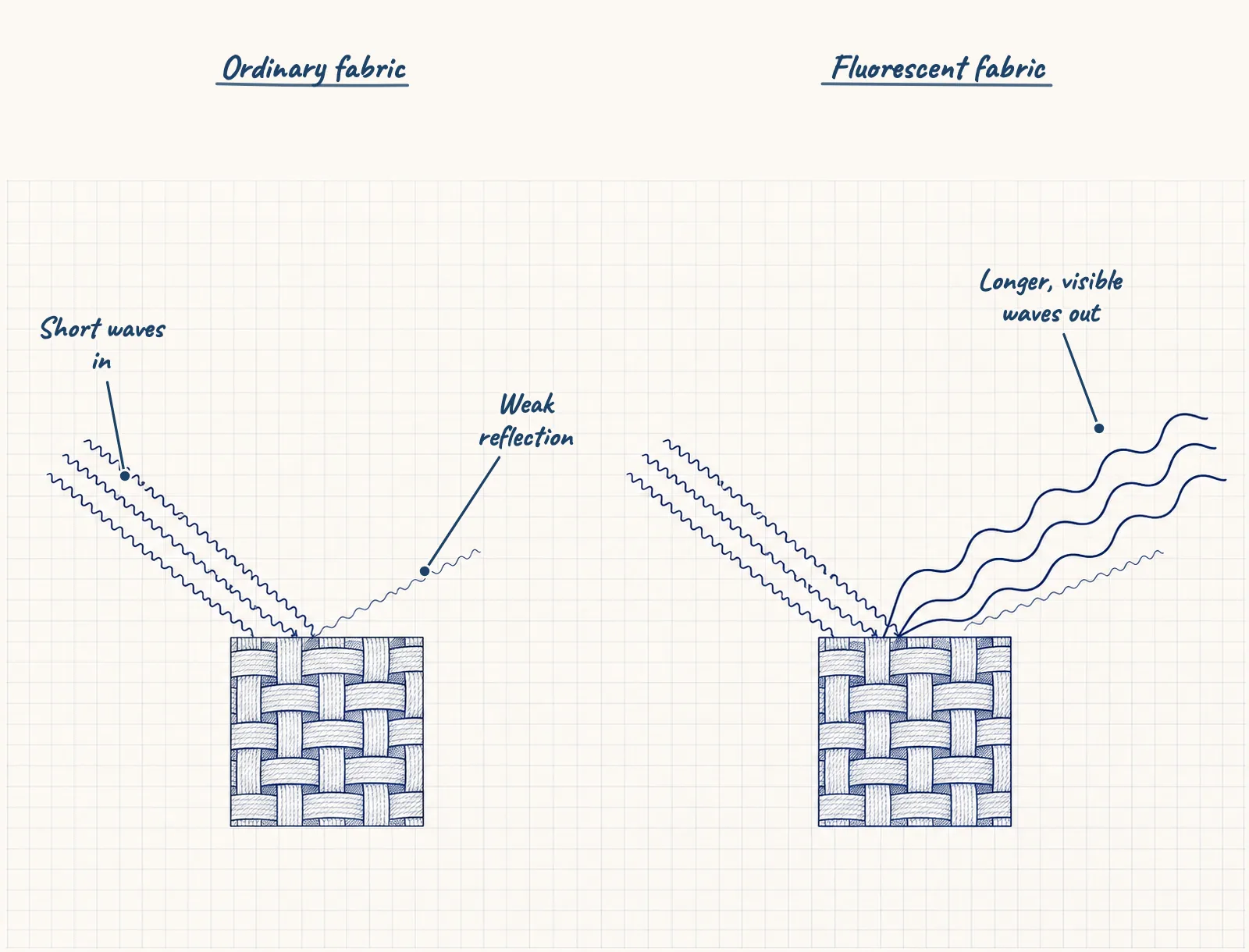
The fourth point was about clothes. Zeno explained that the bright orange and yellow of tree workers’ clothing is not fashion. These are high-visibility garments under EN ISO 20471, and they work by fluorescence.
A fluorescent material absorbs light and emits light of a longer wavelength. In practice, the dye takes in short-wavelength light, including ultraviolet that the eye cannot use, and gives some of it back as visible colour. The garment returns more visible light than an ordinary fabric of the same colour. Manufacturers of high-visibility materials note that the effect is most noticeable in low light, such as at dawn and dusk. Zeno added overcast days; I could not find a study that measures that under identical conditions.
What the standard requires
ISO 20471:2013, amended in 2016, sets the test methods and requirements for high-visibility clothing. It recognises three fluorescent colours: yellow, orange-red and red. Garments are graded into three classes by the minimum area of fluorescent background material and retroreflective material.
| Class | Fluorescent material (minimum) | Retroreflective material (minimum) |
|---|---|---|
| Class 1 | 0.14 m² | 0.10 m² |
| Class 2 | 0.50 m² | 0.13 m² |
| Class 3 | 0.80 m² | 0.20 m² |
In Italy, an interministerial decree of 22 January 2019 requires workers on roads open to traffic to wear garments conforming to UNI EN ISO 20471: class 3 on road categories A to D, at least class 2 on categories E and F. Class 1 is no longer allowed.
Japan has the same standard
Japan has its own version: JIS T 8127, “high-visibility safety clothing”, established on 26 October 2015 and revised on 25 March 2020. The Japanese Standards Association lists it as a modified adoption of ISO 20471:2013 with its 2016 amendment, and it classifies garments by the area of fluorescent fabric and retroreflective material, just as the international standard does.
So the standard exists in Japan. After Milan, the question I want to ask on our own sites is whether the climber in the crown is as visible as the person guiding traffic. One misunderstanding is worth clearing up: the fluorescent fabric and the retroreflective strips do different jobs. The fluorescent colour helps in daylight, especially at dusk; the retroreflective material, which the standard also requires in each class, is the part that shines back when lights are pointed at it. A climber in a dark crown late on an autumn afternoon needs the first.
Not because another country is right
What I wrote after Milan
When I came back I tried to put in one line what the dinner had meant. This is what I wrote:
> We do not learn from other countries because they are right. Conditions are different. But how branches extend, how trees fall, how roots are damaged — these are shared across borders.
Italy is not a model for Japan, any more than Japan is a model for Italy. North-east Italy has its slender cypresses and the memory of Vaia; Tokyo has its own street trees and typhoons. The conditions differ, and the questions clients ask are much the same.
What I took home to Tokyo
Four things. First, the habit of naming the species before naming the cut, which our best gardeners already have and which EAS writes down. Second, the reminder that root damage from works is a problem everywhere, and that Tokyo’s 1-metre rule is something to defend, not apologise for. Third, the clarity of the Italian division of roles, which I want to use more deliberately in how we explain assessments to owners. Fourth, fluorescent clothing for the climber, not just for the person with the traffic baton.
Next — Verona
An invitation
Zeno invited me to Verona to watch Fotosintesi at work and to see their tree climbing; he mentioned they have spare ropes and harnesses. I have not been yet. When I go, I would like to see the slender cypresses he talked about, standing on their own ground, and the way an agronomo’s assessment turns into a climber’s work plan.
Thank you
Thank you, Zeno, for the parcel, the books, the dinner and the patience with my questions. A friendship that started with photos on a screen now has a shelf of books and an evening in Milan behind it. The next chapter will be in Verona.
Frequently asked questions
Who is Zeno Gasparri?
Zeno Gasparri is an arborist based in Verona, Italy, who runs the tree-care business Fotosintesi. It offers felling, pruning using tree-climbing techniques, garden construction and maintenance, and works with licensed agronomists and foresters for tree stability assessments.
What are the European Arboricultural Standards (EAS)?
They are three European standards for tree work written in the EU-funded TeST project (2019–2022): EAS 01 for pruning (2nd edition, imprint November 2024), EAS 02 for cabling and bracing (2022), and EAS 03 for planting (2022). Italian translations are listed on the official site.
What is an agronomo in Italian tree care?
A dottore agronomo, like a dottore forestale, is a regulated professional under Italian Law no. 3 of 1976, qualified by state examination and registered with a professional order. Regional and national guidelines from the profession place tree stability assessments with these professionals.
What is EN ISO 20471?
It is the international standard for high-visibility clothing. It uses three fluorescent colours (yellow, orange-red, red) and three classes defined by minimum areas of fluorescent and retroreflective material. Japan’s equivalent is JIS T 8127.
How did a Japanese arborist meet an Italian arborist?
We connected on Instagram, traded books by post (Zeno sent the three EAS standards with two Italian books, we sent Japanese books on pruning), and met in person over dinner in Milan in September 2026.
Sources
– Fotosintesi, official website of Zeno Gasparri (checked 2026-11-13): https://www.fotosintesi.eu/ – European Arboricultural Standards, official website (checked 2026-11-13): https://www.europeanarboriculturalstandards.eu/ – European Arboricultural Standards, TeST project (checked 2026-11-13): https://www.europeanarboriculturalstandards.eu/test – EAS 01 European Tree Pruning Standard, 2nd edition (checked 2026-11-13): https://instytut-drzewa.pl/wp-content/uploads/2025/09/Tree-Pruning-2nd-edition.pdf – EAS 02 European Tree Cabling/Bracing Standard (checked 2026-11-13): https://instytut-drzewa.pl/wp-content/uploads/2025/09/Tree-Cabling_Bracing.pdf – EAS 03 European Tree Planting Standard (checked 2026-11-13): https://instytut-drzewa.pl/wp-content/uploads/2025/09/Tree-Planting.pdf – EAS, national translations of the pruning standard (checked 2026-11-13): https://www.europeanarboriculturalstandards.eu/etps – Edizioni ETS, Amico albero (checked 2026-11-13): https://www.edizioniets.com/scheda.asp?n=9788846749505 – University of Florence, staff page of Francesco Ferrini (checked 2026-11-13): https://cercachi.unifi.it/p-doc2-0-0-A-3f2a3d2e37302a.html – WorldCat, Modern Arboriculture (1991) (checked 2026-11-13): https://search.worldcat.org/title/Modern-arboriculture-%3A-a-systems-approach-to-the-care-of-trees-and-their-associates/oclc/22955471 – Società Italiana di Arboricoltura, ETT examination notice with reading list (checked 2026-11-13): https://www.isaitalia.org/images/pdf/Moduli/SIA_Bando_ETT_dic2024con_allegati_def.pdf – Shigo and Trees, Associates, “Touch Trees” (checked 2026-11-13): https://shigoandtrees.com/product/trees-hand-t-shirt/ – CONAF, Law no. 3 of 7 January 1976, consolidated text (checked 2026-11-13): https://www.conaf.it/wp-content/uploads/2018/02/8-Legge-del-7-gennaio-1976-n.-3-e-successive-mod.-e-int._1.pdf – CONAF, state examinations (checked 2026-11-13): https://www.conaf.it/professione-2/accesso-alla-professione-0/accesso-alla-professione-dallitalia/esami-di-stato/ – Federation of Agronomists of Lombardy, tree stability guidelines, 2016 (checked 2026-11-13): https://oldfodaflombardia.conaf.it/sites/fodaflombardia.conaf.it/files/Linee%20guida%20stabilit%C3%A0%20alberi%20Fed%20Agronomi%20Lombardia%20adottato%20febbraio%202016%20def.pdf – CONAF, national guidelines, 2026 (checked 2026-11-13): https://www.conaf.it/wp-content/uploads/2026/03/Linee-guida.pdf – SISEF, Forest@, study on the Vaia storm (checked 2026-11-13): https://foresta.sisef.org/contents/?id=efor3070-016 – Regione del Veneto, resolution on Vaia forest damage (checked 2026-11-13): https://bur.regione.veneto.it/BurvServices/pubblica/DettaglioDgr.aspx?id=447676 – Regione del Veneto, press release on fallen trees (checked 2026-11-13): https://www.regione.veneto.it/article-detail?articleId=13677278 – Kew, Plants of the World Online, Cupressus sempervirens (checked 2026-11-13): https://powo.science.kew.org/taxon/urn%3Alsid%3Aipni.org%3Anames%3A261974-1 – RHS, Cupressus sempervirens Stricta Group (checked 2026-11-13): https://www.rhs.org.uk/plants/133025/cupressus-sempervirens-stricta-group/details – Regione Lombardia plant health service, Popillia japonica (checked 2026-11-13): https://fitosanitario.regione.lombardia.it/wps/portal/site/sfr/DettaglioRedazionale/organismi-nocivi/insetti-e-acari/popillia-japonica/popillia-japonica – EPPO, Popillia japonica in Italy (checked 2026-11-13): https://gd.eppo.int/taxon/POPIJA/distribution/IT – EPPO Reporting Service, Toumeyella parvicornis in Italy (checked 2026-11-13): https://gd.eppo.int/reporting/article-7021 – Tokyo Metropolitan Government Bureau of Construction, street-tree diagnosis manual, 2021 (Japanese; checked 2026-11-13): https://www.kensetsu.metro.tokyo.lg.jp/content/000051876.pdf – Japan Greenery Research and Development Center, jumoku-i system (Japanese; checked 2026-11-13): https://www.jpgreen.or.jp/treedoctor/info.html – Japan Greenery Research and Development Center, fiscal 2025 report (Japanese; checked 2026-11-13): https://www.jpgreen.or.jp/gaiyou/shiryou/5_houkoku.pdf – ISO 20471:2013/Amd 1:2016 (checked 2026-11-13): https://committee.iso.org/standard/42816.html – BOKEN Quality Evaluation Institute, ISO 20471 overview (Japanese; checked 2026-11-13): https://www.boken.or.jp/wp-content/uploads/2021/01/topic_151.pdf – New Forest District Council, PPE standards table with EN ISO 20471 classes (checked 2026-11-13): https://democracy.newforest.gov.uk/documents/s29129/Combined%20Apx%202%20docs%20-%20HS%20Rpt.pdf – Florida State University, introduction to fluorescence (checked 2026-11-13): https://micro.magnet.fsu.edu/primer/techniques/fluorescence/fluorescenceintro.html – 3M, Scotchlite reflective material (checked 2026-11-13): https://multimedia.3m.com/mws/media/1614613O/3mtm-scotchlitetm-reflective-material.pdf – Gazzetta Ufficiale, interministerial decree of 22 January 2019 (checked 2026-11-13): https://www.gazzettaufficiale.it/eli/gu/2019/02/13/37/sg/pdf – Japanese Standards Association, JIS T 8127:2020 (Japanese; checked 2026-11-13): https://webdesk.jsa.or.jp/books/W11M0090/index/?bunsyo_id=JIS+T+8127%3A2020 – Japan Safety Appliances Association, high-visibility safety clothing (Japanese; checked 2026-11-13): https://jsaa.or.jp/%E9%AB%98%E8%A6%96%E8%AA%8D%E6%80%A7-%E5%AE%89%E5%85%A8%E6%9C%8D/
Related reading
This story is one of the exchanges on the Worldwide map, where I collect the arborists I have met, hosted and worked with.