

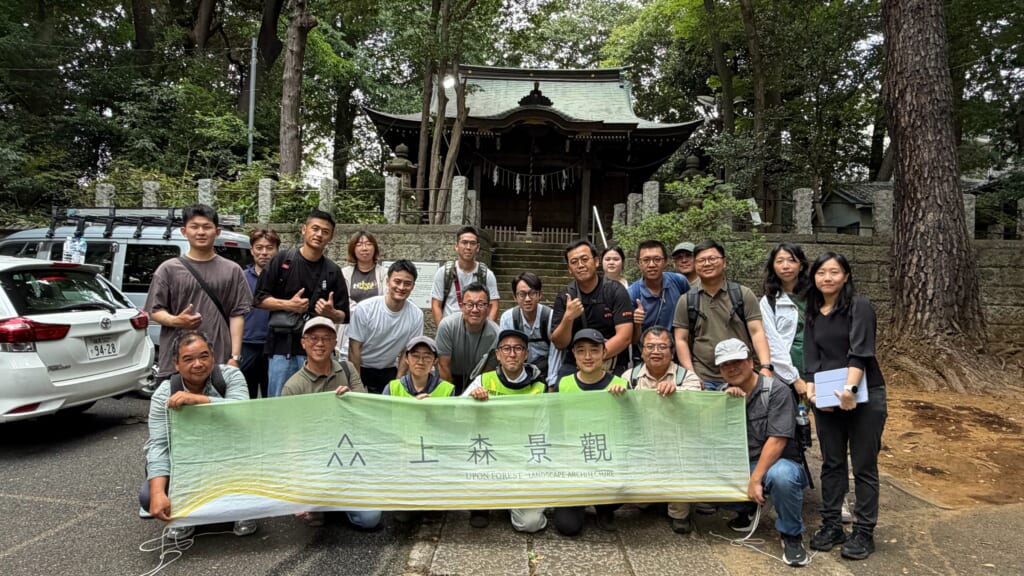
On 2 September 2026, about fifteen people from Upon Forest, a landscape company based in Taichung, Taiwan, came to Kumano Shrine in Horinouchi, Suginami, Tokyo, to learn tree diagnostics with our team at Toshi Landscape. I introduced three tree diagnostic instruments: the IML Resi PD, the PiCUS sonic tomograph and the ArborSonic 3D. The Resi PD draws a resistance line along one path through the wood; the PiCUS and the ArborSonic 3D turn sound travel times into a picture of a whole cross-section. The visitors did more than watch: they held the drill, struck the sensors with a hammer and photographed the readings.
I welcomed the visitors and introduced the instruments alongside my colleagues at Toshi Landscape. This is the story of that day, told through the photographs from it: who came, why tree diagnostics matters in Taiwan right now, what each instrument does, and what the two countries’ systems for tree professionals look like side by side.
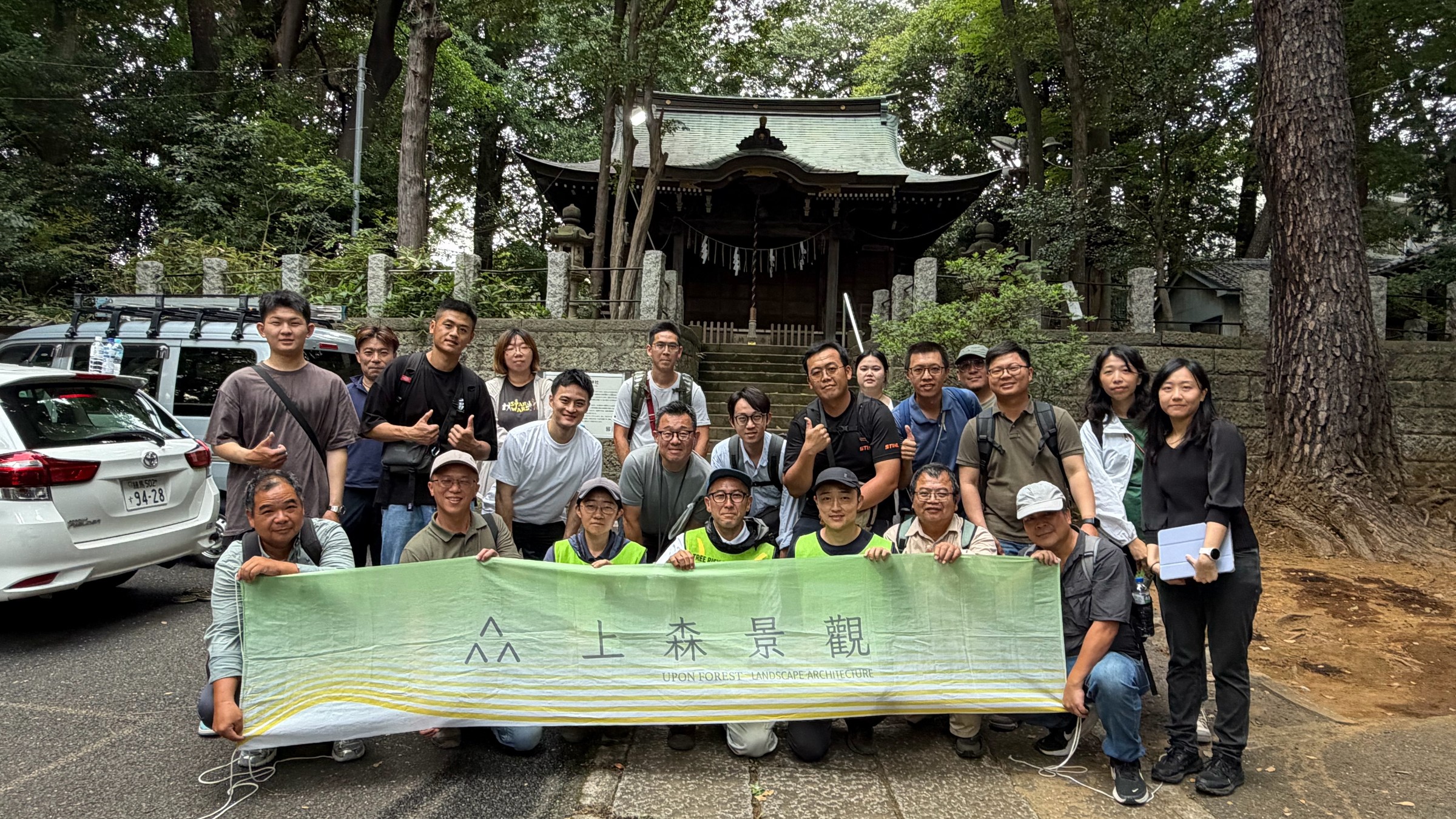
A September day at Kumano Shrine — fifteen guests from Taichung
The drill changes hands
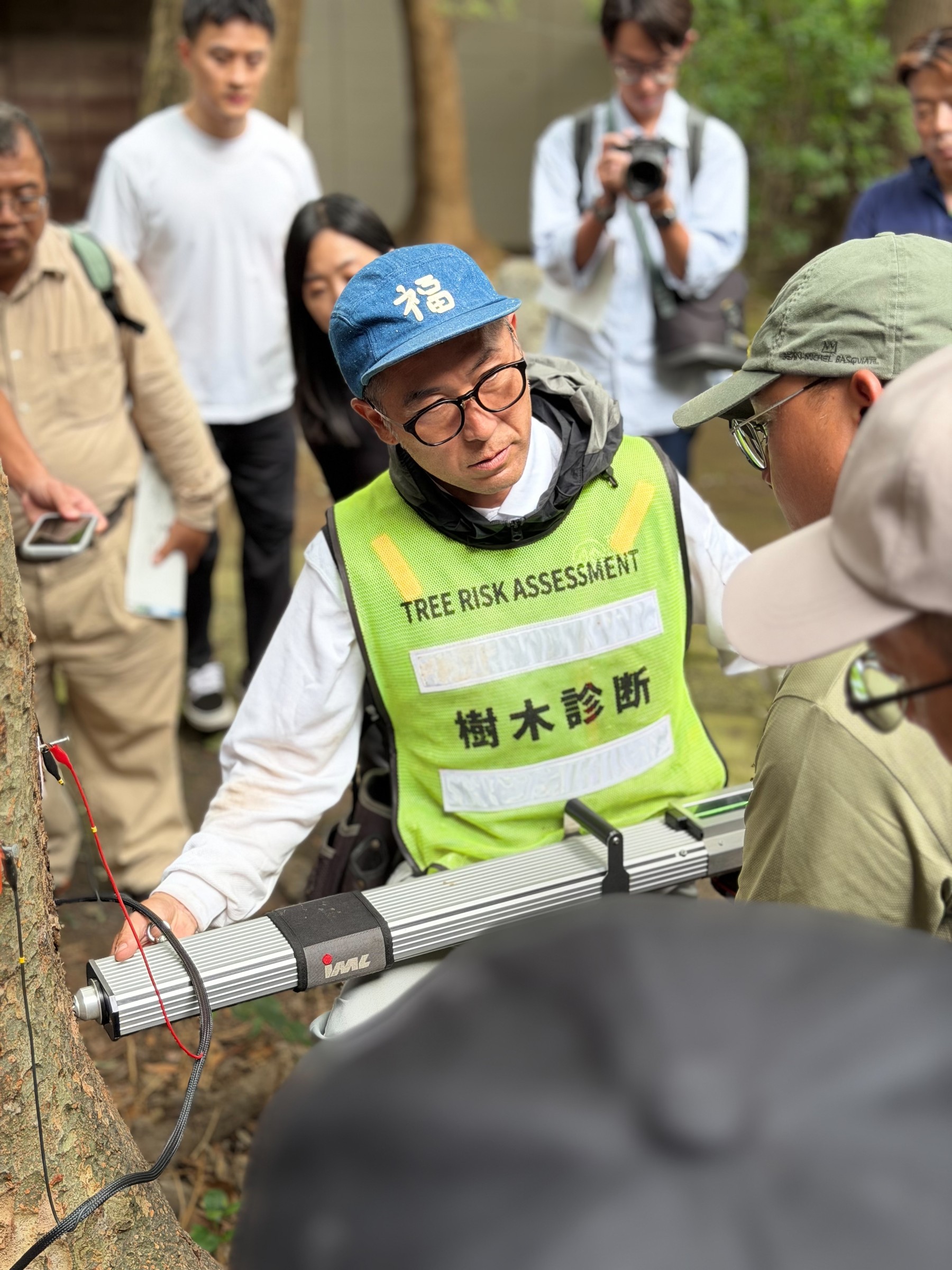
The moment that sums up the day is a simple one. At a tree with a long vertical opening in its trunk, an Upon Forest member holds the Resi PD, a long grey drill, with support from our team. Around them, others watch with their phones out. That photograph appears further down; everything else in this story leads to it or follows from it.
The setting
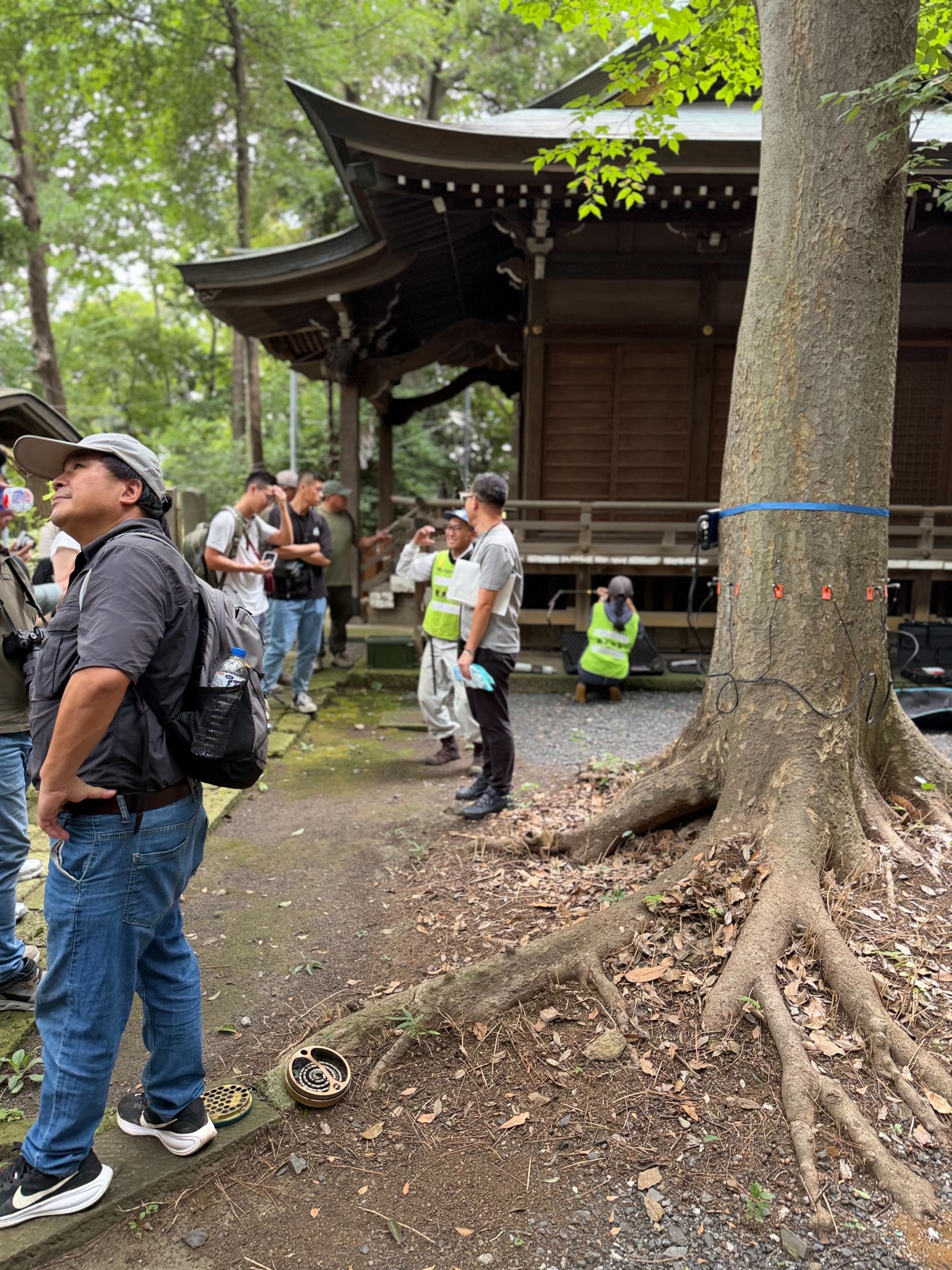
Horinouchi Kumano Shrine stands at 2-6-6 Horinouchi, a residential part of Suginami Ward in western Tokyo. Its grounds hold tall trees around the buildings. Two of them mattered on this day: a tree with a vertical opening in its trunk, and a tree with a broad, spreading root base. For a diagnostics demonstration, real trees with real questions are worth more than any classroom model.
The visitors arrived in a group of about fifteen. One of the photographs shows the group on the stone approach in front of the hall, under the grounds’ tall trees.
The briefing
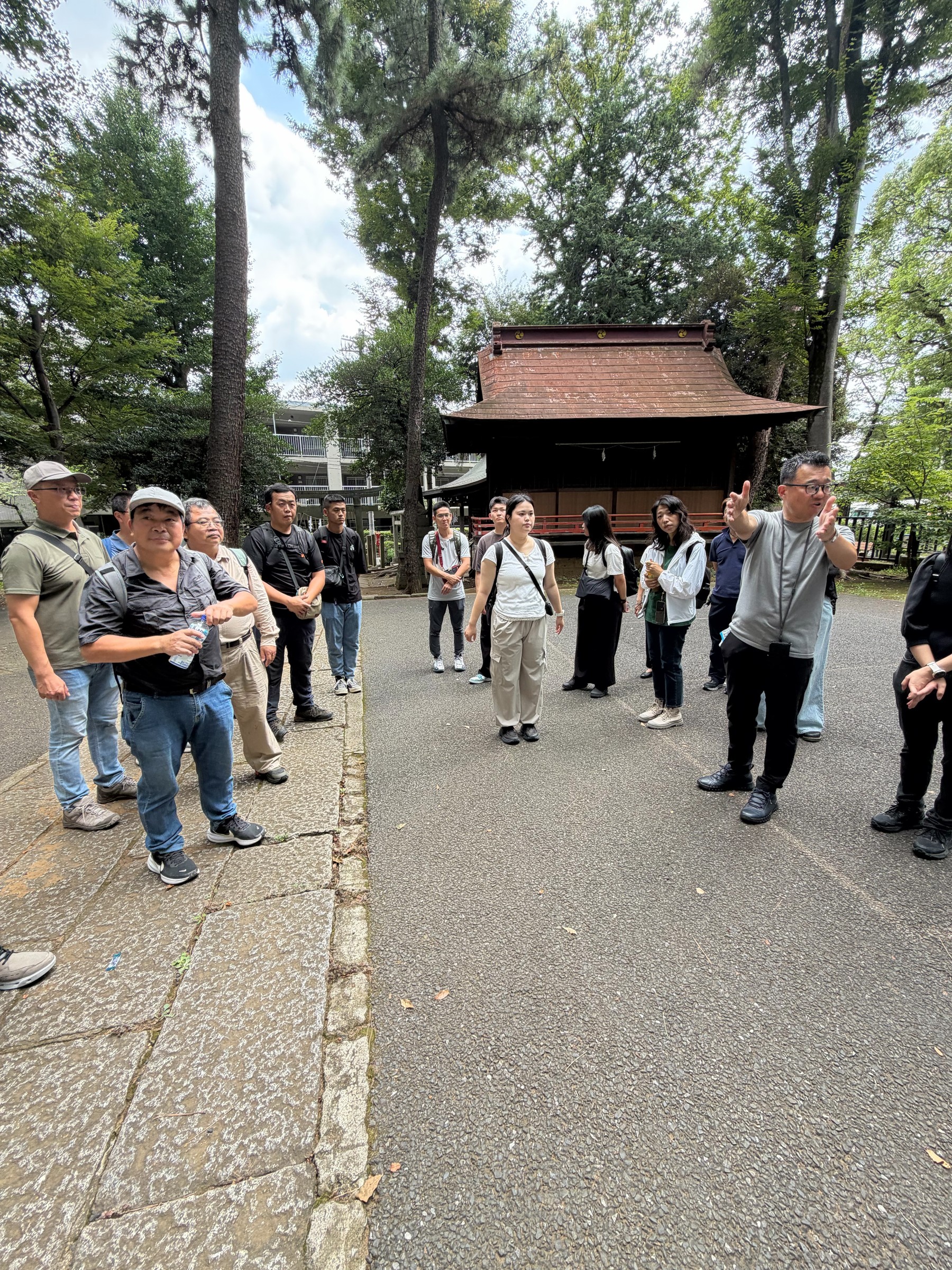
The group gathered in one corner of the grounds in front of the hall for an introduction to the diagnostic instruments. In the photo below, visitors stand in a loose half-circle with cameras raised.
Every hole drilled or nail set is a small wound in a living tree. That point comes back later, because Tokyo’s street tree manual lists, for each of the three instruments, which tissues it damages.
Who came — Upon Forest, and the people who connected us
A young company inside an older group
Upon Forest’s full name is 上森景觀設計工程股份有限公司 (Upon Forest Landscape Architecture). The company was founded in 2019 and belongs to the Laopu (老圃) landscape group, which dates back to 1980. According to its own company page, Upon Forest employs about 160 people across Taichung and Kaohsiung, and works across design, construction management and maintenance.
That last word matters. Maintenance means looking after trees for years after they go in, and looking after a tree includes judging its condition.
Moving 5,000 trees in six months
The story Upon Forest tells on its own company page is a large transplanting job. Looking back on 2015, its head recalls a project connected with the Central Taiwan Science Park: more than 5,000 trees moved within six months, with a survival rate of 92 percent. In the same account, 23 large 相思樹 (xiangsishu) trees were moved to the edge of the factory site, with a survival rate of 95 percent. (The page tells this as the leader’s own experience; it predates the company’s founding in 2019, and I have not confirmed which entity carried out the work.) The company’s technical page adds two working rules for transplanting: after root cutting, the tree generally needs at least 45 to 90 days to grow new roots before it is lifted, and vehicle travel time should be kept to about 30 to 40 minutes.
Those numbers are about moving trees. The visit to Tokyo was about another part of tree work: looking at the condition inside a trunk.
The bridge: Suzuki Yukio of Toho Leo’s Taiwan branch
Visits like this do not happen by themselves. The connection was made by Suzuki Yukio of the Taiwan branch of Toho Leo Co., Ltd. (東邦レオ株式会社), a Japanese company in the landscape and greening field whose Taiwan branch is in Da’an District, Taipei. Mr. Suzuki coordinated the visit from the first contact through to the day itself.
Why now — Taiwan’s new tree protection professionals
A law with a chapter for trees
The visit coincided with changes in Taiwan’s tree protection system, and the dates are worth setting side by side.
On 1 July 2015, Taiwan promulgated an amendment to its Forest Act that added a new chapter, Chapter 5-1, “Tree Protection” (樹木保護), Articles 38-2 to 38-6. Under it, local authorities survey the trees in their area, and the trees they recognise as protected trees (受保護樹木) are registered and publicly announced. The duty does not end at the list: the authority is expected to give protected trees regular health checks and care, and to protect the environment they grow in.
The chapter also changes what happens on development sites. A protected tree inside a development area is, as a rule, to be kept where it stands. It may not be cut, moved, pruned or damaged without the local authority’s permission. A developer who wants to move one has to submit a transplanting and restoration plan and wait for approval before work starts, and the law provides for a public explanatory meeting by the developer and a public hearing by the authority.
On 27 May 2016, the standards for the survey followed. Local authorities are to survey trees outside forests at least once every five years, and a tree can be recognised as protected if it meets any one of a list of conditions. The numerical ones are these:
| Criterion | Threshold |
|---|---|
| Age | 100 years or more |
| Diameter at breast height, broadleaf | 1.5 m (about 59 in) or more |
| Diameter at breast height, conifer | 0.75 m (about 30 in) or more |
| Crown projection area | 400 m² (about 4,300 sq ft) or more |
Diameter is measured 1.3 m above the ground, and the standards also allow an alternative based on girth. Meeting a single condition is enough to be considered, but a tree becomes a protected tree only when the local authority recognises it and announces it. The list does not stop at numbers either; it also reaches ecological, cultural and historical value, including links to major historical events. A designation system like this creates a clear list of trees that society has decided to keep. But a list does not maintain anything. Someone has to inspect those trees, judge them and care for them, and that someone needs training.
Three grades of certified professionals
That is the gap Taiwan’s newest rule addresses. On 20 April 2026, Taiwan’s Ministry of Agriculture issued and put into force the 樹木保護專業人員培訓考選及分級認證辦法, a regulation on the training, selection and graded certification of tree protection professionals. It defines three grades, and the scope of each grade says a great deal about what Taiwan expects of the people who work on its trees:
| Grade | Scope of work in the regulation |
|---|---|
| Junior (初級) | Carrying out tree protection work on site |
| Intermediate (中級) | The above, plus pruning, maintenance, health surveys, tree censuses, drafting protection plans for protected trees |
| Senior (高級) | Both of the above, plus transplanting with restoration, structural support, health inspections, pest-disease control |
Health surveys appear at the intermediate grade, and health inspections at the senior grade.
Taiwan’s Central News Agency reported on the same day the Forestry and Nature Conservation Agency’s explanation that, when local governments approve the transplanting or restoration of protected trees, they can require contractors to employ senior-grade professionals. The first round of intermediate and senior courses was set at four universities: National Taiwan University, National Chung Hsing University, National Chiayi University and National Pingtung University of Science and Technology, with one class per grade at each school, capped at 40 students per class, and applications for the courses open from 24 August to 6 September 2026. Applications for the selection opened from 1 to 14 September.
Read the dates side by side. The certification rule came into force in April. Applications for the first courses opened on 24 August. Upon Forest stood around a hollow tree in Tokyo, watching a resistance drill, on 2 September, inside both application windows. The regulation names transplanting and health inspections among the senior grade’s work, and Upon Forest’s company page lists design, construction management and maintenance as its business.
What already existed: ISA training and a research institute
Taiwan did not start from zero. The Taiwan Urban Forestry Health and Beautification Association (TWAS, 社團法人台灣都市林健康美化協會) runs training for ISA Certified Arborist (樹藝師) and tree climber (攀樹師) credentials under ISA authorisation, and states that about 300 people in Taiwan have qualified. Upon Forest lists an ISA-certified arborist among its staff qualifications.
On the instrument side, Taiwan’s Forestry Research Institute (林業試驗所) presented 3D stress-wave testing of the trunks of old trees and street trees in October 2015. The same TWAS statement notes that only two people in Taiwan held Japan’s jumokui qualification at the time it was written.
The Resi PD — a thin drill that records resistance
What the instrument does
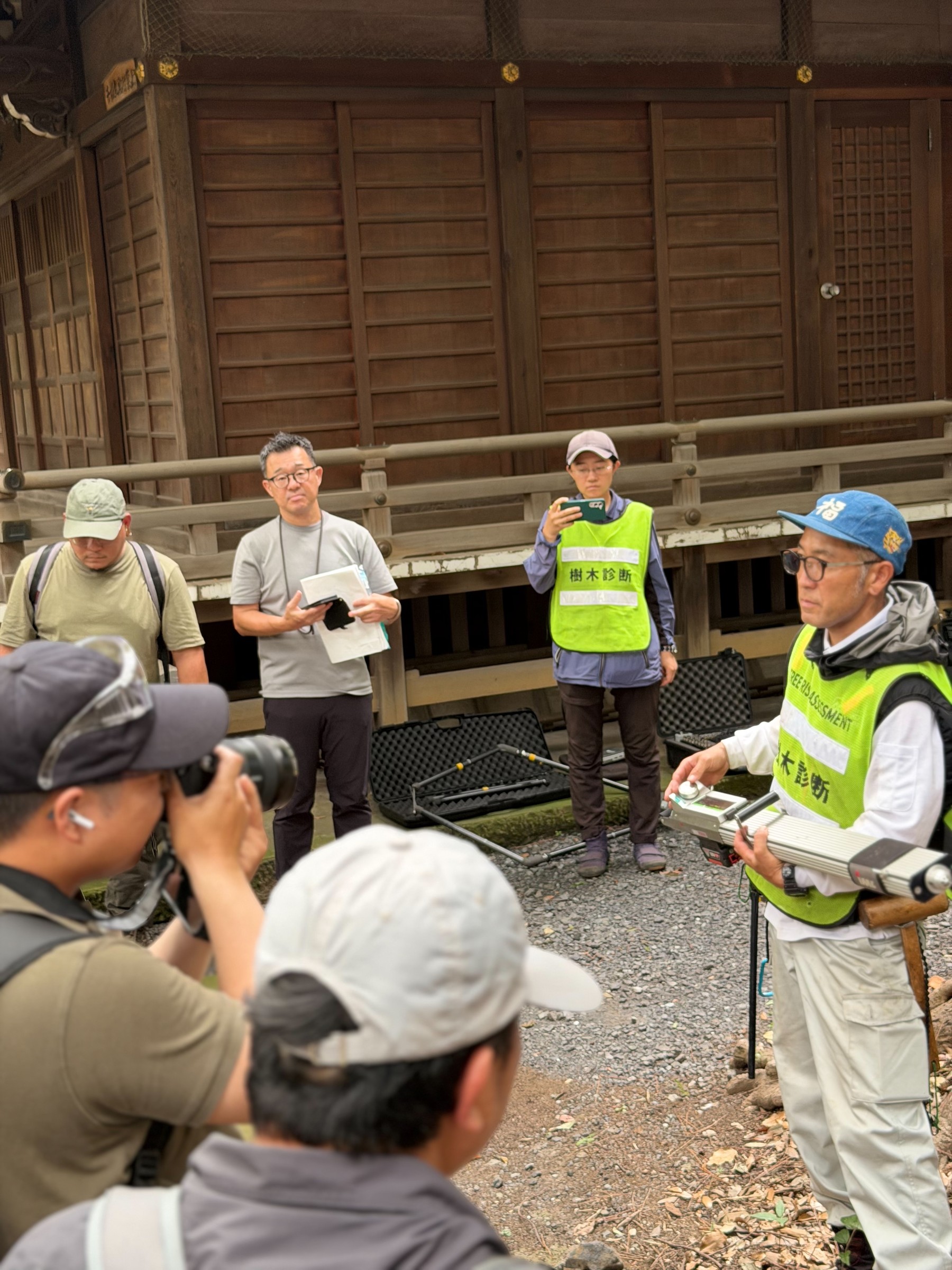
The first instrument of the day was the IML Resi PD, a resistance drill. A very thin drill needle is driven into the trunk, and the instrument records how hard it has to work as it goes: the maker describes the PD series as recording the feed force in addition to the drilling (torsional) force, to look for damage inside the wood. Tokyo’s street tree manual gives the needle a shaft diameter of 1.5 mm and a tip width of 3 mm. The result is a line graph of resistance by depth along one straight path through the wood, and changes in that line are what the diagnostician reads. (For a fuller explanation of the graph, see how a resistograph works.)
The strength of the method is its precision along that path. The limit is that it is a path, not a picture: one drilling samples only one line through the trunk. And the needle does wound the tree, however slightly: the bark, the cambium and the xylem are all penetrated.
The demonstration tree
The demonstration took place beside a tree with a vertical opening in its trunk. The photo below shows the Resi PD raised with its needle end toward the trunk, while visitors photograph the instrument.
Their hands on the drill
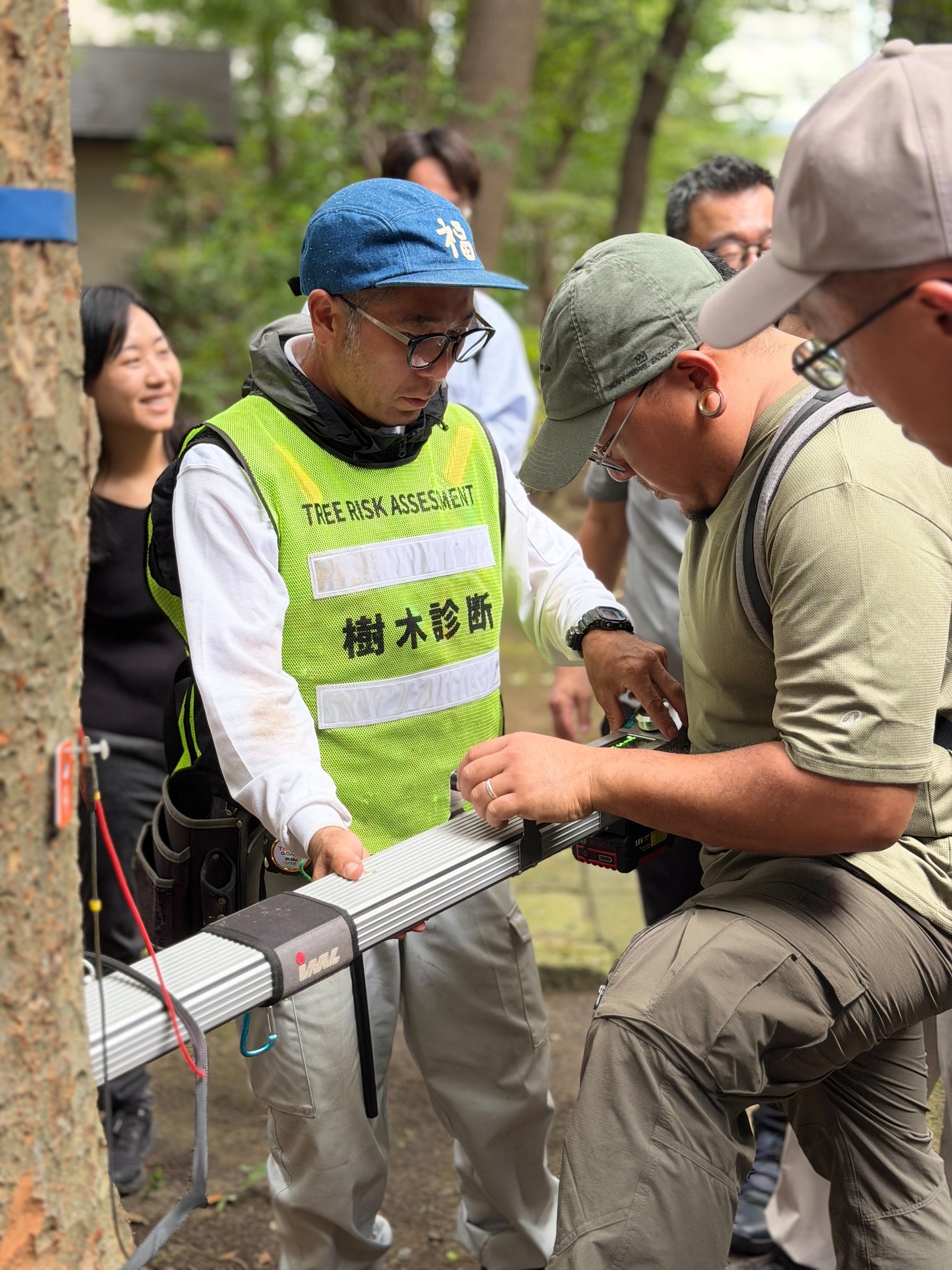
Then the drill changed hands. One of the Upon Forest members took the Resi PD, with support from our team. The Resi PD is long, and the photograph shows two people’s hands on it at once.
Reading the line
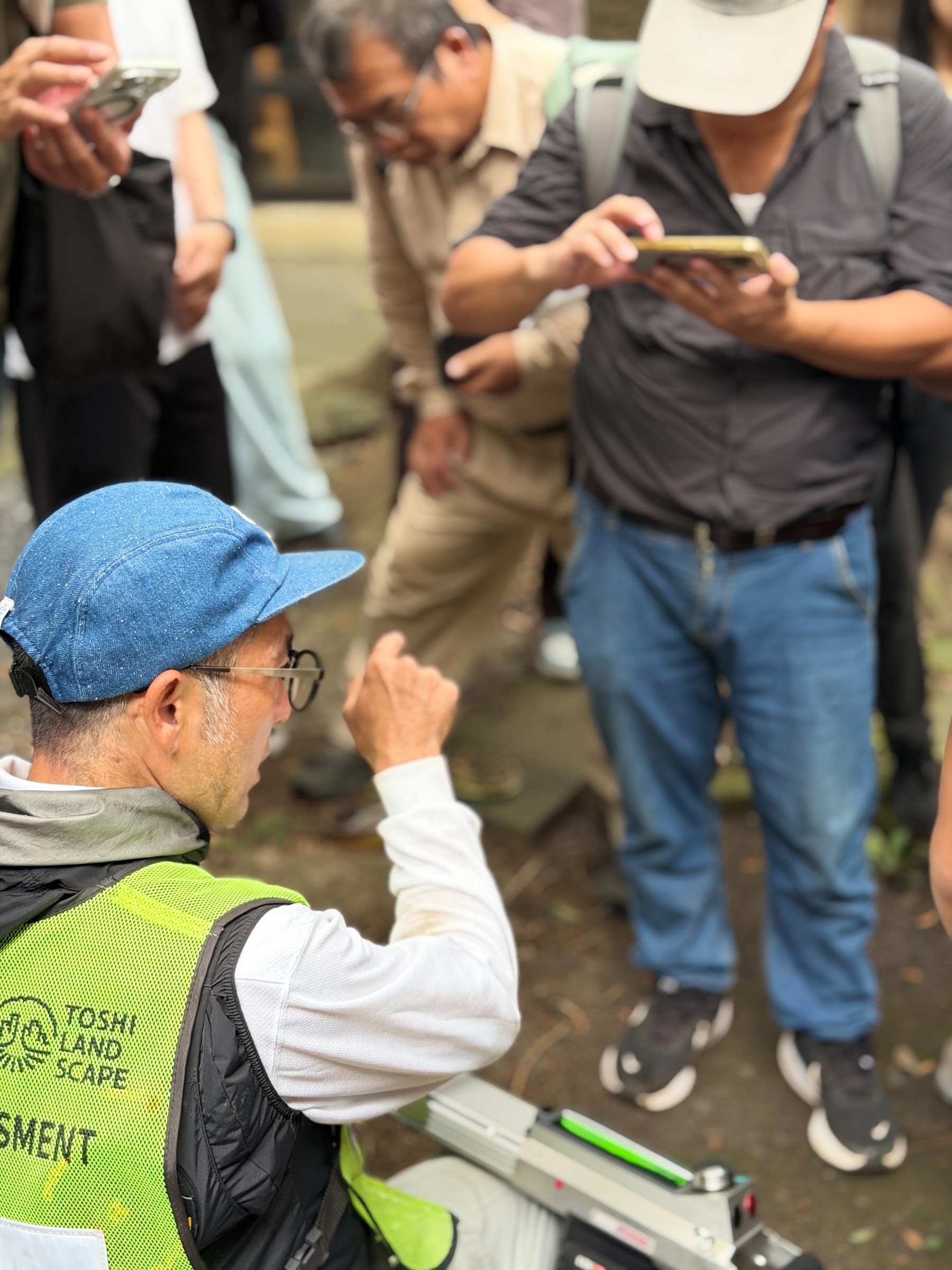
The company report on the day notes that participants listened while taking photographs. The photo below shows that from behind a member of our team crouched at the instrument, with visitors bent over their phones.
PiCUS — listening across the trunk
From a line to a slice
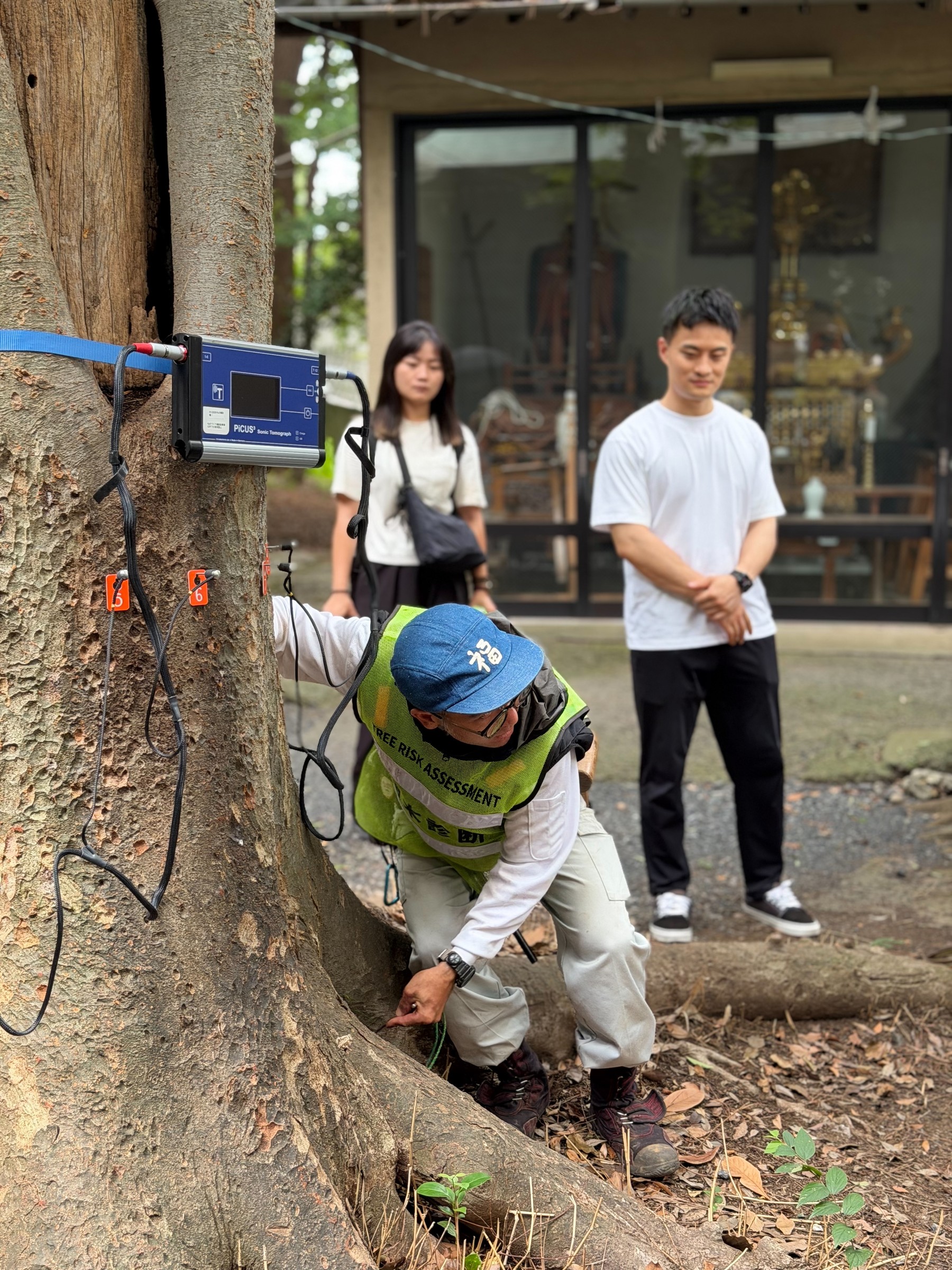
The second instrument changes the question. Instead of drilling one line, the PiCUS sonic tomograph builds a picture of a whole cross-section. Nails are set around the trunk, 12 to 30 of them according to the Tokyo manual, and each sensor is connected to a nail. The instrument measures the time sound takes to travel through the wood between the measuring points, turns those times into a distribution of sound velocity, and draws it as a full-coloured image of the trunk’s cross-section: a tomogram. Where the sound slows, the image changes colour, and that is where the diagnostician looks harder.
The manual’s comparison lists slight damage to the bark and cambium for this method, where it lists bark, cambium and xylem for the drill.
Setting up the sensors
In the photo below, the PiCUS unit is mounted on the trunk with a blue strap, and the lower sensor positions are being checked at the base.
The image on the laptop
Once the measurement runs, the result appears on a laptop as a coloured cross-section. One of our staff members explained the cross-section image to the group on a laptop.
The photo below shows the scale of the audience around a single trunk: the device at the centre, our team beside it, and a ring of heads in the foreground.
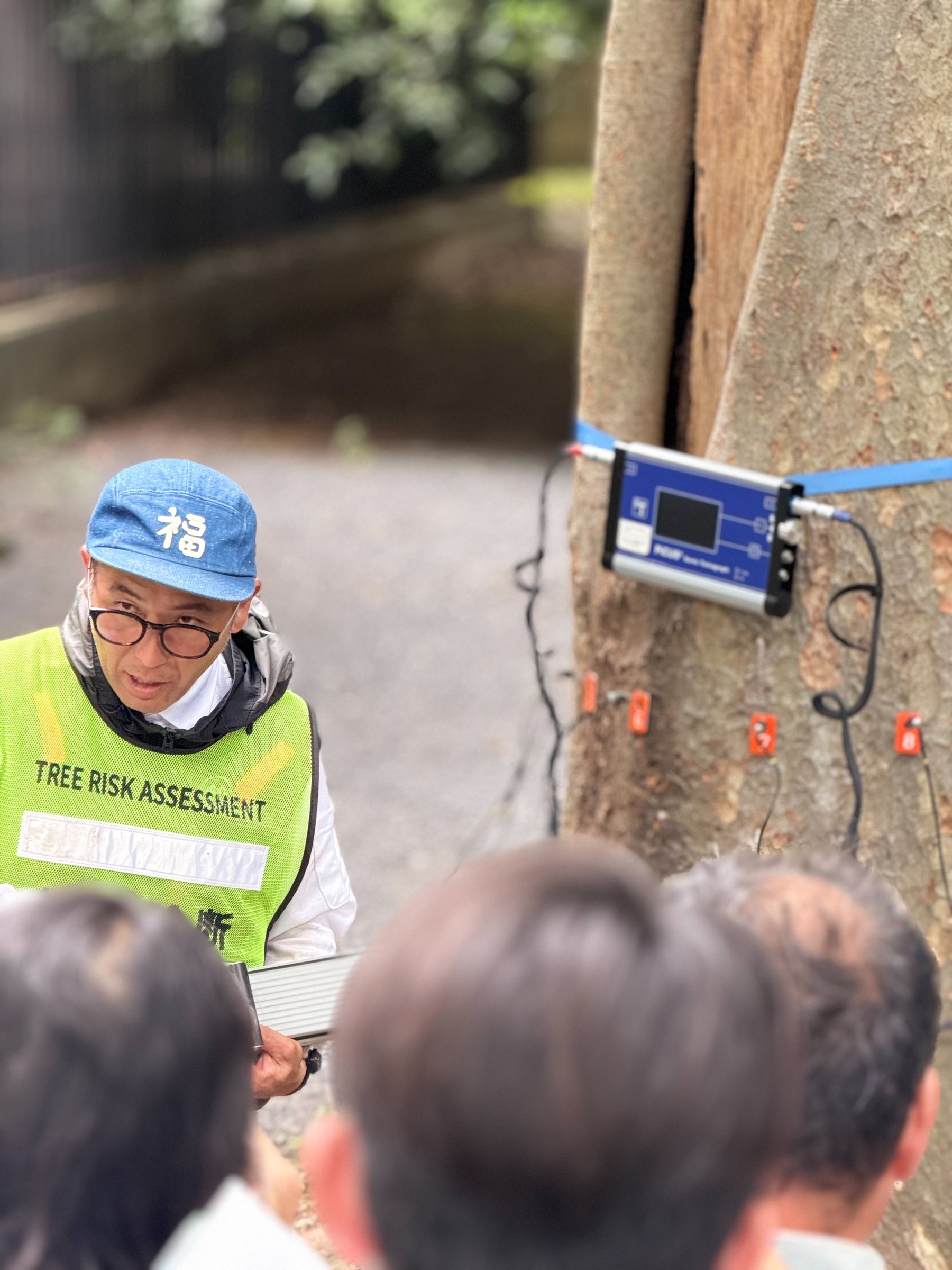
ArborSonic 3D — hammers, sensors and a tape measure
A second way to measure sound
The third instrument, the ArborSonic 3D, works on a related principle: it measures the time a stress wave takes to travel between sensors around the trunk. The maker describes it as measuring sound travel time between sensors, with software that calculates and displays the internal sound-velocity distribution. Tokyo’s manual lists it with dedicated nails (needles), 6 to 32 of them, and the same slight damage to bark and cambium. Taiwan’s own Forestry Research Institute presented 3D stress-wave testing of old and street trees in 2015, so the idea itself was not new to Taiwan. (Our earlier piece on how sonic tomography works walks through the method in more detail.) What a demonstration adds is the procedure: how the sensors go on, how positions are recorded, and how the strikes are made.
Recording positions
Our staff fitted the sensors and measured their positions with a tape measure, recording as they went, while visitors watched and took notes. The photo below shows that step: a tape around the trunk, sensors already in place, and the measurement being read off at one of them.
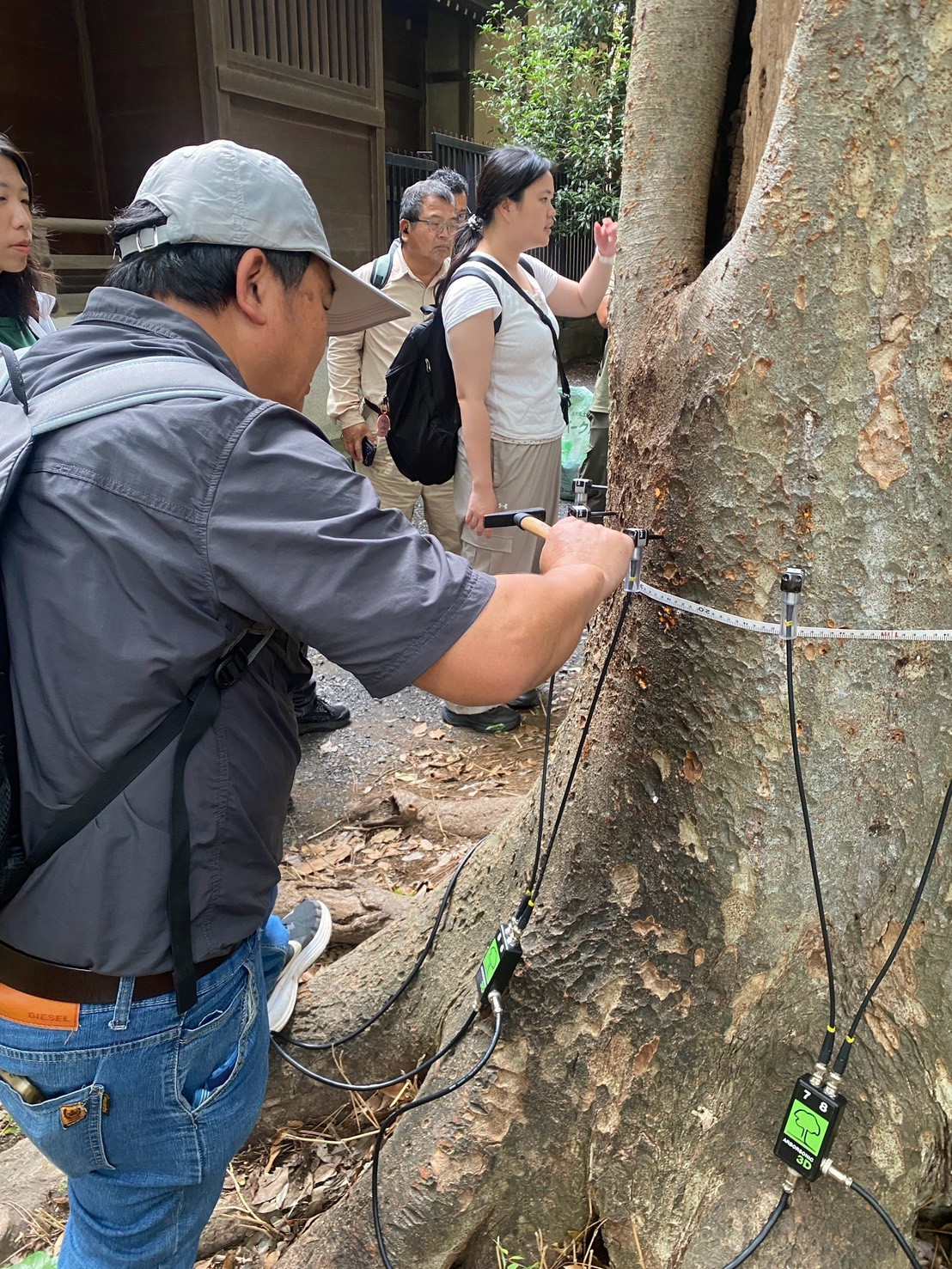
The hammer goes round
Then Upon Forest members struck the sensors with a hammer themselves. The next two photos show that part of the day: first the group gathered around the hammer and sensors, then two visitors at a sensor, one with the hammer, one holding a tablet.
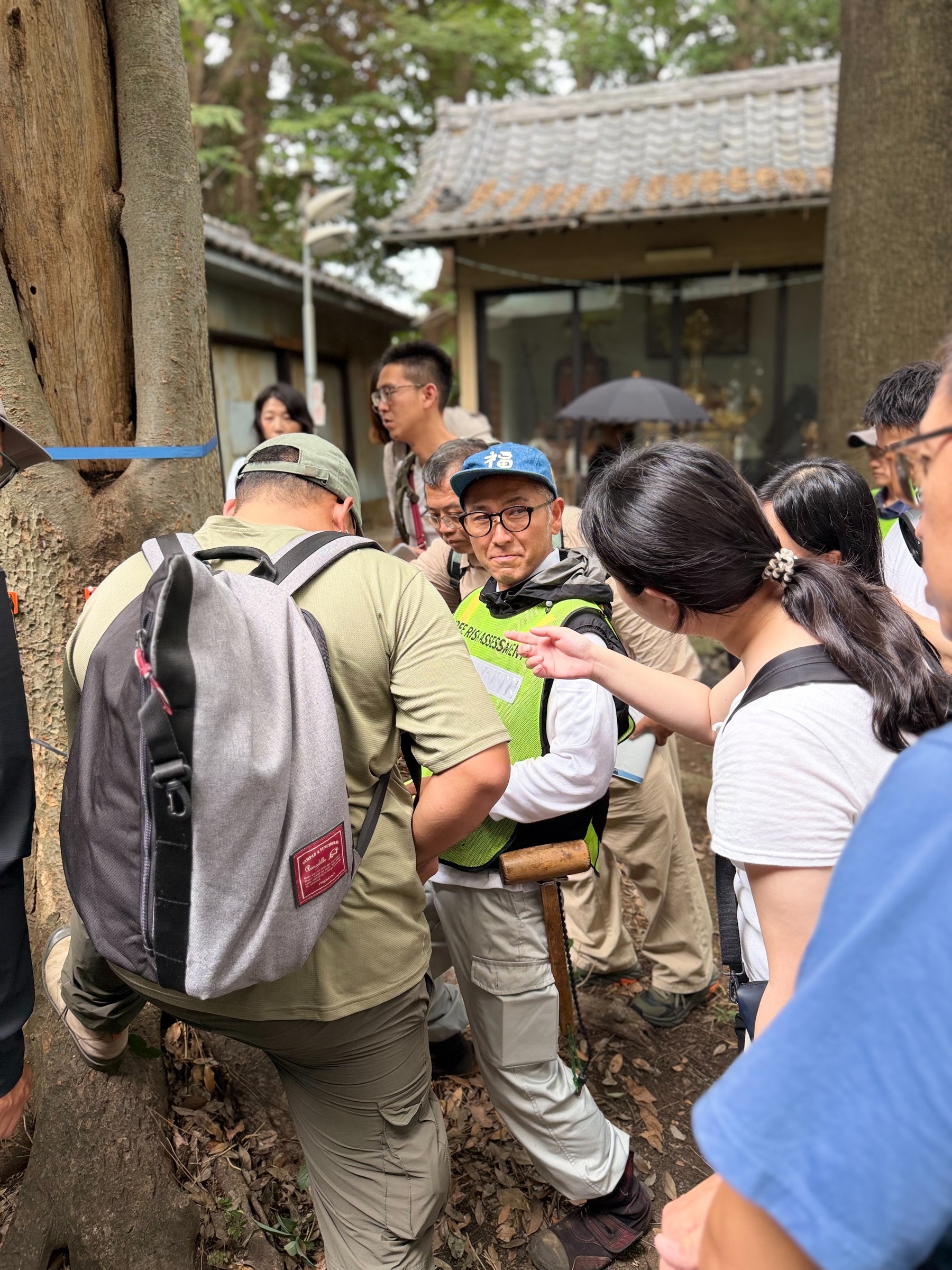
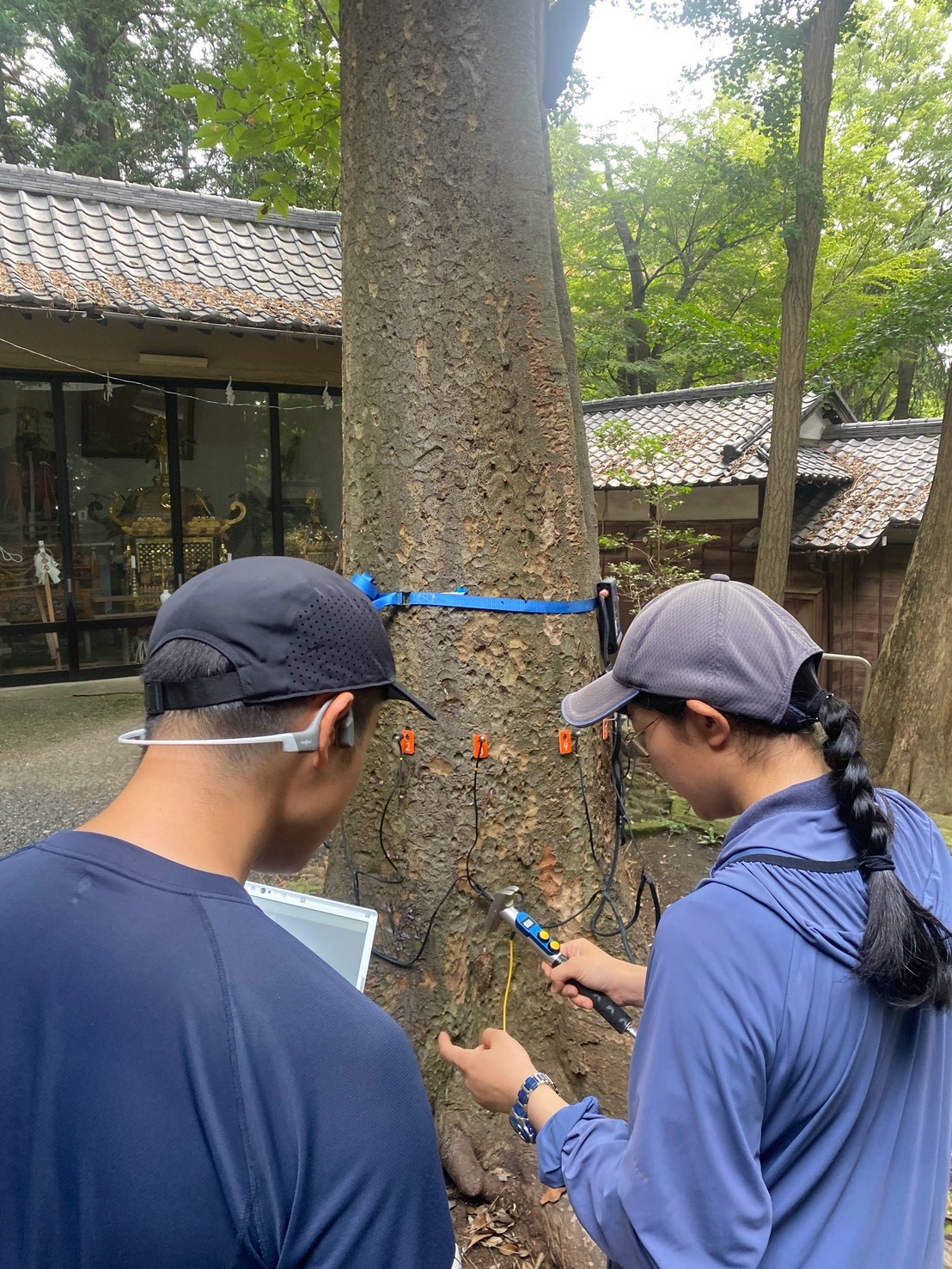
Three instruments side by side — what each asks of the tree
A comparison from Tokyo’s street tree manual
Tokyo Metropolitan Government’s Bureau of Construction publishes a manual for street tree diagnosis. Its FY2021 edition (令和3年度 街路樹診断等マニュアル) compares the instruments in a way that is useful for anyone choosing between them. The table below summarises the points relevant to this morning.
| Resi PD | PiCUS | ArborSonic 3D | |
|---|---|---|---|
| Type (Japanese manual term) | Penetration resistance meter (貫入抵抗測定器) | Sonic tree diagnostic device (弾性波樹木診断装置) | Multi-point stress wave velocity meter (多点式応力波速度測定器) |
| What it measures | Drilling resistance along one line | Sound travel times between nails | Sound travel times between sensors |
| What it touches | Drill needle, shaft 1.5 mm, tip 3 mm | 12 to 30 nails | 6 to 32 dedicated nails |
| Damage listed | Slight, to bark, cambium, xylem | Slight, to bark, cambium | Slight, to bark, cambium |
| Output | Line graph of resistance by depth | Cross-section image | Cross-section image |
Why use more than one
The table makes one trade-off visible. The drill gives a single line and is the only one of the three listed as reaching the xylem; the two sonic instruments give a whole cross-section from nails that the manual lists as touching only bark and cambium. Which to use, and in what combination, depends on the tree’s condition, and no single readout is a diagnosis by itself.
The visitors’ day followed the same sequence: a line, then a slice, then a second way of building the slice. They held the drill and struck the sensors themselves.
The grounds as a classroom — big trees, close attention
Roots, gravel and a crowd
The photo below shows the other tree that mattered that day: a large trunk with a broad root base spreading over bare ground beside the hall, with the group gathered beyond it.
What the photographs show
Looking through the photographs, what they show is people close to the instruments: leaning in, crouching, holding the drill, holding the hammer, holding a phone up to a screen.
Japan’s side — what a jumokui is, in numbers
The certification
Because the visitors were learning from a jumokui, it is fair to describe what that qualification is. Japan’s tree doctor system began in fiscal 1991, and since fiscal 2001 it has been run by the Japan Greenery Research and Development Center (一般財団法人日本緑化センター). To become a jumokui, a candidate must pass the centre’s qualification screening and be registered. (Our explainer what is a jumoku-i covers the system in more depth.) As of 1 December 2025, there were 3,244 registered jumokui nationwide, according to Hiroshima Prefecture’s published figure.
The qualification has been gaining formal standing. On 14 February 2025, Japan’s Ministry of Land, Infrastructure, Transport and Tourism (MLIT) registered jumokui as a qualification for the inspection of park facilities, specifically trees, on its list of qualifications for public works technicians. MLIT’s own guideline for inspecting and diagnosing trees in urban parks, 都市公園の樹木の点検・診断に関する指針(案), was first drafted in September 2017 and revised on 30 March 2026.
Japan and Taiwan side by side
Put the two systems next to each other and the shapes are different, not better or worse.
| Japan | Taiwan | |
|---|---|---|
| Main certification | Jumokui (since 1991; Japan Greenery Research and Development Center since 2001) | Tree protection professionals, three grades (in force 20 April 2026) |
| Who runs it | A foundation (screening, registration) | Ministry of Agriculture (training, selection, grading) |
| Link to public works | Registered by MLIT for park tree inspection (February 2025) | Local governments may require senior grade for protected-tree transplanting or restoration (as reported by CNA) |
| Scale | 3,244 registered (December 2025) | First courses: 40 per grade per university, four universities |
| What the grades cover | One qualification | Junior site work; intermediate surveys, plans; senior transplanting, inspection |
Japan has three decades of practitioners. Taiwan has a newly written national framework, a list of protected trees with clear numerical thresholds, and the first course places opening this year. Each system is answering its own history.
After the day — a message from Mr. Suzuki, a photo in front of the hall
The last pictures
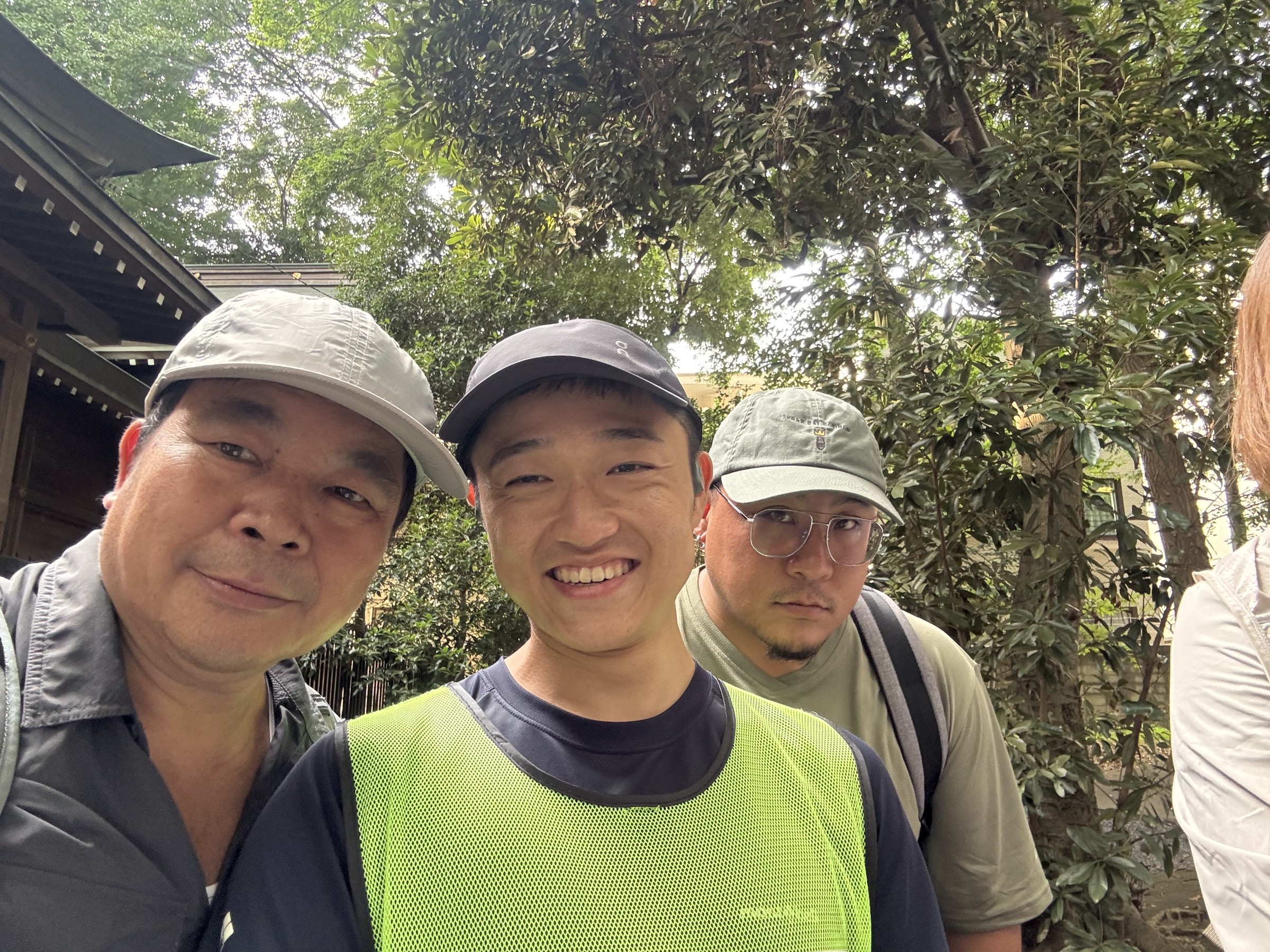
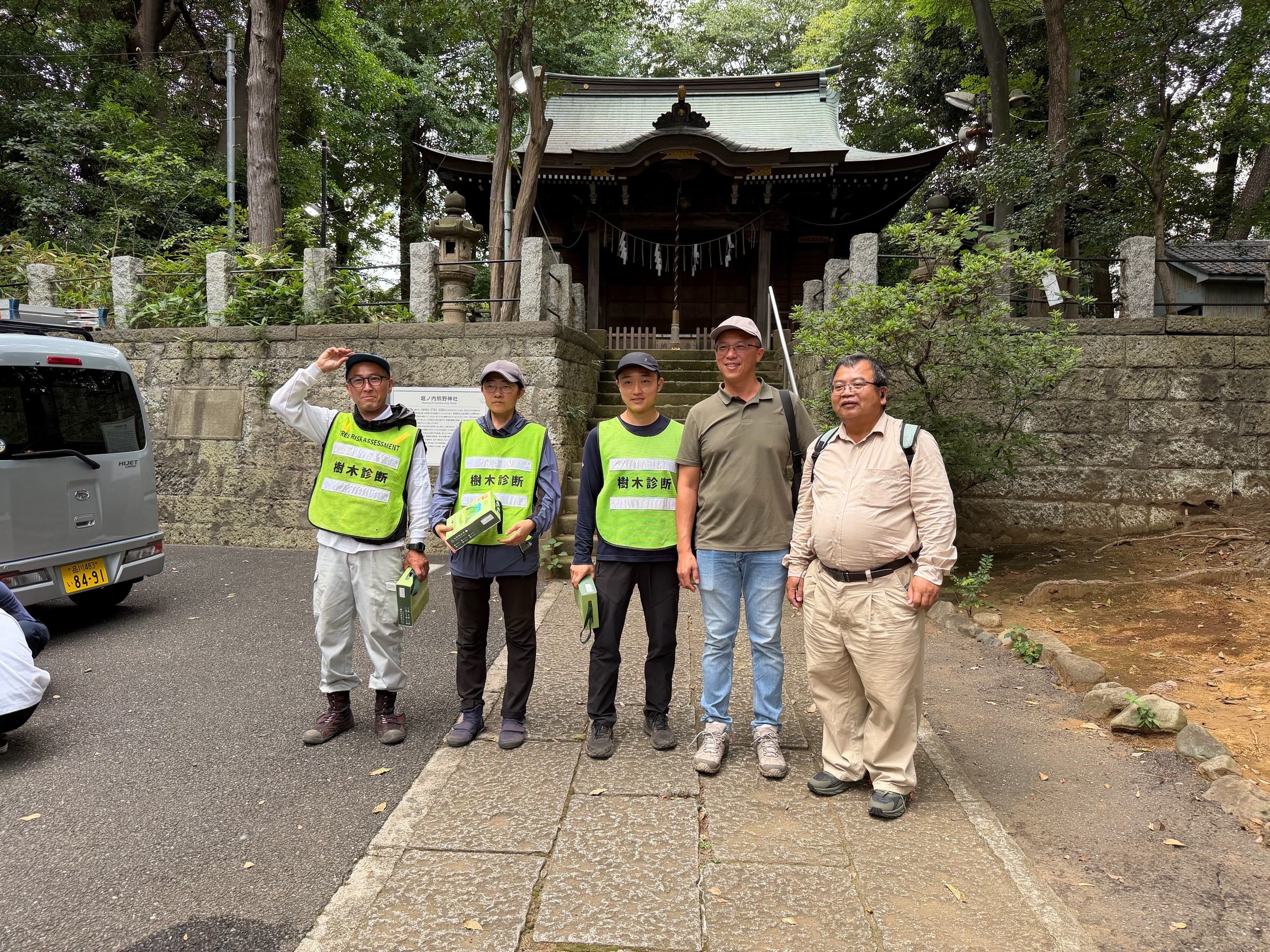
The last photographs were taken in front of the hall. One shows three people in our vests lined up with two others from the day; another, the whole Upon Forest group behind its green banner, which is the image at the top of this article. And there is a selfie, three faces close together under the trees, one of them in a green vest.
What Mr. Suzuki passed on
After the training, Mr. Suzuki relayed a short message: the people from Taiwan had found it very educational and were pleased. I would rather quote that than add to it.
What a day like this is for
A demonstration is a small thing: three instruments, a few trees, a group photo at the end. But the people in these photos work in a country that, in the same year, began certifying tree protection professionals in three grades. Professional knowledge moves between countries through documents, and also through hands on the same drill.
For us, as a company with jumokui on staff, it is also a reminder that the principles of tree diagnostics are not confined to one country even when the qualifications are. What differs is the system around them, and those systems can learn from each other.
Frequently asked questions
Who is Upon Forest?
Upon Forest (上森景觀設計工程股份有限公司) is a Taiwanese landscape company founded in 2019, part of the Laopu landscape group founded in 1980. It has about 160 staff in Taichung and Kaohsiung and works in design, construction management and maintenance.
When and where did the visit take place?
On 2 September 2026, in the grounds of Kumano Shrine in Horinouchi, Suginami Ward, Tokyo. About fifteen Upon Forest members took part.
Which instruments were demonstrated?
Three: the IML Resi PD resistance drill, the PiCUS sonic tomograph and the ArborSonic 3D stress wave tomograph. The visitors held the Resi PD themselves and struck the ArborSonic 3D sensors with a hammer.
What is Taiwan’s new tree protection certification?
A regulation issued by Taiwan’s Ministry of Agriculture and in force from 20 April 2026, setting up three grades of certified tree protection professionals: junior (site work), intermediate (adding pruning, health surveys, protection plans) and senior (adding transplanting, structural support, health inspections). The first intermediate and senior courses were scheduled at four universities.
What makes a tree “protected” in Taiwan?
Under the standards of 27 May 2016, a tree can be recognised if it meets any one of a list of conditions, including: 100 years or older; a diameter at 1.3 m height of 1.5 m or more for broadleaf trees or 0.75 m or more for conifers; or a crown projection of 400 m² or more. It becomes a protected tree when the local authority recognises it and announces it.
How many jumokui are there in Japan?
3,244 were registered nationwide as of 1 December 2025, according to Hiroshima Prefecture’s published figure.
Sources
– Toshi Landscape company blog, report of the 2 September 2026 training (checked 2026-11-13): https://toshilandscape.co.jp/archives/19694 – Upon Forest, company page (checked 2026-11-13): https://www.upon-forest.com/company.html – Upon Forest, transplanting technical guidance (checked 2026-11-13): https://www.upon-forest.com/t1-6.html – Laws and Regulations Database of Taiwan, Forest Act, Chapter 5-1 (checked 2026-11-13): https://law.moj.gov.tw/LawClass/LawParaDeatil.aspx?pcode=M0040001&bp=6 – Laws and Regulations Database of Taiwan, Forest Act amendment history (checked 2026-11-13): https://law.moj.gov.tw/LawClass/LawHistory.aspx?pcode=M0040001 – Office of the President, Presidential Gazette, 1 July 2015 Forest Act amendment (checked 2026-11-13): https://www.president.gov.tw/PORTALS/0/BULLETINS/PAPER/PDF/7200-10.PDF – Laws and Regulations Database of Taiwan, Forest Act, full text (checked 2026-11-13): https://law.moj.gov.tw/LawClass/LawAll.aspx?pcode=M0040001 – Laws and Regulations Database of Taiwan, survey methods and protected tree standards (checked 2026-11-13): https://law.moj.gov.tw/LawClass/LawAll.aspx?pcode=M0040047 – Laws and Regulations Database of Taiwan, tree protection professionals regulation (checked 2026-11-13): https://law.moj.gov.tw/LawClass/LawAll.aspx?pcode=M0040050 – Forestry and Nature Conservation Agency, Ministry of Agriculture, press release (checked 2026-11-13): https://www.forest.gov.tw/news/0079029 – Central News Agency, 20 April 2026 (checked 2026-11-13): https://www.cna.com.tw/postwrite/chi/431222 – Taiwan Forestry Research Institute (checked 2026-11-13): https://www.tfri.gov.tw/News_Content.aspx?n=7747&s=848 – TWAS statement (checked 2026-11-13): https://twas.org.tw/clarification-regarding-the-feature-article-by-initium-media/ – Japan Greenery Research and Development Center, tree doctor system (checked 2026-11-13): https://jpgreen.or.jp/treedoctor/index.html – Hiroshima Prefecture, jumokui registration figure (checked 2026-11-13): https://www.pref.hiroshima.lg.jp/soshiki/87/jyumokuir7.html – MLIT, press release on public works technician qualifications, 14 February 2025 (checked 2026-11-13): https://www.mlit.go.jp/report/press/kanbo08_hh_001175.html – MLIT, guideline for inspection of urban park trees, PDF (checked 2026-11-13): https://www.mlit.go.jp/toshi/park/content/001414802.pdf – MLIT, guideline for inspection of urban park trees (checked 2026-11-13): https://www.mlit.go.jp/toshi/park/toshi_parkgreen_tk_000109.html – Toho Leo, offices (checked 2026-11-13): https://www.toho-leo.co.jp/company/offices/ – Tokyo Metropolitan Government Bureau of Construction, street tree diagnosis manual, FY2021 (checked 2026-11-13): https://www.kensetsu.metro.tokyo.lg.jp/content/000051876.pdf – IML, Resi PowerDrill product page (checked 2026-11-13): https://www.iml.de/produkt/iml-powerdrill/ – IML Electronic, PiCUS Sonic Tomograph manual (checked 2026-11-13): https://files.iml-electronic.com/PiCUS_Sonic_Tomograph_Q74_Manual_EN_v1_0.pdf – Fakopp, ArborSonic 3D product page (checked 2026-11-13): https://fakopp.com/en/product/arborsonic/ – Suginami City Board of Education, Horinouchi Kumano Shrine (checked 2026-11-13): https://www.city.suginami.tokyo.jp/documents/7569/0000.pdf
Related reading
This story is one of the exchanges on the Worldwide map, where I collect the arborists I have met, hosted and worked with.