

Kenninji-gaki (建仁寺垣) is a solid Japanese bamboo fence: split bamboo stands upright, edge to edge, against horizontal rails, and split-bamboo bars across the front are tied through to those rails with shuro palm-fibre rope. The rope ties are real, but the sources we checked do not show that the whole fence is built without metal — one documented Kenninji build screwed its upright strips to the rails. Nor do they give a standard lifespan for Kenninji-gaki alone; one garden-construction report says bamboo work in general needs replacing every few years, ten at the longest.
A Wall of Split Bamboo — What You Are Looking At
The first impression: a surface, not a lattice
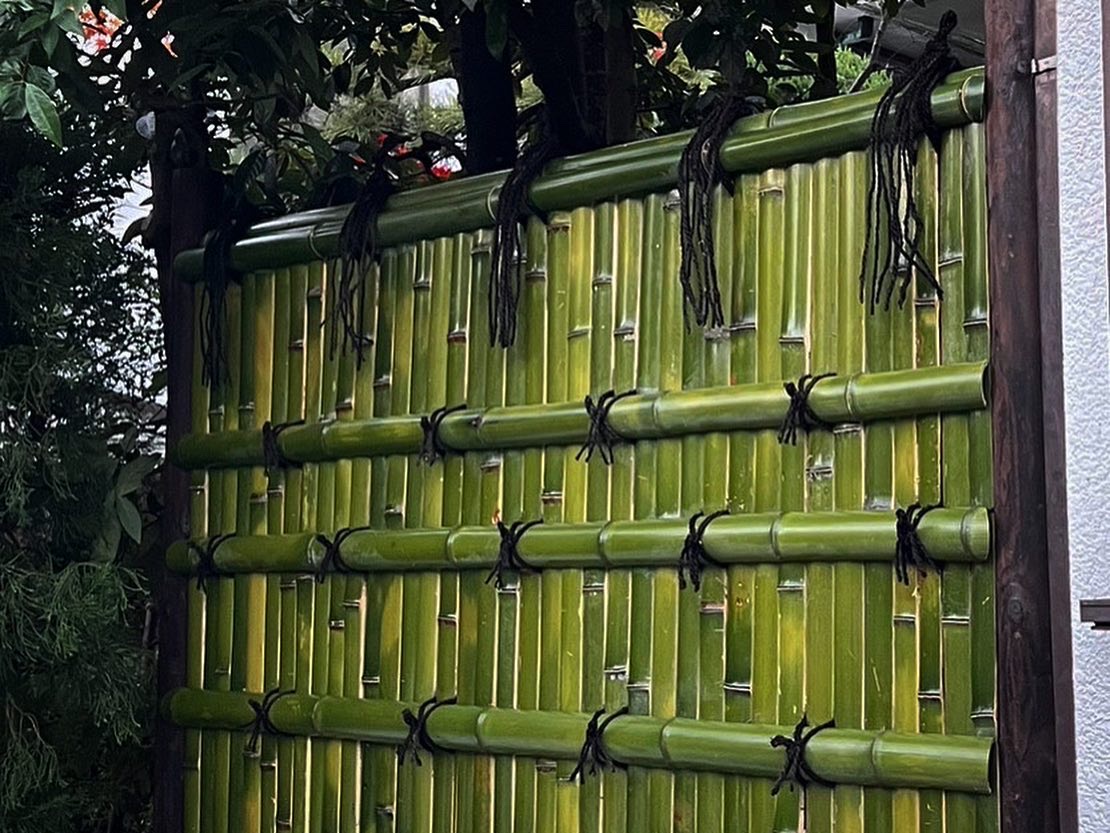
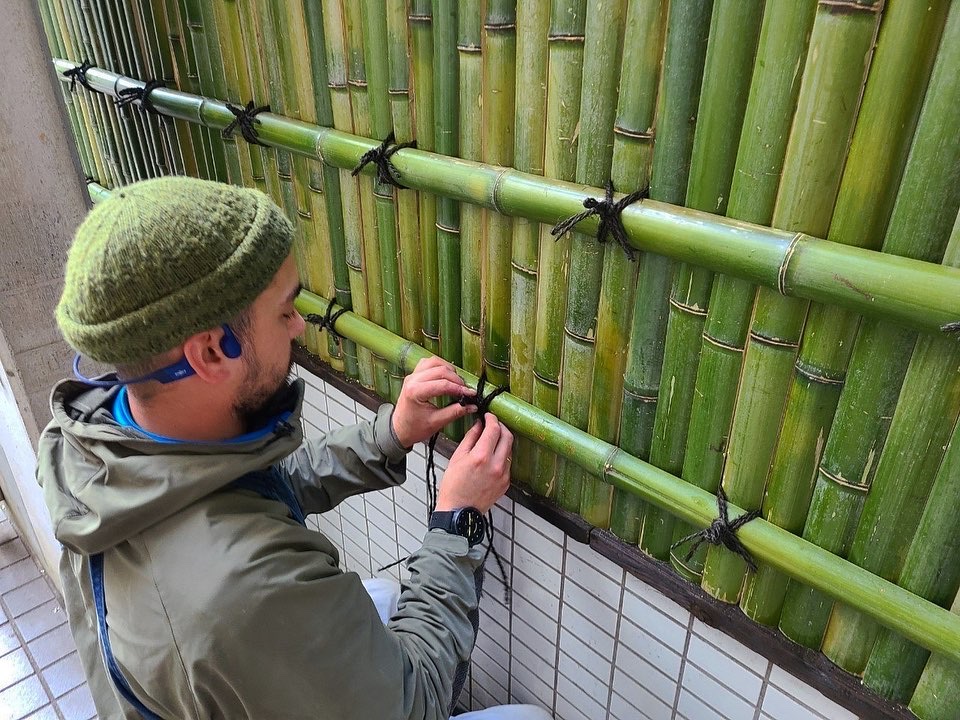
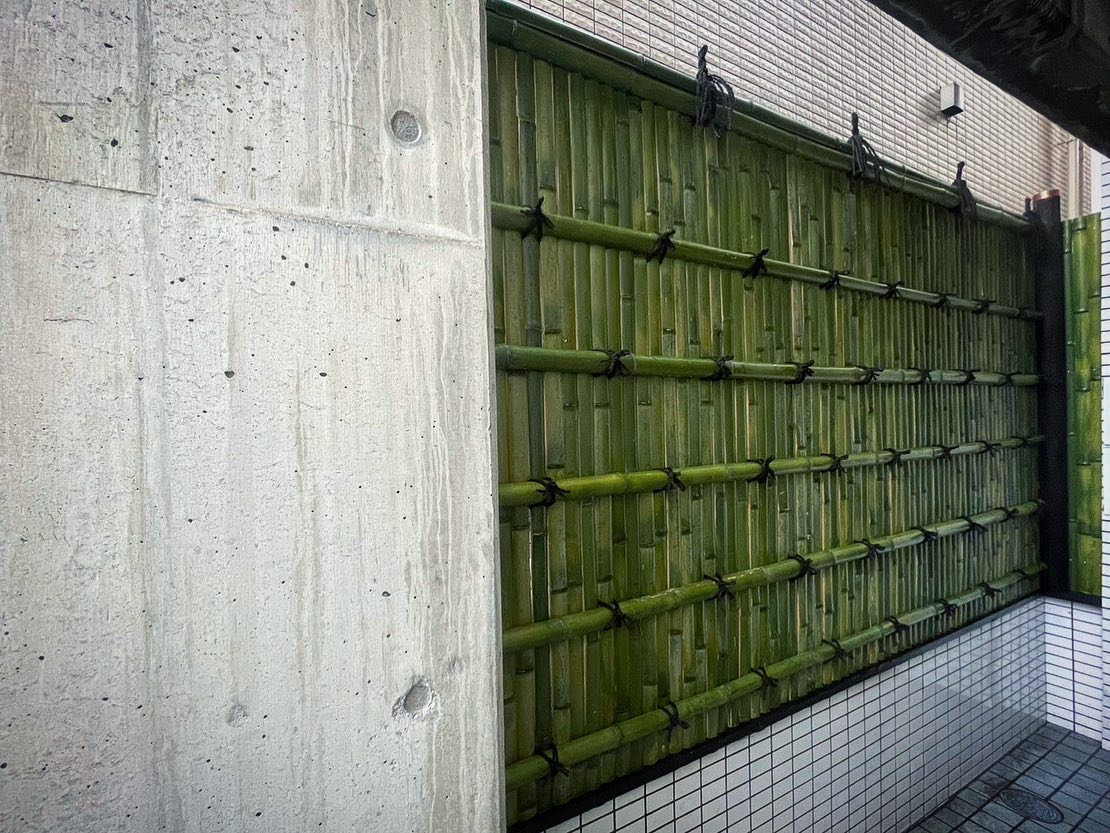
Stand in front of a new Kenninji-gaki and the first thing you notice is that you cannot see through it. Many bamboo fences in Japanese gardens are open lattices that frame the planting behind them. This one is a wall. The upright strips sit so close that the panel reads as one green surface, broken only by the nodes of the culms and by a few horizontal bars, each crossed at regular intervals by a small black knot.
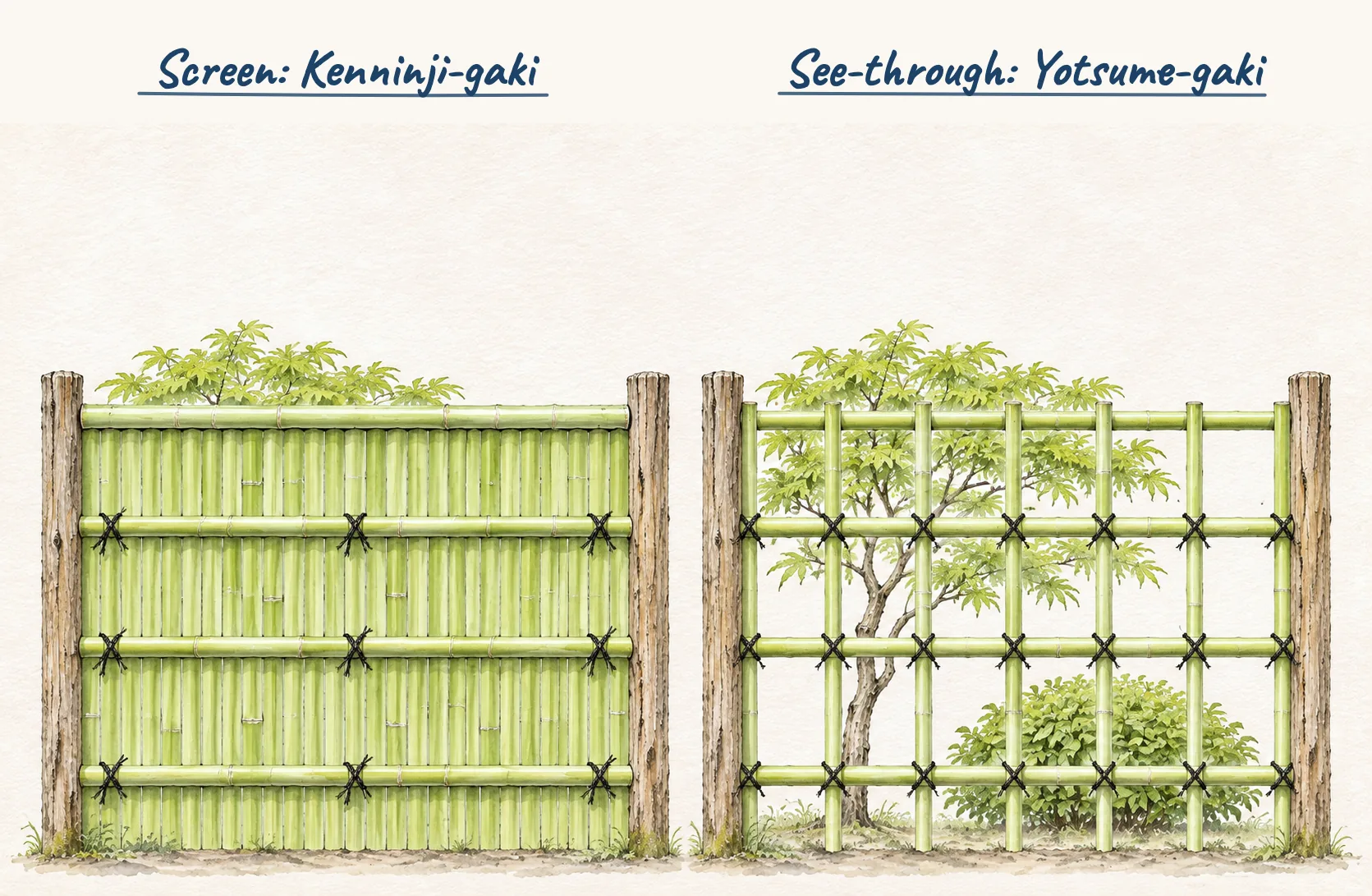
That closeness is the point. A Japanese garden-construction report in the journal of the Japanese Institute of Landscape Architecture sorts bamboo fences into two broad families and places Kenninji-gaki among the screening fences (遮蔽垣, shahei-gaki), the ones built to block a view, while the four-square Yotsume-gaki is the typical see-through fence (透かし垣, sukashi-gaki). It is the kind of fence a garden reaches for when something needs hiding — a service yard, a neighbour’s wall — in that sense the built counterpart of a dense clipped hedge, the kind shaped by karikomi pruning.
Five parts, three layers
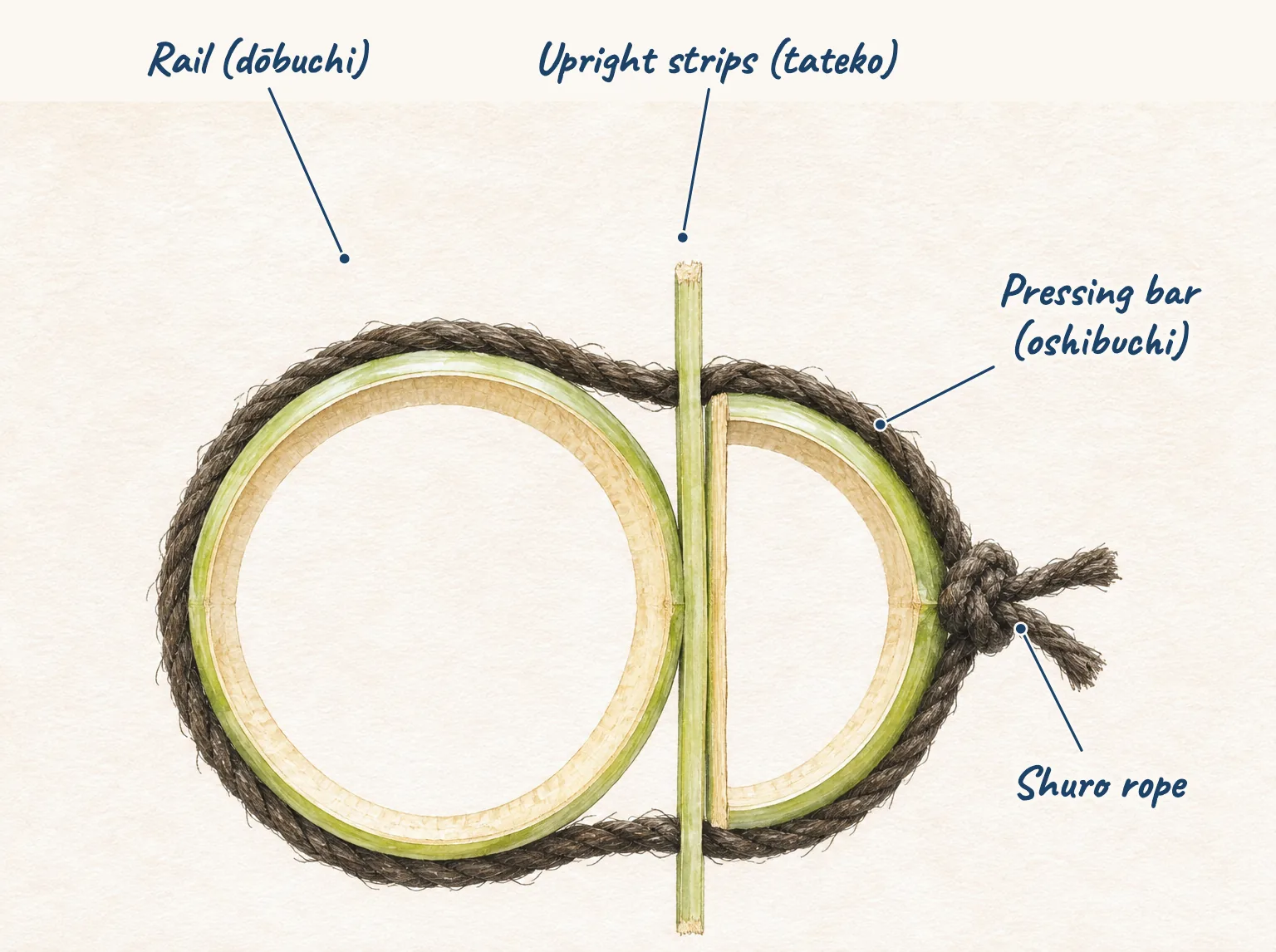
Five main parts explain how a Kenninji-gaki is put together. The Imperial Household Agency’s description of the Kenninji-gaki at Shūgakuin Imperial Villa in Kyoto describes bamboo split in four (四ツ割竹) set “vertically without gaps” and tied with shuro (palm-fibre) rope.
| Part | Japanese | What it is | What it does |
|---|---|---|---|
| Post | 柱 hashira | A timber post (hinoki cypress at Shūgakuin) | Carries the whole panel |
| Rail | 胴縁 dōbuchi | A horizontal member run between the posts | The hidden backbone the upright strips lean on |
| Upright strip | 立子 tateko | Split bamboo set vertically, edge to edge | Forms the screen itself |
| Pressing bar | 押縁 oshibuchi | Split bamboo laid horizontally across the face | Clamps the strips against the rails; carries the visible knots |
| Coping | 玉縁 tamabuchi | A cap of several split-bamboo pieces | Covers the cut tops of the strips |
The Nara National Research Institute for Cultural Properties defines tateko simply as “long and thin materials used vertically in a fence,” and tamabuchi as “a coping made from several pieces of split bamboo, used atop bamboo fences such as Kenninji fence.” A school construction record from Saitama Prefecture describes the oshibuchi as “the split bamboo tied on the front face.”
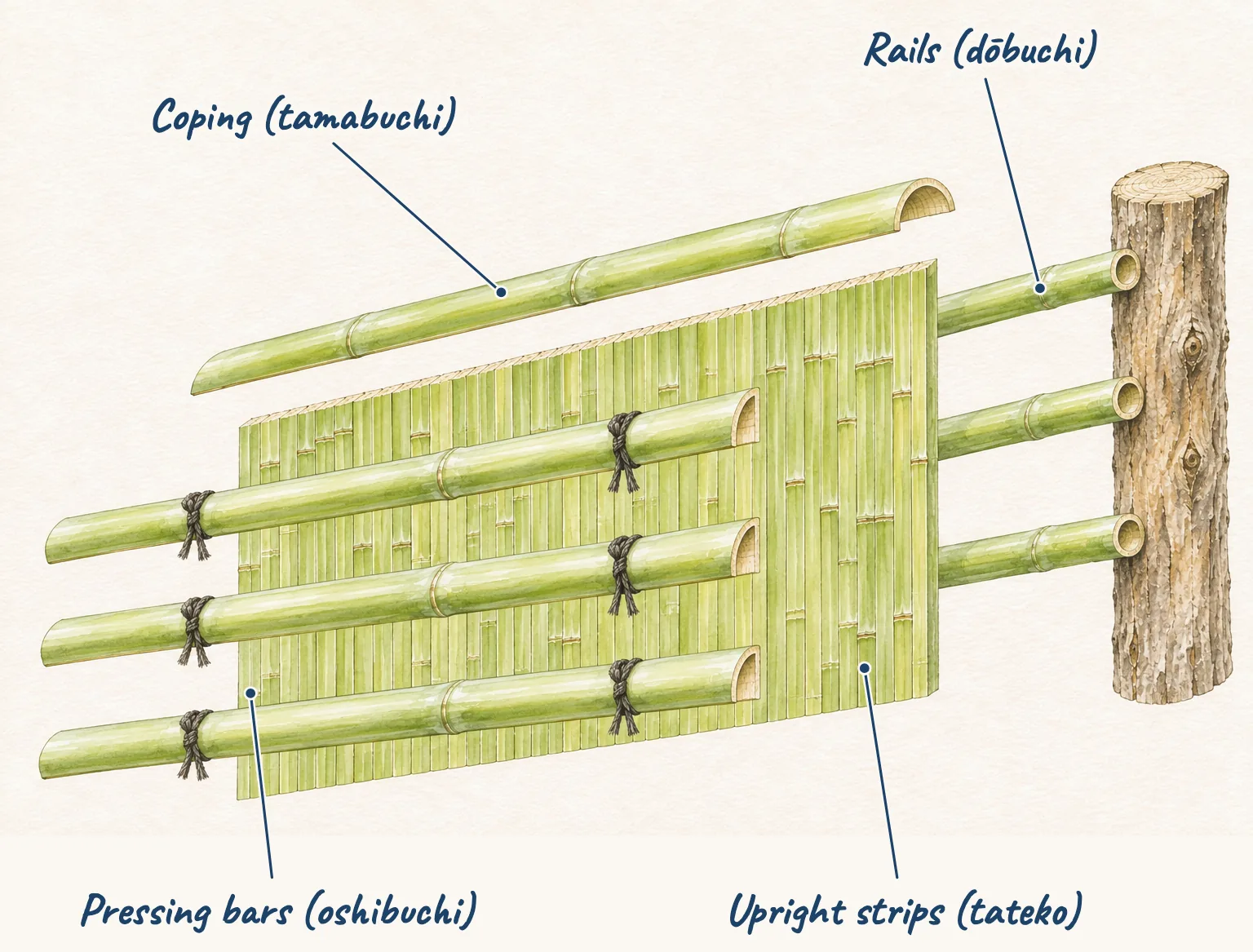
Seen from the side, the fence is a sandwich. The rails sit at the back, the upright strips in the middle, and the pressing bars in front. At each tie, the front bar and the back rail hold the strips between them, and rope pulls the two together. Some builds also fix the strips to the rails with screws, as the frame section below shows, but the rope tie is what you see on the face.
The Name — A Fence Named After a Kyoto Temple
Kenninji and its fence
The Nara institute’s garden dictionary states plainly that the Kenninji fence “is named after one at Kenninji temple in Kyoto.” The temple still points visitors to one. Its official guide to the precincts says that on the west side of the tea house Tōyōbō (東陽坊) stands the temple’s “famous Kenninji-gaki.”
We found no explanation from the temple or from Kyoto City of how or when the name arose, so we give no date for it.
An Edo-period pattern book
The fence also appears in print long before modern construction manuals. The same dictionary credits its illustration of the Kenninji fence to Ishigumi Sono Yaegaki-den (石組園生八重垣伝), a garden book compiled by Akisato Ritō (秋里籬島). Kyoto University’s rare-book archive dates its copy to 1827 (Bunsei 10).
Today the fence is used far beyond temples. At Shūgakuin Imperial Villa the Imperial Household Agency records Madake bamboo for the uprights, the pressing bars and the cap, with hinoki for the posts. In ordinary gardens, the same layout is built in fresh green bamboo, as in the photographs in this article.
Cutting the Bamboo — Why Late Autumn
The cutting season
The choice of bamboo begins with when it is cut. Japan’s Forestry Agency states that for bamboo used as material, the best time to cut is generally late autumn to early winter, the period when the bamboo has stopped growing. It also notes that, depending on the species and the use, culms three to five years old are best.
The Japan Forest Technology Association’s 2018 guide to using bamboo groves gives two reasons for cutting bamboo for traditional products in autumn and winter: the moisture content of the culms is lower at that time, and in the cold season insects and moulds are less likely to appear.
Starch and beetles
The insect question has a specific chemistry behind it. A study published in Wood Preservation in 2002 tested Madake bamboo from Ōita Prefecture against the bamboo powderpost beetle chibitake-nagashinkuimushi (チビタケナガシンクイムシ). The November-cut material contained no starch, and the beetle caused almost no damage to it. A separate review by a researcher at the Forestry and Forest Products Research Institute notes that another wood-boring beetle, the lyctid hiratakikuimushi (ヒラタキクイムシ), prefers hardwood sapwood rich in starch and sugars — and bamboo.
Both findings point the same way, but the 2002 result is one test, on one bamboo from one region, against one beetle.
| Question | What the sources say | Source |
|---|---|---|
| When to cut bamboo for material | Late autumn to early winter, after growth stops | Forestry Agency |
| Age of culm | Three to five years is best, varying with species and use | Forestry Agency |
| Why autumn–winter | Lower moisture content; insects and moulds less likely in the cold season | Japan Forest Technology Association, 2018 |
| Starch in November-cut Madake | None found in the tested material; almost no beetle damage | Ninomiya and Kotani, 2002 |
| Which beetles seek bamboo | The lyctid hiratakikuimushi favours starchy sapwood and bamboo | Ōmura, 2021 |
Which bamboo
The Shūgakuin fence uses Madake (Phyllostachys bambusoides) for every bamboo part. Moso bamboo is used for fences too. Mukō City in Kyoto Prefecture records that local Moso bamboo went into the original fences along its “Take-no-Michi” bamboo path, though that record does not say which fence types.
Splitting the Culms — Making the Upright Strips
Four strips from one culm
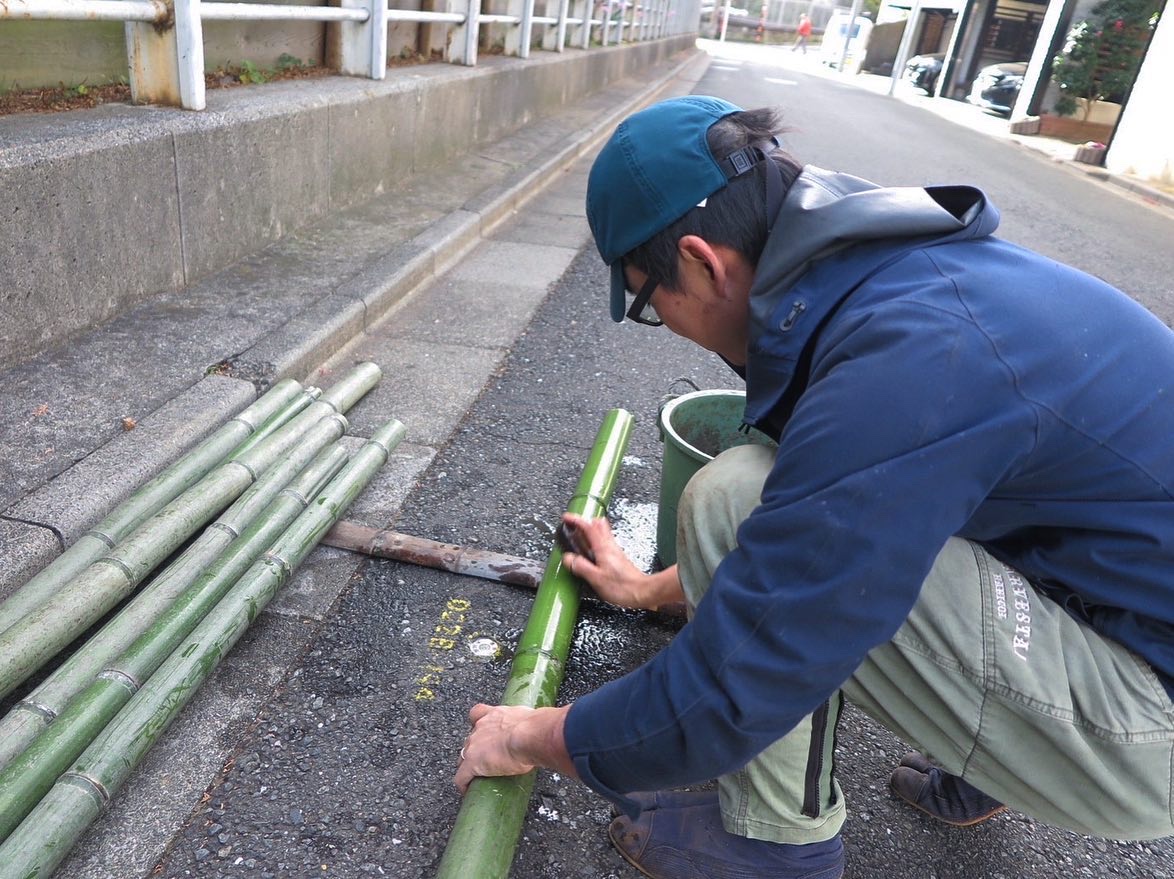
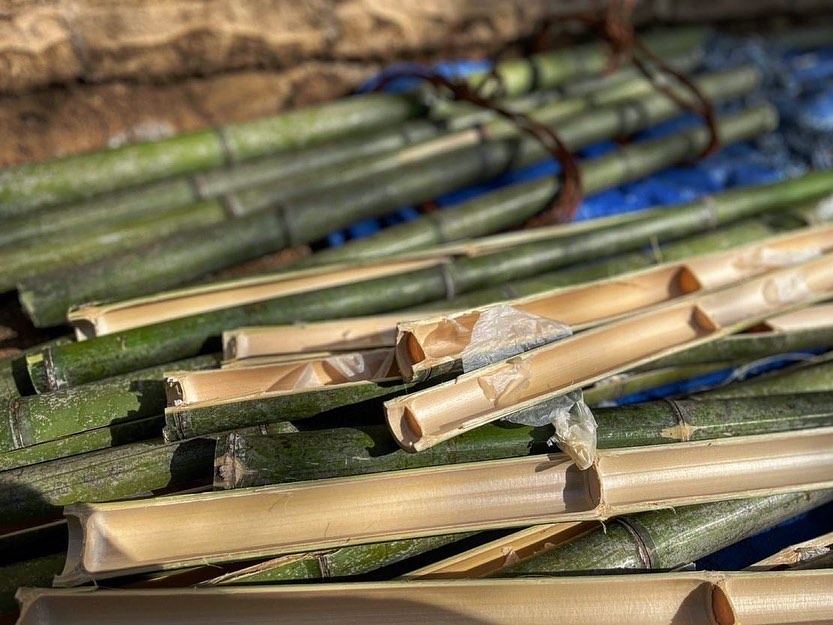
The upright strips are not whole culms. At Shūgakuin they are bamboo split in four lengthwise. Splitting does two things. It turns a round pole into narrower strips that can be set side by side, and it multiplies the material, since one culm gives several strips.
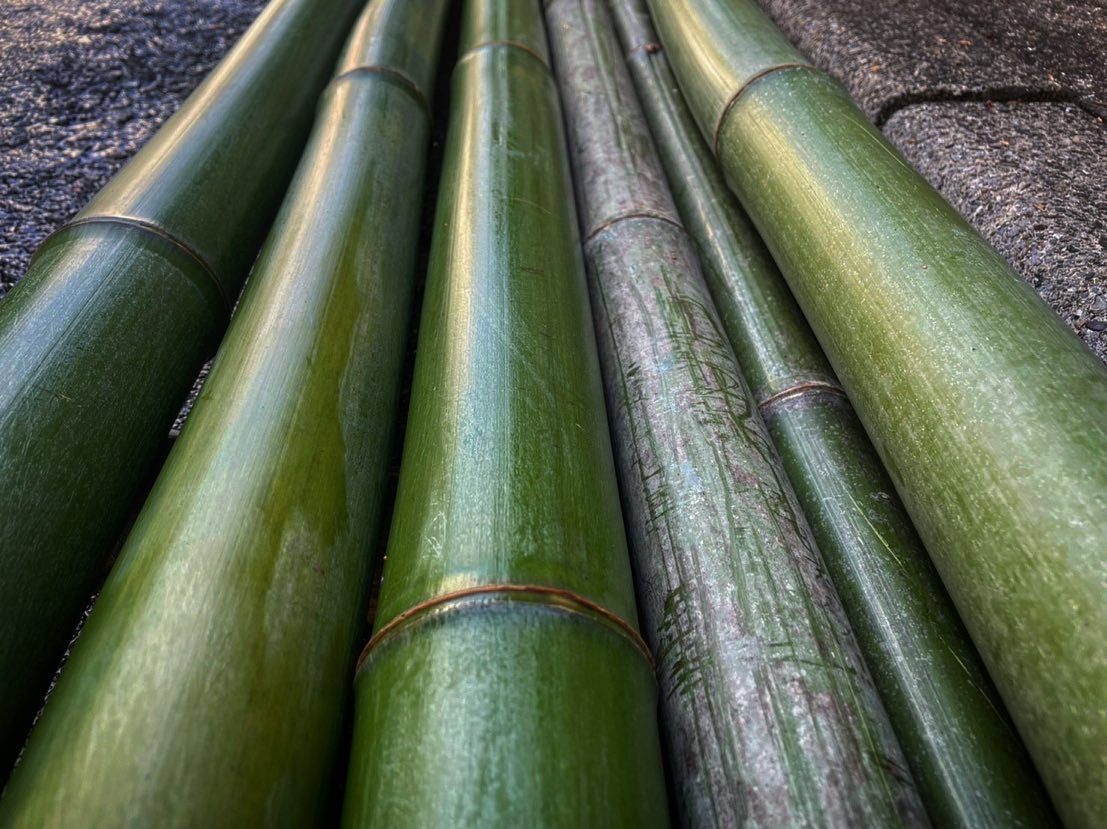
In the work photographed here, splitting is a ground-level job: the culm lies on a sheet or on the paving beside the site and is opened along its length. In the finished fence the strips keep the natural curve of the culm, green skin facing out. A 2011 report from Gifu Women’s University describes the uprights for its Kenninji-gaki being made from bamboo cut to 1.8 m.
Nodes that do not line up
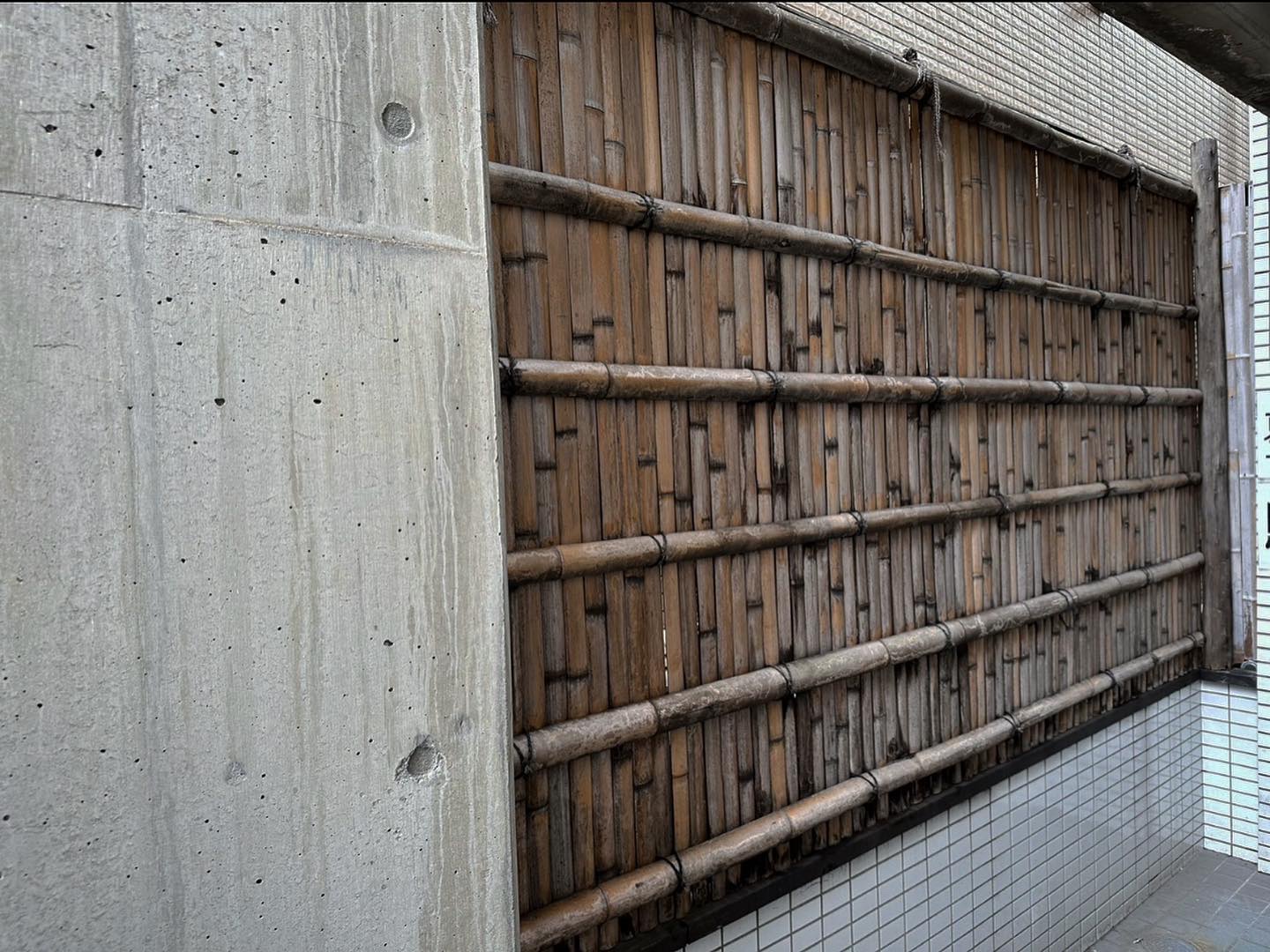
Look closely at the finished panel at the top of this article. Because the strips come from different culms and different heights along each culm, the nodes scatter across the panel rather than lining up in rows. That irregular pattern is part of the fence’s look.
What we could not confirm
We found no national standard for the width of the strips, the height of the fence, the spacing of posts or the number of rails in the public specifications we could open. The numbers in this article come from individual builds.
The Frame — Posts, Rails, and Where the Metal Goes
Setting out the frame
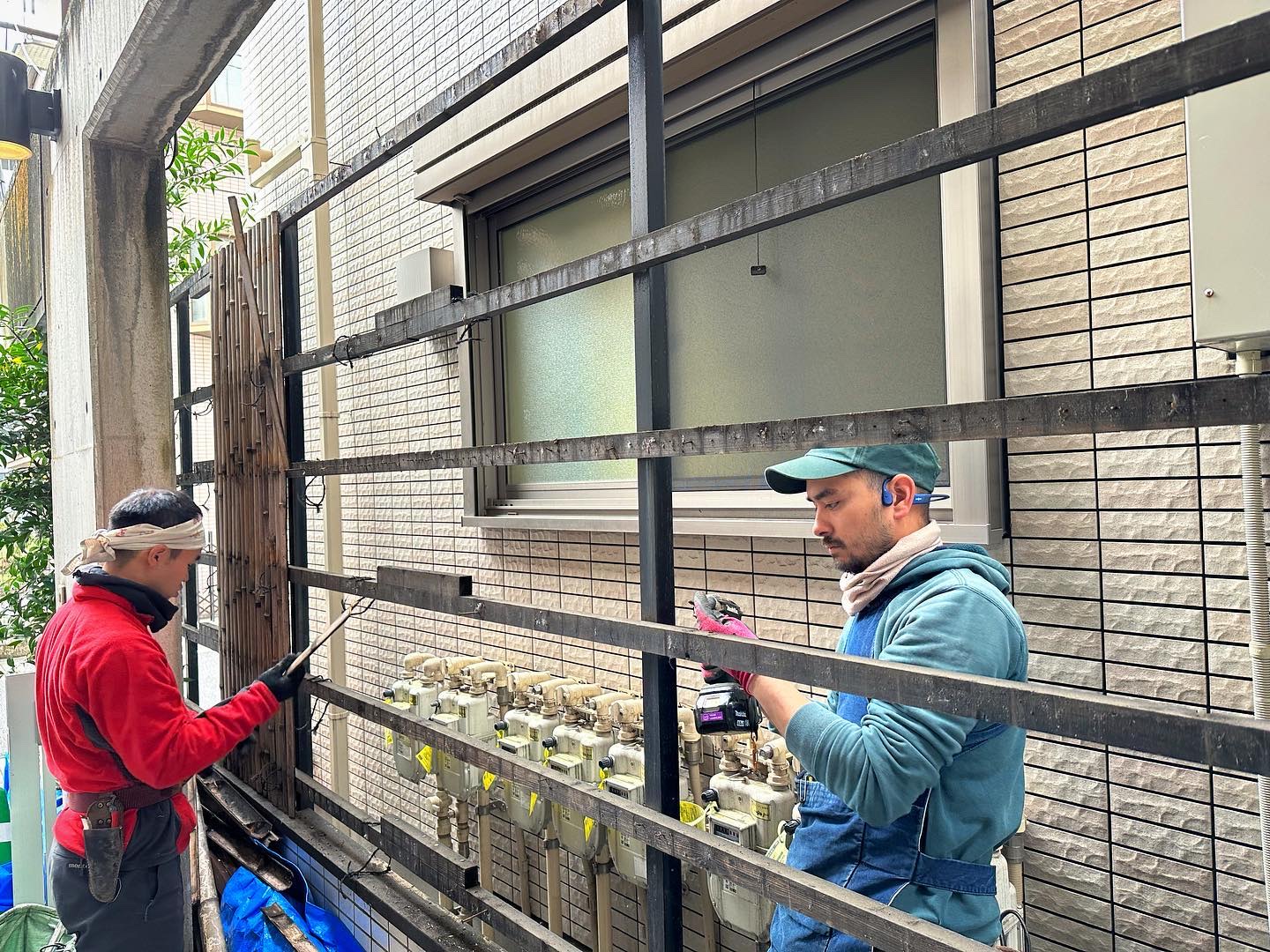
The frame comes first. In the Gifu Women’s University build described in that university’s 2011 bulletin, intermediate posts were set at 1.8 m spacing and timber rails fixed at 30 cm intervals, five rows high. A 2025 school build at Kamo Agricultural and Forestry High School used three rails. The documented builds simply differ; neither is presented as a standard.
The question of nails
“Built without a single nail” is a phrase that needs care. The sources we checked show rope tying the pressing bars on the face of the fence. They do not show that the whole fence, frame included, is free of metal.
| Joint | Kenninji-gaki sources | Related sources (other fence types) |
|---|---|---|
| Pressing bar → rail | Tied with shuro rope, using a lacing needle (Tokyo teacher-recruitment exam); tied with a nejire-ibo knot (Saitama school build) | — |
| Upright strip → rail | Screwed to the 3rd and 5th rails (Gifu Women’s University, 2011); held with a unokubi knot (Kamo, 2025); bound with shuro rope (Saitama school build) | — |
| Rail → post | Not confirmed in the sources we could open | Nailed to log posts in the 2021 grade-2 national exam (Yotsume-gaki); iron nails at the Sentō Imperial Palace repair (Yotsume-gaki) |
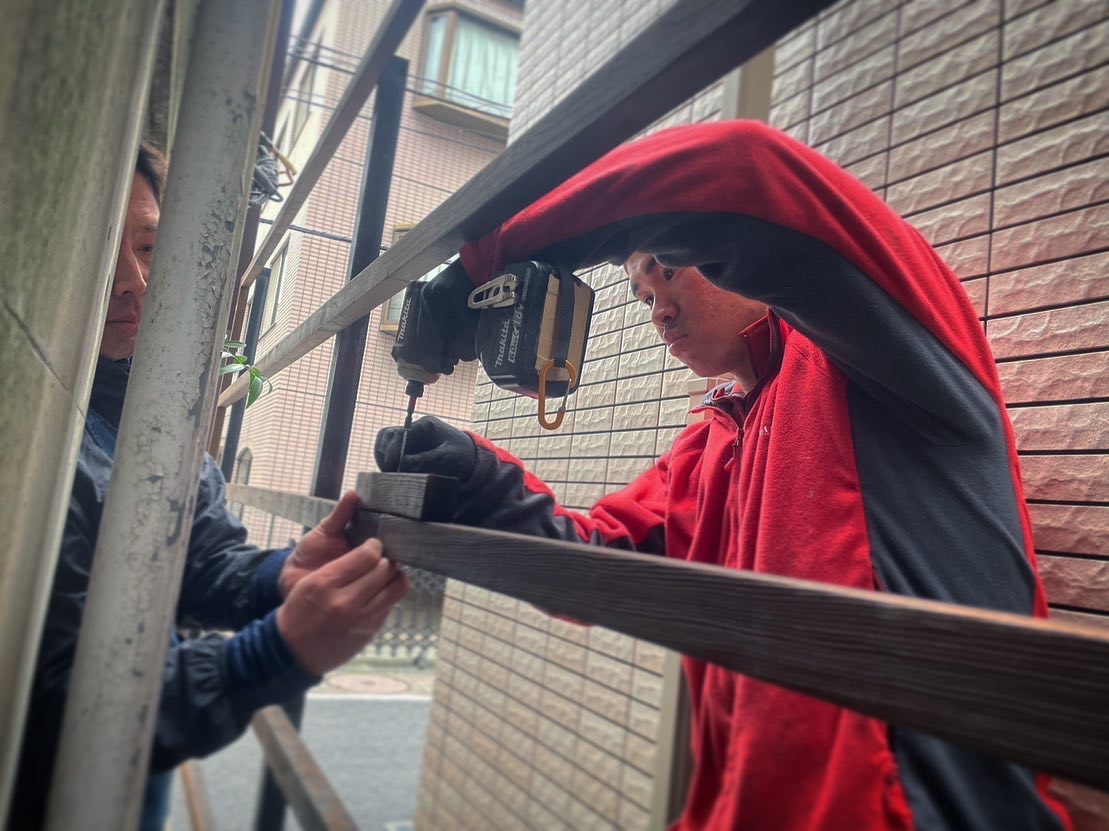
Every source that describes the pressing-bar joint describes a rope tie. The other joints vary: one university build screwed the upright strips to two of the rails, while for the related Yotsume-gaki both the national exam specification and an Imperial Household Agency repair at the Sentō Imperial Palace in Kyoto record nails at the rail-to-post joint. For the Kenninji rail-to-post joint itself, we found no primary source either way.
Why the distinction matters
The visible ties tell you how the pressing bars are held. They do not prove how the rest of the fence is held. For a reader who wants to build or commission one, the useful summary is: the pressing bars are rope-tied in every source we found; the upright strips may be tied or screwed; the rail-to-post joint should be asked about.
Tying the Fence — Rope, Needle and Knot
Shuro rope
The rope is shuro-nawa (棕櫚縄), palm-fibre rope. The Imperial Household Agency describes the Shūgakuin fence as tied with it. In the fences photographed here the rope is black, which makes each knot stand out against the green culms. We could not confirm from a primary source the exact relationship between black “dyed rope” (染縄, some-nawa) and shuro rope, so we describe only what the sources state: shuro rope.
Through the fence with a needle
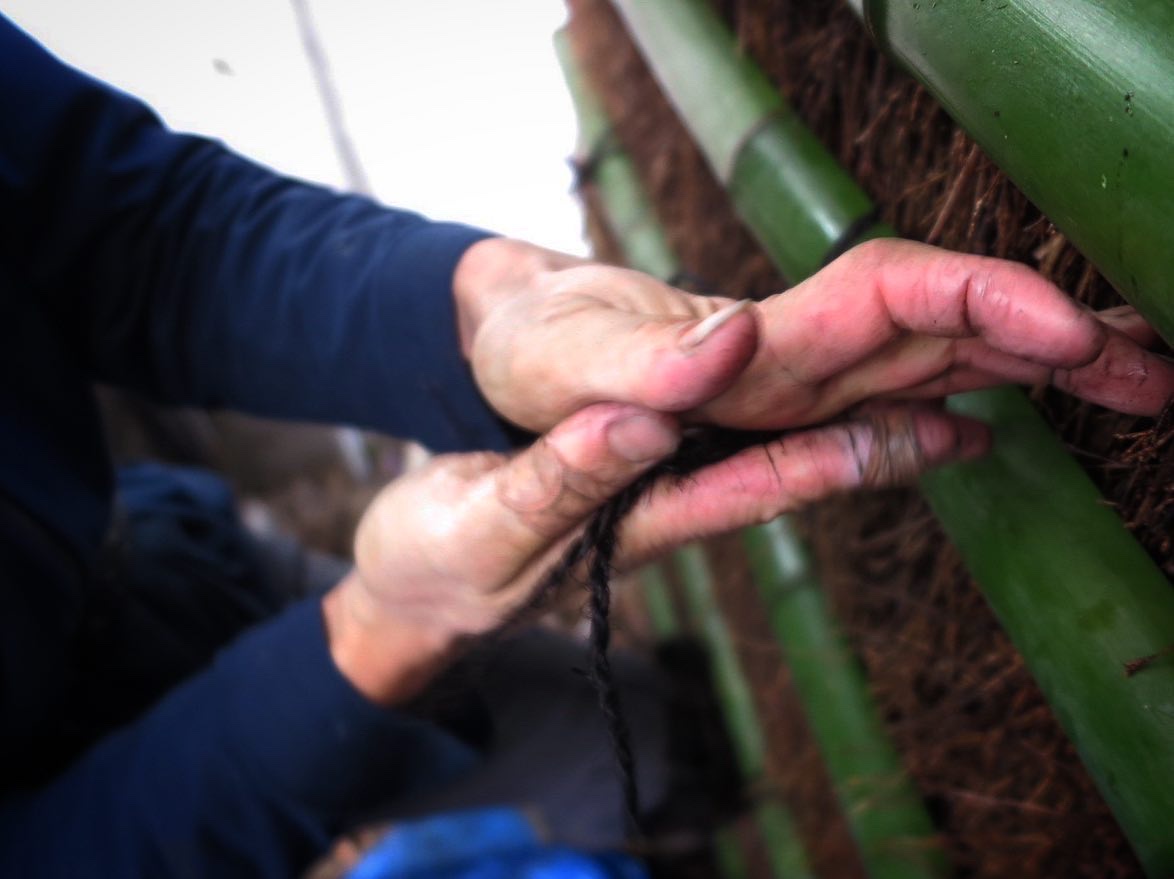
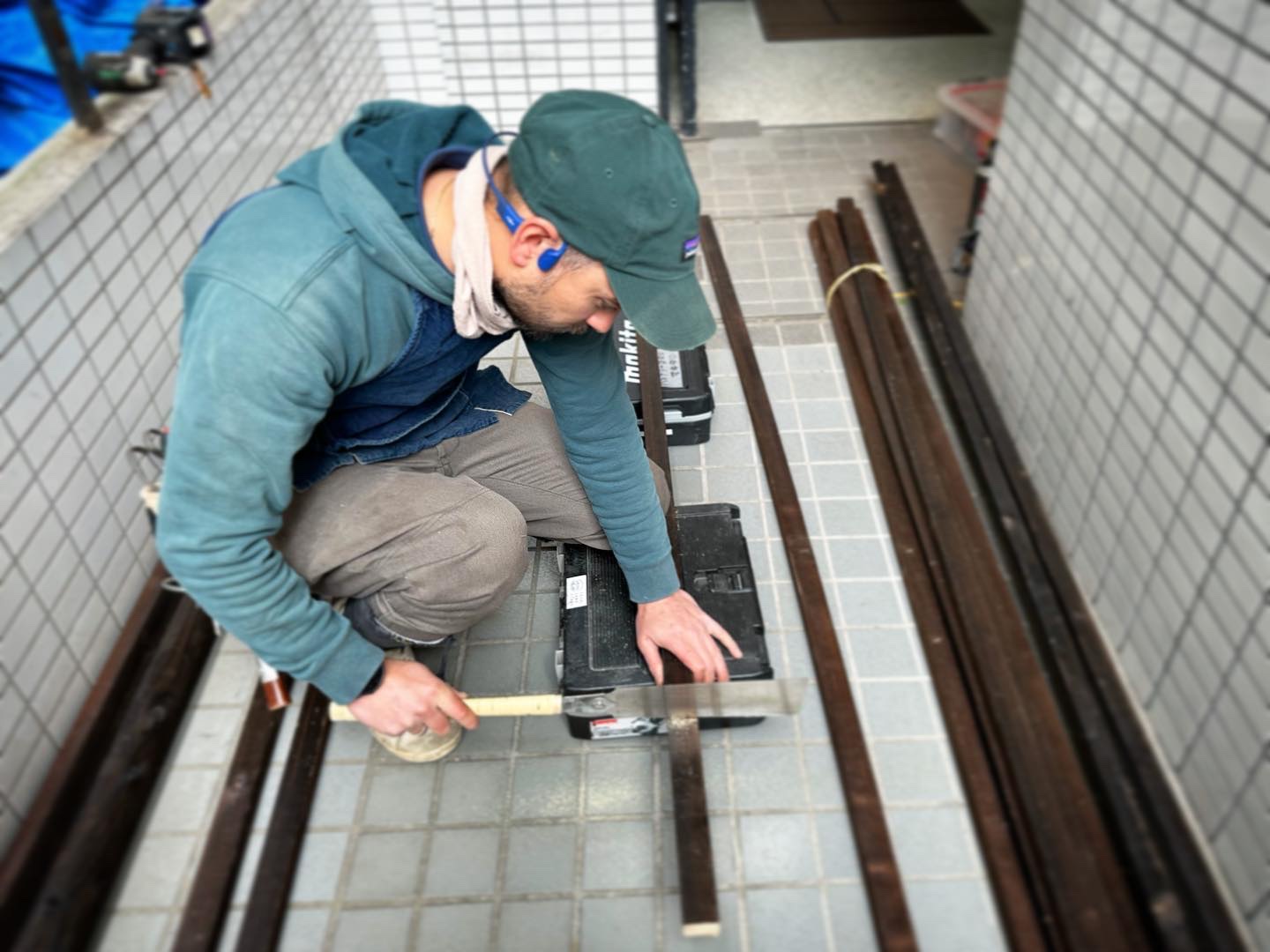
Each tie joins a bar on the front of the fence to a rail at the back. A question in Tokyo’s 2021 teacher-recruitment examination for agriculture teachers sets out the step in which the pressing bars are bound with shuro rope using a kuri-bari (くり針), a lacing needle.
Which knot goes where
The documented builds name the knots they used. These are individual builds, not a fixed rule.
| Position | Knot | Source |
|---|---|---|
| Pressing bars (Kenninji-gaki) | Nejire-ibo-musubi (ねじれいぼ結び), a twisted ibo knot | Saitama Sugito Agricultural High School, 2022 |
| Coping (Kenninji-gaki) | Kazari-musubi (飾り結び), a decorative knot | Same build |
| Upright strips (Kenninji-gaki) | Unokubi-musubi (うの首結び) | Kamo Agricultural and Forestry High School, 2025 |
| Upright-to-rail crossings, 2nd and 4th rails (Yotsume-gaki) | Otoko-musubi (男結び) | Imperial Household Agency, Sentō Imperial Palace repair |
| Upright-to-rail crossings, 1st and 3rd rails (Yotsume-gaki) | Kaizuru (かいづる, a wrapping tie) | Same repair |
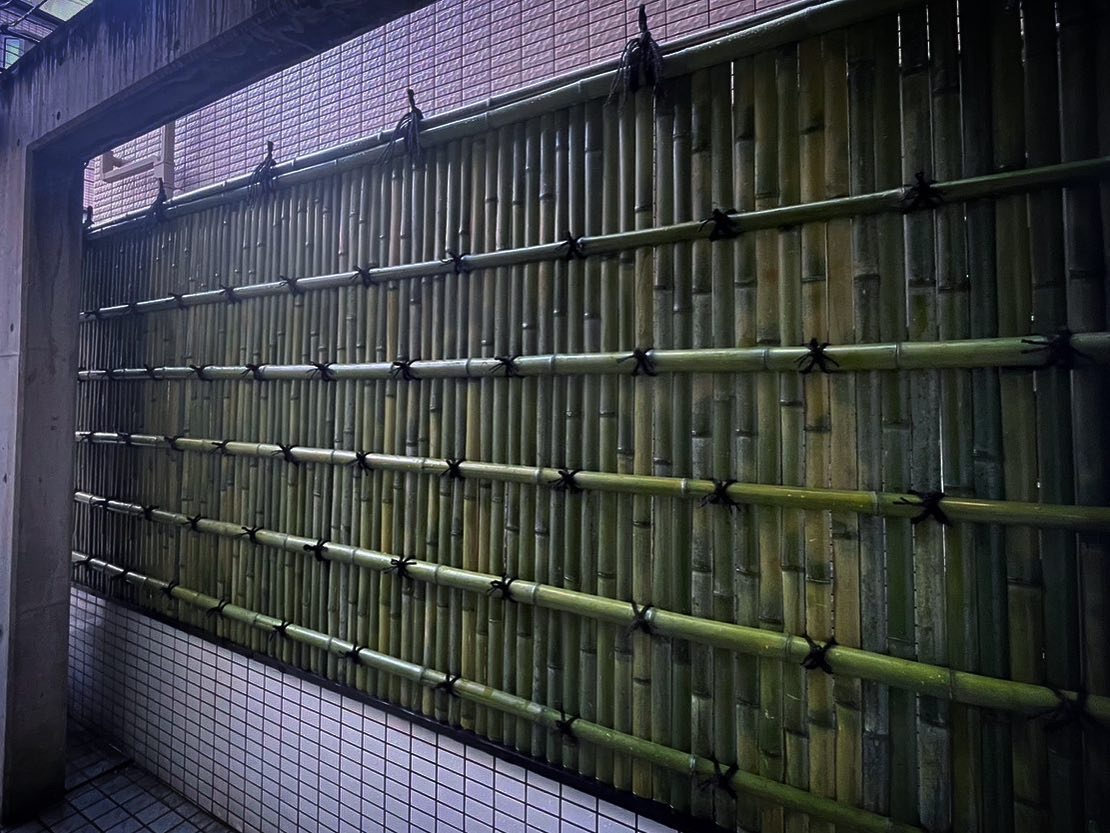
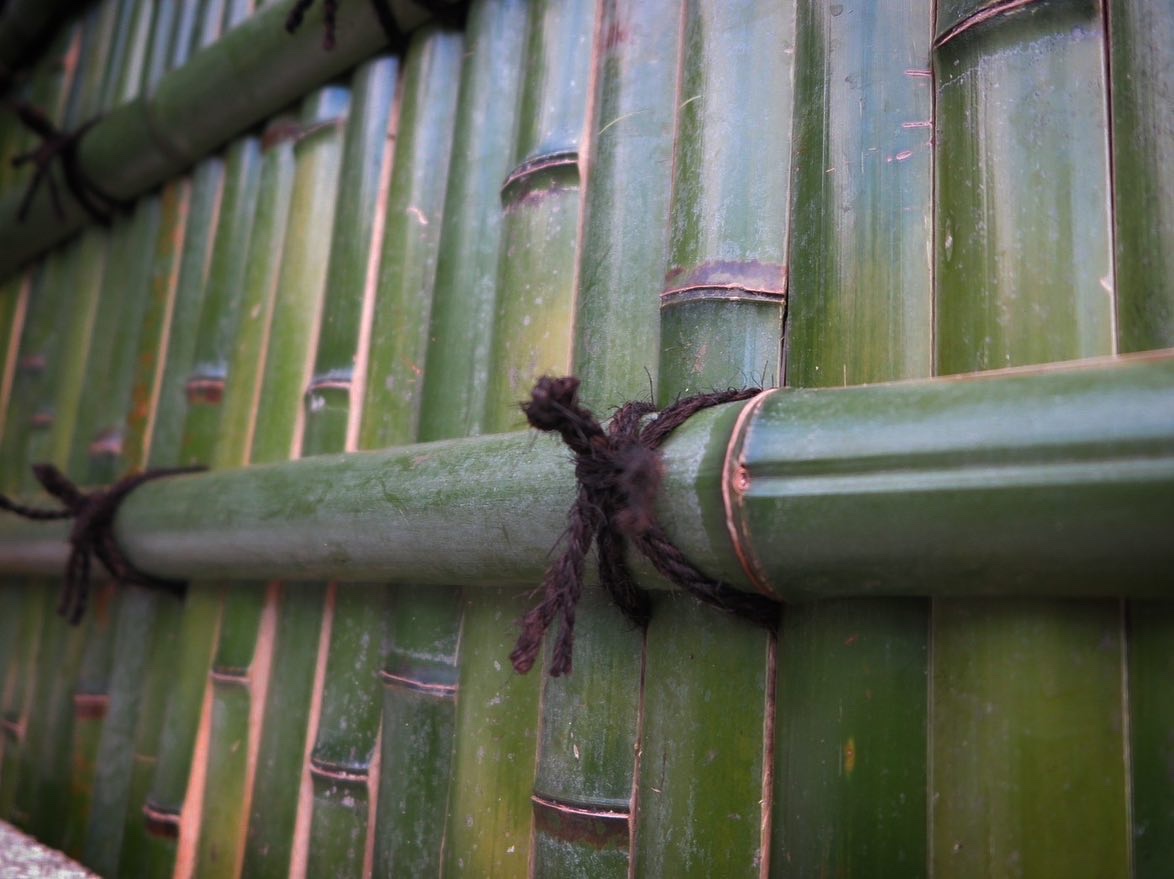
In the photographs, each tie on a pressing bar shows as a small black cross with two short tails, which is why a finished Kenninji-gaki looks studded with knots from a distance.
Rope and Renewal — What the Ties Make Possible
A joint you can see
Why does rope survive on the face of the fence when screws exist? The sources we found do not answer that question directly, and we do not want to invent a tradition for it. What they do show is consistent: wherever a source describes the pressing bars, it describes them tied with shuro rope, and the ties are left exposed as part of the fence’s appearance. On a Kenninji-gaki the joint is also the ornament.
Renewal is expected
What the sources also show is that bamboo fences are expected to be renewed; the next section gives the figures. Working on a cycle of renewal is familiar elsewhere in Japanese tree work — loosely comparable, as an idea rather than a method, to the repeated harvests of daisugi.
How Long Does It Last? — Rot, Repair and Replacement
The numbers in the sources
No source we found gives a standard lifespan for Kenninji-gaki on its own. The figures that exist are for bamboo work in general or for other fence types:
| Source | What it says | Applies to |
|---|---|---|
| Teraishi and Inoue, Landscape Research 87(2) | Bamboo needs replacing every few years, or at longest every ten | Bamboo fences and bamboo work in general |
| Mukō City, 2024 | About 4 years | Take-ho-gaki (竹穂垣, bamboo-branch fence) |
| Mukō City, 2024 | About 10 years | Fukada-gaki (深田垣) |
| Imperial Household Agency | Decay in the uprights and posts four years after the previous repair | A Yotsume-gaki at the Sentō Imperial Palace |
So there is no single answer for Kenninji-gaki. The one general figure we found — every few years, ten at the longest — comes from a report on bamboo work as a whole.
Where it fails first
Matsue City’s conservation plan for the Kanden-an tea house names decay from damp as a problem for both its bamboo-branch and Kenninji fences. At the Sentō Imperial Palace, the Imperial Household Agency found decay in both the uprights and the posts of a Yotsume-gaki four years after its previous repair — the screen and the frame can both fail.
Four Claims to Check — What the Sources Do Not Support
Kenninji-gaki is easy to romanticise. Here are four claims that the sources we checked do not support as stated.
“It uses no nails at all”
The pressing bars are tied, and they are the part visitors see. Behind them, a university build screwed its upright strips to two of the five rails, and the national exam specification for the related Yotsume-gaki calls for rails nailed to log posts. If you are commissioning or building one, ask how the strips and the frame will be fixed.
“It lasts for decades”
The sources we found do not support it. The garden-construction report we cite describes bamboo work in general as needing replacement every few years, ten at the longest; Mukō City gives about 4 years for one bamboo-branch fence and about 10 for another fence type. None of them gives decades.
“There is one correct size”
We found no national standard for the height, post spacing, number of rails or width of the strips. The builds we could document differ: one with five rails at 30 cm intervals, another with three.
“Autumn-cut bamboo will not be eaten by insects”
Late-autumn cutting is the recommended practice, and one study found no starch and almost no beetle damage in November-cut Madake. That is a good reason to cut in autumn. It is not a guarantee. The study tested one bamboo, from one region, against one beetle, and the Forestry Agency frames its advice as general, varying with species and use.
Kenninji-gaki and Its Relatives — Screen or See-Through
Yotsume-gaki: the lattice
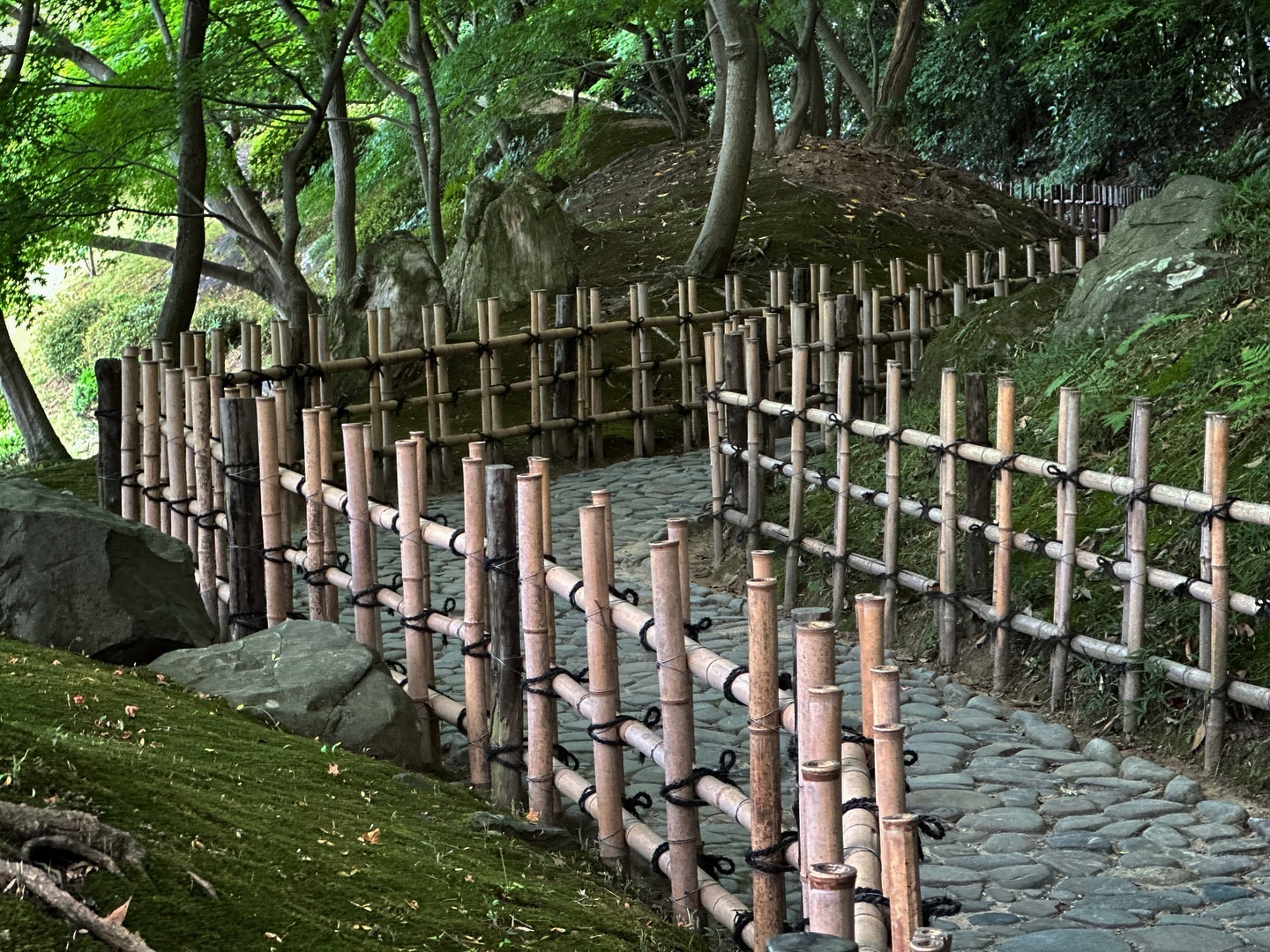
Yotsume-gaki (四つ目垣) is the representative open bamboo fence. The Nara institute defines it as “a lattice made with round bamboo.” Where Kenninji-gaki uses split strips packed tight, Yotsume-gaki uses whole round culms crossed at wide intervals, so that the planting behind it stays in view.
Kōetsu-gaki and the many others
Kyoto’s official tourism site describes the unusual bamboo fence around the tea house Taikyo-an at Kōetsuji temple as the Kōetsu-gaki (光悦垣). It is one of many named fences. Mukō City’s bamboo path alone shows eight kinds of bamboo fence. Choosing among them is a design decision. A gardener asks first whether the fence must hide something or frame it, then chooses the type. A screen can do for a small garden what shakkei, borrowed scenery, does for a large one: it decides what the visitor is allowed to see.
A Test Piece for Japanese Gardeners
Bamboo fences in the national skills exam
Kenninji-gaki is not only a garden feature. It is a test of craft. In the national landscape-gardening skills test (造園技能検定), the Japan Vocational Ability Development Association’s FY2026 (Reiwa 8) outline lists “bamboo fence construction” (竹垣製作) in the practical test for grades 1 and 3, and “Yotsume-gaki construction” for grade 2. The outline does not name the fence type for grades 1 and 3. Saitama Prefecture’s FY2026 training programme for gardeners, however, lists Kenninji-gaki as its practice piece for the grade-1 level and Yotsume-gaki for grade 2.
Why a fence makes a good test — our view
The official outline names the task, not the marking. Our own view is that a bamboo fence suits a test because its faults are visible: a crooked strip or a bar out of level shows across the whole panel, with no finish to hide it.
Compared With British Fencing — Woven, Laid and Tied
Wattle hurdles
Britain has its own tradition of fences made by hand from cut stems. The Museum of English Rural Life at the University of Reading describes wattle hurdles as “usually made from hazel rods which are cut on a 5 to 7-year rotation,” with the basic hurdle woven around ten uprights, or zales. Japanese fence bamboo is also chosen by age — three to five years, in the Forestry Agency’s guidance. The difference is in the joint: a hurdle is woven around its uprights, while a Kenninji-gaki is tied, with bars pressing the upright strips against rails.
Hedge laying
Hedge laying is a different idea again. A UK council guide to hedgerow management describes partially cutting a stem at the base so that it can be laid, yet still continue to grow. It is a living barrier. A Kenninji-gaki is cut material, renewed by replacement.
None of these is better than the others; they start from different materials and different expectations of upkeep, much like Japanese niwaki and Western topiary.
Frequently asked questions
What is Kenninji-gaki?
Kenninji-gaki (建仁寺垣) is a solid Japanese bamboo screen fence. Split bamboo strips stand upright, edge to edge, against horizontal rails, and split-bamboo bars across the front are tied through to the rails with palm-fibre rope. A split-bamboo cap covers the top.
Is a Kenninji fence really built without nails?
Not as a rule. The sources we checked show that the pressing bars on the face are tied with rope. Some documented builds screw the upright strips to rails, and the related Yotsume-gaki is nailed at the rail-to-post joint in the national exam specification. The visible face is rope-tied; the hidden frame may use metal.
Why is it called Kenninji-gaki?
The Nara National Research Institute for Cultural Properties says the fence is named after one at Kenninji temple in Kyoto. The temple’s official guide still points to a Kenninji-gaki on the west side of its tea house Tōyōbō.
How long does a Kenninji bamboo fence last?
No source gives a standard lifespan for Kenninji-gaki alone. A garden-construction report says bamboo work needs replacing every few years, or at longest every ten. Matsue City lists damp-related decay among the maintenance problems of bamboo fences.
When should bamboo for a fence be cut?
Japan’s Forestry Agency recommends late autumn to early winter for bamboo used as material, generally, and — depending on the species and the use — culms three to five years old. A forestry-association guide adds that insects and mould are less active in the cold season.
What is the difference between Kenninji-gaki and Yotsume-gaki?
Kenninji-gaki is a screening fence that blocks the view. Yotsume-gaki is a see-through lattice of round bamboo that frames the garden behind it.
Sources
– Imperial Household Agency, 建仁寺垣―修学院離宮 — https://kyoto-gosho.kunaicho.go.jp/garden-detail/4D98 (checked 2026-11-06) – Imperial Household Agency, 京都大宮仙洞御所垣根改修その他工事, p. 62 — https://kyoto-gosho.kunaicho.go.jp/api/reports/b08cf0738f744ed7a48d1dbd9481d55a/file (checked 2026-11-06) – Nara National Research Institute for Cultural Properties, Japanese Garden Dictionary: Kenninji fence — https://www.nabunken.go.jp/org/bunka/jgd/pages/KenninjiFence.html ; Tateko — https://www.nabunken.go.jp/org/bunka/jgd/pages/VerticalFenceMembers.html ; Tamabuchi — https://www.nabunken.go.jp/org/bunka/jgd/pages/TamabuchiCoping.html ; Yotsume-gaki — https://www.nabunken.go.jp/org/bunka/jgd/pages/BambooLatticeFence.html (checked 2026-11-06) – Kenninji temple, official guide to the precincts — https://www.kenninji.jp/around/ (checked 2026-11-06) – Kyoto University Rare Materials Digital Archive, 石組園生八重垣伝 — https://rmda.kulib.kyoto-u.ac.jp/item/rb00012327 (checked 2026-11-06) – 寺石隆一・井上花子, 竹の仕事, Landscape Research (ランドスケープ研究) 87(2), pp. 128–129 — https://www.jstage.jst.go.jp/article/jila/87/2/87_128/_pdf (checked 2026-11-06) – 森雅治ほか, ものづくり協働プロジェクトの試みと展望, Bulletin of Gifu Women’s University 40, 2011, p. 15 — https://gijodai.jp/library/file/kiyo2011/masaharu_mori.pdf (checked 2026-11-06) – Gifu Prefectural Kamo Agricultural and Forestry High School, 2年生建仁寺垣の製作, February 2025 — https://school.gifu-net.ed.jp/kamo-ahs/gakka/e/pdf/R7.2.18%20kennninnzi.pdf (checked 2026-11-06) – Saitama Prefectural Sugito Agricultural High School, 建仁寺垣の施工, 30 June 2022 — https://sugito-ah.spec.ed.jp/blogs/blog_entries/index/page:3/limit:100?frame_id=45 (checked 2026-11-06) – Tokyo Metropolitan Board of Education, FY2021 teacher-recruitment exam, agriculture, p. 28 — https://www.kyoinsaiyopr.metro.tokyo.lg.jp/pdf/exam-r3/mondai26.pdf (checked 2026-11-06) – Shiga Vocational Ability Development Association, FY2021 grade-2 landscape gardening practical test — https://shiga-nokaikyo.or.jp/cms/wp-content/uploads/2022/04/%E4%BB%A4%E5%92%8C3%E5%B9%B4%E5%BA%A6_%E6%8A%80%E8%83%BD%E6%A4%9C%E5%AE%9A2%E7%B4%9A_%E9%80%A0%E5%9C%92_%E5%AE%9F%E6%8A%80%E8%A9%A6%E9%A8%93%E5%95%8F%E9%A1%8C%E3%80%80.pdf (checked 2026-11-06) – Japan Vocational Ability Development Association, FY2026 practical test outline — https://www.javada.or.jp/jigyou/gino/giken/pdf/R08_zenki_jitsugi1.pdf (checked 2026-11-06) – Saitama Prefecture, 令和8年度造園技術研修実施要領 — https://www.pref.saitama.lg.jp/documents/24078/r8newestjissiyoryopdf.pdf (checked 2026-11-06) – Forestry Agency, 竹の性質 — https://www.rinya.maff.go.jp/j/tokuyou/take/seisitu.html (checked 2026-11-06) – Japan Forest Technology Association, 竹林利用の手引き 2018, p. 27 — https://www.jafta.or.jp/contents/jigyo_consulting/h30%283%29.pdf (checked 2026-11-06) – 二宮信治・小谷公人, Wood Preservation (木材保存) 28(4), 2002 — https://www.jstage.jst.go.jp/article/jwpa1975/28/4/28_4_135/_article/-char/ja/ (checked 2026-11-06) – 大村和香子, ヒラタキクイムシの謎, Wood Preservation 47(6), 2021, p. 293 — https://www.jstage.jst.go.jp/article/jwpa/47/6/47_293/_pdf (checked 2026-11-06) – Ministry of Land, Infrastructure, Transport and Tourism, Ōta River Office, マダケ — https://www.cgr.mlit.go.jp/ootagawa/Bio/plants/index086.htm (checked 2026-11-06) – Mukō City, Kōhō Mukō, March 2024, pp. 2–3 — https://www.city.muko.kyoto.jp/uploaded/attachment/16423.pdf (checked 2026-11-06) – Matsue City, 菅田庵 第4章 整備・活用, p. 64 — https://www.city.matsue.lg.jp/material/files/group/32/4shou.pdf (checked 2026-11-06) – Kyoto City official travel guide, 光悦寺 — https://ja.kyoto.travel/tourism/single01.php?category_id=7&tourism_id=279 (checked 2026-11-06) – University of Reading, Museum of English Rural Life, object 68/100 — https://www.reading.ac.uk/adlib/Details/collect/12334 (checked 2026-11-06) – Basingstoke and Deane Borough Council, Hedgerows — a guide to their management — https://www.basingstoke.gov.uk/hedgerows-guide (checked 2026-11-06)