

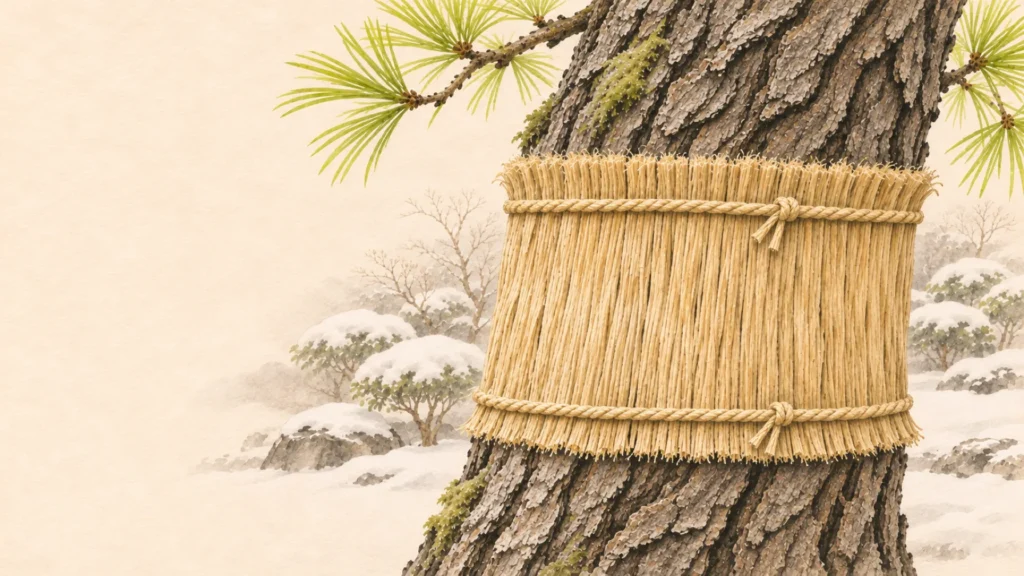
Komomaki — a straw mat tied around a pine trunk in autumn — does catch some pine-moth caterpillars, but at Himeji Castle they turned out to be a small share of what lived in the straw. Across five surveys of the mats from 2002 to 2006, spiders and resin assassin bugs made up 57% of the animals collected, while pine-moth larvae and other pests made up just 4%. The authors called the pest-control effect “slight”, and Himeji ended the custom in 2015.
Below: what komomaki is, the caterpillar it was designed for, what the Himeji mats held, why warm regions get less from it, and what a gardener can do with a straw belt today.
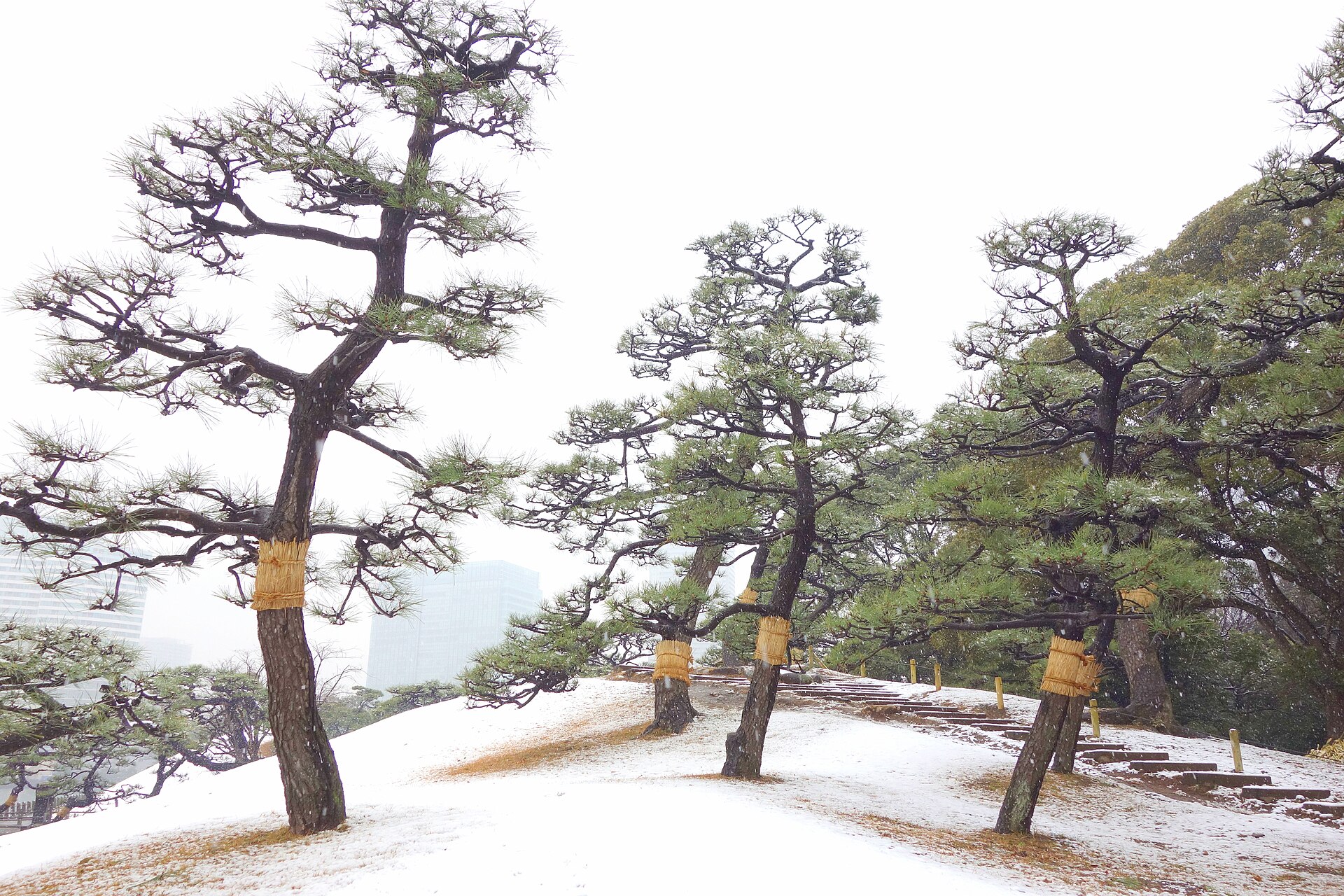
A Corner of Himeji Castle in March — Opening the Mats One by One
The ritual that was meant to end in fire
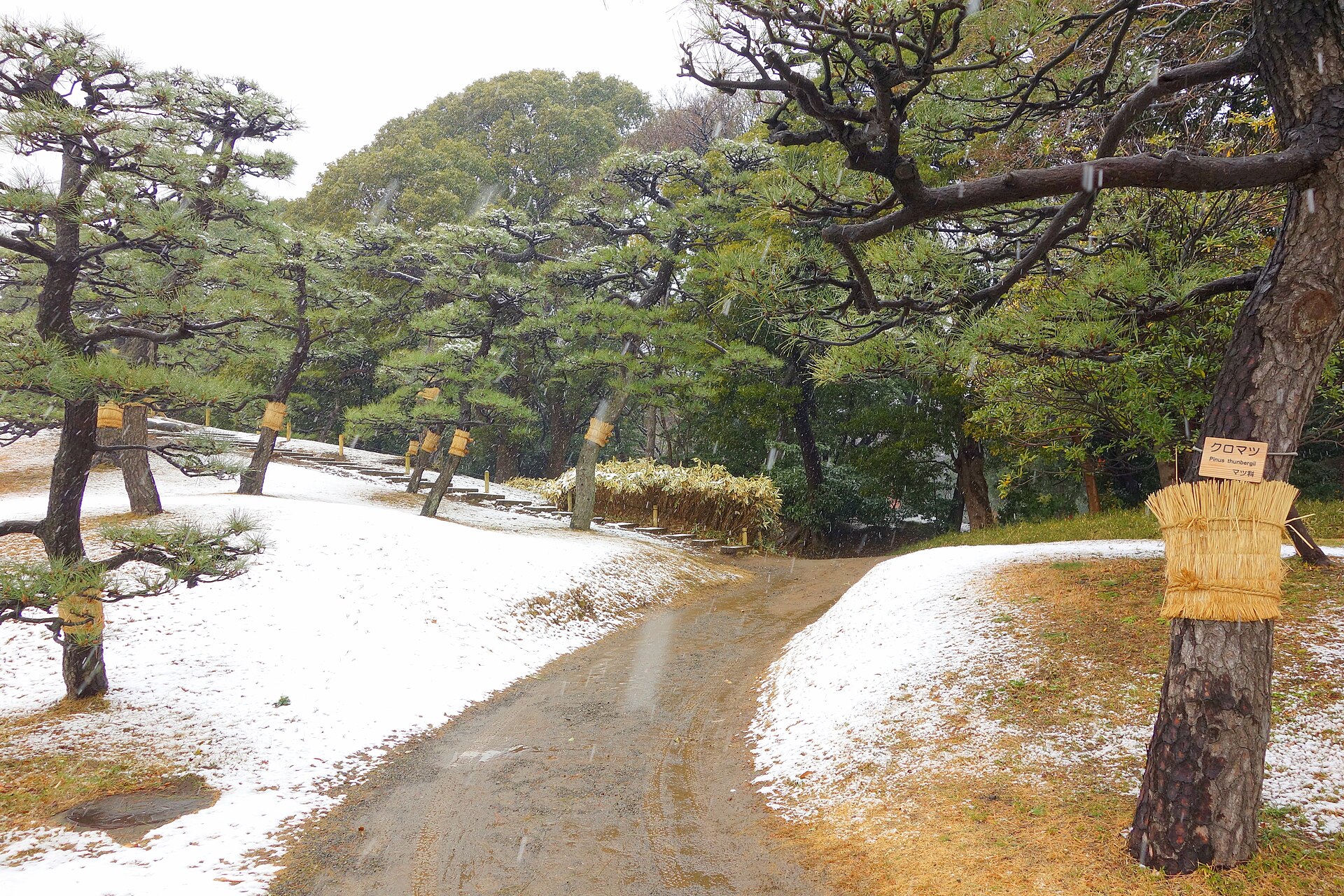
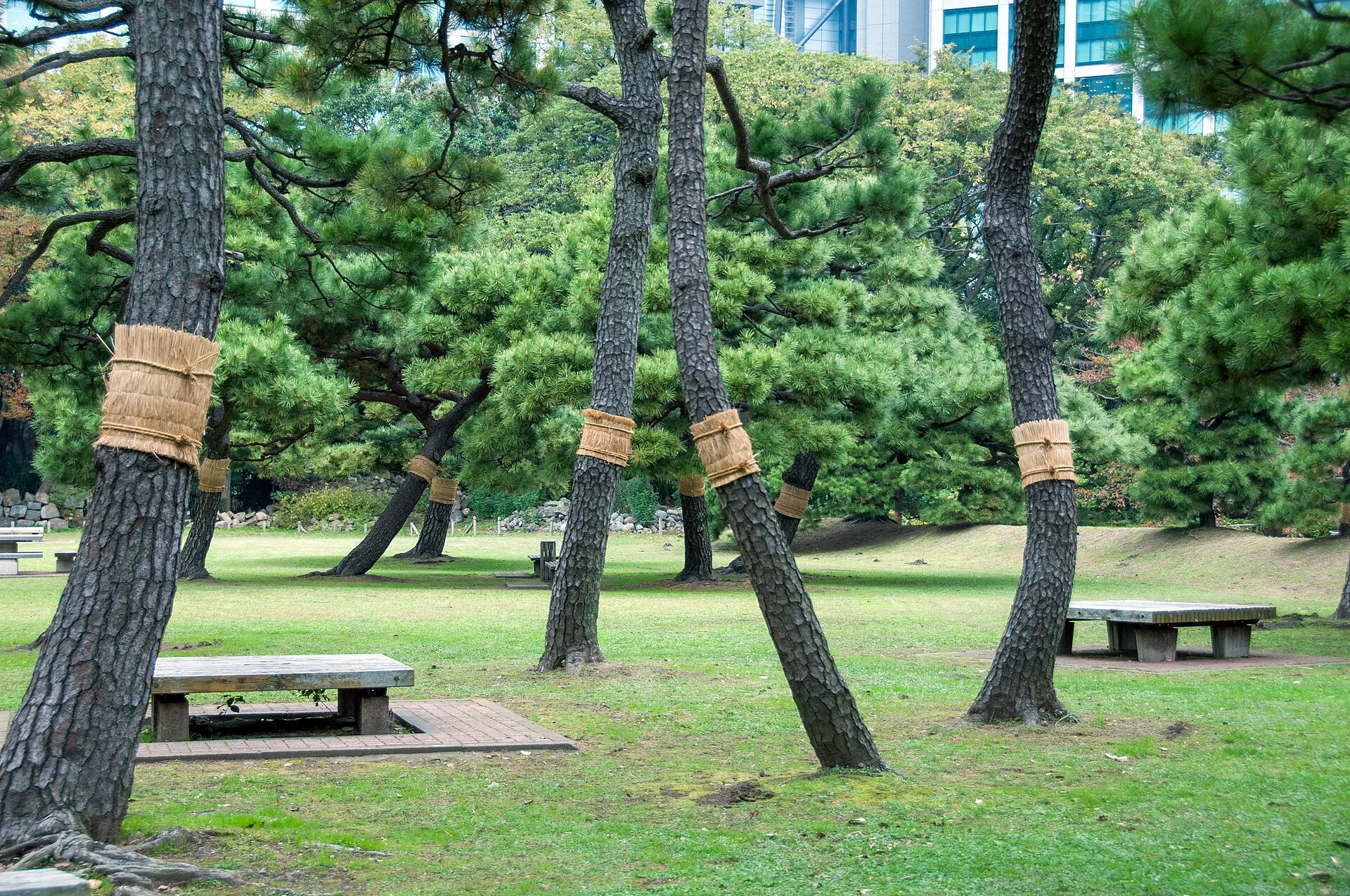
Picture the castle grounds at the beginning of March. For four months, since Rittō (立冬), the start of winter in the old calendar in early November, about 300 pines in and around Himeji Castle and the neighbouring Himeyama Park have worn a belt of straw. Now it is Keichitsu (啓蟄), the day in early March when, by tradition, insects wake from hibernation. Workers take the mats off the trunks.
The custom was meant to end in fire. In the words of the researchers who studied it, this was an event whose purpose was “to gather the pine’s pests in the mats over winter and burn the mats in early spring”. The burning — komo-yaki (菰焼き) — was the point. Whatever had crawled into the straw would go up with it.
What the researchers wanted to know
From 2002, the mats took a detour on their way to the fire. In a survey run every March by Chikako Niiho and three colleagues at Himeji Institute of Technology, the workers who collected the mats piled them in one corner of the castle grounds, sorted by where they had been collected. The researchers then went through them one mat at a time, picking out the animals inside as carefully as they could.
They wanted to answer a plain question: at Himeji, was komomaki “merely a seasonal sight”, or did it have at least some effect on pests? They presented the results to the 55th Annual Meeting of the Ecological Society of Japan in March 2008. Before we open the mats with them, it helps to look at the belt itself and the insect it was built for.
What Komomaki Is — A Straw Belt, a Rope, a Height
The mat
Komo (菰) is a coarse mat. The Digital Daijisen dictionary defines komomaki (菰巻き) as wrapping komo around the trunks of pines or cedars at the end of autumn, so that pests gather in it to overwinter, and then taking it off and burning it in early spring. In Hiroshima, the historic garden Shukkeien describes its komo simply as a mat “made of straw”.
The visual is unmistakable once you know it: a band of golden straw cinched around the trunk with rope, while the rest of the pine stays dark green above it.
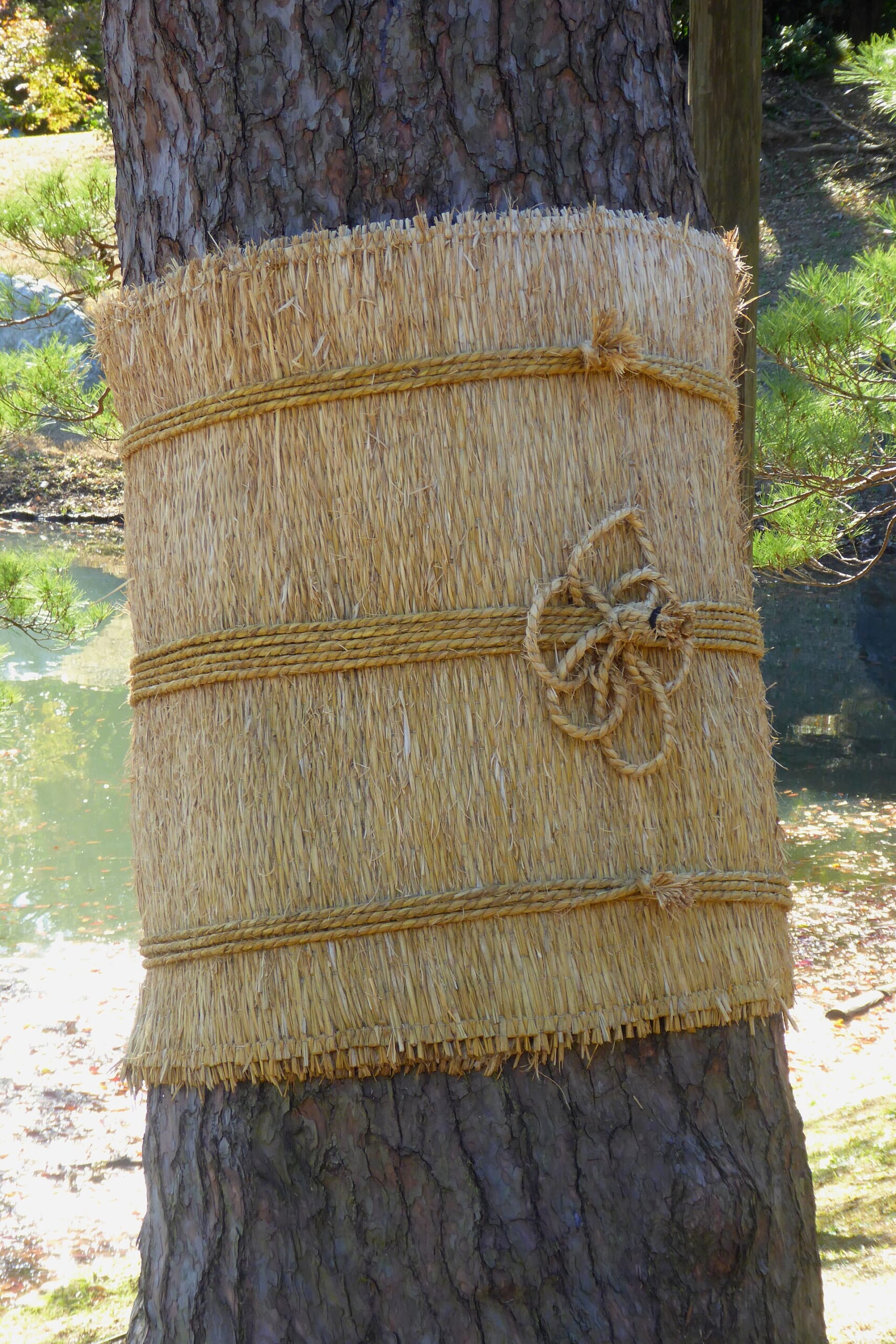
Where it goes on the trunk
The specifications we found differ from site to site, in useful ways. The dates and tree counts below are from published notices of planned work:
| Site | When | Height on trunk | Size of belt | Trees | Source |
|---|---|---|---|---|---|
| Shukkeien, Hiroshima | Sōkō (霜降), 23 October 2026 scheduled | 1.5–2 m (about 5–6.5 ft) above ground | 30–45 cm (12–18 in) wide, tied with rough rope | About 360 pines | Hiroshima Prefecture |
| Okayama Kōrakuen | Around mid-October each year; 14 October 2026 scheduled | Not stated | Not stated | About 240 pines | Okayama Kōrakuen |
| Hikari City beaches, Yamaguchi | 11 November 2025 scheduled, by schoolchildren | About 1.2 m (4 ft) | Not stated | 38 pines about 60 cm (24 in) or more in diameter | Hikari City |
| Himeji Castle (historical) | Rittō, early November | Not stated | Not stated | About 300 (study) / about 350 (city, as reported) | ESJ abstract; Hikari City Council |
The Himeji figures are two different counts — about 300 pines in the castle and Himeyama Park according to the researchers, about 350 black pines and other trees according to the city as quoted in a council inspection report — and the two may cover different areas or years.
Not a belly warmer
Visitors sometimes read the belt the wrong way. Kyoto City Zoo, which was wrapping the pines on its grounds in December 2016, wrote that the straw makes the pine look as if it is wearing a haramaki — a belly band — and that people sometimes mistake it for protection against cold. On a pine it is not. The confusion is understandable: Kyoto Botanical Gardens wraps its cycads in komo every December to protect them from cold, and Shukkeien explains that the same “komo wrapping” serves pest control on pines but cold protection on cycads.
The Caterpillar It Was Built For — Dendrolimus spectabilis
Matsukareha, the pine moth
The target is Matsukareha (マツカレハ), the pine moth Dendrolimus spectabilis. Its hairy caterpillars are called matsukemushi (マツケムシ), “pine hair-worms”, in Hikari City’s announcements. They feed on pine needles. According to the Forestry and Forest Products Research Institute’s Kyushu breeding office, young larvae feed in groups on just one side of the needles on new shoots, and once they grow they spread out and eat whole needles.
Hokkaido’s forestry research institute lists May–June and August–September as the feeding periods and notes that “damage in spring is severe”. The species can have one or two generations a year.
A year in the life of the pine moth
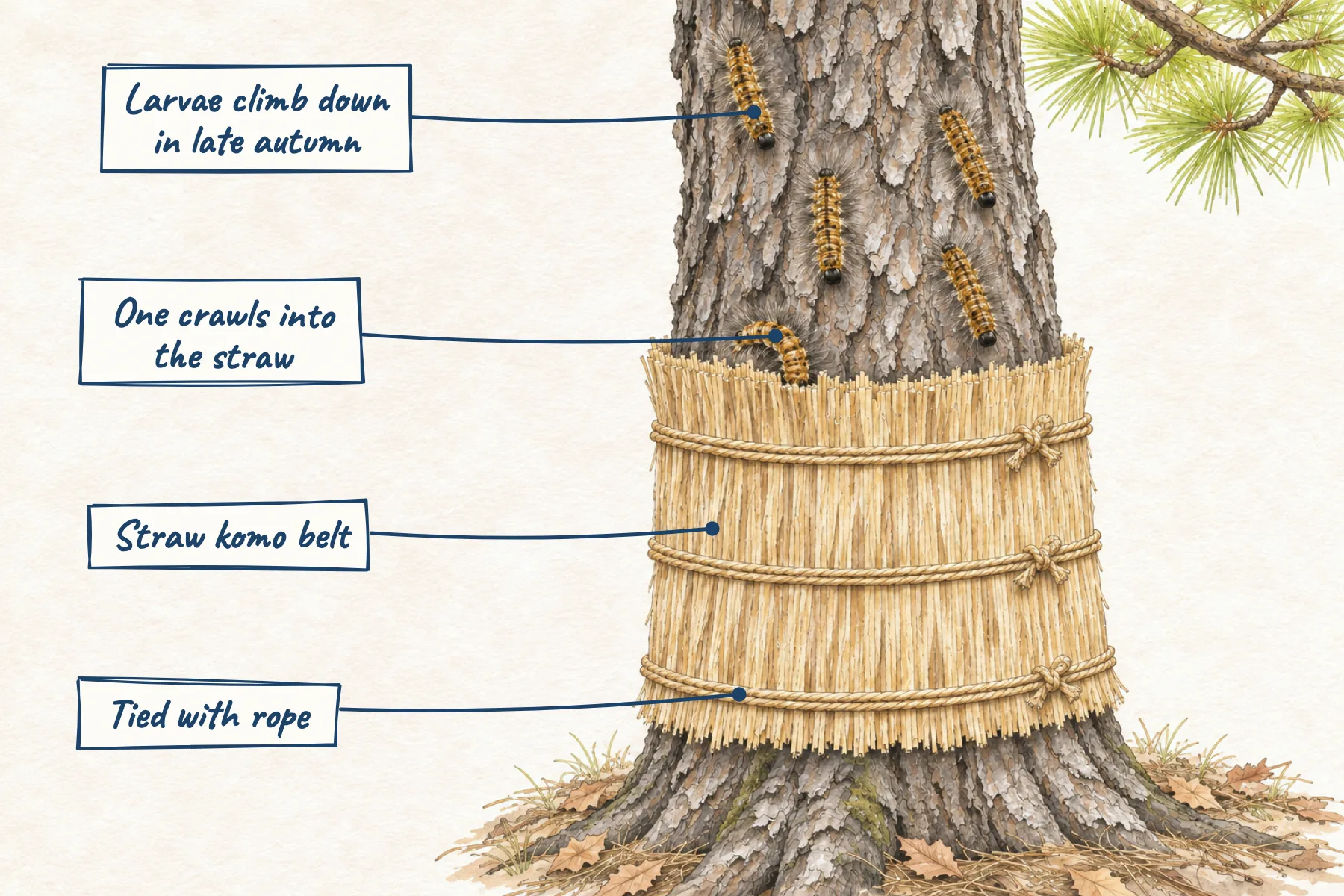
The whole idea of komomaki rests on one habit: the larvae leave the canopy to spend the winter low down.
| Season | What the larvae do | Source |
|---|---|---|
| Late October – early November | Climb down the trunk and crawl into gaps at the base of the tree, under fallen leaves and moss, to overwinter | Hokkaido Research Organization, Forestry Research Institute |
| Winter | Stay in their winter shelter (north) or, in warm regions, often stay in the canopy at the base of the needles | Hokkaido Research Organization; Fukuoka Prefecture |
| March – April | Climb back up into the tree and start eating needles again | FFPRI Kyushu Regional Breeding Office |
| May – June, August – September | Main feeding periods; spring damage is the most severe | Hokkaido Research Organization |
Why a straw belt should work
The logic is simple: give descending caterpillars a better crevice on the way down. Shukkeien’s notice puts it in one sentence: the garden uses “the habit of the pine moth larvae of coming down from the pine tree to the ground to overwinter”, ties straw on the trunk, and “lures the larvae in as a place to overwinter”. Then, in early March — “before the larvae return to the tree” — the mats come off and are disposed of together with the larvae.
On paper, it is a trap that costs only straw and labour and uses no pesticide. The question is what else finds that crevice attractive.
From Rittō to Keichitsu — A Pest Control Written in the Calendar
Rittō, Sōkō and a 15 °C rule
Komomaki is timed by the solar terms of Japan’s traditional calendar. The Himeji study describes the castle’s wrapping running “from Rittō in early November to Keichitsu in early March”, four months of winter. Hikari City uses the same window as its standard — “usually between Rittō and Keichitsu” — but adds a practical rule: start on a day when the daily mean temperature is around 15 °C (59 °F), based on the insect’s ecology.
Other gardens wrap earlier. Shukkeien chose Sōkō (霜降), “frost’s descent”, which fell on 23 October in 2026. Okayama Kōrakuen wraps “around mid-October every year”. This matters, because the Himeji authors noted that earlier reports had already pointed out “problems with timing”: a belt that goes on after the larvae have settled elsewhere may miss them.
Komo-yaki: burning in early March
At the other end of winter, the mats come down. Kōrakuen describes the whole cycle as an old-fashioned method: take the komo off the pines by Keichitsu, “when insects are said to start moving”, and burn it — komo-yaki — to burn away the pests. Hikari City takes its mats off “around early March” and incinerates them.
The fire is where the custom became a problem. If a mat holds mainly pests, burning it removes pests. If it holds mainly the pests’ natural enemies, burning it may kill them too.
An Edo-period method — as far as the record goes
How old is komomaki? Tokyo’s Bunkyō City describes it as a traditional pest-control method “said to have been carried out in daimyo gardens since the Edo period”, and Japan’s Forestry Agency calls it “a traditional Japanese control method continued since the Edo period”. Neither names a first garden or a first year, and we have not found a period document that does. At Himeji itself, the city’s own practice dates from the 1960s, according to the council inspection report.
What Came Out of the Himeji Mats — 2002 to 2007
Five surveys, one pattern
Back to the corner of the castle. The Himeji team was frank that their data were uneven: results varied with the number of people available, the weather and the working time on the day. But over five surveys up to 2006, a pattern held.
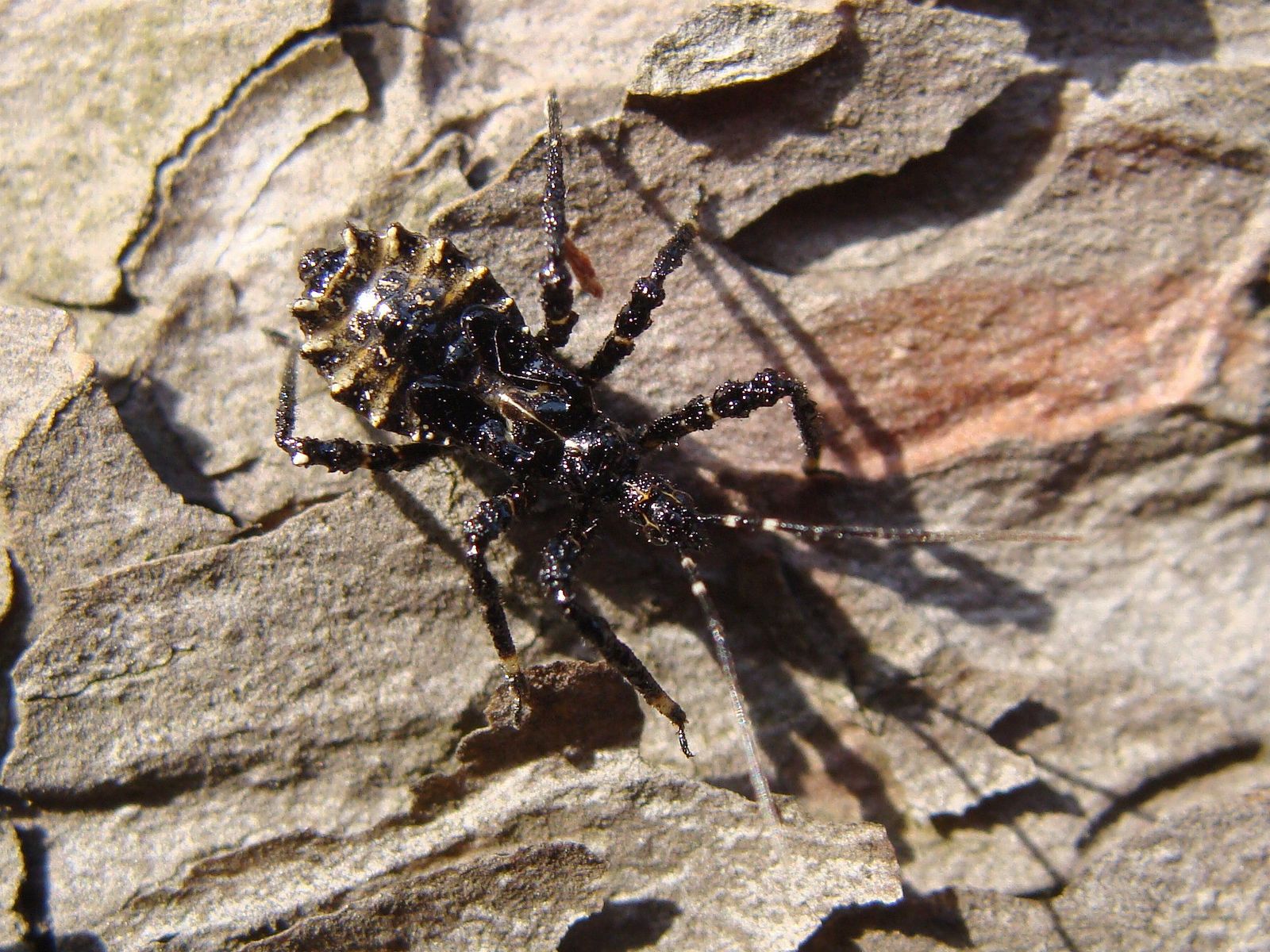
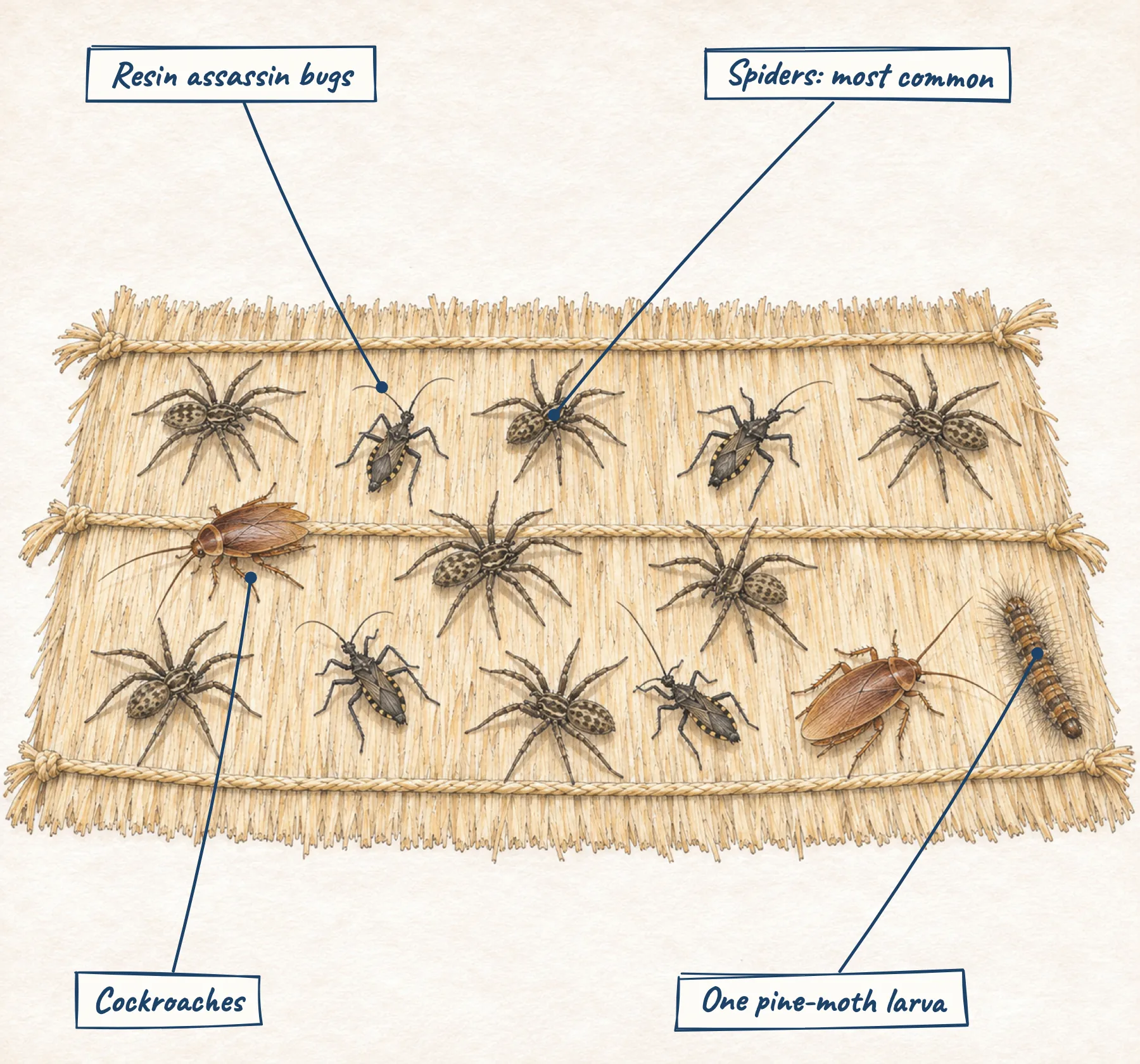
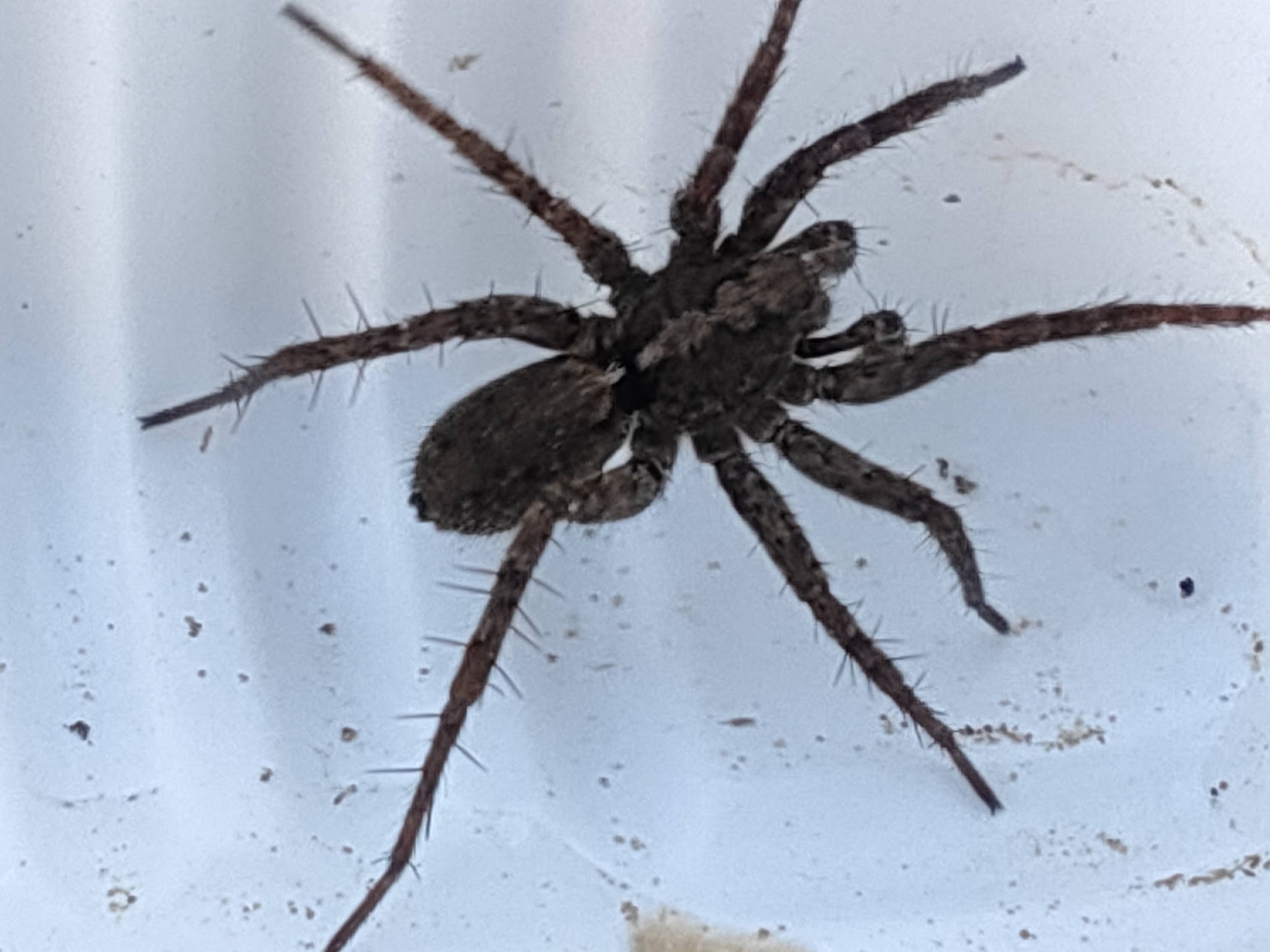
The most numerous animals in the mats were spiders. Next came resin assassin bugs — yani-sashigame (ヤニサシガメ), which the researchers counted among the beneficial animals and which Kyoto City Zoo describes as a natural enemy of pests. Together these beneficial animals made up 57% of everything collected. The next most common group was cockroaches. Pine-moth larvae and other pests made up “only 4%”.
| What was in the mats (Himeji Castle, 5 surveys to 2006) | Share |
|---|---|
| Spiders and resin assassin bugs (beneficial) | 57% |
| Next most common: cockroaches | Not given as a share |
| Pine-moth larvae and other pests | 4% |
Note what the 4% is: pine-moth larvae and other pests together. The abstract does not give the total count or year-by-year numbers, so the percentages are the most that can be quoted. Note also what the percentages measure: the make-up of what was found in the mats, not how many larvae on each tree were caught, nor how much needle damage was prevented.
The trunk they did not check
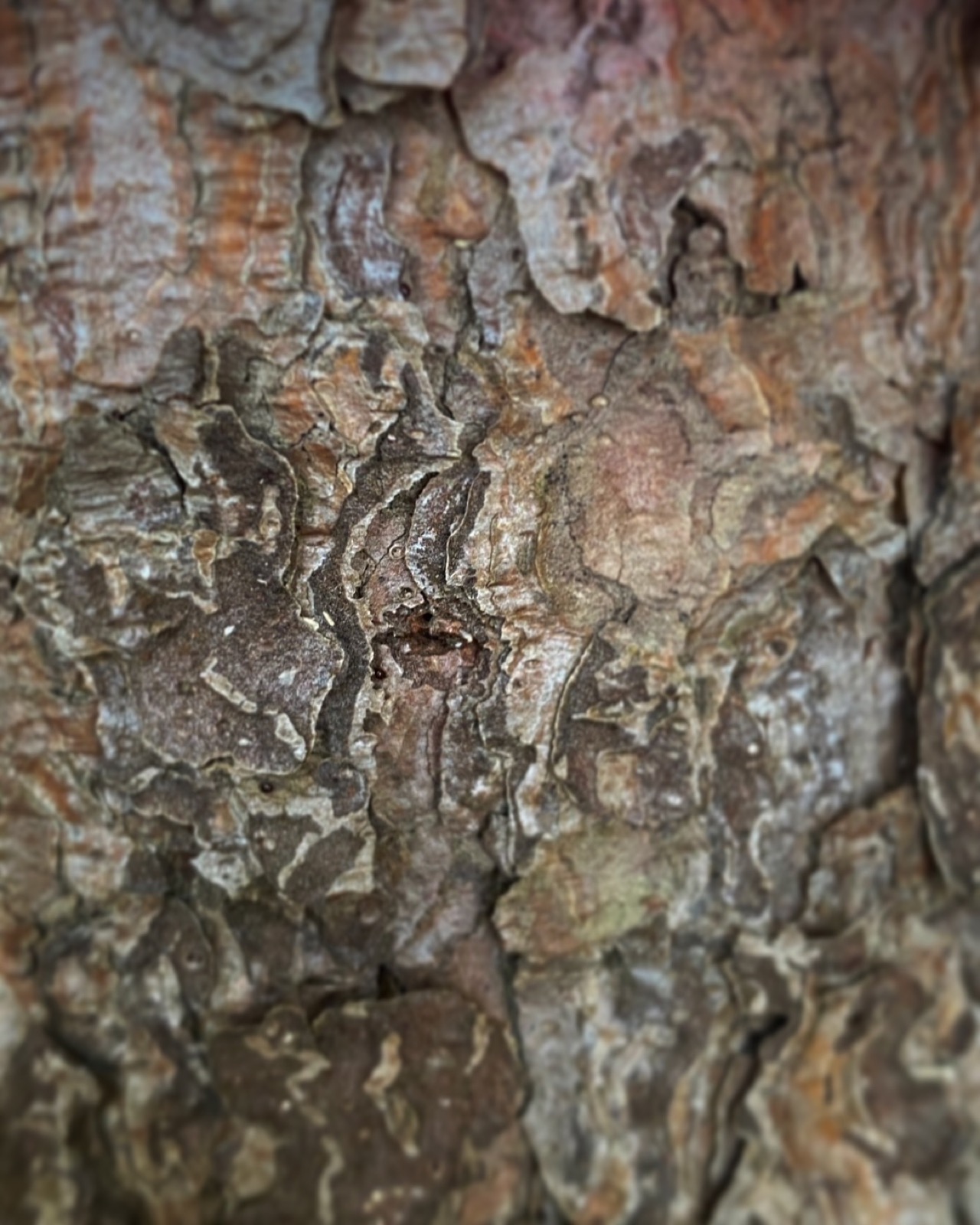
The early surveys had a blind spot, and the authors said so: they had examined only the mats, not the trunk underneath, so what stayed on the bark was “unknown”. Another report said pine-moth larvae are collected mainly on the trunk side of the belt. So in 2007 the team checked the trunks as well, and found larvae left behind in the cracks of the bark where the mats had been removed.
That detail changes the picture of a “trap”. Some of the caterpillars that do come down do not end up in the straw that is burned. They stay on the tree.
What the authors concluded
The conclusion is often summarised as “komomaki doesn’t work”. The authors’ own words are more careful, and more interesting:
– the mats have a large effect in providing overwintering sites for beneficial insects and increasing them, and their pest-control effect is slight; – checking the trunk during removal is important; – surveying the insects in the mats is useful as one method of pest monitoring.
And then a turn: “Pine komomaki is not merely a seasonal sight; depending on how it is used, it has advantages as a pest-control method that increases beneficial insects and puts no load on the environment.” But, they added, sufficient care must be taken in disposing of the mats “so that we do not end up collecting the beneficial insects and killing them”.
In other words, by the authors’ reading, the straw belt is a good winter home for beneficial animals — and burning it in March risks destroying them along with the few pests.
Other Counts — The Same Story in Different Places
A re-evaluation in 1995
Himeji was not the first to look. In 1995, a three-author paper in the entomological journal Kontyû, whose Japanese title translates as “A re-evaluation of the komo-maki method”, tallied what the mats held. Its English abstract says that among insects, “pine pests and natural enemies were almost equally caught”, with spiders making up 34.6% of the catch.
Soka, 2026
Counts are still being made. The three studies used different methods, so their numbers are not directly comparable, but they point the same way. In May 2026, the city of Soka in Saitama Prefecture published a small survey in its nature newsletter: material from five pines held nine pine-moth larvae, against 34 spiders and one assassin bug of a different species, the yokozuna-sashigame. The city notes that some of the animals were collected from the pine bark after the mats were taken off — the same trunk effect the Himeji team found.
| Study | Where | Pests | Natural enemies |
|---|---|---|---|
| Kontyû, 1995 (three authors) | Not stated in the abstract | Pine pests about equal to natural enemies (insects) | Spiders 34.6% of catch |
| Niiho and colleagues, ESJ, 2008 (surveys 2002–2006) | Himeji Castle and Himeyama Park | Pine-moth larvae and other pests 4% | Spiders and resin assassin bugs 57% |
| Soka City, 2026 | Five pines in Soka | 9 pine-moth larvae | 34 spiders, 1 assassin bug |
Why Warm Regions Get Less From the Belt — Where the Larvae Actually Spend Winter
Fukuoka: the caterpillars stay up in the needles
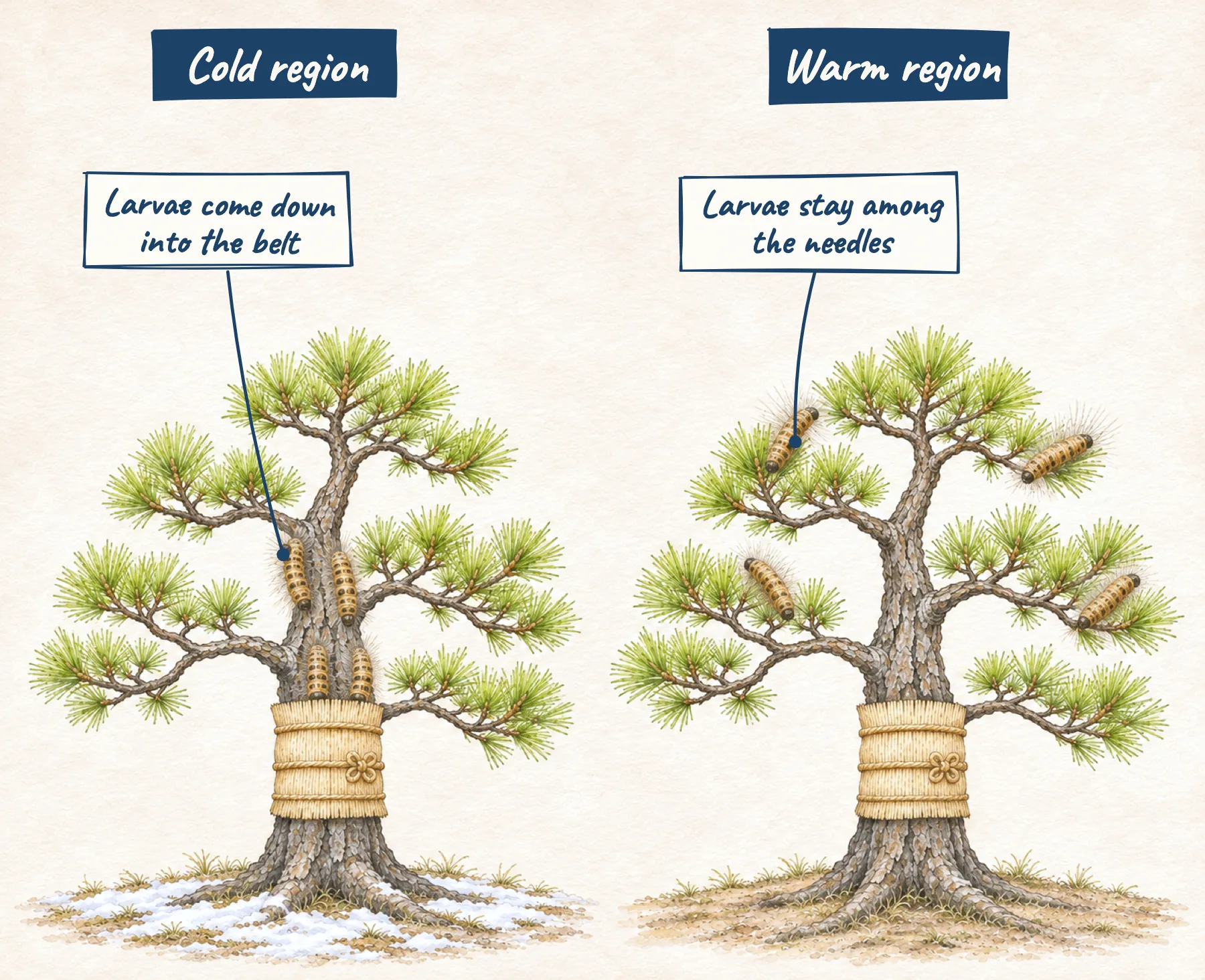
The straw belt assumes the larvae come down. In warm regions, many of them don’t. Fukuoka Prefecture’s guide to pests of flowering trees says plainly that in warm regions the larvae overwinter at the base of the needles and often stay in the canopy — and that komomaki for overwintering larvae “has low effectiveness in warm regions”.
A trap on the trunk can catch only what walks past it.
Larvae spend the winter at different ages, north to south
The insect also changes with latitude. In 1976, Nobutake Habu of Kyoto University reported in the Japanese Journal of Applied Entomology and Zoology that the pine moth’s life cycle varies geographically: northern populations overwinter as third- to fourth-instar larvae, while further south they overwinter at the fifth to seventh, or even eighth, instar. The paper is about the age at which larvae overwinter. Our inference, not the paper’s, is that a belt timed by one calendar date is unlikely to suit every population equally, so local guidance such as Hikari’s 15 °C rule is worth following.
Hokkaido: check the trunk under the mat
Even in the north, the belt is not the whole job. The Hokkaido forestry institute’s control advice adds that larvae may also be on the trunk itself, and should be picked off with tweezers or crushed. That is the 2007 Himeji finding again, written as a work instruction.
| Region (as described in the source) | Where larvae overwinter | What that means for komomaki | Source |
|---|---|---|---|
| Hokkaido | Come down the trunk to gaps at the base, under litter and moss | Belt can intercept some; trunk must still be checked | Hokkaido Research Organization |
| Warm regions (Fukuoka guide) | Often stay in the canopy at the base of the needles | Belt has low effectiveness | Fukuoka Prefecture |
Himeji’s Decision — Ending a Winter Custom in 2015
Half a century of straw
In February 2017, members of the Hikari City Council visited Himeji to ask how the city had ended its komomaki, and their inspection report preserves the answers. At Himeji, the straw belt had been kept up since the 1960s to protect the pines, and every year, timed to Rittō, about 350 black pines and other trees were wrapped. The surveys that began in 2002 by Himeji Institute of Technology (now the University of Hyogo) had found that what was being killed was mostly beneficial animals such as spiders. Even so, the city told the visitors, it had held back from a decision, because the custom was loved together with the spring removal.
Why it lasted
The council members asked the obvious question: if the surveys had shown the practice to be counterproductive, why did it continue until 2014? The answer was candid. It had been kept as a winter tradition since the 1960s, and in particular, because the main keep was under conservation repair during those years, it was continued as one way of drawing visitors. The budget had been about ¥700,000, mostly for materials.
“Stop immediately” — and no complaints
What finally ended it was advice. In 2015, Tamotsu Hattori, professor emeritus at the University of Hyogo and chair of the castle’s tree patrol council, told the city that komomaki “should be stopped immediately”. The city called this the biggest reason. It also noted that many other places, including Matsumoto Castle and the outer gardens of the Imperial Palace, had already stopped, and it took the castle’s grand opening as the moment to end the custom.
The city had at first thought it a pity to lose the seasonal sight. When it came to it, there was not a single complaint or inquiry. The decision was reported in the newspapers, the city said, but no one phoned.
Why Gardens Still Wrap Pines — Seasonal Sight, Monitoring Tool
A late-autumn sight
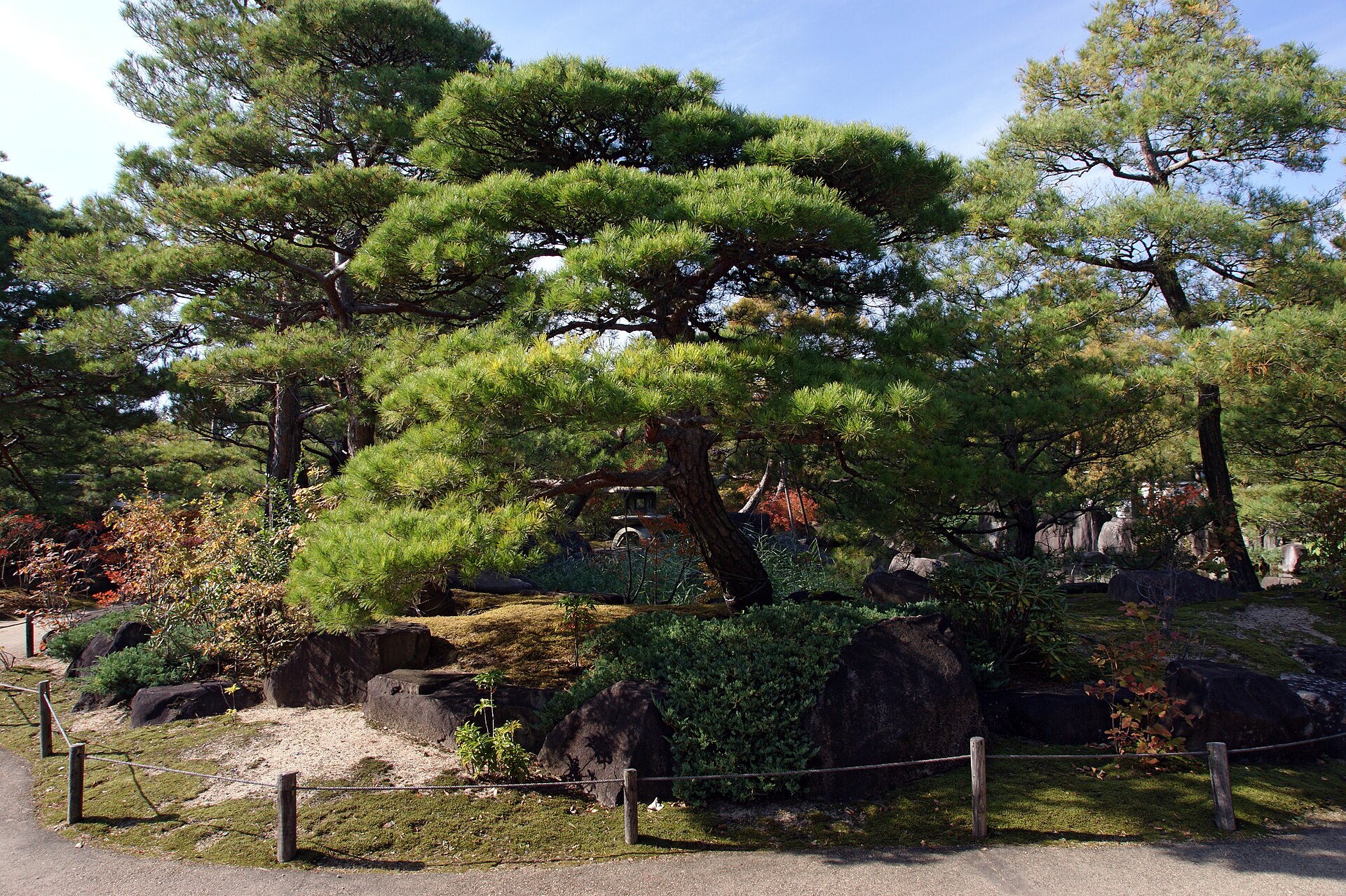
Himeji’s decision did not end komomaki in Japan. Okayama Kōrakuen still wraps its pines every October — its 2026 notice listed about 240 — and says openly that today the event is “the garden’s preparation for winter, a seasonal sight of late autumn”. Shukkeien’s 2026 notice listed about 360 and calls the event a fūbutsushi (風物詩) — a seasonal sight — “announcing late autumn”. In Hikari, schoolchildren take part in wrapping the beach pines, part of caring for about 42,000 black pines that the city describes as a windbreak and sand-control protection forest. For more on how Japan manages trees against wind, see our article on typhoon-proofing trees.
The straw belt has become a calendar marker. For a public garden, that is a legitimate reason to keep it — as long as nobody claims it is the main line of defence for the pines.
Still in the manuals
Some technical guides still list it, and they do not all agree. Chiba Prefecture’s 2026 pest-control guideline for pines tells growers to wrap straw or similar material around the trunk “by the first half of October at the latest” — band trapping — and collect and dispose of the overwintering larvae. Fukuoka, as we saw, says the method works poorly in warm regions. The guides cover different regions, and their advice differs; the safe reading is that local conditions and timing decide whether the belt is worth it. Chiba’s deadline is also a reminder that the belt has to be on before the larvae come down.
The researchers’ second reading
The Himeji authors themselves pointed to a better use. A mat is a sampling device: open it in March, and you have a sample of the animals that used the straw that winter. They called mat surveys “effective as one method of pest monitoring”. And if the mat holds mostly spiders and predatory bugs, burning it also burns the pests’ natural enemies.
Burlap Bands and Grease Bands — The Western Cousins
America’s burlap band
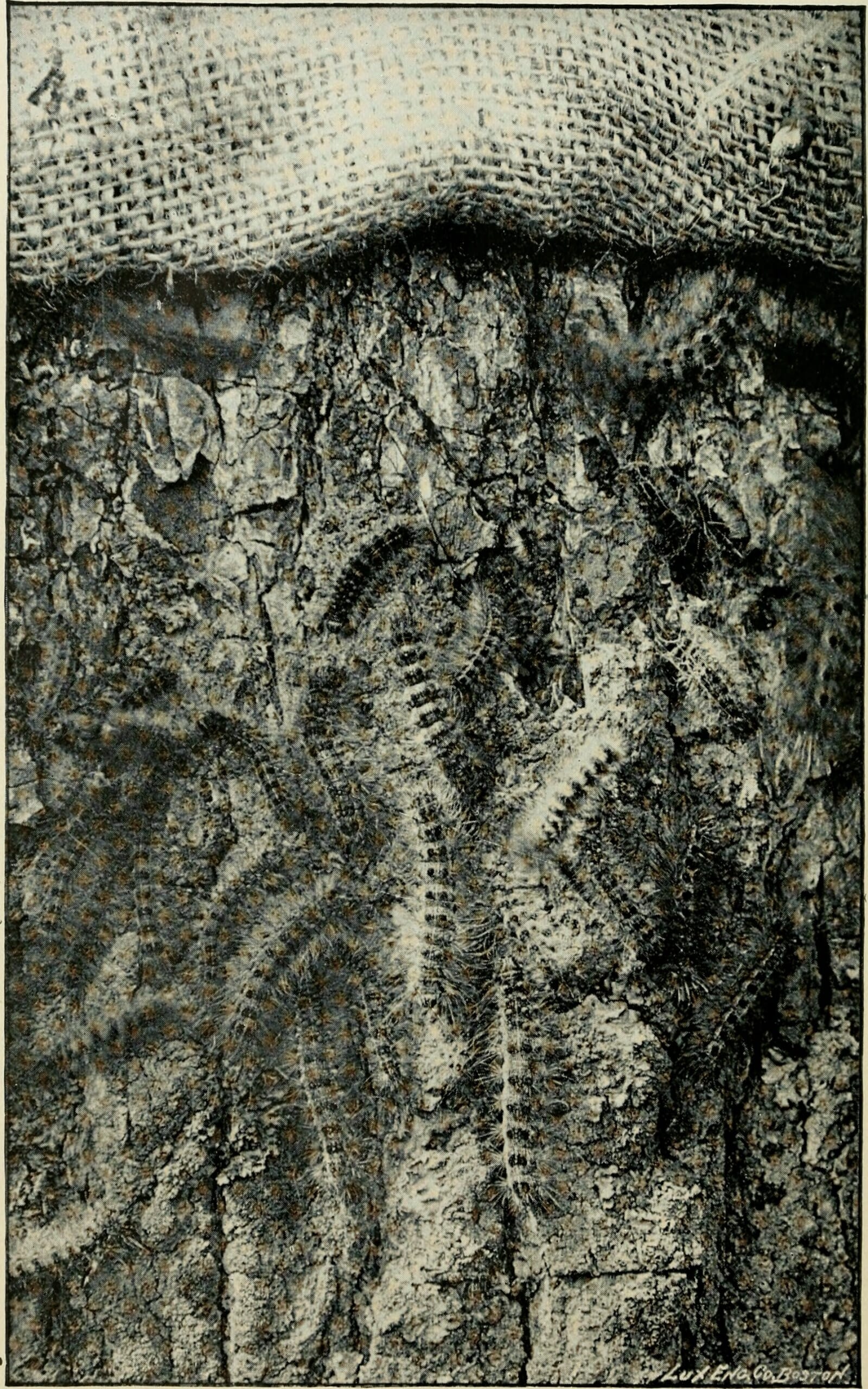
The West has its own trunk belts. In the United States, burlap bands are used against the spongy moth (Lymantria dispar, formerly called gypsy moth) — a different species from Japan’s pine moth. A USDA Forest Service guide describes burlap bands as daytime resting sites under which late-instar larvae and pupae can be collected. The University of Wisconsin–Madison’s extension service tells homeowners to check the bands every afternoon and knock the caterpillars into soapy water.
Extension services are clear about the limits. Virginia Cooperative Extension says banding “will not greatly reduce the general population in the immediate area”, and Rutgers notes that young caterpillars may be blown into trees from adjacent areas.
Britain’s grease band
In the UK, the Royal Horticultural Society describes grease bands on fruit trees as a way to trap wingless female winter moths as they climb the trunk to lay eggs, and says they can reduce the numbers of winter-moth caterpillars. The RHS also warns that the bands are “indiscriminate and can capture any invertebrate”.
Three belts compared
| Komomaki (Japan) | Burlap band (USA) | Grease band (UK) | |
|---|---|---|---|
| Target | Pine-moth larvae coming down to overwinter | Spongy-moth larvae and pupae resting by day | Wingless female winter moths climbing up |
| How it catches | A shelter to crawl into | A shelter to hide under | A sticky barrier |
| When it is cleared | At removal in early March (in the Japanese examples above) | Checked every day (Wisconsin extension) | Not covered here |
| Known side effect | Shelters spiders and predatory bugs, which die if burned | — | Catches non-target invertebrates |
| Official view of effect | “Slight” at Himeji; low in warm regions (Fukuoka) | May help individual trees; does not greatly reduce the surrounding population | Can reduce caterpillar numbers on fruit trees |
The contrast is useful. The American burlap band is a hiding place that is emptied of caterpillars every day; the British grease band is a sticky barrier. The komomaki examples above are a single winter’s shelter, opened once in March — and what happens to its contents then is the gardener’s choice.
What a Gardener Can Do With a Straw Belt — Judgment Before Tradition
Questions to ask before wrapping
None of this says that komomaki must never be done. It says the belt should be a decision, not a reflex. These are the questions the sources above suggest:
| Question | If yes | If no |
|---|---|---|
| Is the site in a cold region where larvae come down the trunk? | The belt can intercept some larvae | In warm regions, Fukuoka rates its effect as low |
| Will the belt go on before the larvae come down (Hikari starts around a 15 °C daily mean; Chiba says by the first half of October)? | Matches the published local guidance | A late belt may miss them |
| Will someone check the trunk under the mat at removal? | Larvae left in the bark can be removed | Some larvae stay on the tree |
| Will someone look at what is in the mat before it is burned? | It becomes a monitoring record | Predators are destroyed with the straw |
| Is the main reason the seasonal sight? | Fine — say so, and keep other controls in place | — |
If you wrap: look before you burn
If a garden keeps the belt, the Himeji findings point to two habits. First, check the trunk when the mat comes off; Hokkaido’s institute tells workers to pick off or crush larvae left on the bark. Second, look at what came out before the mat goes on the fire, because the authors warned that the mats must be handled “with sufficient care” so that the beneficial insects are not gathered up and killed. The conference abstract does not describe a procedure for sorting the animals, and we have not found one elsewhere.
What the prefecture guides list instead
The published guides describe other controls that work on the pine moth directly:
– remove egg masses and young larvae together with the twig (Fukuoka Prefecture); – collect and dispose of cocoons (Fukuoka Prefecture); – apply insecticide, by spraying or by trunk injection, from just before to during the emergence of the larvae (Chiba Prefecture); – for young trees in an outbreak, inspect often and combine spraying with hand removal; the Forestry and Forest Products Research Institute’s Kyushu office, writing in August 2026, says young trees “cannot be fully protected” otherwise.
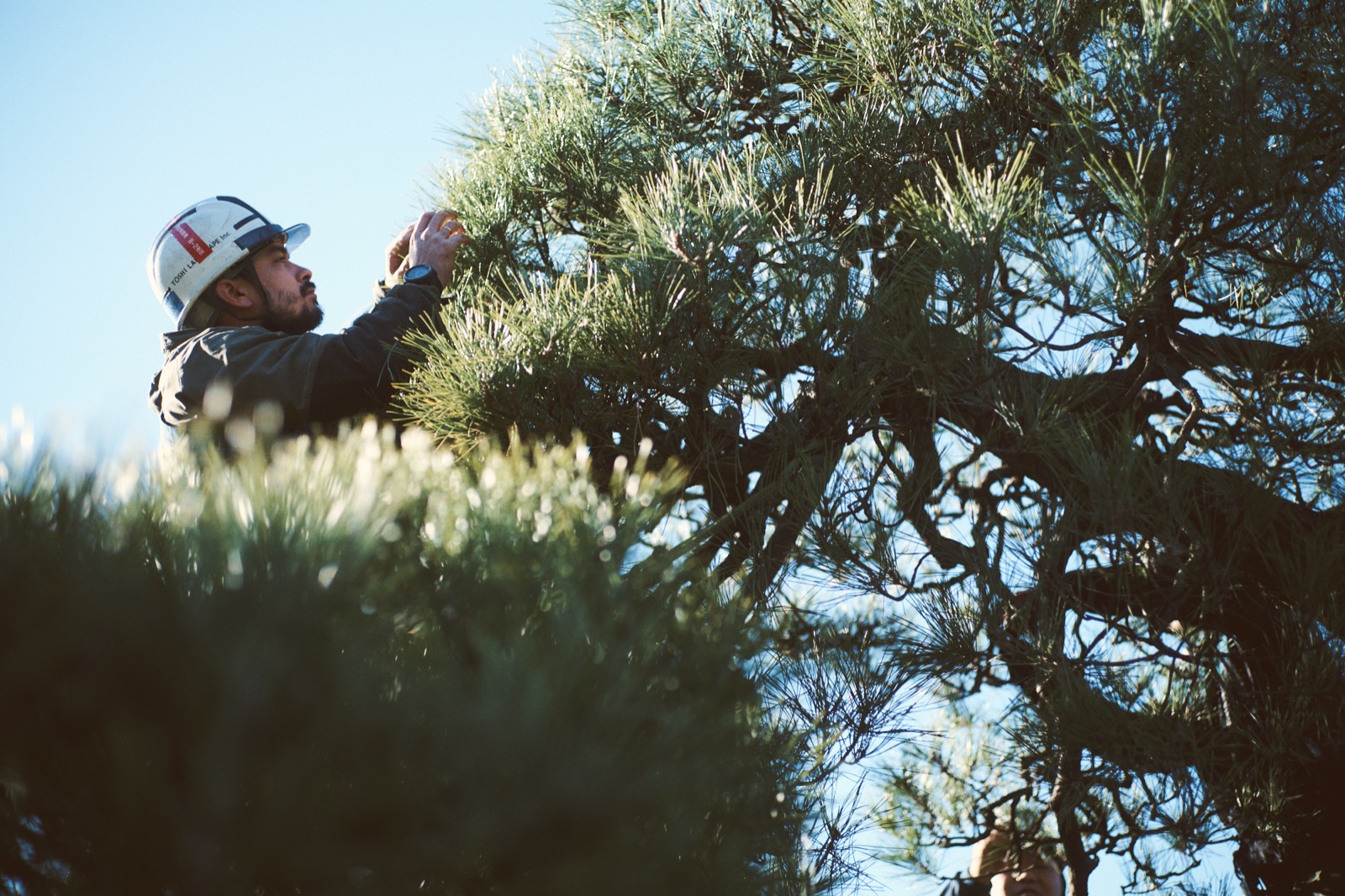
Several of these can be folded into the routine work of pruning a pine, which already takes a gardener branch by branch through the crown, as in the spring work described in our article on midori-tsumi, reading a pine’s spring candles. In warm regions, where Fukuoka says many larvae stay at the base of the needles over winter, that is also where they can be looked for.
A step-by-step version, from the sources
Put together, the published material suggests this sequence for a garden that keeps the belt:
- Before wrapping: check whether pine moth is present on the site; the belt targets only larvae that come down the trunk.
- Timing: wrap before the larvae descend — Hikari uses a daily mean of about 15 °C; Chiba says by the first half of October; Shukkeien and Kōrakuen wrap in October.
- Wrapping: Shukkeien ties a 30–45 cm band of straw komo with rough rope at 1.5–2 m; Hikari wraps at about 1.2 m.
- Removal in early March: take off the mat before the larvae climb back into the tree (by Keichitsu).
- Check the mat and the trunk separately: look at what is in the straw, then check the bark under it and remove any larvae there, as Hokkaido advises.
- Record, then decide: note what the mat held. The Himeji authors called this a useful monitoring record and warned against killing the beneficial animals with the mat.
None of the sources we used compares results between pine species, such as black pine and red pine, so we cannot say whether the method should differ between them. For a different kind of close reading of a pine’s trunk, see our article on reading tree decay without technology.
Frequently asked questions
Does komomaki work?
Partly. A straw belt does catch some pine-moth larvae that come down the trunk to overwinter. But across five surveys of the mats at Himeji Castle from 2002 to 2006, pine-moth larvae and other pests were only 4% of the animals collected, while spiders and resin assassin bugs were 57%, and the authors described the pest-control effect as slight.
What pest is komomaki meant to catch?
The pine moth, Dendrolimus spectabilis (Matsukareha), whose hairy larvae feed on pine needles. In Hokkaido’s description, the larvae climb down the trunk in late October to early November to overwinter near the ground, and climb back up in March–April.
When are the straw mats put on and taken off?
Traditionally from Rittō in early November to Keichitsu in early March, after which the mats are burned. Some sources, such as Shukkeien and Hikari City, describe disposal or incineration. Some gardens wrap earlier: Okayama Kōrakuen in mid-October, Shukkeien on Sōkō in late October. Hikari City starts on a day when the daily mean temperature is around 15 °C.
Why did Himeji Castle stop komomaki?
According to a 2017 Hikari City Council inspection report, Himeji ended the custom in 2015 after a professor emeritus of the University of Hyogo advised that it should be stopped immediately. Surveys at the castle had found mainly beneficial animals, such as spiders, in the mats. The city reported no complaints from residents.
Is komomaki the same as a burlap band or a grease band?
They are related ideas. US burlap bands give spongy-moth larvae a daytime hiding place and are checked daily; UK grease bands are sticky barriers against wingless female winter moths. Komomaki offers pine-moth larvae a winter shelter; in the Japanese examples here it comes off once, in early March.
Sources
– 新穂千賀子・中居裕美・村上諒・松村和典「姫路城のマツのこも巻き調査(2002年-2007年)」(“Survey of komomaki on the pines of Himeji Castle, 2002–2007”, translated), Ecological Society of Japan, 55th Annual Meeting, oral presentation B2-15, 2008 (accessed 2026-10-31): https://www.esj.ne.jp/meeting/abst/55/B2-15.html – Ecological Society of Japan, 55th Annual Meeting programme, March 2008 (accessed 2026-10-31): https://www.esj.ne.jp/meeting/55/ESJ55_program.pdf – 吉村仁志・木上昌己・矢野宏二「こも巻き法の再評価」(Japanese title; “A re-evaluation of the komo-maki method”, translated), Kontyû 63(4): 897–909, 1995, author abstract via National Diet Library (accessed 2026-10-31): https://dl.ndl.go.jp/pid/10654970 – Habu N., “Geographic Variation of the Pine Moth, Dendrolimus spectabilis Butler (Lepidoptera: Lasiocampidae)”, Japanese Journal of Applied Entomology and Zoology 20(2): 55–60, 1976 (accessed 2026-10-31): https://www.jstage.jst.go.jp/article/jjaez1957/20/2/20_2_55/_article/-char/ja/ – Hokkaido Research Organization, Forestry Research Institute, “Matsukareha” (accessed 2026-10-31): https://www.hro.or.jp/forest/research/fri/database/zukanf/00top/cho-ga/karehaga/matukare/note.html – Forestry and Forest Products Research Institute, Kyushu Regional Breeding Office, pine moth outbreak report, updated 6 August 2026 (accessed 2026-10-31): https://www.ffpri.go.jp/kyuiku/gyomushokai/jyonai/matsukareha/matsukareha.html – Hiroshima Prefecture, Shukkeien “Pine komo wrapping” notice, 2026 (accessed 2026-10-31): https://www.pref.hiroshima.lg.jp/uploaded/attachment/686019.pdf – Okayama Kōrakuen, “Pine komo wrapping” 2026 (accessed 2026-10-31): https://okayama-korakuen.jp/ibento/kaisaibi/2026_10/4527.html – Hikari City, press release on komomaki at the coastal pine forests, 30 October 2025 (accessed 2026-10-31): https://www.city.hikari.lg.jp/material/files/group/1/20251030nourinsuisan.pdf – Hikari City Council, Environment, Welfare and Economy Committee inspection report (Himeji City), 2017 (accessed 2026-10-31): https://www.city.hikari.lg.jp/material/files/group/125/290207kankyousisatu.pdf – Kyoto City Zoo, “Komomaki”, 22 December 2016 (accessed 2026-10-31): https://zoo.city.kyoto.lg.jp/zoo/enjoy/blog/crew-blog/20161222-22859.html – Soka City, Sōka Ikimono Dayori No. 36, 2026 (accessed 2026-10-31): https://www.city.soka.saitama.jp/cont/s1701/030/010/010/040/030/ikimonodayori36.pdf – Bunkyō City, Fumi no Miyako Ikimono Shashinkan album, 2021 (accessed 2026-10-31): https://www.city.bunkyo.lg.jp/documents/4848/2022415173217.pdf – Forestry Agency, Hokkaido Regional Forest Office, Goryōkaku protection forest (accessed 2026-10-31): https://www.rinya.maff.go.jp/hokkaido/square/kakutidayori/2024/240129.html – Shogakukan, Digital Daijisen, “komomaki”, via Kotobank (accessed 2026-10-31): https://kotobank.jp/word/%E8%8F%B0%E5%B7%BB-504889 – Kyoto Botanical Gardens, “Komomaki of the cycads” (accessed 2026-10-30): https://www.pref.kyoto.jp/plant/1327824213085.html – Shukkeien, “The people who support the garden” (accessed 2026-10-30): https://shukkeien.jp/hitobito/ – Fukuoka Prefecture, pests of flowering plants and trees: ecology and control (accessed 2026-10-31): https://www.pref.fukuoka.lg.jp/uploaded/life/805964_62798281_misc.pdf – Chiba Prefecture, pest-control guideline for flowering plants and trees, (42) pines, 2026 (accessed 2026-10-31): https://www.pref.chiba.lg.jp/annou/shokubo/documents/r8shishin010542.pdf – USDA Forest Service, Gypsy Moth Larval Necropsy Guide, GTR-NRS-179, 2018 (accessed 2026-10-31): https://www.fs.usda.gov/nrs/pubs/gtr/gtr_nrs179.pdf – University of Wisconsin–Madison Extension, “Making a burlap barrier band trap” (accessed 2026-10-31): https://fyi.extension.wisc.edu/spongymothinwisconsin/pest-management-2/making-a-burlap-barrier-band-trap/ – Virginia Cooperative Extension, Spongy Moth Management for Homeowners, ENTO-594 (accessed 2026-10-31): https://www.pubs.ext.vt.edu/content/dam/pubs_ext_vt_edu/2811/2811-1021/ENTO-594.pdf – Rutgers Cooperative Extension, FS004 (accessed 2026-10-31): https://extension.rutgers.edu/fs004 – Royal Horticultural Society, “Grease bands and tree barrier glues” (accessed 2026-10-31): https://www.rhs.org.uk/prevention-protection/grease-bands-and-tree-barrier-glues