

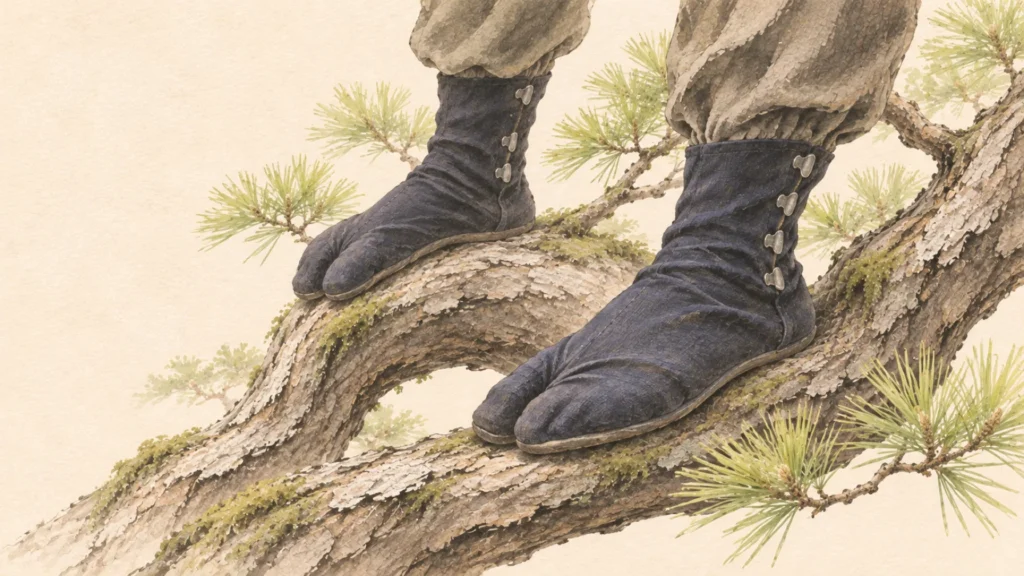
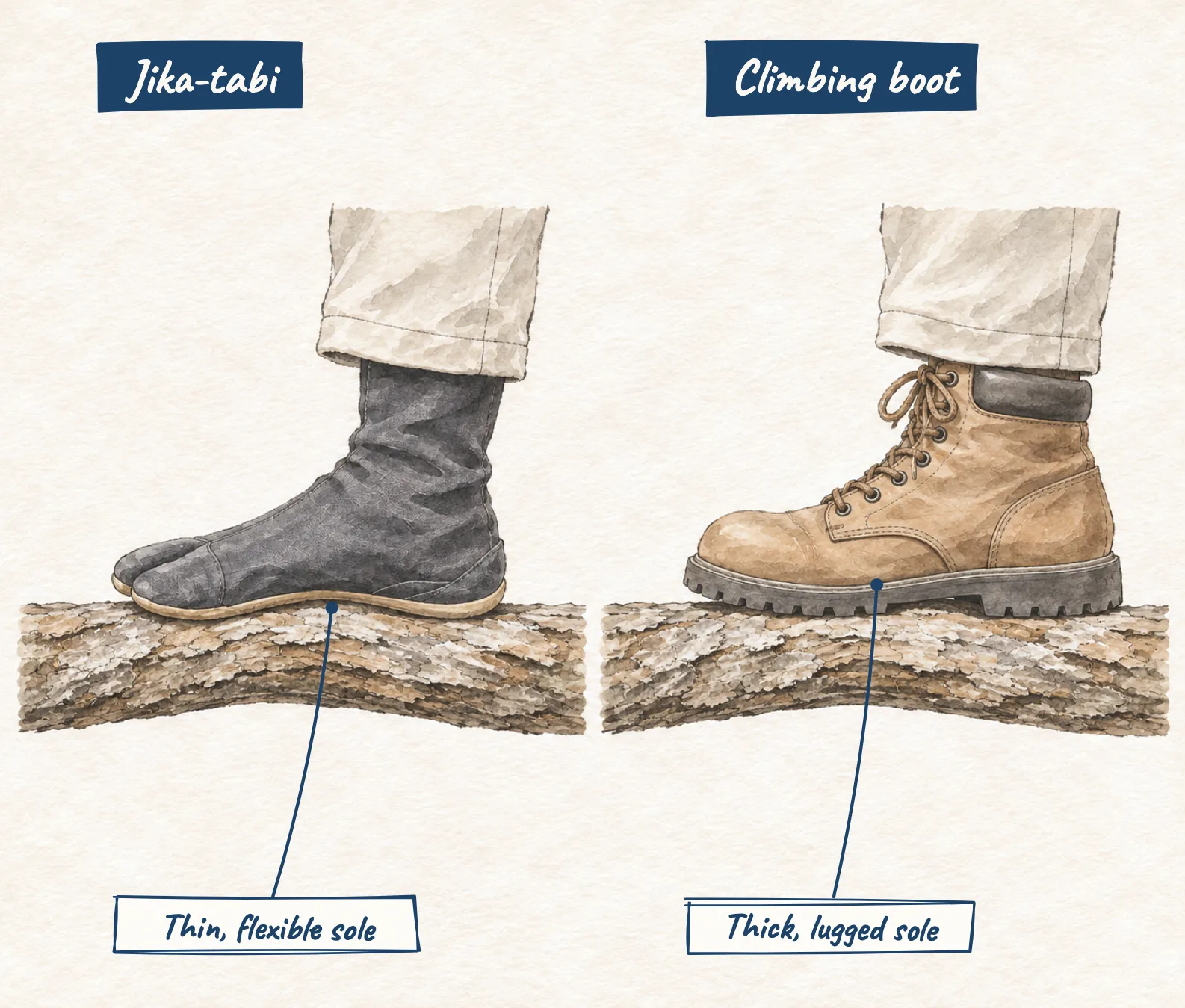
Japanese gardeners climb tripod ladders and trees in jika-tabi — split-toe work boots with a cloth upper and a rubber sole — because, in the words of the people who make and describe them, the sole lets the wearer feel the footing and the divided toe lets the wearer brace with the toes. Japan’s Ministry of Foreign Affairs says jika-tabi are still favored on building sites and in forestry because it is easy to feel the ground through them and they are hard to slip in. Those are descriptions rather than test results, and one Japanese safety test found a jika-tabi sample to be the most slippery of three on a wet metal roof.
Below: how the boot is built, where it came from, what the evidence does and does not show, and how it compares with the boots that Western standards ask arborists to wear.
Up the Ladder, Into the Pine — The Scene
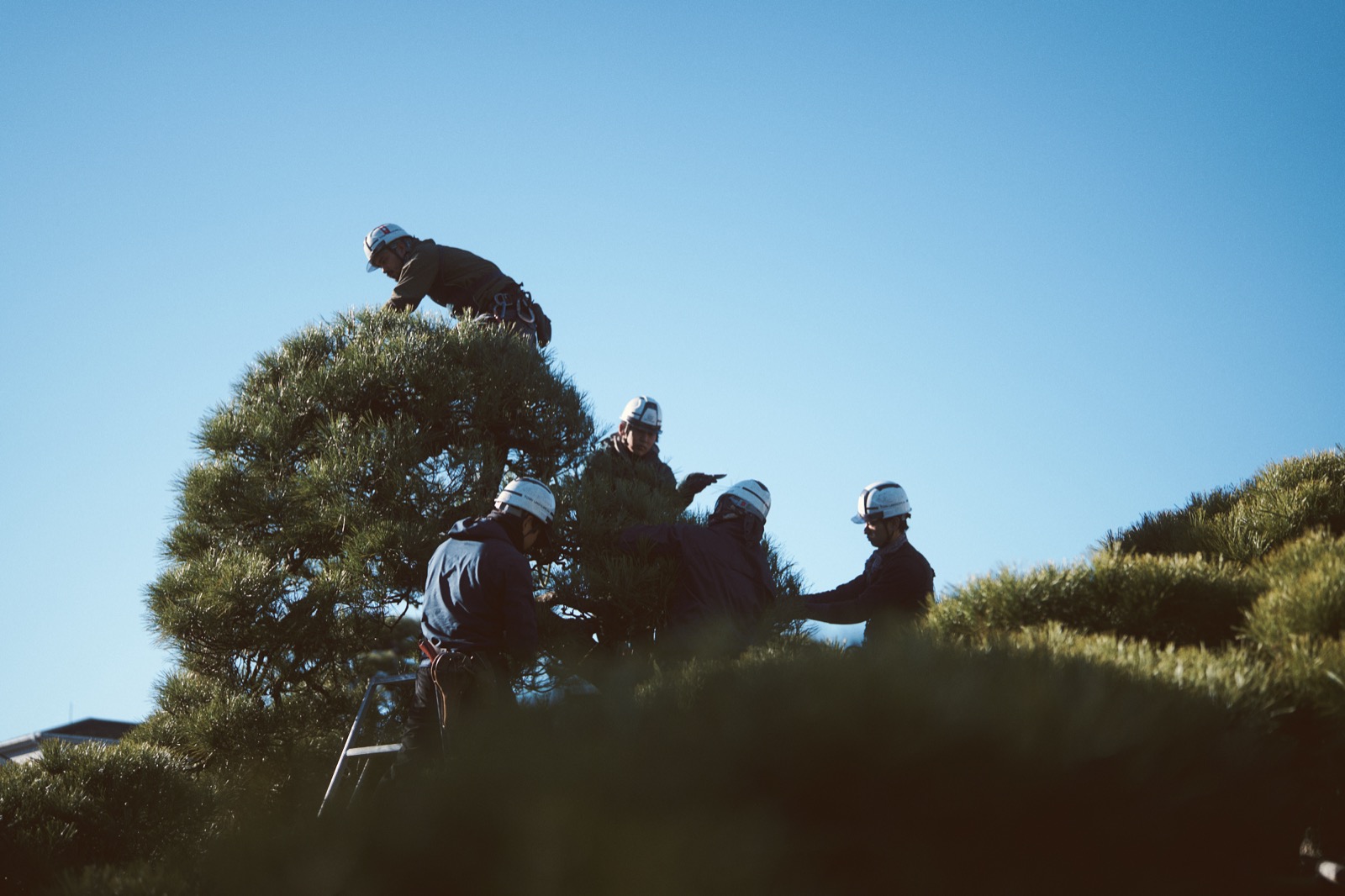
Five people standing in a tree
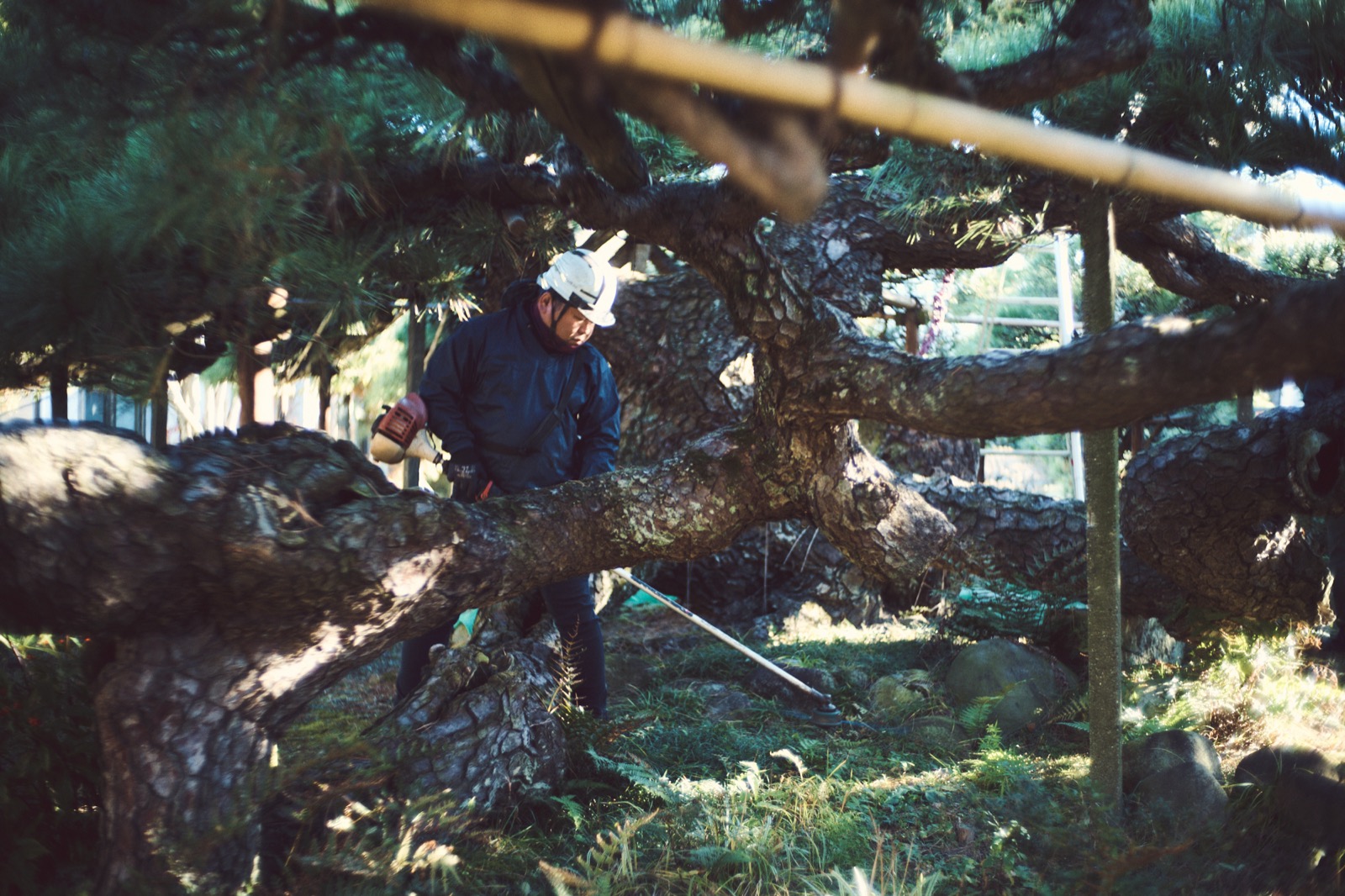
The photograph above was taken during winter work on a large black pine. Five gardeners are in the top of the tree. None of them is on a platform or a bucket truck; they are standing and crouching among the limbs, leaning into the foliage, with an aluminum ladder just visible below the crown. Everything they do depends on where their feet are.
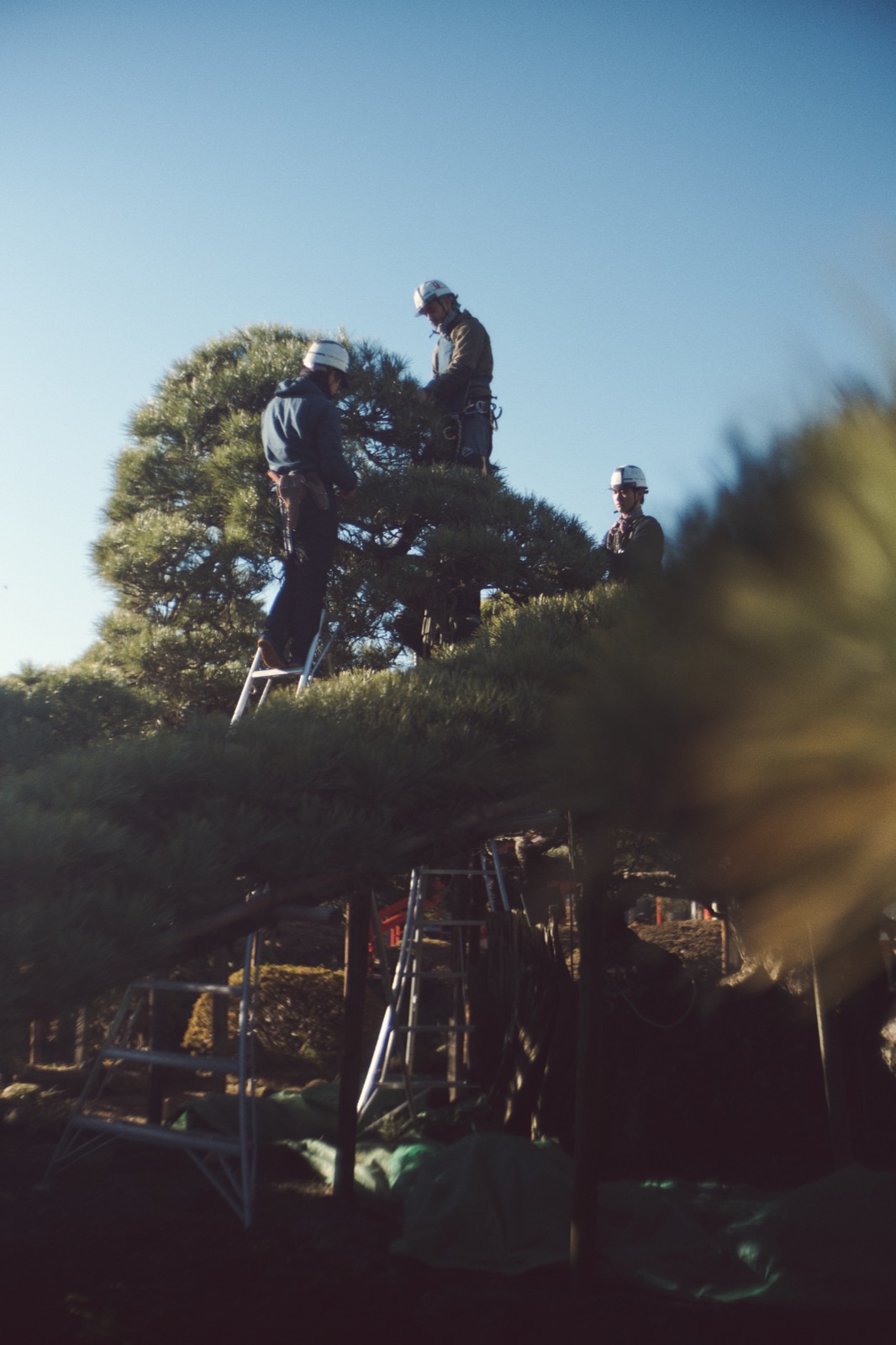
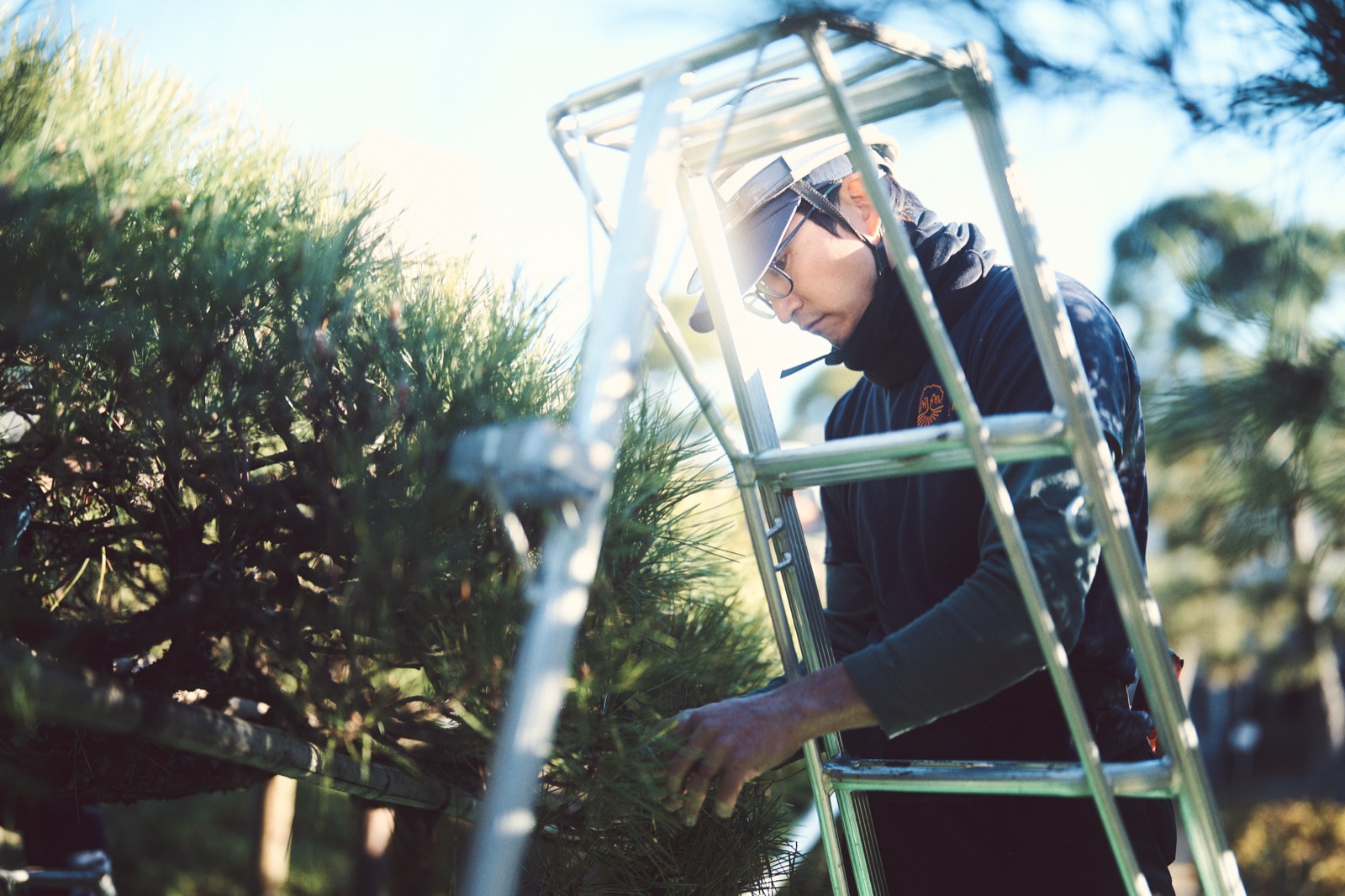
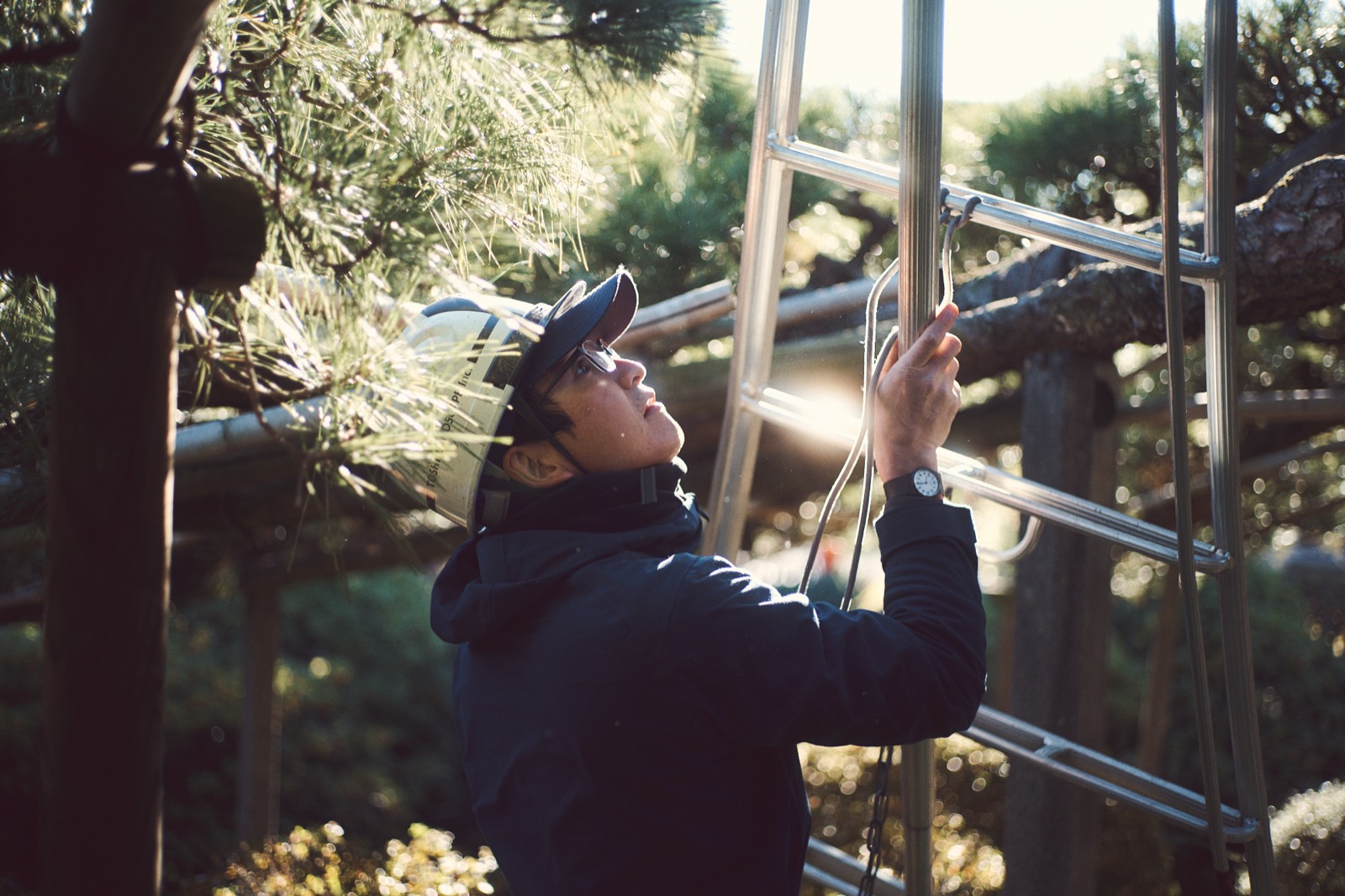
The photograph below shows how they got there. A three-legged ladder, the sankyaku (三脚), stands under the pine. One gardener is on its upper steps at the edge of the crown, while two others are already working in the tree above him. The step from a flat ladder step onto a round, sloping limb is the moment this article is about.
What the makers say the foot is doing
The makers explain the choice of boot in terms of feel. Rikio describes the rubber soles of its sewn jika-tabi as thin and soft, with a fit close to bare feet and a light, nimble feel. Marugo says craftspeople keep choosing jika-tabi because the sole of the foot can grasp the feel of the footing, and because the wearer can brace with the toes on unstable ground.
We found no study that measures whether the split toe holds a branch or a ladder step better than a closed boot, and no data on how many gardeners wear jika-tabi or whether they fall less. So this article keeps two things apart throughout: what the makers and users describe, and what has been measured.
Who wears them
Marugo, in a press release, names the people who use its jika-tabi: tobi (鳶) construction workers, carpenters, garden craftspeople, and people who take part in festivals around Japan. Rikio markets one model, Taro, to tobi workers, saying it tightens the fork between the toes for a closer fit. Niponica, the Ministry of Foreign Affairs’ culture magazine, adds construction and forestry.
How a Jika-tabi Is Built — The Parts That Matter on a Ladder
The split toe
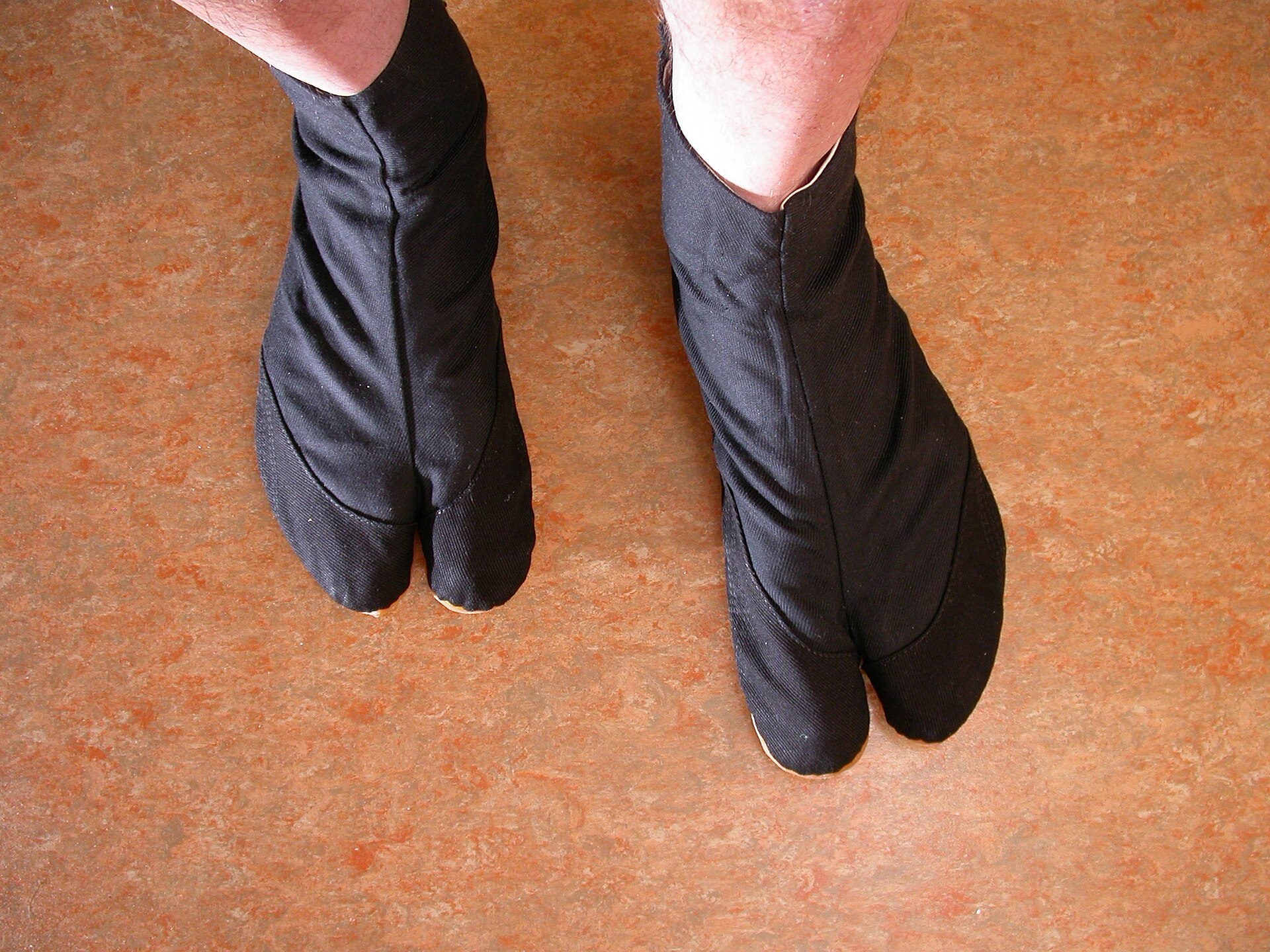
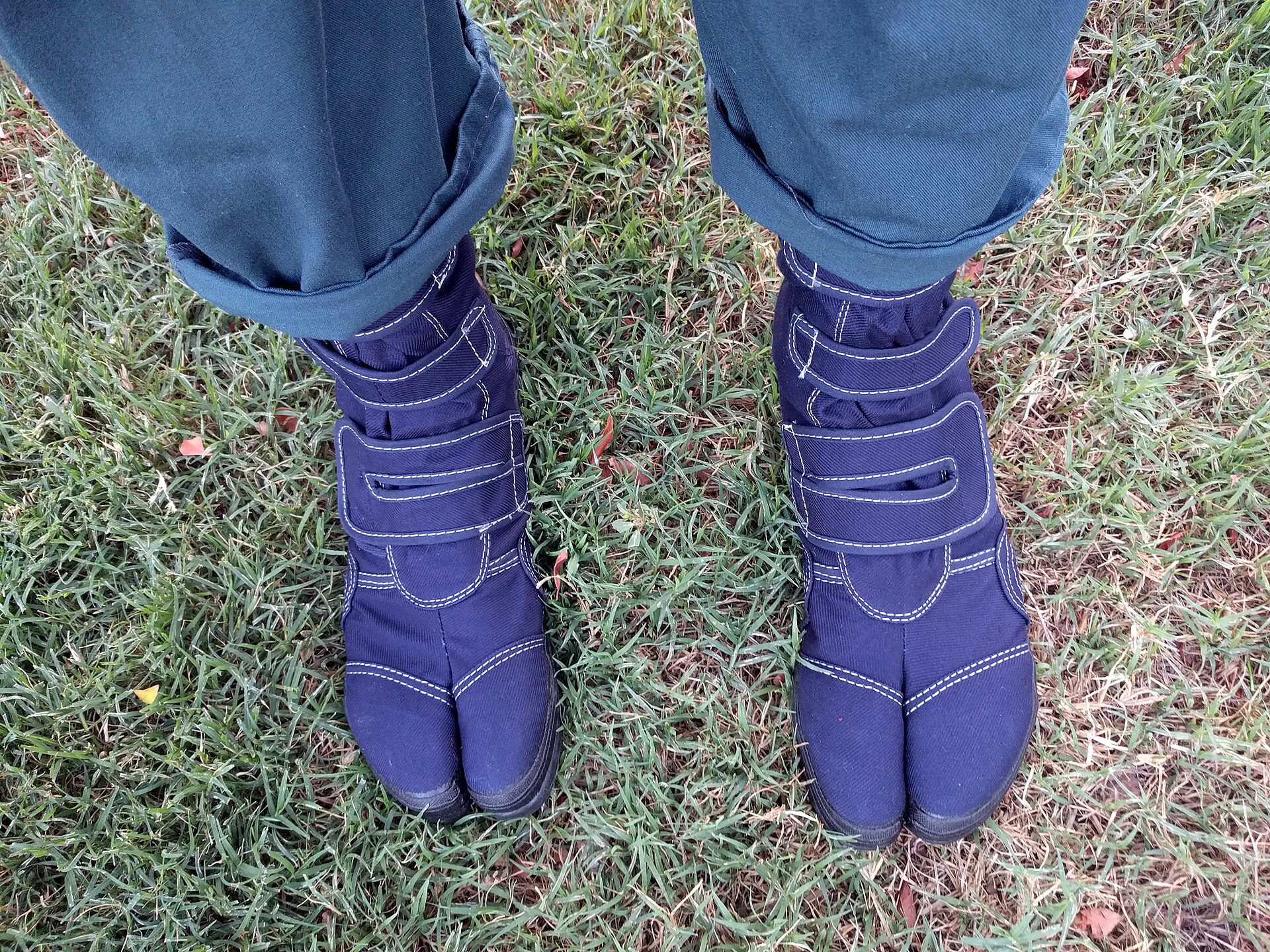
Marugo describes the defining shape simply: the big toe is separated from the other toes. The big toe has its own pocket; the other four share one. The name says what the boot grew from: tabi (足袋), the split-toe socks of Japanese dress, here with a rubber sole underneath.
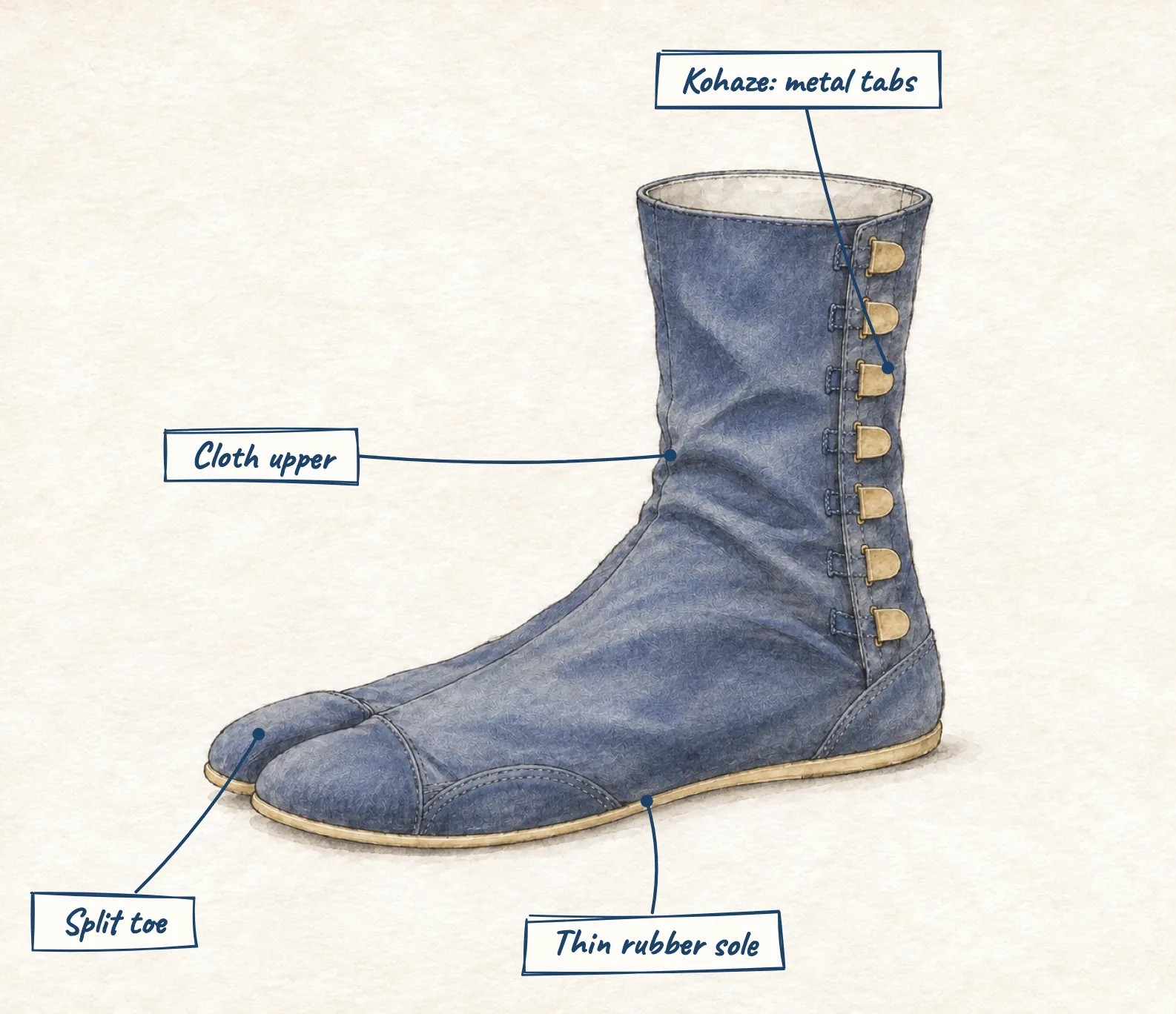
Kohaze: metal tabs on lines of thread
Instead of laces, the boots that this article draws on close with small metal tabs called kohaze (コハゼ). Rikio explains that kohaze are made of metal such as brass and hook onto receiving threads, so the wearer can fasten the boot at the position that fits the leg. Marugo’s Mannen Nuitsuke 12, for example, has 12 kohaze and five lines of receiving thread for adjusting the fit.
Marugo sells models with five, seven, ten and twelve kohaze. More kohaze means a taller shaft on those models, but how kohaze count translates into height depends on the product. MoonStar, for one model, lists a shaft about 16 cm (6.3 in) high in size 25.5 cm and says it is about the height of a five-kohaze boot. We could not find a common conversion between kohaze count and height across makers.
Two ways to attach the sole
Rikio describes two methods of attaching the sole. In nuitsuke (縫付, sewn) construction, the rubber sole is stitched to the fabric upper with thread; Rikio describes the result as a thin, soft sole. In haritsuke (貼付, bonded) construction, the rubber sole is fixed to the upper with adhesive. Marugo describes its ten-kohaze Kaisoku 10 as a “sturdy bonded type.”
The table below is a way to read a product listing, using the makers’ own descriptions.
| What to look for in a listing | Example from a maker | What the maker says it means |
|---|---|---|
| Sole construction: sewn (縫付) | Rikio sewn tabi | Thin, soft rubber sole; close to bare-foot fit |
| Sole construction: bonded (貼付) | Marugo Kaisoku 10 | “Sturdy bonded type” |
| Number of kohaze | Marugo: 5, 7, 10, 12 | Height of the shaft on that model |
| Receiving threads | Marugo Mannen Nuitsuke 12: five lines | Fit can be adjusted |
| Upper material | Marugo Kaisoku 5: cotton | — |
| Toe protection | Marugo Proguard Mannen 7: resin toe guard | Some protection for the toes; not the same as a certified safety shoe |
Rickshaw Tires and a Coal Mine — How the Rubber Sole Arrived
Before rubber
Tabi themselves are old. The Chūō City Machikado exhibition hall in Tokyo notes that deerskin tabi came before cotton ones. The Gyōda City Folk Museum gives one reported reason for the change to cotton: leather became expensive after the Great Fire of Meireki in 1657. Early tabi were tied at the ankle with cords; the museum dates the move toward tabi fastened at the heel with kohaze to the middle of the Meiji era. We could not find who invented the kohaze, or a year for it.
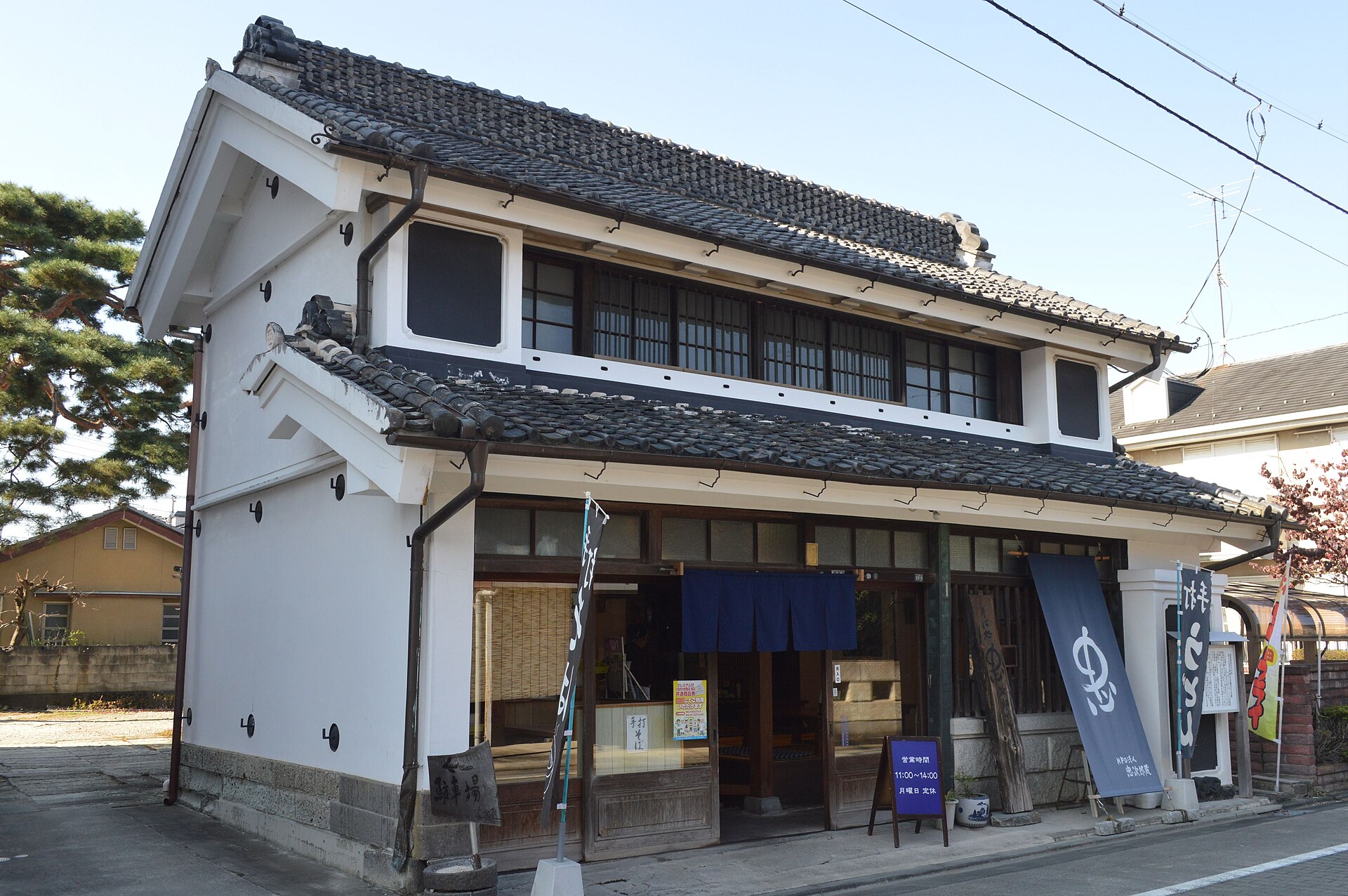
Gyōda, in Saitama, became a major producer. Japan Heritage cites a Kyōhō-era town map from the early 18th century showing three tabi shops in Gyōda, and says that at its peak, in 1938–1939, the town produced about 80 percent of Japan’s tabi.
Two records: 1919 and 1922
The step from sock to boot is recorded by two companies in two different ways.
Marugo’s corporate history, under 1919, describes a “sewn-on” jika-tabi made by stitching processed rickshaw tires onto tabi — the sewn method, in its earliest form.
The bonded method has a longer paper trail. Asahi Shoes dates the founding of Nippon Tabi Co., Ltd. to June 1918, when an individual shop was reorganized as a company, and dates its invention of the bonded-sole jika-tabi to 1922. A utility-model gazette in the Japan Patent Office’s J-PlatPat database names Tokujirō Ishibashi as the applicant for a “rubber-soled jika-tabi” filed on 10 August 1922.
Tested underground
What makes the Nippon Tabi story useful for this article is how the boot was tested and sold. According to Bridgestone’s corporate history, prototypes were tried by more than a thousand workers at the Mitsui Miike coal mine. The Asahi jika-tabi went on sale in January 1923, and staff promoted it by wearing it themselves at the Miike mine and in farming villages. Daily production rose from 1,000 pairs at launch to 10,000 pairs by the end of that year, and the history gives a figure of two million pairs for 1923 without saying whether that is production or sales. Utility-model registrations Nos. 80594 and 80595 secured the company’s rights in October 1923.
The first people the company tested and promoted the boot with, in other words, were coal miners and farming communities.
| Year | Event | Source |
|---|---|---|
| 1657 | Great Fire of Meireki; one reported reason for the shift from leather to cotton tabi | Gyōda City Folk Museum |
| Early 18th c. | Three tabi shops on a Kyōhō-era map of Gyōda | Japan Heritage |
| Mid-Meiji | Shift toward tabi fastened at the heel with kohaze | Gyōda City Folk Museum |
| 1919 | Sewn-on jika-tabi using processed rickshaw tires | Marugo |
| 1922 | Bonded-sole jika-tabi; utility model filed 10 August | Asahi Shoes; J-PlatPat |
| January 1923 | Asahi jika-tabi on sale after trials at the Miike coal mine | Bridgestone |
| 1938–1939 | Gyōda makes about 80% of Japan’s tabi | Japan Heritage |
| 1995 | Marugo launches Proguard Mannen with a resin toe cap | Marugo |
Why “jika”?
The sources we checked give two explanations. A Tokyo High Court judgment quotes the Kōjien dictionary: “jika” means treading directly on the ground, and the characters 地下 (“underground”) are a phonetic spelling. Rikio gives the other: the boots are said to have been named because they could be used for underground work in coal mines. Neither could be settled from documents of the time.
The Tripod Ladder — A Ladder Designed With the Boot in Mind
Flat steps for jika-tabi wearers
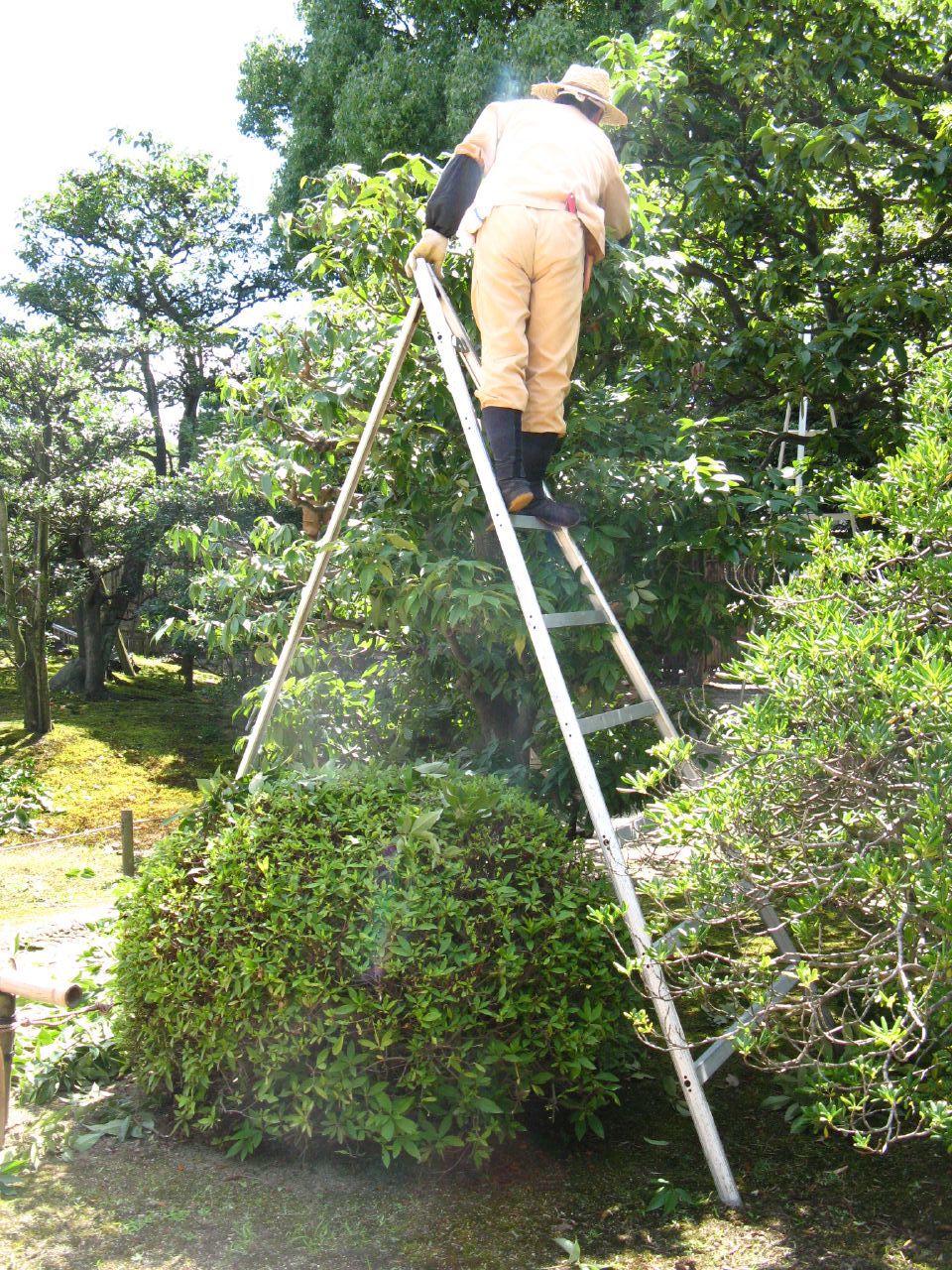
The sankyaku has two legs joined by steps and a single pole as its third leg. One maker states plainly that it designs these ladders with jika-tabi in mind. Kitazawa says the flat steps on its KS series of garden tripod ladders reduce foot fatigue, “especially for craftspeople who work in jika-tabi.”
That sentence is the clearest link we found between the boot and Japanese garden work: a ladder maker shaping its steps around the footwear of the people who use them.
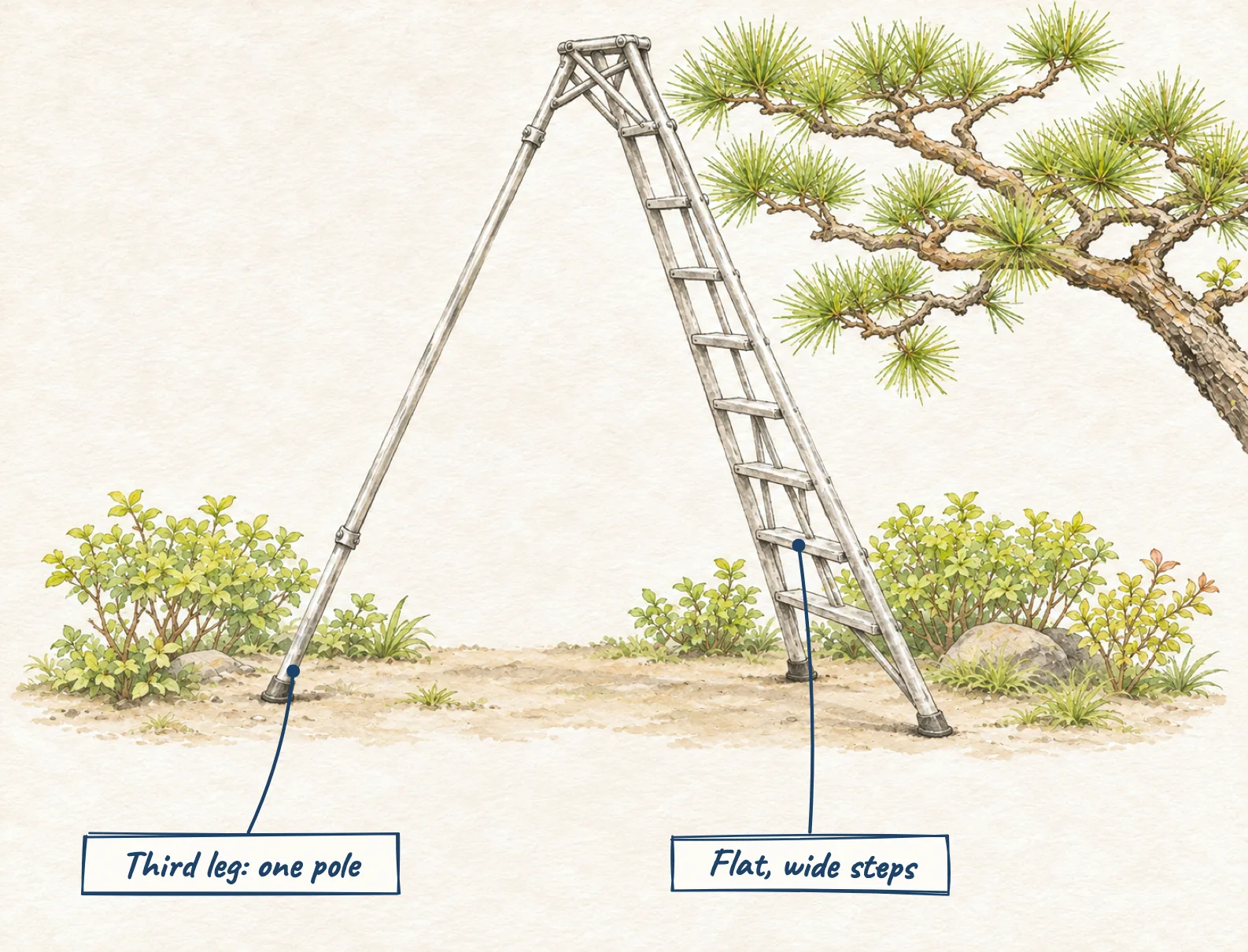
The ladder has its own rules
Footwear is not the only thing between a gardener and the ground. Article 528 of Japan’s Industrial Safety and Health Regulations requires stepladders to have their legs at no more than 75 degrees to the horizontal and, for folding types, fittings that reliably hold that angle. In 2017, after a fatal landscaping accident involving a tripod ladder, the Ministry of Health, Labour and Welfare issued a notice: the ladder’s chain had been a mechanism that could not prevent the legs from closing unexpectedly.
So besides the boot, the set-up of the ladder and the device that holds its legs open need checking. Our photographs show how the ladder is used in pine work: the gardener stands inside its frame, with both hands free for the tree.
The work in the crown
Other hand work on pines and clipped shrubs is described in our articles on midori-tsumi, the spring candle pinching of pines and on karikomi, cloud pruning. In both, the gardener works with hand tools close to the foliage, which is the setting in which the makers’ talk of feel and bracing makes sense. The season matters too. The photographs in this article were taken on black pines in winter, with the gardeners standing among thick, woody limbs; midori-tsumi is spring work on the soft new candles, so the footing and the time spent in the crown differ.
On the Limb — Footing, Rope and Protection
A rope, not just a sole
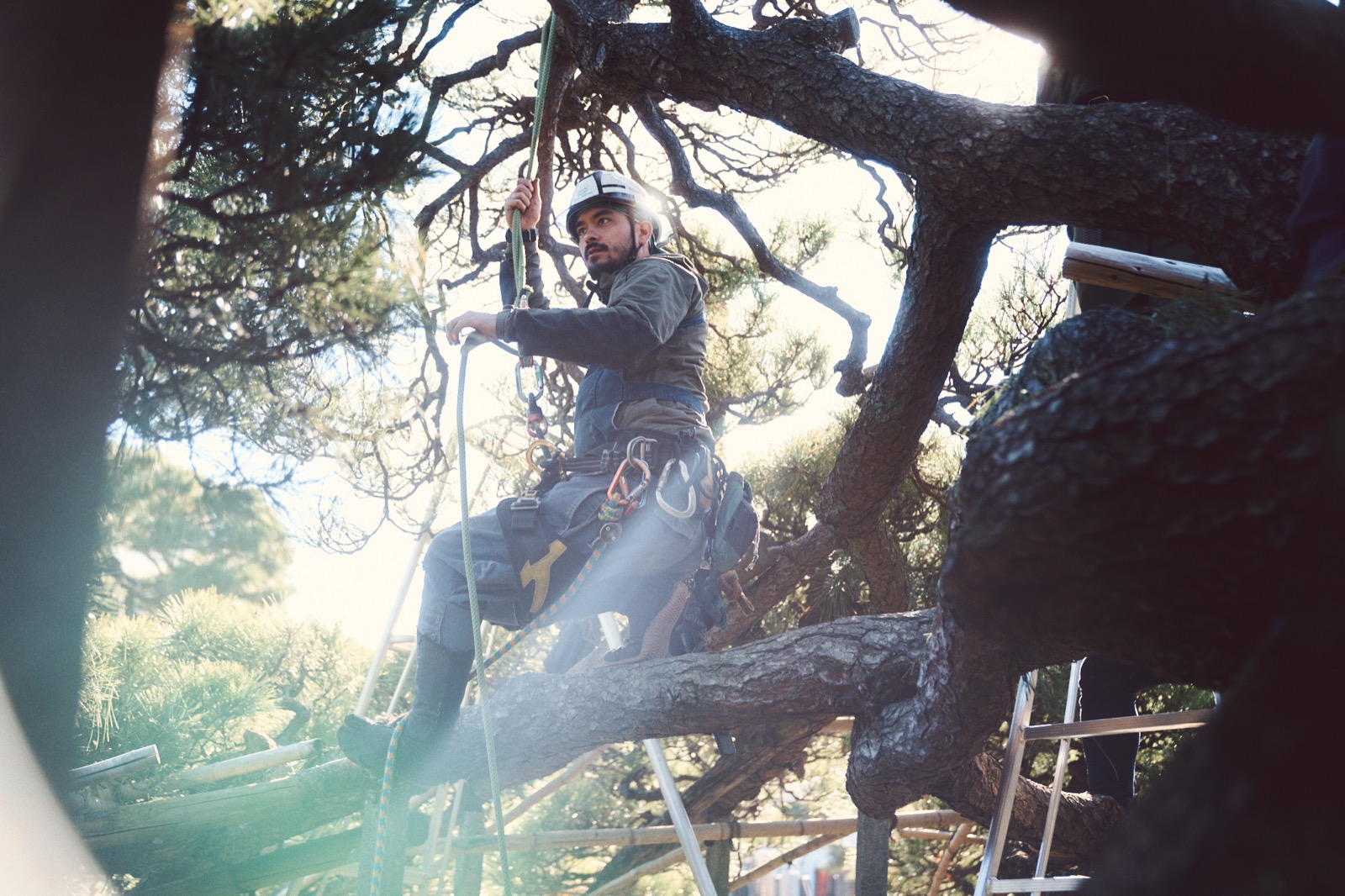
Japanese guidance for tree work does not leave fall prevention to footwear. The Japan Federation of Landscape Contractors (JFLC) introduces a work-positioning guideline for tree work that recommends a tensioned double lanyard, with the aim of bringing free-fall distance as close to zero as possible. The photograph below shows a gardener seated on a thick pine limb with his rope in hand. Our account of an aerial tree diagnosis at a Tokyo temple by rope climbing shows rope work in a larger crown.
Three kinds of protection, checked separately
Protection for the foot is not one property. Toe protection, resistance to puncture through the sole, and protection against chainsaw cuts are separate performances, tested separately. A jika-tabi, or any boot, has to be checked for each. A name such as “toe-capped” or “safety tabi” does not by itself show that a product meets JIS T 8101, carries certification from the Japan Safety Appliances Association (JSAA), resists puncture, or protects against a chainsaw; the product’s own labeling and certification have to be checked.
Wet Roofs and Steep Slopes — What the Studies Show
Slipping on wet sheet metal
The National Institute of Occupational Safety and Health, Japan (JNIOSH), tested three footwear samples on sloping roof surfaces. On wet sheet-metal (totan) roofing, the jika-tabi sample was the most slippery of the three. This is one test, of three samples, on particular roof surfaces. It does not tell us how jika-tabi behave on bark or ladder steps. It does show that “hard to slip in” depends on the surface.
Steep forest slopes
A study presented at the 131st Annual Meeting of the Japanese Forest Society in 2020 looked at forestry workers who habitually wore jika-tabi. After they were given instruction in walking in chainsaw boots, the number of steps on steep slopes where they lost balance and put a hand on the ground went down. The finding suggests that how a worker is taught to walk can affect stability in a given boot.
Balance studies
Two balance studies touch on thin or minimal footwear. A conference study of 20 healthy young men found that sway was lowest in tabi socks, but the difference was not statistically significant. A laboratory study of 20 older women found no statistically significant difference in balance between supportive and minimalist footwear. Neither study was done on ladders or in trees, and from them alone no advantage, or disadvantage, of jika-tabi at height can be concluded.
| Question | What was found | Conditions | Source |
|---|---|---|---|
| Slip on a wet metal roof | Jika-tabi sample slipped most of three samples | Sloping roof surfaces, three footwear samples | JNIOSH |
| Balance on steep slopes | Fewer balance-loss steps after walking instruction in chainsaw boots | Habitual jika-tabi users in forestry | Koyama, 2020 |
| Standing sway in tabi socks | Lowest sway, not statistically significant | 20 healthy young men | Nagao and Hiraiwa, 2020 |
| Balance in minimalist shoes | No significant difference from supportive footwear | 20 older women | Azhar et al., 2023 |
Workwear and Festivals — Where Else Jika-tabi Appear
On building sites
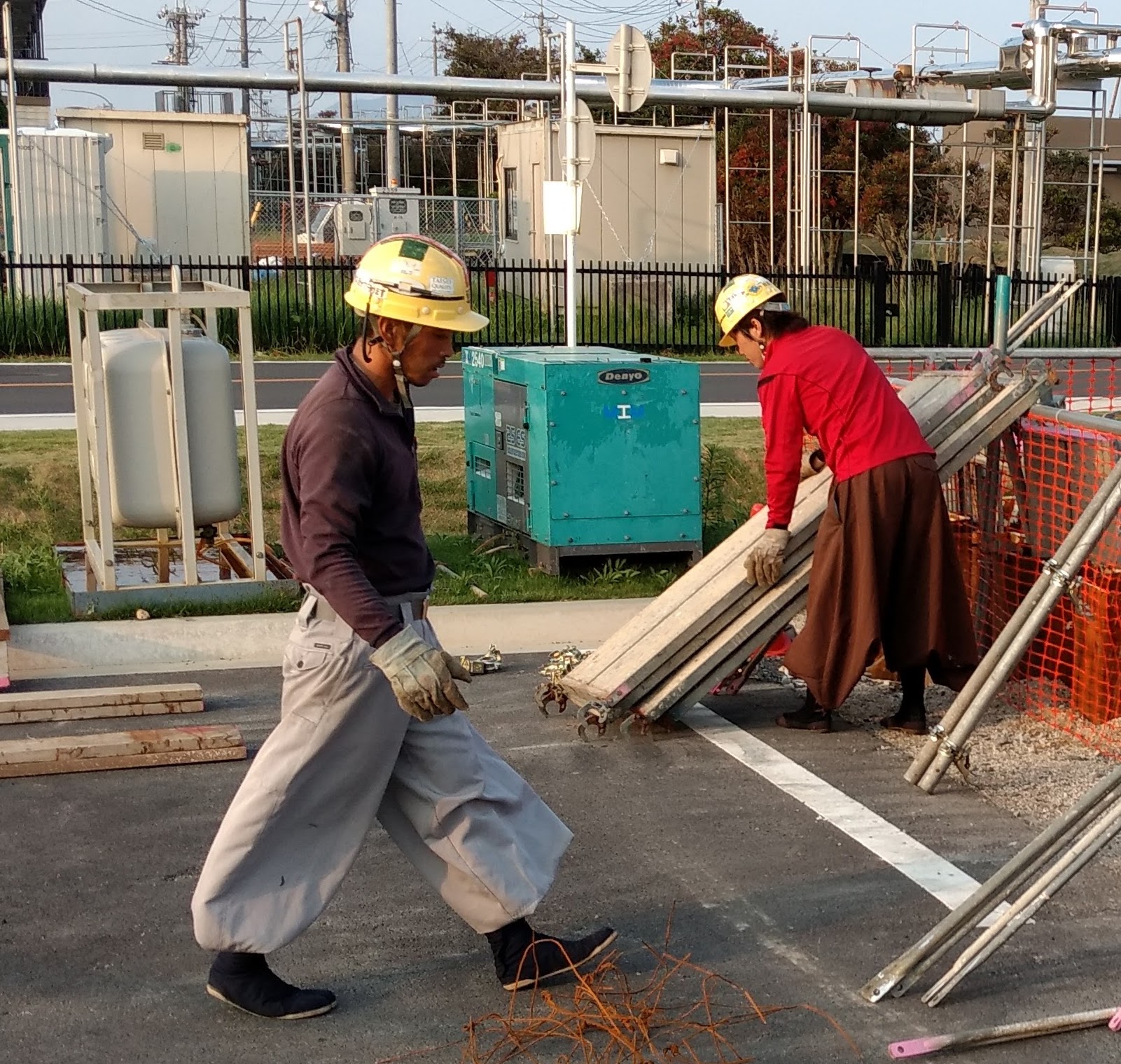
Jika-tabi are often seen on Japanese building sites, and Marugo lists tobi construction workers and carpenters among its users. The photograph below, from a site in Yamaguchi Prefecture, shows construction workers at work in split-toe footwear.
Edo firefighters
The Edo-Tokyo Museum describes Edo-period town firefighters, machi-bikeshi, wearing quilted cotton sashiko coats and momohiki trousers and soaking themselves with water before fighting fires. That is a record of their clothing. We found no primary source connecting them to rubber-soled jika-tabi, which appear in the records only from around 1919–1923.
Under the mikoshi
Jika-tabi also appear at festivals. Marunao, a festival outfitter in Nihonbashi, Tokyo, recommends them for carrying a mikoshi, a portable shrine, because they are less tiring.
Western Standards — Starting From the Hazard
What the documents require
The documents that govern arborists’ footwear in the United States and Europe start from hazards. This is a comparison of starting points, not a ranking of boots.
ANSI Z133-2026, the American safety standard for arboricultural operations published by the International Society of Arboriculture (ISA), states in section 3.3.7 that footwear appropriate to the known worksite hazards shall be approved by the employer and worn by the employee. The US Occupational Safety and Health Administration’s general-industry rule, 29 CFR 1910.136, requires protective footwear where feet are endangered by falling or rolling objects, objects piercing the sole, or specified electrical hazards.
Germany’s statutory accident insurance body (DGUV) describes safety footwear under EN ISO 20345 as having toe caps tested with an impact energy of 200 joules and a compressive force of 15 kilonewtons. EN ISO 17249 sets requirements for safety footwear resistant to chainsaw cutting. In the UK, the Health and Safety Executive (HSE) recommends, for chainsaw users climbing trees, protective boots with good grip and protective guarding at the front vamp and instep, complying with BS EN ISO 20345.
Climbing boots without protection
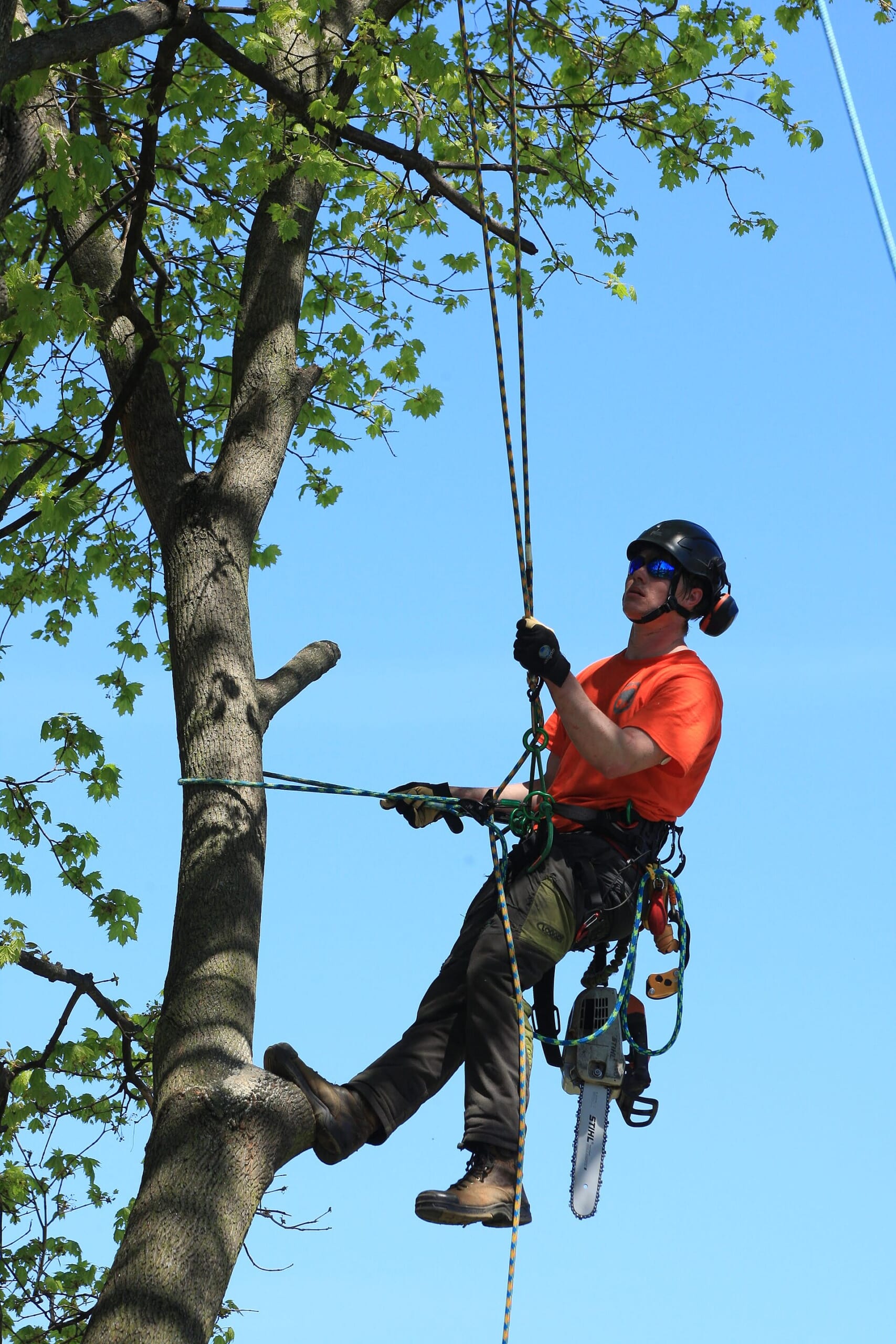
Western makers also sell boots for climbing that are not protective footwear. Arbpro describes its Evo2 as having a dedicated climbing zone in the outsole and a bark-friendly tread pattern, and classifies it as a non-protective boot.
Comparing by performance, not by country
Japan has toe-capped jika-tabi; the West has non-protective climbing boots. The useful comparison is therefore not Japanese versus Western but one performance at a time, for a given job.
| Performance | What to check | Where it is defined |
|---|---|---|
| Toe protection | Toe cap tested to a standard | EN ISO 20345 (200 J impact, 15 kN compression, per DGUV); JIS T 8101 in Japan |
| Slip resistance | Tested slip class | JIS classes F1 (≥0.20) and F2 (≥0.30), per the Japan Safety Footwear Manufacturers Association |
| Chainsaw cut protection | Chainsaw-resistant footwear | EN ISO 17249; JIS T 8125-3 in Japan’s felling guideline |
| Climbing feel | Sole design for bark and ladders | Maker descriptions (Arbpro Evo2 climbing zone; Rikio and Marugo on underfoot feel) |
| Employer’s decision | Footwear chosen for the hazards of the job | ANSI Z133-2026 §3.3.7; Japan’s Article 558 |
Japanese Rules — What Article 558 and JIS Say
The employer decides
Article 558 of Japan’s Industrial Safety and Health Regulations requires employers to specify safety shoes or other suitable footwear according to the structure of passageways or the condition of the work, and to have workers use it. Workers ordered to use the specified footwear must do so. The article names no particular type of footwear.
What counts as a safety shoe
According to the Japan Safety Appliances Association (JSAA), only footwear that passes JIS requirements can be called anzen-gutsu (安全靴, safety shoes). The 2020 edition of JIS T 8101 was prepared from ISO 20345 and ISO 20346, with some technical requirements changed to fit how safety shoes are used and managed in Japan. The Japanese Standards Association’s catalog also lists a 2024 amendment to the standard, which we did not review for this article. The Japan Protective Sneaker Association describes a separate category, JSAA-certified protective sneakers, as offering toe protection equivalent to JIS S- and L-class safety shoes, with lower durability requirements for upper and sole materials.
Jika-tabi makers have added protection too. In 1995 Marugo launched Proguard Mannen, a jika-tabi with a resin toe cap; its current Proguard Mannen 7 has seven kohaze and a resin toe guard.
Chainsaw felling
For felling with chainsaws, Japan’s guideline calls for safety shoes with protective material against saw-chain injury that meet JIS T 8125-3, or footwear with equal or better performance. The same gardener may need different footwear for a different task.
Choosing Footwear for Tree Work — A Checklist From the Sources
Start from the task
Following Article 558 and ANSI Z133, start from the hazards of the specific task rather than from the trade. Hand work from a tripod ladder, chainsaw felling, and work on wet sloping roofs are different tasks with different documented requirements and findings.
Read the product, not the name
For a jika-tabi, check the sole construction (sewn or bonded), the number of kohaze and receiving threads (fit and height), and whether any toe protection is certified. A product name does not establish JIS or JSAA status.
Check the ladder, then the rope
Check the ladder’s angle and the device that holds its legs open (Article 528, and the 2017 notice), and for work in the crown, the work-positioning system the JFLC guideline describes. Our piece on typhoon-proofing trees with wind-resistant pruning describes crown work where these questions arise.
| Step | Question | Source |
|---|---|---|
| 1 | What are the hazards of this task: falling objects, puncture, chainsaw, wet smooth surfaces? | Article 558; ANSI Z133 §3.3.7; OSHA 1910.136 |
| 2 | Does the task call for certified protection (toe, puncture, chainsaw)? | JSAA; JIS T 8101; JIS T 8125-3; EN ISO 17249 |
| 3 | Is the boot’s protection certified, or only named? | JSAA; maker labeling |
| 4 | Does it fit, and can the fit be adjusted? | Rikio on kohaze and receiving threads |
| 5 | Is the ladder’s angle held, and are its legs secured from closing? | Article 528; MHLW 2017 notice |
| 6 | In the crown, is the gardener on a tensioned double lanyard? | JFLC guideline |
Common Misreadings — What Jika-tabi Are Not
“They are non-slip”
The government’s culture magazine describes them as hard to slip in. In JNIOSH’s test on wet sheet-metal roofing, the jika-tabi sample slipped the most. A split toe alone does not guarantee slip resistance.
“The split toe grips the branch like a hand”
The makers speak of bracing with the toes and feeling the footing. We found no measurement of the split toe gripping a limb or a ladder step.
“They are safety shoes”
In JSAA’s terms, only footwear that passes JIS is a safety shoe. A jika-tabi has to be checked model by model.
“Edo firefighters wore them”
The museum record for Edo firefighters is of sashiko coats and momohiki trousers. Rubber-soled jika-tabi appear in company records from 1919 onward.
Frequently asked questions
Does the number of kohaze tell me how tall the boot is?
Only within one maker’s range. Marugo sells models with 5, 7, 10 and 12 kohaze, with taller shafts on the higher counts. MoonStar lists one model at about 16 cm high in size 25.5 cm. We found no common conversion across makers, so check the listed height.
Are jika-tabi non-slip?
Not in every condition. Japan’s Ministry of Foreign Affairs describes them as hard to slip in, but in a JNIOSH test on wet sheet-metal roofing, a jika-tabi sample slipped the most of three footwear samples.
Do jika-tabi count as safety shoes in Japan?
Not by default. The Japan Safety Appliances Association says only footwear that passes JIS can be called a safety shoe. Some jika-tabi have resin toe caps, but certification has to be checked for each model.
What is the difference between sewn and bonded jika-tabi?
Rikio defines sewn (nuitsuke) construction as stitching the rubber sole to the fabric upper with thread, giving a thin, soft sole, and bonded (haritsuke) construction as fixing the sole with adhesive. Marugo describes a bonded model as sturdy.
Who made the first rubber-soled jika-tabi?
Marugo’s history records a sewn-on jika-tabi using rickshaw tires in 1919. Asahi Shoes dates its bonded-sole jika-tabi to 1922, and Bridgestone’s history records its sale from January 1923 after trials at the Mitsui Miike coal mine.
Do Western arborists wear jika-tabi?
We found no data on how many do. Western documents start from hazards: ANSI Z133 requires footwear appropriate to known worksite hazards, and the UK HSE recommends protective boots meeting BS EN ISO 20345 for chainsaw users climbing trees.
Sources
– Ministry of Foreign Affairs of Japan, Niponica No.27, tabi feature (accessed 2026-10-30): https://web-japan.org/niponica/pdf/niponica27/no27_ja.pdf#page=15 – Marugo, press release on jika-tabi (accessed 2026-10-30): https://prtimes.jp/main/html/rd/p/000000001.000045590.html – Marugo Wellness, TABIN (accessed 2026-10-30): https://marugo-wellness.jp/pages/tabin – Marugo, Air Jog V 12 (accessed 2026-10-30): https://marugo-online.jp/collections/rairjog/products/airjog12v – Marugo, Kaisoku 5 (accessed 2026-10-30): https://marugo-online.jp/products/kaisoku5 – Marugo, Proguard Mannen 7 (accessed 2026-10-30): https://marugo-online.jp/products/pgmn7 – Marugo, Kaisoku 10 (accessed 2026-10-30): https://marugo-online.jp/products/kaisoku10 – Marugo, Mannen Nuitsuke 12 (accessed 2026-10-30): https://marugo-online.jp/products/mnnui12 – Marugo Group, company history (accessed 2026-10-30): https://www.marugo-holdings.co.jp/history/ – Rikio, product features: sewn and bonded tabi (accessed 2026-10-30): https://www.rikio.co.jp/product/pr33.html – Rikio, product information: Taro (accessed 2026-10-30): https://www.rikio.co.jp/seihin.html – Rikio, Q&A (accessed 2026-10-30): https://www.rikio.co.jp/qa.html – MoonStar official store, Taian Kichijitsu 04 (accessed 2026-10-30): https://store.shopping.yahoo.co.jp/moonstar/11411265.html – Asahi Shoes, company history (accessed 2026-10-30): https://www.asahi-shoes.co.jp/company/history.html – J-PlatPat, utility-model gazette Jitsukō Taishō 12-010832 (accessed 2026-10-30): https://www.j-platpat.inpit.go.jp/c1801/PU/JP-T12-010832/22/ja – Bridgestone, Bridgestone Story, chapter 1, section 3 (accessed 2026-10-30): https://www.bridgestone.co.jp/corporate/history/story/01_03.html – Bridgestone, Bridgestone Story, chapter 1, section 4 (accessed 2026-10-30): https://www.bridgestone.co.jp/corporate/history/story/01_04.html – Chūō City Machikado Exhibition Halls, Tabi Museum (accessed 2026-10-30): https://www.chuoku-machikadotenjikan.jp/tenjikan/tabi/ – Gyōda City Folk Museum, The History of Tabi (accessed 2026-10-30): https://www.city.gyoda.lg.jp/material/files/group/49/tabinorekisi.pdf – Gyōda Tourism Association, Gyōda tabi (accessed 2026-10-30): https://www.gyoda-kankoukyoukai.jp/features/29938 – Agency for Cultural Affairs, Japan Heritage: Gyōda, the town of tabi storehouses (accessed 2026-10-30): https://japan-heritage.bunka.go.jp/ja/stories/story041/ – Courts of Japan, Tokyo High Court judgment, 2001 (Gyō-ke) No.387 (accessed 2026-10-30): https://www.courts.go.jp/assets/hanrei/hanrei-pdf-11792.pdf – Kitazawa, garden tripod ladder KS series (accessed 2026-10-30): https://www.al-kitazawa.jp/ks.setumei/kssyusai.html – Ministry of Health, Labour and Welfare, Tottori Labour Bureau, safety measures for tripod ladders, 23 March 2017 (accessed 2026-10-30): https://jsite.mhlw.go.jp/tottori-roudoukyoku/content/contents/h_sankyaku_yousei.pdf – Ministry of Health, Labour and Welfare, Industrial Safety and Health Regulations, Articles 528 and 558 (accessed 2026-10-30): https://www.mhlw.go.jp/web/t_doc?dataId=74003000&dataType=0&pageNo=9 – Japan Federation of Landscape Contractors, work-positioning guideline for tree work (accessed 2026-10-30): https://www.jflc.or.jp/?blogid=3 – Japan Safety Appliances Association, safety shoes (accessed 2026-10-30): https://jsaa.or.jp/%E5%AE%89%E5%85%A8%E9%9D%B4/ – Japanese Standards Association, JIS T 8101:2020 preview (foreword) (accessed 2026-10-30): https://webdesk.jsa.or.jp/preview/pre_jis_t_08101_000_000_2020_j_ed10_ch.pdf – Japanese Standards Association, JIS T 8101:2020 catalog entry with amendment history (accessed 2026-10-31): https://webdesk.jsa.or.jp/books/W11M0090/index/?bunsyo_id=JIS+T+8101:2020 – Japan Protective Sneaker Association, JSAA standard (accessed 2026-10-30): https://prosneaker.jp/about/ – Japan Safety Footwear Manufacturers Association, slip resistance (accessed 2026-10-30): https://anzengutsu.jp/about/ – Ministry of Health, Labour and Welfare, guideline for felling with chainsaws (accessed 2026-10-30): https://jsite.mhlw.go.jp/miyagi-roudoukyoku/content/contents/001801480.pdf – International Society of Arboriculture, ANSI Z133-2026 publication page (accessed 2026-10-30): https://www.isa-arbor.com/Publications/Z133-2026 — section 3.3.7 was read in a copy of the standard’s text hosted by a third party, not in the file distributed by ISA – OSHA, 29 CFR 1910.136 Foot protection (accessed 2026-10-30): https://www.osha.gov/laws-regs/regulations/standardnumber/1910/1910.136 – DGUV, foot protection (accessed 2026-10-30): https://www.dguv.de/fb-psa/sachgebiete/sachgebiet-fussschutz/index.jsp – BSI, BS EN ISO 17249:2013 (accessed 2026-10-30): https://knowledge.bsigroup.com/products/safety-footwear-with-resistance-to-chain-saw-cutting – UK Health and Safety Executive, PPE for aerial tree work (accessed 2026-10-30): https://www.hse.gov.uk/treework/safety-topics/ppe.htm – Arbpro, Evo2 (accessed 2026-10-30): https://arbpro.it/product/evo2/ – Nagao and Hiraiwa, toe grip strength and postural sway in tabi socks, 2020 (accessed 2026-10-30): https://www.jstage.jst.go.jp/article/cjpt/47S1/0/47S1_J-93_2/_pdf/-char/ja – Azhar et al., supportive vs minimalist footwear in older women, 2023 (accessed 2026-10-30): https://pubmed.ncbi.nlm.nih.gov/37331962/ – JNIOSH, slip characteristics on sloping roofs (accessed 2026-10-30): https://www.jniosh.johas.go.jp/publication/doc/srr/SRR-No22-5.pdf – Koyama, comparison of walking in jika-tabi vs chainsaw boots, Japanese Forest Society, 2020 (accessed 2026-10-30): https://www.jstage.jst.go.jp/article/jfsc/131/0/131_188/_article/-char/ja – Edo-Tokyo Museum, “Ōedo Raisan” exhibition materials (accessed 2026-10-30): https://www.edo-tokyo-museum.or.jp/asset/2026/05/press-raisan-jp.pdf#page=8 – Nihonbashi Marunao, festival outfits by style (accessed 2026-10-30): https://marunao.llc/pages/matsuri-style