

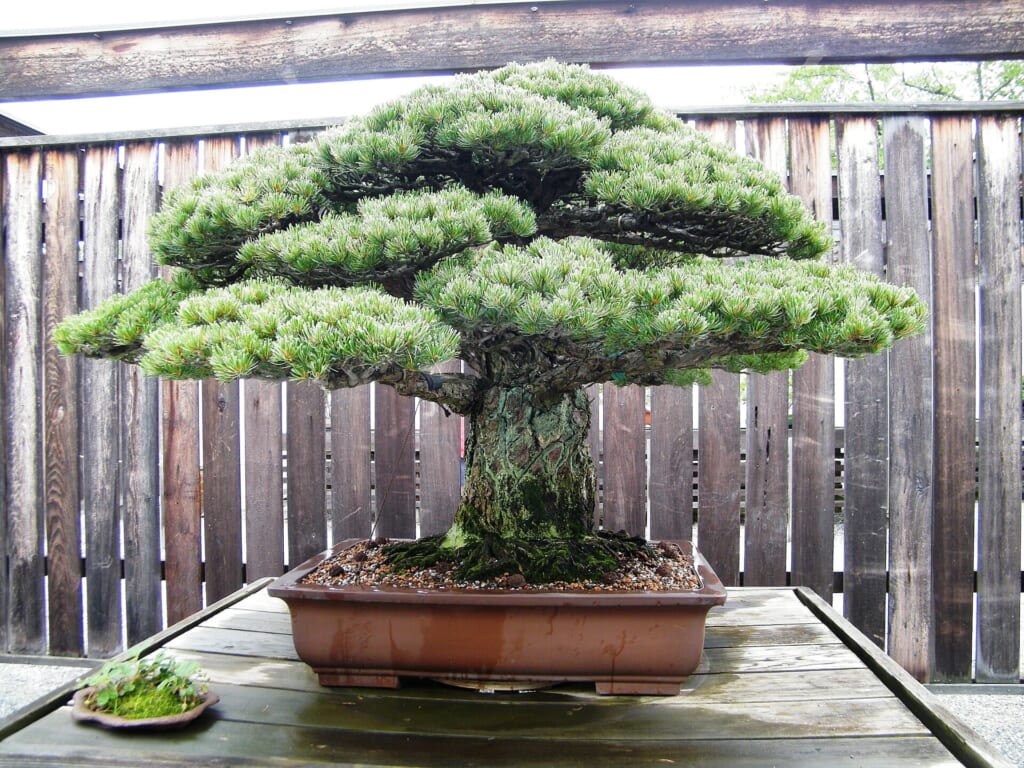
The Hiroshima survivor bonsai is the Yamaki pine, a Japanese white pine (Pinus parviflora) in training since 1625, now in the National Bonsai & Penjing Museum at the U.S. National Arboretum in Washington, D.C. It came through the atomic bombing of 6 August 1945 at the Yamaki family’s bonsai nursery in Hiroshima, about three kilometres from the explosion by the family’s account. It is in America because Masaru Yamaki gave it in 1976, as one of 53 bonsai that the Nippon Bonsai Association presented for the American Bicentennial.
The Arboretum did not learn that this tree had survived the bombing until two of Masaru’s grandsons visited in 2001. This article starts with that visit, then goes back through the tree’s four centuries: the species, the date 1625, the morning of the bombing, the gift, and the yearly hand work that keeps a five-needle pine alive in a pot.
March 2001 — Two Brothers Come to See Their Grandfather’s Tree
Straight from the airport
On 8 March 2001, two brothers from Japan landed in Washington, checked into their hotel and, in the words of the National Bonsai Foundation’s account, “headed straight to the Museum”. They were Shigeru Yamaki, grandson of the man the Foundation calls “bonsai master Masaru Yamaki”, and his younger brother Akira. They knew their grandfather’s pine well from photographs and family stories, but “they had never seen it”.
At the museum, volunteers Yoshiko Tucker and Michiko Hansen took their enquiry and called the curator, Warren Hill. Over lunch, with the two volunteers interpreting, the brothers told the story of their family and the tree, including what happened on the morning of 6 August 1945.
What the museum had not known
The tree had been on display in Washington since 1976. National Geographic later reported that the Arboretum “wasn’t aware of the Hiroshima connection until 2001”. The sources do not say why the bombing was not recorded at the time of the gift, and this article does not guess.
The visit started a new chapter in the tree’s record. Back in Japan, Shigeru gathered photographs and other records from his father, and on 1 September 2003 he returned to Washington “bringing with him copies”. Earlier that year, on 9 May 2003, Masaru’s daughter Takako Yamaki Tatsuzaki had visited with members of her family. Masaru himself had come long before: a 1979 photograph from the Arboretum shows him standing beside his tree in Washington.
The Tree at the Pavilion Door — What the Brothers Saw
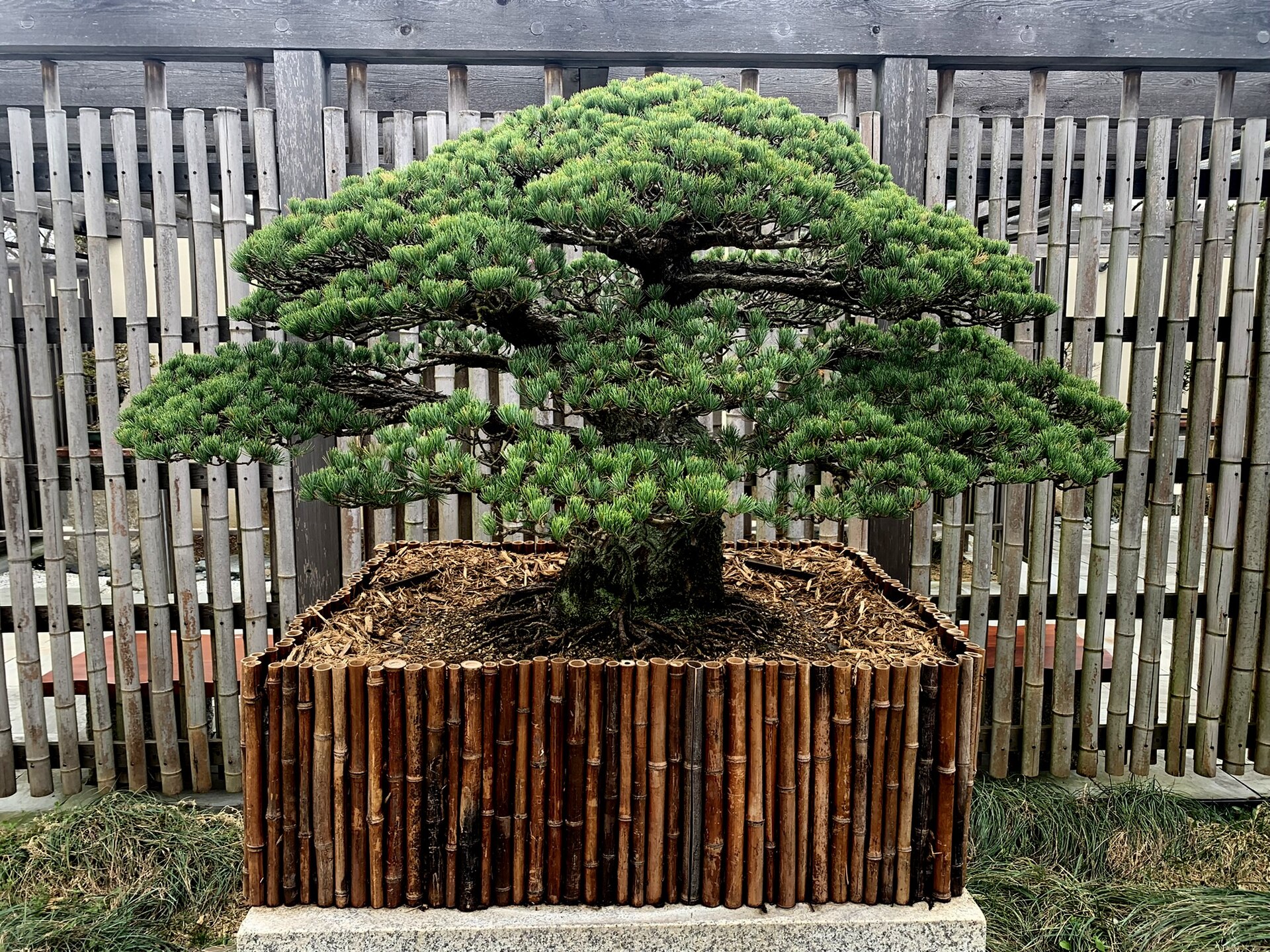
A low dome of needles over a heavy trunk
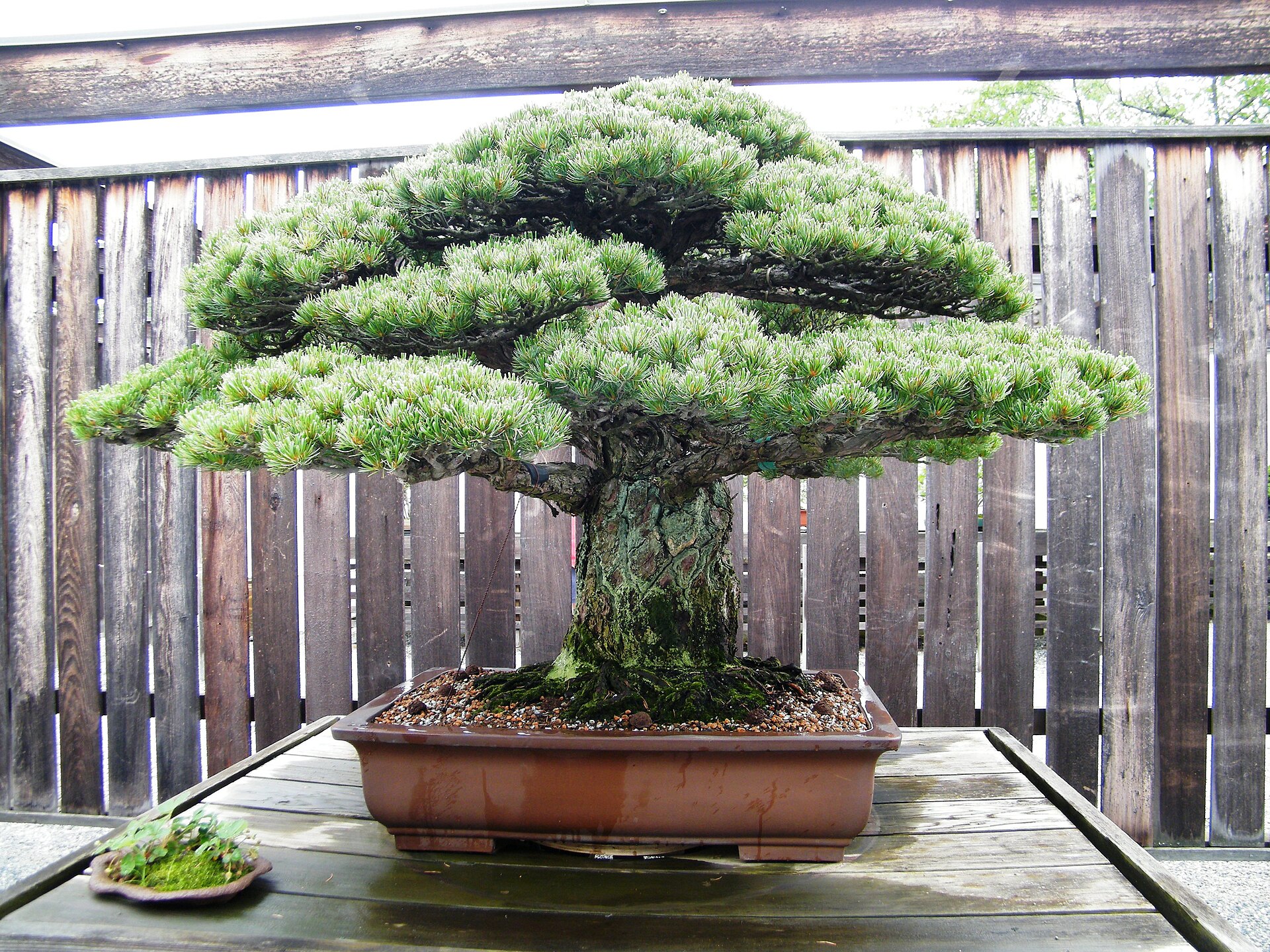
The Yamaki pine is displayed at the entrance to the Japanese Pavilion. The Foundation describes it as the tree people see “when they enter into the Japanese Pavilion”. An NPR reporter who stood in front of it in May 2025 described it as “about 2 feet tall in a black rectangular pot, its green foliage perfectly trimmed.”
The crown is a broad, flat-topped dome of needle pads, wider than the tree is tall, over a short, heavy trunk. That silhouette is the classic image of an old pine in Japan, and it is made by people, through generations of pruning, wiring and needle work.
Measurements that do not agree
Published figures for the tree differ. The Foundation’s 2020 annual report says it “stands approximately 44 inches and weighs more than 400 pounds”. A Foundation article on the 2020 repotting gives the tree and pot together as “between 200 and 300 pounds”. The NPR figure is a reporter’s description. How each was measured could not be confirmed, so this article does not choose one.
Why a potted tree could travel
A bonsai is an ordinary tree species kept small in a shallow container by root and crown pruning. Because it lives in a pot, it can be inherited, moved and shipped across an ocean. That is the plain reason this survivor of Hiroshima lives in Washington.
Five Needles in a Bundle — What a Japanese White Pine Is
Pinus parviflora ‘Miyajima’
The Foundation’s catalogue lists the tree as “Japanese white pine” and gives the name Pinus parviflora ‘Miyajima’. In Japanese the species is goyō-matsu (五葉松), “five-leaf pine”, and the Nippon Bonsai Association uses the same Latin name.
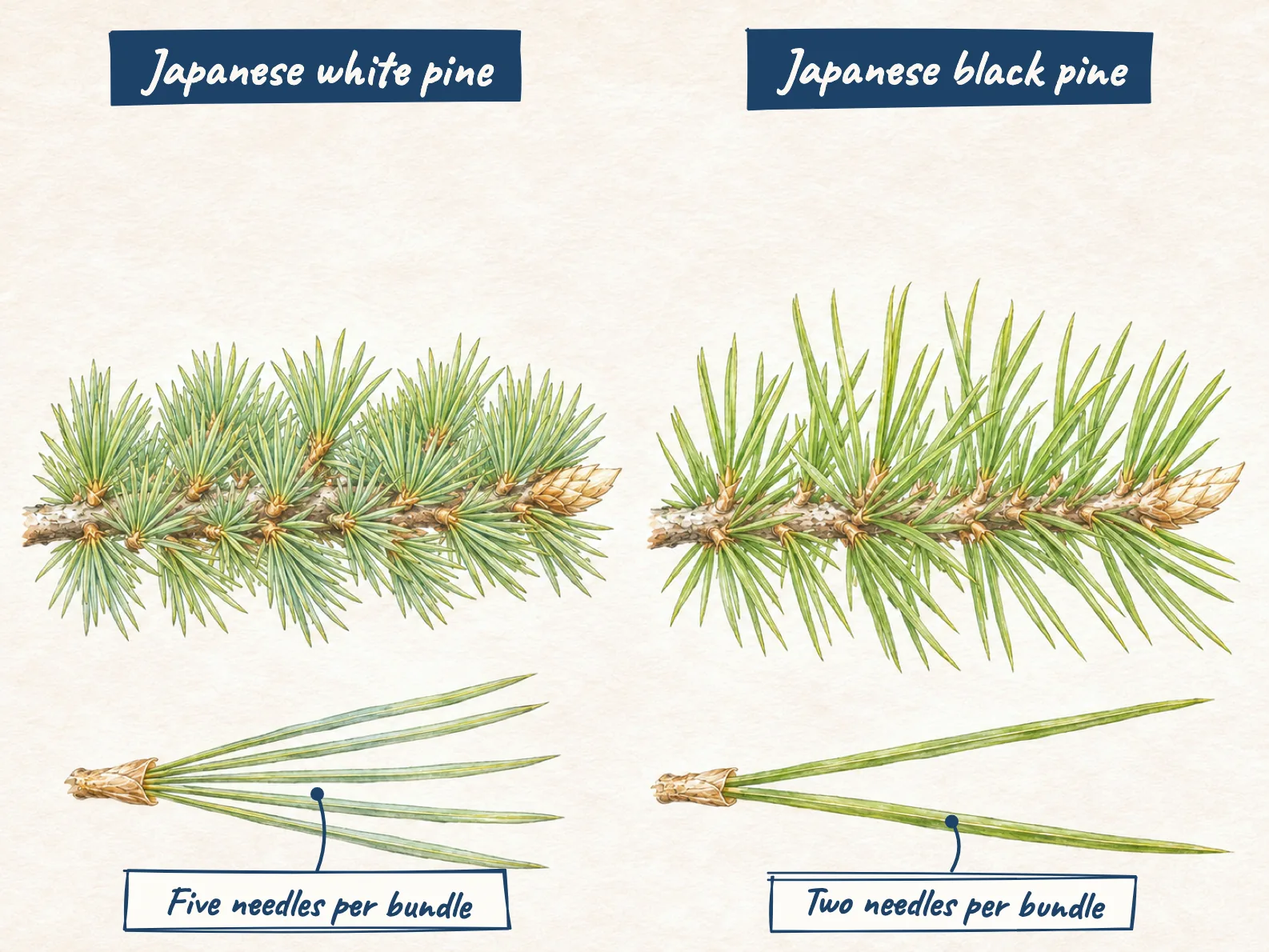
The “five leaves” are needles. The Forestry and Forest Products Research Institute (FFPRI) puts the difference in one line: the needles are not in pairs like those of red pine or black pine (kuro-matsu, 黒松) but grow five to a bundle (「二本一組ではなく、五本束生します」). Counting the needles in one bundle is the quickest way to tell the two apart, and the two species need different handling in spring, as the care section below explains.
What ‘Miyajima’ tells us, and what it does not
FFPRI’s Kyushu centre describes a tree it thinks is probably of the Miyajima type, which it calls the type most in demand, and says it is propagated by grafting: cleft grafts in February or March onto black pine seedlings two to three years old.
That page describes one specimen and its propagation; it says nothing about the Yamaki pine. None of the sources checked says whether the Yamaki pine was grafted or where its first plant came from. The cultivar name is not evidence that the tree was collected on the island of Miyajima.
| Japanese white pine (goyō-matsu) | Japanese black pine (kuro-matsu) | |
|---|---|---|
| Needles per bundle | Five | Two |
| Spring work on new shoots | Remove only the strong buds in early May; no candle cutting (Kinashi) | Candle cutting (me-kiri) in June–July to force a second, shorter flush (Kinashi) |
| Second flush after cutting | Not produced, so not de-candled (Cheshire Bonsai Society) | Produced; the basis of needle shortening |
| Grafting noted by FFPRI | Scion, for the Miyajima type | Rootstock (seedlings two to three years old) |
In Training Since 1625 — Reading the Date
A training date, not a birth date
The catalogue entry reads “In training since 1625”. It records when the tree’s life as a trained tree is said to have begun, not when the seed germinated or the plant was collected. The tree’s age from seed is unknown. In 2025 the Foundation celebrated the “400th anniversary of the Yamaki Pine” on World Bonsai Day with a formal tea toast; it is four hundred years of training that is being counted.
The early owners are not recorded in the sources checked. The catalogue does record that the tree “was in the same family in Japan” until the gift.
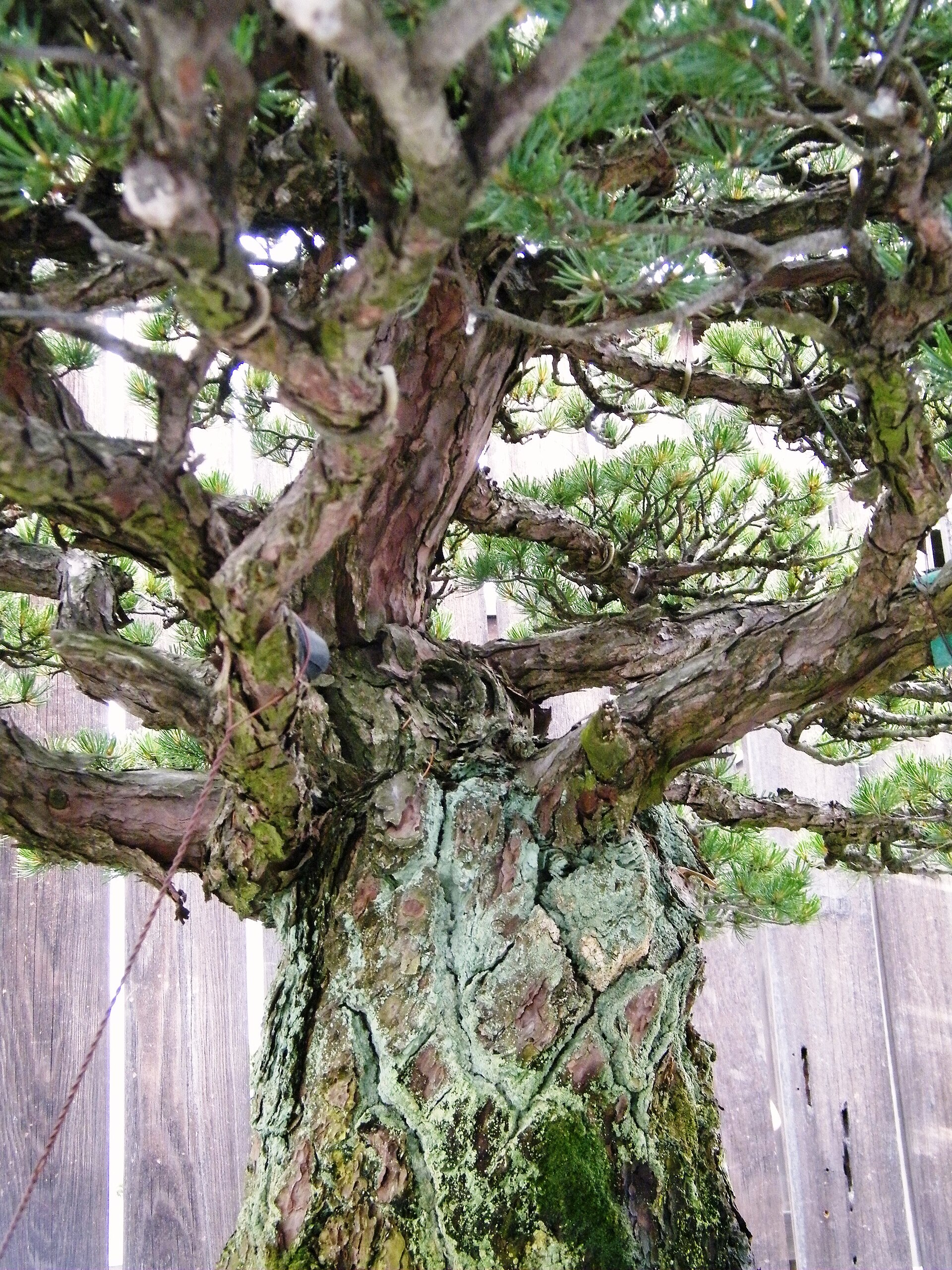
How many generations?
National Geographic counted five generations of the Yamaki family; Smithsonian Magazine wrote at least six. How the generations were counted could not be confirmed. What can be said is that the tree passed through many generations of one family before it left Japan.
The tree’s life in dates
| Year | Event | Source |
|---|---|---|
| 1625 | Recorded start of training | National Bonsai Foundation catalogue |
| 6 Aug 1945 | Atomic bombing of Hiroshima; the tree survives at the Yamaki nursery | NBF; Smithsonian |
| Early 1975 | The gift trees reach the United States and spend a year in quarantine at Glenn Dale, Maryland | NBF collection history |
| July 1976 | The Nippon Bonsai Association formally presents 53 bonsai; the museum begins | NBF museum history; USDA ARS |
| 1979 | Masaru Yamaki photographed with his tree in Washington | U.S. National Arboretum photo, via Smithsonian |
| 8 Mar 2001 | Grandsons Shigeru and Akira Yamaki visit and tell the bombing story | NBF |
| 2003 | Visit by Masaru’s daughter (9 May); Shigeru returns with family records (1 Sep) | NBF |
| 2015 | Repotted | NBF |
| 5 Aug 2019 | Sister-museum declaration with the Omiya Bonsai Art Museum signed in front of the tree | City of Saitama |
| 26 Mar 2020 | Repotted | NBF |
| 2025 | 400th anniversary of training celebrated | NBF; NPR |
| End of 2025 | The National Bonsai Foundation concludes operations; the museum stays open under the Arboretum | NBF |
8:15 a.m., 6 August 1945 — The Nursery Outside the Centre
The morning of the bombing
The City of Hiroshima records the moment in two lines: at 8:15 a.m. on 6 August 1945, for the first time in human history, an atomic bomb was dropped on Hiroshima. The city gives the most reliable position of the explosion as 600 metres above Shima Hospital; the ground directly below is the hypocentre.
The Yamaki family were indoors. In the account the Foundation published in 2003, the blast “blew out all the glass windows” of the house and “each member of the family was cut” by flying glass, but “none of them suffered any permanent injury”.
How far from the hypocentre?
In Shigeru’s account, published by the Foundation, the family’s property was about “three kilometers” from the explosion. The Foundation’s 2020 report says “less than two miles”; Smithsonian Magazine said two miles and National Geographic within two miles. The point each distance was measured from could not be confirmed, so the safest statement is the family’s own: about three kilometres.
For comparison, Hiroshima’s register of survivor trees, described in the next section, covers trees within about two kilometres of the hypocentre.
A tall wall
Smithsonian Magazine, drawing on the museum’s information, reported that the bonsai were “protected by a tall wall surrounding the outdoor nursery.” That is all the sources say. Where the wall stood in relation to the blast, and how much heat or pressure it kept off the trees, is not recorded, and there is no measurement of the tree’s exposure to radiation.
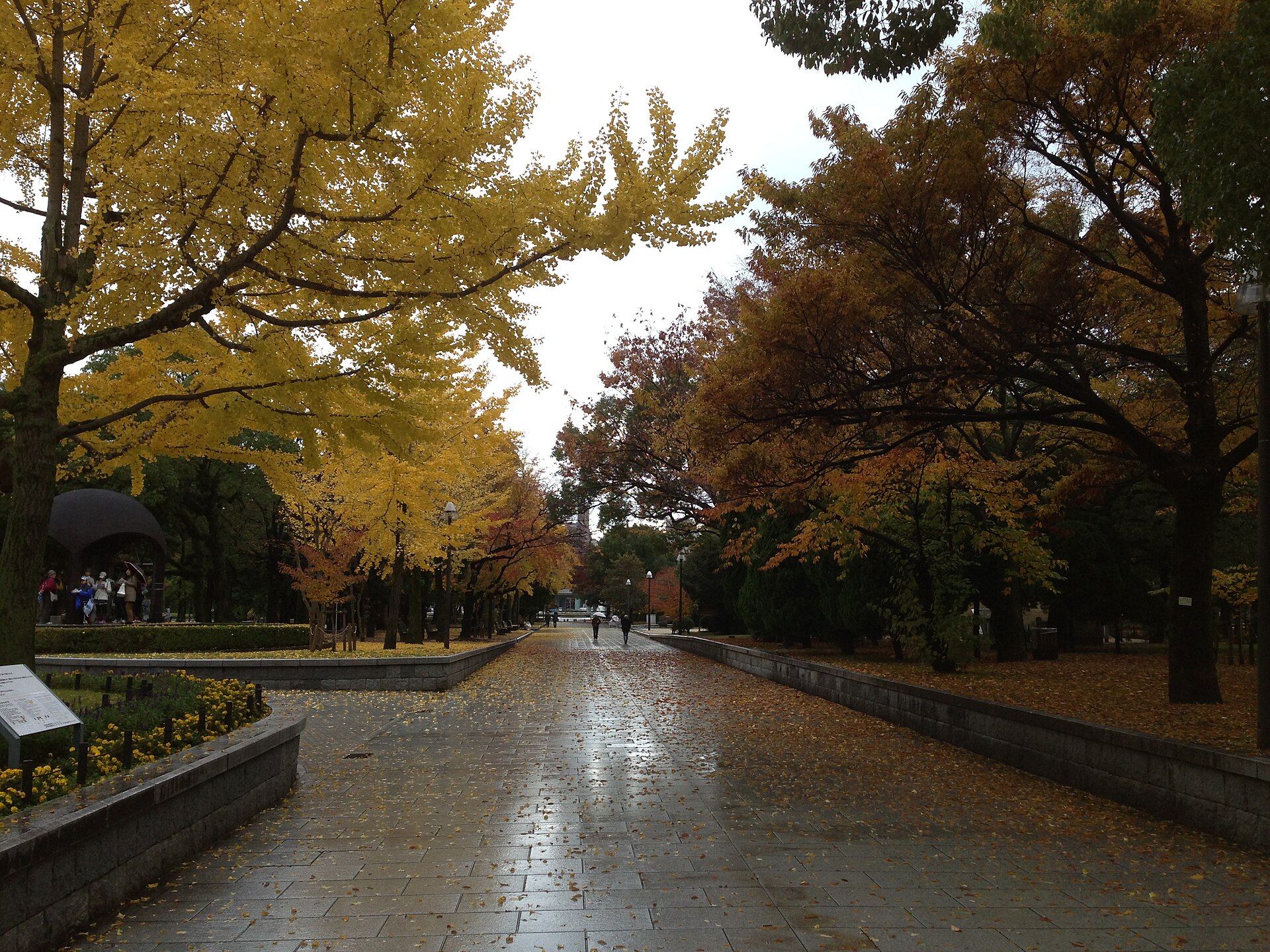
Hiroshima’s Survivor Trees — The Bonsai’s Rooted Relatives
A city said to be barren for 75 years
In its 2004 Peace Declaration, the City of Hiroshima recalled that the city had been so destroyed it was said nothing would grow there for 75 years (「75年間は草木も生えぬ」と言われた). The trees proved the saying wrong. UNITAR’s Green Legacy Hiroshima records that the parts above ground of the city’s muku trees and kurogane hollies burned down, “but their roots survived and sprouted later.” The city’s Chinese parasol tree (aogiri) lost every branch and leaf to the heat and blast, half its trunk on the hypocentre side was burned away, and it sprouted again the next spring.
The city’s register: 159 trees
Since fiscal 1996, the City of Hiroshima has registered surviving trees within about two kilometres of the hypocentre. As of March 2026 the register held 159 trees. Many carry plates giving their distance from the hypocentre and a short description, and at one site the city’s staff installed a new plate in Japanese and English. The city has jumoku-i (樹木医, certified tree doctors) monitor the trees, carries out treatments to restore the health of city-owned survivor trees, and subsidises the same work on private ones. We wrote about how some of these trees still lean toward the hypocentre in Hiroshima’s survivor trees still lean toward ground zero.
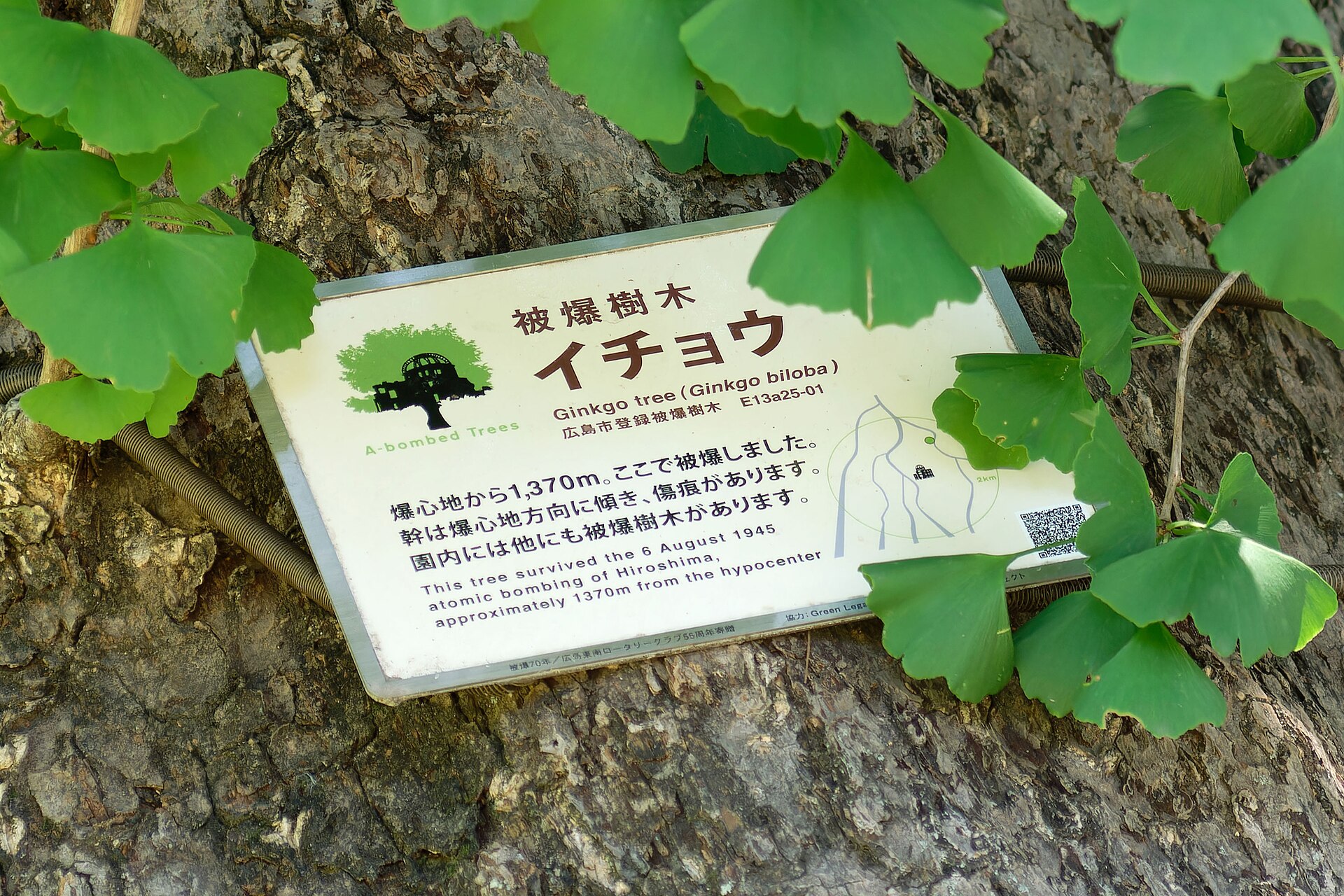
Three survivor trees near the hypocentre
| Registered tree | Distance from hypocentre | What the city records |
|---|---|---|
| Weeping willow, west of the Youth Center by the Hon River | 370 m | The closest of the surviving trees to the hypocentre |
| Kurogane holly, Rai Sanyō Historical Museum | 410 m | Shaded by the former Bank of Japan Hiroshima branch, so it did not burn, but the blast broke its trunk |
| Weeping willow, Hannover Garden by the Children’s Museum | 450 m | Exposed nearby; later transplanted to its current site |
A 2014 study in the journal of the Japanese Institute of Landscape Architecture listed the damage seen in these trees, beginning with burns and shrinkage caused by heat, radiation and the fires in surrounding buildings.
The difference a pot makes
The city’s survivors are rooted in Hiroshima’s soil; a few, like the willow in Hannover Garden, were moved within the city. The Yamaki pine crossed the Pacific. Like them, it is a living witness to the bombing, now cared for in Washington.
Fifty-Three Trees for a Birthday — The 1976 Gift
From Japan to Glenn Dale, Maryland
For the 200th anniversary of American independence, the Nippon Bonsai Association sent bonsai to the United States. The trees arrived in early 1975, according to the Foundation’s collection history, and spent “a year in quarantine” at Glenn Dale, Maryland. The Nippon Bonsai Association “formally presented fifty-three bonsai trees to the U. S. National Arboretum in July of 1976.” The USDA’s Agricultural Research Service counts the gift as “53 bonsai and 6 viewing stones” and says “The museum began in 1976”; one Foundation timeline gives seven stones.
Who gave what
The catalogue lists each tree with its donor. The Yamaki pine is a “Gift of Masaru Yamaki, 1976”. The same gift included a red pine from the Imperial Household, a hemlock from the household of Princess Chichibu, and a trident maple from the household of Prince Takamatsu. A family nursery in Hiroshima gave its tree alongside the imperial family’s.
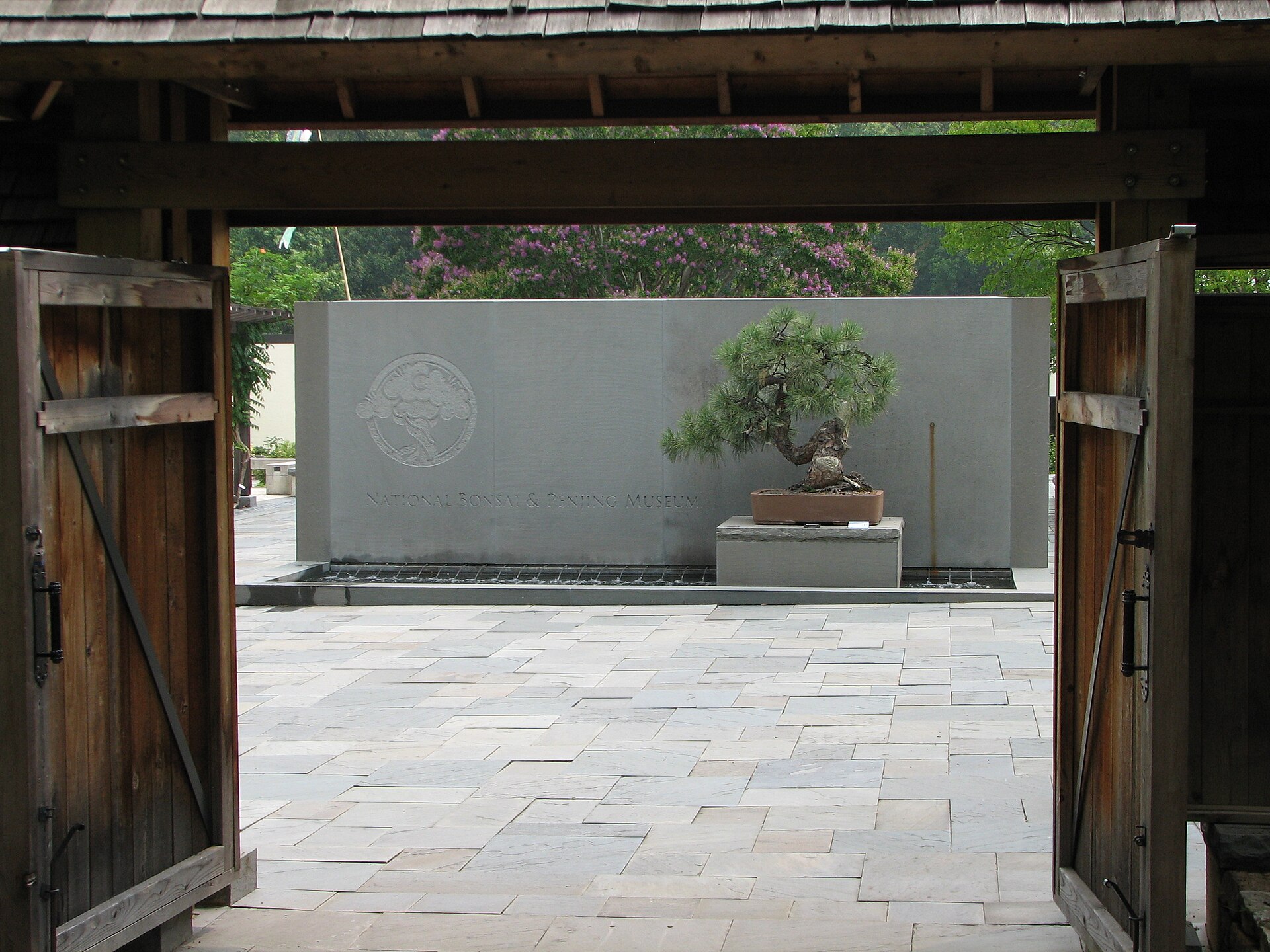
A gift of friendship
Kathleen Emerson-Dell of the museum put it simply to National Geographic: “It was a gift of friendship.” The stated occasion for the gift was the Bicentennial. The Arboretum learned of the tree’s Hiroshima history 25 years later, when the brothers visited.
Keeping a Five-Needle Pine in a Pot — The Yearly Work
A pine in a pot stays the same size only because someone controls each year’s growth. Five-needle pine and black pine need different handling at some key steps, above all in spring.
Spring: remove only the strong buds
The City of Saitama’s guide to practical work at the Omiya Bonsai Art Museum schedules pinching for pine bonsai in May, explaining that for black pine and five-needle pine the new shoots are nipped part way, to make short, even foliage. The Kinashi Bonsai Center in Kagawa, a growers’ organisation, is more specific: five-needle pine is not candle-cut, and in early May you scrape off only the strong buds.
Read literally, the rule means looking along each branch in early May and taking out only the most vigorous buds, leaving the weaker ones alone. The aim is to even out vigour, not to shorten everything.
Black pine is the opposite case. Kinashi describes me-kiri (芽切り, candle cutting) as the key method for short needles on black pine: cutting the first flush makes the tree produce a second, which has less time to grow, so its needles stay short. Large bonsai are cut in mid-June and small ones in early July, so that the needle length suits the tree. Bonsai societies in the West draw the same line. The Buffalo Bonsai Society in the United States notes that its candle-pruning steps “are for Black Pines (two needle sets)” and that “White Pines (five needle sets) are handled DIFFERENTLY!” The Cheshire Bonsai Society in Britain says single-flush pines such as Japanese white pine “must NOT be de-candled as they will NOT produce a 2nd flush of growth”. On this point Japanese and Western practice agree. Our article on midori-tsumi, reading a pine’s future in its spring candles covers the same spring decisions on garden pines.
September: removing old needles
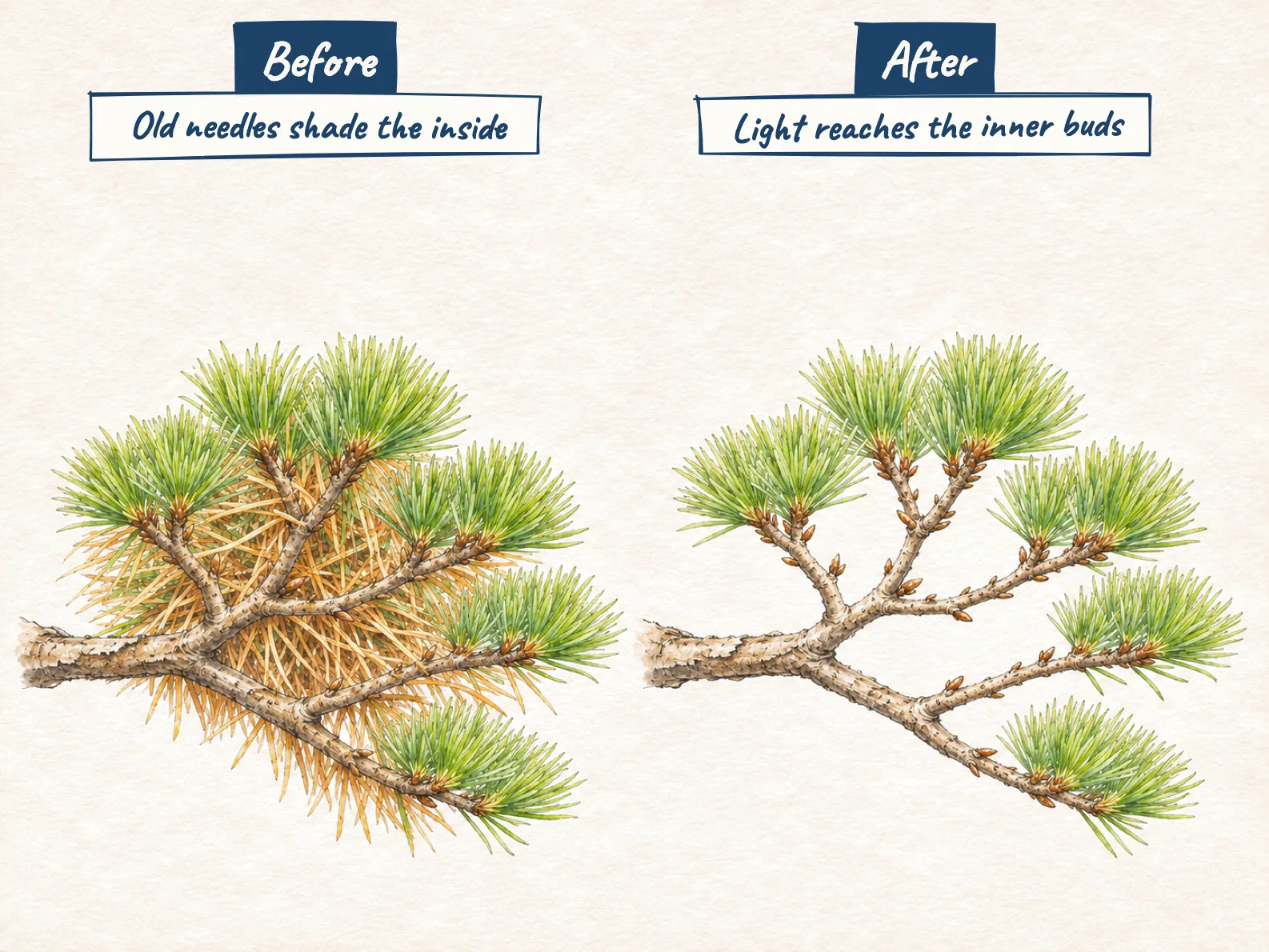
In September, Kinashi’s calendar turns to furuha-tori (古葉取り), taking off the old needles. Its reasons: better airflow and light, which also helps prevent pests and diseases and gives strength to the new buds. Old needles shade the inside of the branch; once they are gone, light reaches the small inner buds.
Autumn to winter: wiring
Branches are positioned with wire, and the rule is about the state of the tree, not the calendar. Kinashi’s guide to pine care says pines should be wired as little as possible while needles and buds are extending, because needles fall, break or deform during the work. The Cheshire Bonsai Society gives autumn as the ideal time to wire single-flush pines. As one example, the Omiya Bonsai Art Museum’s 2026 advanced course, which uses five-needle pine, holds its three wiring sessions in October and December 2026 and January 2027.
Every few years: repotting
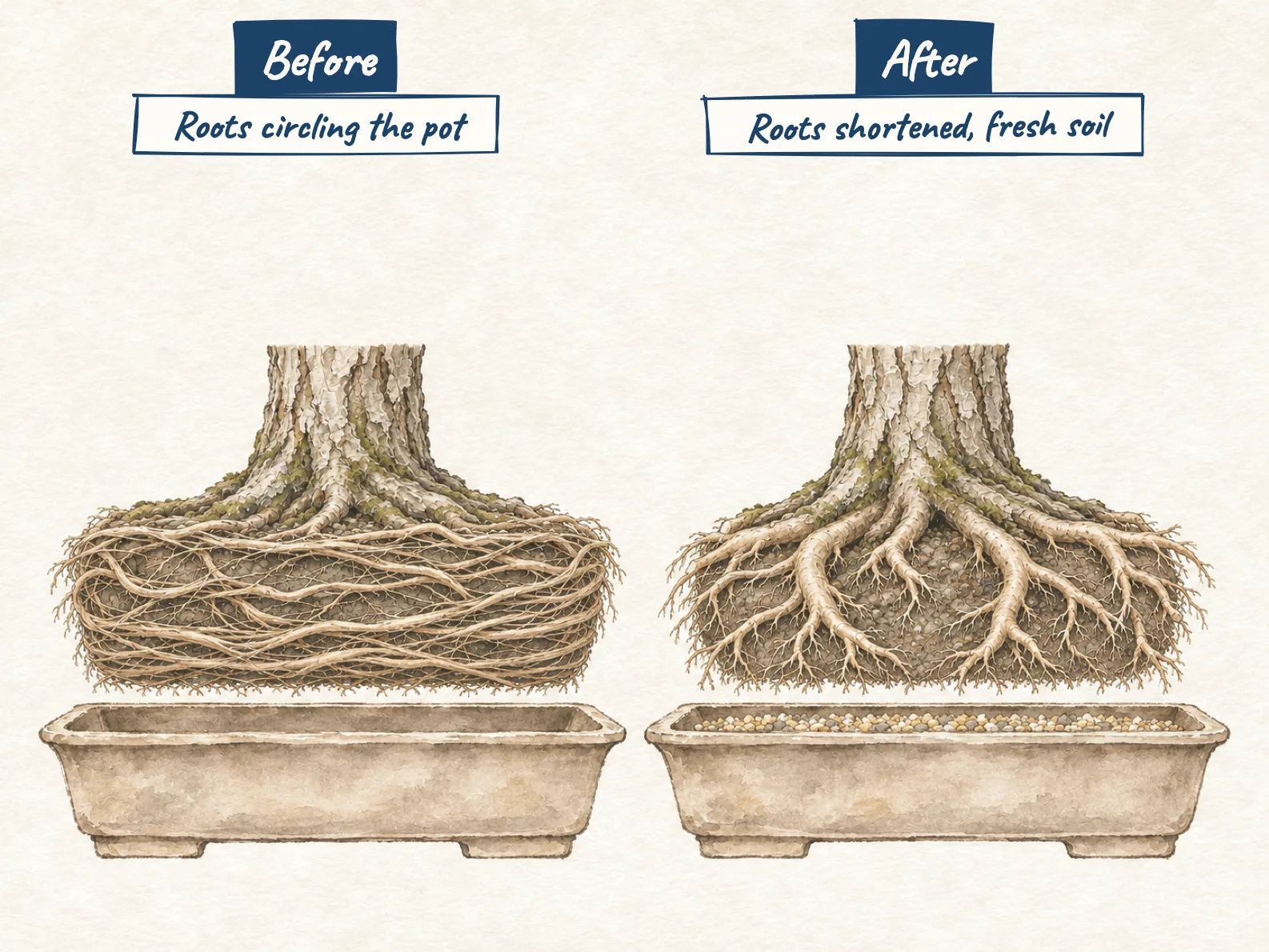
Kinashi explains repotting as cutting back and tidying overgrown roots, then using new soil to improve aeration and water retention so that new shoots grow well. For shohin (small) bonsai, the All Japan Shohin Bonsai Association gives a guide of about once every three years for conifers including black pine, red pine and five-needle pine, at the time new buds start to move.
Big old trees have their own records. The Omiya museum repotted its five-needle pine ‘Seiryū’ in early April 2024, for the first time in ten years. The Yamaki pine was repotted in 2015. Michael James and colleagues repotted it again on 26 March 2020, in a year when the museum was closed for most of the year.
A year of work on a five-needle pine bonsai
| When | Work | Deciding sign | Source |
|---|---|---|---|
| As new buds start to move | Repot (shohin conifers about every 3 years) | Roots overgrown; soil no longer drains or holds water well | All Japan Shohin Bonsai Association; Kinashi |
| Early May | Remove only the strong buds; no candle cutting | The strongest buds on each branch | Kinashi; City of Saitama (Omiya) |
| While needles extend | Do not wire | Needles still growing break or deform | Kinashi |
| September | Old-needle removal | Interior of branches shaded by old needles | Kinashi |
| Autumn (e.g. Oct 2026–Jan 2027 at Omiya) | Wiring | Shoots firm; needles no longer extending | Cheshire Bonsai Society; Omiya course |
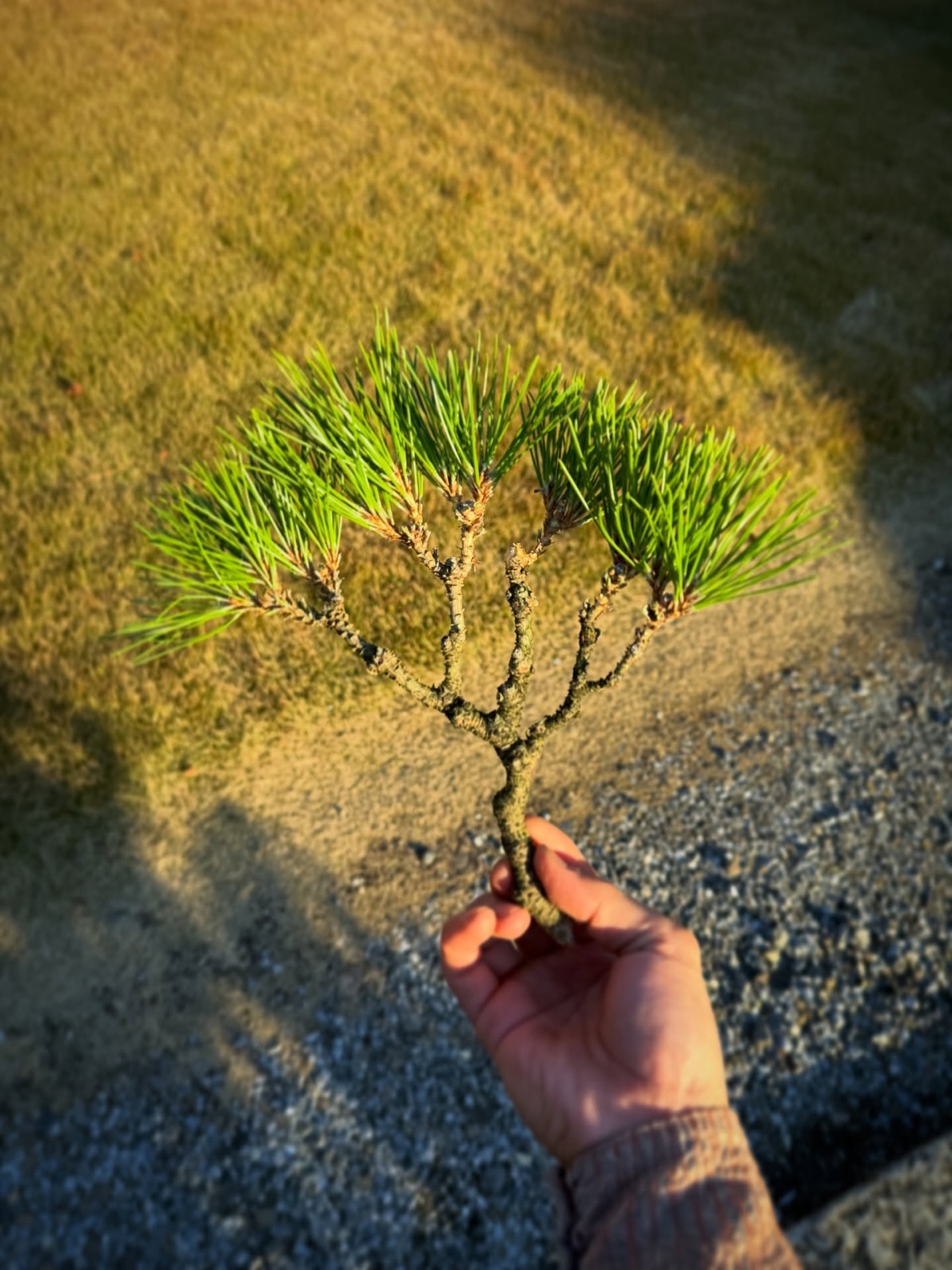
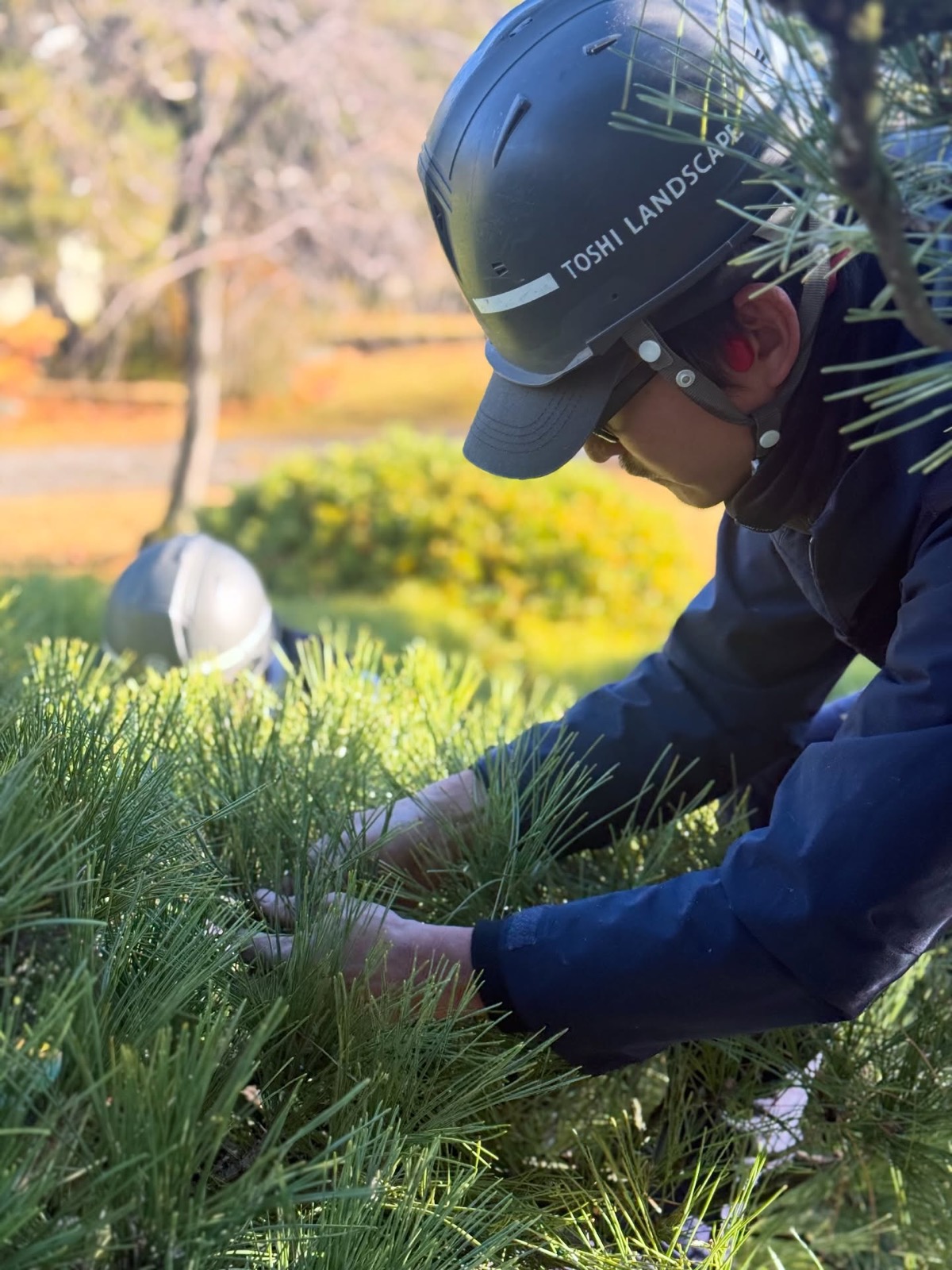
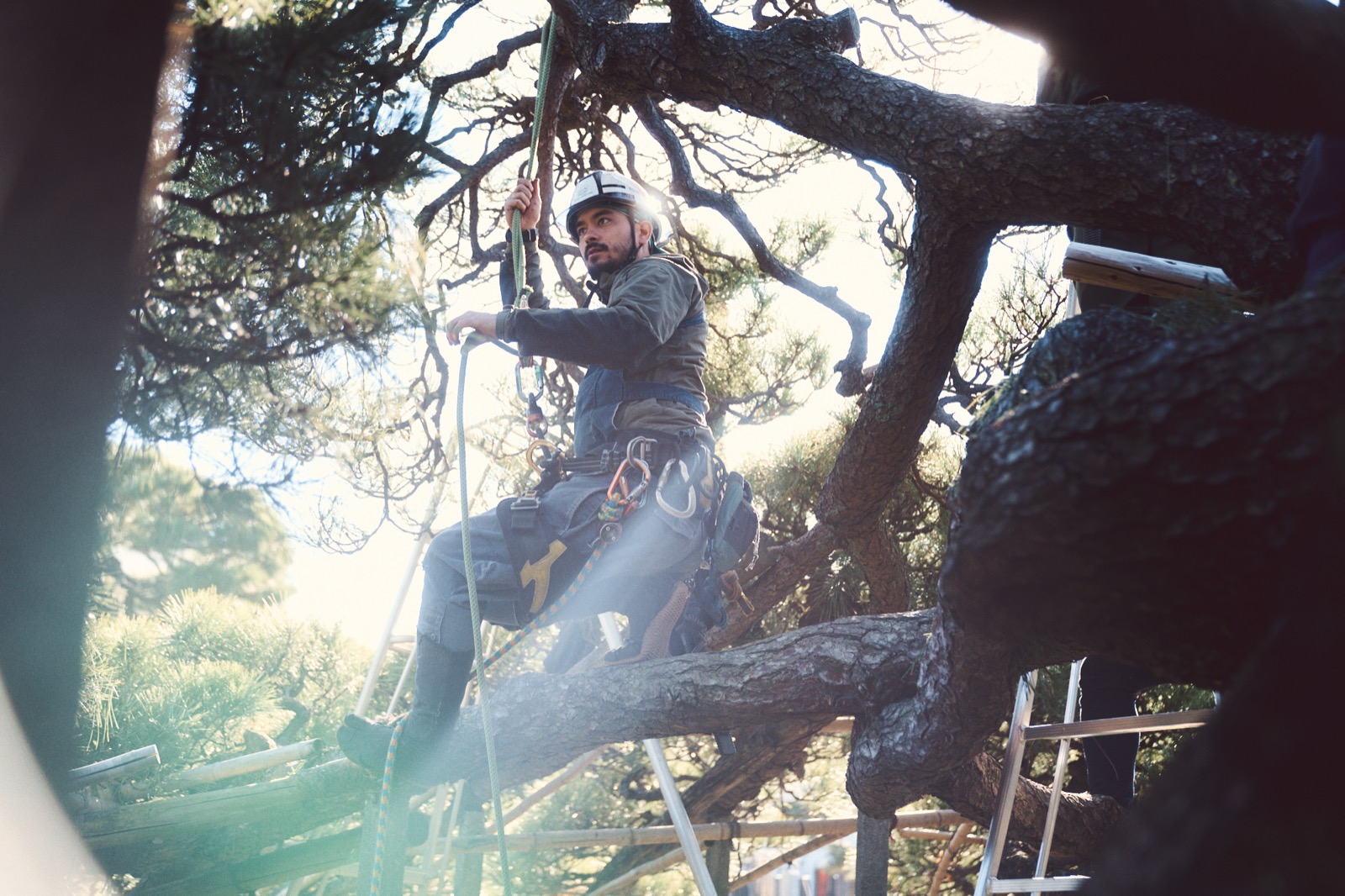
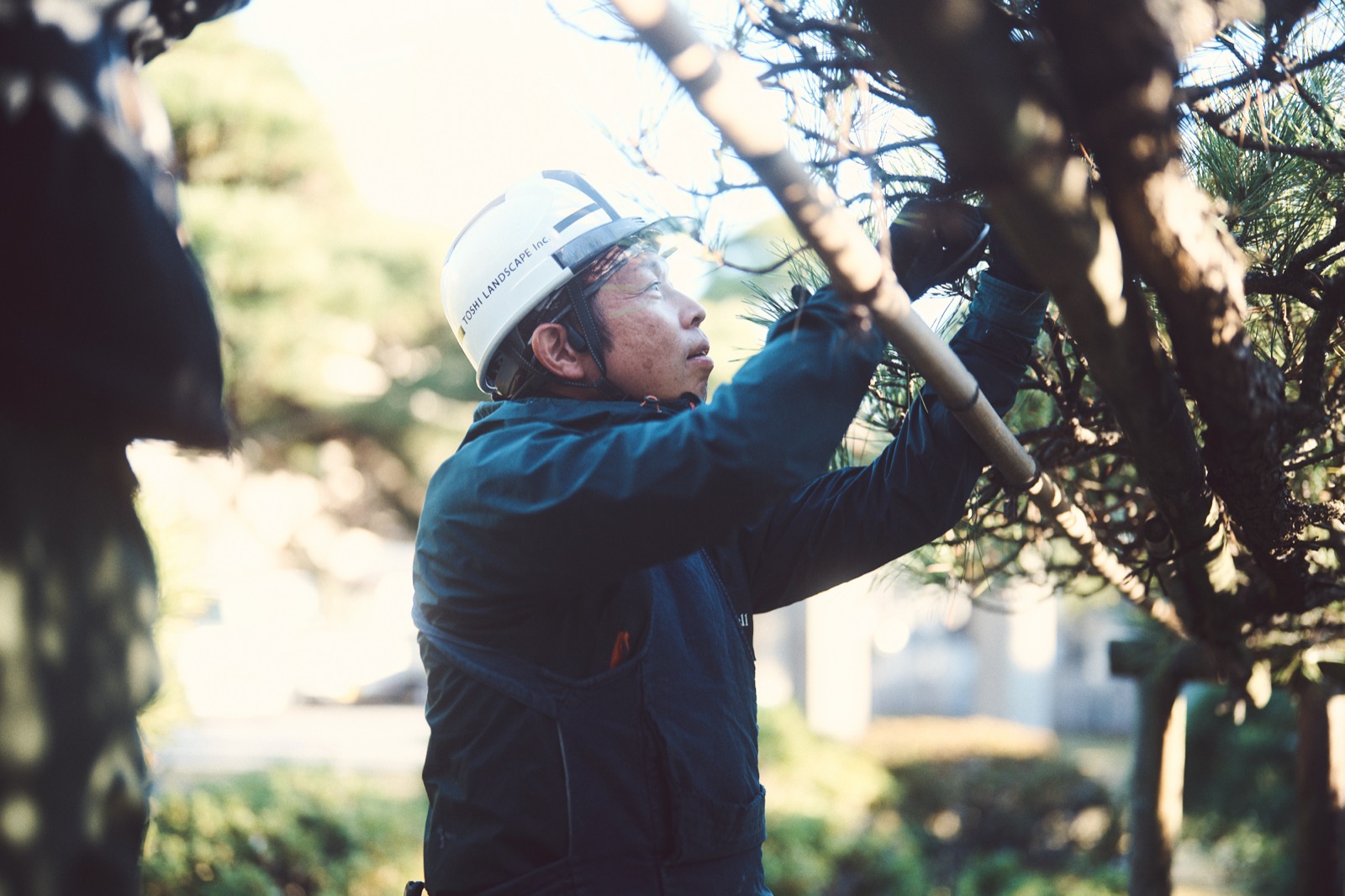
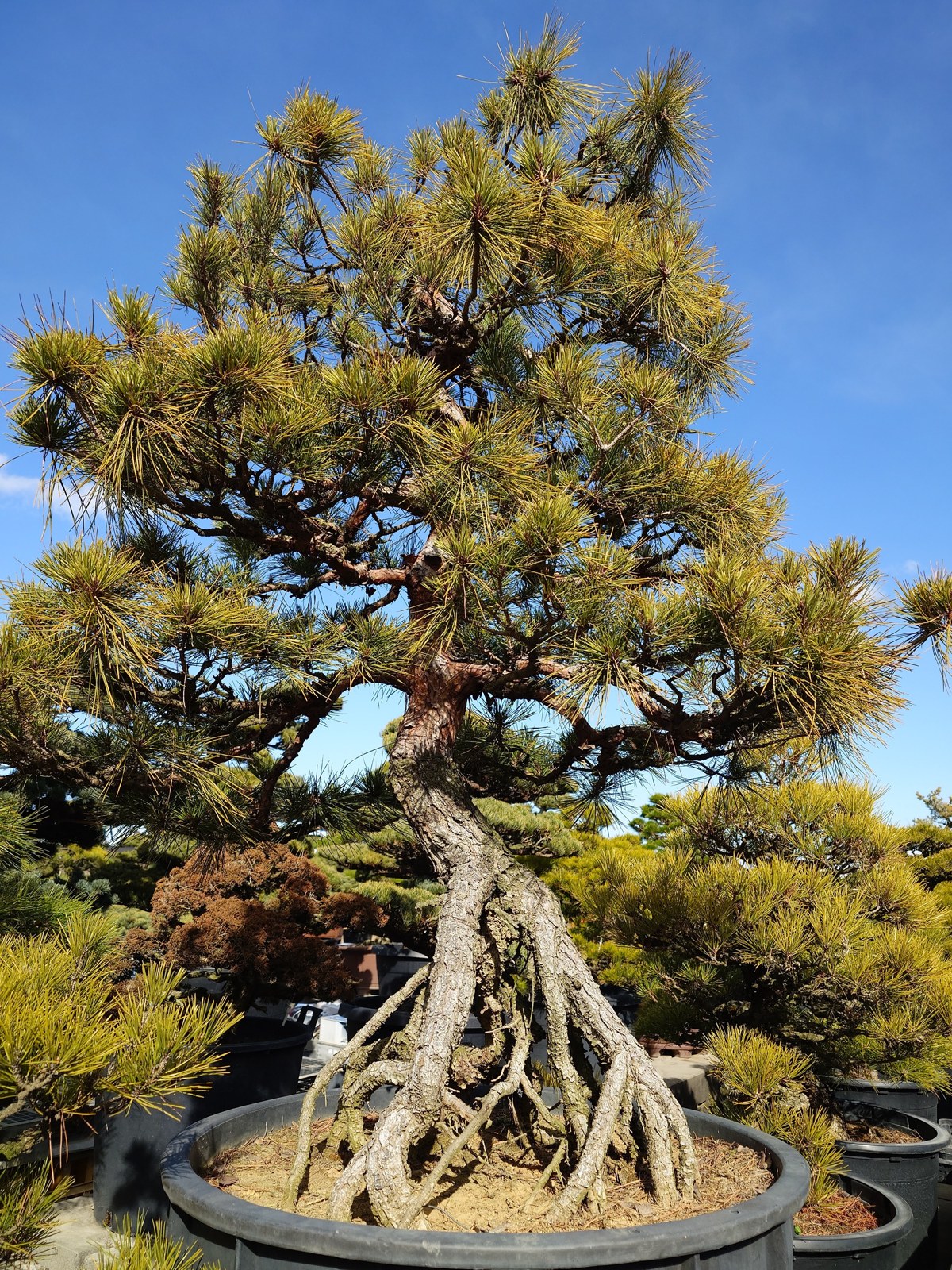
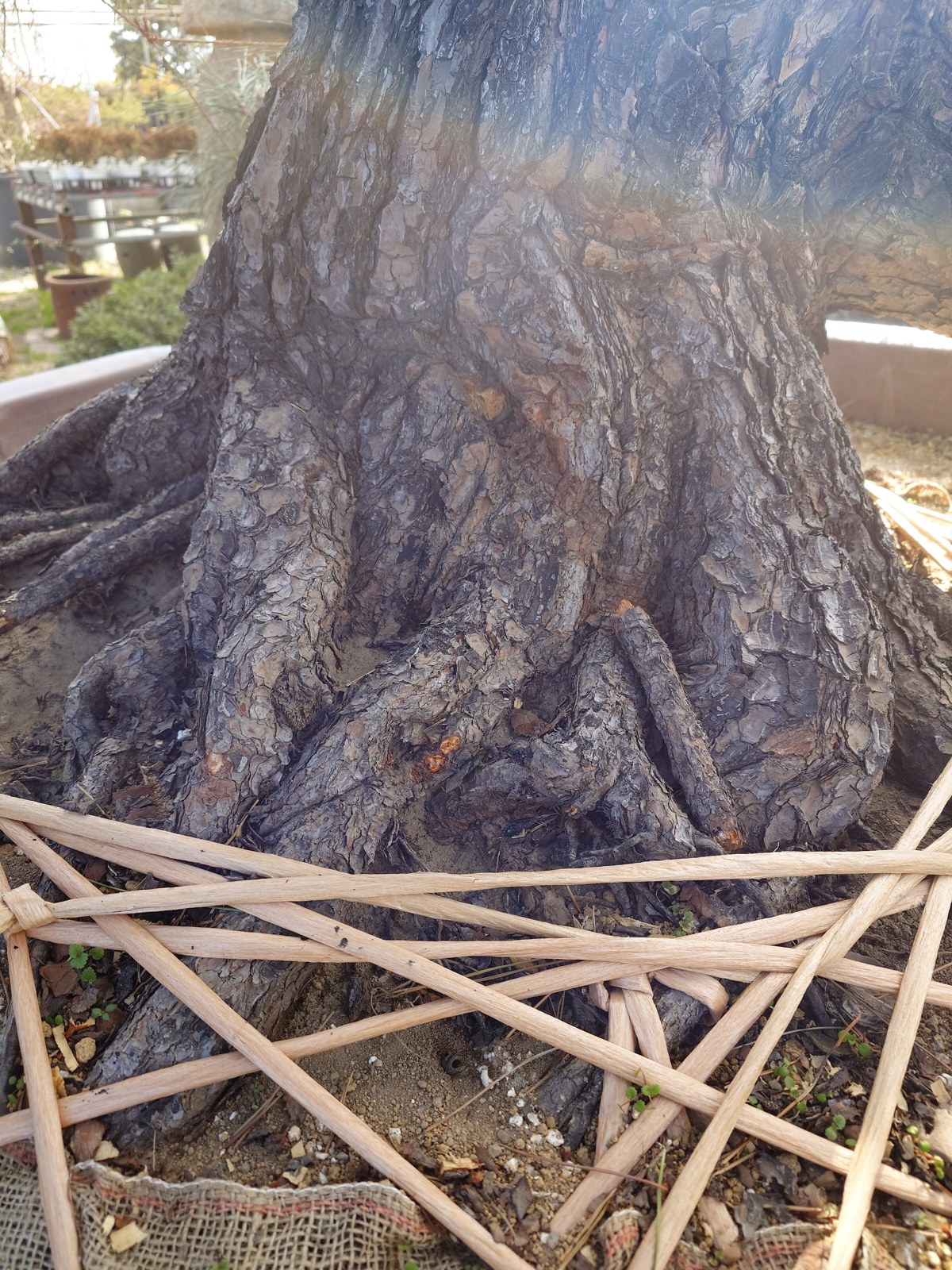
The Yamaki pine’s four hundred years are a record of this kind of care, passed from one generation to the next. In Japan the same hand work goes on in gardens at a larger scale: the photographs in this section show our own crews working garden pines.
How Japan Passes a Bonsai Down — Families, Owners and a Register
One family, or twelve owners
The Yamaki pine stayed in one family until 1976. That is not the only way a great bonsai survives in Japan. The Omiya Bonsai Art Museum’s five-needle pine ‘Higurashi’ has passed through 12 owners, the museum among them, in 90 years. The Nippon Bonsai Association runs a registration system for valuable bonsai, with the stated aim of preserving them and passing them on (保存・継承).
Since 1976 the Yamaki pine has belonged to a public institution, the U.S. National Arboretum, part of the U.S. Department of Agriculture. The two trees show different ownership histories: ‘Higurashi’ passed through many owners before entering a public museum, while the Yamaki pine has stayed in one public collection since 1976.
Three famous five-needle pines
| Tree | Where | What the record says |
|---|---|---|
| Yamaki pine | National Bonsai & Penjing Museum, Washington, D.C. | In training since 1625; one family until 1976; survived the Hiroshima bombing |
| ‘Sandai Shōgun’ (三代将軍, “the Third Shogun”) | Imperial Palace, Tokyo | Said to be 550 years old and traditionally associated with a Tokugawa shogun (Imperial Household Agency); presented to the imperial household under the will of Itō Miyoji (Agency for Cultural Affairs report) |
| ‘Higurashi’ (日暮し) | Omiya Bonsai Art Museum, Saitama | Passed through 12 owners in 90 years |
Reading age claims
Old bonsai attract round numbers. The Imperial Household Agency hedges its own description in Japanese: the ‘Third Shogun’ pine is said to be (と言われ) 550 years old and is traditionally associated (と伝えられる) with a shogun. The same care applies to the Yamaki pine, whose record is a training date. When you read “a 400-year-old bonsai”, ask whether the source means the tree’s age or the length of its training. Our piece on why Japan’s ancient trees live for a thousand years applies the same caution to trees in the ground.
The Tree Today — A New Partner and a Fiftieth Year
The Foundation steps back; the museum stays open
The National Bonsai Foundation, the private partner that had supported the museum for decades, “concluded operations at the end of 2025.” Its transition notes state: “The Museum will remain open and active under the care of the U.S. National Arboretum.” The Foundation’s site now points to the Friends of the National Arboretum (FONA), which “will serve as the Arboretum’s sole nonprofit partner”, and FONA offers restricted donations for the museum.
Fifty years of the museum
The Arboretum’s calendar listed a celebration of the museum’s 50th anniversary for 7 November 2026. Today more than 300 specimens rotate through the display tables of three pavilions and a special exhibits gallery. In 2019 the City of Saitama’s mayor told reporters that the sister-museum declaration with the Omiya Bonsai Art Museum had been signed on 5 August in front of the Yamaki pine, which he described as the five-needle pine given by Masaru Yamaki of Hiroshima (広島の山木勝氏から贈られた五葉松).
Visiting the Yamaki pine
| Item | Detail |
|---|---|
| Place | National Bonsai & Penjing Museum, U.S. National Arboretum, Washington, D.C. |
| Where the tree is shown | At the entrance to the Japanese Pavilion |
| Admission | Free to the Arboretum and the Museum |
| Usual hours | Generally 10 a.m. to 4 p.m. daily; closed on federal holidays from November through February |
| Winter | The Japanese and North American Pavilions close in winter; check before travelling to see this tree |
Three Common Misreadings
“The tree is 400 years old”
Four hundred years is the length of its training, celebrated in 2025, as explained above; it is not the tree’s age.
“It stood near ground zero” or “it was untouched by radiation”
By the family’s account the nursery was about three kilometres from the explosion, outside the two-kilometre circle Hiroshima uses for its register of survivor trees. What is recorded is a tall wall around the nursery and a family that survived with cuts from glass. No measurement of the tree’s exposure exists.
“It was sent to mark Hiroshima”
It was sent for the American Bicentennial. The Arboretum learned of its Hiroshima history only in 2001.
Frequently asked questions
What is the Hiroshima bonsai? It is the Yamaki pine, a Japanese white pine (Pinus parviflora ‘Miyajima’) in training since 1625. It survived the atomic bombing of Hiroshima at the Yamaki family’s nursery and is now in the National Bonsai & Penjing Museum in Washington, D.C.
Why is a Hiroshima bonsai in Washington, D.C.? Masaru Yamaki gave it in 1976 as one of 53 bonsai presented by the Nippon Bonsai Association for the American Bicentennial. The trees arrived in early 1975, spent a year in quarantine, and were formally presented in July 1976.
How did the bonsai survive the atomic bomb? By the family’s account the nursery was about three kilometres from the explosion, and Smithsonian Magazine reported that the bonsai were protected by a tall wall around the outdoor nursery. The family’s windows were blown out and everyone was cut by glass, but no one was permanently injured.
How old is the Yamaki pine? It has been in training since 1625, so it has been a bonsai for about 400 years. Its age from seed is not recorded.
When did the museum learn the tree’s history? In March 2001, when Masaru Yamaki’s grandsons Shigeru and Akira visited and told the story to staff through volunteer interpreters.
Can you see the Yamaki pine today? Yes. Admission is free, and the museum is generally open 10 a.m. to 4 p.m. The tree is shown at the Japanese Pavilion, which closes in winter, so check before you go.
Sources
– National Bonsai Foundation, “Japanese Collection” — species, cultivar, “In training since 1625”, “Gift of Masaru Yamaki, 1976”, one family until the gift, imperial gifts. https://www.bonsai-nbf.org/japanese-collection (checked 2026-10-30) – National Bonsai Foundation, “Yamaki Pine” — the 2001 visit, the family’s account of the bombing, distance, the 2003 return. https://www.bonsai-nbf.org/yamaki-pine (checked 2026-10-30) – National Bonsai Foundation, “Collections” and “The Museum” — arrival in 1975, quarantine at Glenn Dale, presentation in July 1976, 2003 visit, place at the Japanese Pavilion. https://www.bonsai-nbf.org/collections (checked 2026-10-30) – National Bonsai Foundation, “Repotting the World-Famous Yamaki Pine” (2 April 2020). https://www.bonsai-nbf.org/blog-archive/2020/4/2/repotting-the-world-famous-yamaki-pine (checked 2026-10-30) – National Bonsai Foundation, Annual Report 2020; “World Bonsai Day 2025”; “Transition FAQs”; “Location & Hours”. https://www.bonsai-nbf.org/ (checked 2026-10-30) – USDA Agricultural Research Service, “National Bonsai & Penjing Museum’s Anniversary” (October 2016). https://agresearchmag.ars.usda.gov/2016/oct/bonsai/ (checked 2026-10-30) – U.S. National Arboretum, “National Bonsai & Penjing Museum” and Calendar of Events. https://usna.usda.gov/discover/gardens-collections/national-bonsai-penjing-museum/ (checked 2026-10-30) – NPR, “Washington honors an ancient tree that survived Hiroshima” (19 May 2025). https://www.npr.org/2025/05/19/nx-s1-5383306/bonsai-survived-hiroshima-bombing-anniversary (checked 2026-10-30) – Smithsonian Magazine, “The Bonsai Tree That Survived the Bombing of Hiroshima” (4 August 2015). https://www.smithsonianmag.com/history/390-year-old-tree-survived-bombing-hiroshima-180956157/ (checked 2026-10-30) – National Geographic, “This Bonsai Survived Hiroshima But Its Story Was Nearly Lost” (5 August 2015). https://www.nationalgeographic.com/science/article/1508050-japanese-bonsai-survived-hiroshima-bombing (checked 2026-10-30) – City of Hiroshima, overview of the atomic bomb damage. https://www.city.hiroshima.lg.jp/atomicbomb-peace/fukko/1026918/1003094.html (checked 2026-10-30) – City of Hiroshima, register of A-bombed trees and support measures. https://www.city.hiroshima.lg.jp/atomicbomb-peace/peace-efforts/1006057/1015081.html (checked 2026-10-30) – City of Hiroshima, 2004 Peace Declaration. https://www.city.hiroshima.lg.jp/atomicbomb-peace/1036662/1003065/1036188/1026924/1008134.html (checked 2026-10-30) – UNITAR Green Legacy Hiroshima, “Trees in Hiroshima”. https://glh.unitar.org/en/trees-in-hiroshima/ (checked 2026-10-30) – Owaki, Suzuki and Horiguchi, study of tree-form abnormalities in A-bombed trees, Journal of the Japanese Institute of Landscape Architecture 77(5), 2014. https://www.jila-zouen.org/wpdata/wp-content/uploads/2014/04/627.pdf (checked 2026-10-30) – Forestry and Forest Products Research Institute, Kansai Research Center, “ゴヨウマツ” (five needles to a bundle). https://www.ffpri.go.jp/fsm/business/jumokuen/02_ka/goyoumatu.html (checked 2026-10-30) – Forestry and Forest Products Research Institute, Kyushu Research Center, “ゴヨウマツ” (grafting). https://www.ffpri.go.jp/kys/business/jumokuen/jumoku/zukan/goyoumatu.html (checked 2026-10-30) – Kinashi Bonsai Center (Kagawa), seasonal care pages for pine bonsai. https://www.kinashi-bonsai.com/teire/bonsai/06/ (checked 2026-10-30) – City of Saitama, Omiya Bonsai Art Museum practical work guide (盆栽実技). https://www.city.saitama.lg.jp/004/005/004/006/003/p134722.html (checked 2026-10-30) – Omiya Bonsai Art Museum, “Jinshari” Vol. 47 (five-needle pine ‘Higurashi’). https://www.bonsai-art-museum.jp/wp-content/uploads/2023/09/eb236c70e7a4e16b50aa36e201ba0245.pdf (checked 2026-10-30) – Omiya Bonsai Art Museum, 2026 advanced course outline (wiring schedule). https://www.bonsai-art-museum.jp/wp-content/uploads/2026/04/d8eb589286fee6f691574d276f752b3e.pdf (checked 2026-10-30) – City of Saitama, mayor’s press briefing of 29 August 2019 (sister-museum declaration in front of the Yamaki pine). https://www.city.saitama.lg.jp/006/003/003/010/011/p066398_d/fil/0829kaikennroku.pdf (checked 2026-10-30) – All Japan Shohin Bonsai Association, guide to growing bonsai. https://shohin-bonsai.or.jp/ (checked 2026-10-30) – Buffalo Bonsai Society, “Black Pines: Needle & Candle Pruning”. https://buffalobonsaisociety.com/Black_Pine_Pruning.html (checked 2026-10-30) – Cheshire Bonsai Society, “How To Care For Pine Bonsai”. https://cheshirebonsaisociety.co.uk/how-to-care-for-pine-bonsai/ (checked 2026-10-30) – Nippon Bonsai Association, association overview. https://bonsai-kyokai.or.jp/company.html (checked 2026-10-30) – Imperial Household Agency, notes on the Imperial Palace bonsai garden. https://www.kunaicho.go.jp/learn/institution/shisetsu/kokyo/bonsai-ph/harukazari-sakusei.html (checked 2026-10-30) – Agency for Cultural Affairs, “近代盆栽の誕生と展開” (survey report). https://www.bunka.go.jp/tokei_hakusho_shuppan/tokeichosa/seikatsubunka_chosa/pdf/94359701_05.pdf (checked 2026-10-30)