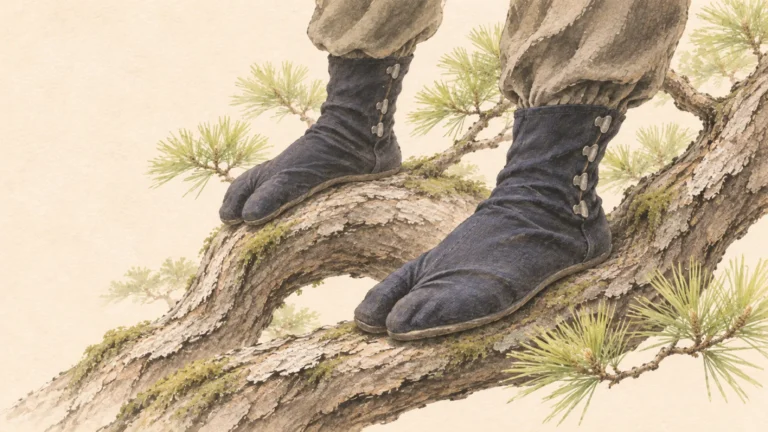
Japanese gardeners work from a three-legged tripod ladder, the sankyaku (三脚), because its single back leg can be set between branches, which brings the gardener close to the foliage being cut. Three feet also settle on the soft, uneven soil of a garden, and the 1.8 to 3.6 m aluminium tripods listed below weigh about 5.6 to 14 kg; in our photographs below, one gardener carries and sets his ladder alone. The same three-legged design is used in American orchards and landscape work; in Japan it is taught and used for clipping hedges, rounded shrubs and pines.
This article follows one ladder into a maple, then the parts, the clipped shapes it is used on, its history, the American orchard ladder, and the rules for where to stand.
Prefer to watch? The video version (6 min):
A Ladder Walks Into a Maple — The Scene
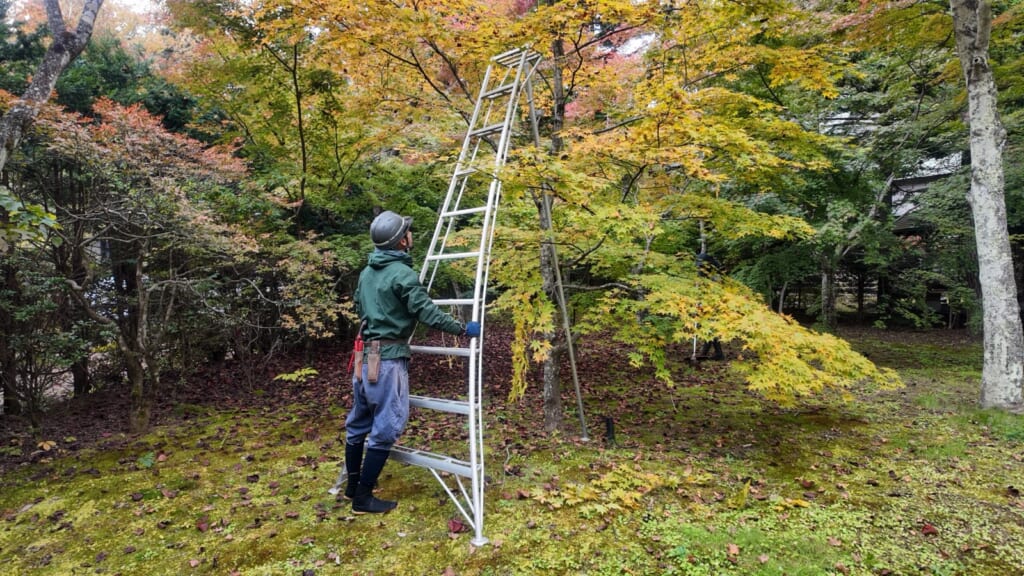
Just after nine in the morning on 30 October 2025, one of our gardeners was at work in a garden of Japanese maples. The leaves were turning yellow and orange, and the ground under the trees was moss and fallen leaves. He carried a folded aluminium tripod ladder across the moss to a maple.
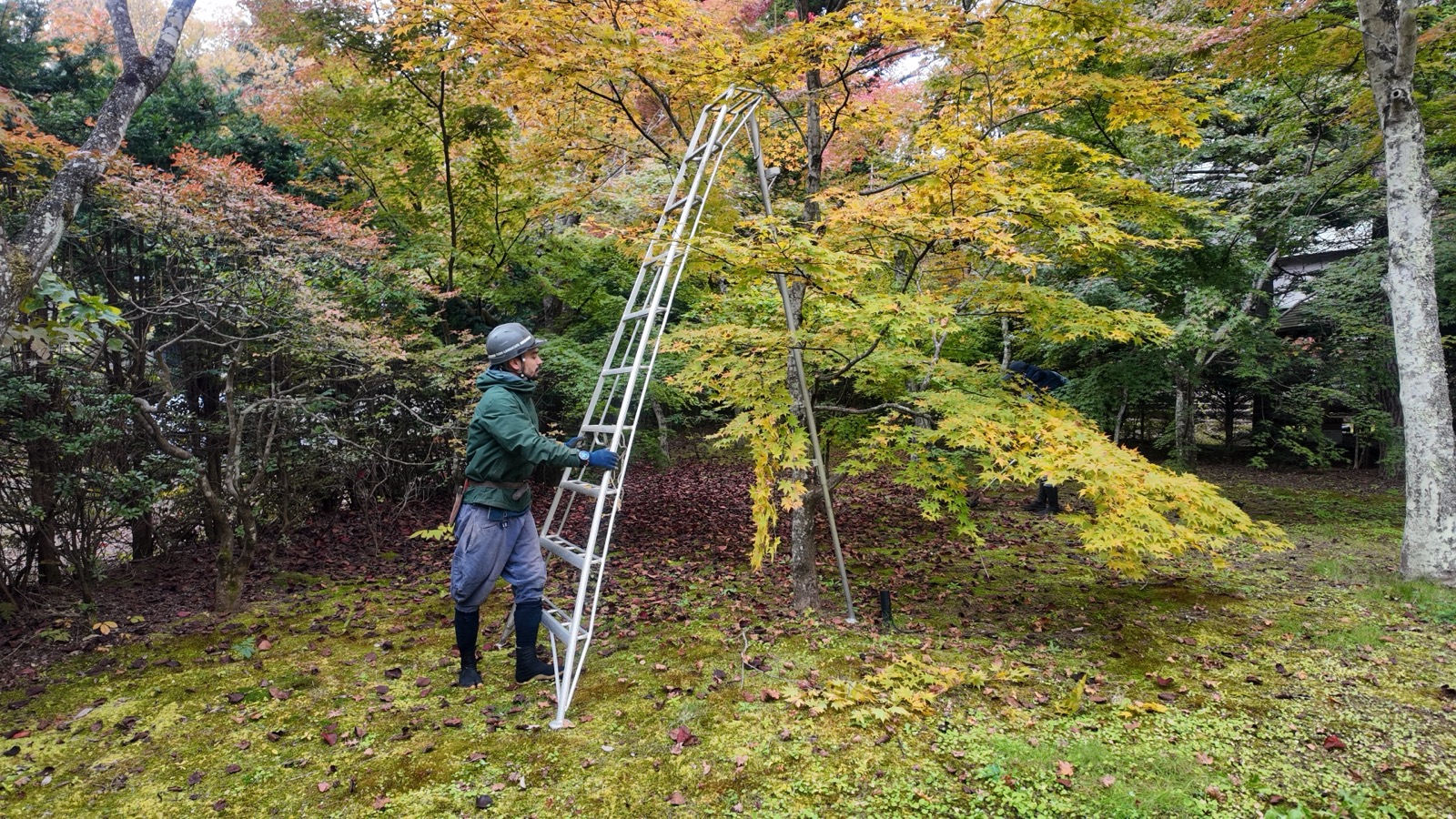
Two feet on the moss, one pole in the crown
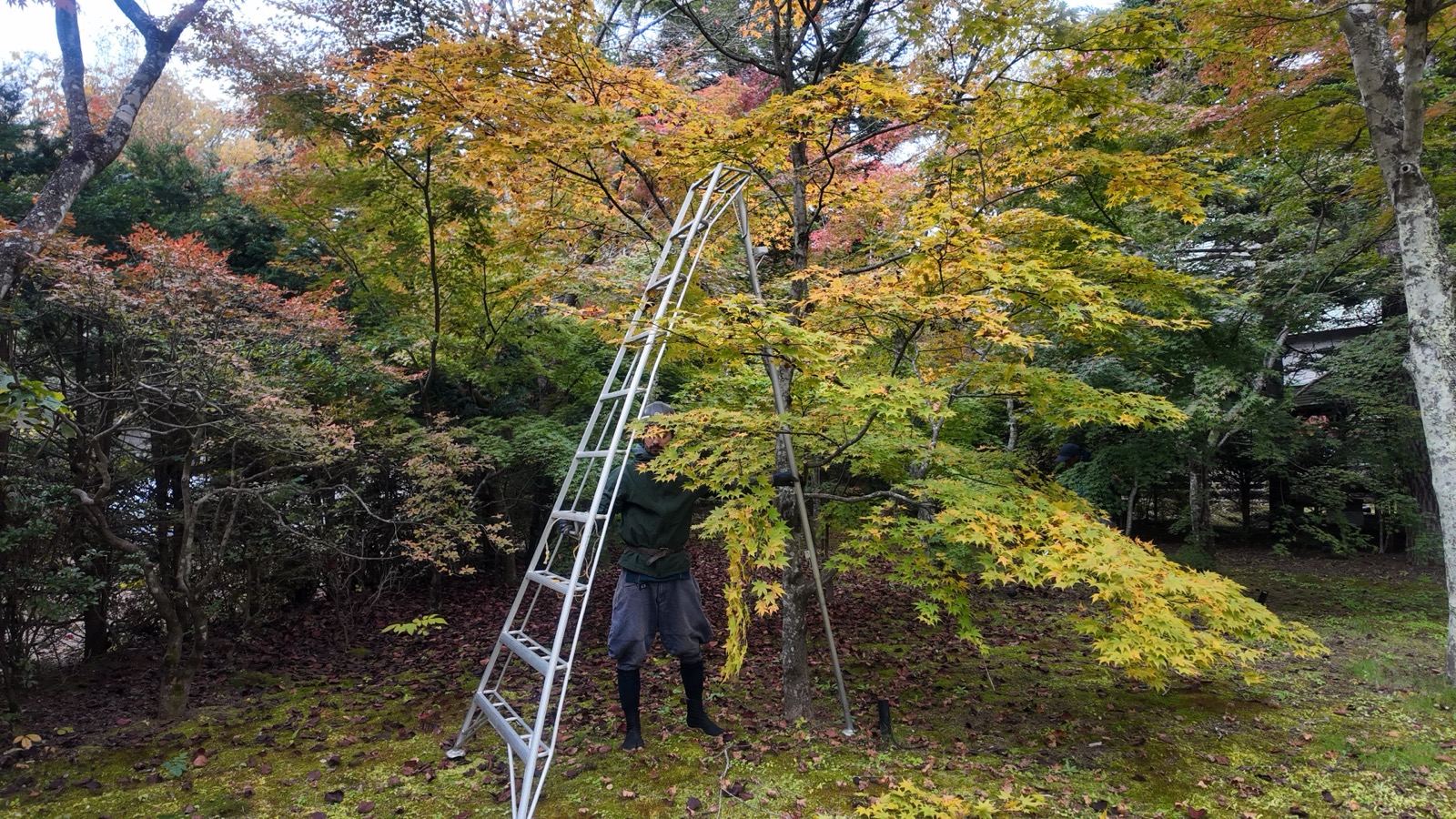
The first four photographs in this section were taken within about ten seconds of one another. He stands the ladder up, then swings the single back leg away from the rails and sets it in among the lowest branches. The pole does not lean on the trunk. It passes between limbs and stands on the ground under the canopy, so the ladder is held up by its own three feet.
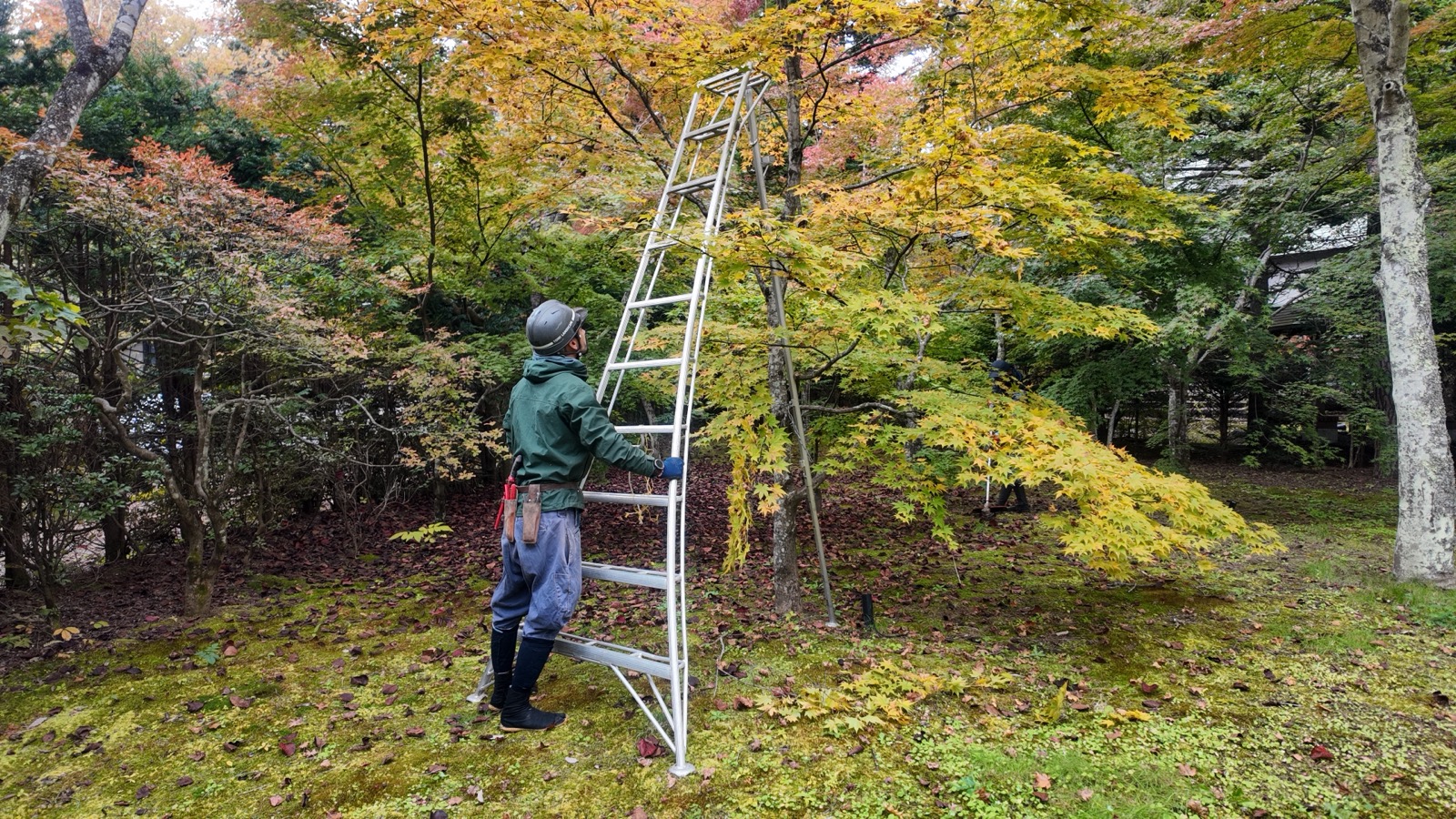
Then he climbs. The stepped side is at the edge of the canopy; the pole is inside it. The ladder now stands close against the branches he will work on.
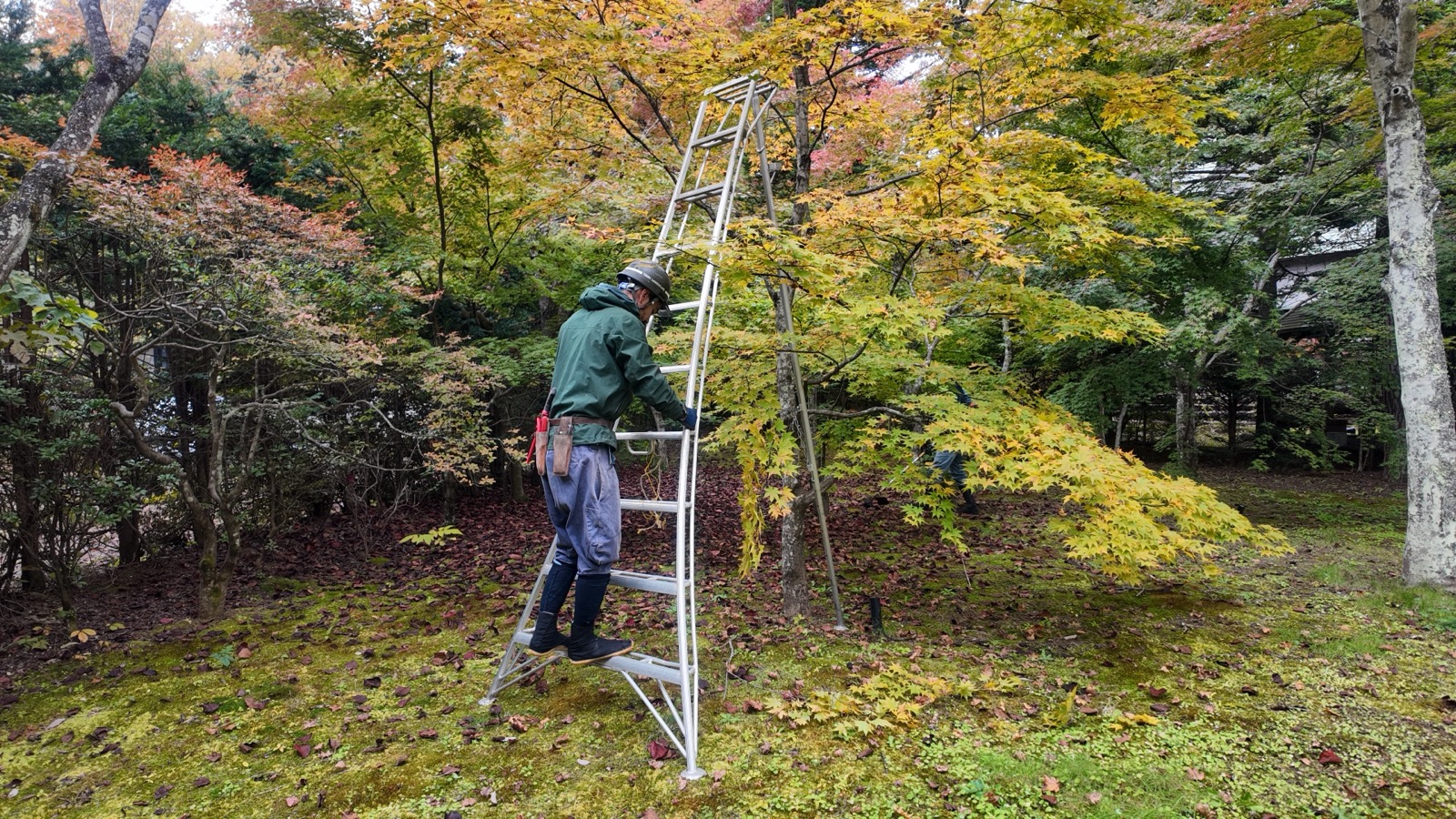
What the gardener gains by standing inside the tree
That is the idea of the tool, and it is easy to miss if you only see a tripod ladder folded on a truck. Because the back leg is a single pole, it is easier to find a place for it among branches and plants. A four-legged stepladder needs all four feet on firm, level ground; the UK’s former HSE ladder leaflet, INDG455 (since replaced by the Ladder Association’s LA455), asked for all four stepladder feet to be in contact with the ground, with the steps level.
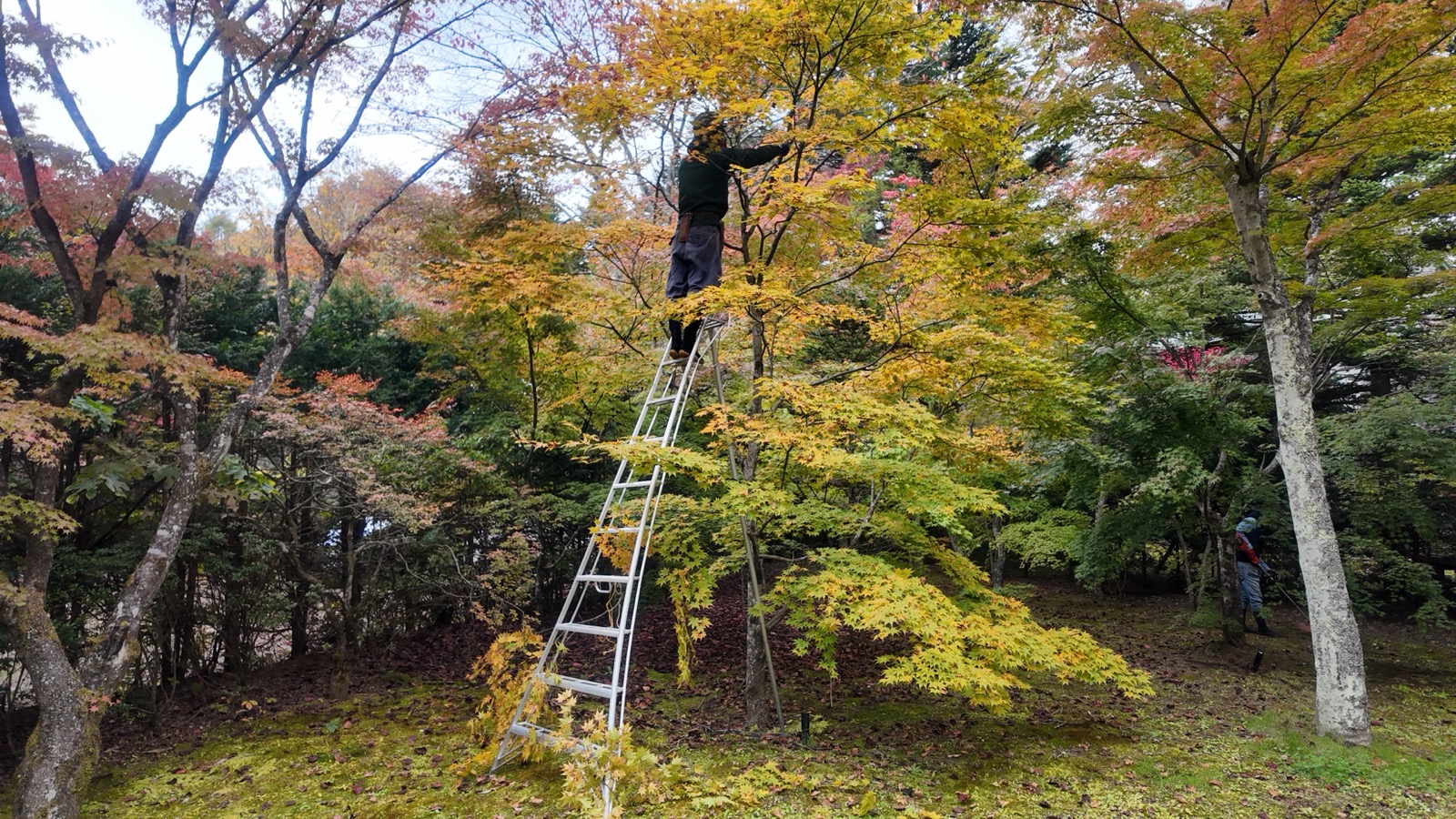
Niwaki, the UK company that sells Japanese-designed tripod ladders, describes the same advantage in one line: the “single back leg” lets the ladder reach “right into the crown of the tree.” About two minutes later our gardener was high in the canopy, the ladder’s pole hidden among the branches below him.
Rails, Pole, Chain — The Anatomy of a Sankyaku
In Japanese the tool is called sankyaku (三脚, “three legs”) or sankyaku kyatatsu (三脚脚立, “three-legged stepladder”). Hasegawa, the Osaka ladder maker, uses both names for its GSC range, which it calls “the standard type of gardening tripod” (園芸三脚のスタンダードタイプ).
Three parts with their own names
Japan’s National Institute of Technology and Evaluation (NITE), in its guide to ladder types, labels three parts on a tripod ladder:
– Shōkōmen (昇降面) — the climbing face: two side rails joined by steps. – Kōshichū (後支柱) — the rear support: the single back leg, hinged at the top. – Hirakidome chēn (開き止めチェーン) — the opening-restraint chain that limits how far the pole can swing out.
Hasegawa’s rear support adjusts in 15 cm steps. PiCa’s GMK range uses a spring-loaded pin with 15 cm intervals. Kitazawa says its KS support can be adjusted continuously, an operation it describes as simply lowering three plates with the fingertips. Its KⅢS model goes further: all three legs adjust continuously.
Sizes still counted in shaku
The ladders are sold in metres, but the old Japanese unit, the shaku (尺, about 30 cm), is still part of the trade. ALUMIS sells its assembly-type gardening tripods as 4, 6, 8, 10 and 12 shaku. Kitazawa writes that the size number of each model is “approximately one shaku (300 mm)” per number.
| Model (maker) | Size name | Height (as listed) | Weight |
|---|---|---|---|
| GSC-180a (Hasegawa) | — | Top 1.81 m | 6.3 kg |
| GSC-240a (Hasegawa) | — | Top 2.41 m | 8 kg |
| GSC-360a (Hasegawa) | — | Top 3.61 m | 11.8 kg |
| GMK-180A (PiCa) | — | Vertical 1.74 m | 5.6 kg |
| A-06 (ALUMIS) | 6 shaku | About 1.81 m | About 7.0 kg |
| A-08 (ALUMIS) | 8 shaku | About 2.42 m | About 9.0 kg |
| A-12 (ALUMIS) | 12 shaku | About 3.63 m | About 14.0 kg |
Hasegawa’s GSC range, PiCa’s GMK-180A and ALINCO’s KWX range are all rated for a maximum load of 100 kg. ALUMIS advertises steps 50 mm wide.
The top is a cap, not a platform
On most of these ladders the very top is a cap where the rails and the pole hinge meet. Kitazawa describes the top of its tripod as a 25 mm pipe. It is not a place to stand. Hasegawa sells a separate model, the GSU, that it describes as an upper-framed tripod on which you can work from the top platform; the fact that it needs its own design says a good deal about the ordinary ones.
Why the Third Leg Is a Single Pole — Getting Into the Branches
If the single back leg were only about stability on rough ground, any three-legged design would do. Japanese makers instead shape the pole to get into plants.
The pine-needle type
Kitazawa makes a model it calls the matsuba-gata (松葉型, pine-needle type), and says its rear support, which has no bracing, is easier to insert among branches (「補助具がないのでより枝の中に挿しやすい支柱」). Nagano, an aluminium ladder maker founded in 1973, sells a professional pine-needle tripod and says its tip is designed to enter crowded branches easily (「先端部は混んだ枝の中に入りやすい設計」).
The makers’ words stop there, and so do we: these are ladders designed to go in among crowded branches, rather than to stand clear of them.
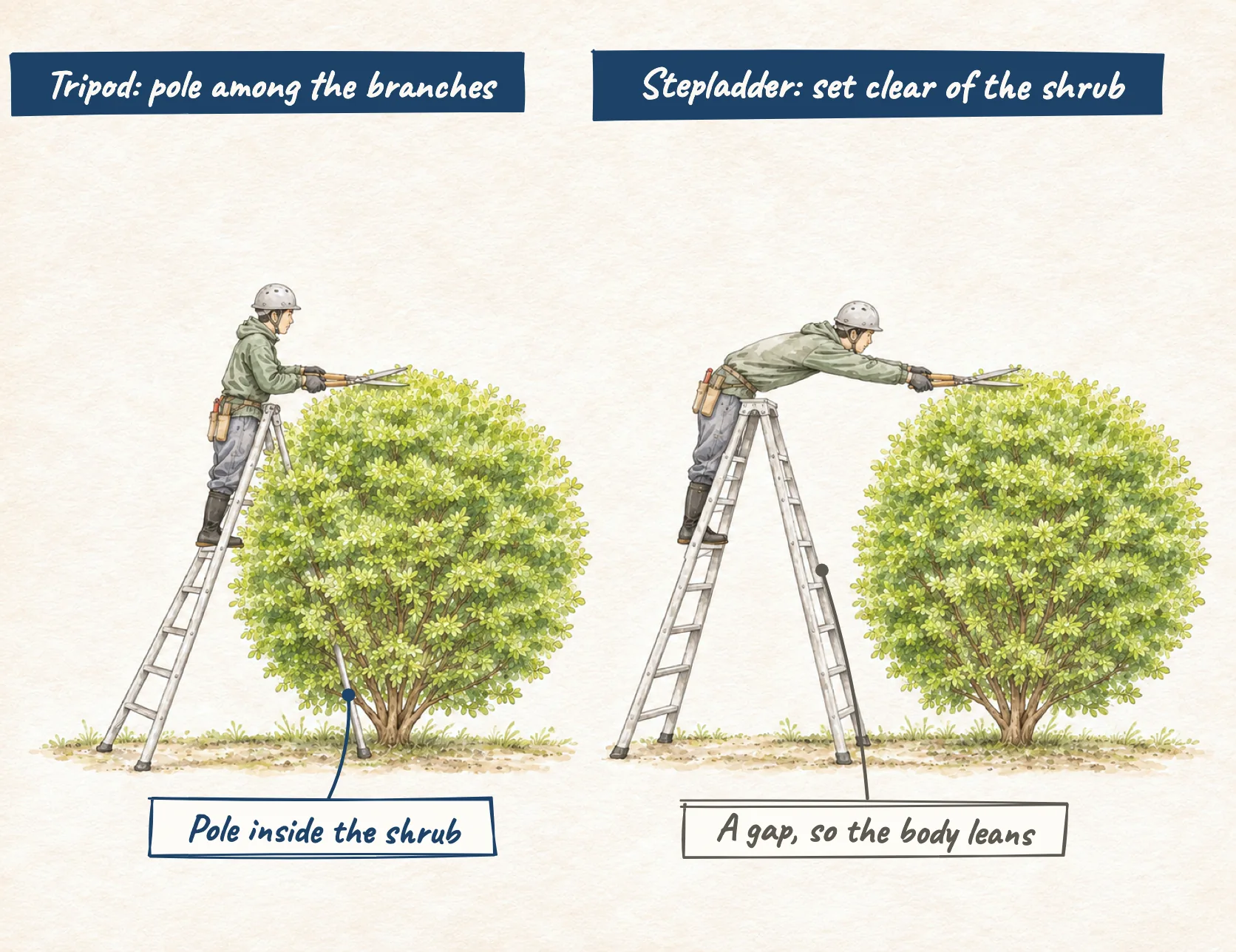
Around azaleas without crushing them
The same thinking applies near the ground. Kitazawa says that with the sliding legs of its KⅢS, you can work even where there are shrubs such as satsuki azaleas “without damaging the plants” (「植木を傷つけることなく作業ができます」). In a densely planted garden, the ground under a tree may hold clipped azaleas, moss and stones. A ladder whose legs can be placed or lengthened around them suits that kind of ground.
Distance, not quality
The practical result is distance. The figure above compares two set-ups around the same shrub. Neither ladder is better in general: a four-legged stepladder on a level path is a sound choice. The difference is that the tripod lets the ladder stand closer to a plant that has no clear ground around it, so the gardener does not have to lean out to reach.
The Shapes That Ask for It — Karikomi, Tamamono, Hedges
The tripod fits Japan because of what Japanese gardeners spend their days cutting.
A garden of surfaces
Karikomi (刈込) is the Japanese practice of clipping shrubs and trees into continuous forms; we described it in detail in our piece on karikomi cloud pruning. Tamamono (玉物) are trees or shrubs clipped into rounded masses. At Daichi-ji in Shiga Prefecture, much of the garden is clipped surfaces: rounded mounds and waves.
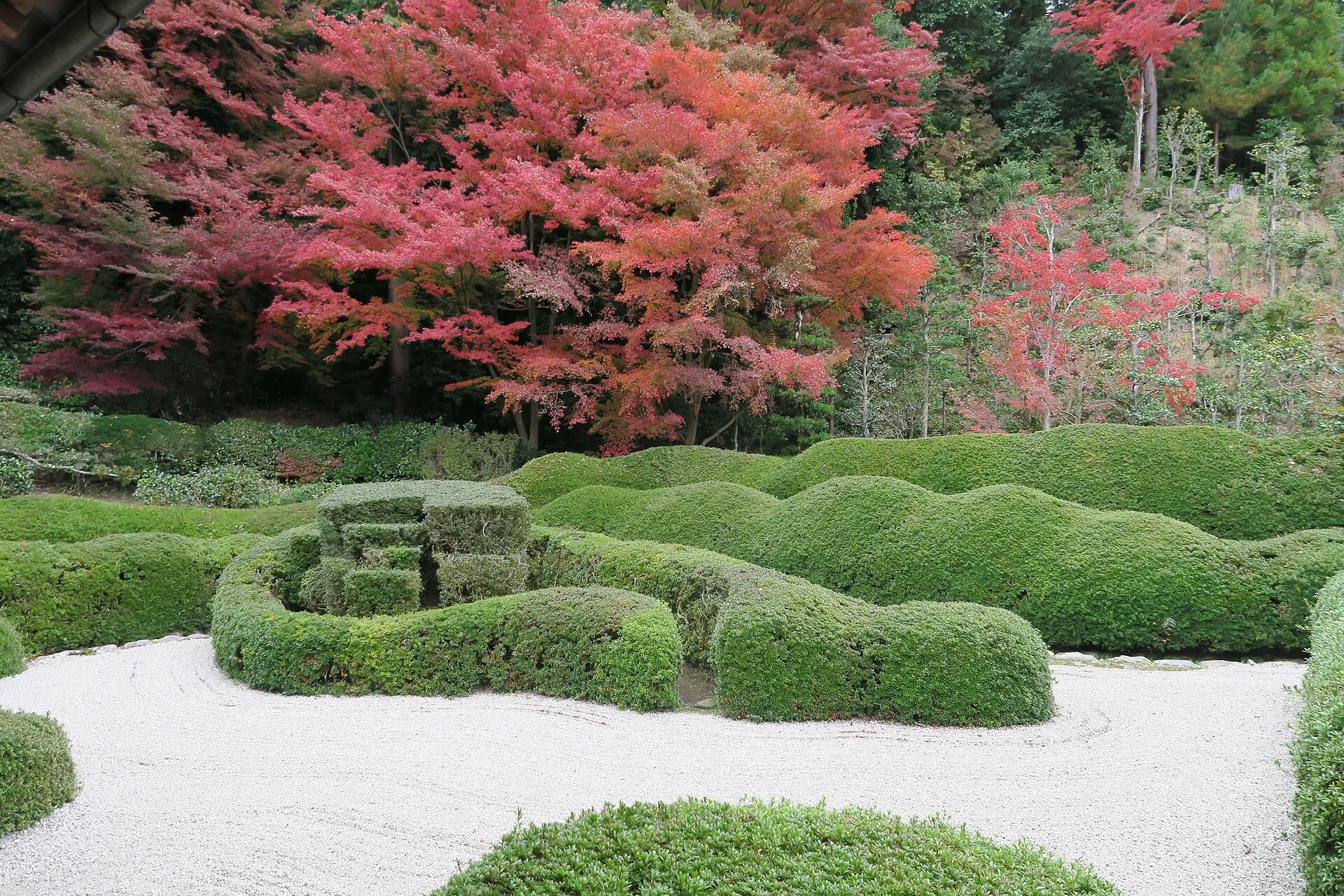
Clipping a shape means working over the outside of the plant, top and sides, and the top of a shrub taller than the gardener is out of reach from the ground.
Taught alongside the shears
Japanese training puts the ladder and the shears in the same lesson. The 2025 annual plan for the landscape-construction course at Tokyo Metropolitan Nōgei High School lists “pruning kaizuka juniper” (カイヅカイブキ剪定), “methods of clipping” (刈込剪定の方法について) and “how to set up a tripod” (三脚のかけ方について) as topics in the same course.
A safety bulletin from Japan’s national association of Silver Human Resources Centers, which places older workers in jobs such as garden maintenance, describes a worker clipping a kaizuka juniper hedge from a ten-step tripod ladder with an electric hedge trimmer. The Japan Federation of Landscape Contractors (JFLC) publishes a hazard-prediction training sheet devoted to “pruning on tripods and ladders” (三脚・はしご上での剪定作業). In each case the tripod is not a special piece of kit. It is the normal place to stand.
Pines in winter
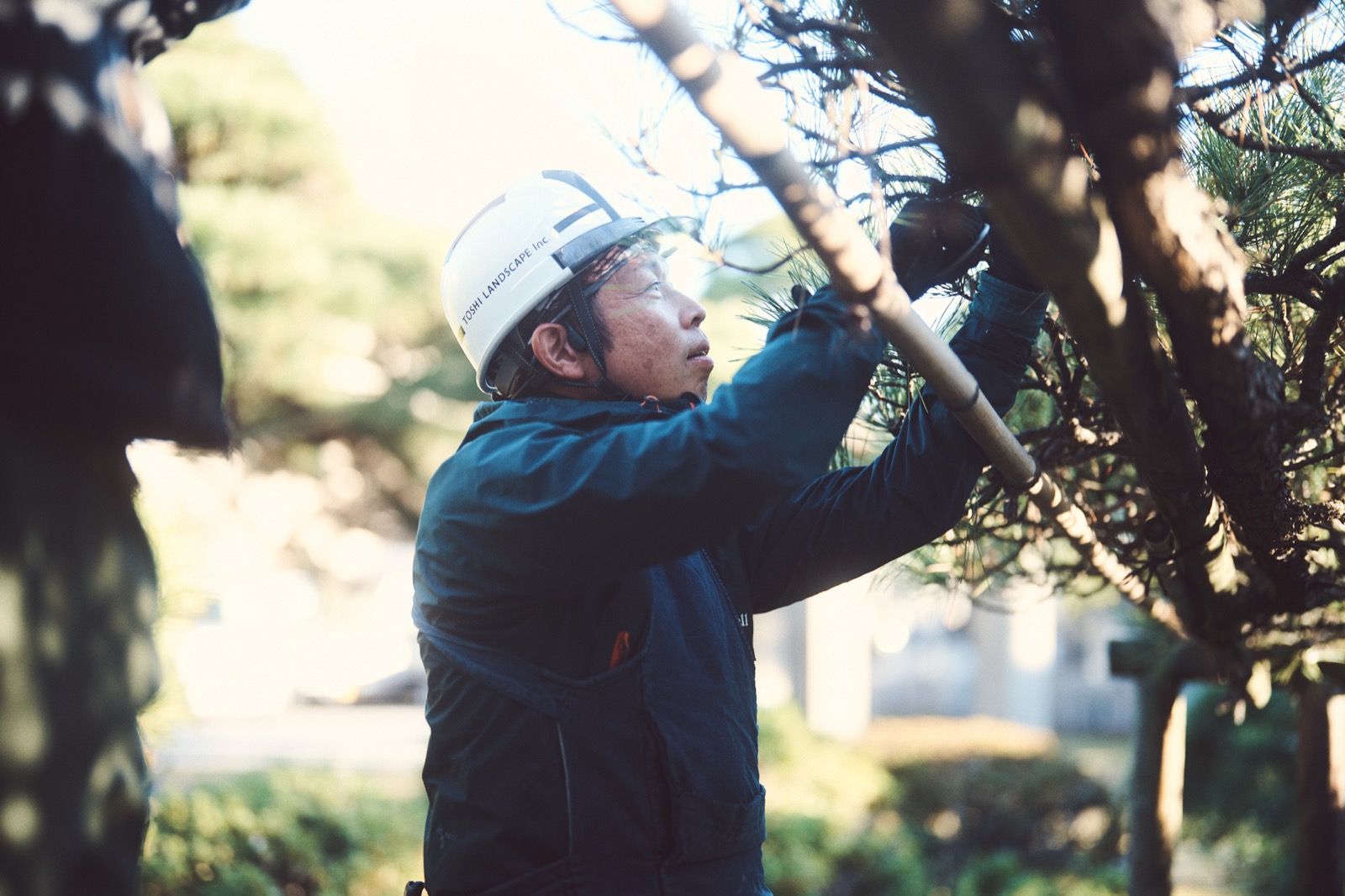
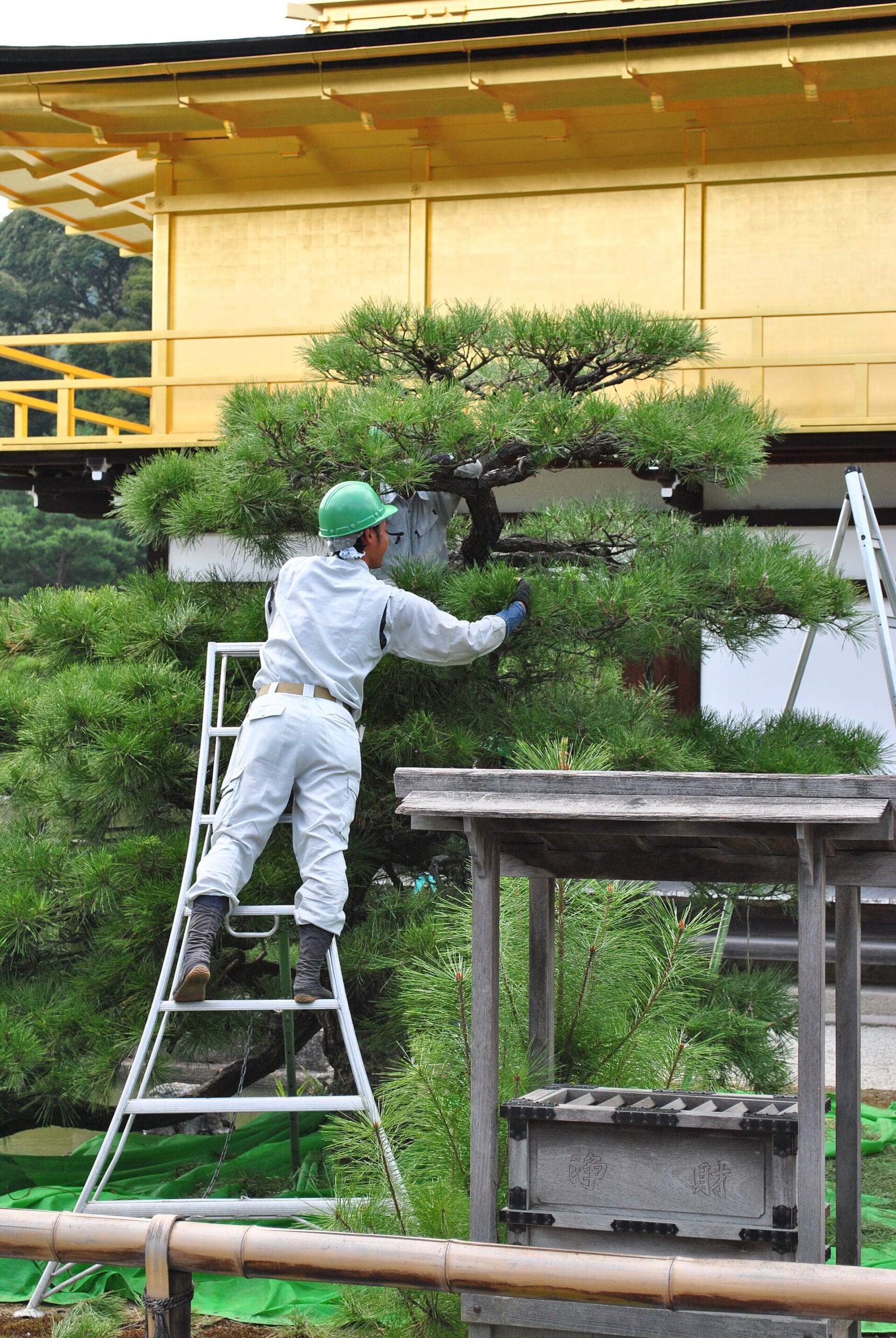
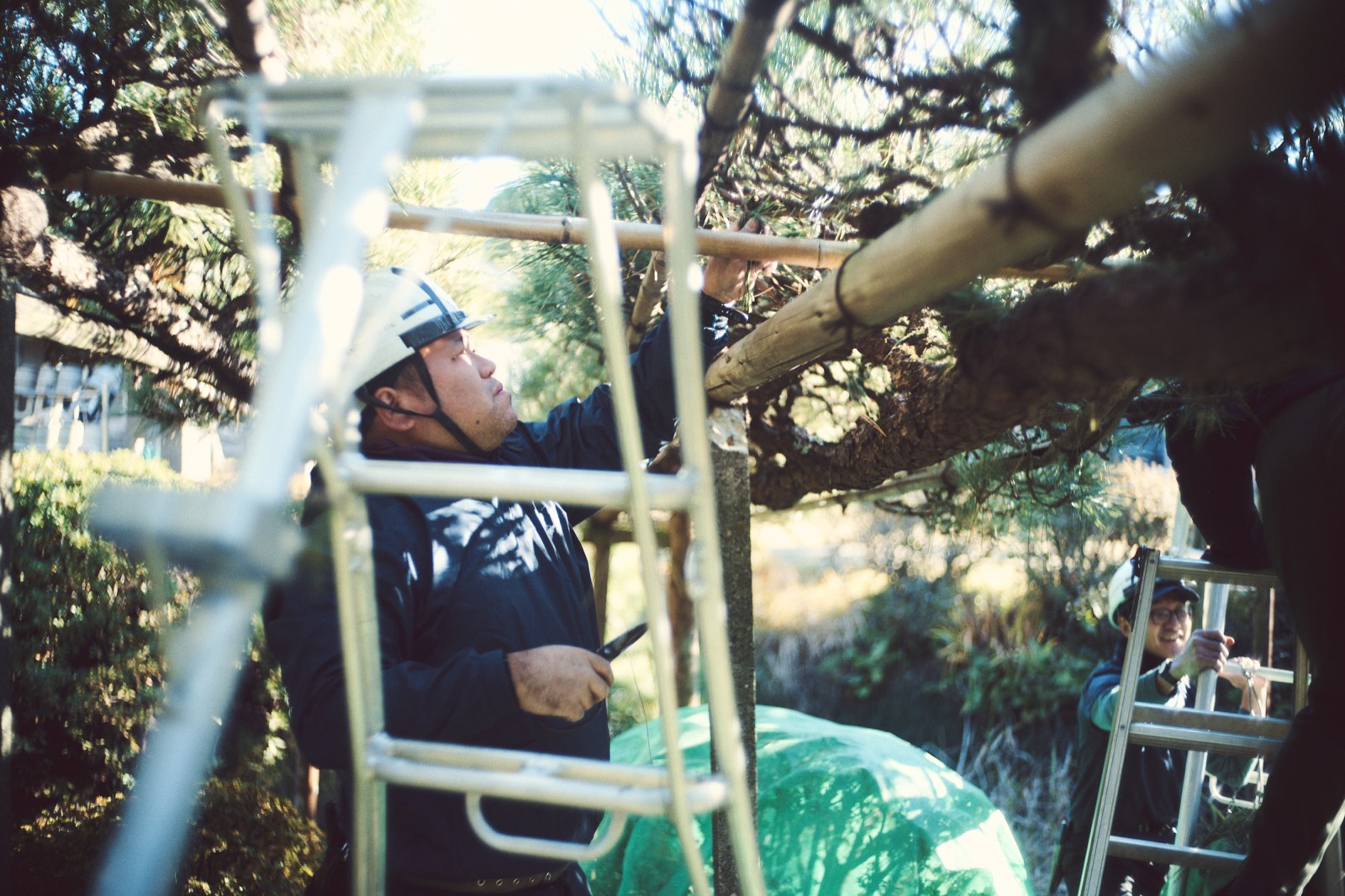
The same ladders come out for winter pine work. In our photographs from a garden of clipped black pines, several tripods stand under the trees at once.
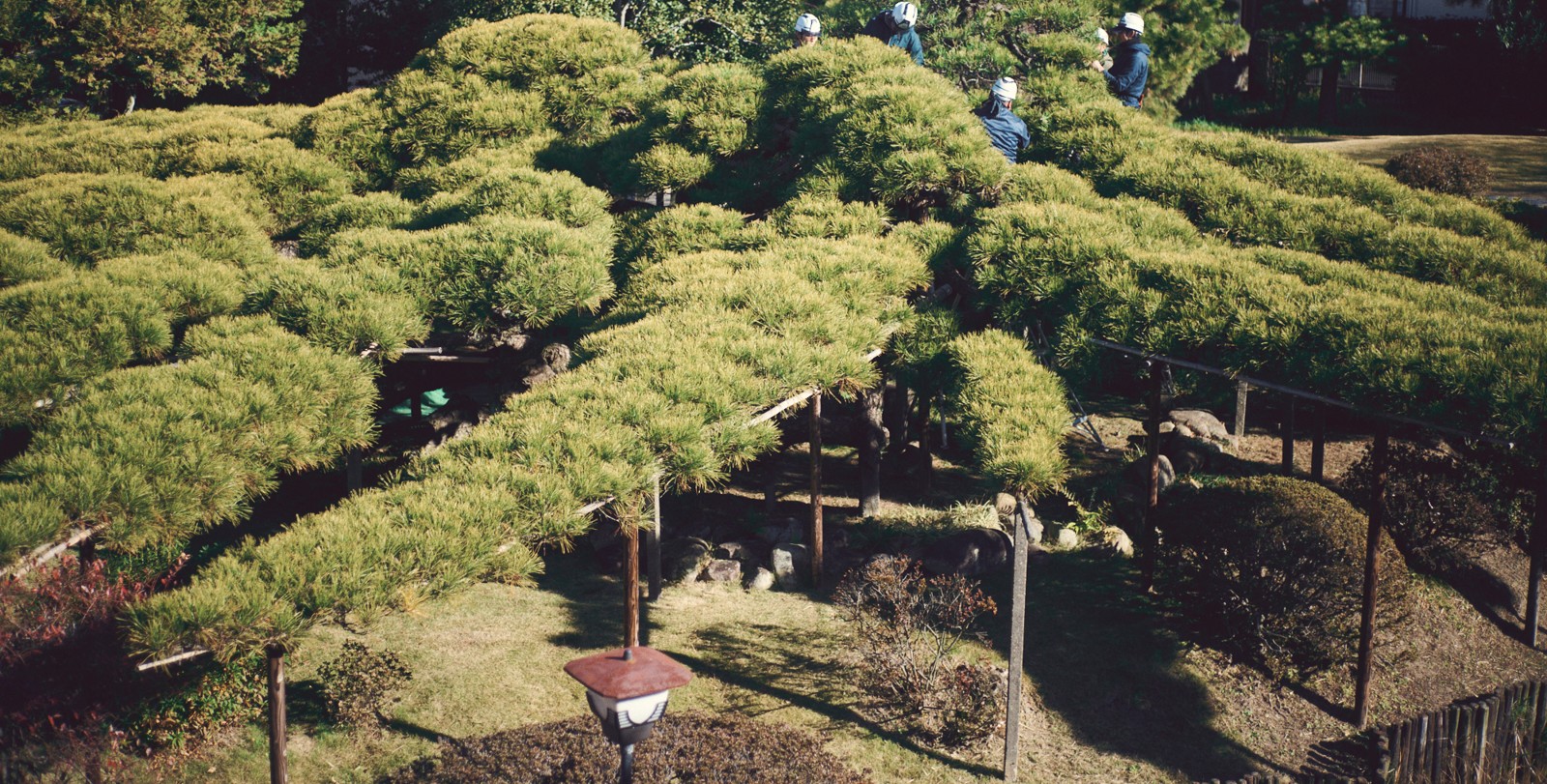
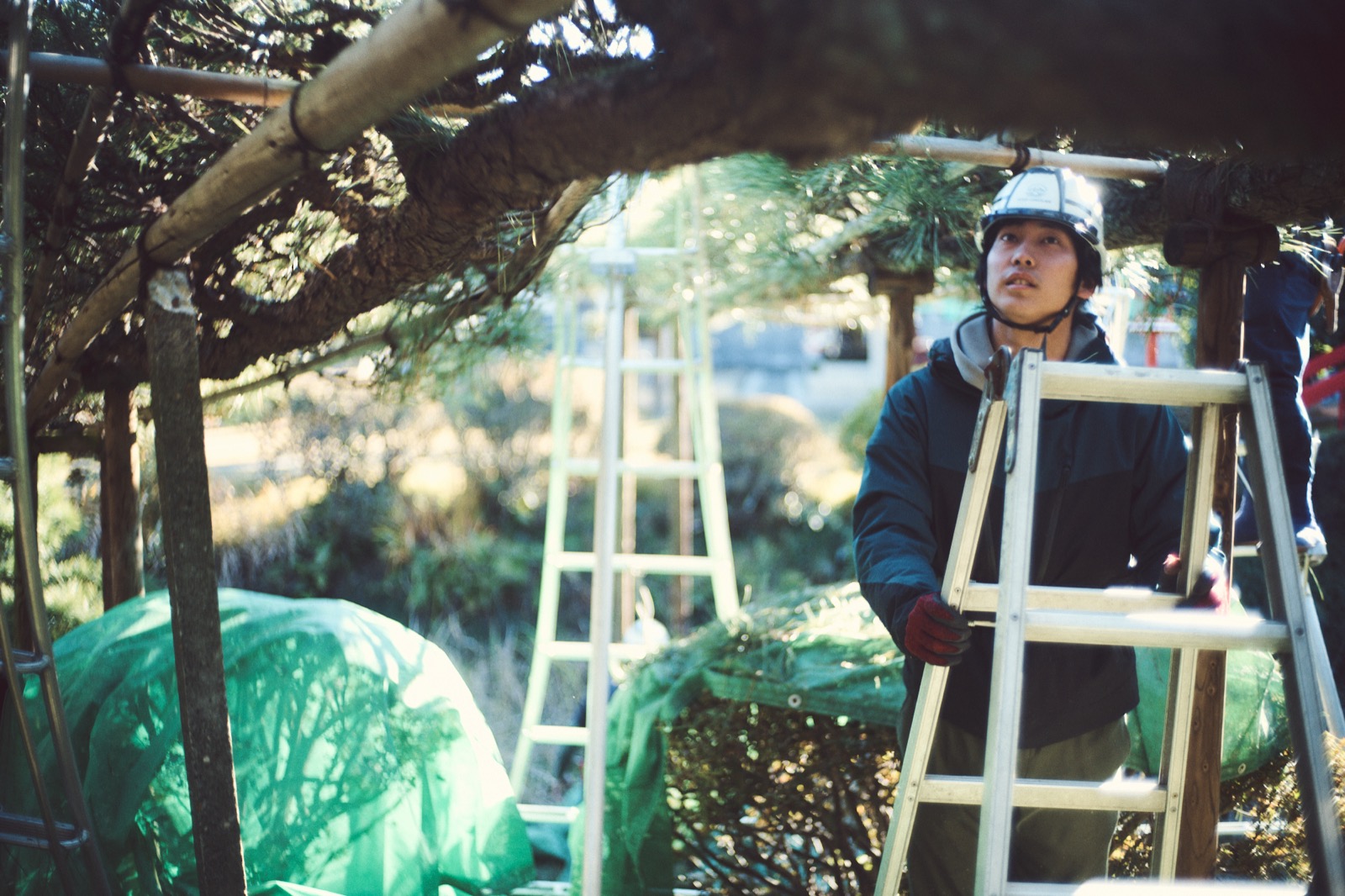
Pine work changes with the season. In spring it is midori-tsumi, the pinching of new candles by hand; in winter, the thinning and cleaning seen in these photographs. Either way the gardener works shoot by shoot among the needles, and the ladder is set so the pole sits in the crown and the steps stand at its edge. In our maple photographs, by contrast, the work was in an open, deciduous canopy over moss, where the pole could go straight in to the ground under the branches.
Small Gardens, Soft Ground — The Japanese Premise
Two other conditions make the tripod a good fit in Japan: the size of the gardens and the ground they stand on.
How small is small
Japan’s statistics give site areas, not garden areas, so they set an upper limit rather than measure the garden itself. Even so, they are telling.
| Place (2023 Housing and Land Survey) | Average site area per detached house |
|---|---|
| Japan, owner-occupied detached houses | 263 m² |
| Yokohama, detached houses | 159.83 m² |
| Tokyo’s special wards, detached houses | 118.90 m² |
The national figure covers owner-occupied houses; the two city figures cover detached houses as a whole.
The house, parking and paths take part of that area. Where planting fills what remains, a ladder whose third foot can go into the planting is easier to place than one that needs clear, level ground for four feet. We could not find a source that shows small gardens caused the tripod to spread in Japan, so we offer this as a fit, not a cause.
Soft, uneven ground
Garden soil, moss and lawn are uneven and give underfoot. Utah State University Extension says plainly that orchard ladders “have three legs and are more stable on uneven ground than standard home ladders,” and an older USU bulletin on orchard pruning says four-legged ladders “should only be used on level surfaces.”
The tripod is not only tolerant of soft ground; it relies on it. OSHA, the US workplace safety agency, says the side rails and pole of a tripod orchard ladder must “slightly penetrate the ground” for it to stay stable. Oregon OSHA describes these ladders as intended for soil or turf. We return to what that means on paving below.
Carried in by hand
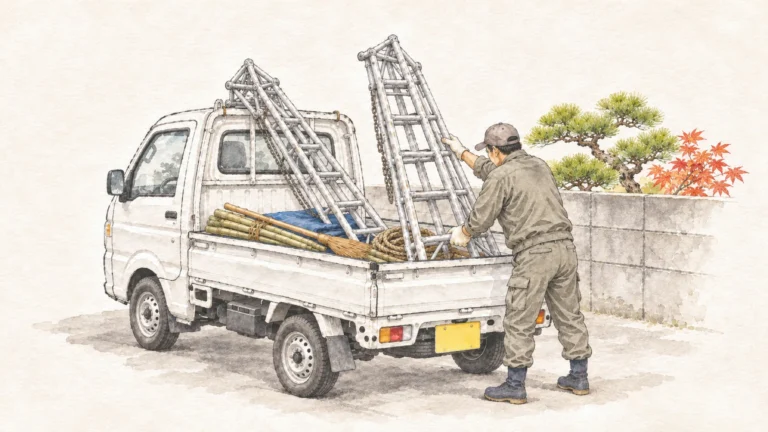
The table above shows that a 2.4 m class tripod weighs about 8 to 9 kg. Some Japanese makers also mention the vehicle that brings it. ALINCO says the compact base of its KWX tripod fits inside a kei truck’s cargo bed, and ALUMIS sells a boxed assembly tripod that it says can be loaded even into a kei car. The standard Suzuki Carry kei truck has a cargo bed 1,940 mm long. From the truck, the ladder is carried the rest of the way by hand, as in our maple photographs.
From Cedar Logs to Aluminium — A Short History
The aluminium tripod is recent. The idea is older.
Logs and a bamboo pole
Kitazawa, describing its pine-needle model, writes that garden craftsmen once built their pruning ladders from cedar or cypress logs, with the supporting pole made by tying on something like bamboo (「庭職人が杉やヒノキなどの丸太を」「支柱の支えとなる棒は、竹などくくり付けて作られてました」). A wooden tripod of this kind, photographed in a Japanese garden in 2007, shows the form: stepped wooden rails and a thin bamboo third leg, with clipped shrubs on the bank behind.
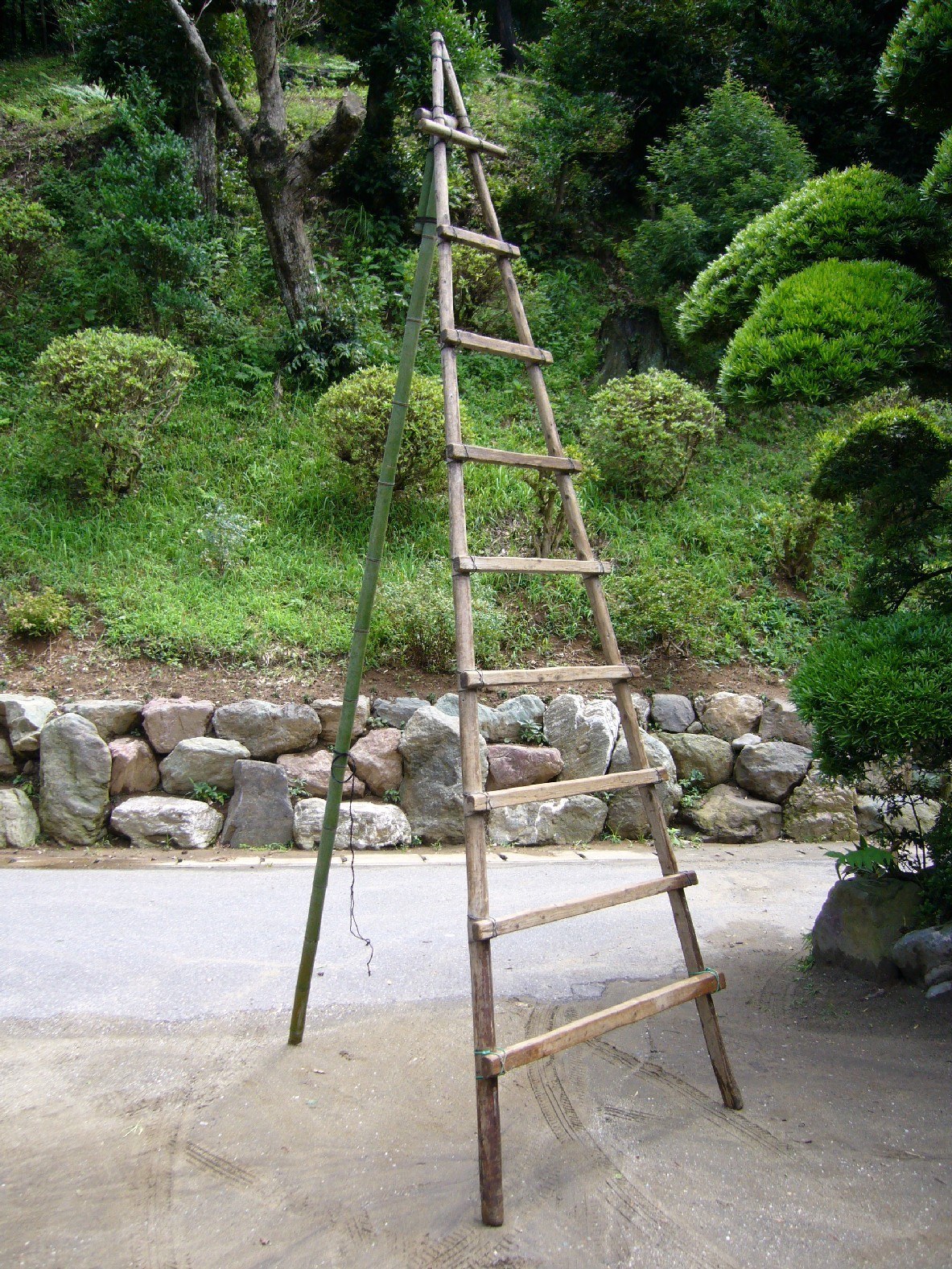
We could not confirm who made such ladders or where; no public record we found names makers or producing districts for wooden garden tripods.
Iron, then aluminium
The makers’ own histories give these dates:
| Year | Event (from the maker’s own history) |
|---|---|
| 1921 | Kitazawa founded |
| 1956 | Hasegawa founded in Osaka, first selling steel-tube ladders |
| 1965 | Hasegawa’s first aluminium-alloy extending ladder |
| 1973 | Nagano founded; it says gardening ladders then were heavy iron |
| 1974 | ALINCO starts making aluminium stepladders |
| 1976 | Hasegawa develops the GSC aluminium gardening tripod |
| Late 1980s | Kitazawa starts its standard aluminium orchard tripod (“as the Shōwa era was ending”) |
Nagano’s account is the most direct: when it was founded in 1973, it says, gardening stepladders were only heavy iron ones, and it developed aluminium gardening ladders in response. We did not find a national figure for when aluminium replaced wood and iron, so the table records makers’ dates, not a turning point for the whole trade.
A Japanese ladder in an English garden
One route to British gardeners is told by Niwaki. Its company history describes how Jake’s brother-in-law in Japan, Haruyasu, shipped over “a couple of tripod ladders” to England. Niwaki says its tripods are made with Hasegawa Kogyo of Osaka, and lists its Original range at 4, 6, 8, 10 and 12 steps, with open heights of 1.2 to 3.6 m. One detail matters for buyers, and we return to it in the section on misunderstandings: Niwaki’s current product page lists the models it shows as made in China.
The Orchard Ladder — Same Three Legs, a Different Job
We found no source showing that the tripod ladder was invented in Japan, and the American record goes back further than the Japanese makers’ dates.
Washington, 1915
On 18 May 1915, John F. Merrill of Wenatchee, Washington, was granted US Patent 1,139,990 for an orchard ladder with two side rails and a “supplementary leg or prop” connected by a hinge. A 1922 US patent describes improvements to “side hill orchard ladders of the tripod type.” A photograph from Washington’s Yakima Valley, taken around the 1910s, shows apple pickers on wooden tripod ladders.
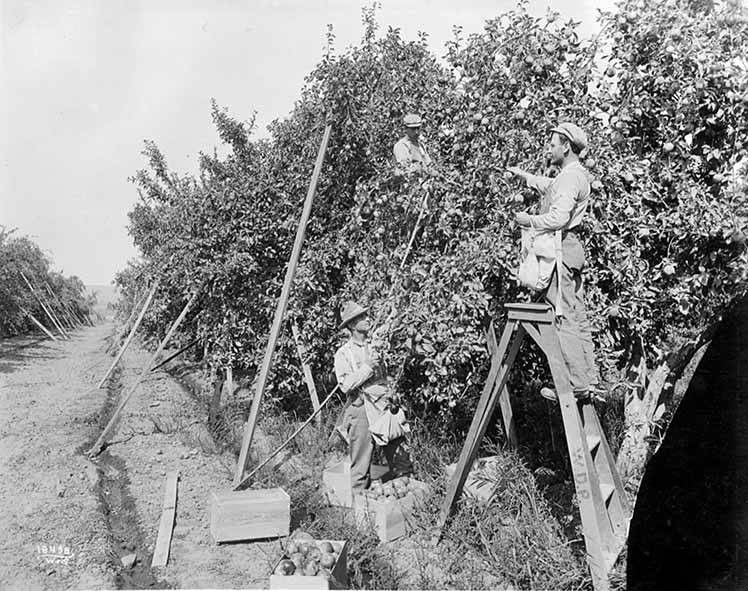
These are the earliest dated examples we found, not proof of where the tripod began.
Aluminium in Oregon and California
Tallman Ladders of Hood River, Oregon, dates Bob Tallman Sr.’s lightweight aluminium tripod ladder to 1953, as an alternative to heavy wooden orchard ladders, and its first production run to 1954. Stokes Ladders says pear grower Russ Stokes began building aluminium orchard ladders in Kelseyville, California, in the early 1960s, and opened a plant in Grandview, Washington, in 1974.
So aluminium orchard tripods were in production in the United States about two decades before Hasegawa developed its aluminium gardening tripod in 1976. Kitazawa, for its part, began making standard aluminium tripods for orchards in Japan in the late 1980s: the fruit grower’s tripod exists in both countries.
An orchard and a garden, compared
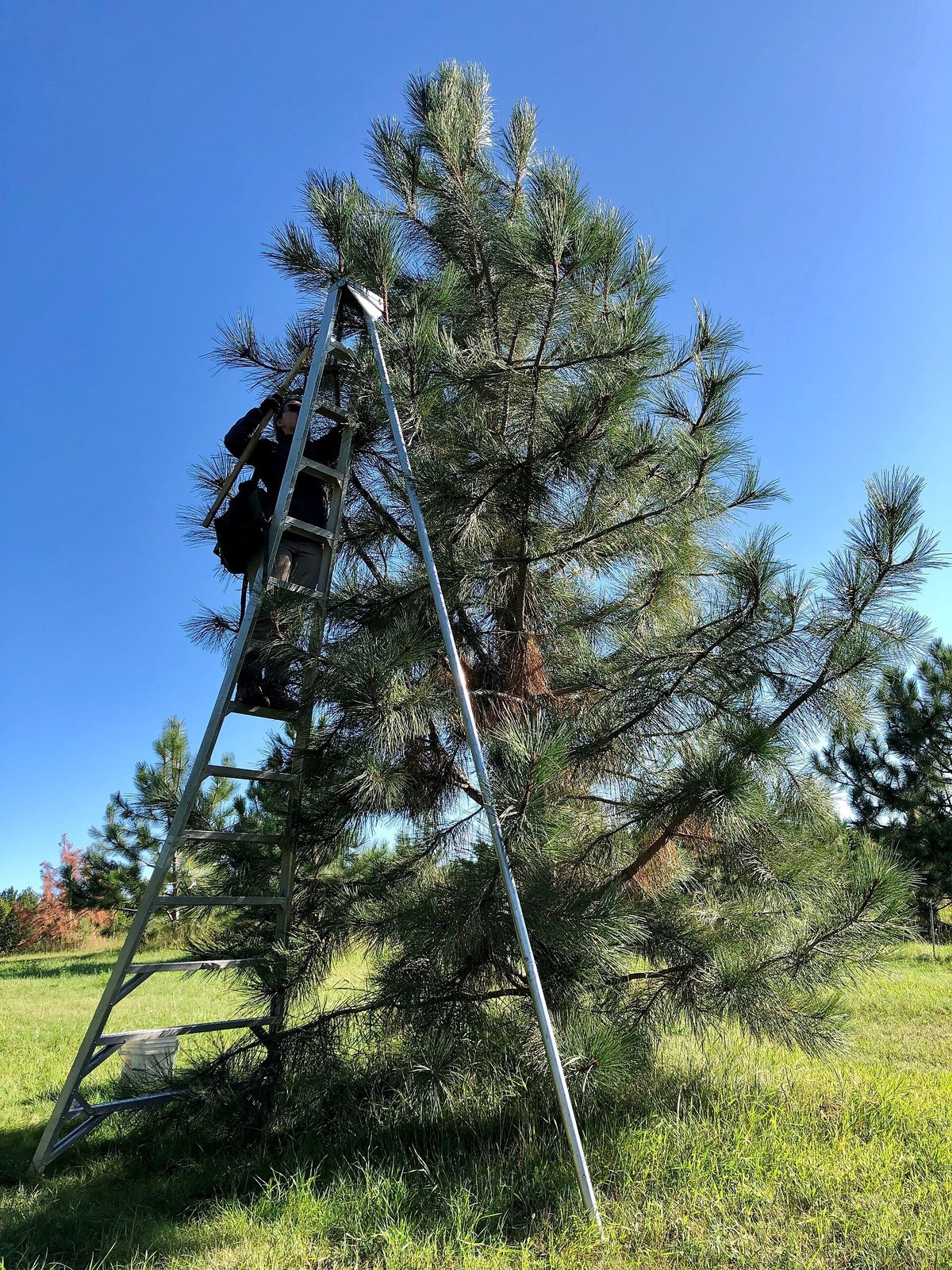
The useful comparison is between two kinds of site, not two countries. OSHA describes the tripod orchard ladder as a ladder for orchard and landscape-maintenance work such as pruning and harvesting. The Japanese garden tripods discussed here are used mainly for clipping in planted gardens, and their makers describe features such as pine-needle (matsuba) models and adjustable legs.
| Orchard tripod (US guidance) | Garden sankyaku (Japanese examples here) | |
|---|---|---|
| Work described | Orchard and landscape maintenance: pruning, harvesting | Clipping hedges, rounded shrubs, pines |
| Ground | Orchard soil or turf | Garden soil, moss, beds between plantings |
| Where the pole goes | Into the fruit tree’s crown | Into the crown or the clipped shrub |
| Features noted in sources | Flared base, single tripod pole | Pine-needle (matsuba) models; adjustable pole or legs |
| Safety guidance quoted here | OSHA FS-3728, SAIF | Industrial Safety and Health Regulations Art. 528; JNIOSH; Light Metal Products Association |
Ropes and platforms for other jobs
The UK’s Health and Safety Executive (HSE) describes tree climbing with ropes and a harness where a risk assessment supports it, notes that rope-access and positioning systems normally use at least two separately anchored lines, and says mobile elevating work platforms should always be considered when planning tree work. OSHA’s tree-care guidance tells aerial-lift workers to wear a body harness or restraining belt with a lanyard attached to the bucket. Our article on aerial tree diagnosis with rope climbing at a Tokyo temple shows that Japanese crews use ropes too, for large trees.
The choice follows the tree and the task: how high the work is, what the ground is like, and how the worker can reach it. A tripod reaches as far as its height allows: the tallest models in the table above are about 3.6 m. For the clipped forms these ladders are used on, see our comparison of niwaki and topiary.
Where to Stand — The Top Is Not a Step
Standing close to the work tempts a gardener to climb higher. The standing-height guidance quoted in this section shares one warning: stay off the top steps.
How far down
The rules differ in wording but point the same way:
| Source | Rule for standing height |
|---|---|
| Light Metal Products Association (Japan), tripods 210 cm or taller | Stand on the 4th step from the top or lower |
| Light Metal Products Association, tripods 180 cm or shorter | Stand on the 3rd step from the top or lower |
| JNIOSH study of stepladders | Stand at least 2 steps below the top plate |
| OSHA FS-3728, tripod orchard ladders | Do not stand or work on the top three steps |
| SAIF, orchard ladders | Do not stand on the top cap or top step |
The JNIOSH recommendation comes from a posture experiment by Atsushi Sugama with ten men in their twenties on a three-step stepladder. It was a study of an ordinary stepladder, not a tripod; the Light Metal Products Association’s tripod guidance is the one written for tripods, and it is stricter for tall ones. In every case, follow the label and manual for your own model.
Choosing the ladder by standing height
The practical judgement comes before climbing: choose a ladder tall enough that the work is within reach from a permitted step. Japanese makers publish this as a separate figure. Hasegawa’s GSC-360a has a top height of 3.61 m but a maximum standing height of 2.71 m, and PiCa’s GMK-360A a vertical height of 3.48 m with a maximum standing height of 2.61 m. If the work is above what the permitted steps allow, the answer is a taller ladder or a different method, not the top step.
Ground, Legs, Chain — The Checks Before Climbing
The tripod’s few rules are about the three feet and the hinge that joins them.
Soft ground, not pavement (unless the model allows it)
Because a tripod stays up by biting into soil, OSHA says tripod orchard ladders should never be used on hard surfaces. Some makers now sell rubber feet: Hasegawa’s US site says its rubber safety feet allow use on hard surfaces such as concrete. That is a feature of particular models, not of tripods in general.
Japan’s own records show what happens when the feet move. In the JFLC’s list of landscaping fatalities for 2020, one case describes a worker pruning a residential tree when the feet of a tripod ladder slipped and spread, and he fell about 2 m onto a paved road. The JFLC compiles these cases from the published data of local labour bureaus.
Pole uphill on a slope
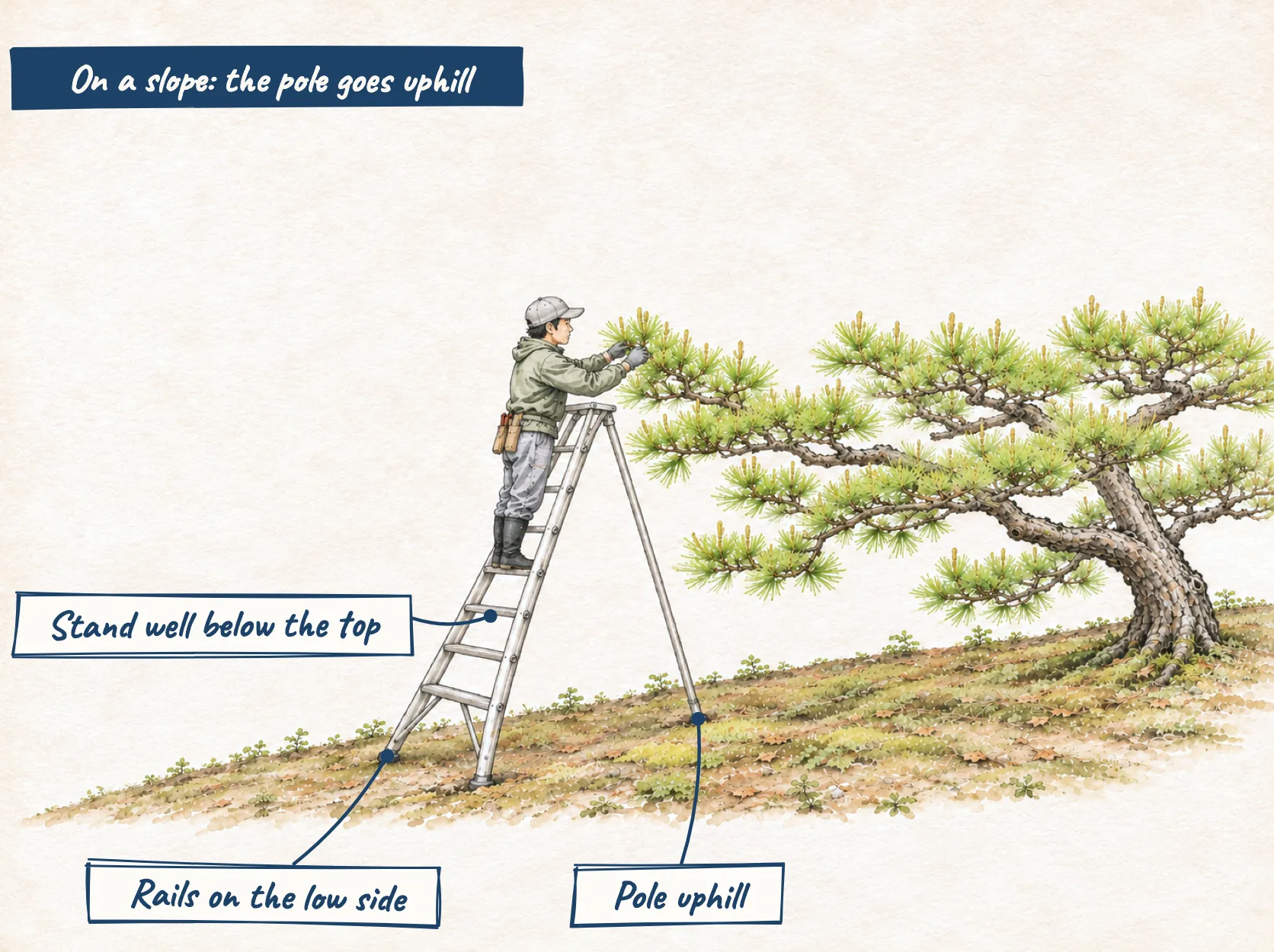
On sloping ground, OSHA says the pole goes uphill. The two rails then stand across the slope at the same level, and the pole, shortened if needed, reaches up the bank. The adjustable pole is useful here: shortening it lets the ladder stand upright on a bank.
The angle and the chain
Japanese law sets the frame. Article 528 of the Industrial Safety and Health Regulations requires stepladders to be strongly built, free of significant damage or corrosion, with legs at 75 degrees or less to the horizontal, and, for folding types, with fittings that reliably hold that angle. NITE advises setting both the climbing face and the rear support of a tripod at about 75 degrees; follow any angle your maker specifies.
In March 2017, after a landscaping worker in Gifu Prefecture fell from a tripod ladder and died in September 2016, the Ministry of Health, Labour and Welfare asked the Light Metal Products Association to produce retrofit fittings that fix the leg angle; the investigation had found that the ladder’s chain could not stop the legs from closing unexpectedly. In February 2018 the ministry reported that member manufacturers had begun selling these fittings. Hasegawa’s GSC-TD, for example, fits over the opening-restraint chain.
Checks before use
| Check | From |
|---|---|
| Rivets, joints and fastenings secure | OSHA FS-3728 |
| Steps secure, not dented or bent; no rust, grease or oil | OSHA FS-3728 |
| Load label on the side rail | OSHA FS-3728 |
| Top cap secure to the rails and the pole hinge | OSHA FS-3728 |
| Pole straight, without cracks or dents; foot plates sound | OSHA FS-3728 |
| Leg-angle fitting present and engaged | Art. 528; MHLW 2017 |
| Inspect before use each day; thoroughly at least once a year | SAIF |
SAIF adds two rules that apply to Japanese gardens as much as to orchards: use the tripod pole rather than leaning the ladder against the tree, and keep three points of contact while climbing.
What the Numbers Say About Falls
Japan
We found no national count of falls from garden tripods alone. The nearest figure is broader: a JNIOSH analysis of 2006 injury reports estimated 3,896 stepladder-related occupational accidents a year across all industries. The JFLC’s case lists give the landscaping detail. One 2024 case describes a gardener who fell about 1.9 m from a tripod ladder while pruning at a residence and struck his head; the ladder itself had not fallen over. A ladder that stays standing does not mean the person on it is safe.
Washington’s orchards
The most detailed data we found come from American orchards. A study of Washington orchard workers’ compensation claims from 1996 to 2001 found that 4,020 of 13,068 claims, or 31 percent, were ladder-related, and that ladder injuries made up 48 percent of the claims with costs beyond medical bills. Washington’s Department of Labor and Industries reports that 43 orchard workers were hospitalized after ladder falls in 2014–2018, and that more than half could not work for a year or more. Its 2026 report, based on workers’ compensation records, counts 4,614 ladder falls among fruit-farm workers between 2014 and 2023.
These numbers have no denominator of hours on ladders, so they do not give a rate. They do record a large number of ladder injuries in one fruit-growing state.
Common Misunderstandings About the Tripod Ladder
“A Japanese tripod ladder is made in Japan”
Not always. The design is Japanese in use and in many makers, but Niwaki’s current product page labels the models it lists as made in China. If country of manufacture matters to you, check the product page, not the name.
“The top cap is the highest step”
On standard tripods it is a cap, not a step. Hasegawa makes a separate tripod, the GSU, designed for working from the top platform, which shows that ordinary tripods are not. Check the label and manual of your own model.
“Lean it on the tree if the pole is in the way”
SAIF advises the opposite: use the tripod pole, because leaning the ladder against a tree raises the risk of falling. The pole going into the crown is the point of the design; leaning the rails on a trunk throws it away.
“It works anywhere a stepladder does”
It works where a stepladder struggles, on soft and uneven ground, and struggles where a stepladder works, on smooth pavement, unless the model is made for it.
Frequently Asked Questions
Why do Japanese gardeners use tripod ladders? Because the single back leg can be set between branches, which lets the ladder stand close to the foliage being cut. Three feet also settle on soft, uneven garden soil, and an aluminium tripod is light enough for one person to carry.
What is a sankyaku? Sankyaku (三脚) is the Japanese name for the tripod ladder: two rails joined by steps, plus a single hinged rear leg. It is also called sankyaku kyatatsu (三脚脚立), “three-legged stepladder.”
How high should I stand on a tripod ladder? Well below the top. Japan’s Light Metal Products Association says the 4th step from the top or lower on tripods 210 cm or taller, and the 3rd step or lower on tripods 180 cm or shorter. OSHA says not to stand or work on the top three steps of a tripod orchard ladder.
Can I use a tripod ladder on concrete? OSHA says tripod orchard ladders should never be used on hard surfaces, because their feet must bite into the ground. Some models have rubber feet that their maker says allow use on concrete; check your own model.
Is a Japanese tripod ladder the same as an orchard ladder? They share the three-legged design. American orchard tripods date back at least to a 1915 patent from Washington State and were built for picking fruit. In Japanese gardens tripods are taught and used for clipping hedges, rounded shrubs and pines, and some makers shape them to enter crowded branches.
Which size should I buy? Pick by the height you will stand at, not the height of the ladder, and remember you will stand several steps below the top. A 2.4 m (8 shaku) class tripod weighs about 8 to 9 kg, which matters if you will carry it through a garden.
Sources
– NITE, はしご・脚立の種類と用途 (types of ladders), p.2 — https://www.nite.go.jp/data/000140307.pdf (accessed 2026-10-31) – NITE, 製品安全情報マガジン Vol.318 — https://www.nite.go.jp/jiko/chuikanki/mailmagazin/2018fy/psm_vol318_181009.html (accessed 2026-10-31) – Hasegawa Kogyo, GSC tripod — https://www.hasegawa-kogyo.co.jp/product/GSC ; GSC-TD — https://www.hasegawa-kogyo.co.jp/product/GSC-TD ; GSU — https://www.hasegawa-kogyo.co.jp/product/GSU ; company history — https://www.hasegawa-kogyo.co.jp/company/history.php ; 70th anniversary — https://www.hasegawa-kogyo.co.jp/70th_anniversary/ (accessed 2026-10-31) – PiCa Corporation, GMK-180A — https://www.pica-corp.jp/products-02/gmk-180a/ (accessed 2026-10-31) – ALUMIS, catalogue — https://alumis.jp/wp-content/uploads/2021/12/d79284b3fc0215e94f754e7b9f400294.pdf (accessed 2026-10-31) – Kitazawa, KS series — https://al-kitazawa.jp/ks.setumei/kssyusai.html ; pine-needle tripod — https://al-kitazawa.jp/matuba/matuba.html ; parts — https://al-kitazawa.jp/ks.kakubu/ks.kakubu1.html ; history — https://al-kitazawa.jp/sougyu/hensen.html ; company — https://al-kitazawa.jp/kaisyanannai1/kaisyaannai.html (accessed 2026-10-31) – ALINCO, KWX — https://alinco.co.jp/housing/product/detail/KWX/ ; history — https://alinco.co.jp/corporate/history/ (accessed 2026-10-31) – Nagano, company — https://nagano-alumi.co.jp/company/index.html ; philosophy — https://nagano-alumi.co.jp/idea/index.html ; pine-needle tripod — https://nagano-alumi.co.jp/content01/index5.html (accessed 2026-10-31) – Suzuki, Carry cargo capacity — https://www.suzuki.co.jp/car/carry/capacity/ (accessed 2026-10-31) – Tokyo Metropolitan Nōgei High School, 2025 course plan — https://www.metro.ed.jp/nogei-h/assets/filelink/filelink-pdffile-30856.pdf (accessed 2026-10-31) – National Silver Human Resources Center Association, 安全就業ニュース No.168 — https://webc.sjc.ne.jp/hasudasilver/blocke_pdf/6346/26181 (accessed 2026-10-31) – Japan Federation of Landscape Contractors, safety materials — https://www.jflc.or.jp/?blogid=3 ; 2020 fatal cases — https://www.jflc.or.jp/media/niwa_navi/20230127_1519_21_0216.pdf ; 2024 fatal cases — https://www.jflc.or.jp/media/niwa_navi/20251104_0930_53_3198.pdf (accessed 2026-10-31) – Statistics Bureau of Japan, Statistical Handbook 日本の統計2026, Table 21-9 — https://www.stat.go.jp/data/nihon/pdf/26nihon.pdf (accessed 2026-10-31) – MLIT, council material citing the 2023 Housing and Land Survey — https://www.mlit.go.jp/policy/shingikai/content/001895150.pdf (accessed 2026-10-31) – MHLW, Industrial Safety and Health Regulations, Art. 528 — https://www.mhlw.go.jp/web/t_doc?dataId=74003000&dataType=0 ; request on tripod ladders, 23 March 2017 — https://jsite.mhlw.go.jp/tottori-roudoukyoku/content/contents/h_sankyaku_yousei.pdf ; follow-up notice — https://www.mhlw.go.jp/web/t_doc?dataId=00tc3362&dataType=1&pageNo=1 (accessed 2026-10-31) – Sugama, A. (2017), 脚立からの転落災害の現状と防止対策の展望 — https://www.jstage.jst.go.jp/article/josh/10/1/10_JOSH-2016-0010-SHI/_pdf/-char/ja ; Sugama, A. and Ohnishi, A. (2015), 脚立に起因する労働災害の分析 — https://www.jstage.jst.go.jp/article/josh/8/2/8_JOSH-2015-0009-CHO/_article/-char/ja (accessed 2026-10-31) – Light Metal Products Association, 三脚の正しい使い方 — https://www.apajapan.jp/media/2/3/23_1020x1233.jpg?t=1694760779 (accessed 2026-10-31) – OSHA, Safe Use of Tripod Orchard Ladders (FS-3728) — https://www.osha.gov/Publications/OSHA3728.pdf (accessed 2026-10-31) – SAIF, Orchard ladder safety — https://www.saif.com/safety-and-health/orchard-ladder-safety.html (accessed 2026-10-31) – Oregon OSHA, orchard ladders interpretation — https://osha.oregon.gov/OSHARules/interps/orchardladders.pdf (accessed 2026-10-31) – Utah State University Extension, Fruit FAQs — https://extension.usu.edu/productionhort/small-acreage/fruit/faq ; Pruning the Orchard — https://extension.usu.edu/forestry/files/publications/other-publications/pruning-the-orchard.pdf (accessed 2026-10-31) – US Patent 1,139,990 (Merrill, 1915) — https://patentimages.storage.googleapis.com/31/19/af/aedc62839b19ba/US1139990.pdf ; US Patent 1,424,934 (1922) — https://patents.google.com/patent/US1424934A/en (accessed 2026-10-31) – Tallman Ladders, history — https://tallmanladders.com/about-us/ ; Stokes Ladders, about — https://www.stokesladders.com/about (accessed 2026-10-31) – Niwaki, The Story So Far — https://www.niwaki.com/about/ ; Tripod Ladders — https://www.niwaki.com/tripod-ladders/ (accessed 2026-10-31) – Hasegawa USA, Tripod Ladders — https://www.hasegawaladders.com/tripod-ladders/ (accessed 2026-10-31) – HSE, INDG455 Safe use of ladders and stepladders (2014; reproduced copy) — https://www.ladderlimb.com/wp-content/uploads/2017/12/indg455.pdf ; Ladder Association, LA455 — https://ladderassociation.org.uk/la455/ (accessed 2026-10-31) – HSE, Tree climbing — https://www.hse.gov.uk/treework/safety-topics/climbing-operations.htm (accessed 2026-10-31) – OSHA, Solutions for Tree Care Hazards — https://www.osha.gov/sites/default/files/publications/OSHA3940.pdf (accessed 2026-10-31) – HSE, MEWPs in tree work — https://www.hse.gov.uk/treework/safety-topics/mewps.htm (accessed 2026-10-31) – Hofmann, Snyder and Keifer (2006), Occupational Medicine — https://stacks.cdc.gov/view/cdc/185912/cdc_185912_DS1.pdf (accessed 2026-10-31) – Washington L&I SHARP, Orchard Ladder Falls (2021) — https://lni.wa.gov/safety-health/safety-research/files/2021/100_05_2021_OrchardLadderFalls_Update.pdf ; Falls from Ladders and Orchard Platforms (2026) — https://lni.wa.gov/safety-health/safety-research/files/2026/76_57_2026_AgFallsLaddersPlatforms.pdf (accessed 2026-10-31)
Related Reading
– Karikomi: the Japanese art of cloud pruning – Typhoon-proofing trees: Japan’s wind-resistant pruning methods – Niwaki and topiary compared