

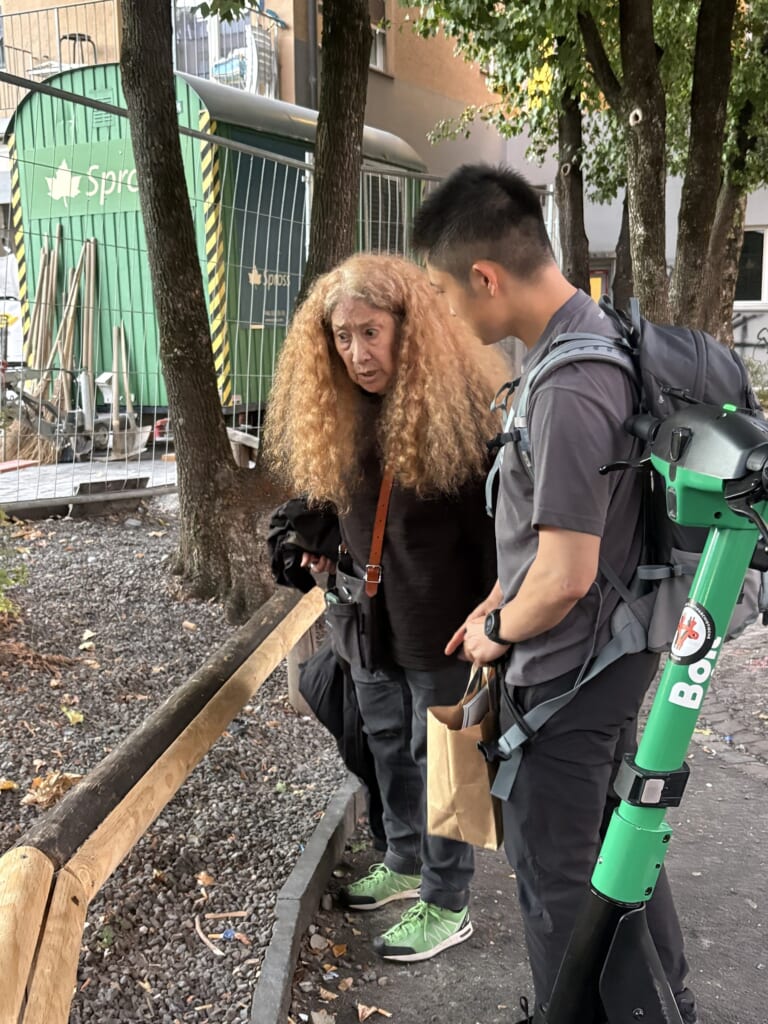
In September 2026 I met Naomi Zurcher, a Lucerne-based urban forester and consulting arborist, in Zurich, and we walked from one street tree to the next. She told me it was the first time she had spoken directly with an arborist from Japan. What she gave me were four questions for using research in the field: what does it act on, does it really work, can it be used on site, and under which conditions.
This is the story of that meeting, roughly in the order of my photos: how a LinkedIn post led to Zurich, the trees we stopped at, what she told me about a lime in Lucerne, i-Tree, the way arborists talk about risk and white-painted trunks, and what I took home to Tokyo.

Before Zurich — a post, an invitation
Why I was in Europe
In September 2026 I spent about two weeks in Europe: Germany first, from Munich, then Switzerland, through Zurich, Bern, Interlaken, Grindelwald and Zermatt, then Italy, to Milan and Venice. It was mostly a personal trip. I added one purpose to it: to see how trees and landscapes are cared for on the ground, and to meet the people who do that work.
Before I left, I posted the route on LinkedIn and invited arborists and tree people along the way to meet. I am an arborist at a landscape company in Tokyo, and the trip was a chance to look at the same trees as the people who care for them there.
Who I met in Zurich
Naomi Zurcher is based in Lucerne; we met in Zurich. Her public profile describes her as an Urban Forester and Consulting Arborist with Arbor Aegis, registered in Luzern, and an affiliate member of the i-Tree team, the group behind the urban forest tools associated with the USDA Forest Service. She was also on the project team of a Swiss research project run with the Zurich University of Applied Sciences (ZHAW) from 2018 to 2022.
She told me that I was the first arborist from Japan she had spoken with directly. Her career and mine are on different continents, but our work circles the same problems, which this article will come back to: old trees in tight urban ground, tools that promise to see under the pavement, and clients who want a clear answer.
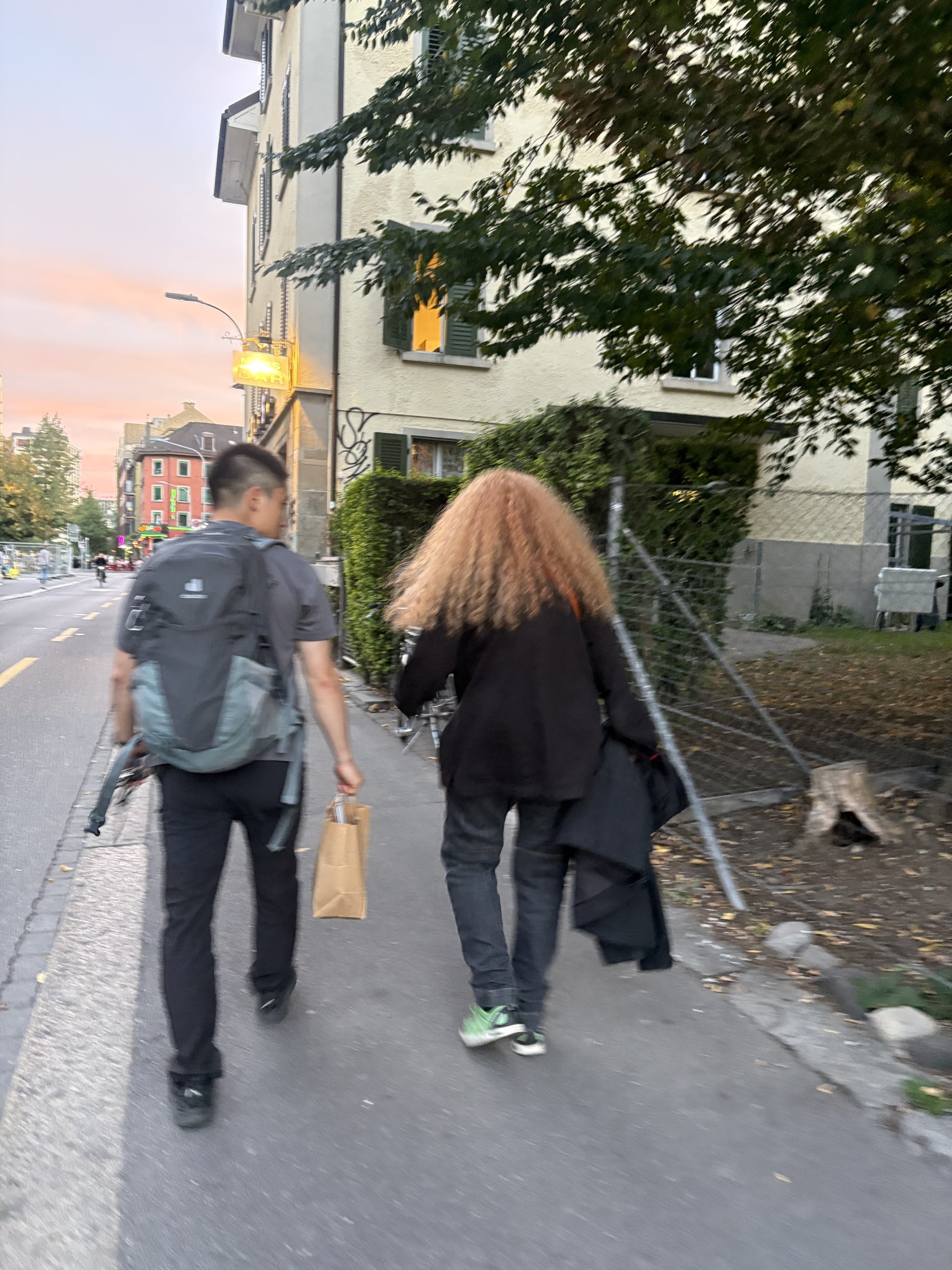
The walk — one street tree at a time
The first tree
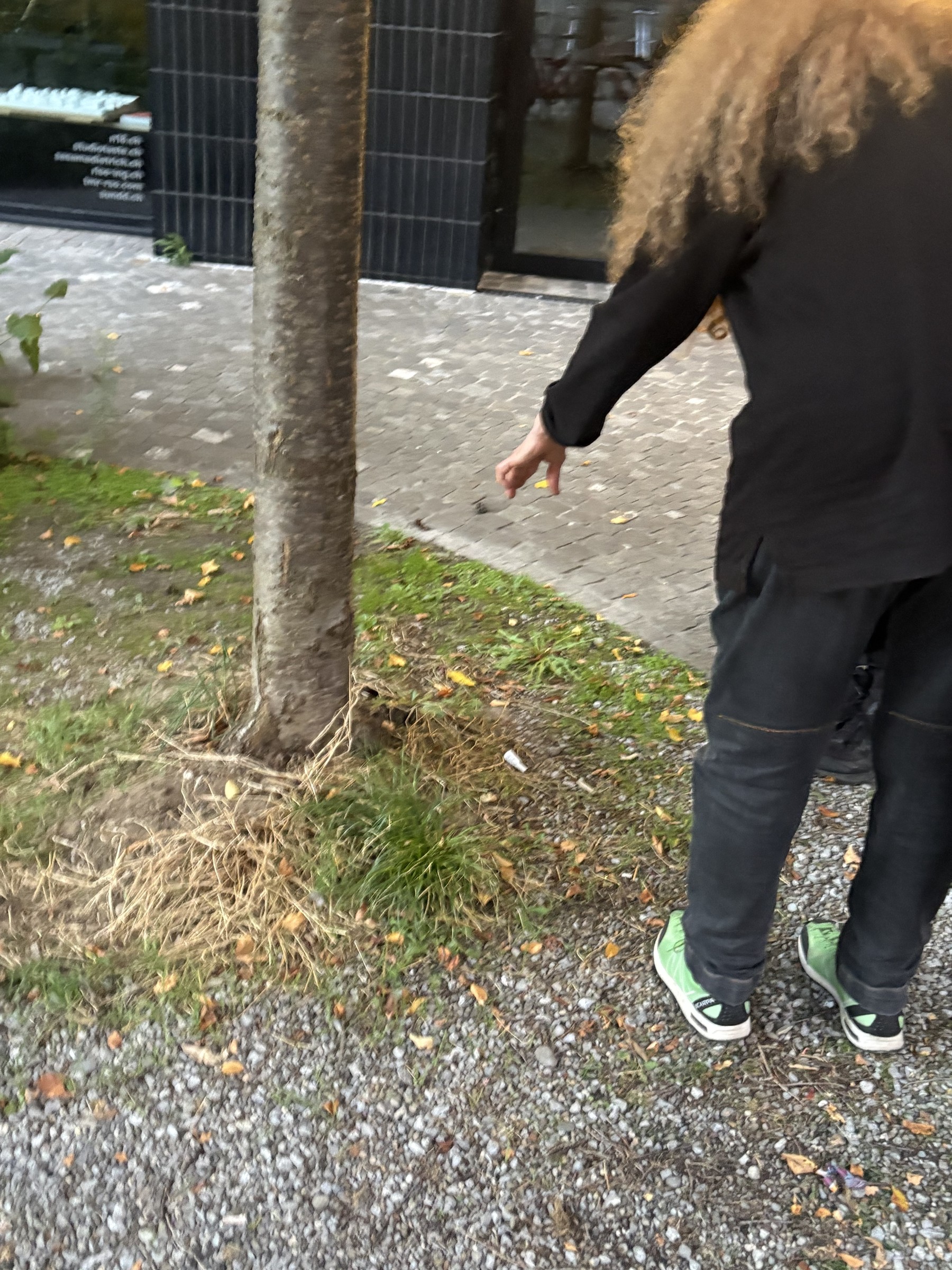
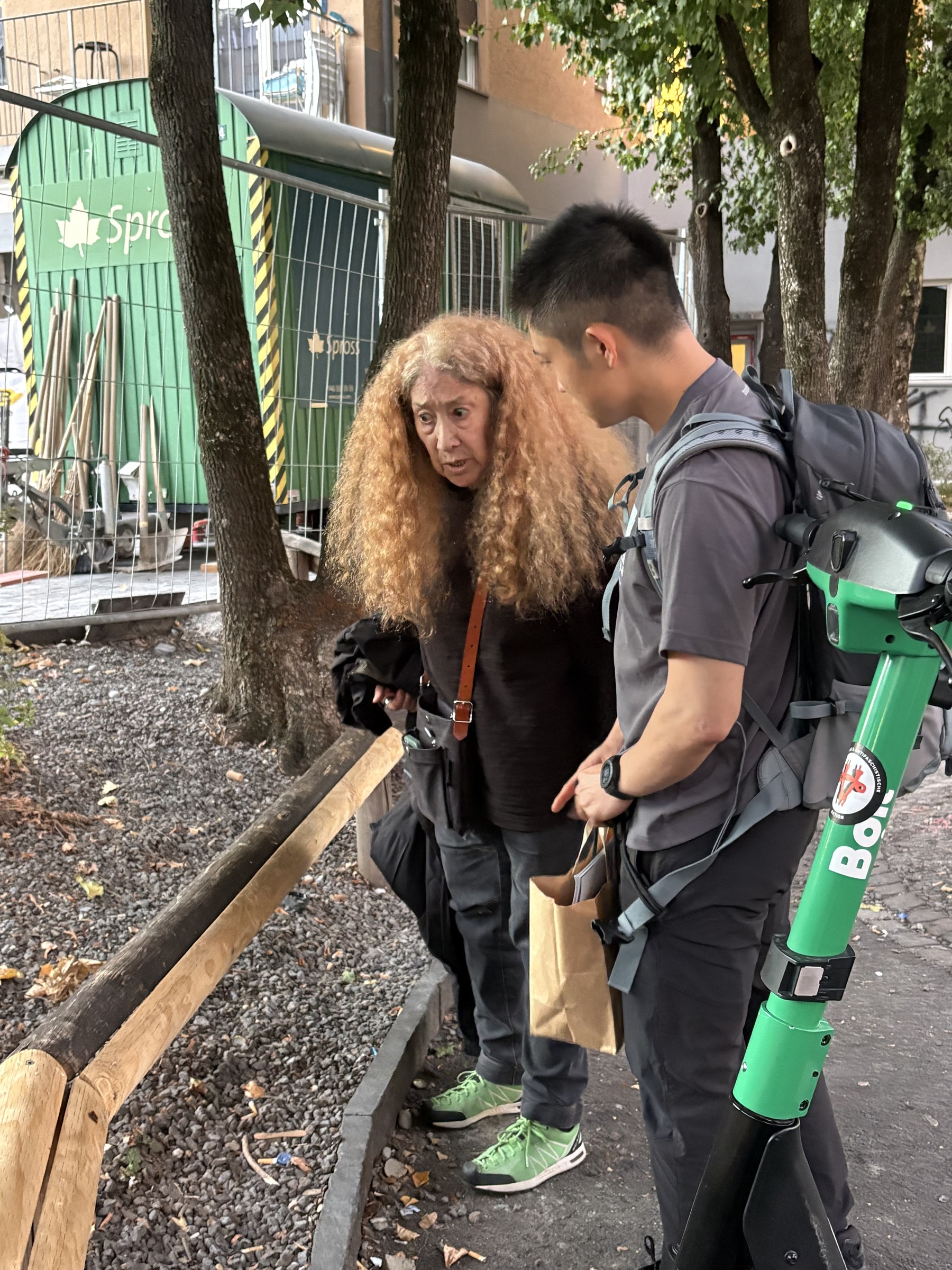
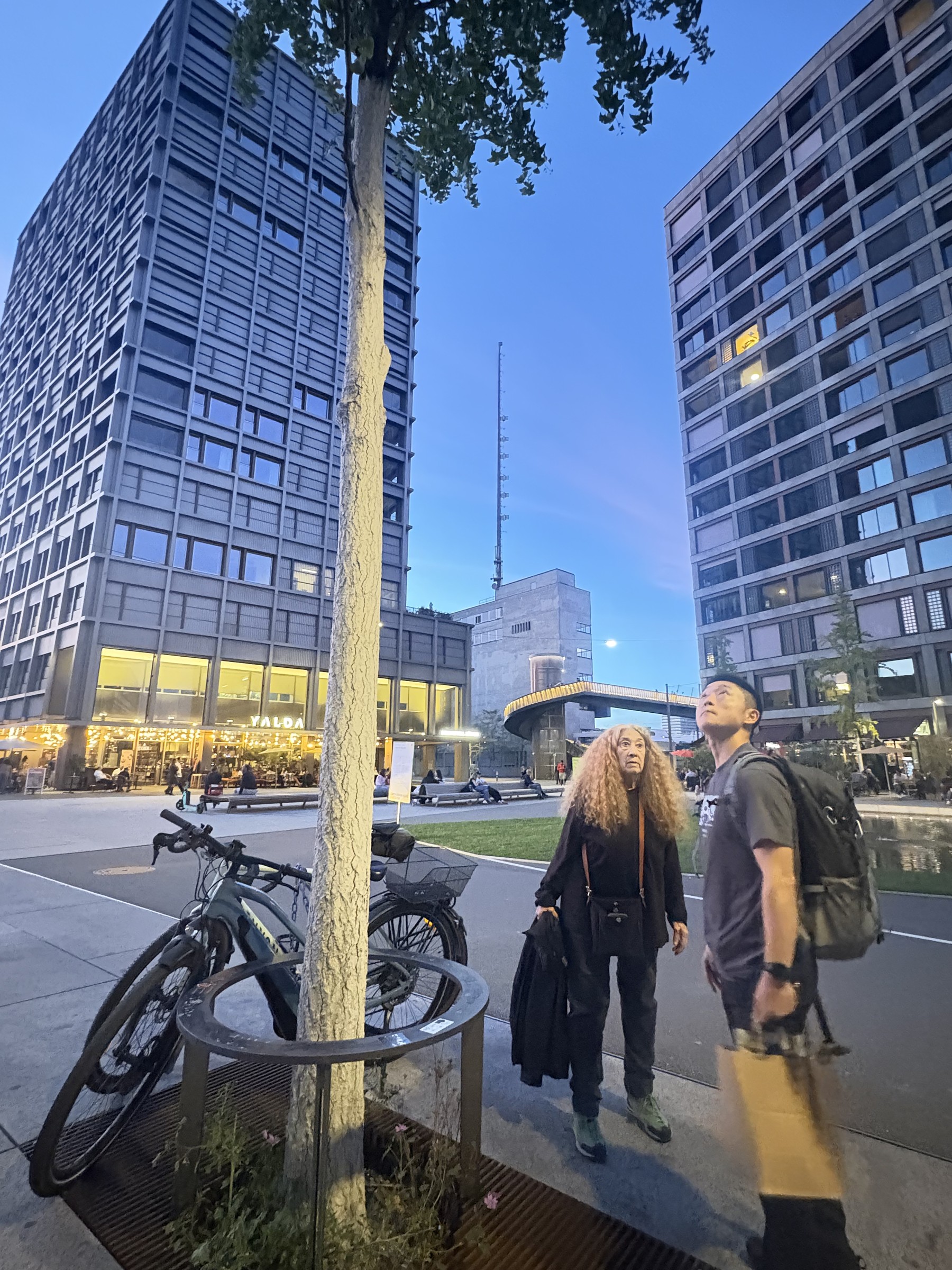
We walked ordinary streets and stopped at ordinary street trees. The first stop in my photos is a young tree standing in a grass bed, where we both bent over its base. Naomi pointed to the base of the trunk, where it meets the turf and the soil.
In Japan, too, a visual check of a tree starts at the base, before any instrument comes out (I have written about reading decay without technology separately). A Swiss urban forester and a Japanese arborist went to the same spot first.
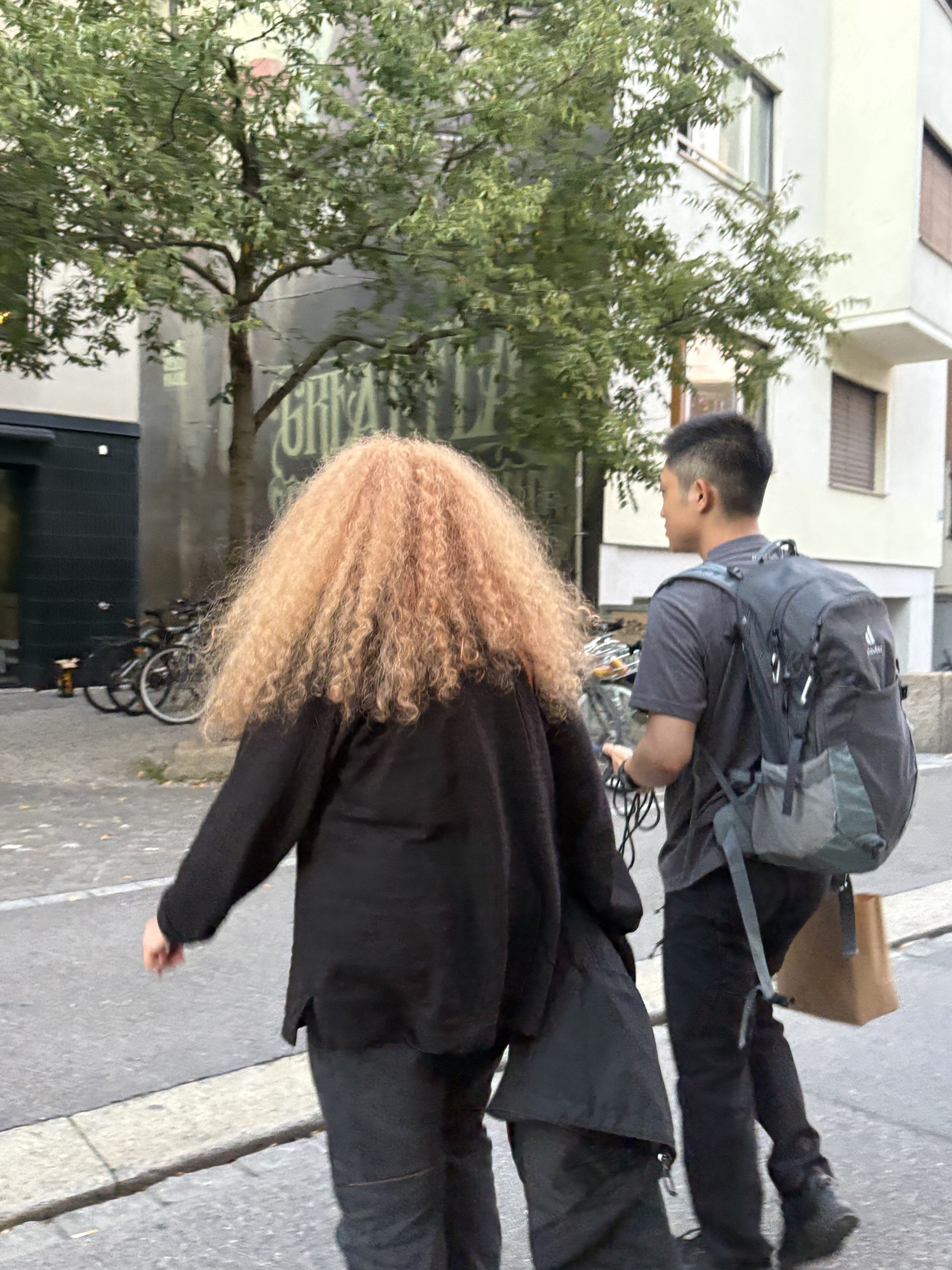
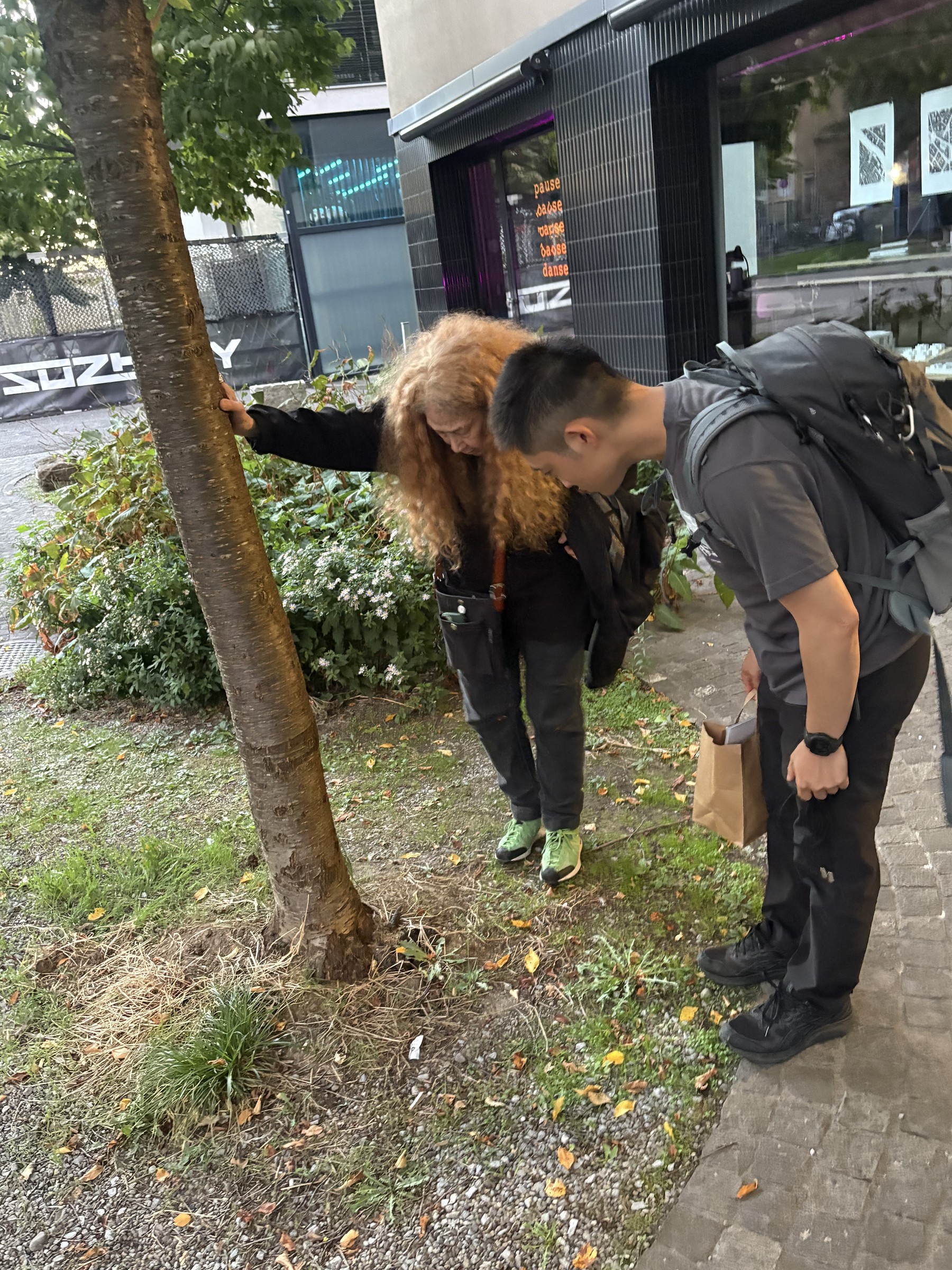
Trees in gravel, bark, grating
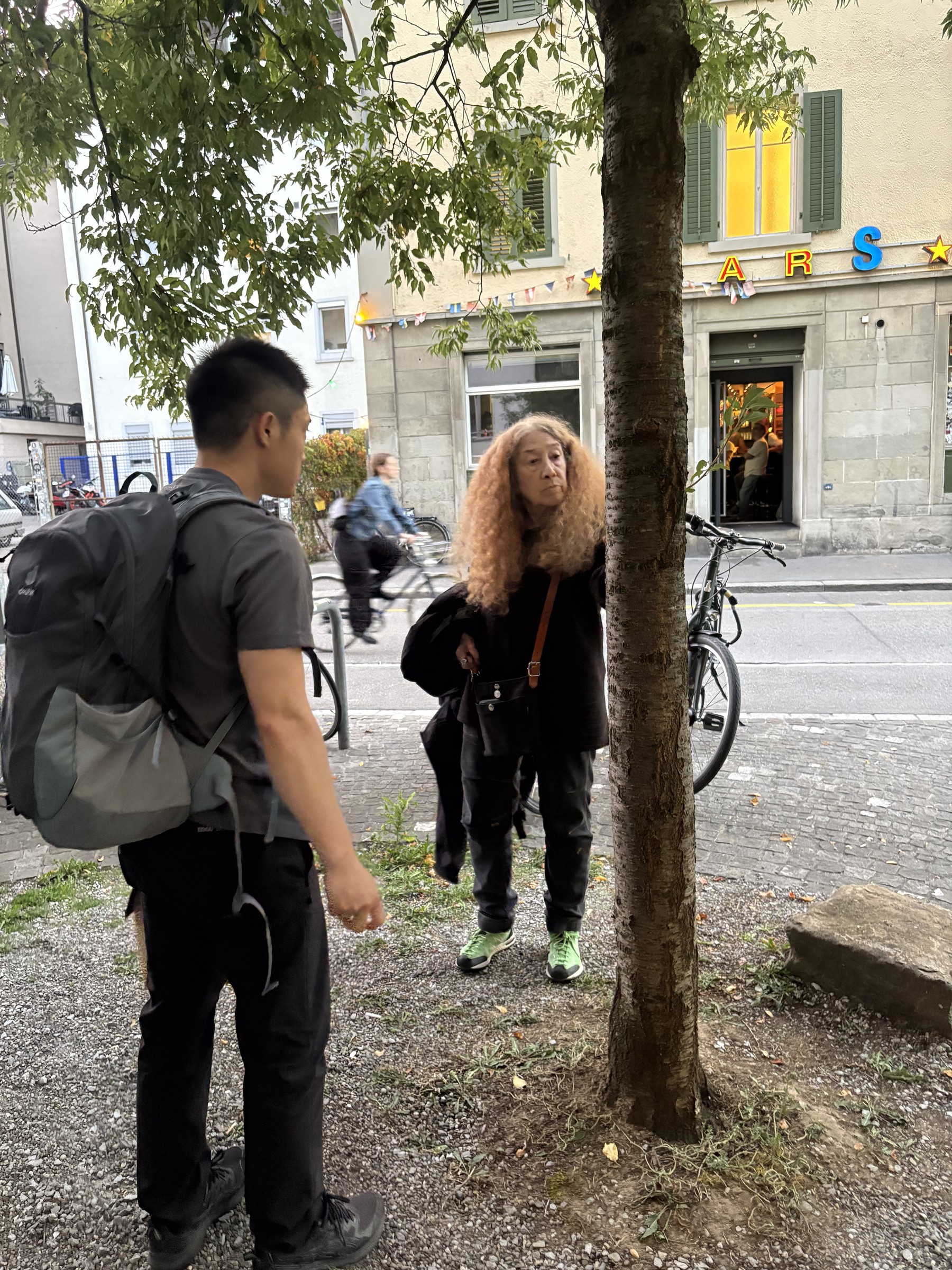
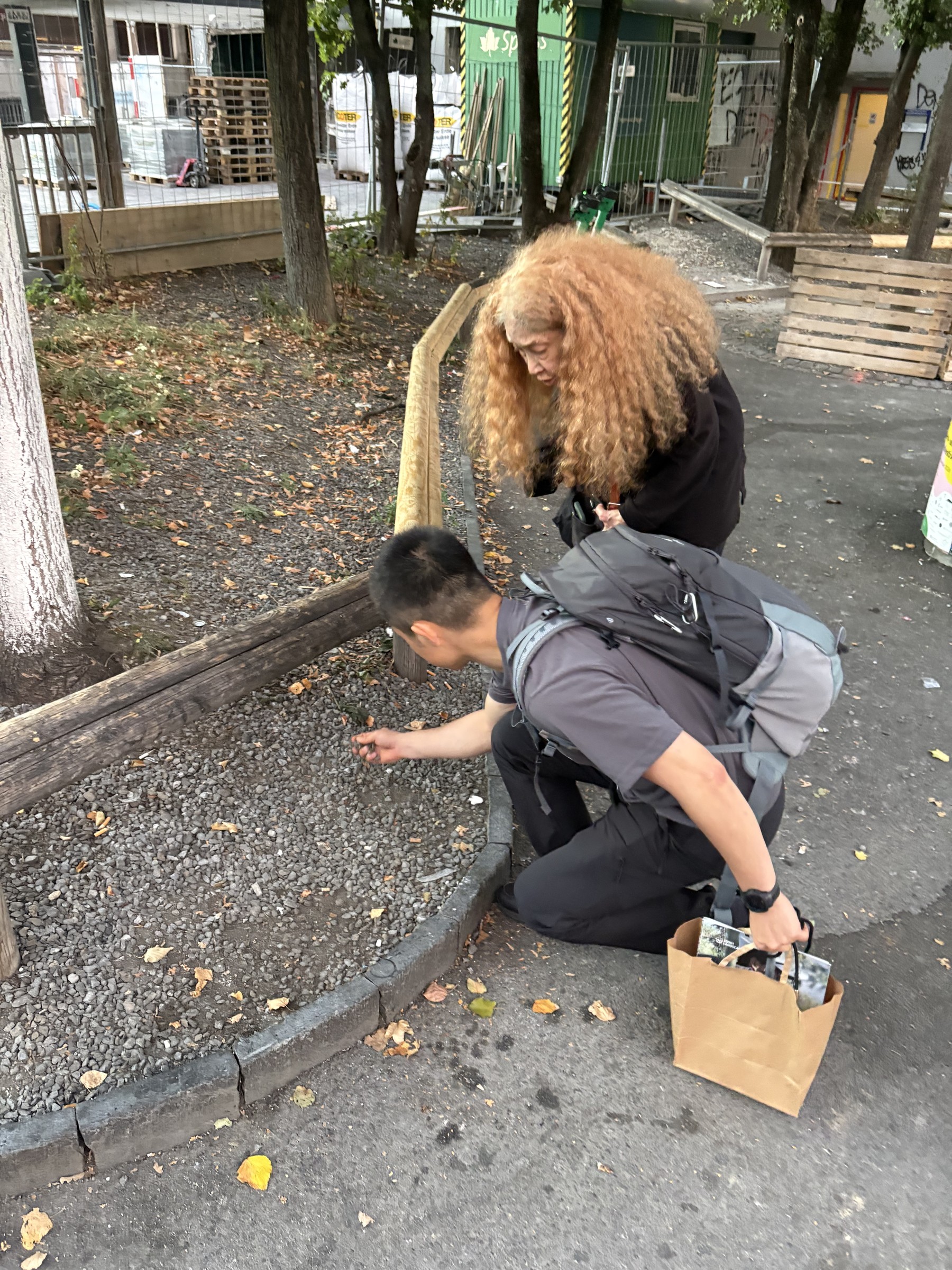
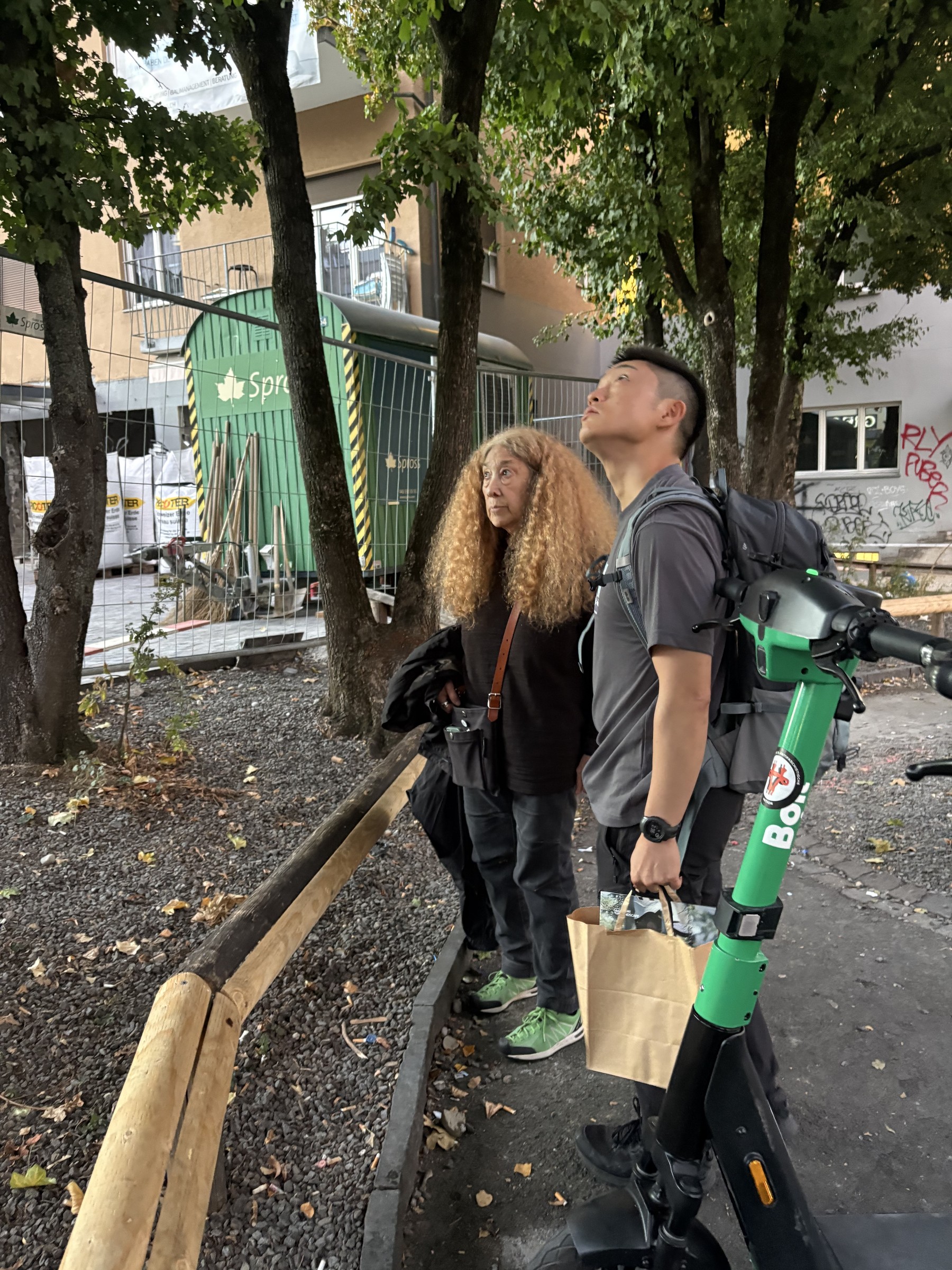
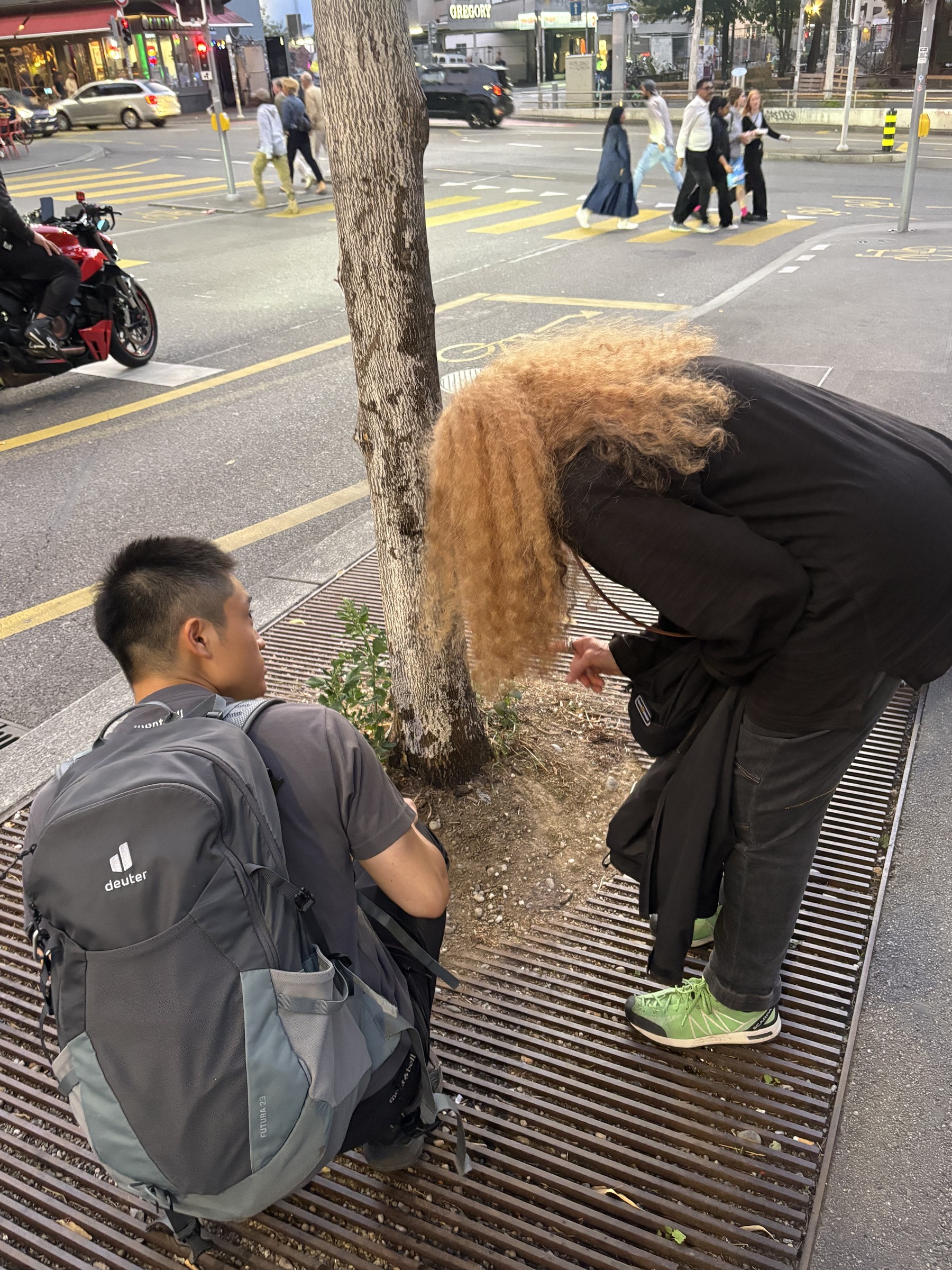
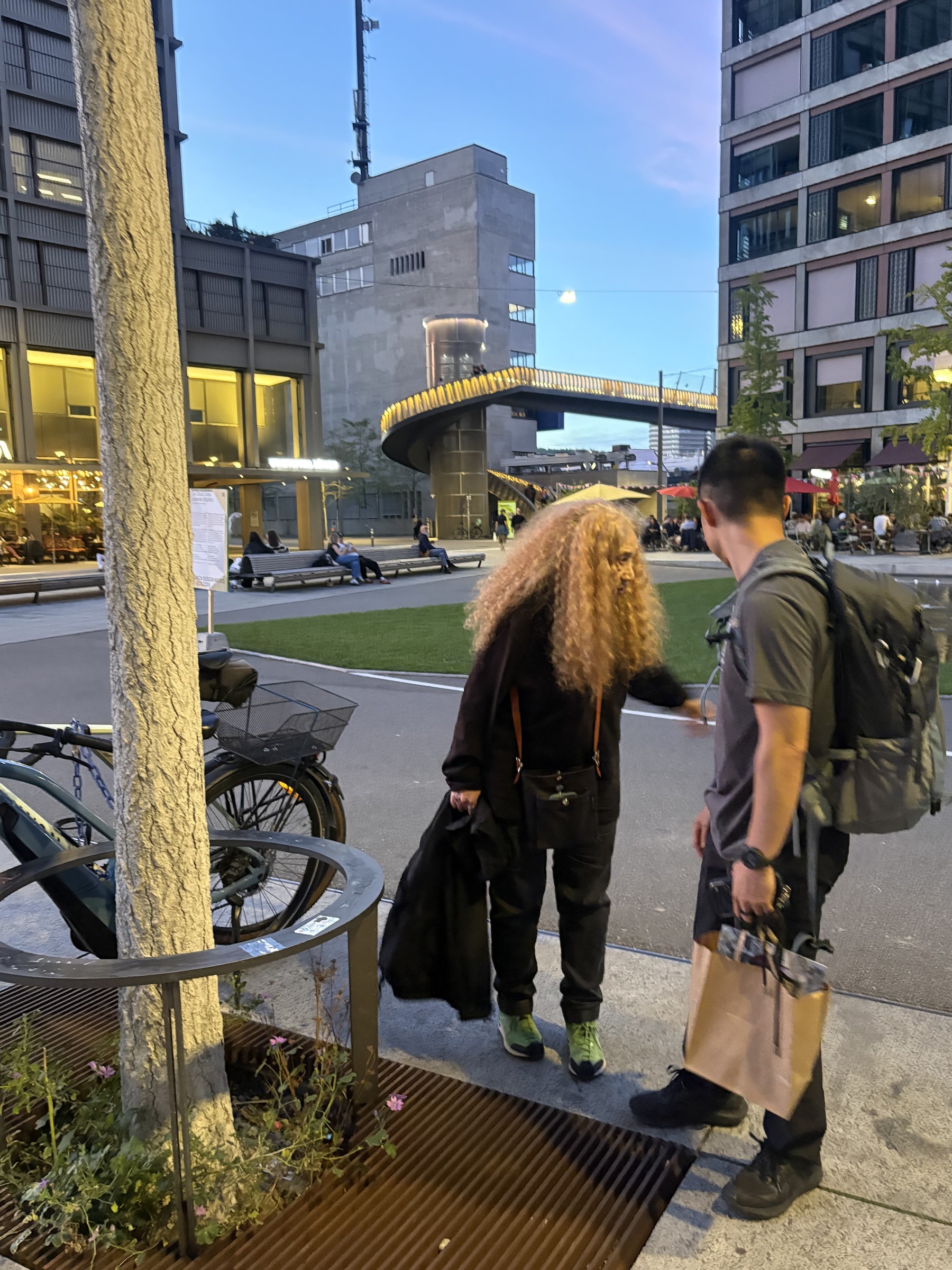
The next trees stood in a gravel bed beside a bicycle rack, and then in a planting bed edged with timber. At one we stood on either side of the trunk and talked across it. At the timber-edged bed I crouched and pointed at the soil while Naomi leaned over to look, then I looked up into the crown, and we talked beside the timber edge.
My notes do not record what was said at each tree, so I will not invent it here. The rest of this article sets out what she told me during our time together, as I recorded it afterwards.
Four questions — how she turns research into practice
The gap she works in
The thread running through everything Naomi said was the gap between research and practice. Research on tree roots, soils and urban canopies grows every year. Field crews, contractors and city tree officers work from procedures, and research does not reach those procedures by itself. Her work, as she described it, is to read the research, decide what holds up, and translate it into procedures and specifications that a crew can follow and a client can sign.
She is not alone in naming that gap. A 2016 paper in Environmental Management, available through USDA Treesearch, examined cases in which “researchers and practitioners are working jointly to develop applicable knowledge for planning and managing the urban forest.” A 2019 essay by C. Y. Jim on urban tree soils put it plainly: “Research findings could be more proactively transformed and transferred into practices.”
The four questions
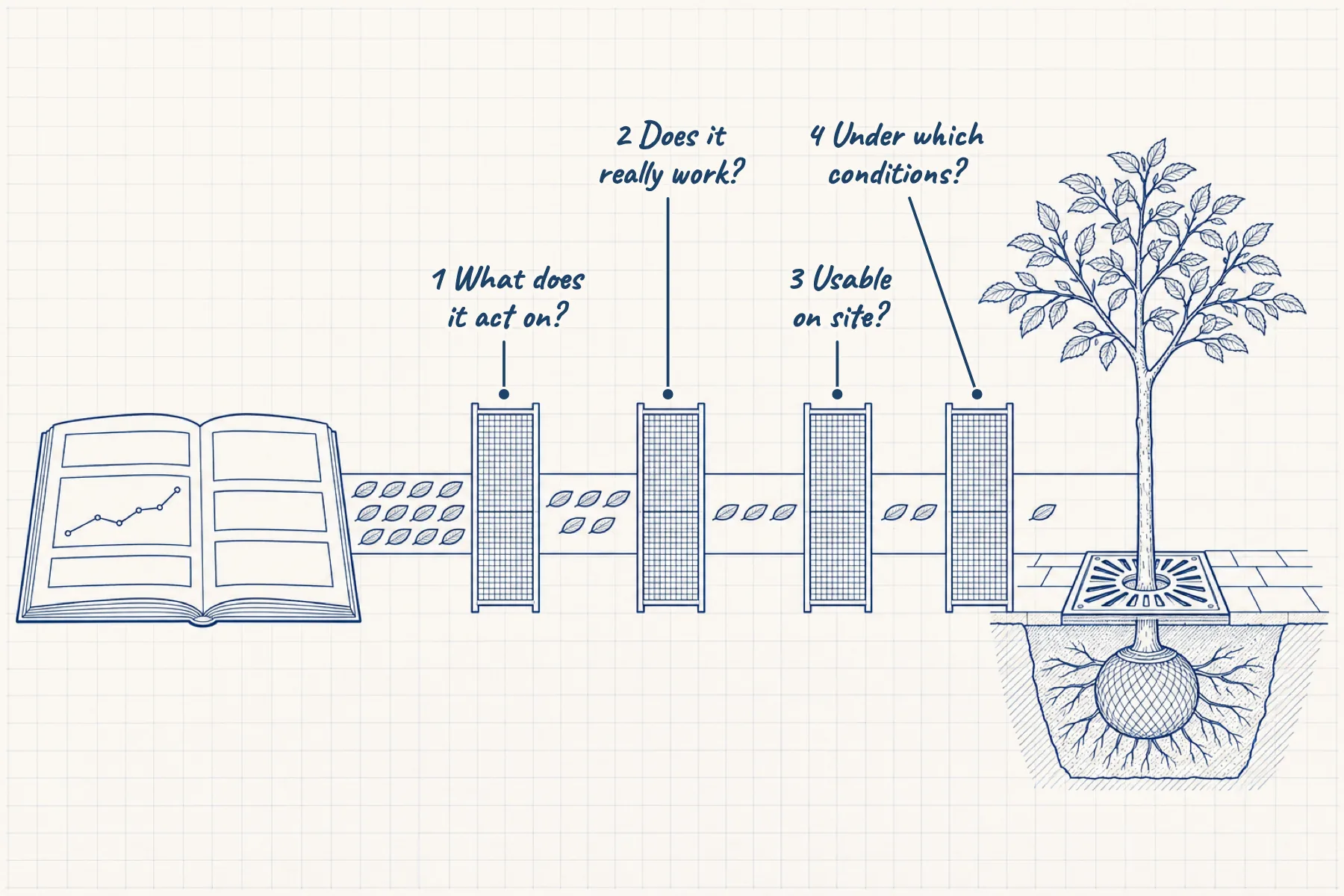
Her tool for crossing that gap is four questions, asked of any finding before it goes into a specification:
- What does it act on? The roots, the soil, the bark, the crown, or the way the tree is managed? A sound result applied to the wrong part of the tree does not help it.
- Does it really work? What was the evidence: a control, a sample size, a number of years? Was the effect measured on the tree, or estimated by a model?
- Can it be used on site? Can a crew do it with the equipment, time and access they actually have, on a street, around traffic, utilities and paving?
- Under which conditions? Which species, soils, climate and tree ages did the study cover? A result on dry sand may not carry over to wet clay.
Each question catches a different mistake. Mixing up the target is how a sound result gets applied to the wrong problem, for example a remedy for compacted soil recommended for a tree whose real trouble is a girdling root. A method that needs a laboratory, or a dry week in spring, may be correct and still unusable on a city street. And a result from young nursery trees may not apply to a lime more than a century old.
As I read her approach, the four questions work as a filter: a finding with a weak answer to any of them is one to watch, not yet one to specify.
| Question | What it checks | Where it goes wrong |
|---|---|---|
| What does it act on? | The target: roots, soil, bark, crown, management | A sound result applied to the wrong part of the tree |
| Does it really work? | Evidence: controls, sample size, duration, what was measured | A single trial treated as a standard; an estimate treated as a measurement |
| Can it be used on site? | Equipment, time, access, timing | A correct method no crew can deliver on a street |
| Under which conditions? | Species, soil, climate, age, site | A result carried from one soil or species to another |
A lime in Lucerne — prevent damage before you have to repair it
Her example
Naomi also talked about a lime in Lucerne, which she identified as Tilia platyphyllos, the large-leaved lime. In an interview published by Reforestation World, she describes a lime that, in her words, has graced the lakeside promenade since 1880. What she told me was about root recovery and soil regeneration for the lime, and about TreeRadar, a ground-penetrating radar, to see where the roots ran without digging.
The City of Lucerne announced a rescue treatment for a lime on the Schweizerhofquai in March 2021. The city’s release describes a tree more than 100 years old and about 20 metres (65 feet) tall, whose root environment had deteriorated after extensive work on underground utility lines and changes to the surface. The treatment loosened the soil, then worked in compost, tree substrate and wood chips, a technique the city calls “Radical Trenching.” The release names the tree only as a “Linde,” a lime.
Which lime?
The species matters to the fourth question. Tilia platyphyllos Scop. is the accepted name for the large-leaved lime, native from Europe to northern Iran, according to Kew’s Plants of the World Online. Its leaves are usually 6 to 12 cm long and hairy on the underside, especially on the veins. The Woodland Trust gives a practical field check against the small-leaved lime, T. cordata: large-leaved lime has hairs all over the underside, while small-leaved lime has tufts only where the veins branch. Hybrids exist, so a single leaf does not settle an identification. Before you apply a finding about “limes” to a tree, it helps to know which lime you are standing under.
Order, not technique
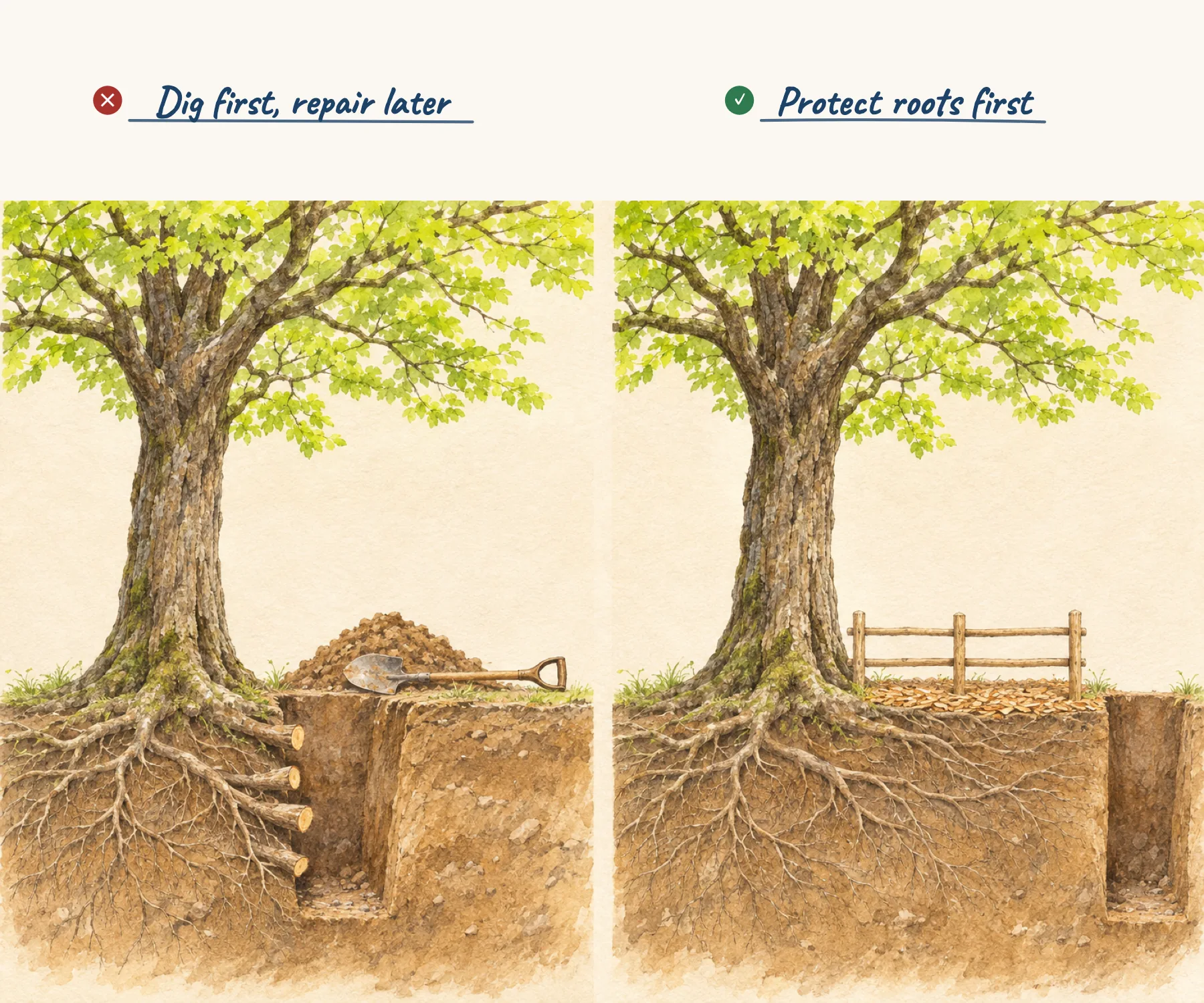
The lesson Naomi drew from Lucerne was about order. A rescue treatment starts from damage already done. Her emphasis was on the sequence of construction: find out where the roots are before anyone digs, then plan the works so the roots are not cut in the first place.
The International Society of Arboriculture’s public guidance makes the same point from the other side: “Construction damage to trees may take many years to impact the tree,” and heavy equipment compacts soil. By the time a crown thins, the trench that caused it may be years in the past.
In the UK, BS 5837:2012 sets a default root protection area as a circle whose radius is 12 times the trunk diameter measured at 1.5 m (about 5 feet) above ground, as a Leicestershire County Council design guide explains. That circle is a planning rule, not a map of where the roots actually are. Finding the roots before digging, as Naomi described, goes further than drawing a circle on a plan.
What the radar can show
Here the four questions applied to the tool itself. TreeRadar’s published procedure says it can scan over bare soil or over brick, concrete, paving or asphalt, and gives indicative figures: roots of about 1 cm (0.4 inch) to about 1 m (3 feet) deep with a 900 MHz antenna, about 2 cm (0.8 inch) to about 3 m (9 feet) with 400 MHz. Research adds the conditions. A 2009 Plant and Soil study by Hirano and colleagues found that root size, water content and spacing all affected detection, and that “two roots that were located closely together were not individually distinguished.” A 2013 review by Guo and colleagues concluded that results are “site specific,” best in well-drained, electrically resistive soils. So a radar map is evidence to read with its conditions, not a picture of every root.
| Point | Manufacturer guidance | What research adds |
|---|---|---|
| Surface | Bare soil, paving, brick, concrete, asphalt | Surface layers still affect the signal |
| Smallest root | About 1 cm at 900 MHz; about 2 cm at 400 MHz | Detection depends on diameter, moisture, spacing |
| Depth | About 1 m at 900 MHz; about 3 m at 400 MHz | Best in well-drained, electrically resistive soils |
| Close roots | Not stated as a limit | Two roots close together may not be distinguished |
Run through her questions, the radar comes out like this. It provides information about roots; it does not treat the tree. It works, within limits that research has measured. The manufacturer says it can be used over paving. And it depends heavily on conditions: soil moisture, soil type, root size and root density. A map from wet clay deserves more caution than one from dry, well-drained ground.
i-Tree in Switzerland — standing, looking, measuring
From Bern to an English field guide
Naomi told me she had begun bringing i-Tree to Switzerland with a company in Bern. A final report published by the Swiss Federal Office for the Environment (FOEN) records that i-Tree Eco was first applied in Switzerland by Arbor Aegis together with Pan Bern AG in a pilot project in 2017, along the Bundesgasse in Bern and in the park of the Kleine Schanze.
i-Tree Eco takes field data from single trees, complete inventories or sample plots and estimates the structure of an urban forest and its environmental effects, such as pollution removal, carbon storage and avoided run-off. Those outputs are model estimates, which is question two again: they are only as good as the field data and the local inputs behind them. The i-Tree site notes that the tool has been adapted for Europe, and that limited local pollution or precipitation data can restrict which reports are available. The same Swiss federal report includes i-Tree surveys in Zurich and Basel, so the city we were walking through has been measured this way too.
She also talked about a field guide in English for survey crews: where to stand, how to look, how to measure. ZHAW hosts “i-Tree Eco – Field guide for complete inventories,” and i-Tree’s resources page credits material as “Created and/or shared by Naomi Zurcher, Arbor Aegis.” It covers the measurements that drive the model, among them trunk diameter at breast height, total height, crown width, percent crown missing and crown light exposure. ZHAW notes that the original English document was taken into the official international training strategy of the i-Tree team in the USA. Each of those measurements is a place where two careful people can disagree: where to put the tape on a leaning trunk, where to stand to judge how much of a crown is missing. A model can only be as consistent as the people feeding it.
Why this mattered to me
This part of the conversation applied directly to my own work: my company has just started using i-Tree Eco in Japan. A guide like hers makes a simple point that is easy to miss. Unless every crew stands, looks and measures the same way, the numbers will not mean the same thing from one site to the next.
| i-Tree Eco field item | Where two crews can differ |
|---|---|
| Trunk diameter at breast height | Tape height on a leaning or buttressed trunk |
| Total height | Viewing distance, angle |
| Crown width | Which branch tips count as the edge |
| Percent crown missing | Judging the outline of a “full” crown |
| Crown light exposure | Counting the sides open to light |
Talking about risk — and about what people do to trees
“Trees are dangerous”
Naomi was careful about one word: risk. When an arborist leads with risk, she said, what clients and the public hear is that trees are dangerous. In my reading, that framing can push decisions toward removal rather than toward care.
Her alternative is to widen the frame. Trees can fail, but they are also damaged, and much of that damage is done by people: roots cut during construction, inappropriate pruning, soil compacted by traffic and use. If a report names what people do to trees, the options include changing what people do, not only what happens to the tree.
What I took from it
In Japan, tree assessments are often written for a client who wants to know whether a tree is safe. I have compared Japanese and European approaches to assessment in VTA versus jumoku-i. Naomi’s point applies there as well: a report that also names the human causes of decline gives the client something to change, not only something to fear.
The ISA guidance quoted above lists the same kinds of human causes: roots severed by trenching, soil compacted by heavy equipment. None of them is visible in a crown on the day it happens. On the streets we walked, the visible signs were small: bicycles parked against a tree guard, bare soil inside gratings. Whether such pressures add up to damage has to be checked at each tree, which is exactly why they belong in an assessment rather than outside it.
White trunks at dusk — why not paint every tree
The trees near Europaallee
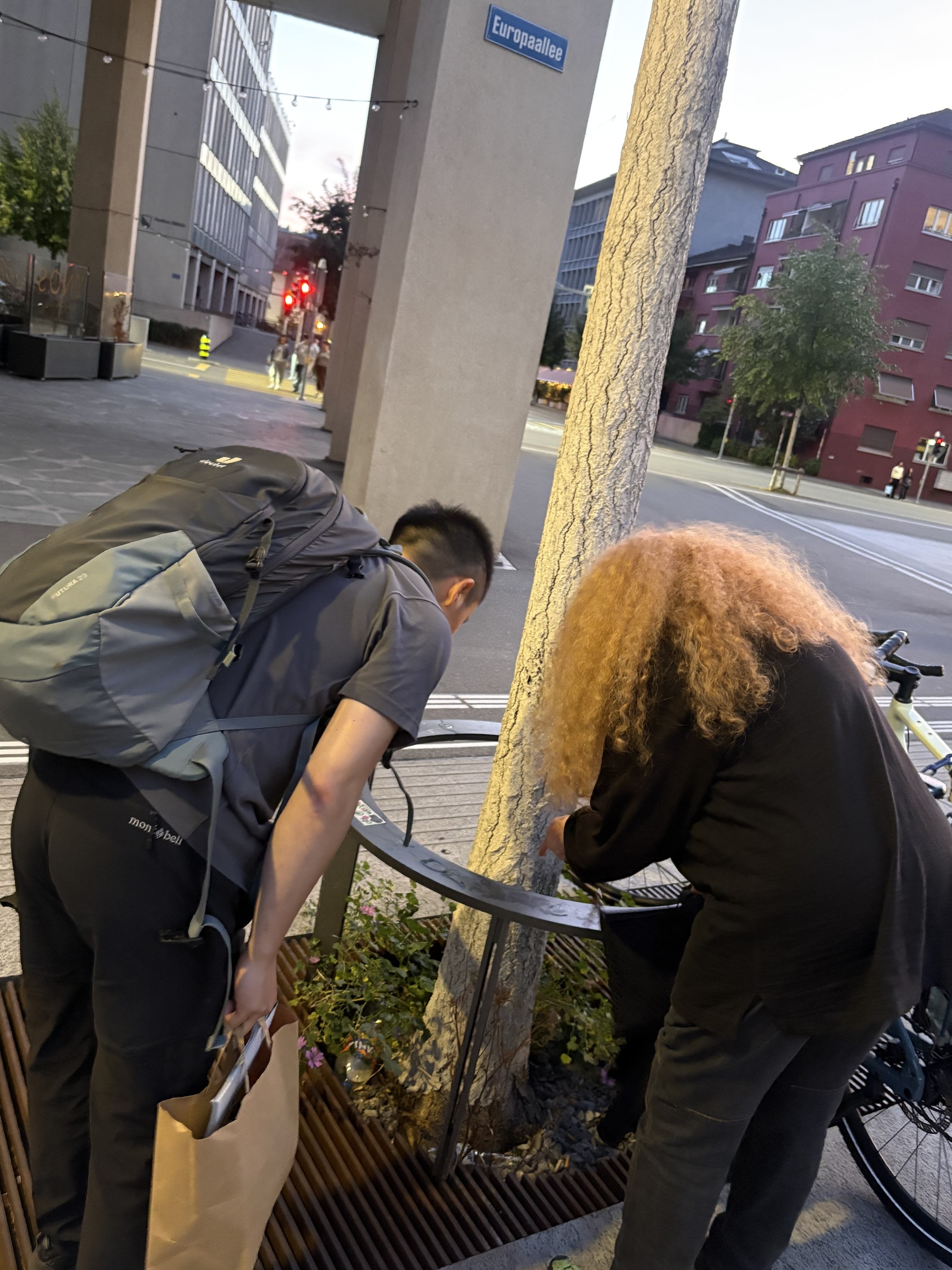
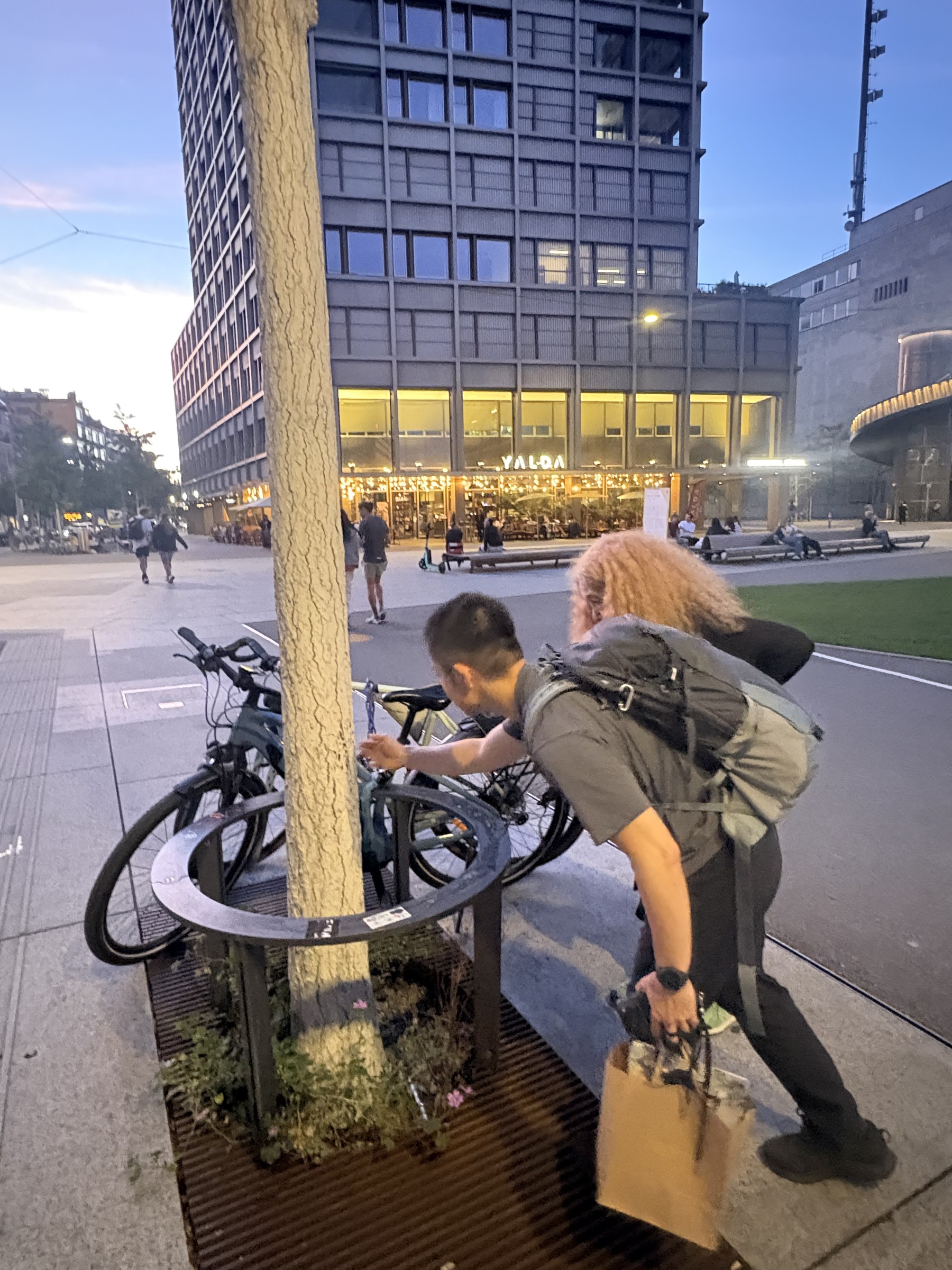
By the time we reached the trees near Europaallee, the light was going. The trunk we stopped at there was painted white. We stood beside it, by its steel ring guard, and talked; I bent down by the bicycles parked against the guard. I did not ask the city why that tree was painted, and I do not know.
Naomi’s own position was clear: she does not whitewash trunks as a rule.
Why trunks are painted, why she marks the north side
The usual reason for whitening a trunk is sunscald: winter sun warms the bark during the day, it freezes again at night, and the bark can be damaged or split. Utah State University Extension lists a 50:50 mix of white exterior latex paint and water on lower trunks as one protection.
Naomi’s alternative comes earlier. Young trees grown densely in a nursery shade one another’s trunks. When such a tree is planted alone on a street, bark that grew in shade can suddenly face full sun. So for densely grown nursery trees she marks the north side when the tree is bought, then plants it facing the same way. A University of Georgia extension article gives the same advice: “mark the north side of the tree at the nursery, then orient the stem in the same direction.”
Put through her four questions, paint acts on bark temperature, has a mechanism behind it, and is easy to apply, but whether it is needed depends on the conditions: climate, species, and how the bark was exposed before planting. The north-side mark works on the cause instead.
| Approach | When | Acts on | Depends on |
|---|---|---|---|
| White trunk paint | After planting | Bark temperature in winter sun | Climate, species, previous exposure of the bark |
| North-side mark | At purchase, then at planting | The bark’s exposure history | A nursery tree grown in the shade of its neighbours |
One line of my own — keep reading research
What I added
When I wrote about our meeting afterwards, I added one line of my own: keep reading research after graduation, and after your initial training. In Japan, as elsewhere, most of us learn our methods early and then repeat them. Her four questions are a way to keep reading without being carried away by every new paper.
Walking on
The last photos of the walk show us heading down a street under a pink evening sky, then standing by the white-trunked tree between tall buildings as the sky turned blue. The final one is the two of us together, smiling, under a lit canopy.
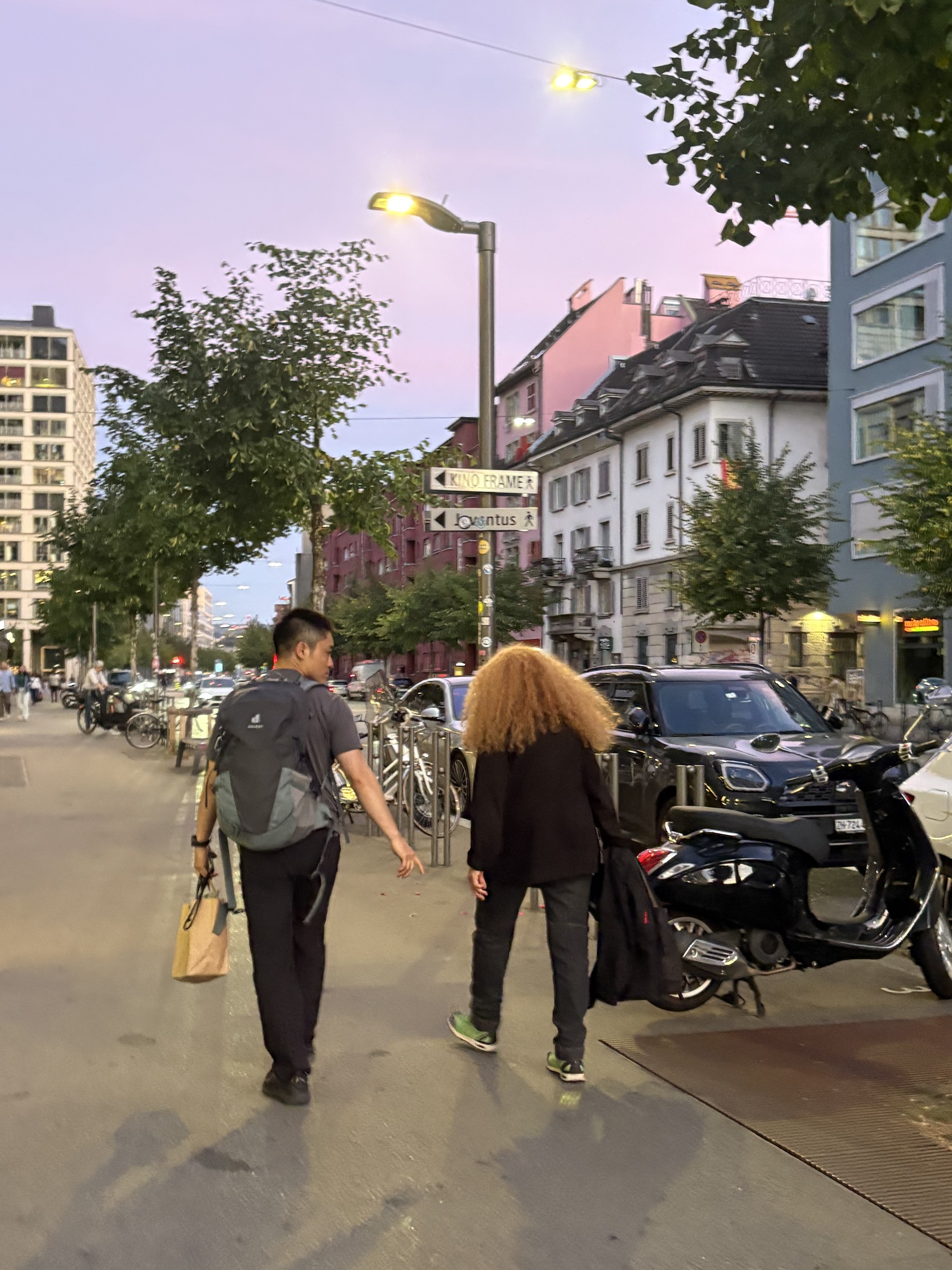
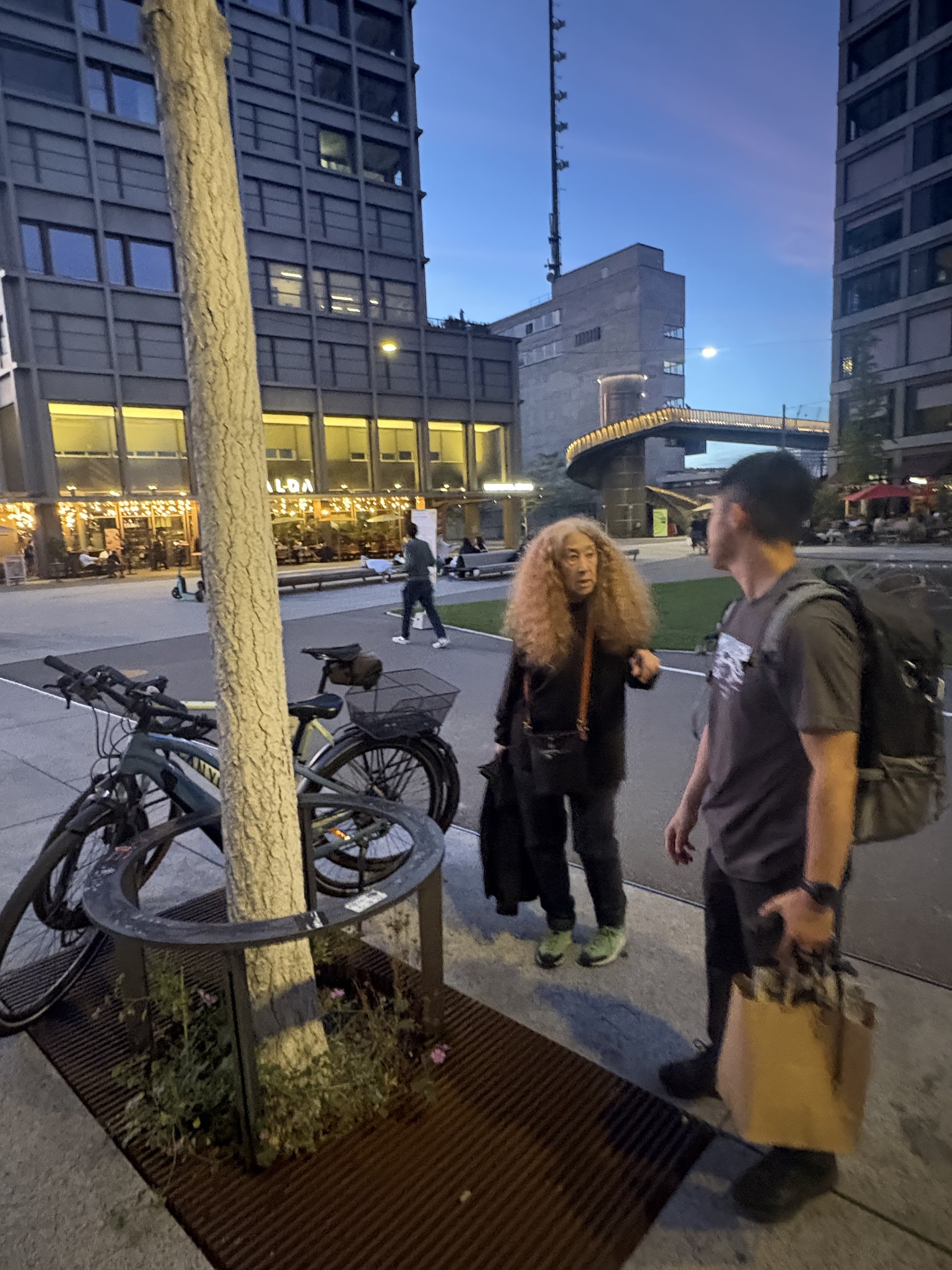
After Zurich — a repost from France, what I took home
ARBRES et PATRIMOINE
When I later shared our exchange on LinkedIn, ARBRES et PATRIMOINE, a French association that promotes ornamental arboriculture and urban forestry, reposted it and praised it, with a note that travel and exchange had spread tree-care skills. A conversation between a Japanese arborist and a Swiss urban forester, on a few Zurich street corners, had reached tree people in a third country.
What I took home to Tokyo
Three things from that day apply directly to work in Tokyo. The first is the four questions, which apply just as well to the instruments used in Japanese tree diagnosis, such as the resistograph and sonic tomography: what the tool measures, how well that has been tested, whether it can be used on this tree in this street, and under which conditions the reading holds. The second is her sequence for street trees, many of which are struggling in Tokyo’s tight ground: find the roots before digging, name the human damage, plant the tree the way it grew. The third is the field-guide idea for our own i-Tree Eco work: agree first on how we stand, look and measure.
Take a single example. Suppose a new paper reports that a soil treatment helps street trees recover after construction. Her first question asks whether it acts on the soil, the roots, or both. The second asks how many trees were treated, for how long, against what control. The third asks whether a crew can do it in a narrow tree pit beside a road, with the paving left in place. The fourth asks which species, which soil, which climate. Only after those four answers does the treatment belong in a specification for a Tokyo street. If one answer is weak, the treatment becomes something to trial and watch, not something to write into every contract.
Thank you
Naomi, thank you for the evening, the walk, and the conversation.
Frequently asked questions
Who is Naomi Zurcher?
She is an urban forester and consulting arborist with Arbor Aegis, registered in Lucerne (Luzern), Switzerland, and an affiliate member of the i-Tree team. A Swiss federal report records that Arbor Aegis and Pan Bern AG first applied i-Tree Eco in Switzerland in a 2017 pilot.
What are her four questions for using research?
What does it act on, does it really work, can it be used on site, and under which conditions? They are a way to decide whether a research finding is ready to be written into a procedure or specification, or is still one to watch.
How did a Japanese arborist come to meet her?
Before a two-week trip through Germany, Switzerland and Italy in September 2026, I posted my route on LinkedIn and invited tree people along the way to meet. We met in Zurich, where we spent an evening looking at street trees together.
Can ground-penetrating radar find all of a tree’s roots?
No. The manufacturer gives indicative limits, and research shows detection depends on root size, soil moisture and root spacing; roots lying close together may not be told apart. Results are best in well-drained soils.
Should young street trees have their trunks painted white?
Not as a rule. Paint can protect bark from winter sunscald, but whether it is needed depends on climate, species and how the bark was exposed before planting. Marking the north side at the nursery, then planting the tree facing the same way, avoids a sudden change in the sun exposure of its bark.
Sources
– Uforest Alliance, member profile of Naomi Zurcher (checked 2026-11-13): https://www.uforest.eu/join/naomi-zurcher/ – ZHAW, project overview, i-Tree project team 2018–2022 (checked 2026-11-13): https://www.zhaw.ch/de/forschung/projekt/71658 – Swiss Federal Office for the Environment (FOEN/BAFU), final report on i-Tree in Switzerland (checked 2026-11-13): https://www.bafu.admin.ch/dam/it/sd-web/-qIjnBsisUPc/i-tree-baeume-und-stadtwaelder-klimaangepasst-managen.pdf – ZHAW, i-Tree Eco – Field guide for complete inventories (checked 2026-11-13): https://www.zhaw.ch/storage/lsfm/dienstleistung/iunr/urban-forestry/i-tree-cheat-sheet-english.pdf – i-Tree, international language resources (checked 2026-11-13): https://www.itreetools.org/support/resources-overview/i-tree-international/support-language – i-Tree Eco, official description (checked 2026-11-13): https://www.itreetools.org/tools/i-tree-eco – TreeRadar, Root Mapping Procedure (checked 2026-11-13): https://www.treeradar.com/Root-Mapping-Procedure.pdf – Hirano et al. (2009), Plant and Soil (checked 2026-11-13): https://link.springer.com/article/10.1007/s11104-008-9845-4 – Guo et al. (2013), Plant and Soil (checked 2026-11-13): https://link.springer.com/article/10.1007/s11104-012-1455-5 – Stadt Luzern, press release on the Schweizerhofquai lime, 25 March 2021 (checked 2026-11-13): https://www.stadtluzern.ch/_docn/3031598/Erhalt_Linde_Schweizerhofquai_MM_25.03.2021.pdf – Reforestation World, interview with Naomi Zurcher (checked 2026-11-13): https://www.reforestationworld.org/voices/naomi-zurcher-arbor-aegis/ – Utah State University Extension, Sunscald (checked 2026-11-13): https://extension.usu.edu/planthealth/ipm/ornamental-pest-guide/abiotic/sunscald – University of Georgia CAES Field Report, Paul Pugliese, “Tree bark can split from cold temperatures following excessive sun and heat” (2017; checked 2026-11-13): https://fieldreport.caes.uga.edu/news/tree-bark-can-split-from-cold-temperatures-following-excessive-sun-and-heat/ – Campbell et al. (2016), Environmental Management, USDA Treesearch (checked 2026-11-13): https://research.fs.usda.gov/treesearch/50704 – Jim (2019), Socio-Ecological Practice Research (checked 2026-11-13): https://link.springer.com/article/10.1007/s42532-018-00005-z – ISA, Avoiding Tree Damage During Construction (checked 2026-11-13): https://www.treesaregood.org/Portals/0/TreesAreGood_Avoid%20Damage%20During%20Construction_0721.pdf – Kew, Plants of the World Online, Tilia platyphyllos (checked 2026-11-13): https://powo.science.kew.org/taxon/urn%3Alsid%3Aipni.org%3Anames%3A332109-2/general-information – Woodland Trust, large-leaved lime (checked 2026-11-13): https://www.woodlandtrust.org.uk/trees-woods-and-wildlife/british-trees/a-z-of-british-trees/large-leaved-lime/ – Leicestershire County Council, root protection areas (checked 2026-11-13): https://www.leicestershirehighwaydesignguide.uk/highway-layouts-and-design/protecting-natural-assets/excluding-construction-activity-root – ZHAW, Urban Forestry und i-Tree in der Schweiz (checked 2026-11-13): https://www.zhaw.ch/de/lsfm/dienstleistung/umwelt-und-natuerliche-ressourcen/urban-forestry-und-i-tree-in-der-schweiz/i-tree-und-die-oekosystemleistungen – ARBRES et PATRIMOINE, association page (checked 2026-11-13): https://www.helloasso.com/associations/arbres-et-patrimoine
Related reading
This story is one of the exchanges on the Worldwide map, where I collect the arborists I have met, hosted and worked with.