

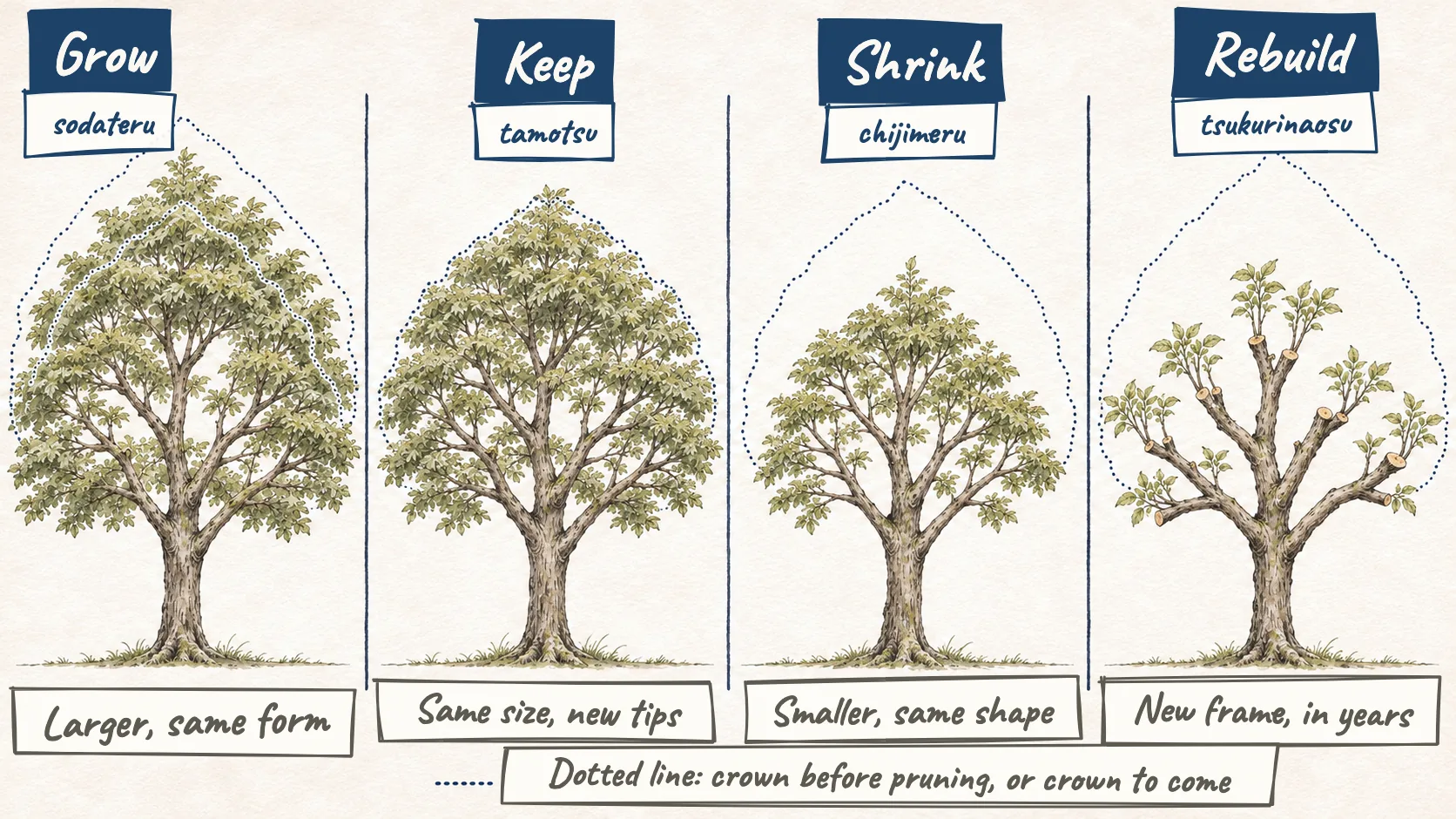
Before a branch is cut, Japanese public pruning manuals ask for two decisions: the target form the trees should have in their space, and which of four purposes the work serves — grow (ikusei), keep (iji), shrink (shukushō) or rebuild (saisei). The purpose guides the choice of cuts and, for shrinking or rebuilding, sets a management plan measured in years. Read in order, the four types also trace the life of a garden tree, from a young tree that is still filling its space to an old one whose form has to be rebuilt.
The question before the first cut — target form
Stand in front of a garden tree with a pair of shears and the first temptation is to look for something to cut: a long shoot, a crossing branch, a twig sticking out of the outline. Japanese practice asks you to put the shears down first and answer a different question. What should this tree look like, in this place, in the years ahead?
Kanri mokuhyō jukei — the target form
Saitama Prefecture’s street-tree pruning manual calls this the kanri mokuhyō jukei (管理目標樹形), the management target form. It is set for each street before individual trees are cut. The manager also decides whether the target is a natural form, corrected toward the species’ own shape, or an artificial form shaped by repeated heading cuts. Only after that does the manual assign a pruning policy, which it calls a target type: grow, keep, shrink or rebuild.
The Japan Federation of Landscape Contractors (日本造園組合連合会) describes the same habit of mind for garden trees. Before pruning, it writes, the gardener needs to “simulate in their head how the tree will grow” (その木がどのように生長していくかを頭の中でシミュレーションすることが必要です), and the method differs “depending on what you want to do with that tree” (その木をどのようにしたいかによって方法が異なります).
Where the four types come from
The Saitama manual credits its four types to a 1999 joint report by the Ministry of Construction’s Public Works Research Institute and the Japan Landscape Contractors Association, whose second volume is titled Gairoju sentei no tebiki (街路樹剪定の手引き), a guide to street-tree pruning. The Tokyo Metropolitan Government’s street-tree maintenance plan (December 2021) uses a parallel set: keep, shrink, enlarge and, as a reference type, regenerate.
The manuals assign a type according to where a tree stands against its target form. They do not say that every tree passes through all four. But a garden tree that lives long enough often meets them in order, and that is how this article follows them: one imaginary deciduous garden tree, from planting to old age.
Youth — sodateru, growing a frame
Picture the tree a few years after planting: a thin trunk, a handful of branches, a crown that has not yet filled its allotted space. Its target form is still years away. The purpose is to grow, and almost every decision follows from that.
What growing allows
In the Saitama manual the grow type for natural forms “enlarges the tree form” (樹形を拡大), and its basic cuts are eda-sukashi, removing whole branches at their origin, and kirikaeshi, shortening a branch back to a smaller one. Tokyo’s enlarge type is even more restrained: young trees get little more than the removal of unnecessary branches, so that the whole form can grow large (樹形全体を大きく育成する).
The International Society of Arboriculture (ISA) gives the same restraint in its brochure Pruning Young Trees. For a newly planted tree it recommends removing only dead or broken branches and holding other pruning until the second or third year, when the tree has recovered from transplanting. Its first instruction is the one that runs through this whole article: “Set an objective for why the tree will be pruned.”
One leader, chosen early
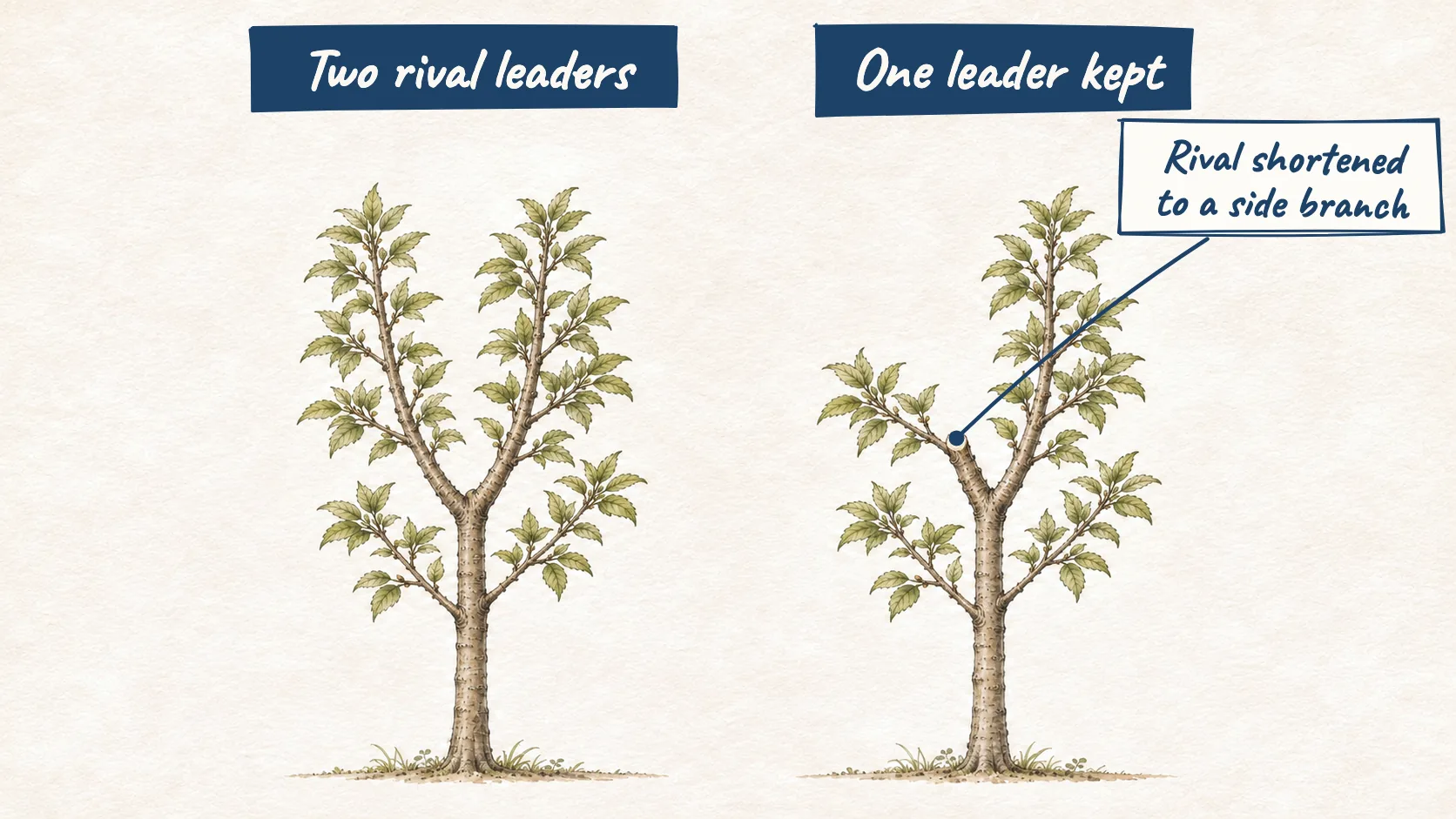
The main structural decision in youth is the leader. ISA’s stated aim for young trees is “a strong, central trunk with sturdy, well-spaced branches”. When two stems of similar size compete, it advises choosing one while the tree is young and removing or shortening the other.
A schedule measured in decades
Edward Gilman’s plan for training shade trees, published by University of Florida IFAS Extension (EP276), spreads this work over seven prunings in the first 25 years after planting: at planting and in years 2, 4, 8, 14, 20 and 25. Its central strategy is “subordinating all but one codominant stem”. The plan also notes that less frequent pruning may be needed when a good nursery tree with one dominant leader is planted and watered until established.
On young trees, the Japanese manuals and these American guides point the same way: prune lightly, keep one leader, let the tree grow. The paths separate once the tree reaches its space.
Maturity — tamotsu, maintaining a target size
Some years on, the tree fills the place it was planted for. Its crown reaches the edge of the view, the eaves or the path. From here on, the question is no longer how big it can become, but how to hold it where it is. The purpose becomes keep.
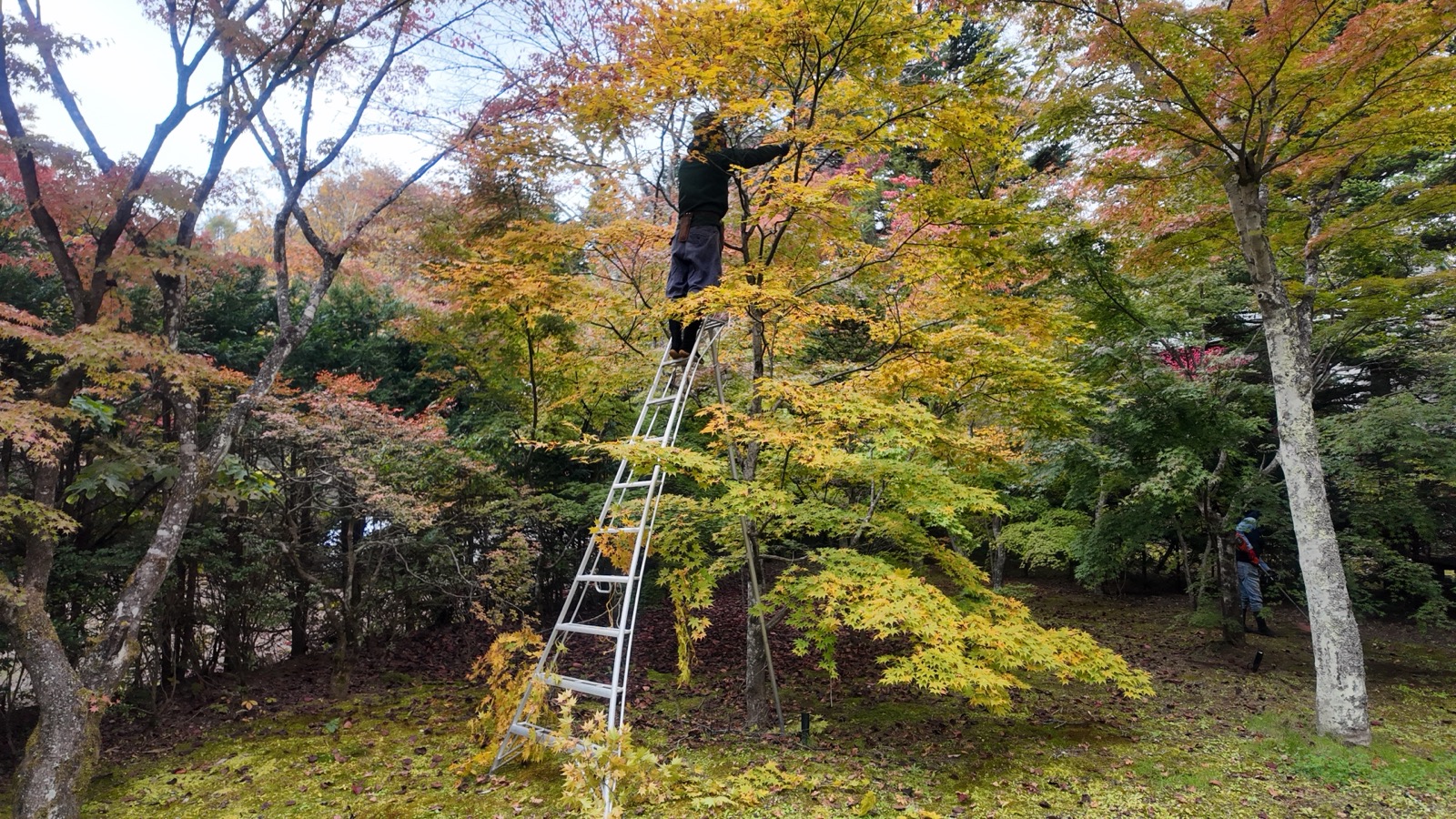
Same size, renewed tips
Saitama’s keep type holds a natural-form tree “at its present size” (大きさを現状維持), and its principal cut is kirikaeshi. Tokyo’s keep type is defined the same way: trees close to their management target are held by cutting back side branches, and some secondary limbs, to shorter branches (切返し剪定によって樹形を維持する).
This is what lets a kept tree keep a natural outline. The long shoot at the edge of the crown is cut back to a suitable lateral growing from the same limb, so the outline stays roughly where it was while growth continues from the retained lateral. Yokohama City’s park-maintenance specification describes the purpose of this cut as shrinking the crown or handing the lead over to the side branch.
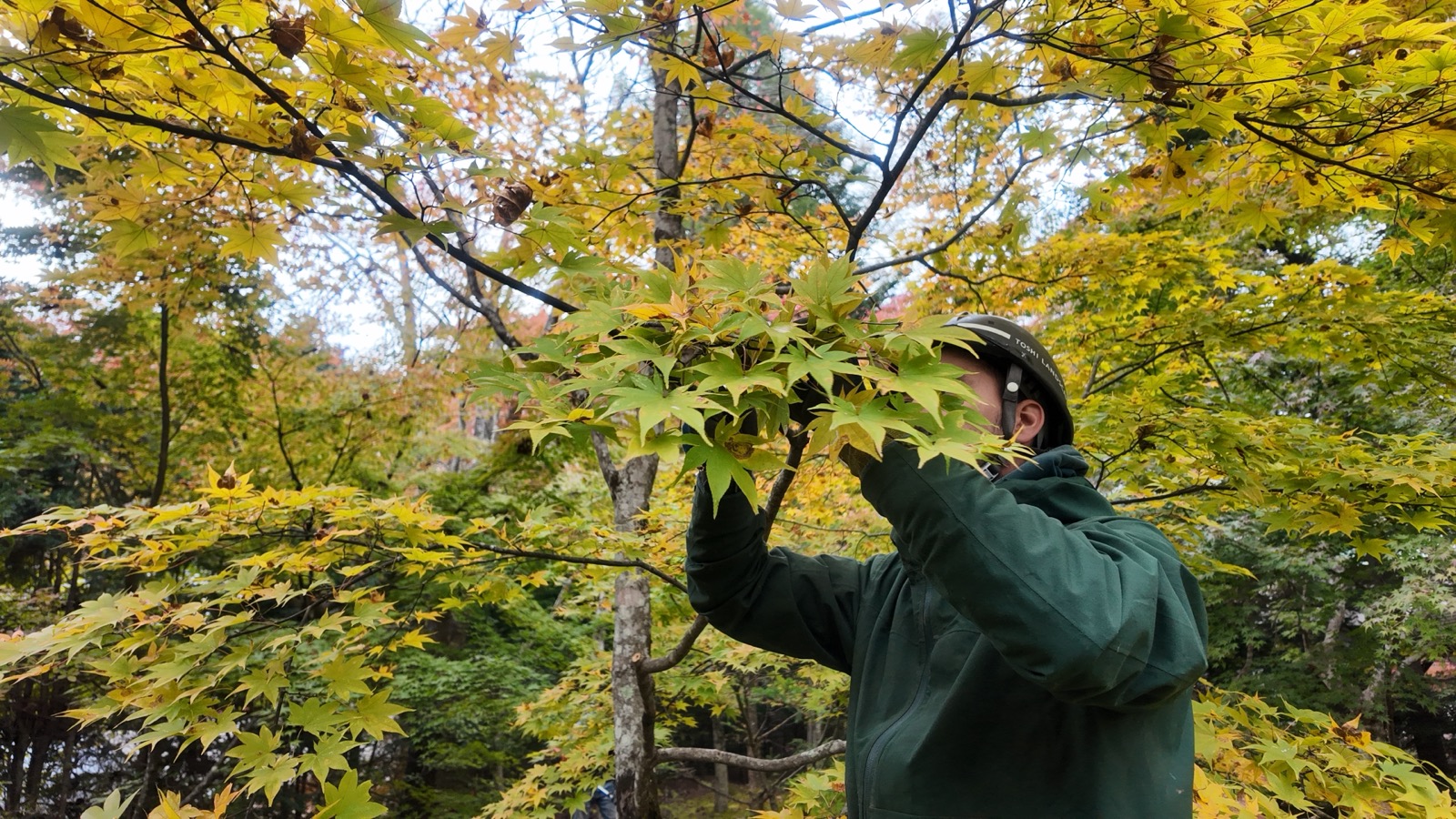
Every year, for compact trees
Size maintenance is repeated work. The Hyogo Prefecture horticulture and parks association writes in its maintenance guidebook that medium and tall trees are pruned every year when they are to be kept compact (コンパクトにする場合は毎年剪定します). A Tokyo Metropolitan Medicinal Plant Garden handout for home gardeners says one pruning a year is enough: deciduous trees in winter, evergreens from late May to June. Yokkaichi City’s agricultural centre gives hedges two clippings a year, with a recommended timing for those clipped only once.
Public bodies split the year in a similar way. The Tokyo street-tree plan calls winter pruning kihon sentei (基本剪定), basic pruning, and summer pruning kei sentei (軽剪定), light pruning. The Japan Greenery Research and Development Center describes winter basic pruning as the work that forms the skeleton branches, and summer light pruning as a light pruning that corrects disorder or overcrowding in the crown.
Pines, written down
Shaping trees has its own written tradition in Japan. The National Diet Library holds a manuscript copy of Niwaki chōhōki (庭木重宝記), a garden-tree handbook, with a separate section headed Matsu tsukuriyō no koto (松つくりやうの事), “on how to shape pines”. Pine shaping was treated as a subject of its own.
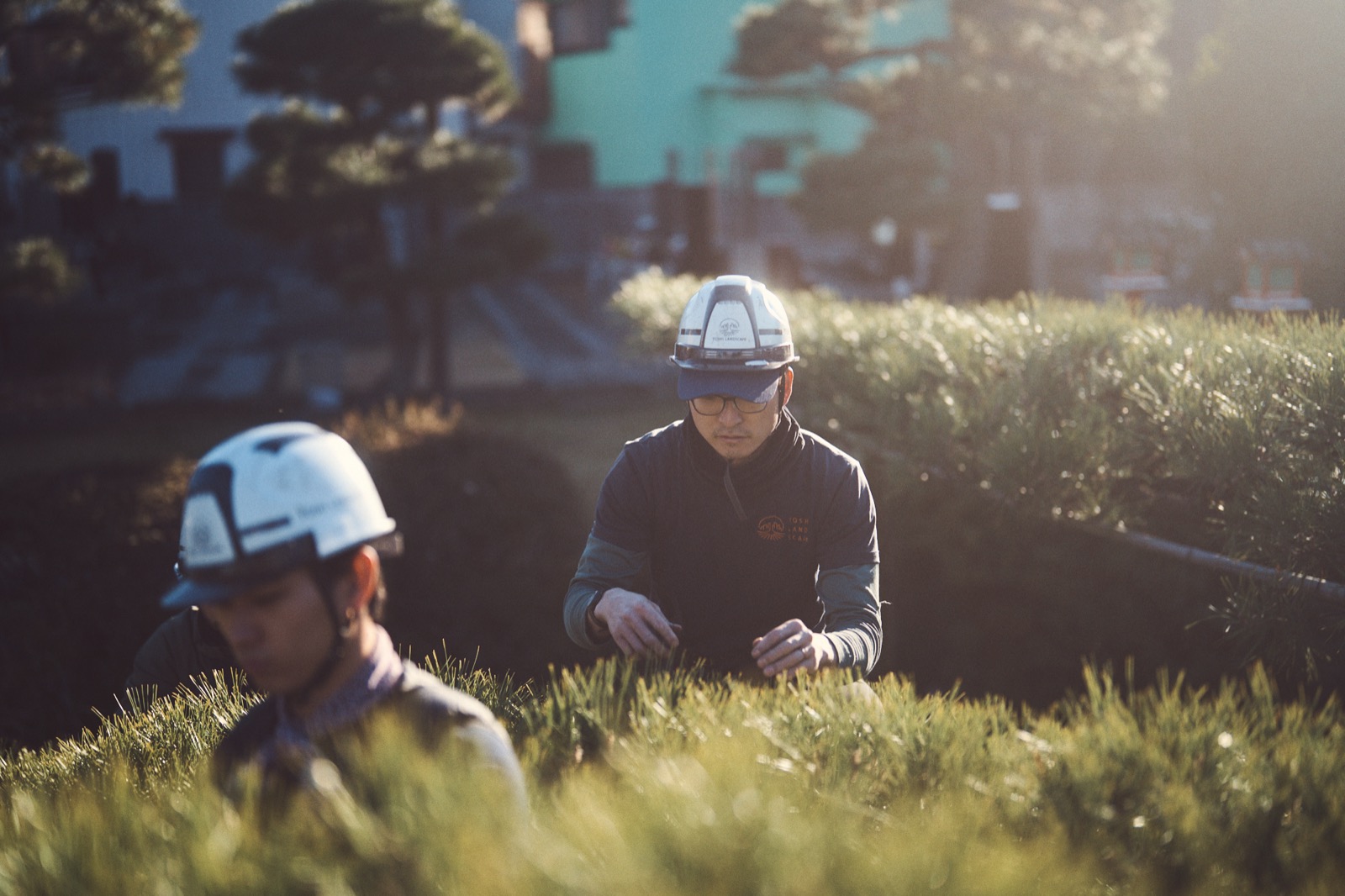
Clipped forms such as karikomi are close to what the Saitama manual calls artificial forms. How a natural-form niwaki differs from a clipped topiary shape is explored in Niwaki vs Topiary.
The four cuts — one vocabulary in two languages
All four purposes are carried out with the same small set of cuts. Japanese specifications use their own names; the English terms in the table are the nearest equivalents, not exact translations. The definitions follow Yokohama City’s common specification for park maintenance (February 2026); the last column is this article’s summary of where each cut appears in the Saitama types.
| Japanese cut | What it does (Yokohama) | Nearest English term | Used mainly in |
|---|---|---|---|
| Eda-nuki / eda-sukashi (枝抜き・枝透かし) | Removes unwanted branches at the fork, after choosing the skeleton branches to keep | Removal cut, thinning | Grow, keep, shrink |
| Kirikaeshi / kirimodoshi (切返し・切戻し) | Removes a long branch, leaving a shorter fork, to shrink the crown or hand the lead to the side branch | Reduction cut | Grow, keep, shrink, rebuild |
| Kiritsume (切詰め) | Cuts a new shoot part-way, just above a bud, to adjust crown size or the placement of new branches | Heading cut | Artificial forms, rebuild |
| Eda-oroshi (枝降ろし) | Removes a thick main limb at its junction with the trunk | Limb removal | Shrink, rebuild |
Tsukuba City’s street-tree guidelines list eda-nuki and eda-sukashi as two names for the same cut, which is why both appear in Japanese specifications.
The one-third guideline
A reduction cut depends on the branch left behind. ISA’s brochure Pruning Mature Trees gives a guideline: the lateral that takes over should be at least one-third the diameter of the stem being removed. A side branch much thinner than that is less able to take over the lead.
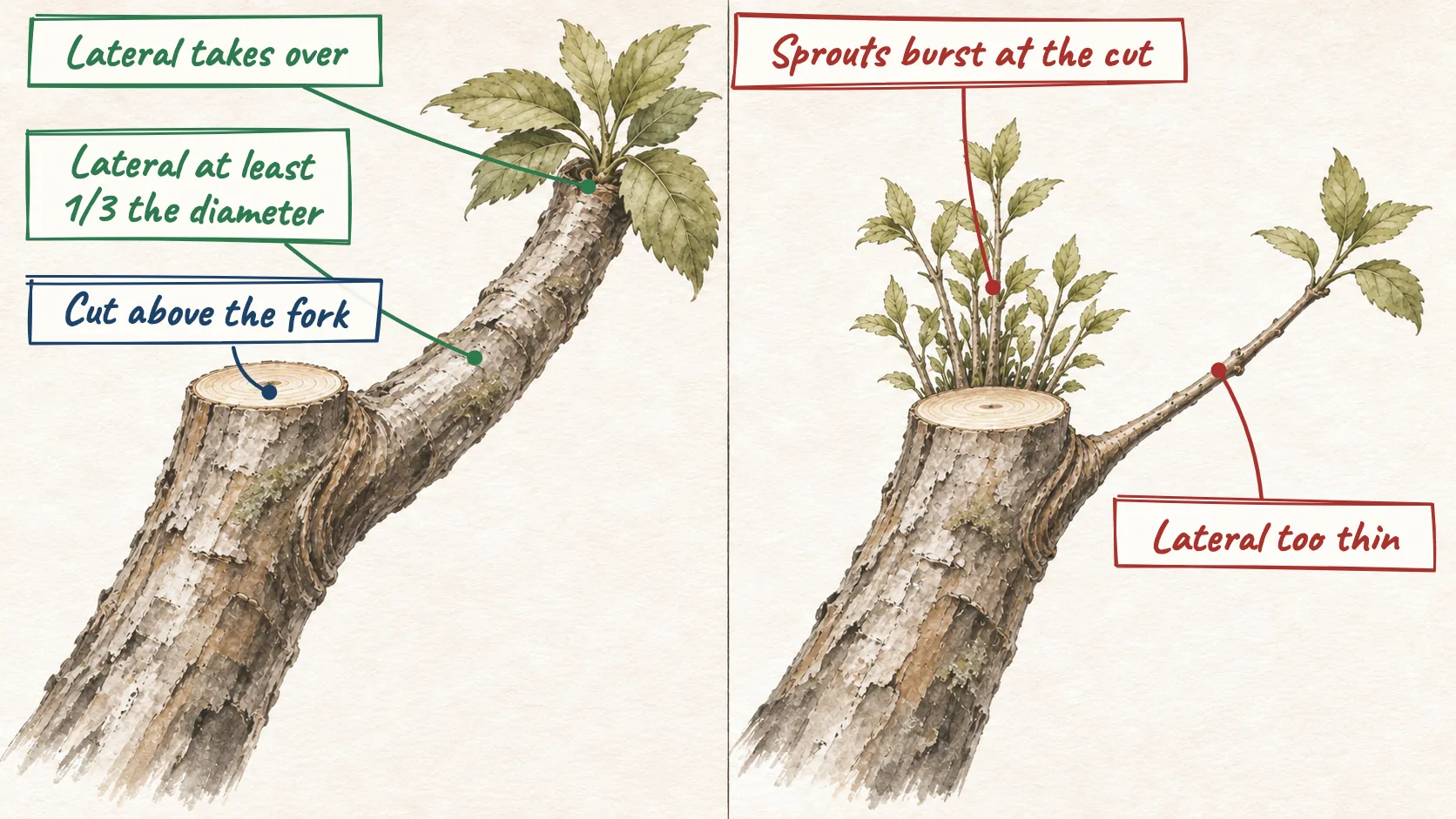
In Saitama’s tables, the artificial-form versions of all four types rely mainly on kiritsume. That is a different target, not a lapse in technique: an artificial form is a shape the manager has chosen to hold by heading cuts.
Outgrowing the space — chijimeru, shrinking
Trees do not read plans. A tree kept carefully for years can still end up too big — because the house was extended, because a neighbour’s window now faces it, because the species was too large for the space from the start. When a tree is larger than its target form, the purpose changes to shrink.
Shrinking in Japan — a smaller copy, over years
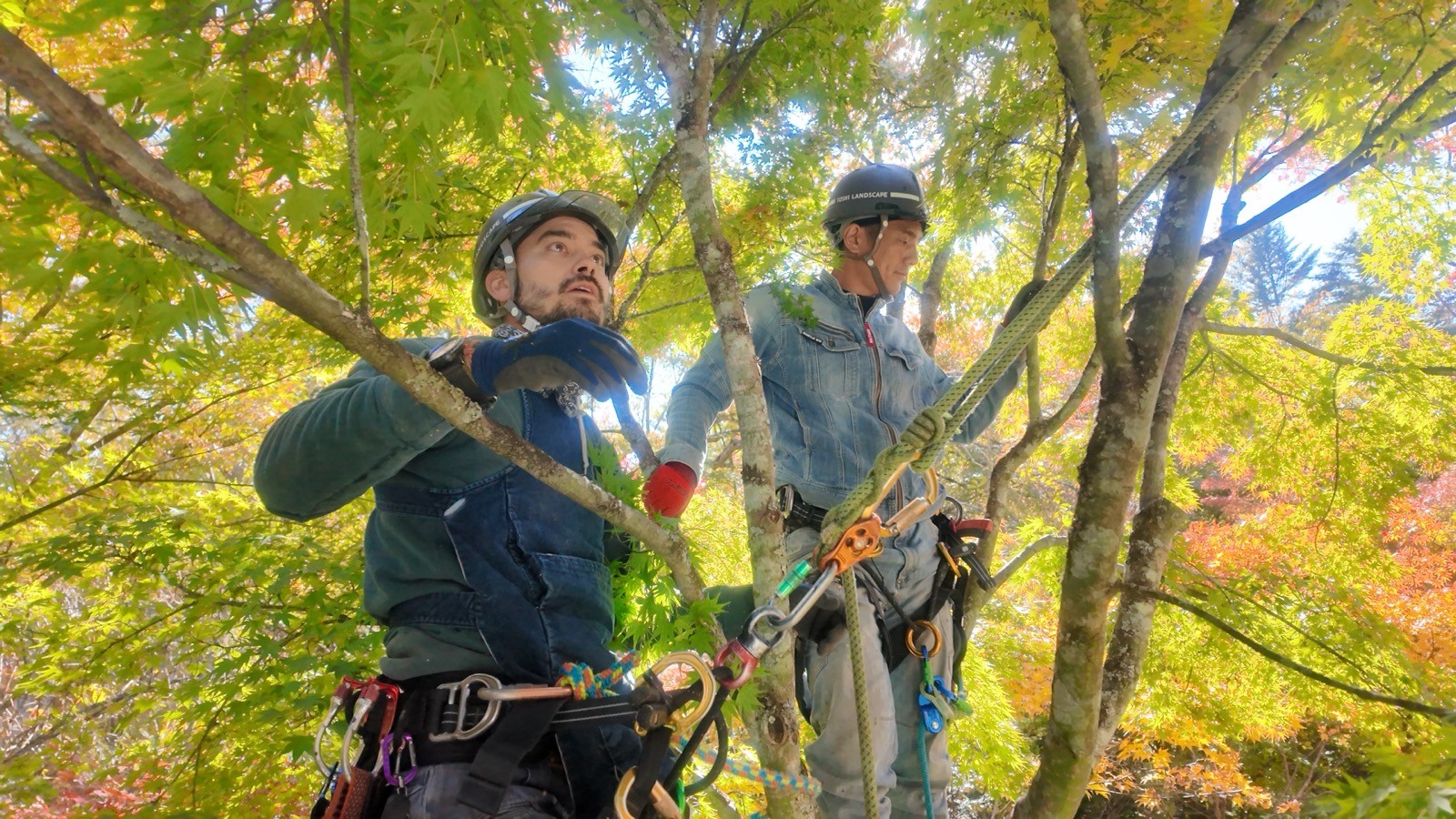
Saitama’s shrink type makes a natural-form tree compact (コンパクトに縮小) — a smaller version of the same shape — using kirikaeshi, eda-oroshi and eda-sukashi. Tokyo’s shrink type covers street trees that have grown larger than their target, with the sprouts produced by the cuts re-trained over several years.
The time is the point. Saitama requires a management plan of three to five years for both the shrink and rebuild types. Two working rules apply: start at the top of the crown and work down, and adjust foliage density using a guideline ratio of 1:2:3 for the upper, middle and lower crown. The manual is explicit that this is a ratio of density, not of branch length.
Shrinking in the Western guides — by necessity, and by dimension
The USDA Forest Service guide How to Prune Trees advises that crown reduction be carried out “only when absolutely necessary”. For crown thinning, its limit is no more than one-quarter of the living crown at one time; if more must come off, the work is spread over successive years. ISA’s Pruning Mature Trees gives a general guideline of no more than 25% of the crown at once, and less for mature trees.
BS 3998:2010, the British recommendations for tree work, approaches reduction by specification: the work can be defined by the tree height and branch spread to remain, in metres. For crown thinning it recommends removing no more of the leaf-bearing structure than the objective needs, and no more than 30%.
Why heavy shrinking fails
Japan’s National Institute for Land and Infrastructure Management (NILIM) explains in its guide to preventing street-tree failure that heavy pruning (強剪定) produces masses of adventitious shoots, water sprouts and epicormic growth, and that this means more branches liable to break (折れやすい枝が増える). To avoid heavy pruning, it calls for a long-term pruning plan matched to the tree’s stage of growth (長期間の剪定計画). Planning by life stage is not only a garden habit; it is written into national street-tree guidance.
How Japanese cities hold street trees small, and what it costs them, is covered in Why are Japanese street trees so small?
When the form breaks — topping
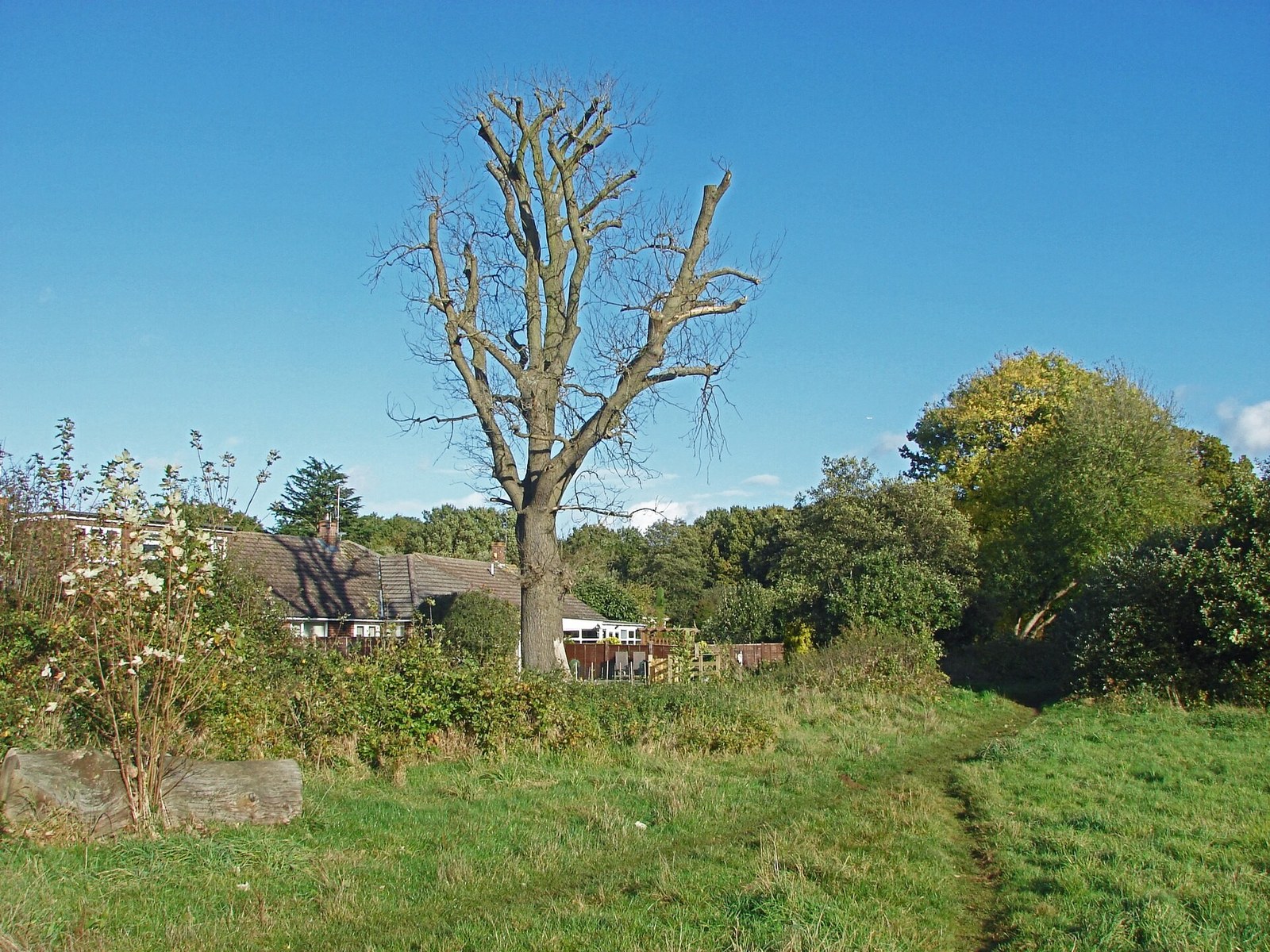
Sometimes the shrinking is done in a single day. The leaders are cut back to stubs, most of the crown is gone, and what remains is a frame of bare limbs. In English this is topping. Japanese guidance describes a related practice on thick trunks as zundō-giri (寸胴切り) or dankan (断幹), trunk cutting.
What topping does
ISA’s brochure Why Topping Hurts Trees defines topping as the indiscriminate cutting of branches to stubs or to laterals not large enough to take over as leaders. It can remove 50 to 100% of a tree’s leaf-bearing crown. Dormant buds are activated, and multiple shoots grow quickly below each cut. Where the wounds cannot close, the exposed wood begins to decay. The new shoots are weakly attached and prone to breaking, and sudden exposure to the sun can cause sunburn on the bark.
NILIM lists similar problems for zundō-giri of thick trunks in Japanese street trees: decline in vigour, decay, root decline and weak adventitious shoots.
A misunderstanding worth correcting
Topping is often defended as a way to make a tree safer, on the reasoning that a shorter tree is less dangerous. The sources above describe the opposite: a crown of fast, weakly attached shoots growing from cuts that may decay. In the four-type system, a tree in this condition has left the keep or shrink stage. It needs a different purpose.
Rebuilding — tsukurinaosu, a frame grown again
A topped, storm-damaged or long-neglected tree can sometimes be given a new frame, and the work usually involves selecting and training new shoots. Saitama’s rebuild type returns a damaged form to a natural one (自然樹形に再生), combining kiritsume, kirikaeshi and eda-oroshi. ANSI A300 Part 1 (2008) has a matching category, restoration pruning: selective pruning to “redevelop structure, form, and appearance” of trees that have been severely headed, vandalised or otherwise damaged. Tokyo lists its regenerate type as a reference type, for trees whose skeleton cannot be corrected by light pruning.
Year one, two and three
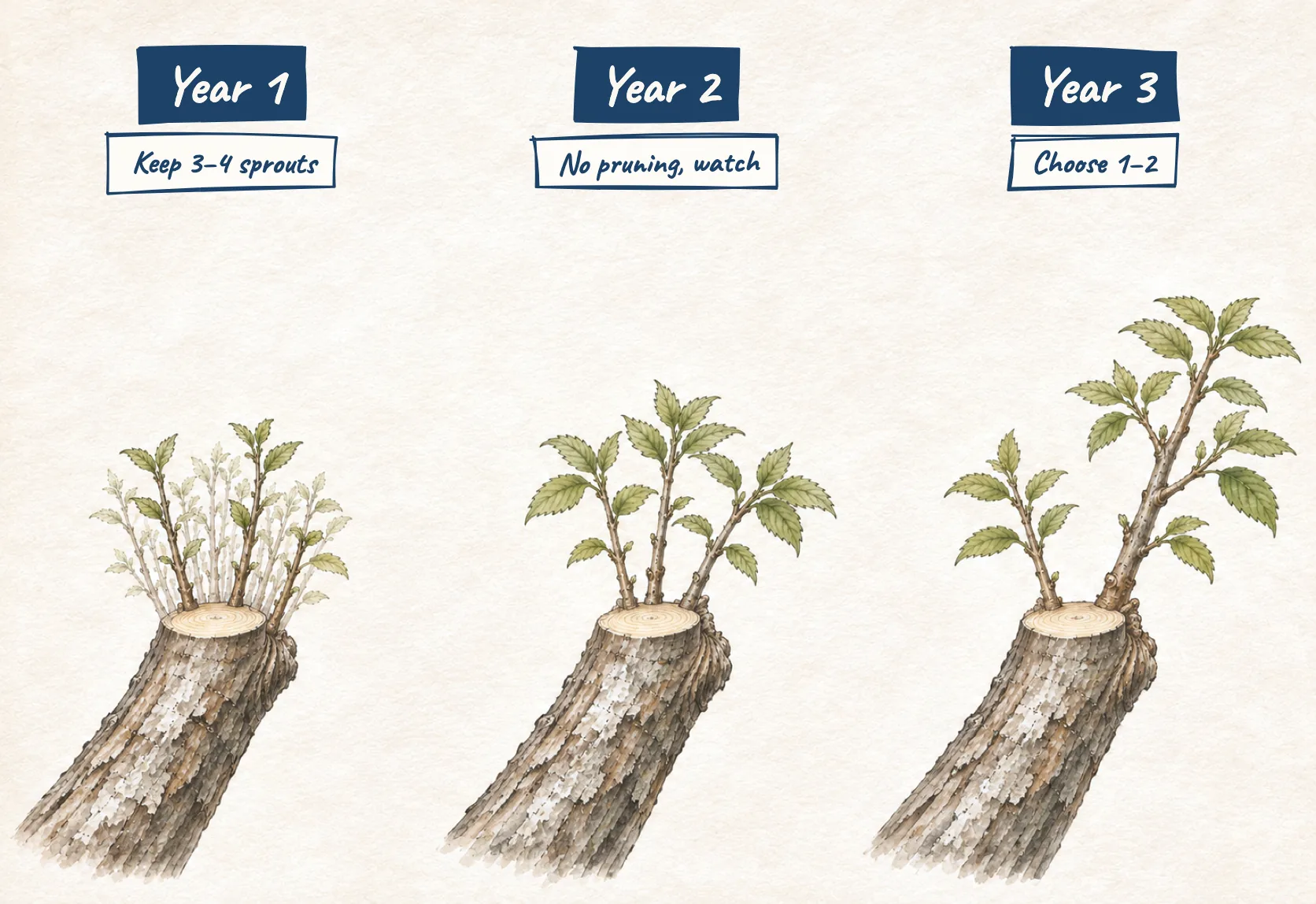
Saitama’s manual asks the planner to picture the ideal form five to ten years ahead, and sets out the first three years after the major cut.
| Year | Work | Reason given or implied |
|---|---|---|
| Year 1 | From the new shoots, keep three or four candidates for future branches; remove the rest | The extra candidates are a reserve against breakage by wind or snow |
| Year 2 | No pruning in principle; observe, removing only broken shoots and similar | The kept shoots are left to grow before the final choice |
| Year 3 | Full shaping; reduce the kept shoots to one or two, judged against the target form | The new limbs are chosen |
What the sequence asks of the owner
The hard year is the second. For a full season the tree looks untidy, with shoots standing up from the old cuts, and apart from broken shoots and the like they are left alone. The sequence treats that pause as part of the work. The practical risk is the opposite impulse: clearing away the candidate shoots along with the extras, so that the choice in year three has nothing left to choose from.
Old age — when the tree shrinks itself
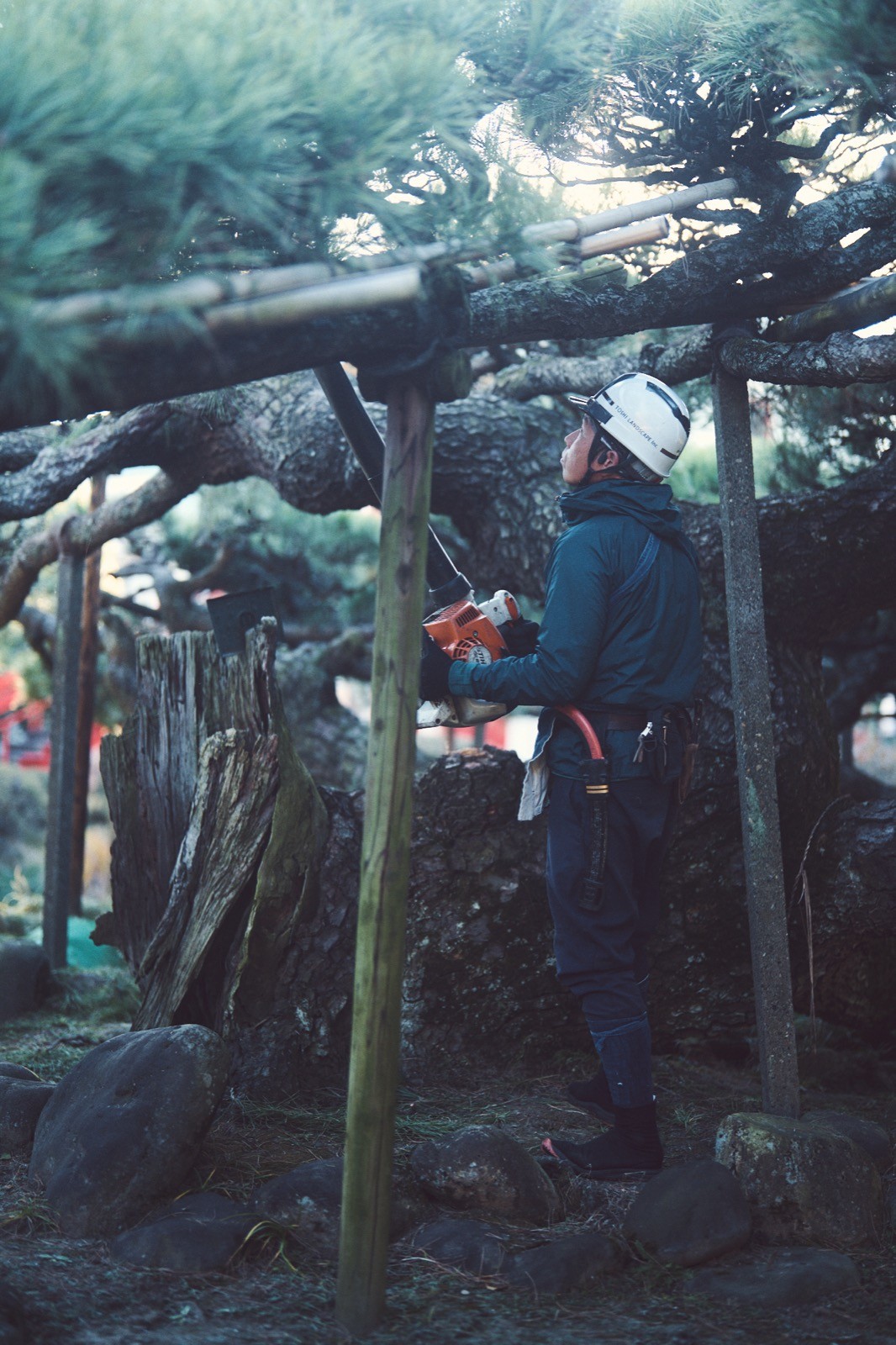
Our tree has now lived through every type the Japanese manuals name. Old age brings a stage they do not name. Some old trees begin to reduce their own crowns. In Japanese gardens, the long limbs of an old pine are often seen resting on wooden props.
Retrenchment
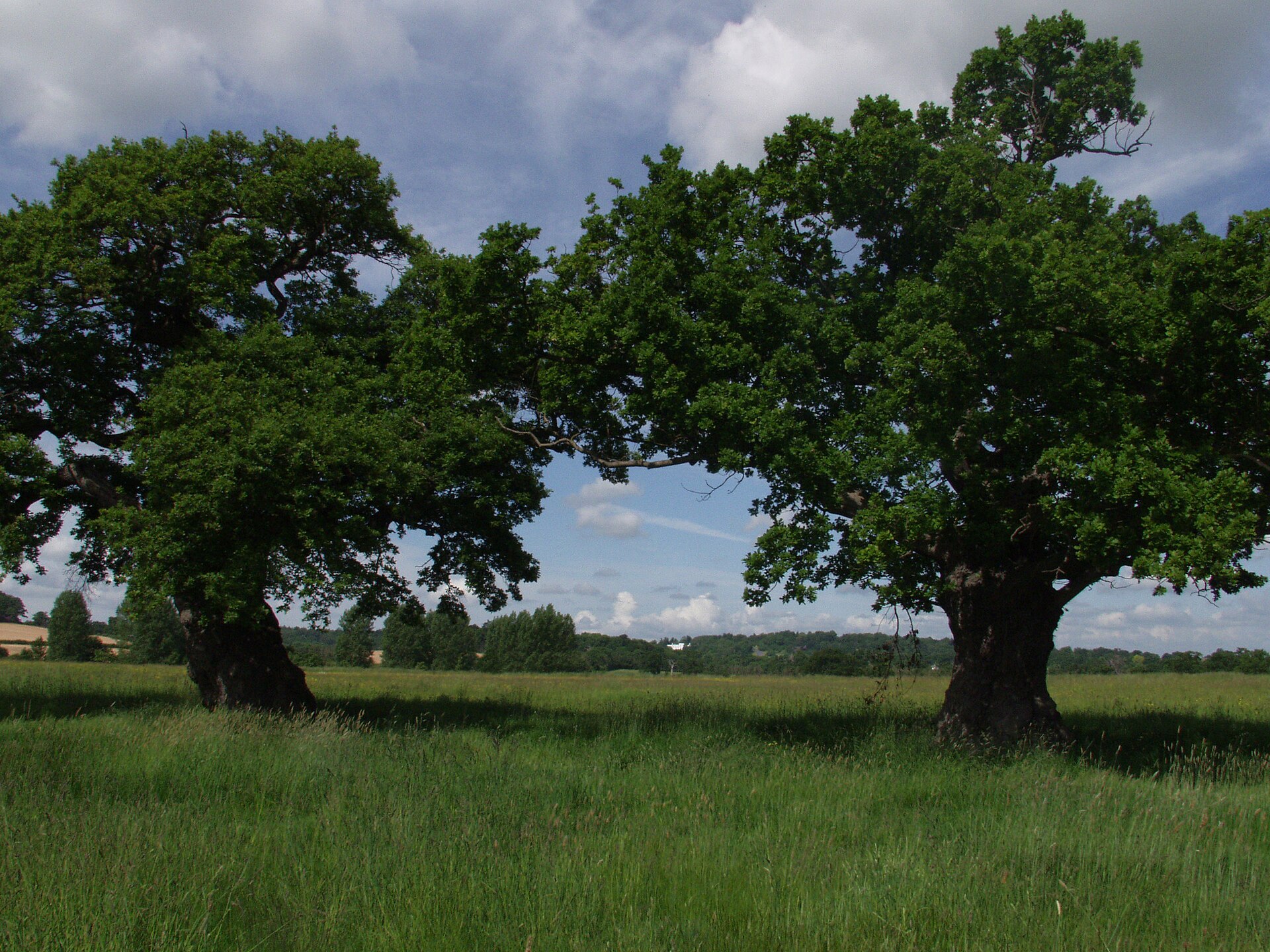
British veteran-tree management has a word for this. The Ancient Tree Forum defines natural retrenchment as the “progressive reduction in the size of the crown of an old tree”, as twigs and branches die back or break and a lower, inner crown develops. Retrenchment pruning imitates that process for trees that cannot tolerate losing a large amount of leaf at once, reducing height and spread “in gradual stages”. The Forum advises waiting until new growth has been “well established for three or more years” before the next stage, except where emergency work is needed to prevent failure.
Natural England’s Veteran Trees: A guide to good management describes reducing a crown in “two or more stages, several years apart”, moving to a lower crown “after an interval of one to five years” depending on species and regrowth. BS 3998:2010 (Annex C.2) treats retrenchment pruning of old trees and lapsed pollards as reduction in “phased form” that imitates natural crown reduction.
A shared idea of time
Here the two sets of documents meet most closely. A Japanese rebuild plan of three to five years and a British retrenchment plan with stages one to five years apart measure different things — the length of a plan, the interval between stages — but rest on the same observation: replacing lost crown takes time and new growth. Both sides also have multi-year plans for young trees, as Gilman’s 25-year schedule shows.
Two lists that work together
Set side by side, the Western objectives and the Japanese types are not rival systems. They answer different questions.
What each list describes
The Tree Care Industry Association’s guide to ANSI A300 Part 1 lists eight pruning objectives: manage risk, manage health, develop structure, provide clearance, manage size or shape, improve aesthetics, manage production of fruit, flowers or other products, and manage wildlife habitat. The 2008 edition of Part 1 required that objectives “shall be established” before work begins and recommended that they “should be specified in writing”. The 2017 edition required that one or more objectives be specified. In 2023 the separate parts were consolidated into one document, the A300 Tree Care Standards, with pruning in Clause 5, and TCIA describes a shift from the rigid “25% rule” to objective-based pruning.
| Japanese target type | Where the tree stands | Closest A300 objective | Closest Western pruning type |
|---|---|---|---|
| Ikusei — grow | Smaller than its target | Develop structure | Structural pruning |
| Iji — keep | At its target size | Manage size or shape; improve aesthetics | Thinning, light reduction |
| Shukushō — shrink | Larger than its target | Manage size or shape; provide clearance | Reduction |
| Saisei — rebuild | Form broken by topping or damage | Develop structure; manage risk | Restoration pruning |
The A300 objectives name what the pruning is for. The Japanese types name the tree’s position against its target form, and with it a policy for the visits ahead. A specification that states both — the objective of the work and the target form it serves — answers more of a contractor’s questions than either alone.
Pollarding — Europe’s own repeated management
Europe has its own long-term method of holding a tree’s size. A pollard is cut back to the same points, the pollard heads, at regular intervals. A British parish council’s tree policy notes that the method is not normally used on trees that have not been managed as pollards from a young age, and ANSI A300 Part 1 (2017) states that “pollarding should not be initiated on mature trees.”
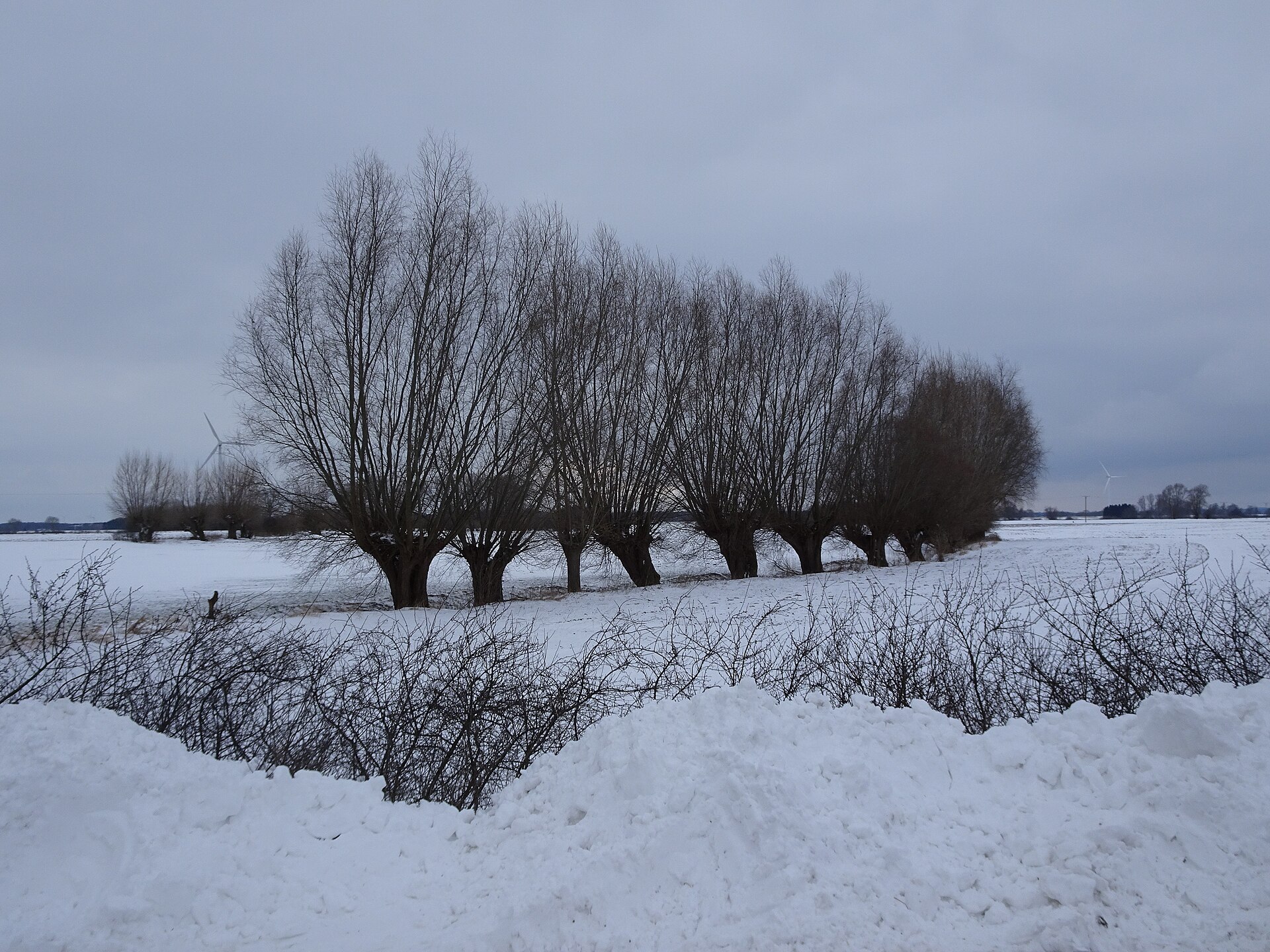
What pollarding shares with the keep type is repetition: a size is chosen, and the work returns to the tree again and again. The methods differ. A pollard is cut back to fixed heads, while a natural-form tree in the keep type is held mainly with reduction cuts to side branches.
Where the details differ
Three practical differences matter when a specification crosses from one system to the other.
– Cleaning and raising. In the 2008 edition of ANSI A300 Part 1, clean and raise are pruning methods of their own, alongside reduce and thin. The Japanese four-type system has no separate categories for them. – Wound treatment. Saitama’s manual calls for a preservative (防腐剤) on large cuts such as those made in rebuild work. The USDA guide says wound dressings are in most cases unnecessary and may be harmful, with the specific exceptions of Dutch elm disease and oak wilt. – Limits per visit. ISA gives 25% of the crown as a general guideline, less for mature trees. The USDA limits crown thinning to one-quarter of the living crown at one time. BS 3998 recommends no more than 30% for crown thinning. Saitama limits summer pruning of evergreens to one-third of the foliage, and sets three-to-five-year plans for shrinking and rebuilding.
Season and strength — when each purpose is carried out
Purpose decides how heavily a tree is pruned; season, species and region decide when a cut of that strength is appropriate. The Japanese documents tie them together.
| Season | Japanese term | Strength | Source |
|---|---|---|---|
| Winter (deciduous trees) | Kihon sentei (基本剪定), basic pruning | Structural work on skeleton branches; the season for stronger cuts | Tokyo street-tree plan; Japan Greenery Research and Development Center; NILIM |
| Summer | Kei sentei (軽剪定), light pruning | Light; corrects density or disorder; not needed every year for every tree | Tokyo; Saitama; Japan Greenery Research and Development Center |
| Summer (evergreens) | Thinning in summer pruning | No more than one-third of the foliage | Saitama manual |
| Late autumn (October–December, Yokkaichi garden calendar) | Extension of summer pruning | Avoid strong pruning | Yokkaichi City agricultural centre |
NILIM advises that strong pruning of the main skeleton branches of deciduous trees be done in winter, with summer pruning kept light or avoided, and warns that heavy summer pruning can lead, through loss of vigour and decay, to tree failure and branch breakage. For evergreen broadleaves of warm regions, it advises avoiding the coldest part of winter and pruning once the cold eases.
What this means in November
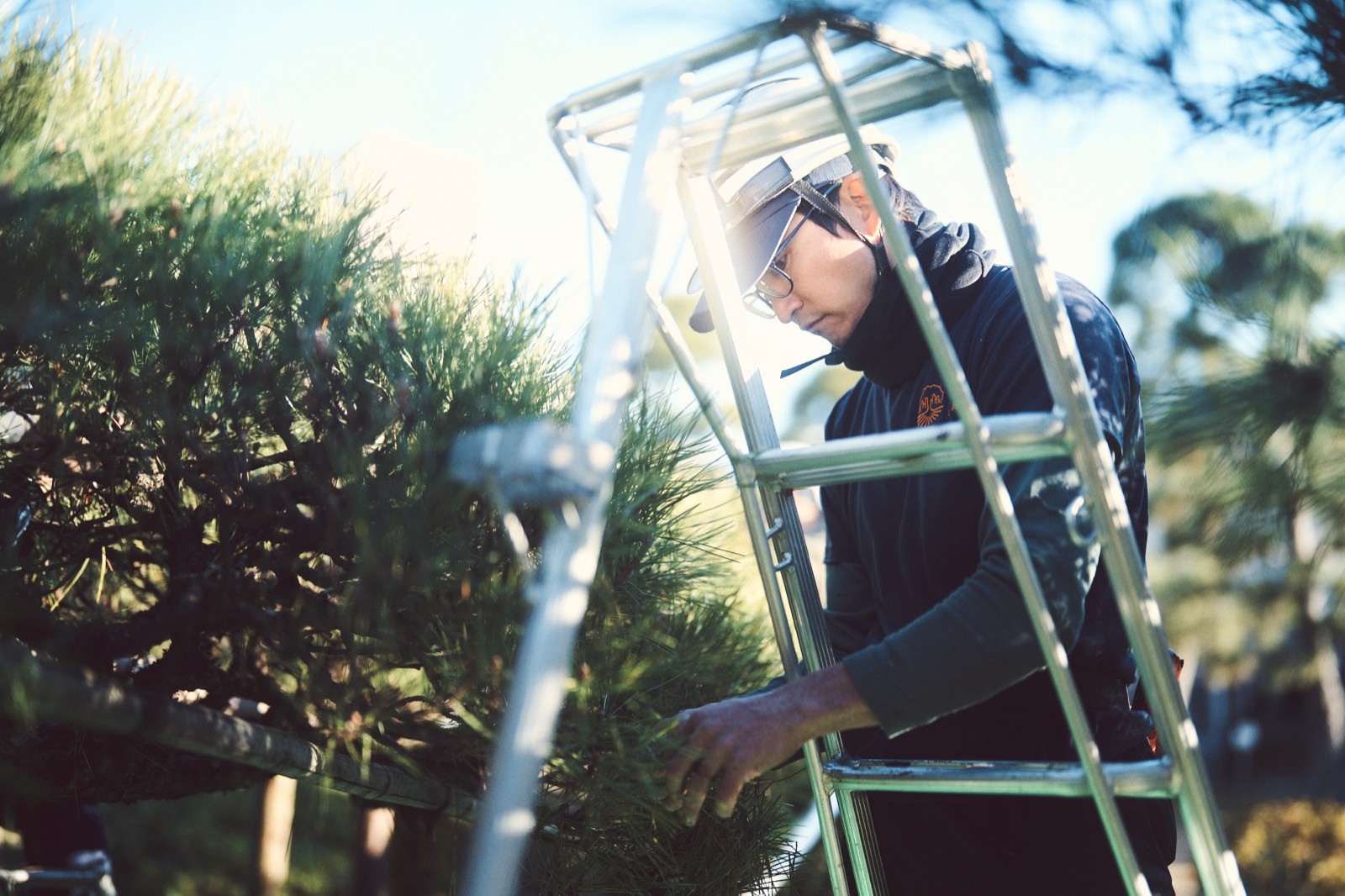
In Yokkaichi’s garden calendar, October to December is an extension of the summer pruning season, with strong pruning held back. On that reading, November work on garden trees is light, and the strong cuts that shrinking or rebuilding a deciduous tree requires wait for winter, when the branch structure is visible. Evergreens follow their own timing.
Reading a tree’s stage — a field checklist
The value of the four types is that they turn a vague request — “tidy the tree” — into a decision that can be checked. The table below is this article’s reading of the Saitama and Tokyo definitions, not a table from either manual.
| What you see | Purpose | First cuts to reach for | Planning horizon |
|---|---|---|---|
| Crown smaller than its allotted space; leader still being chosen | Grow | Remove dead, broken and competing branches; shorten a rival leader | Long; light visits |
| Crown at its target; long shoots at the edge each year | Keep | Kirikaeshi to shorter branches; thin by removing whole branches | Regular; every year for compact trees (Hyogo) |
| Crown larger than its target; touching eaves, wires or neighbours | Shrink | Kirikaeshi and limb removal, top first | Plan of three to five years (Saitama) |
| Stubs from topping or breakage, clusters of sprouts | Rebuild | Select shoots; normally leave year two unpruned | Three-year sequence; form pictured five to ten years ahead (Saitama) |
When to reconsider the purpose
These are signs, in the author’s practice, that the plan for a tree should be looked at again — after checking its condition and its target form.
– Clusters of sprouts at the cuts on a tree meant to be kept. The cuts may have been made to laterals too thin to take over; check against the one-third guideline. – A heavy reduction done in one visit. NILIM’s warnings about heavy pruning apply; the tree may now need a rebuild plan rather than routine maintenance. – A young tree pruned like a mature one. Shortening every shoot of a young tree to hold its outline works against the grow purpose.
Reducing wind load by thinning and reducing crowns is also the basis of typhoon-proofing in Japan.
Frequently asked questions
What are the four purposes of pruning in Japanese manuals? Japanese public pruning manuals, such as Saitama Prefecture’s street-tree manual, assign trees one of four target types: grow (ikusei), keep (iji), shrink (shukushō) and rebuild (saisei). The type is chosen after the target form has been set, and it guides the cuts and the length of the plan.
What is the difference between kirikaeshi and kiritsume? Kirikaeshi removes a long branch back to a shorter fork, so the side branch can take over; it is close to a reduction cut. Kiritsume cuts a shoot part-way, just above a bud; it is close to a heading cut and is used mainly for artificial forms.
How long does it take to rebuild a topped tree? Saitama’s manual plans rebuilding within a three-to-five-year management plan, with the target form pictured five to ten years ahead. In year one three or four candidate shoots are kept, year two is normally left unpruned apart from broken shoots, and in year three the shoots are reduced to one or two.
How much of a tree can be removed at once? ISA gives a general guideline of no more than 25% of the crown, less for mature trees. The USDA limits crown thinning to one-quarter of the living crown at one time. BS 3998 recommends no more than 30% for crown thinning. Saitama limits summer pruning of evergreens to one-third of the foliage.
Is late autumn a good time for heavy pruning? Japanese public guidance generally keeps strong cuts on deciduous trees for winter. Yokkaichi City’s garden calendar treats October to December as an extension of summer pruning and advises against strong pruning in that period.
Sources
– Saitama Prefecture, 街路樹剪定マニュアル (Street-tree pruning manual), pp. 3-1, 3-9, 4-1 to 4-9, 4-12, 5-3, 5-4, 5-12. https://www.pref.saitama.lg.jp/documents/4144/gairozyusenntei1.pdf — checked 2026-10-31. – Public Works Research Institute, 大型街路樹の維持管理手法に関する共同研究報告書 (第2分冊 街路樹剪定の手引き), 1999, bibliographic record. https://thesis.pwri.go.jp/public_detail/104694 — checked 2026-10-31. – Tokyo Metropolitan Government Bureau of Construction, 街路樹維持管理計画書, December 2021, pp. 1, 12. https://www.kensetsu.metro.tokyo.lg.jp/content/000056063.pdf — checked 2026-10-31. – National Institute for Land and Infrastructure Management, 街路樹の倒伏対策の手引き 第2版 (Technical Note No. 1059), pp. 1-79 to 1-83. https://www.nilim.go.jp/lab/bcg/siryou/tnn/tnn1059pdf/Ks1059008.pdf — checked 2026-10-31. – City of Yokohama, 公園緑地等維持業務共通仕様書, February 2026, p. 22. https://www.city.yokohama.lg.jp/business/nyusatsu/youshiki/kankyo/koenshiryo/download/2ijiitaku-shiyousyo.files/0125_20260127.pdf — checked 2026-10-31. – Tsukuba City, 街路樹の維持管理指針, p. 13. https://www.city.tsukuba.lg.jp/material/files/group/130/gairojyunoijikannrisisin.pdf — checked 2026-10-31. – Japan Greenery Research and Development Center, 緑化樹木の剪定技術. https://www.jpgreen.or.jp/kyoukyu_jyouhou/gijyutsu/sentei/index.html — checked 2026-10-31. – Japan Federation of Landscape Contractors, 庭師は枝を切らない!? https://www.jflc.or.jp/index.php?catid=61&itemid=155 — checked 2026-10-31. – Japan Federation of Landscape Contractors, 「木を生かす」ための剪定. https://www.jflc.or.jp/index.php?catid=61&itemid=154 — checked 2026-10-31. – Hyogo Prefecture horticulture and parks association, 花緑育成・維持管理ガイドブック, p. 4. https://center.hyogohanamachi.jp/wp-content/uploads/2025/10/2017_guide_compressed.pdf — checked 2026-10-31. – Tokyo Metropolitan Medicinal Plant Garden, 薬草教室だより No. 3, December 2021. https://www.tokyo-shoyaku.com/mod_evna/moddata/updoc/d20211215142104do.pdf — checked 2026-10-31. – Yokkaichi City Agricultural Center, autumn gardening calendar. https://www.city.yokkaichi.mie.jp/farm/gardening-calendar/autumn/ — checked 2026-10-31. – National Diet Library, 平助『庭木重宝記』 (manuscript). https://dl.ndl.go.jp/pid/2537408/1/15 — checked 2026-10-31. – Tree Care Industry Association, ANSI A300 Part 1 — Pruning. https://treecareindustryassociation.org/business-support/ansi-a300-standards/part-1-pruning/ — checked 2026-10-31. – ANSI A300 (Part 1)-2008 Pruning, as published by the City of Vallejo, pp. 6–7. https://www.cityofvallejo.net/common/pages/DisplayFile.aspx?itemId=17971983 — checked 2026-10-31. – ANSI A300 (Part 1)-2017 Pruning, excerpt published by Alachua County, pp. 8–10. https://pub-alachuacounty.escribemeetings.com/filestream.ashx?documentid=11316 — checked 2026-10-31. – Tree Care Industry Magazine, “Introducing the newly designed ANSI A300 Tree Care Standards”. https://tcimag.tcia.org/training/introducing-the-newly-designed-ansi-a300-tree-care-standards/ — checked 2026-10-31. – Tree Care Industry Magazine, “ANSI A300 Clause 5 expands use of mechanical pruning”. https://tcimag.tcia.org/safety/equipment-safety-mechanization/ansi-a300-clause-5-expands-use-of-mechanical-pruning/ — checked 2026-10-31. – Tree Care Industry Magazine, “Stop pruning malpractice with a prescription”. https://tcimag.tcia.org/training/stop-pruning-malpractice-with-a-prescription/ — checked 2026-10-31. – International Society of Arboriculture, Pruning Mature Trees. https://www.treesaregood.org/Portals/0/TreesAreGood_Pruning%20Mature%20Trees_0621.pdf — checked 2026-10-31. – International Society of Arboriculture, Pruning Young Trees. https://www.treesaregood.org/Portals/0/TreesAreGood_Pruning%20Young%20Trees_0621.pdf — checked 2026-10-31. – International Society of Arboriculture, Why Topping Hurts Trees. https://www.treesaregood.org/Portals/0/TreesAreGood_Why%20Topping%20Hurts_0321.pdf — checked 2026-10-31. – BS 3998:2010 Tree work — Recommendations, as published by West Berkshire Council, §4.1, §7.5–7.7, Annex C.2. https://www.westberks.gov.uk/media/50570/CD17-2-BS3998-2010-Tree-Work-Recommendations/pdf/CD17.2_BS3998.2010_Tree_Work__Recommendations.pdf — checked 2026-10-31. – USDA Forest Service, How to Prune Trees, NA-FR-01-95, rev. 2012. https://research.fs.usda.gov/download/treesearch/12602.pdf — checked 2026-10-31. – Edward F. Gilman, Pruning Shade Trees in Landscapes: A Plan for Training Shade Trees (EP276), University of Florida IFAS Extension. https://edis.ifas.ufl.edu/publication/EP276 — checked 2026-10-31. – Ancient Tree Forum, Ancient and other veteran trees: further guidance on management, pp. 92–95, 195. https://www.ancienttreeforum.org.uk/wp-content/uploads/2023/12/ATF_book.pdf — checked 2026-10-31. – Natural England, Veteran Trees: A guide to good management, §4.3.7. https://publications.naturalengland.org.uk/file/116003 — checked 2026-10-31. – Great Chart with Singleton Parish Council, Tree Management Policy, p. 3. https://www.greatchartsingleton-pc.gov.uk/_UserFiles/Files/Policies/Tree-Managment-Policy.pdf — checked 2026-10-31.