“Do Japanese people grow up with special feelings for sacred trees?” A student asked me this in October 2026, when I gave a guest lecture to an urban forestry class at the University of Toronto. As I answered, I realised that big shrine trees had been part of my own life since childhood. Explaining that feeling to someone outside Japan, though, turned out to be harder than I expected.
Reverence for sacred trees in Japan is not taught as doctrine. It grows out of small, repeated habits: a pine set by the front door at New Year, an evergreen sprig placed on the household altar, a shrine forest where the whole neighbourhood gathers for the festival. People raised among these habits stop in front of a roped tree without being told to, even if they cannot say why.
This article looks at that feeling through what people actually do. First, how trees and kami (Shinto deities) appear in everyday Japanese life. Then the things people do in front of a sacred tree: stopping, touching, praying before a cut, keeping a fallen tree. Finally, what this means for the tree’s health, how an arborist weighs it, and what tree care professionals outside Japan can take home.
The short answer
Japanese reverence for sacred trees shows less in stated belief than in behaviour and in the everyday customs of using trees. People stop at the shimenawa rope, hold a purification rite before a cut, and keep the stump of a fallen tree while raising its successor. That feeling is the strongest force protecting these trees — but the same feeling, through the feet of people who come to touch the trunk, can compact the soil over the roots. Good management does not try to stop the feeling. It gives the feeling somewhere better to go.
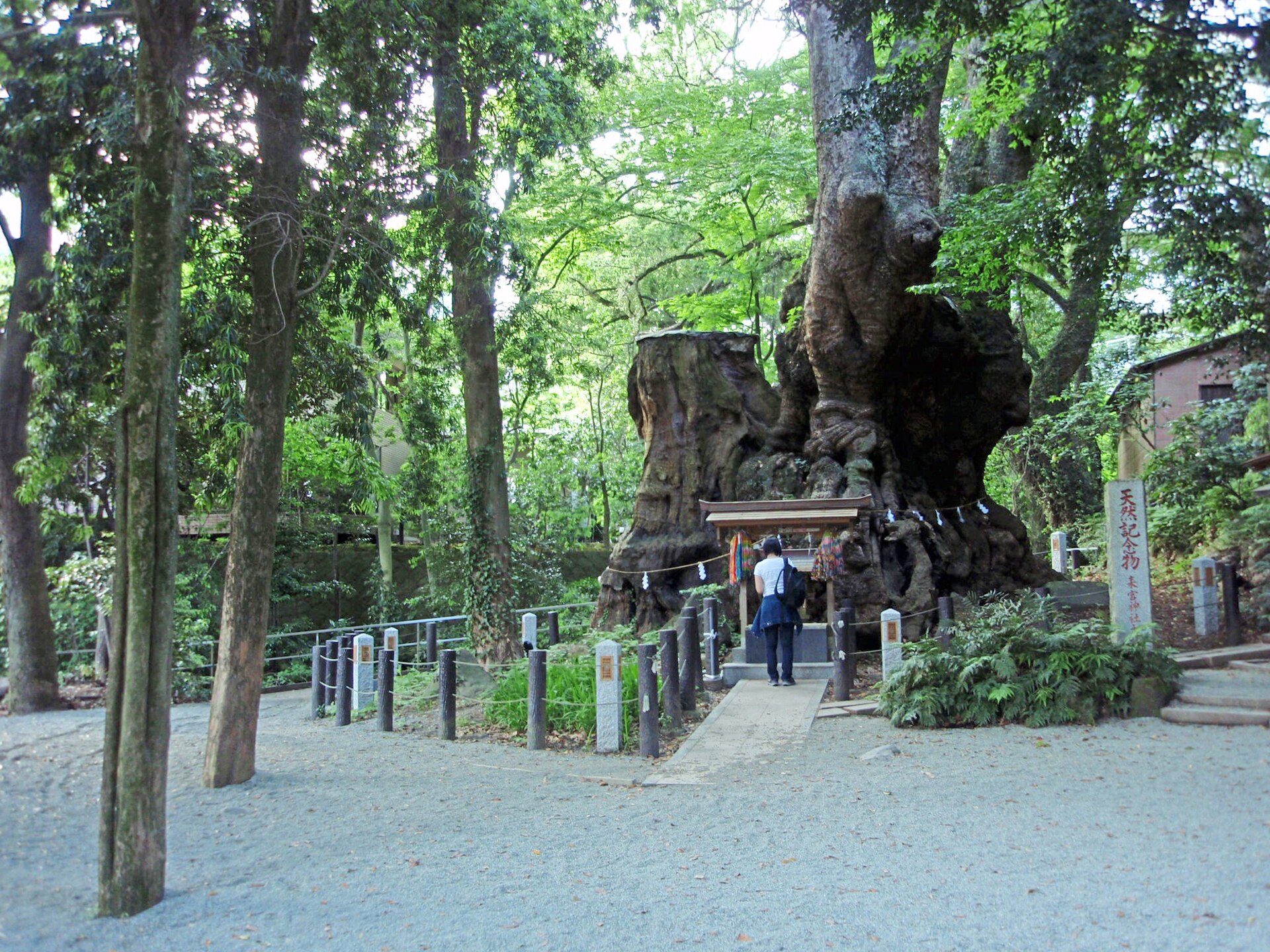
What is a shinboku? — A place where the kami comes down
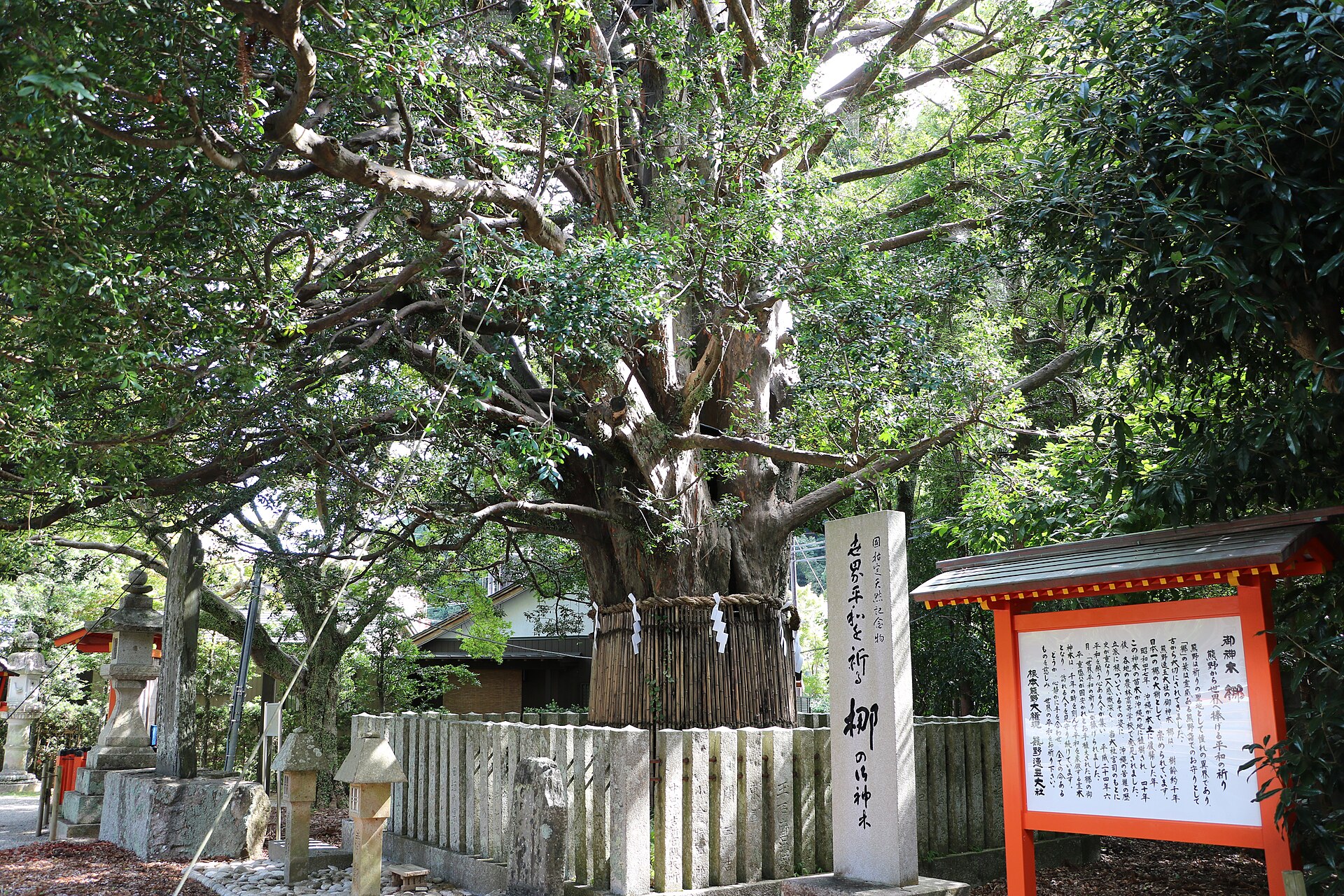
Shinboku (神木), or goshinboku with the honorific prefix, means “divine tree”. Kokugakuin University’s Encyclopedia of Shinto describes it as a tree regarded as sacred, either as a symbol of sacred territory or as a place where kami dwell. Most are old, large trees. They are usually wrapped in a shimenawa or enclosed by a fence, and cutting or defiling them is avoided. Where a shrine has no building, the tree itself can serve as the object of worship.
The key point for a reader outside Japan is this: a shinboku is understood less as a god than as the place where a god comes down. The Japanese word for such a place is yorishiro (依代) — an object a kami descends into during a ritual. Trees and rocks can be yorishiro, as can pillars or banners. So Japanese people are not exactly worshipping the tree. They are honouring the place the tree marks. That sense of “place” explains two behaviours we will see later: respecting a boundary, and keeping the site even after the tree has fallen.
| Term | Romanised | Meaning |
|---|---|---|
| 御神木・神木 | goshinboku / shinboku | A tree revered as a dwelling place of kami, or as a marker of sacred ground |
| 依代 | yorishiro | An object a kami descends into during a ritual — a tree, rock, pillar |
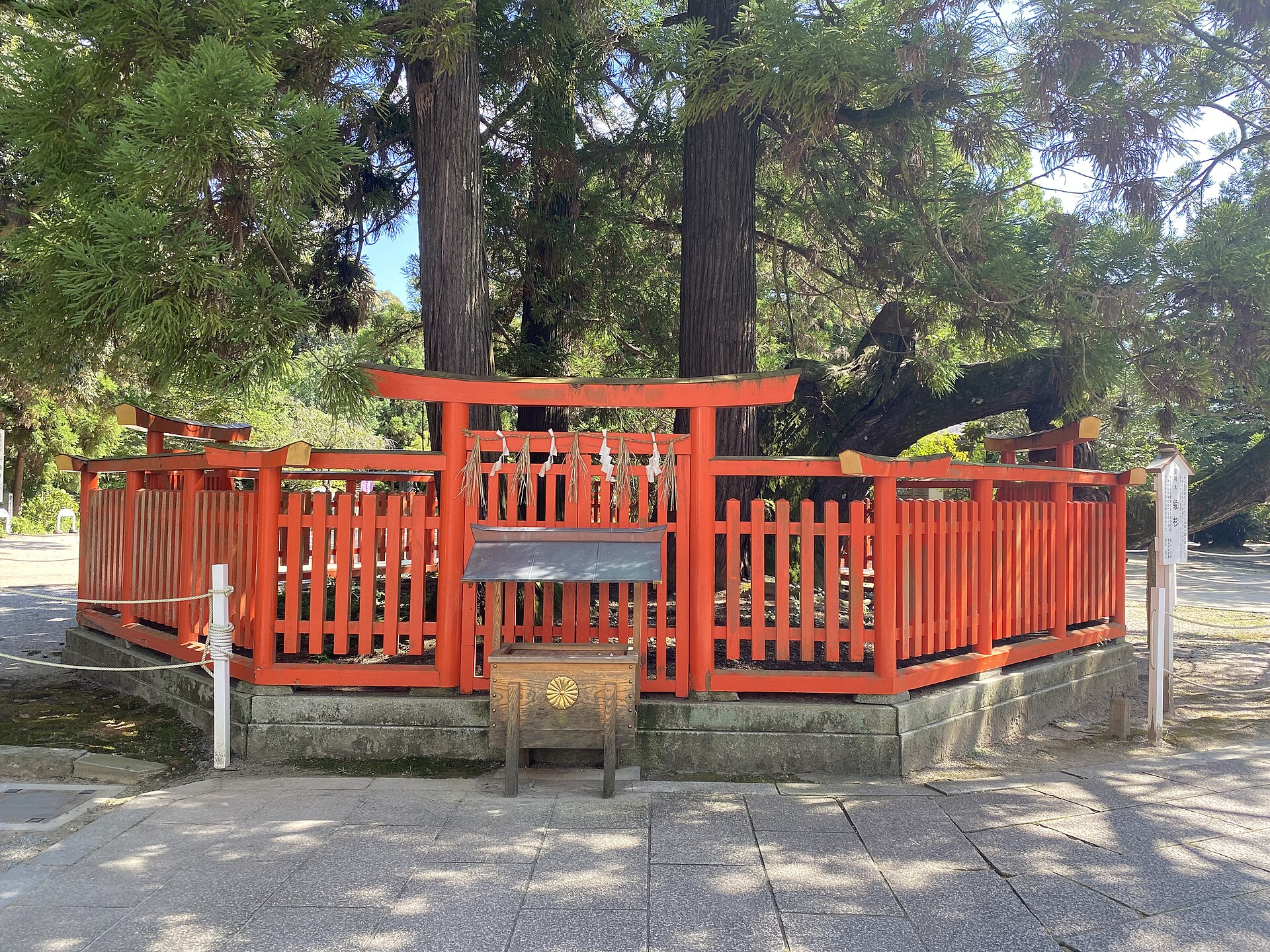
| 注連縄 | shimenawa | A rope of twisted new straw marking a kami’s presence or the edge of a sacred area |
| 紙垂 | shide | Zigzag paper strips hung from a shimenawa or a sakaki branch |
| 玉垣 | tamagaki | A fence around a shrine precinct or a sacred tree |
| 榊 | sakaki | An evergreen (Cleyera japonica) used in Shinto ritual |
| 神籬 | himorogi | A temporary sacred space, with a sakaki branch at its centre as yorishiro |
| 鎮守の森 | chinju no mori | The forest surrounding a shrine, protected as sacred ground |
Trees in everyday Shinto life — Sakaki, kadomatsu, groundbreaking rites
Reverence for a great shinboku does not begin at the shrine. Japanese life is punctuated by moments when a tree branch is used for the kami. Respect for the giant tree is an extension of these small habits.
Sakaki — an evergreen branch for the altar
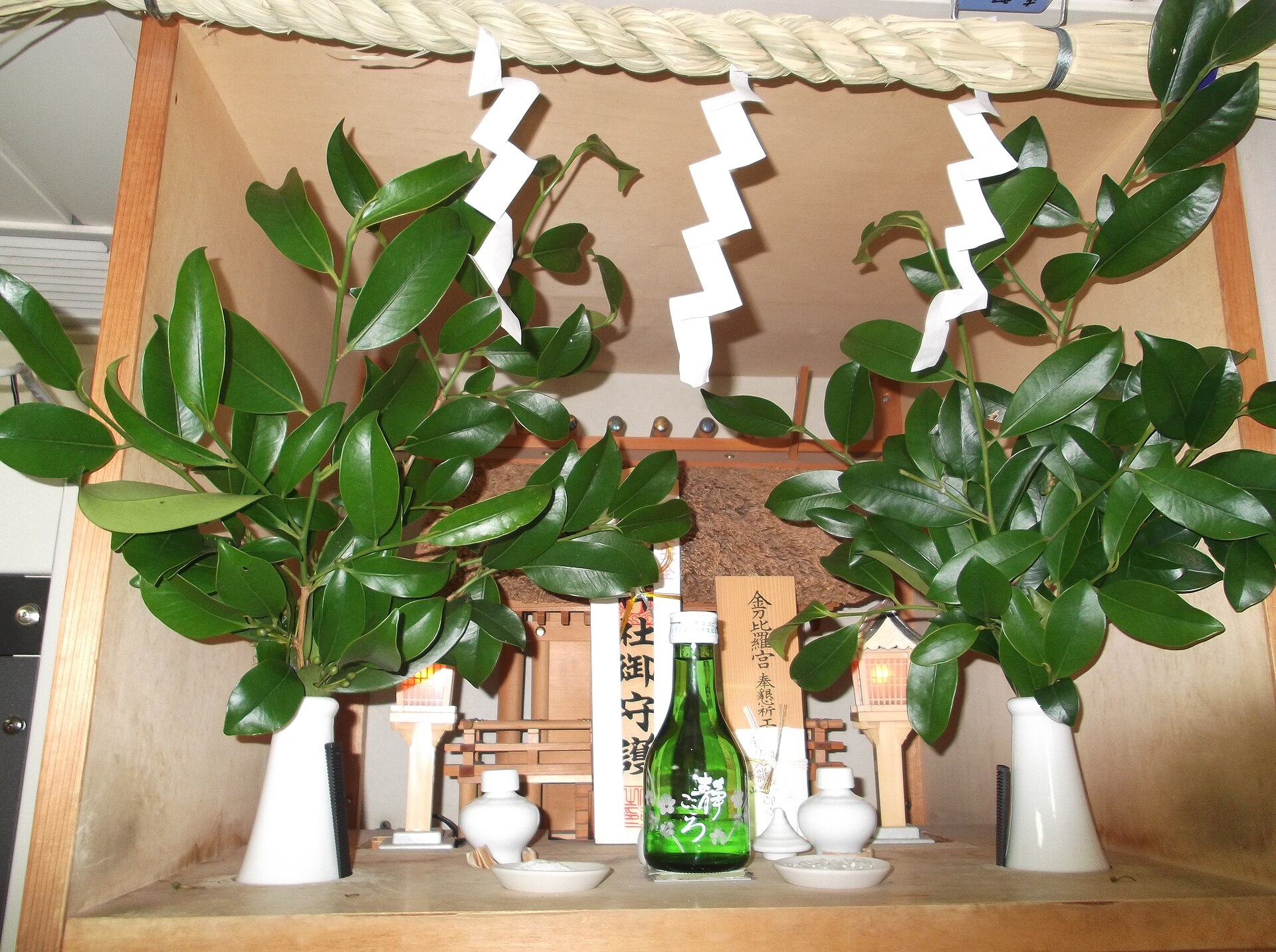
Sakaki is the essential ritual evergreen. The Association of Shinto Shrines describes it as a tree that stays green all year and has long been offered before the kami. One theory links its name to sakaeru, “to flourish”; another to sakai, “boundary”, because it marked the edge of sacred ground. The tamagushi that worshippers offer at a shrine is a sakaki sprig with shide attached.
Homes with a kamidana, a small household altar, place sakaki there too. In eastern Japan, where sakaki is scarce, the similar-leaved Eurya japonica (hisakaki) is used instead. Omiwa Shrine in Nara even offers sprigs of its sacred cedar, hung with shide, to place on home altars in place of sakaki. A branch of the shrine’s sacred tree goes straight into the family home.
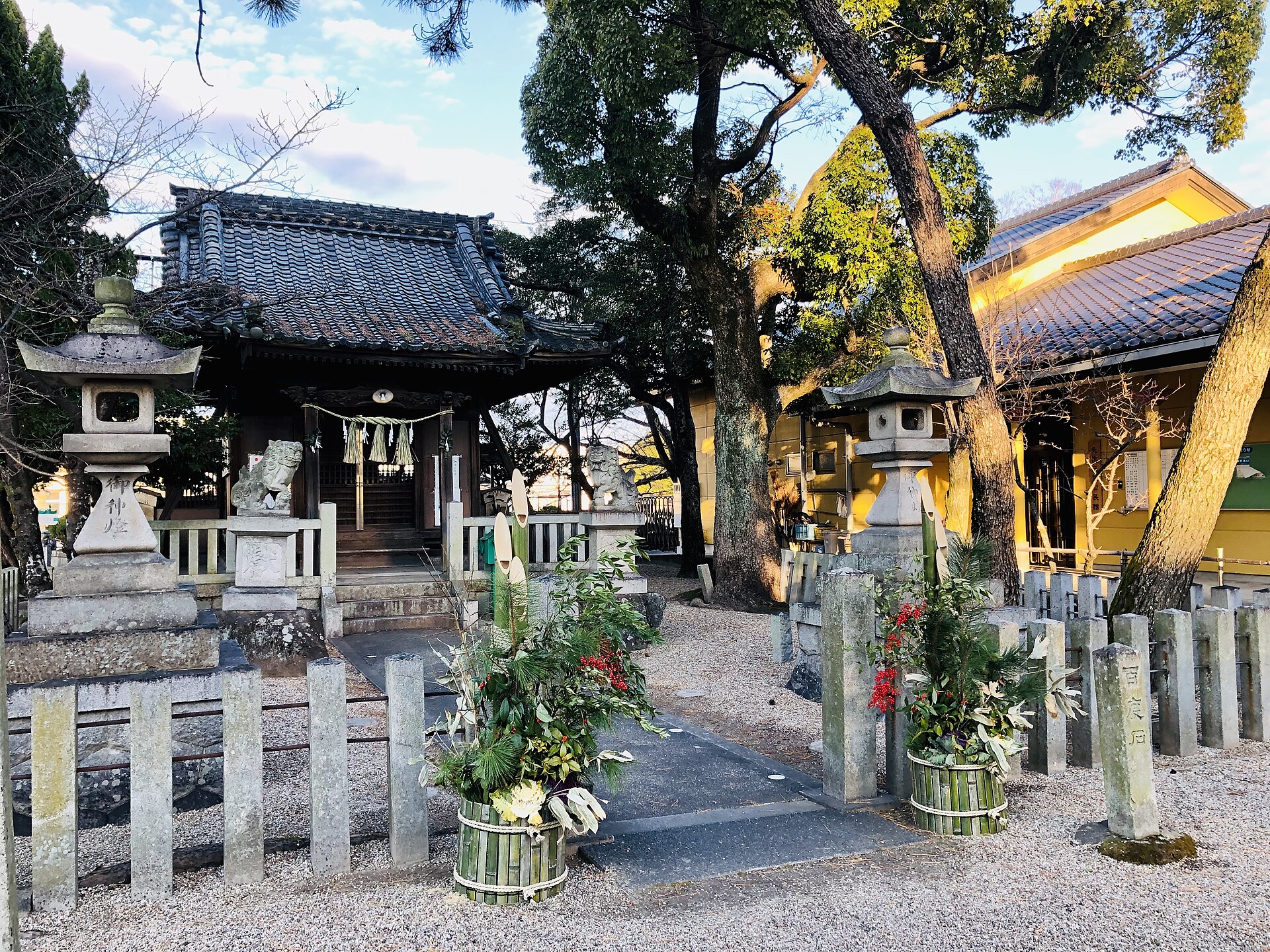
Kadomatsu — a pine to welcome the New Year’s kami
The kadomatsu set at gates during the New Year is also a yorishiro. The Encyclopedia of Shinto names the pine at the entrance as the classic New Year’s tree that receives toshigami, the kami of the new year. In some regions, people still go into the mountains on 13 December to cut the pine for their decorations. In effect, every Japanese household raises a small sacred tree at its door each January. Children learn, year after year, that a kami can come down into a tree — then leave again.
Jichinsai — a sakaki branch before the house is built
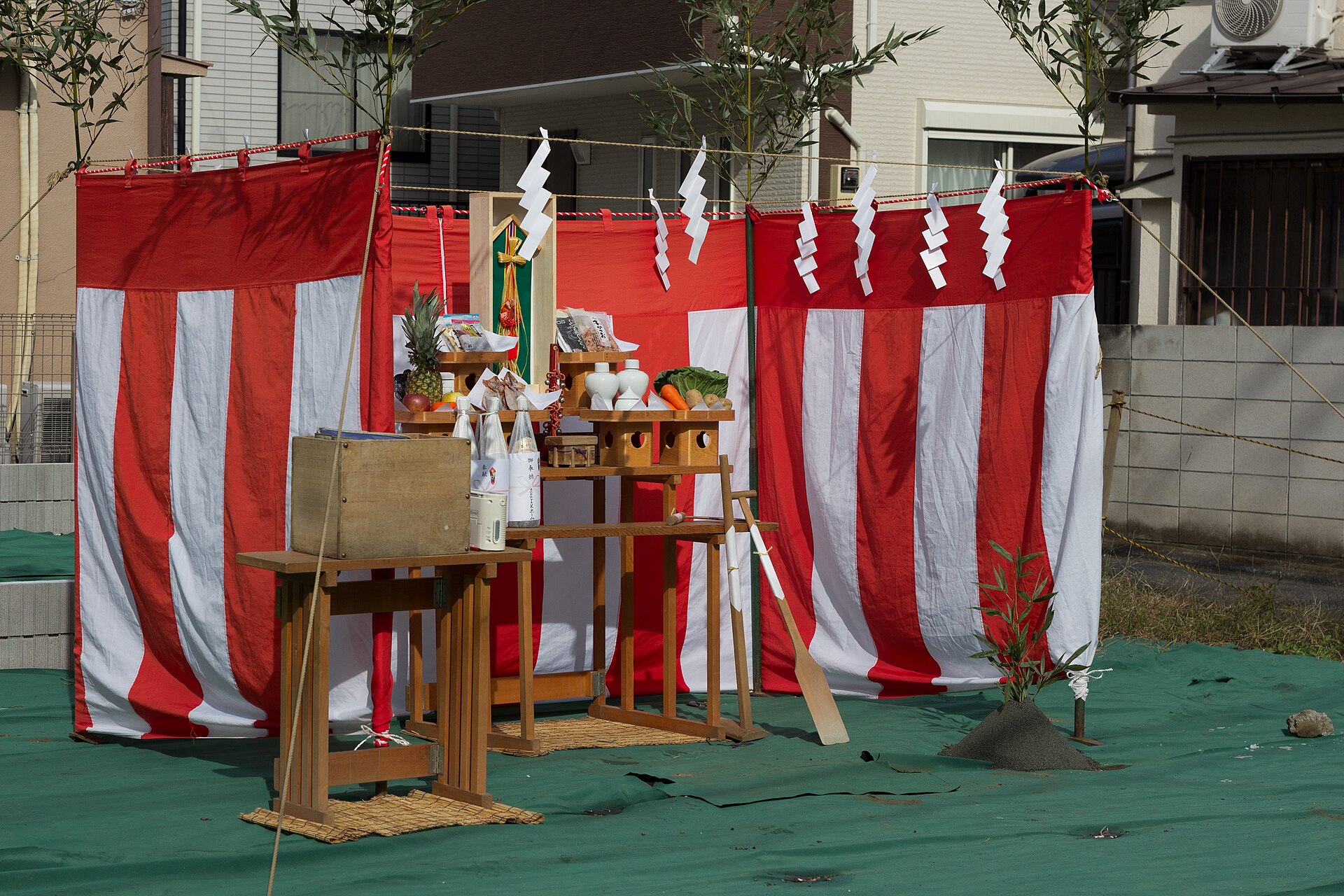
Before a house or office goes up, many sites in Japan still hold a jichinsai, a rite to calm the kami of the land. A himorogi is set up: green bamboo at four corners, a shimenawa strung between them, and a sakaki with shide in the centre as yorishiro. On an empty lot with no shrine, a temporary sacred tree is raised. When the frame of the house is complete, the tree kami Kukunochi is honoured as a guardian of the building. The Engishiki, a 10th-century code, calls this kami kodama, “the spirit of trees”.
Chinju no mori — protecting the forest, not just one tree
Many shrines sit inside their own forest. The Association of Shinto Shrines calls it the chinju no mori and says it is “not merely a collection of trees” but a way of passing on the Shinto spirit of humans living together with nature. Kumano Hayatama Taisha in Wakayama has a nagi tree said to be a thousand years old; pilgrims once carried its leaves home as a charm for a safe journey, and leaf amulets are still offered today.
Stopping at the shimenawa — A boundary of respect, a boundary of roots
At almost any Japanese shrine you can watch visitors slow down in front of a roped tree, bow slightly, and hesitate before taking a photo. This is less a learned rule than an instinct: when you see a boundary, you do not cross it. For anyone caring for a sacred tree, that instinct is the most valuable asset there is.
The kami’s boundary is not the root’s boundary
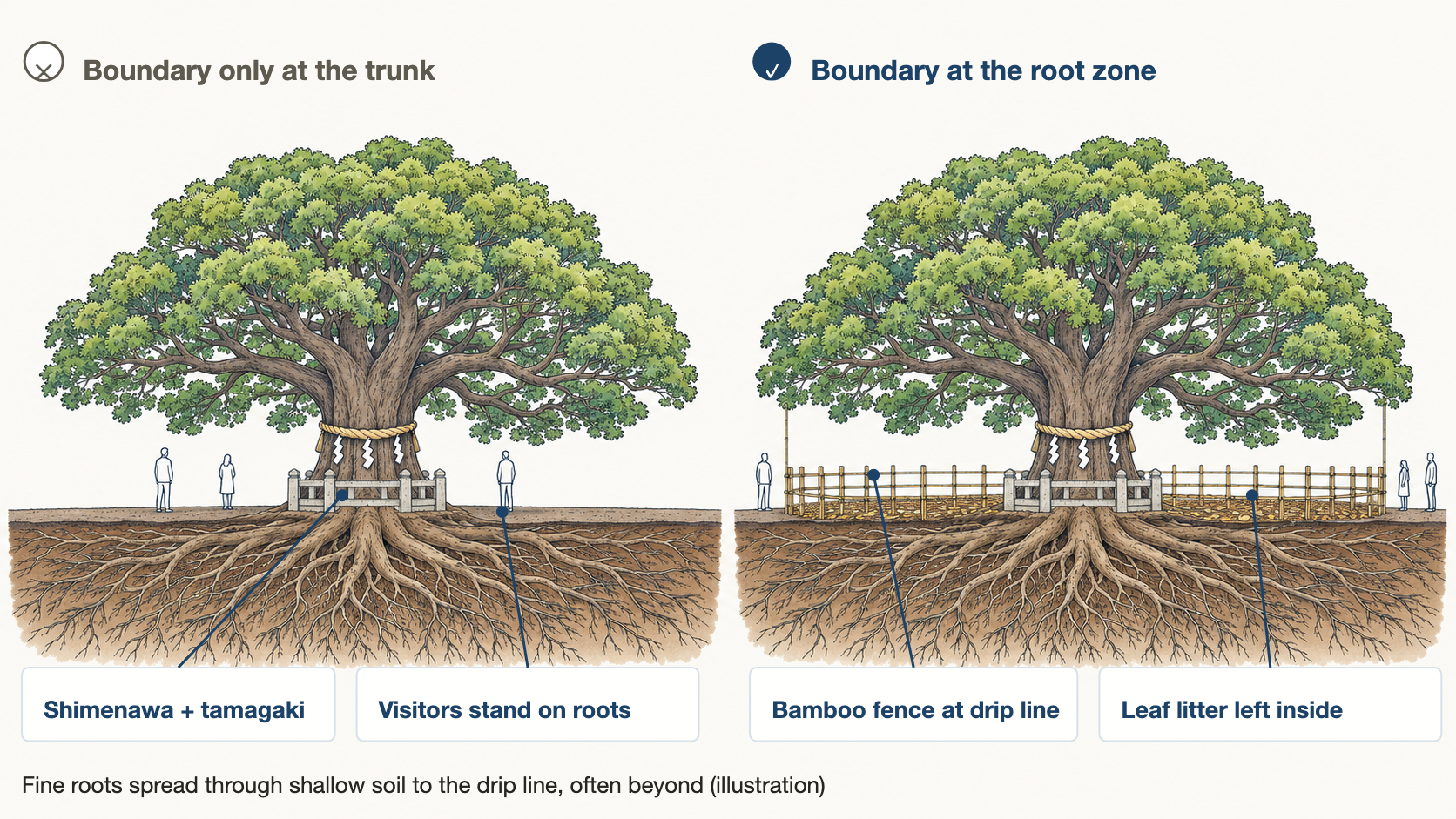
The problem is that the rope or tamagaki usually sits close to the trunk, while the fine absorbing roots spread through the shallow topsoil to the drip line and often well beyond. Visitors respectfully stay outside the rope — and stand directly on the roots that matter most. When assessing a shinboku, the first thing to look at is not the trunk but the soil just outside that boundary. Is it hard and shiny? Has leaf litter been swept away? Does water pool after rain? That is where the gap between feeling and biology shows.
Place the fence as a boundary, not a prohibition
The fix is to extend the reach of that “do not cross” instinct out to the root zone. If you install a fence, set it near the drip line rather than at the trunk, in materials that belong to the setting, such as bamboo or timber. Wording matters too. “Please stay outside this fence to protect the roots of the sacred tree” works with the visitor’s feeling; a bare “Keep Out” works against it. Hang shide from the fence and it is read as the kami’s boundary rather than a management barrier — but the form is for the priest to decide, not the arborist.
Touching, circling, passing through — Closeness, at a cost to the roots
Alongside the reflex to keep a distance, Japan also has customs of coming close. Reverence takes two forms — stepping back and stepping in — and the tree pays for the second.
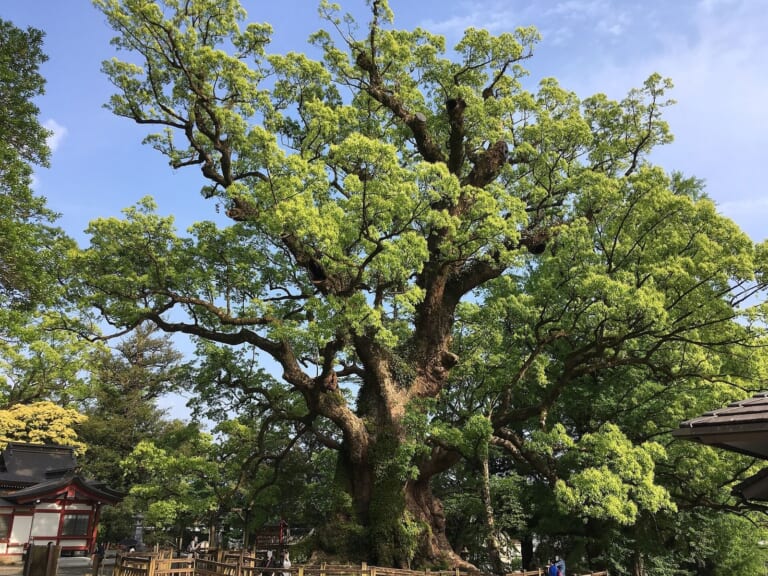
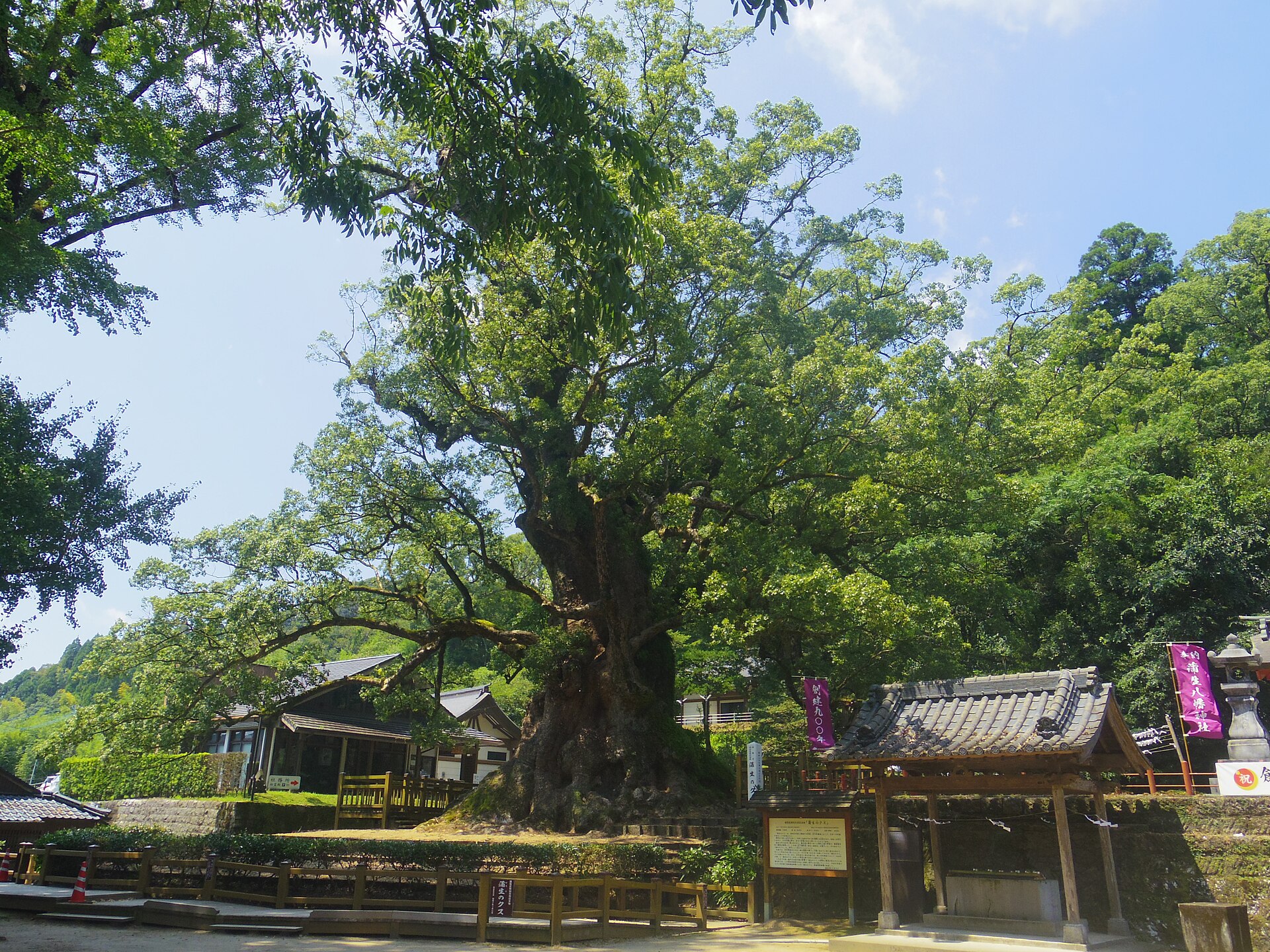
Kinomiya Shrine in Atami, Shizuoka, has a camphor (Cinnamomum camphora) with a trunk girth of 23.9 m (78 ft), the second largest in Japan in the Ministry of the Environment survey. The shrine says that walking once around the tree adds a year to your life, inspired by its reputed 2,100 years; walk around in silence with a wish, and the wish comes true. What people seek here is a share of the tree’s time. At Kumano Nachi Taisha, a camphor estimated at 850 years old has a hollow trunk about 8.5 m (28 ft) round, which visitors walk through carrying a prayer stick — a custom called tainai kuguri, “passing through the womb”. To an arborist, that is a hollow tree; but a hollow alone is not fatal, since strength depends on the remaining wall thickness against the crown’s weight. People see vitality, not weakness, in a tree that keeps its leaves around a hollow you can walk through. (For more on the trees themselves, see Japan’s sacred giant at Kinomiya Shrine.)
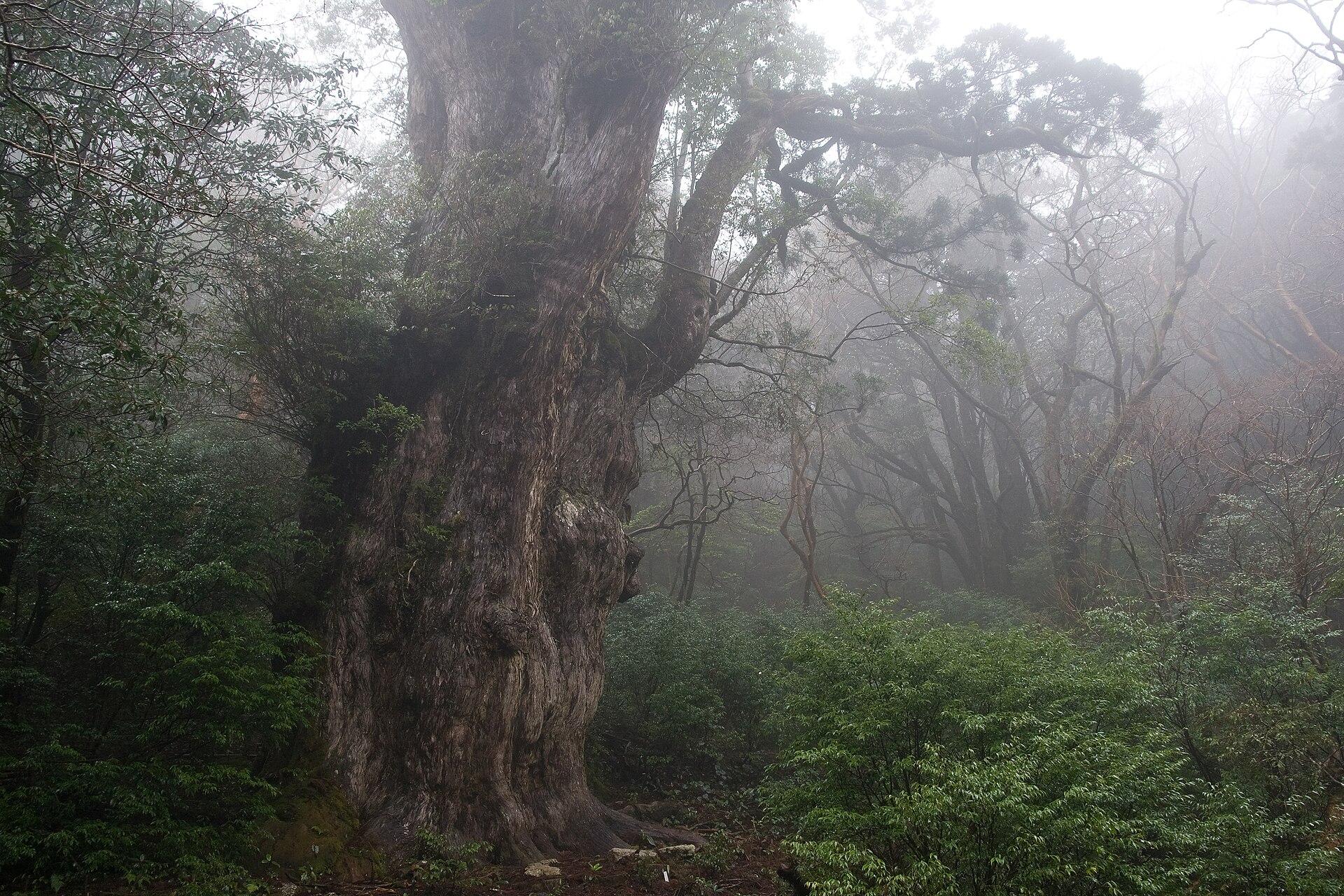
Closeness compacts soil. When pore space collapses, roots get less air and less water. Japan’s national research institute on infrastructure lists soil compaction from trampling among the human causes of decline in its casebook on giant trees. On Yakushima, crowds around the Jōmon Sugi cedar (Cryptomeria japonica) led to bark stripping and trampled roots; in 1994 the area around the tree was closed, and in 1996 a viewing deck was built. Even so, in 2005 a piece of bark about 10 cm (4 in) across was cut away and taken.
The casebook includes a survey of 359 giant or veteran trees managed by certified tree doctors (jumoku-i):
| Item (of 359 trees) | Number | Share |
|---|---|---|
| Growing at a shrine or temple | 149 | 41% |
| Regarded as a local symbol | 226 | 63% |
| Received soil improvement | 187 | 52% |
| Protected with fences, decks or similar | 110 | 31% |
Of the trees protected with fences or decks, 71% were reported to show a “relatively high effect”. You do not need to erase the wish to come close; you only need to decide where people come close. The deck at Jōmon Sugi does not hide the tree — it says, “see it from here.”
Praying before the cut — Purification rites, hesitation, restraint
Cutting trees is not taboo in itself in Japan; it is a country built of wood. But before a large, old or sacred tree is felled, a step is inserted: tell the kami, and ask permission. Cutting and revering sit inside the same procedure.
The Encyclopedia of Shinto notes that cutting or defiling a shinboku is avoided, and cites the Nihon Shoki (720), which records the felling of trees at Ikukunitama Shrine as an example of an emperor making light of the kami. The taboo was in writing 1,300 years ago.
The Grand Shrine of Ise keeps the most careful version alive. Every 20 years its sanctuaries are rebuilt in a cycle called shikinen sengu, which requires great quantities of Japanese cypress. In May 2025 two rites opened the next cycle: the Yamaguchi-sai, praying to the kami at the mouth of the mountain for safe felling, and the Konomoto-sai, which honours “the kami who dwells at the base of the tree” chosen for the central pillar. Even a tree destined for timber is seen as home to a kami, who is asked to move before the cut.
This is not only for great shrines. Many shrines offer a purification rite for felling a tree on private land; Shimogamo Shrine in Kyoto lists it among its kiyoharae rites. Families still call a priest before taking down a large garden tree their grandparents planted. In our own company, the tree doctors offer salt with sake at the base of a sacred or veteran tree, then bow, before starting the cut.
What happens to the cut wood matters too. Nakano Shrine in Kanagawa once made handmade amulets from branches removed from its sacred tree — while stating plainly that it would never prune the tree just to make amulets. Use with care what had to be cut; never cut in order to use. That order of priorities is the etiquette of putting a blade to a sacred tree.
After a sacred tree falls — Keep the stump, raise the next generation
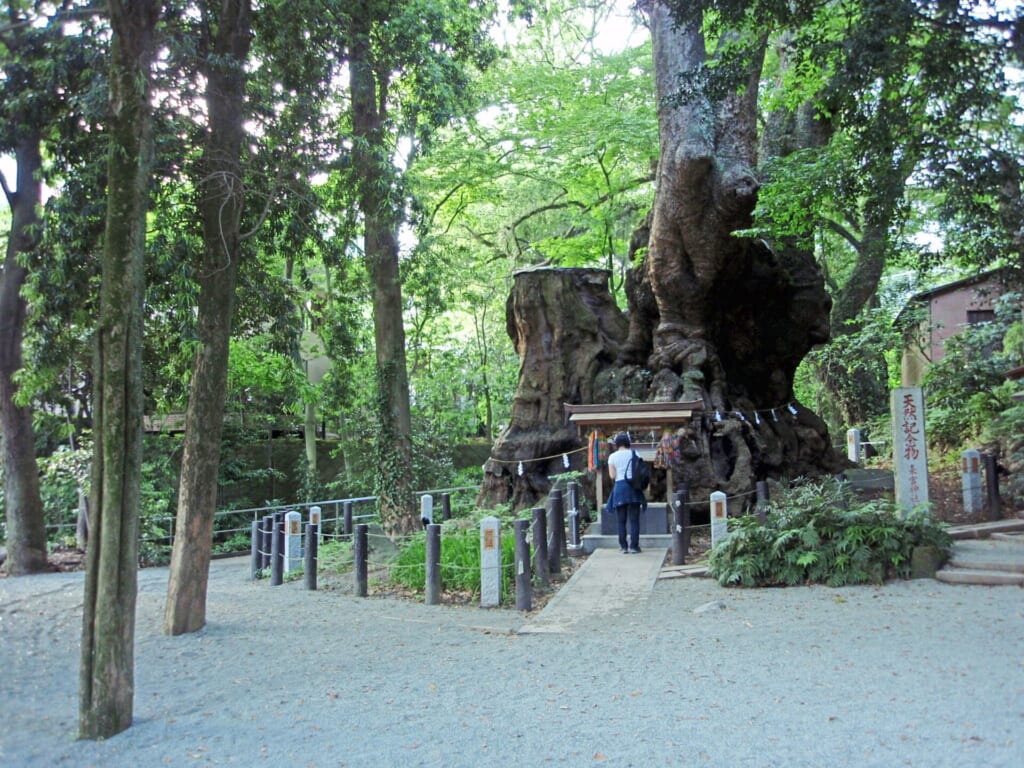
The feeling is clearest when a sacred tree falls. It is not cleared away as storm debris. It is purified, its stump or trunk is kept on the grounds, and a successor is raised from its roots or branches. In Japan, a shinboku remains “the tree of that place” even after it has gone.
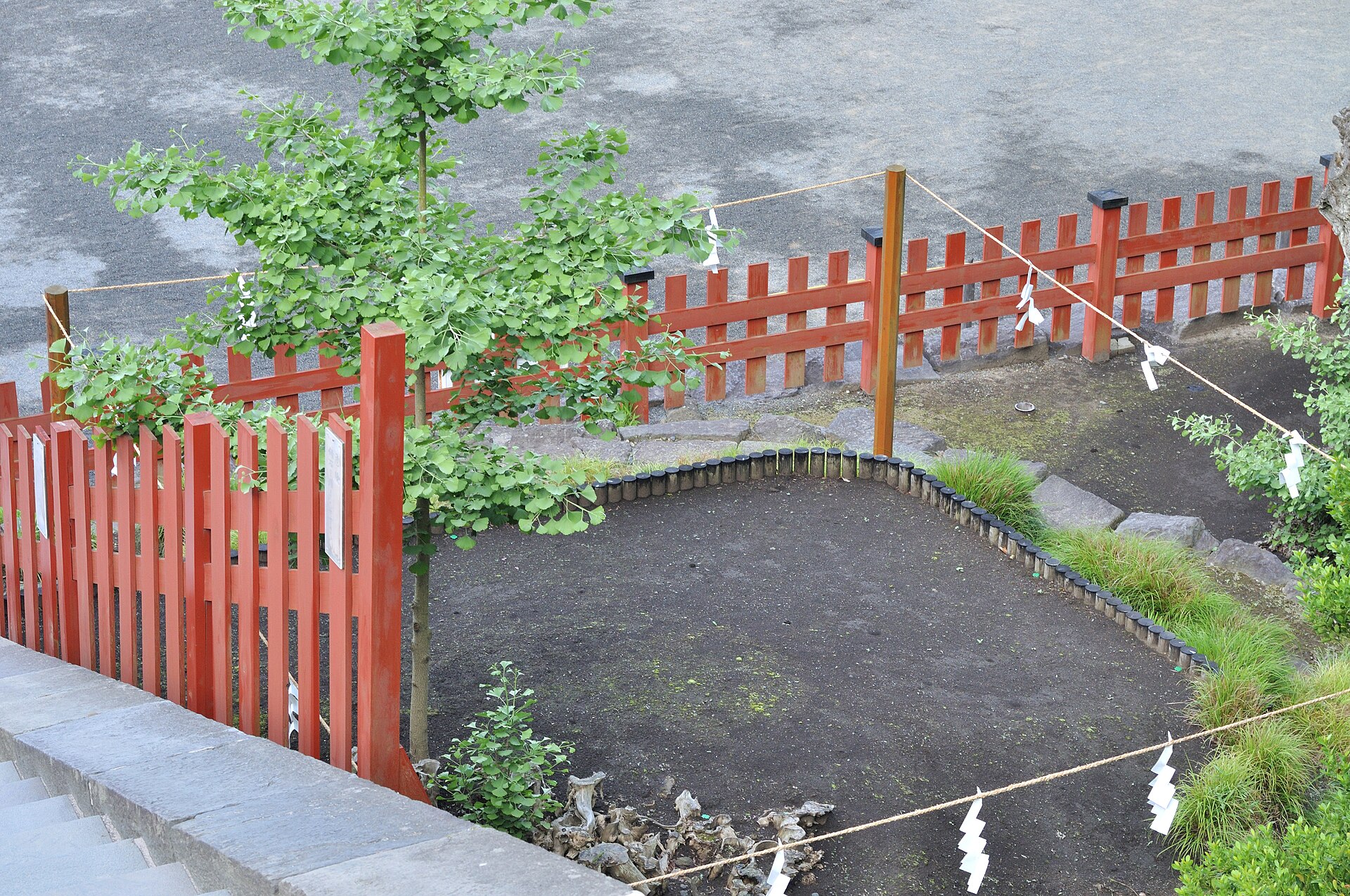
Tsurugaoka Hachimangu in Kamakura lost its great ginkgo, estimated at over 1,000 years old, in a gale before dawn on 10 March 2010. A sprout from one of its roots grew into a young tree, and today the transplanted “parent” stands beside the “child” growing on the original site. The Japanese word for such root sprouts is hikobae — written with characters meaning “grandchildren growing”.
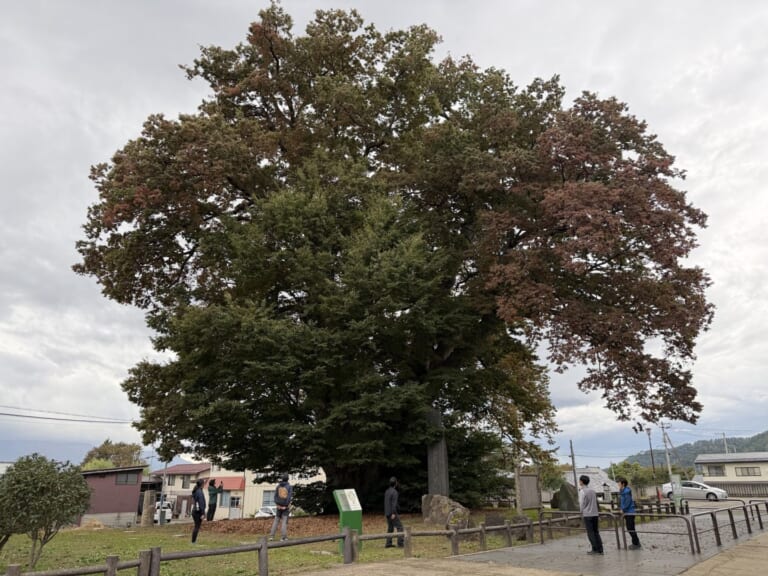
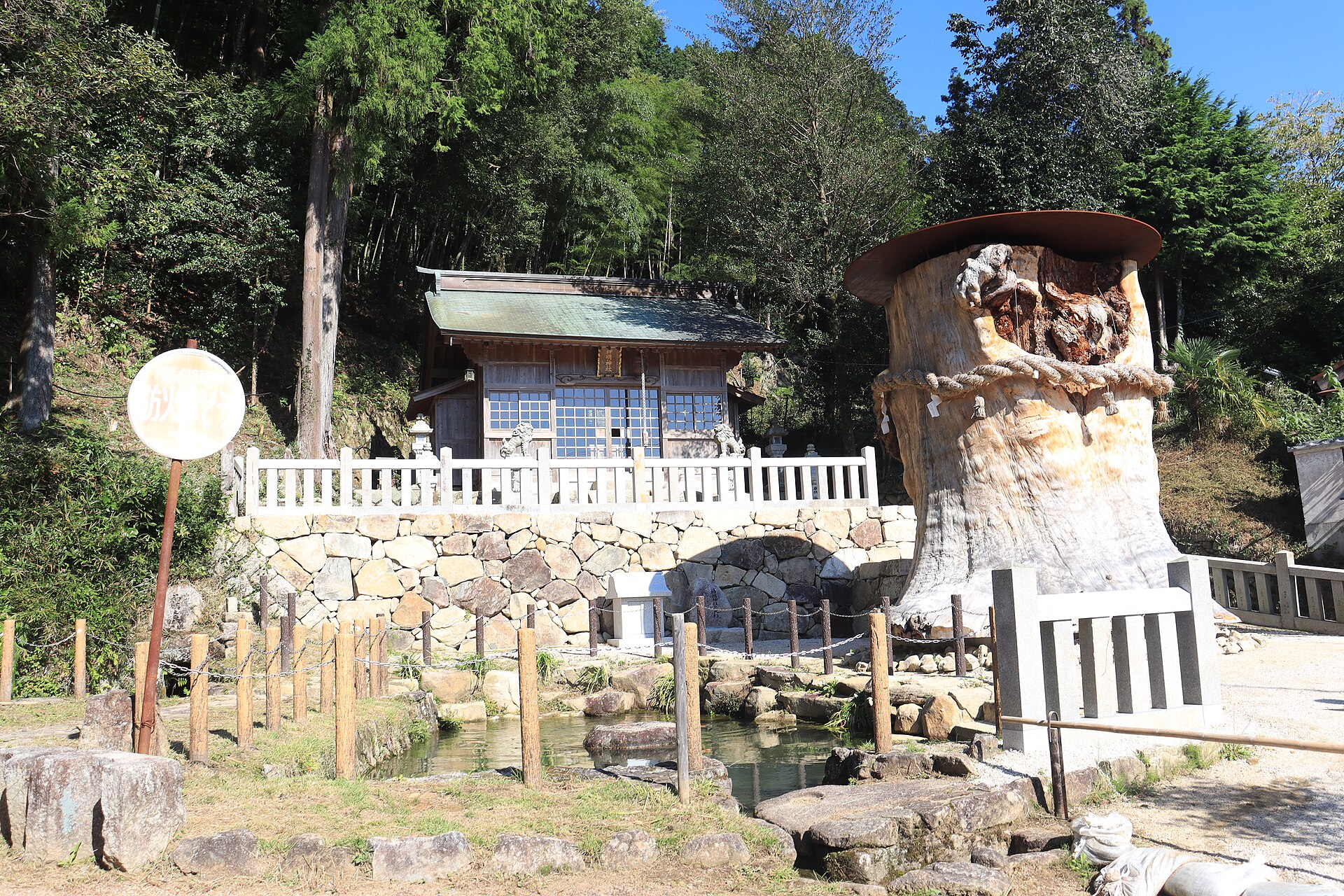
In Ōkute, Mizunami (Gifu), the shrine’s great cedar — 11 m (36 ft) in girth, about 40 m (131 ft) tall, a designated natural monument — fell during heavy rain on 11 July 2020. Residents set up a revival council at once; the head of the district association said they wanted to protect “the honour of the great cedar”. Local tradition put its age at 1,300 years; a Nagoya University study found about 670, with restricted root growth plus root decay as causes of the fall. The gap between legend and measurement did not change how people felt. Part of the trunk is preserved under a roof, and children still come to count its rings.
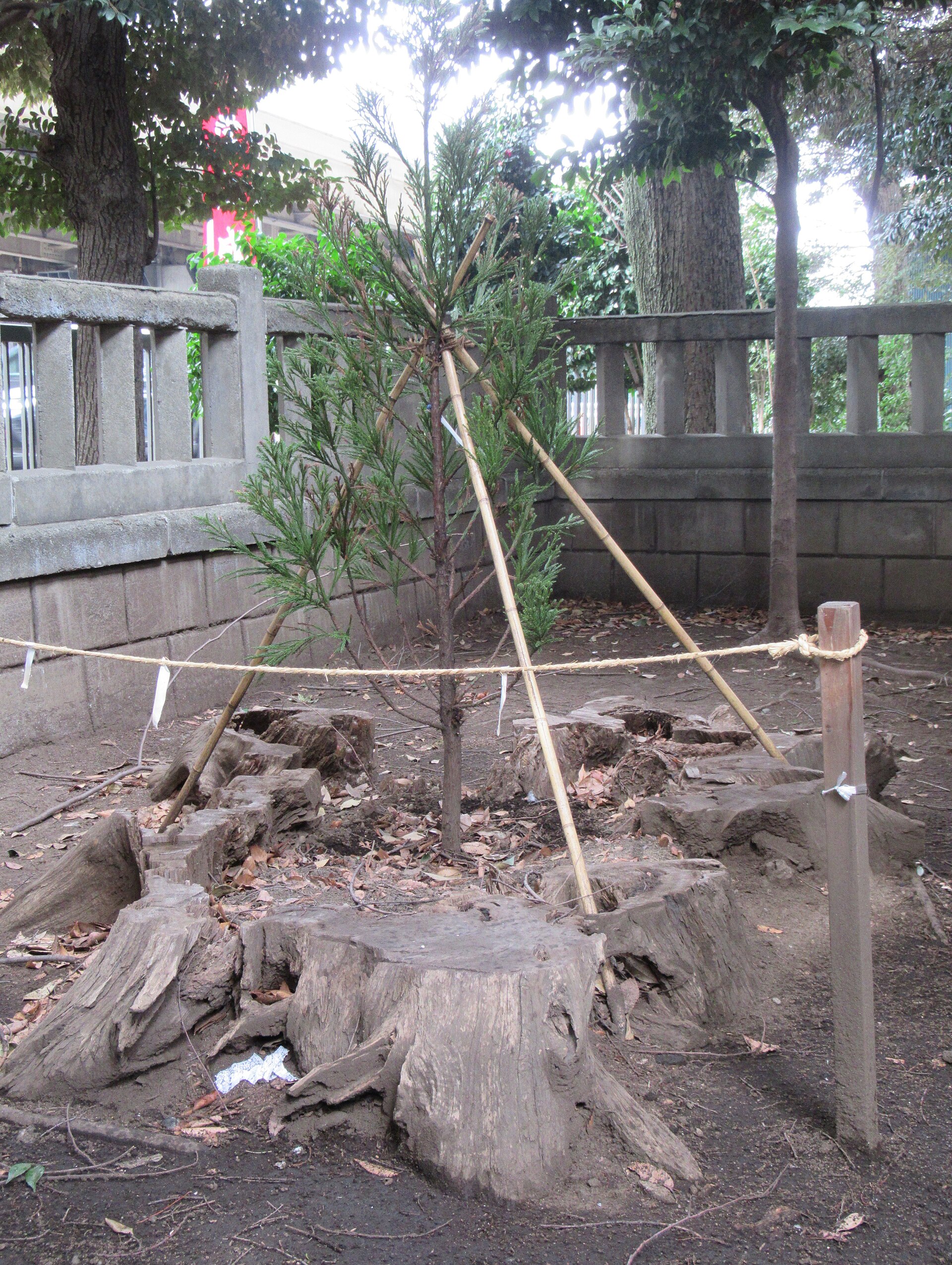
At Shimogamo Shrine in Kyoto, a sacred Castanopsis cuspidata, about 450 years old, fell on 16 June 2026 despite years of inspections by tree doctors with support props. The shrine announced that it would purify the tree and keep it as the “site of the sacred tree”.
Some successors are prepared before the fall. At Enō-ji temple in Asago, Hyōgo, a zelkova believed to be over 1,000 years old was weakening, so in November 2016 the national forest tree breeding centre took scions, grafted them the next spring, and returned the young tree to the temple in March 2018. Japan’s “Forest Tree Gene Bank 110” programme has done this since 2003, with 229 successor trees returned home out of 306 requests by March 2021. People want “a child of that tree”, not just another tree, and propagation makes it possible.
| Case | What happened | What followed |
|---|---|---|
| Tsurugaoka Hachimangu ginkgo | Fell in a gale, March 2010 | Parent transplanted; root sprout raised as the “child”; stump kept |
| Ōkute cedar, Gifu | Fell in heavy rain, July 2020 | Trunk preserved; revival council; school visits |
| Shimogamo Shrine Castanopsis | Fell under its own weight, June 2026 | Purified; to be kept as the “site of the sacred tree” |
| Enō-ji zelkova, Hyōgo | Declining vigour | Grafted; genetically identical successor returned |
When reverence harms the tree — Six moments that change the management decision
Some of a sacred tree’s problems are caused by the very care people give it. There is no ill will anywhere — which is why the answer is to redirect the feeling, not forbid it.
| Moment | The feeling behind it | What happens to the tree | Response that keeps the feeling |
|---|---|---|---|
| Touching, circling the trunk | Wanting a share of the tree’s time | Soil compaction; bark wear | One designated place to touch or pray, on a boardwalk or deck |
| Sweeping leaves away | Keeping the grounds pure | Soil loses organic matter, dries out | Leave litter inside the fence; keep sweeping the paths |
| Gravel, paving, added soil at the base | Making it tidy, accessible | Air, water cannot reach roots | Permeable finishes; no layering of gravel or fill |
| Fixing the shimenawa with wire, nails | Keeping the rope in place | Wire girdles; nail holes admit decay | Never fix to the trunk; check at each rope renewal |
| Never pruning | Not wanting a blade on the tree | Dead wood falls on visitors; crown imbalance | Explain deadwood removal as “tending”; ask the priest about a rite |
| Never felling, even in decline | Not ending centuries of care on one’s watch | Decay advances; failure risk rises | Combine props, cabling, crown reduction, exclusion zones |
The last row is the hardest. Before asking “fell or keep?”, ask “what would it take to keep it safely?” Three conditions frame the answer: what lies within the fall zone (shrine buildings, paths, roads, power lines, homes); whether the exclusion zone can be widened; and whether there are people with budget to keep inspecting props or cables. Felling is the last choice, made only when the conditions for keeping the tree cannot be met. For more on how Japanese assessment works, see what a jumoku-i is, and why Japan’s ancient trees live for a thousand years.
What to take home — Five practices for trees a community holds dear
There are no shimenawa outside Japan. But every country has trees people hold dear: an old churchyard tree, a village square tree, trees honoured by Indigenous communities, a tree a family planted. Perhaps the Toronto student asked about shinboku with trees in their own city in mind. What Japan offers is not a belief system but a procedure for making people’s feelings work for the tree.
- Ask what the tree means before you assess its condition. Who is it important to, and which events or memories is it tied to? Even a correct recommendation is rejected if it ignores this.
- Draw the fence as a boundary of respect. Set it at the root zone, in materials that suit the place, with wording that gives the reason.
- Leave time before the cut. Announce it, hold a farewell, invite a faith leader or community representative to say a few words. The pause is for the people as much as for the tree.
- Keep the stump, the wood, the offspring. Agree with the owner beforehand how the wood will be used. Take scions while the tree is still alive, so that “a child of that tree” can be planted on the same spot.
- Leave the records with the owner. A veteran tree outlives every caretaker. Diagnosis results, yearly photos from the same point, treatments with reasons, the next inspection date — kept in one file, so the next person knows why the fence is there.
Caring for a sacred tree means two things at once: reading the tree, and handing on the feelings of the people who love it. That is also why trees here end up in trouble when the people around them change — a theme behind Japan’s falling trees crisis.
Frequently asked questions
Q1. How is a shinboku different from any other big old tree?
A. A shinboku is revered as a place where a kami comes down, or as a marker of sacred ground. Size and age alone do not make one. Most are wrapped in a shimenawa or fenced, and cutting or defiling them is avoided.
Q2. Can I touch a sacred tree in Japan?
A. It depends on the shrine. Some trees, like the camphor at Kinomiya Shrine, have a custom of walking around them; others are closed off to protect their roots. Stay outside any fence or rope, and follow the signs. Feet on the root zone hurt the tree far more than hands on the bark.
Q3. Are sacred trees ever cut down?
A. Yes. When failure risk is high and props or exclusion zones cannot keep people safe, felling is the last option. A priest performs a purification rite first, and the shrine decides how the stump and wood will be treated.
Q4. What happens when a sacred tree falls?
A. Usually it is purified, and the stump or part of the trunk is kept on the grounds. Some shrines raise a root sprout as the next generation, as at Tsurugaoka Hachimangu; others plant a grafted successor with the same genes.
Q5. Is this useful outside Japan?
A. Yes. For any tree a community holds dear, the five practices apply: ask its meaning first, fence it as a boundary of respect, pause before the cut, keep the stump or offspring, leave the records. You do not need to share the belief to make the feeling work for the tree.
Sources
Kokugakuin University, Encyclopedia of Shinto: Shinboku, Shinju; Yorishiro; Shide; Himorogi; Sakaki; Tamagushi; Shōgatsu; Kukunochi. Kokugakuin University, Basic Terms of Shinto: Shimenawa.
Association of Shinto Shrines (Jinja Honchō): shrine grounds; kamidana; susuharai; tamagushi; Nakano Shrine amulets.
Omiwa Shrine: sacred cedar sprigs. Kumano Hayatama Taisha: history. Kumano Nachi Taisha: shrine guide. Japan Tourism Agency multilingual database: Shōreisha; Great Ginkgo of Tsurugaoka Hachimangu.
Kinomiya Shrine: the great camphor. Ministry of the Environment: giant tree follow-up survey, 4 October 2001. Tsurugaoka Hachimangu: precinct guide. Shimogamo Shrine: the fallen sacred tree; purification rites.
Mizunami City: Kōhō Mizunami, 15 August 2020; the Ōkute great cedar. Nagoya University: press release, 27 September 2021. Forestry Agency: Rinya No. 152. Shōbara City: Forest Tree Gene Bank 110. Grand Shrine of Ise: shikinen sengu schedule.
Ministry of the Environment, Yakushima: history of Jōmon Sugi visitor use. Kyushu Regional Forest Office: press release, 25 May 2005. National Institute for Land and Infrastructure Management, Technical Note No. 566: conservation measures; survey.
All accessed 18 October 2026.
Field notes from Japan’s trees arrive a few times each month — subscribe via the form in the footer, or follow the work on LinkedIn.
Isaki Kasahara, Arborist, Toshi Landscape (Tokyo)