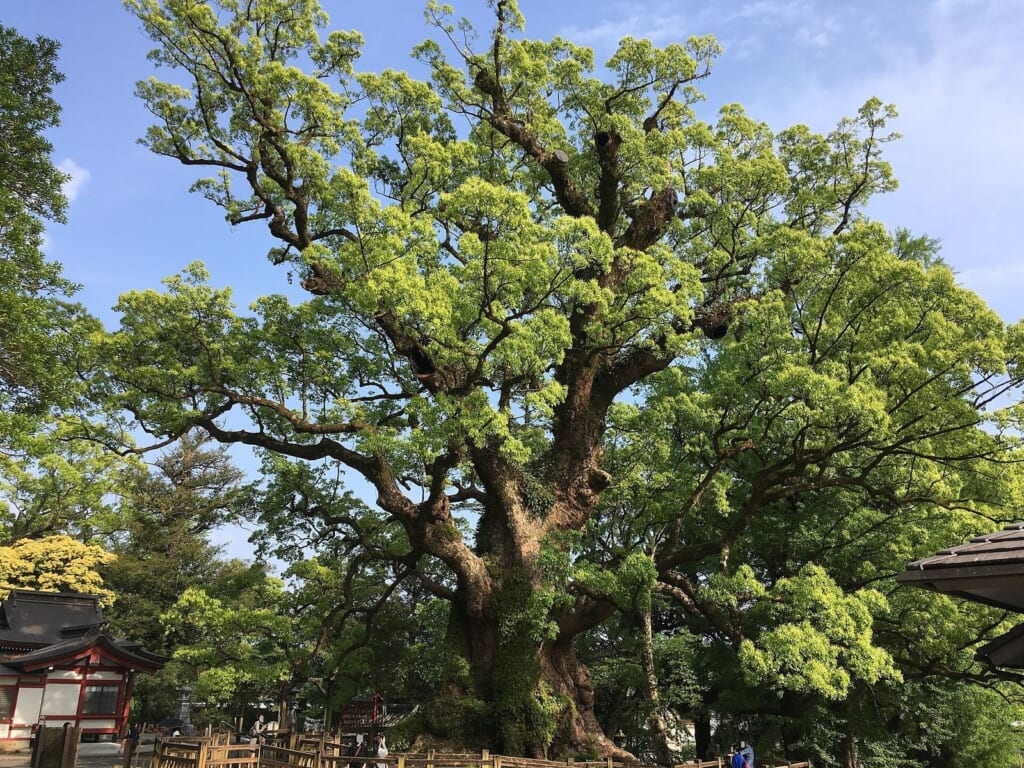
Kamō no Ōkusu (蒲生の大楠), the great camphor tree of Kamō Hachiman Shrine in Aira, Kagoshima, is the largest tree in Japan by trunk girth: 24.22 m (79.5 ft) around at eye level, about 30 m (98 ft) tall, with an estimated age of about 1,500 years. As for camphor tree lifespan, the honest answer is that a camphor tree (Cinnamomum camphora) can live for many centuries. Records show this one was already a sacred tree when the shrine was founded in 1123, over 900 years ago; older ages are estimates.
This article sets out the official figures, explains what “Japan’s largest” actually measures, compares Kamō with the Kinomiya camphor that usually ranks second, looks at why camphor trees live so long, and how the ground around a tree this old is protected.
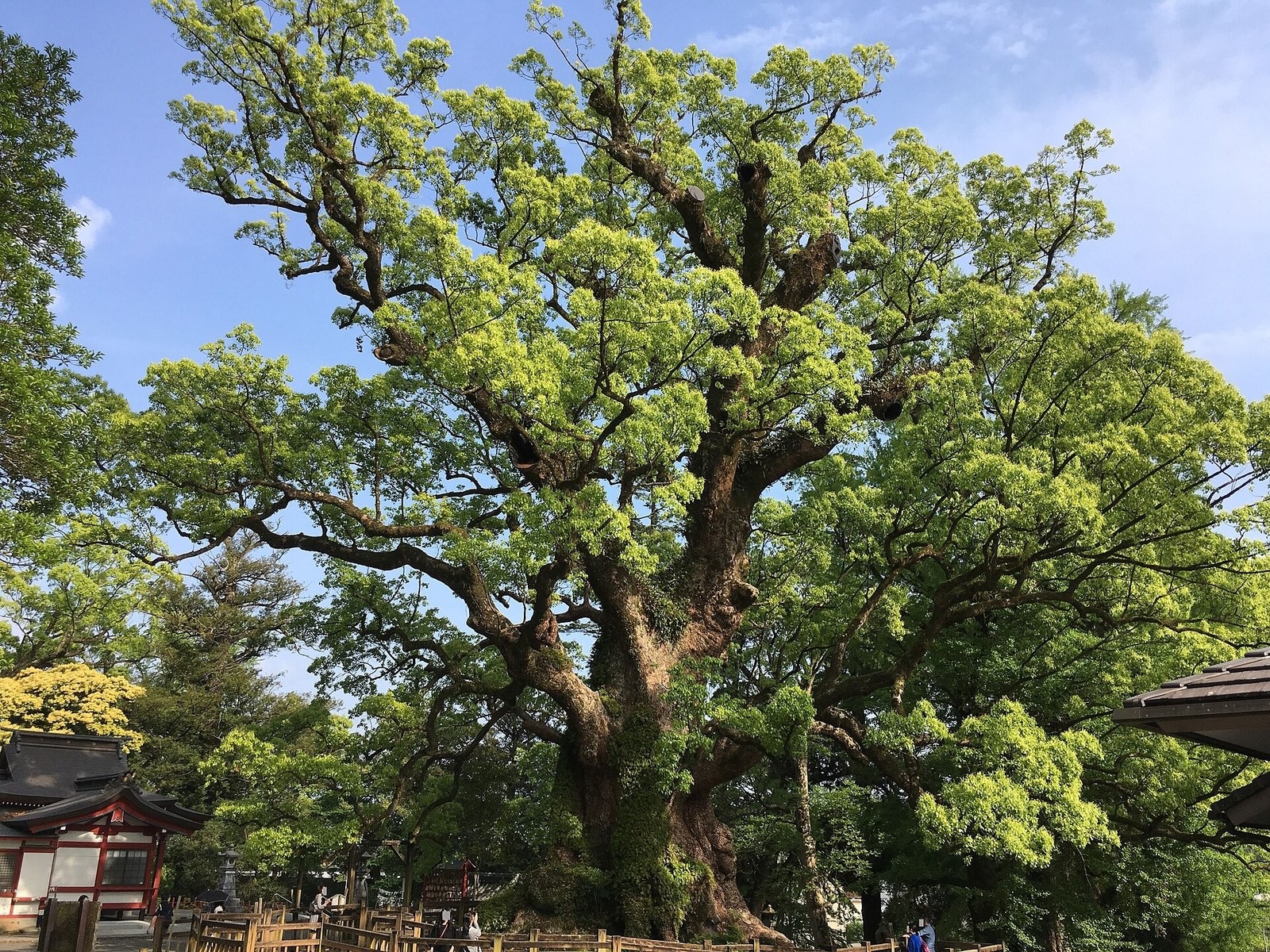
Kamō no Ōkusu at a glance — the official figures
The tree is a national Tokubetsu Tennen Kinenbutsu (特別天然記念物) — a Special Natural Monument, the highest grade of protection Japan gives to a natural feature. It was designated a Natural Monument on 8 March 1922 and raised to Special Natural Monument on 29 March 1952.
| Item | Figure | Source |
|---|---|---|
| Girth at eye level (me-dōri, 目通り) | 24.22 m (79.5 ft) | Aira City |
| Root-collar circumference | 33.57 m (110 ft) | Aira City |
| Height | about 30 m (98 ft) | Aira City; Agency for Cultural Affairs |
| Crown spread from the trunk | 12 m east, 12 m west, 10 m south, 19 m north | Aira City |
| Hollow inside the base | about 4.5 m (15 ft) across — roughly eight tatami mats | Aira City |
| Estimated age | about 1,500 years (city); “over 1,000 years” (national register) | Aira City; Agency for Cultural Affairs |
| Natural Monument | 8 March 1922 | Agency for Cultural Affairs |
| Special Natural Monument | 29 March 1952 | Aira City |
The two age figures in the table are not a contradiction. The national register gives a conservative minimum; the city gives the commonly cited estimate. More on that below.
What “Japan’s largest tree” actually measures — the giant tree survey
Japan’s Ministry of the Environment defines a kyoju (巨樹, giant tree) as a tree whose trunk measures 3 m (9.8 ft) or more around at 1.3 m (51 in) above the ground. Its national giant-tree survey, carried out as part of the fourth National Survey on the Natural Environment in fiscal 1988, recorded 55,798 such trees. Kamō no Ōkusu came out first by girth.
Two points matter here for anyone comparing big trees across countries:
- The ranking is by girth, not height or volume. A broad, buttressed camphor wins on this measure; a tall conifer may not.
- The 24.22 m figure is taken at 1.3 m, not at the base. The root-collar figure of 33.57 m is a different measurement and should not be compared with breast-height girths elsewhere.
The reputation is older than the survey. Aira City notes that a 1913 ranking of Japan’s old trees, the Dai-Nihon Rōju Banzuke (大日本老樹番附), placed it as Higashi no Yokozuna — the top rank on the east side, borrowed from sumo. It has been Japan’s greatest tree for over a century.
Kamō and Kinomiya — number one and number two
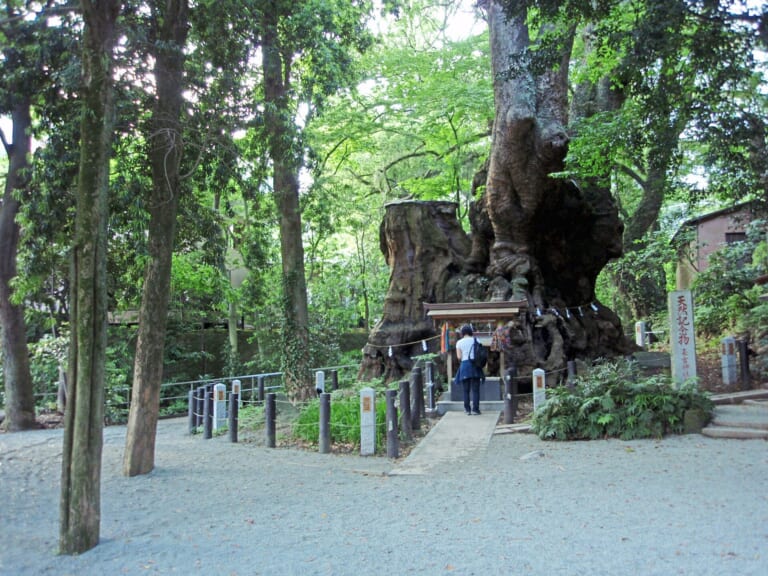
Many readers searching for Kamō land on our article on the Kinomiya camphor in Atami. The two are Japan’s largest camphor trees, and Kinomiya is usually ranked second.
| Kamō no Ōkusu | Kinomiya no Ōkusu | |
|---|---|---|
| Location | Kamō Hachiman Shrine, Aira, Kagoshima | Kinomiya Shrine, Atami, Shizuoka |
| Girth | 24.22 m (eye level) | about 24 m, as stated by the shrine |
| Rank in the national survey | 1st | 2nd, as stated by the shrine |
| Age claimed | about 1,500 years | over 2,000 years (shrine) |
| National protection | Special Natural Monument | Natural Monument |
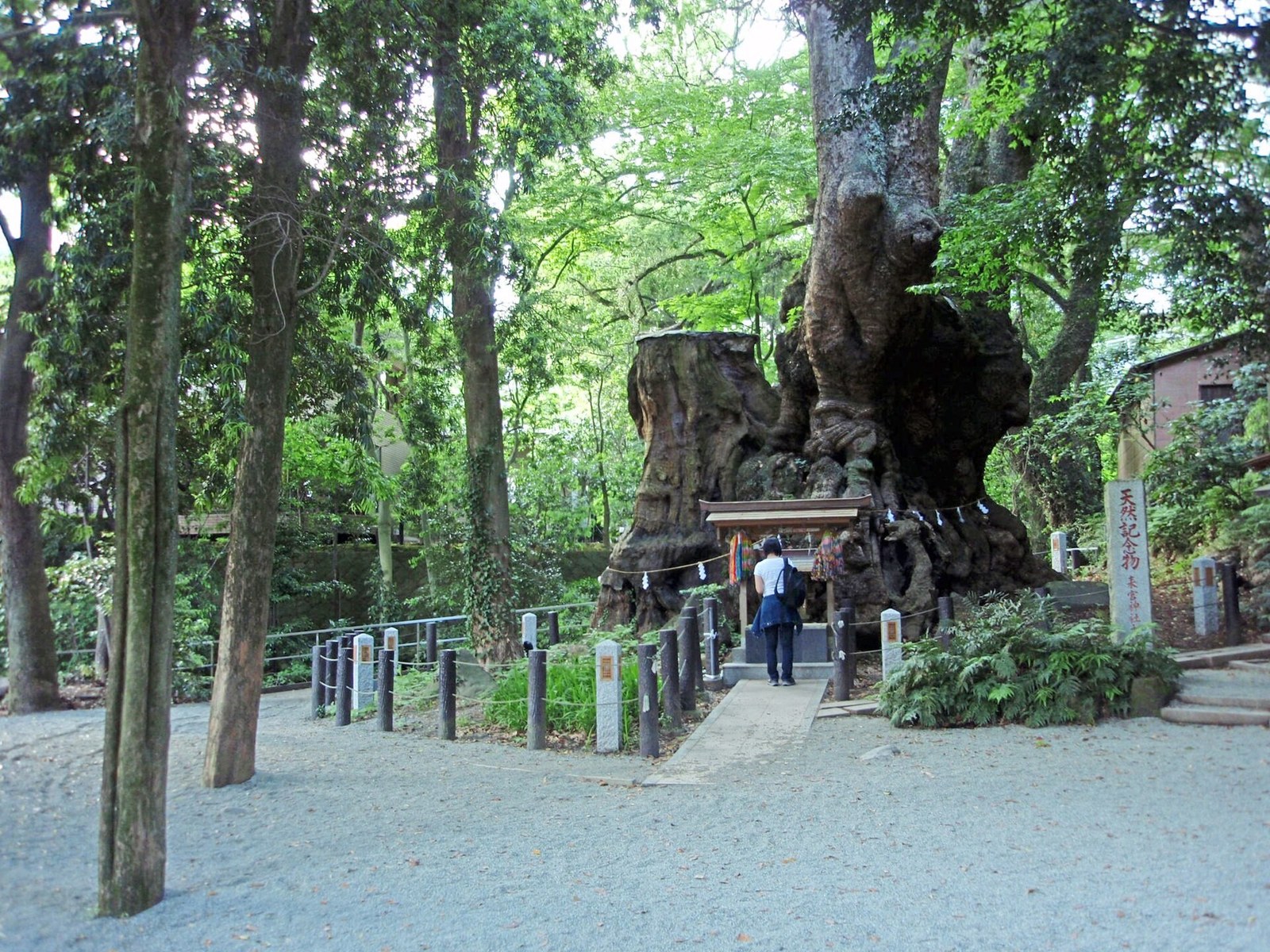
The comparison carries a useful lesson. The smaller tree claims the greater age. Girth tells you how much wood a tree has laid down, not how long it took; growth rate depends on soil, water, light and how many times the crown has been broken and rebuilt. Size and age are related, but in old camphors they do not track closely.
How long do camphor trees live? — what can be said honestly
Most English pages give a single number for camphor tree lifespan. The evidence does not support one. What we can say:
- Records prove more than 900 years; 1,000 and beyond are estimates. Kamō no Ōkusu was already a sacred tree in 1123, so it was established before that date.
- The exact age of a giant camphor cannot be counted. The oldest wood at the centre — where the first rings would be — has rotted away. Kamō’s base holds a hollow about 4.5 m across. With no core, there are no rings to count.
- Published ages are estimates. They combine written records (such as a shrine’s founding date), girth, local tradition and comparison with trees of known age. That is why Japan’s national register says “over 1,000 years” while the city says “about 1,500.”
- A planted street or garden camphor will not reach these ages by default. The giants grew on protected ground for centuries. Lifespan is set as much by site, soil and human treatment as by species.
Why camphor trees live so long — five reasons
Our article on why Japan’s ancient trees live for a thousand years covers the broader picture. For camphor in particular, five factors stand out.
- A warm, wet climate. Camphor is an evergreen broadleaf tree native to East Asia. Southern Kyushu, where Kamō stands, gives it a long growing season and ample rain.
- A hollow trunk is not a dying trunk. The living part of a tree is the thin outer shell — the cambium, the sapwood and the bark. Decay of the central heartwood removes dead wood, not living tissue. A hollow tube can stay standing and keep growing outward for centuries. For judging how much sound wood remains, see how to read tree decay without technology.
- Strong recovery after damage. In Japanese practice, camphor is known for answering lost limbs with a flush of new shoots from the trunk and main branches. A crown broken by a typhoon can be rebuilt over decades.
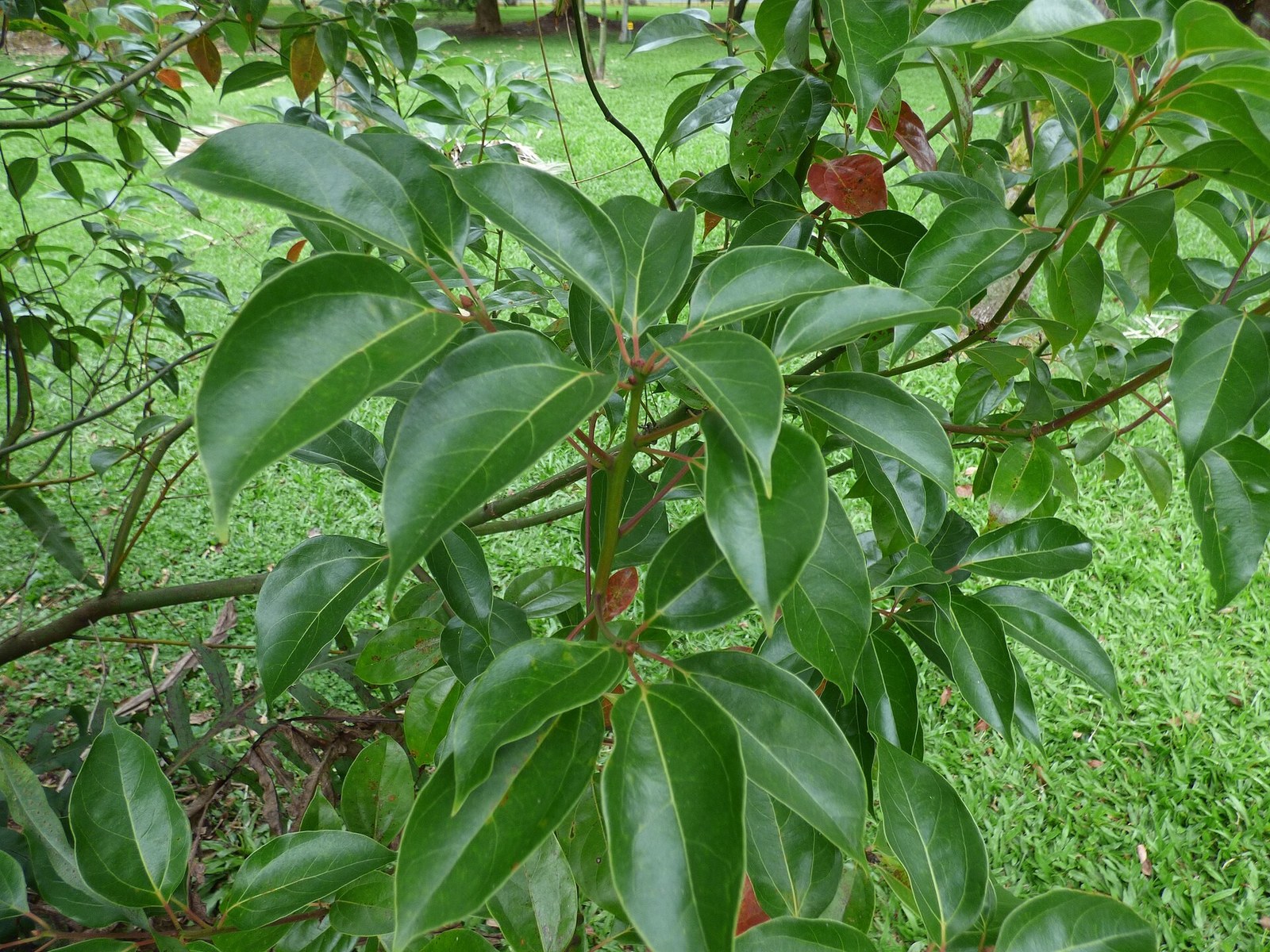
- Aromatic chemistry. The leaves give off a camphor smell when crushed, and the wood was long distilled for camphor itself. How much these compounds slow decay in a living tree is less well documented, so we treat this as a likely contributor rather than a proven cause.
- Protection as a sacred tree. Many of Japan’s oldest camphors stand on shrine ground. As a shinboku (神木), or sacred tree, Kamō was not cut, and the soil around it was not built over. From 1922 the law protected it too.
Keeping a 1,500-year-old camphor alive — protecting the ground
Aira City describes a protection and propagation programme for the tree that includes treatment of the tree and soil improvement. The city does not publish a detailed work record, so we do not describe specific operations here. What any visitor can see is simpler: a raised boardwalk around the base, and a door fitted to the hollow.
Both protect the ground and the trunk rather than the crown. Natural England’s handbook Veteran Trees: A guide to good management (2000) notes that trampling around old trees can, in extreme cases, compact the soil enough to affect water uptake and the mycorrhizal fungi the roots depend on, and that car parking under old trees does the same. Its remedies are about access rather than about the tree itself:
| Measure in the handbook | What it protects |
|---|---|
| Relocate footpaths away from the tree | Soil structure in the root zone |
| Keep car parks, new buildings, new paths well away | Roots from compaction, severing |
| Do not tarmac around the tree | Air, water reaching the roots |
| Restrict access to the tree itself where needed | Root zone, bark, open cavities |
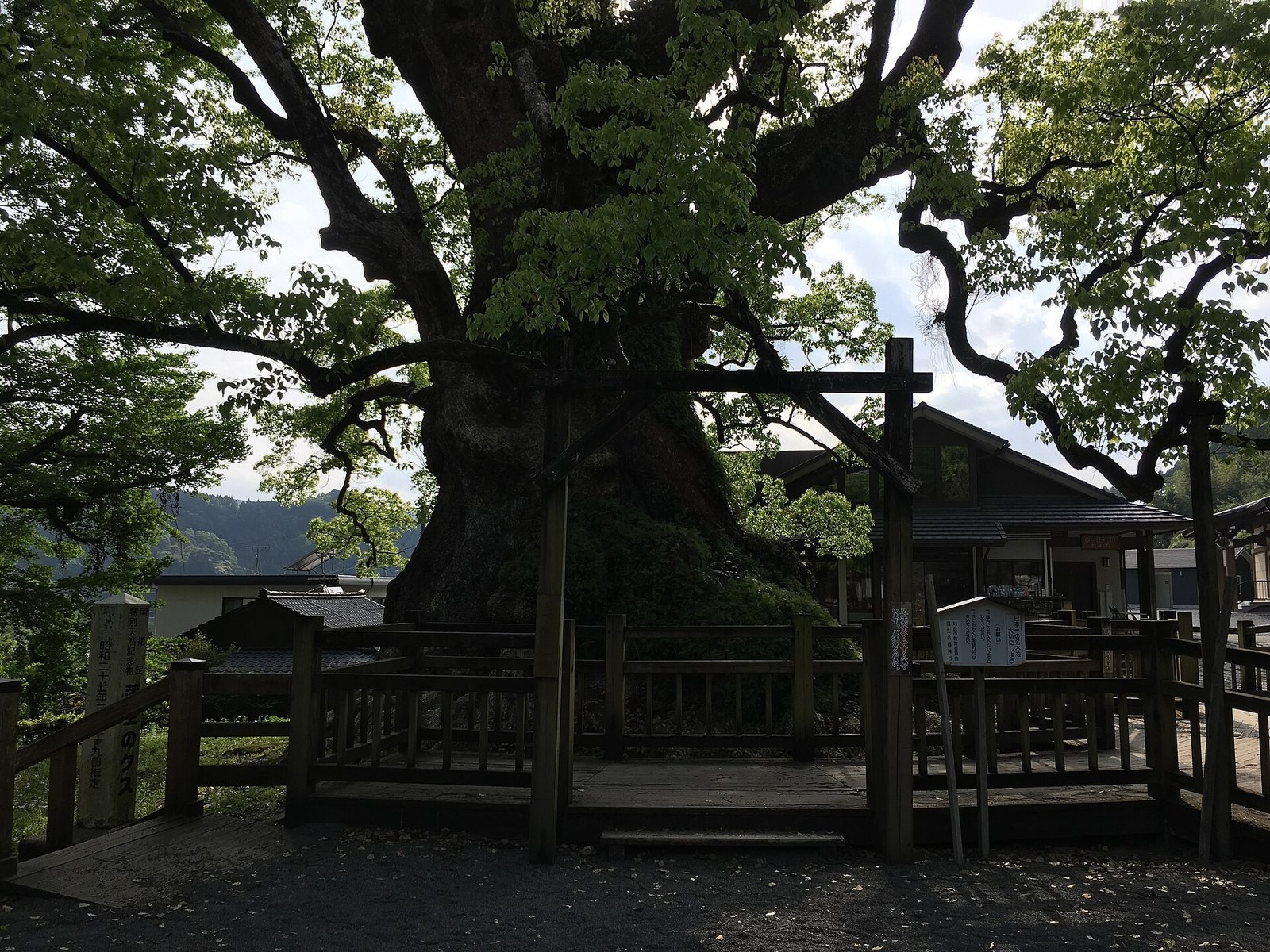
A boardwalk does the first and last of these at once: visitors still reach the tree, but their weight stays on the deck instead of the soil. The door does the same for the hollow.
Camphor outside Japan — a note for Western readers
Outside Asia, camphor’s reputation is very different. In Florida, the University of Florida’s IFAS lists Cinnamomum camphora as invasive in the north and central parts of the state, because birds spread its seed. The same vigour that lets it live for centuries in Kagoshima makes it a problem species elsewhere.
Botanists have also revised its name. A 2022 molecular study in Ecology and Evolution (Yang and colleagues) split the genus Cinnamomum and moved the camphor tree to the revived genus Camphora, as Camphora officinarum. Japanese official sources and most horticultural references still use Cinnamomum camphora, which is why we use it here.
Frequently asked questions
What is the largest camphor tree in Japan? Kamō no Ōkusu at Kamō Hachiman Shrine in Aira, Kagoshima. It measures 24.22 m around at 1.3 m above the ground and ranked first among all trees in the Ministry of the Environment’s national giant-tree survey.
How long do camphor trees live? In favourable, protected conditions, for many centuries: records prove over 900 years, estimates for the oldest run past 1,000. Kamō no Ōkusu is documented as a sacred tree in 1123 and is estimated at about 1,500 years old. Exact ages cannot be counted because the oldest central wood has decayed.
Is Kamō no Ōkusu older than the Kinomiya camphor? Not by the shrines’ own figures. Kinomiya Shrine gives its tree an age of over 2,000 years, while Kamō’s is estimated at about 1,500. Kamō is larger by girth. Both ages are estimates.
Sources
- Aira City, “Japan’s largest giant tree: Kamō no Kusu” (日本一の巨樹「蒲生のクス」) — designation dates, dimensions, survey, protection. Checked 2026-10-17.
- Agency for Cultural Affairs, Cultural Heritage Online, “蒲生のクス” (designation 1922-03-08; height, girth, 1123 record). Checked 2026-10-17.
- Ministry of the Environment, press release of 25 October 2000 on the giant tree follow-up survey (definition at 1.3 m, 3 m; 55,798 trees in the previous survey). Checked 2026-10-17.
- Kinomiya Shrine, official website — age, girth, survey rank. Checked 2026-10-17.
- Shizuoka Prefecture, list of designated cultural properties — Kinomiya camphor as a national Natural Monument. Checked 2026-10-17.
- University of Florida IFAS Extension, ST168 Cinnamomum camphora fact sheet. Checked 2026-10-17.
- Natural England (2000). Veteran Trees: A guide to good management (IN13), ch. 5 and ch. 10. Checked 2026-10-17.
- Yang, Z., Liu, B., Yang, Y., Ferguson, D.K. (2022). Phylogeny and taxonomy of Cinnamomum (Lauraceae). Ecology and Evolution 12(10): e9378. Checked 2026-10-17.
Related reading
- Japan’s sacred giant: the 2,000-year-old camphor tree of Kinomiya Shrine
- Why do Japan’s ancient trees live for a thousand years?
- Miharu Takizakura: Japan’s 1,000-year-old weeping cherry
New field notes from Japan’s trees every day — subscribe to the Japan Blue Arborist Journal on LinkedIn, or via the form in the footer.