A 1,200-year-old ginkgo in Takayama, 27 m tall, with breast-like aerial roots called chichi, and a local saying that its falling leaves bring snow.
Introduction
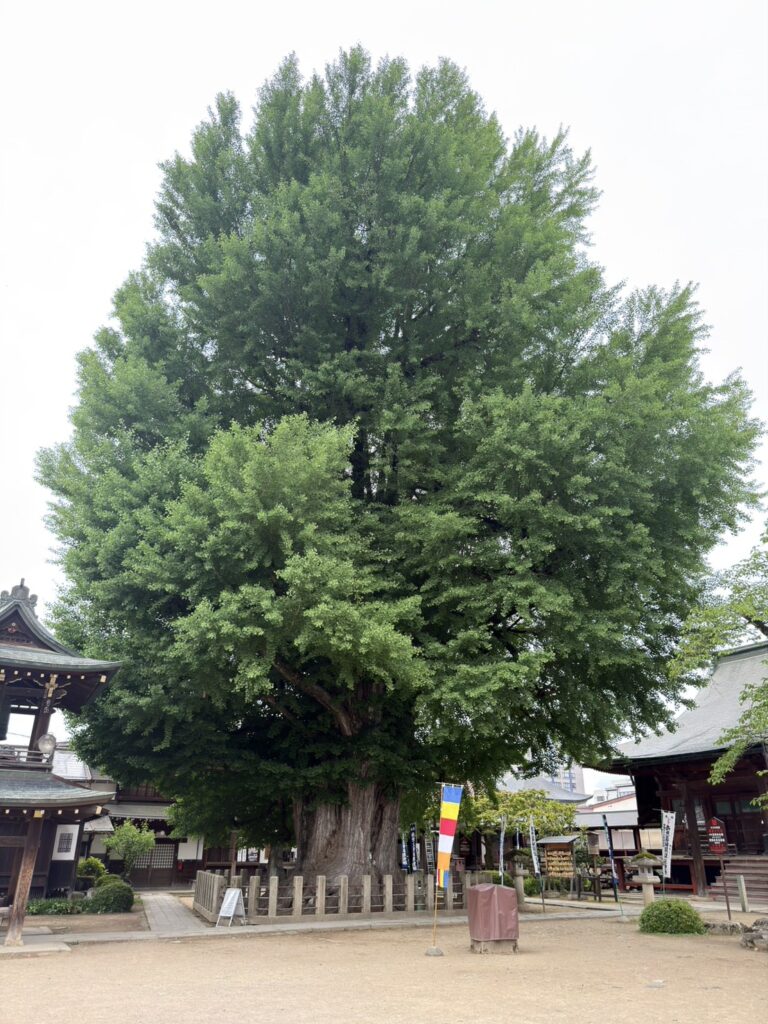
The great ginkgo of Hida Kokubunji is an estimated 1,200-year-old tree standing in the temple grounds in Takayama, Gifu Prefecture — roughly 27 meters tall, about 10 meters around the trunk, and designated a National Natural Monument of Japan in 1953. It is the sole living survivor from the temple’s Nara-period founding, and for twelve centuries it has been woven into local life through two things: the breast-like aerial roots (called chichi) that hang from its trunk, and an old saying that when its leaves have all fallen, snow will come.
As a Japanese arborist, I have stood before many of the country’s ancient trees, and this one does not read as merely old. It reads as the memory of a place made visible. In this article I’ll walk through the ginkgo’s history, the science and folklore behind its “nursing” aerial roots, its role as a living snow calendar, and the deeper question that draws so many people to it: why do ginkgo trees live so long? Along the way, this tree offers a lens on Japan’s wider culture of ancient trees that reach a thousand years.
A Tree Older Than the Temple That Shelters It
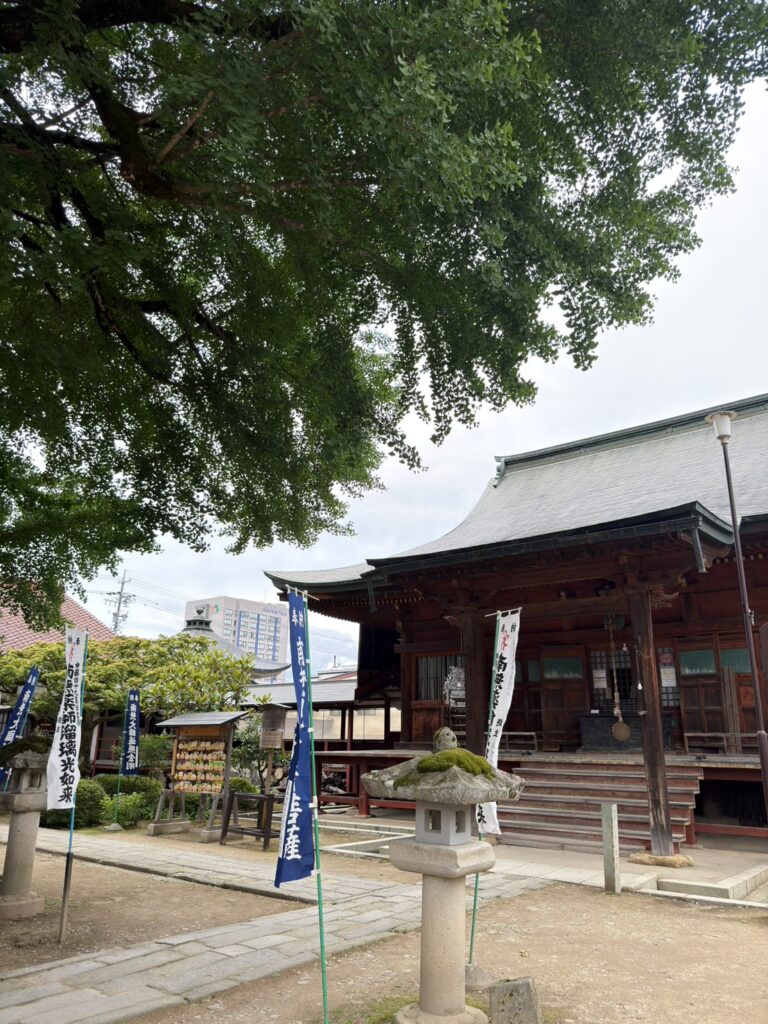
The last survivor of an imperial decree
Hida Kokubunji is one of the provincial temples (kokubunji) established across Japan by the edict of Emperor Shomu in 741, during the Nara period. The original temple halls were lost over the centuries to repeated fires and unrest, and every structure standing today was rebuilt later. The great ginkgo, however, is said to have lived on continuously since around the founding. In other words, the tree is older than the temple around it — a first-generation survivor that has outlasted every wall and roof raised beside it.
That single fact changes how you see the site. Visitors come for the historic three-story pagoda, but the oldest thing on the grounds is not made of wood and joinery — it is still growing.
Planted by a monk: Gyoki, or Kobo Daishi?
Tradition holds that the tree was planted by the eighth-century monk Gyoki, though some local accounts credit Kobo Daishi (Kukai) instead. History cannot confirm who put the sapling in the ground, but both versions agree on what matters to the community: this is a sacred tree, planted by a great monk at the temple’s founding. Age estimates carry a similar, revealing wobble — most sources say “about 1,200 years,” while one 2013 assessment put it nearer 1,250. Either figure lines up neatly with the Nara-period founding.
A darker legend
The ginkgo also carries a shadow story. In one folk tale, the daughter of the master carpenter building the temple’s pagoda — a young woman named Yaegiku — quietly solved a construction problem her father could not. Fearing that word of a woman’s help would shame him, he is said to have killed her and planted a small ginkgo where she died. It is oral legend, not record, but it captures something true about how Japan’s great trees are remembered: as vessels for a place’s births, deaths, and unspoken debts. The same quality surrounds many revered giants, from the 2,000-year-old camphor tree of Kinomiya Shrine to Japan’s ancient weeping cherries.
The “Nursing Ginkgo”: The Science and Faith of Aerial Roots
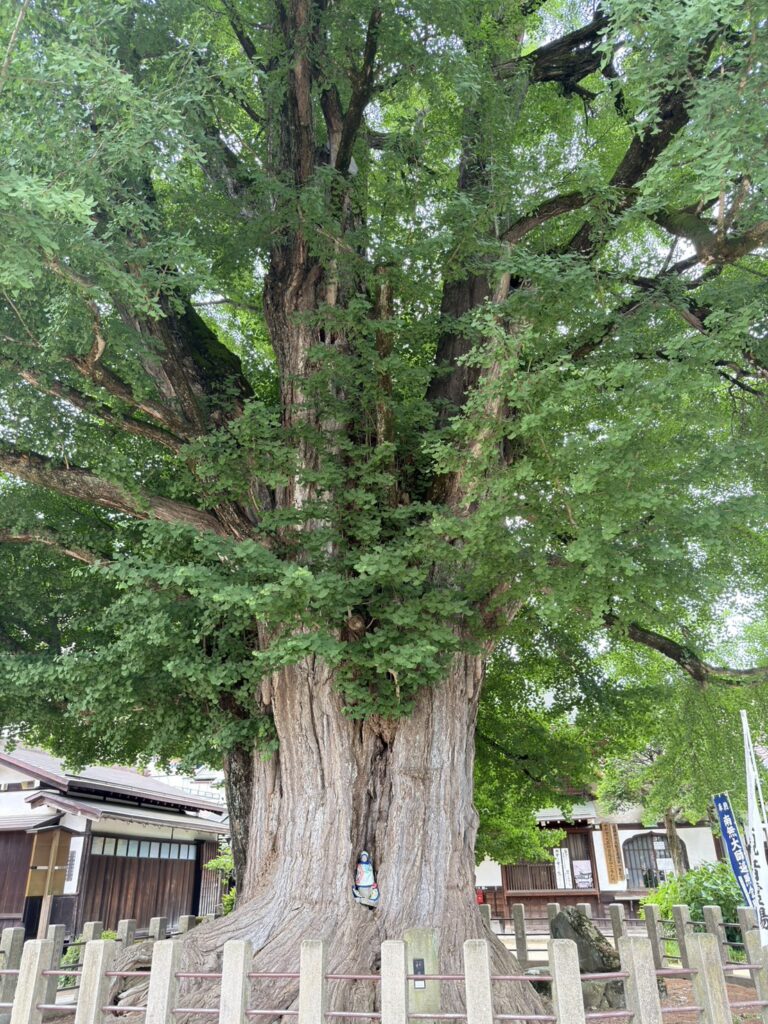
What chichi actually are
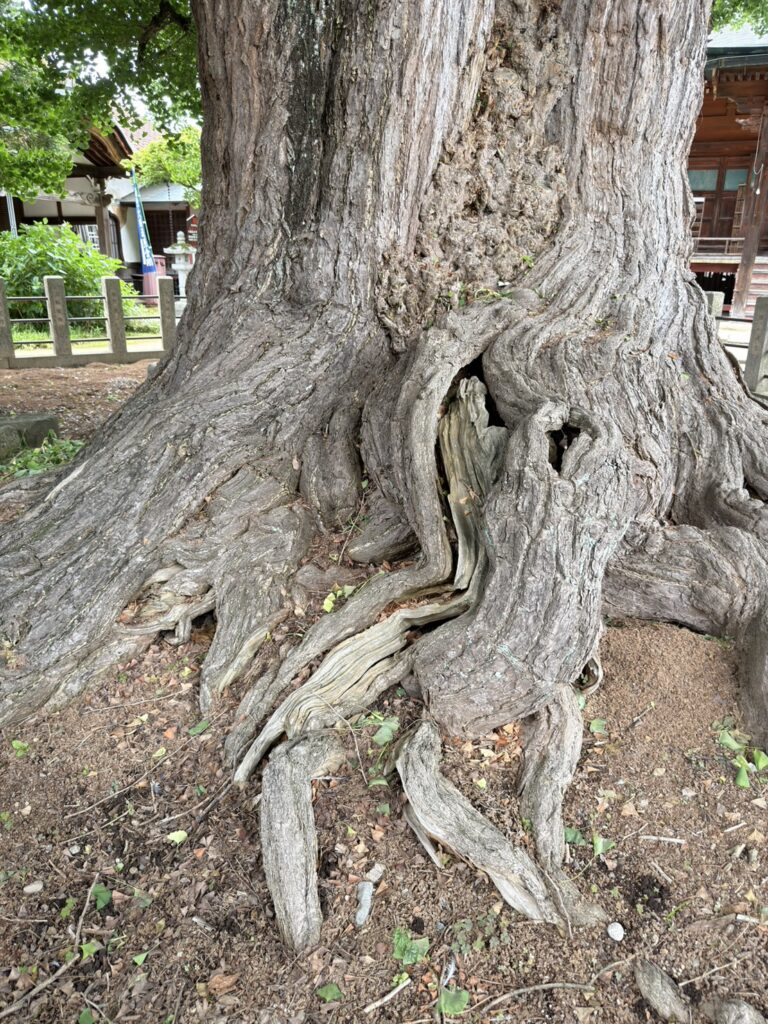
Old, large ginkgo trees often develop woody, stalactite-like growths that hang down from the trunk and major branches. In Japanese these are called chichi (乳) — literally “breasts” — and they are why the Hida Kokubunji tree is known as the chichi-ichō, the “nursing ginkgo.” Botanically, chichi are a form of aerial root: root tissue that normally develops underground instead grows downward from dormant buds in the trunk and emerges into the open air. They tend to form on very old, large-diameter specimens, which makes them something like a medal earned only by age.
The folk belief in milk
Because their shape resembles a woman’s breast, a belief grew up around such trees: that a mother struggling to nurse would produce milk more freely after praying to the tree, or after taking a decoction made from a scraping of its bark. This folk practice appears at ancient ginkgo across Japan, not only here. It is the reason the tree became more than a botanical marvel — it became a place where people entrusted the health of mother and child to something living and enduring.
Reading chichi in the field
When I examine an old ginkgo, the condition of its chichi is one of the cues I use to read the tree’s vigor. Where the aerial roots are well formed and their tips still look fresh and turgid, the tree usually retains real capacity to build new tissue. Where they are dry, cracked, and shedding, I start to suspect internal decline or environmental stress. The chichi of the Hida Kokubunji ginkgo are, for a tree of this age, in notably good condition — a visible sign that after twelve centuries, this individual is still very much alive rather than merely persisting. Reading a tree’s future from small living signals is central to Japanese practice, much as arborists do when they read decay without technology.
The Tree That Forecasts Snow
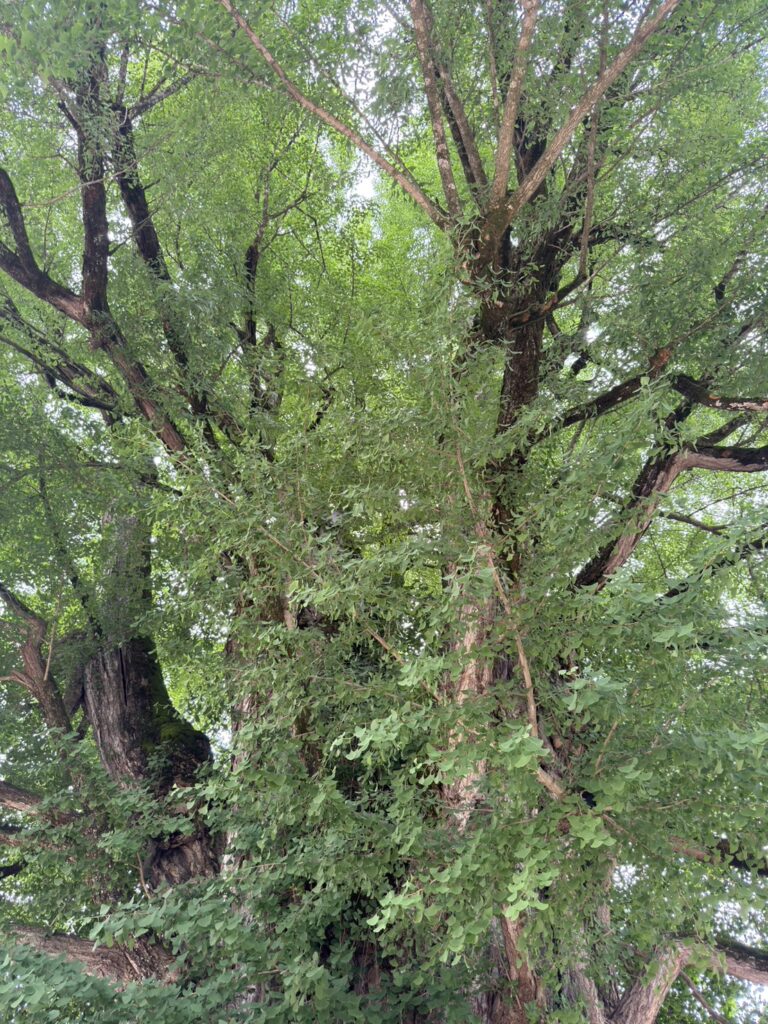
“When the leaves have all fallen, snow will come”
The Hida region has a saying: when the Kokubunji ginkgo has dropped all of its leaves, snow will reach the valley. This is not idle poetry. The tree’s leaf fall concentrates in mid-to-late November, and Hida is a heavy-snow region where that timing lines up closely with the first snows. Scientifically, ginkgo leaf drop is triggered by shortening day length and falling temperatures, so the tree’s behavior each autumn mirrors how quickly the cold is advancing that year. Long before printed calendars, residents read this single tree as a living almanac.
Why the leaves turn gold
The ginkgo’s famous autumn gold comes from a straightforward pigment shift. Through the growing season, green chlorophyll masks the yellow carotenoid pigments already present in the leaf. In autumn the chlorophyll breaks down, the carotenoids are revealed, and for a short early-winter window green and gold mingle before the whole crown turns a uniform blaze of yellow. A fully golden ancient ginkgo against a blue Takayama sky is one of the defining images of autumn in the Hida highlands.
Why Do Ginkgo Trees Live So Long?
A living fossil’s resilience
Ginkgo (Ginkgo biloba) has existed for roughly 200 million years and survived the age of the dinosaurs — a genuine “living fossil” that outlasted nearly all of its relatives to remain the single surviving species of its lineage. That deep evolutionary history shows in its constitution: ginkgo is exceptionally resistant to pests, disease, and air pollution, which is exactly why it was so widely planted along modern city streets. It also resprouts vigorously after damage. A ginkgo that is cut, scorched, or broken can push new shoots and recover in ways many trees cannot — and this is precisely how the Hida Kokubunji tree kept standing through the fires that destroyed the temple halls around it.
The culture that keeps giants alive
Biology alone does not explain a 1,200-year-old tree. In Japan, ancient trees reach that age because a culture of protection surrounds them. The sheltered environment of a temple or shrine precinct, formal status as a sacred tree or National Natural Monument, and steady local care together extend a tree’s life far beyond what it would reach untended. The Hida Kokubunji ginkgo survives because temple, city, and community have watched over it for centuries. The same combination keeps other giants alive — Japan’s 1,000-year-old weeping cherry at Miharu and the 360-year-old cherry growing straight through a boulder in Morioka both endure for the same reason: a resilient tree meeting a society determined to keep it.
Frequently Asked Questions
Q: How old is the great ginkgo of Hida Kokubunji?
A: It is estimated to be about 1,200 years old, with some sources placing it nearer 1,250. It is believed to have lived since the temple’s founding in the Nara period, which makes it older than any of the temple’s current buildings — the sole survivor from the founding era.
Q: Why is it called the “nursing ginkgo”?
A: The tree has developed prominent chichi — woody, breast-shaped aerial roots that hang from its trunk and branches. Their shape gave rise to a folk belief that praying to the tree helps mothers produce milk, and from that belief comes the affectionate name “nursing ginkgo” (chichi-ichō).
Q: Where is the tree, and when is the best time to see it?
A: It stands in the grounds of Hida Kokubunji temple in Takayama, Gifu Prefecture. The golden foliage usually peaks from mid-to-late November, and there is a local saying that once all the leaves have fallen, snow will arrive in the valley.
Q: Why do ginkgo trees live so long?
A: Ginkgo is a 200-million-year-old “living fossil” with strong resistance to disease, pollution, and damage, plus a powerful ability to resprout after injury. In Japan, that natural resilience is reinforced by a culture of protection — temple grounds, natural-monument status, and continuous care — which together allow ancient trees to reach a thousand years and beyond.
Conclusion
The great ginkgo of Hida Kokubunji is not simply an old, large tree. It is the memory of a place stretching back to the Nara period, a sacred tree that held the prayers of nursing mothers, and a living calendar that announces the coming of snow. Twelve hundred years is possible only where a tree’s own extraordinary vitality meets the patient work of the people who protect it. If you find yourself in Takayama, stand for a moment beneath this golden giant and feel the depth of time it has quietly kept.
Field notes from Japan’s trees arrive a few times each month — subscribe via the form in the footer, or follow the work on LinkedIn.