A 1991 typhoon split Garyu-zakura's trunk and broke four limbs. Specialists said recovery was impossible. The 20-year root restoration that worked.
Introduction
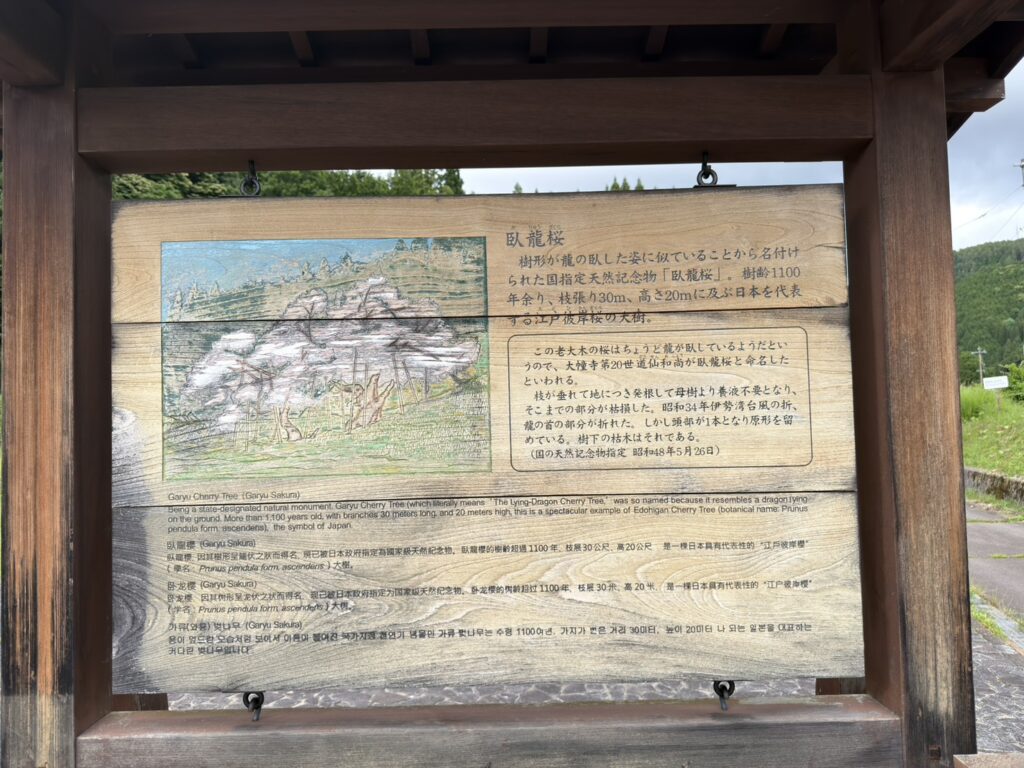
Garyu-zakura (臥龍桜), the “reclining dragon cherry tree” of Hida Takayama, is an Edohigan cherry estimated at 1,100 years old and designated a National Natural Monument of Japan. Here is the part most visitors never hear: in 1991 a typhoon left this tree with four major limbs broken and its trunk split, and specialists were told recovery was impossible. It took roughly twenty years to bring it back — and the treatment that worked was not pruning or fertiliser. It was replacing the soil beneath its roots.
I am a Japanese arborist, and Garyu-zakura is one of the most instructive heritage trees I know — not because of its age, but because its entire decline and recovery is documented year by year. This article walks through that record, and through one structural feature of the tree that I think deserves far more attention from arborists outside Japan.
What Makes Garyu-zakura a “Reclining Dragon”
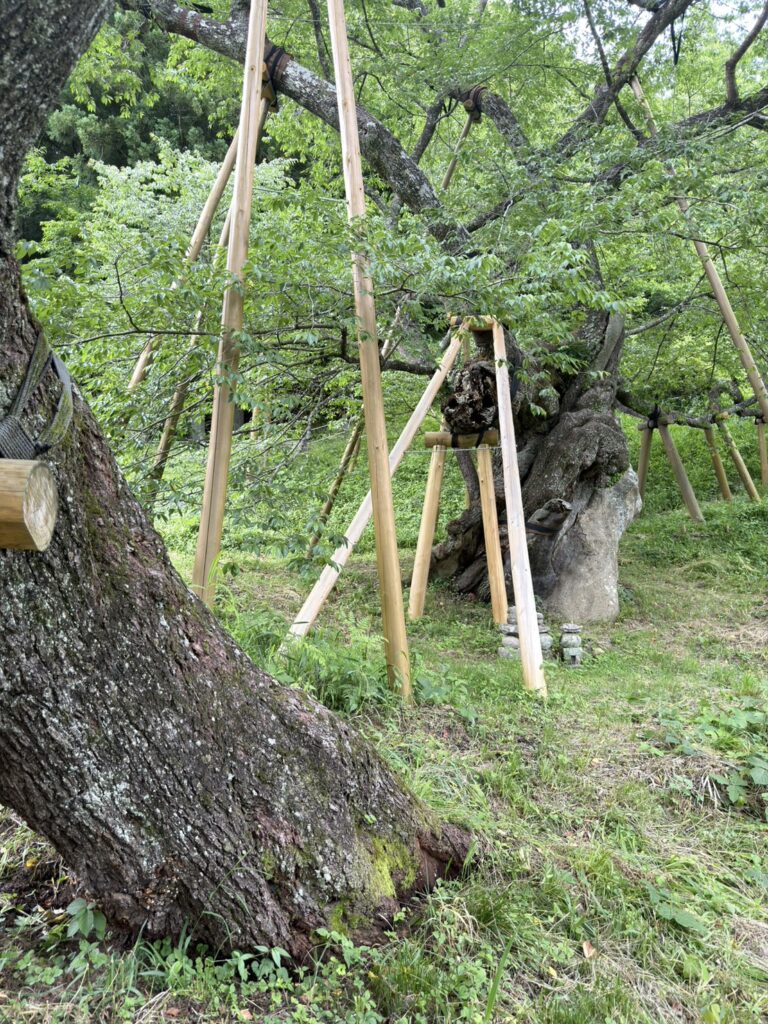
A branch that touched the ground and rooted itself
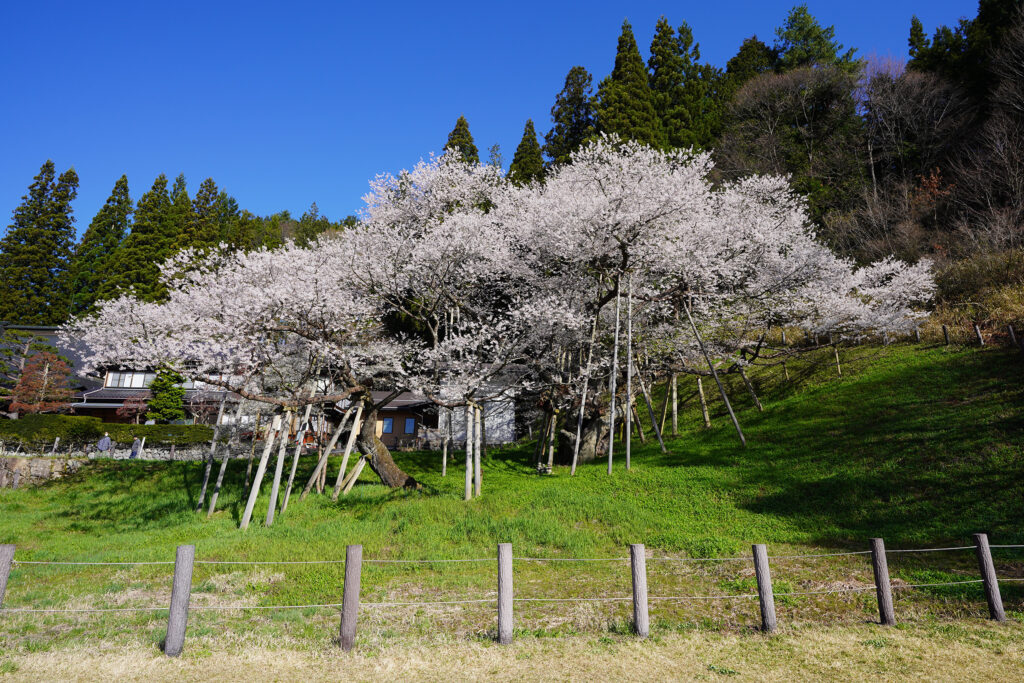
The tree’s silhouette is not an accident of pruning. According to the Hida Ichinomiya Tourism Association’s account, a single large limb sagged under its own weight until it reached the ground — and then rooted at the point of contact and became independent.
Botanically, this is natural layering: when a branch rests against moist soil in low light, adventitious roots form along the contact zone. Over time that section draws its own water and behaves like a semi-independent tree. The low, muscular curve that reads as a dragon’s body is the product of that process.
This is also why the tree is officially registered as one Edohigan cherry even though it visually reads as two. When it was named in 1932, the two “bodies” were still joined.
Garyu-zakura by the numbers
- Species: Edohigan cherry (Prunus itosakura) — one tree
- Estimated age: 1,100 years
- Height: 20 m (66 ft)
- Trunk girth at breast height: 7.3 m (24 ft)
- Crown spread: 20 m east–west, 30 m north–south
- Location: Garyu Park, on the grounds of Daido-ji Temple, Ichinomiya-machi, Takayama City, Gifu Prefecture
- Designation: Gifu Prefectural Cultural Property (1937) → National Cultural Property / Natural Monument (1973)
Edohigan is the longest-lived cherry species in Japan, which is why nearly every thousand-year cherry in the country belongs to it — including Miharu Takizakura, the 1,000-year-old weeping cherry. The familiar Somei-yoshino of city parks is a grafted cultivar with a working life measured in decades, not centuries. If you want the underlying biology, I covered it in why Japan’s ancient trees live for a thousand years.
Propped, not pruned
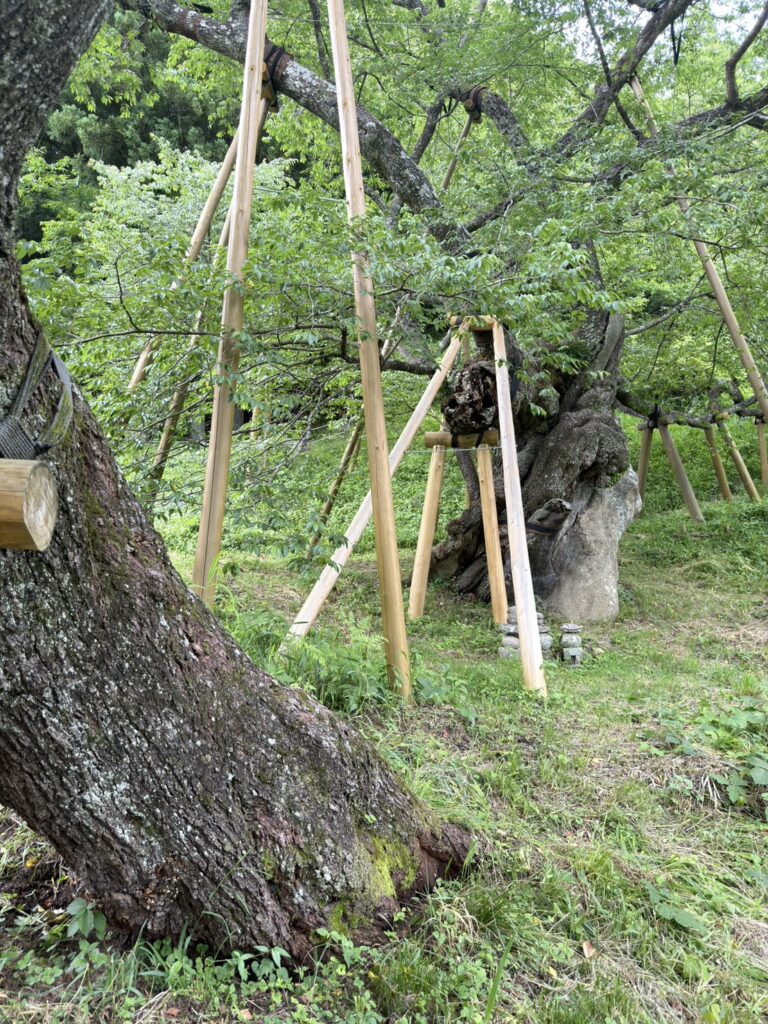
Stand under Garyu-zakura and the first thing you notice is not the blossom. It is the props.
Where Western practice often responds to a failing veteran tree with crown reduction or retrenchment pruning — shortening the lever arm to reduce failure risk — the decision here was different: carry the load rather than change the form. Damaged limbs were supported from below instead of being shortened.
That choice rests on a premise worth stating plainly. The value of this tree is not only that it is alive. It is that it is this shape. A crown built over eleven centuries cannot be rebuilt once it is cut. (Japan does reduce sail area when wind loading is the actual threat — see Japan’s wind-resistant pruning methods — but on a monument tree of this rank, form comes first.)
A tree that is also a grave marker
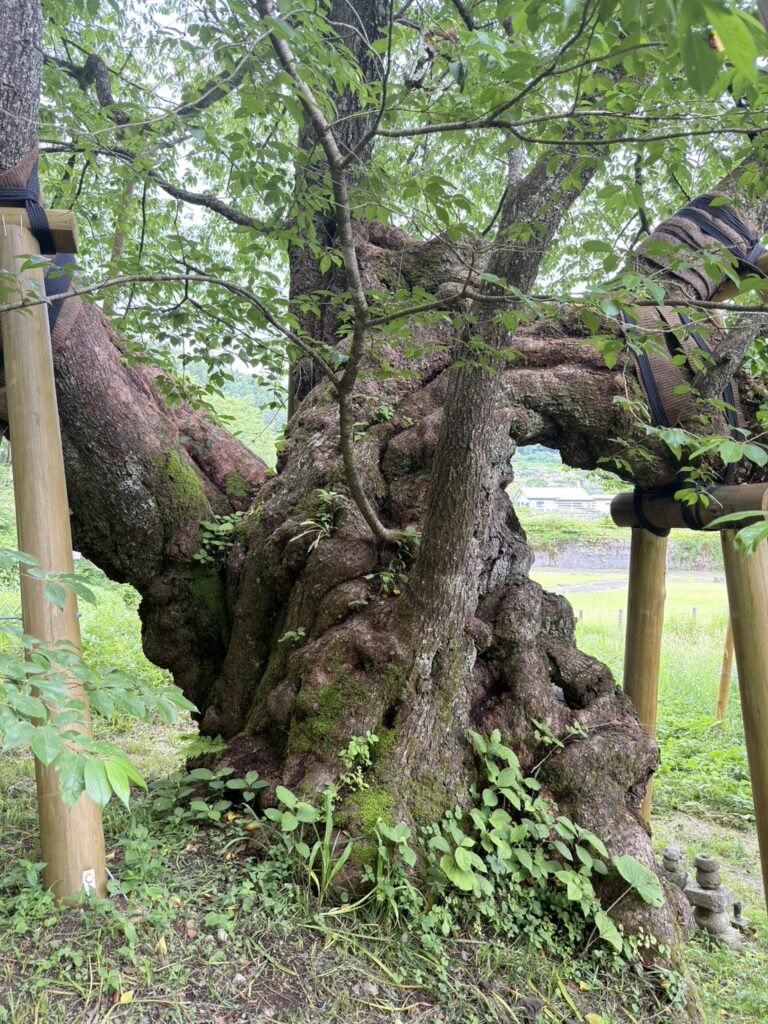
Garyu-zakura has stood through most of recorded Japanese history, and local records tie it to two figures.
During the Tensho era (1573–1592), Miki Kunitsuna, who governed this area, was defeated in battle by Kanamori Nagachika and — by tradition — buried at the foot of the great cherry. A five-tiered stone pagoda still stands at its base, and each autumn roughly thirty people gather for the “Miki Festival” to honour those ancestors.
Around 1680, the wandering monk Enku is said to have composed a poem beneath this tree during his travels through the province.
In Japan, a heritage tree is frequently a grave, a shrine and a landmark at once. That layering of meaning is part of why the community stayed with this tree for twenty years when the outlook was hopeless.
The day it got its name
For most of its life the tree was simply “the great cherry of Daido-ji.” That changed on 4 May 1932, at a full-bloom flower-viewing party.
Villagers asked the 20th head priest of Daido-ji, Kameyama Dosen, to give the tree a proper name. He studied the great limb curving sideways like a dragon flexing its body, thought for a while, and — as the record has it — called out: “Garyu-zakura! How about that!”
A tree eleven centuries old has carried its famous name for less than a hundred years.
Two Typhoons, Thirty-Two Years Apart
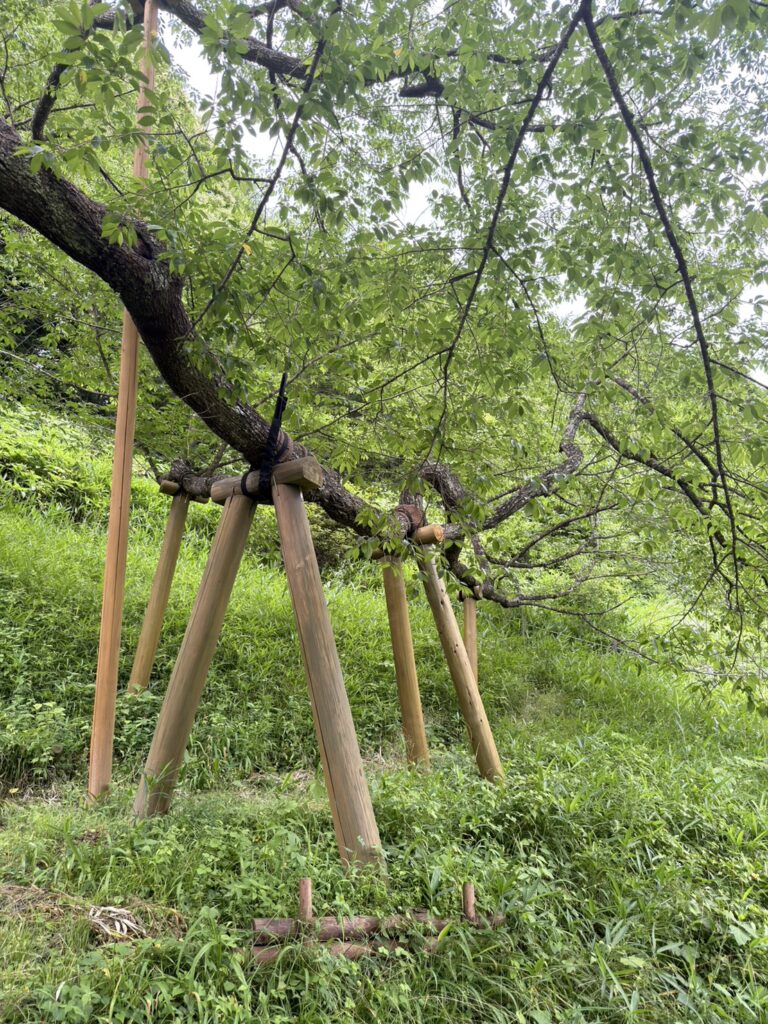
26 September 1959 — Typhoon Vera (the Ise-wan Typhoon). Japan’s deadliest typhoon on record broke an important limb at the centre of the tree and caused severe damage.
26 September 1991 — Typhoon Mireille (Typhoon No. 19). By coincidence, the same calendar date. The tree had already been losing vigour that year. The storm broke four major limbs and split the trunk, leaving it, in the words of the local record, “critically injured.”
One more date belongs in this sequence. In 1989, as a village centennial project, the surroundings were developed into Garyu Park. Until then the tree stood in open rice paddies where frogs called and fireflies flew. The official record does not assert a causal link between that work and the decline that followed two years later. But for anyone who manages veteran trees, the order of events is hard to ignore: the root environment changed, and the tree weakened shortly afterwards. Root-zone damage rarely shows in the canopy the same season.
The Problem Was Underground: A Twenty-Year Root Restoration
Why the surgery was not enough
For three years after the 1991 storm, the response was what you would expect: tree surgery on the wounds, and props installed to support the remaining limbs.
The tree did not come back.
Investigation eventually established that the cause of the decline lay in the roots. This is the single most transferable lesson from Garyu-zakura. Broken limbs are visible. Split trunks are visible. What actually kills veteran trees is almost always the part nobody photographs. Treating the canopy of a root-failing tree is one of the most common — and most expensive — mistakes in heritage tree work worldwide.
What they actually did to the soil, from 1997
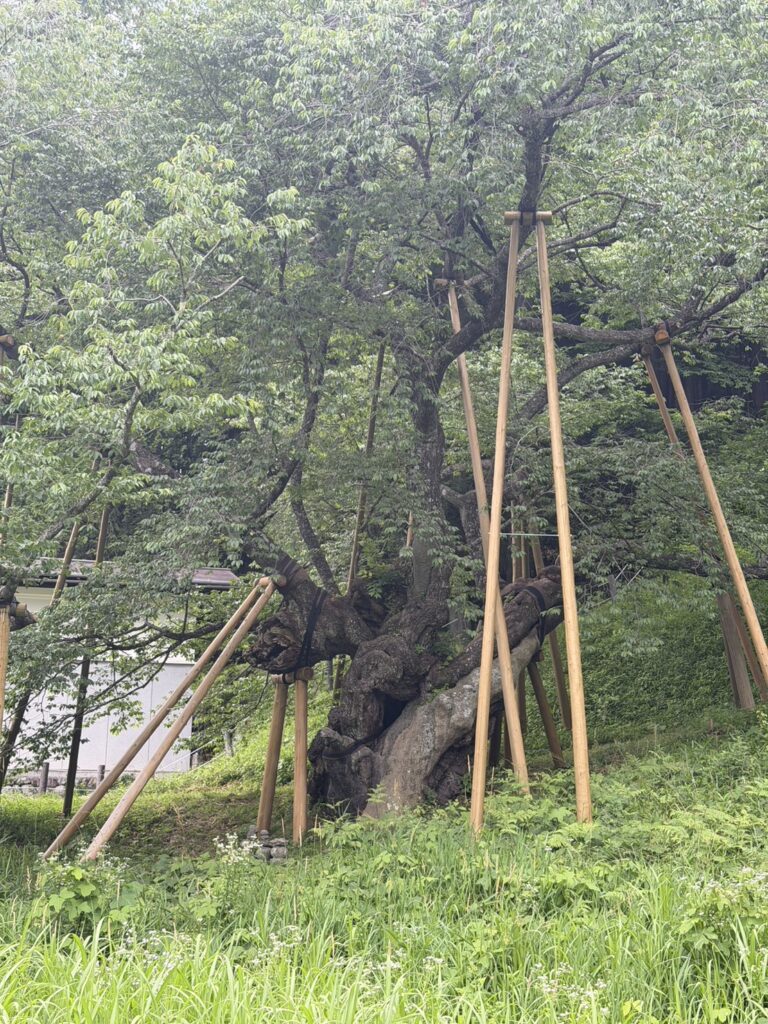
Once the diagnosis pointed underground, the treatment changed completely:
- Remove the poor-quality soil from around the tree
- Replace it with well-draining soil
- Blend in charcoal and finely chopped reed (yoshi, Phragmites)
Notice what is absent: fertiliser. Charcoal is highly porous — it holds micro-pore space open in the soil profile and provides habitat for soil microorganisms. Chopped reed acts as an organic amendment that maintains structure and breaks down slowly into stable aggregates. Every component of that prescription targets aeration and soil structure, not nutrition.
A weakened ancient tree cannot use nitrogen it has no functional roots to absorb. Feeding it simply asks a failing system to do more work. Japanese jumoku-i practice puts diagnosis strictly before treatment, and the parallels with Western Visual Tree Assessment are closer than most people assume — I compared the two systems in VTA vs. jumoku-i. It is also worth noting how closely this 1997 protocol anticipates what is now becoming standard elsewhere: biochar amendment, decompaction, and organic replacement of degraded root-zone soil.
1999, and the white roots of 2001
From around 1999, Garyu-zakura began to recover. Flowering improved markedly, and the tree produced blossom in numbers the village had not seen for years.
Then, in 2001, a root development survey found the evidence that mattered: countless white feeder roots extending nearly two metres beneath the soil surface.
One person present described the moment this way: touching the sight of this giant tree’s roots striving so hard to live, they were moved beyond words and simply wept.
Count the timeline. Critical injury in 1991. Root diagnosis and soil work from 1997. Visible improvement by 1999. Confirmed root regeneration in 2001. The full restoration programme ran roughly twenty years. Veteran tree care is not measured in seasons.
“Without heart, the tree will not answer”
The recovery was led by Professor Emeritus Susumu Hayashi of Gifu University. After the storm, he was told the tree could not be saved. He wrote:
“A cherry tree is a living thing too. There is a shared feeling between tree and person. You draw out the tree’s own will to live, and you lend it your hand.”
He also refused to take the credit alone:
“However much technique you have, if there is no heart in it the tree will not answer. The people who brought straw mats and rope. The people who wept at the sight of the tree. Everyone together brought the reclining dragon back.”
Villagers wrapping komo straw mats and carrying rope did not replace the science. They are the reason the science was allowed to continue for twenty years. Budgets run in annual cycles; this tree was saved on a generational one. Technique transfers easily across borders. That structure does not.
Field Note: Natural Layering Is a Backup of Form
When I stood under Garyu-zakura, what stayed with me was not the blossom or the age. It was that single limb: bowed to the ground under its own weight, rooted where it touched, and standing independent.
When we preserve an important tree, we normally reach for cuttings or air layering. The genetics are secured reliably. But what survives is a sapling — a small form. If the parent falls, eleven centuries of architecture are gone permanently. The clone lives; the history does not.
What this tree did on its own is a different strategy altogether.
A drooping limb reaches the soil, roots, and gains a water supply system independent of the main trunk. From that moment, if the trunk fails — uproots, splits, decays — that limb can survive. And it survives not as a nursery plant, but at full mature size, with the form intact.
That is redundancy in the engineering sense. In practical terms, it is a backup:
- Cuttings and air layering = a backup of genetics (form resets to zero)
- Ground-contact rooting = a backup of genetics and form together
For Garyu-zakura this was never theoretical. It lost a central limb to the 1959 typhoon and four major limbs plus a split trunk in 1991. The reason it still reads as a dragon is that its structure was never concentrated in a single point of failure.
Which raises an uncomfortable question for our profession. How often do we cut off a low, sagging limb reaching toward the ground because it looks hazardous, or untidy, or inconvenient?
Ground-contact limbs do carry real problems: high humidity at the soil interface can open a decay pathway, they conflict with pedestrian circulation, and they raise management costs. But on a tree you are genuinely committed to preserving, “wait a few more years before removing it” deserves to be on the table. Under veteran trees all over the world, limbs that could have become a full-size backup are taken off every season.
Nature worked this out long before we did. Garyu-zakura has been demonstrating it for 1,100 years.
Six takeaways for practitioners
- Visible damage is usually a symptom, not the cause. Repairing the canopy will not save a tree whose roots cannot breathe.
- Expect a lag between root-zone disturbance and canopy decline — typically two to three years, not the same season.
- Treat soil for aeration and structure, not nutrition. Charcoal, organic amendment, drainage — the entire Garyu-zakura prescription points one way.
- Confirm recovery at the roots. Flowering is encouraging; new feeder roots are proof.
- Plan in decades. A single-year budget cannot save a veteran tree.
- Do not reflexively remove a limb heading for the ground. On a tree worth preserving, it may become a backup that keeps the form, which no cutting can do.
Visiting Garyu-zakura
- Best time: mid to late April. Hida sits at high elevation, so bloom runs two to three weeks behind Tokyo and Kyoto.
- Cherry festival: about three weeks from mid-April in Garyu Park.
- Access: one minute on foot from Hida-Ichinomiya Station on the JR Takayama Main Line — and visible from the train window. About 12 km (20 minutes) from the Takayama IC.
- Admission: free. Parking for 250 cars, also free.
- Evening: the tree itself is not floodlit; the park is lit with paper bonbori lanterns instead.
- Please stay outside the fence. This is root protection, not crowd control — the crown spread roughly matches the root spread, and foot traffic compacts soil. Donations toward the tree’s care are collected in the park.
If you make the trip, Takayama holds a second thousand-year tree worth your time: the 1,200-year-old ginkgo of Hida Kokubunji, about fifteen minutes away by train.
Frequently Asked Questions
Q: Why is Garyu-zakura shaped like a reclining dragon?
A: A single large limb sagged under its own weight until it reached the ground, then rooted at the contact point and became self-supporting. This is natural layering, and it produced the low, curving form that resembles a dragon’s body. The 20th head priest of Daido-ji, Kameyama Dosen, gave the tree its name in 1932.
Q: How old is Garyu-zakura, and how can a cherry tree live that long?
A: It is estimated at 1,100 years. It is an Edohigan cherry (Prunus itosakura), the longest-lived cherry species in Japan, and essentially every thousand-year cherry in the country belongs to this species. Grafted ornamental cultivars such as Somei-yoshino live on a completely different timescale.
Q: How was the tree saved after the 1991 typhoon?
A: Tree surgery and props stabilised it first, but the decline continued. Once investigation showed the cause lay in the roots, work from 1997 removed the poor-quality soil and replaced it with free-draining soil blended with charcoal and finely chopped reed. Recovery became visible around 1999, and a 2001 survey confirmed white feeder roots extending nearly two metres. The full programme ran about twenty years.
Q: Is it good for a tree when a branch touches the ground and roots?
A: On a tree you intend to preserve, it can be a significant advantage. That limb gains a water supply independent of the main trunk, so it can survive trunk failure or advanced decay — and unlike a cutting or an air layer, it survives at mature size with the form intact. The trade-offs are real: decay risk at the soil interface, conflict with circulation, higher management cost. But where the form itself is the value, removal deserves careful thought.
Q: What can visitors do to help protect ancient trees?
A: Stay outside the fence line. Crown spread approximates root spread, and simply walking on the ground compacts soil and restricts root respiration. Breathable soil is precisely what took Garyu-zakura twenty years to regain.
Conclusion
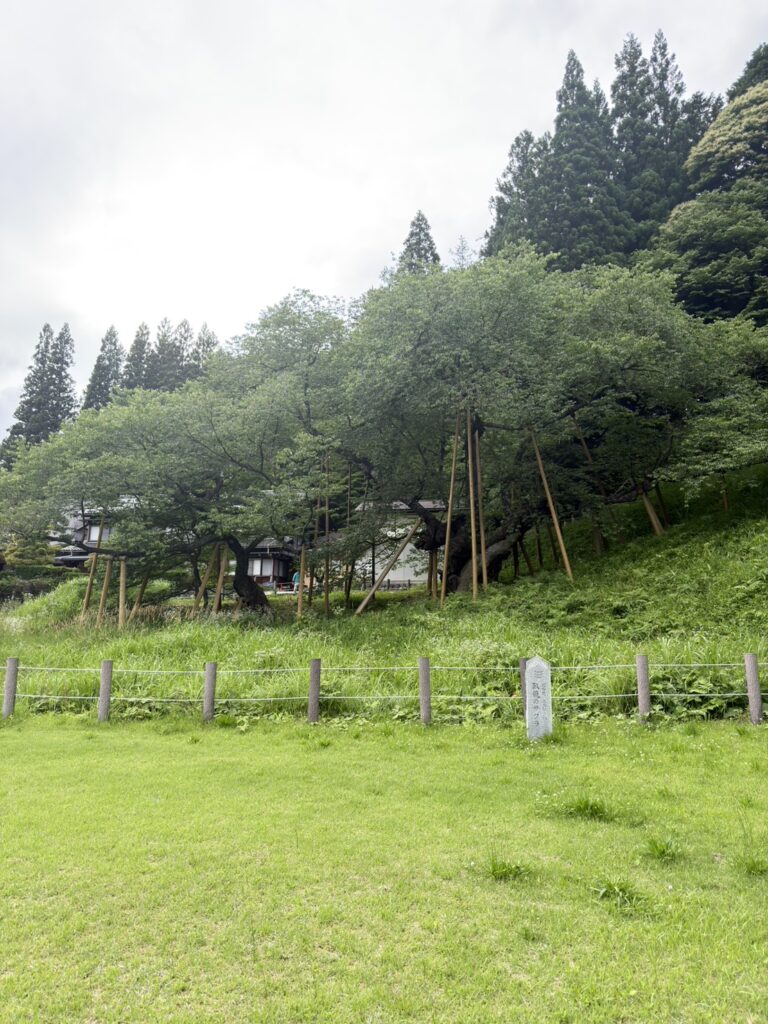
Garyu-zakura is usually introduced as a tree that has bloomed for a thousand years. The more accurate description is that it is a tree that nearly died, and was brought back over two decades by a professor, a village, and a soil prescription made of charcoal and reed.
What saved it was not a dramatic technique. It was locating the problem in the roots, and then continuing long enough for roots to answer.
The tree teaches two things at once. There is what people did beneath it — stripping out bad soil, building a profile that could breathe, and waiting twenty years. And there is what the tree did for itself — laying a limb on the ground, rooting it, and backing up its own form in full size. Good veteran tree care may be largely a matter of recognising the strategy a tree has already begun, and staying out of its way.
Field notes from Japan’s trees arrive a few times each month — subscribe via the form in the footer, or follow the work on LinkedIn.