Walk into a Japanese garden centre and you will see two bags side by side: reddish-brown granules labelled akadama, and yellow-brown granules labelled kanuma. They look like the same product in two colours. They are not. Akadama is red subsoil dug out of the Kanto Loam, dried and sieved into grades. Kanuma is weathered pumice that fell out of the sky during a volcanic eruption — strictly speaking, it is not soil at all.
That distinction matters the moment you stop gardening in pots and start planting in the ground. Choose by colour instead of by origin, and you end up adding a water-holding material to a bed that already drains too slowly, or packing strongly acidic pumice around a tree that was perfectly happy near neutral. A planting medium is not good or bad. It is a material chosen for one purpose.
This article works through the three soils an arborist meets most often in eastern Japan — kuroboku (the black volcanic topsoil), akadama, and kanuma — starting with where each one came from, then why granular structure matters to roots, and finally how I decide what to use on a planting site. The frame throughout is ground-planted trees: street trees, garden trees, courtyard plantings. Not bonsai.
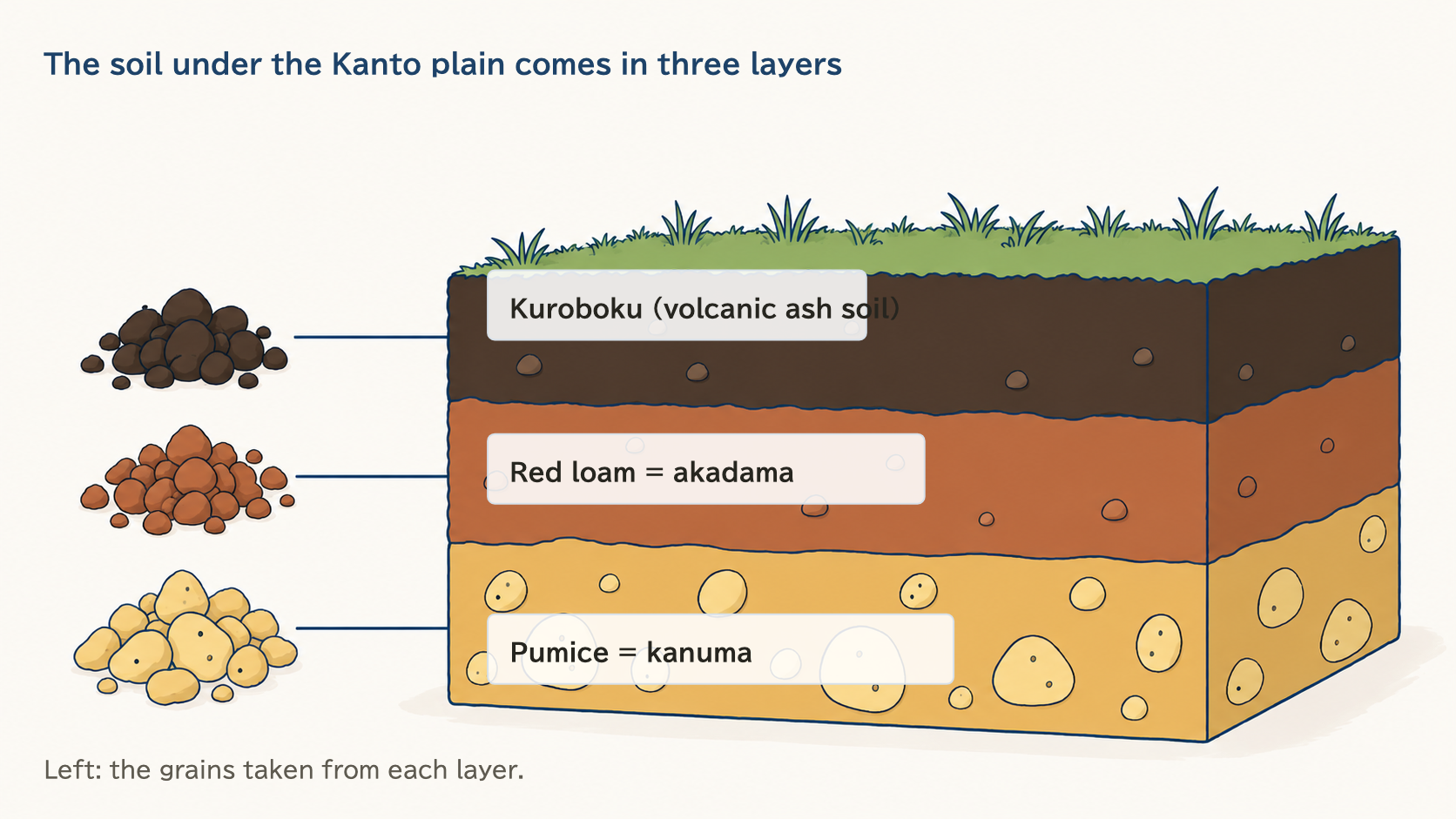
Japan’s soils were built by volcanoes — kuroboku
A black soil covering 31 percent of the country
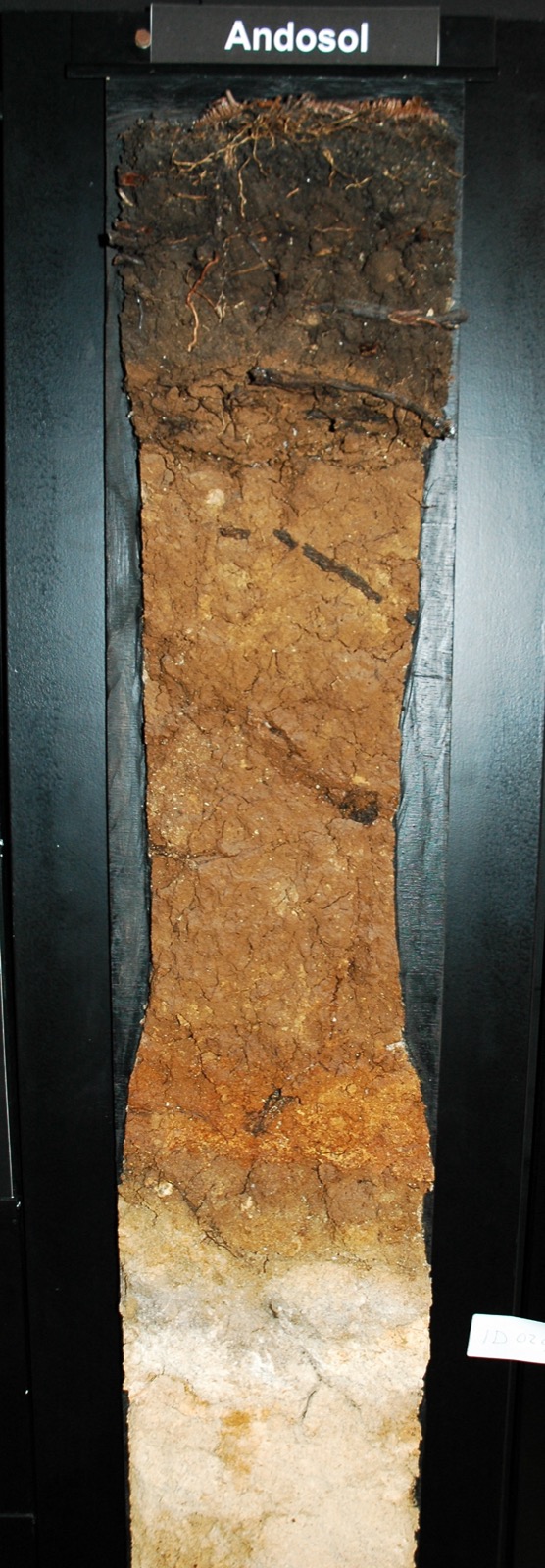
The most common soil underfoot in Japan is kuroboku, known internationally as an Andosol. Japan’s National Agriculture and Food Research Organization defines it as a soil whose parent material is mainly volcanic ash, with a high phosphate absorption coefficient, low bulk density, and a light, loose feel. It covers roughly 31 percent of Japan’s land area and about 47 percent of its arable fields. Globally, Andosols account for less than one percent of the land surface. Japan is unusual in having so much of it.
The name is literal. Kuro means black, from accumulated organic matter; boku imitates the soft, crumbly feel in the hand. Its distribution maps closely onto Japan’s active volcanoes — southern Hokkaido, northern Tohoku, Kanto, Kyushu — and areas that were volcanically active until twenty to thirty thousand years ago.
Light, water-retentive, reluctant to release phosphate
The same source describes kuroboku as having good water retention, good permeability, low compactness, easy to till. Anyone who has dug a planting hole in Kanto knows the feeling — the spade goes in with very little weight behind it. For landscape work that is a gift.
The complication is chemical. Kuroboku binds phosphate strongly and contains large amounts of active aluminium. In practice this means phosphate fertiliser applied to the surface can be locked up by the soil before roots reach it. Japanese farmers compensate by applying more phosphate than the crop appears to need. With trees, the equivalent observation is that fertilising a poor kuroboku site often produces a disappointingly small response.
The point worth carrying away: black and crumbly does not automatically mean good. The physical properties are excellent. The chemistry has quirks. Both are true at once.
On a landscape site, it is also the spoil heap
Kuroboku has a second identity in my trade. It is the material that comes out of the ground. Dig a planting pit and you are standing next to a pile of it; on a hardscape job it leaves the site as surplus spoil. Light to handle, yes — but it turns to slurry after rain, then sets surprisingly hard once compacted.
When backfilling, what you do with that pile decides how roots behave three years later. Return it as dug, screen out stones and old roots, or blend in an amendment. Returning the native soil is not laziness — matching the surrounding conditions is often exactly right. The mistake is returning it while treading it down.
Akadama was dug up; kanuma fell from the sky
Akadama — red subsoil, dried, sieved into grades
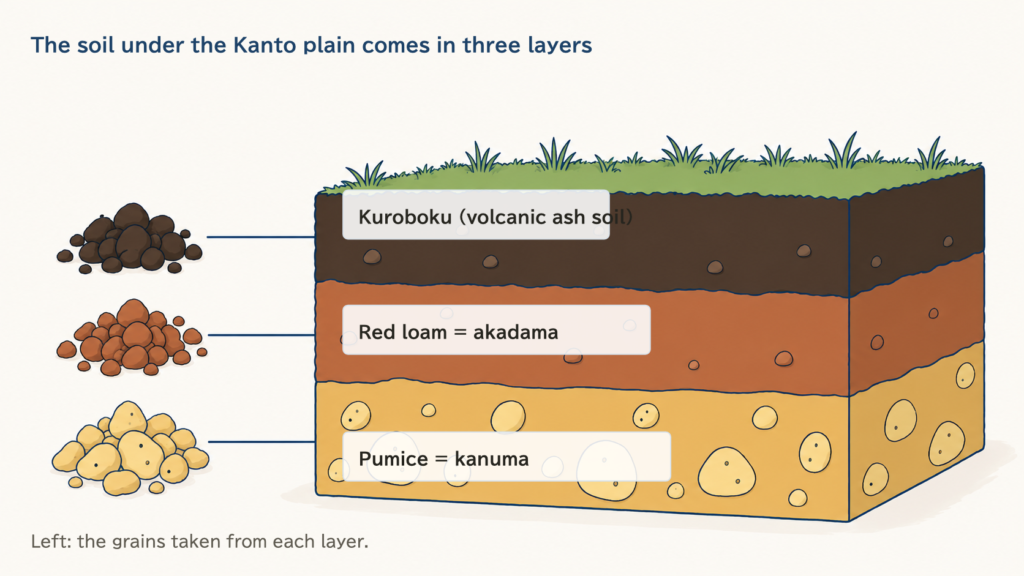
Akadama is the red subsoil that sits beneath the black topsoil in the Kanto Loam Formation: a volcanic-ash clay, excavated, dried, then screened into large, medium, and small grades. The grades are what you see on the shelf.
Its behaviour is balanced — reasonable aeration, reasonable water retention, reasonable nutrient-holding capacity, slightly acidic in reaction. It carries almost no nutrients of its own. It is, in effect, plain soil reduced to grains, which is precisely why it works as the base of so many mixes.
Kanuma — pumice from Mount Akagi, carried by wind
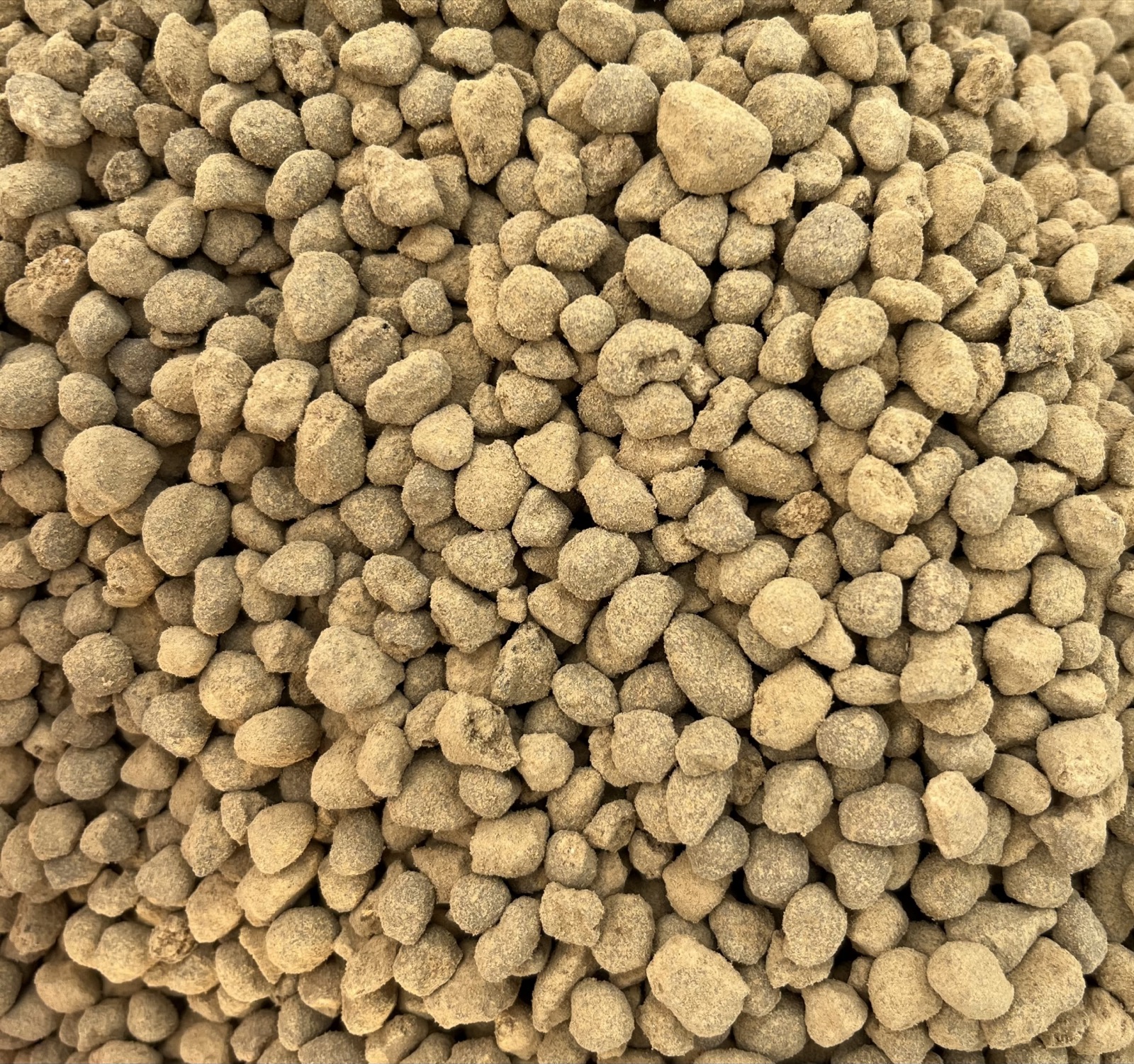
Kanuma is a different substance entirely. It is a pumice layer within the Kanto Loam, distributed around Kanuma City in Tochigi Prefecture, formed when pumice ejected by an eruption of Mount Akagi was carried downwind and deposited. The eruption is generally placed around 45,000 years ago.
So kanuma is weathered pumice rather than soil. It is yellow-brown, highly porous, excellent at holding both water and air, weak at holding nutrients, and distinctly acidic. That acidity explains its standing as the default medium for acid-loving plants: satsuki azalea (Rhododendron indicum), rhododendron, blueberry.
Grain size is a question of where, not of quality
Both products are sold in large, medium, and small grades. These are not quality tiers. They describe where the material belongs.
Coarse grains go low, fine grains go high. Larger particles leave larger voids between them, so water moves through quickly — useful at the base of a container, or in a layer intended to assist drainage on a planting site. Small grains pack more tightly, hold more water, give fine roots something to weave through. Medium is the sensible default when you are unsure.
The same material changes character as it breaks down. Once grains crumble, the voids fill in, infiltration slows. This is behind the familiar complaint that akadama collapses after a few seasons — while kanuma, being pumice, keeps its shape far longer. Blending a pumice-type material into places where structure has to last is a deliberate use of that difference.
The three, side by side
| Kuroboku | Akadama | Kanuma | |
|---|---|---|---|
| What it actually is | Volcanic ash enriched with humus | Sieved red subsoil from the Kanto Loam | Weathered pumice (not soil) |
| Colour | Black to blackish brown | Red-brown | Yellow-brown |
| pH | Near neutral to slightly acidic | Slightly acidic | Strongly acidic |
| Nutrients | High humus, but binds phosphate | Almost none | Almost none |
| Best use | The native medium of the site itself | Base of a planting mix | Acid-loving plants, cuttings |
Shelved together, born entirely differently. Akadama was excavated. Kanuma was deposited by wind. Kuroboku was assembled on top by living organisms.
Why local origin is worth noticing
One practical consequence. Akadama and kanuma both come out of the ground in eastern Japan. When I use them on a Kanto planting site, I am not importing exotic material — I am closer to returning the local stratigraphy in granular form.
No tree requires a specialist medium hauled in from far away. Understanding the soil already on the site comes before choosing a brand on a bag.
Why granular — aggregates, and the pores roots breathe through
Roots need air as much as water
Why is planting medium sold as grains at all? The answer is simple: to create voids between the particles.
Roots respire. In waterlogged soil there is not enough oxygen, so roots deteriorate. Bone-dry soil is no better. The large voids between grains let water drain while air enters; the fine pores inside each grain hold water in reserve. That two-tier arrangement is the whole point of a granular medium.
Aggregates are built by living things
The grains in a bag were made by drying and sieving. The crumb structure in a field or a woodland floor is different: it is aggregate built by organic matter, roots, and soil organisms. Roots push soil aside as they extend, then leave channels behind when they die. Leaf litter decomposes into sticky compounds that bind fine particles together. Aggregates formed this way outlast anything mixed in by hand.
Which means improving the soil of a planting site is not finished when the material is spread. It needs the other half: leave the leaf litter, mulch the surface, give roots room to extend — the measures that keep aggregates forming. Imported granules will eventually collapse. A structure that organisms rebuild continuously does not.
Trodden soil is soil whose grains have been crushed
Most of the decline I see in street trees and apartment planting beds is this structure, lost. People walk across it, vehicles mount it, materials get stacked on it. Each time, the soil densifies, grains crush, the pathways for water and air disappear. Tokyo’s street trees show the pattern clearly — I have written about why they look healthy from a distance while struggling at ground level.
At that point fertiliser achieves nothing. The preconditions for uptake — water, air — are missing. This is why a soil assessment measures penetration resistance and infiltration before it looks at nutrients. When the crown gives you no clear answer, the ground usually will.
Restoring structure beats replacing material
Discussion of planting media tends to drift towards what to add. On an established planting site, relieving the collapsed structure usually comes before replacing anything: break up the compacted horizon, add organic matter so aggregates can form, remove the source of the traffic itself. Bagged material comes after that, if at all.
Three mix-ups I see on site
1. Adding a water-holding material to fix drainage
A client says water sits on the surface, so the soil needs replacing — then a highly water-retentive material gets added. The bags invite this: “excellent water retention and aeration” reads as though both improve together.
Granules do hold both — voids between grains shed water, pores within grains retain it. But if the water is standing because of a compacted lower horizon or because the site collects runoff, nothing applied to the surface will drain it. Find out where the water stops first.
2. Moving pH on assumption
“It’s acidic, so add lime.” “It’s an azalea, so use kanuma.” Both get done without a measurement. Most garden trees grow perfectly well from slightly acidic to neutral. Shifting pH when there was no need changes micronutrient availability, which creates the next problem.
Measure, then adjust. If you are not measuring, do not adjust. That single rule removes a surprising share of failures.
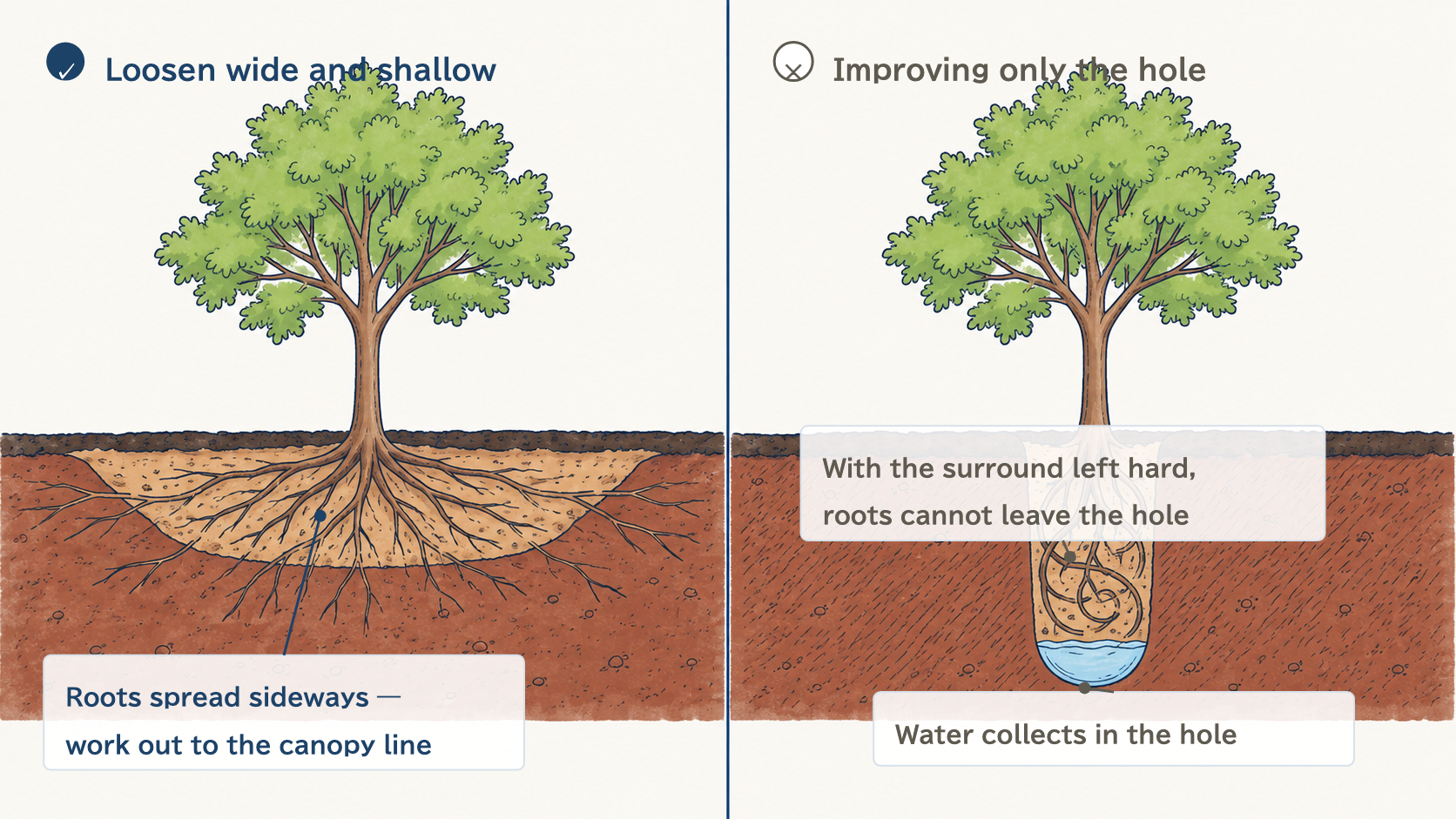
3. Improving the planting pit alone
This is the most common of the three. Good material is bought, placed in the pit, nothing else is touched. Roots cannot leave the pit; water collects inside it. Functionally, a container has been buried in the ground.
The correction is unglamorous: go wider, not deeper. Roots extend laterally. Loosening a shallow, broad area outperforms excavating deep then backfilling with something expensive.
How to decide on a planting site — four judgements
| Decision | What to go on |
|---|---|
| 1. What are you fixing? | Drainage, retention, acidity, or physical structure. Until the objective is singular, no material can be chosen |
| 2. What is already there? | In Kanto, usually kuroboku over red subsoil. Dig first. There is far more native soil than bagged soil |
| 3. Does the species want acid? | Ericaceae (satsuki, rhododendron, blueberry) lean acidic, so kanuma earns its place. Most garden trees are fine from slightly acidic to neutral |
| 4. Can the structure survive? | Under foot traffic, any medium collapses within a few years. Without a plan to stop the traffic, the work is wasted |
Each one, briefly.
1. One objective at a time
“Improve the soil” nearly always resolves, on inspection, into one of three complaints: it drains too slowly, it dries out too fast, roots are not establishing. Put the objective into words before selecting a material, because the materials pull in different directions.
2. There is more native soil than bagged soil
However many litres go into the pit, the roots are heading out into whatever was there already. So the first action is to dig, then look: colour, feel, resistance, how water behaves. In Kanto you expect black topsoil over a red-brown horizon — that horizon being the source of the akadama on sale.
Doing this is what prevents the “I used good soil but it failed” outcome. If everything around the pit is still dense, a soft pit changes nothing. The plant is in a container, with the water to prove it.
3. Kanuma has a narrow window
Because kanuma is markedly acidic it suits the Ericaceae. Used in quantity around a species that prefers neutral ground, it moves soil reaction further than anyone intended. The idea that a good medium is good everywhere is the most expensive assumption in this field.
4. Where it gets trodden, it reverts
No medium withstands continued compaction; a few seasons is typical. Planting strips used as footpaths, bicycle parking, contractors’ storage — in those places, changing how the ground is used beats changing what is in it. Low fencing, mulch, a revised desire line: cheaper than soil works, with effects that last longer. Japan’s older street plantings are now showing what happens when this is deferred for decades, which I covered in the postwar planting boom reaching its limit.
Street trees and apartment beds — read the use before the soil
When planting-bed soil goes bad, the cause is usually how the space gets used. The boundary between pavement and bed is vague so people cut the corner; bicycles park there; materials land there every time there are works; de-icing salt drains into it. That is a circulation problem, not a soil property.
Replace the medium in that situation and it reverts within a year or two. The intervention that holds is making the ground physically hard to walk on: a low rail, a kerb, planting, mulch. Less expensive than soil replacement, longer-lasting in effect.
Where works genuinely cannot be avoided, the priority is establishing the rooting area first, then keeping excavation out of it. If a trench severs the root system, no amount of soil improvement brings the tree back. Root anchorage is also what decides whether a tree stands up in a storm, which is why Japanese wind-resistant pruning is only half the job.
Good soil for a tree is not good soil for a field
By this point the divergence is probably obvious: trees and crops want different things from soil.
A field is tilled every year, fertilised every year, carried to harvest within a season. The soil is expected to be remade by human hands. A tree stands in ground that will not be tilled for decades. Once it compacts, it stays compacted unless someone intervenes. So for trees, the decisive question is not how much fertility is present but whether the structure is intact.
Depth is the other difference. A field’s cultivated layer is roughly 20 to 30 cm (8 to 12 in). Tree roots run shallower than people expect, and far wider. Most of the root system sits within the top few tens of centimetres, extending well beyond the crown. That is why replacing the soil in a ring around the trunk disappoints — it does not match the distribution.
Improving soil for a tree is therefore area work, not spot work. Treating the surface out along the spread of the crown returns more than excavating one square metre (about 10 sq ft) beside the stem, for the same labour.
Where the roots actually are — blow the soil off and look
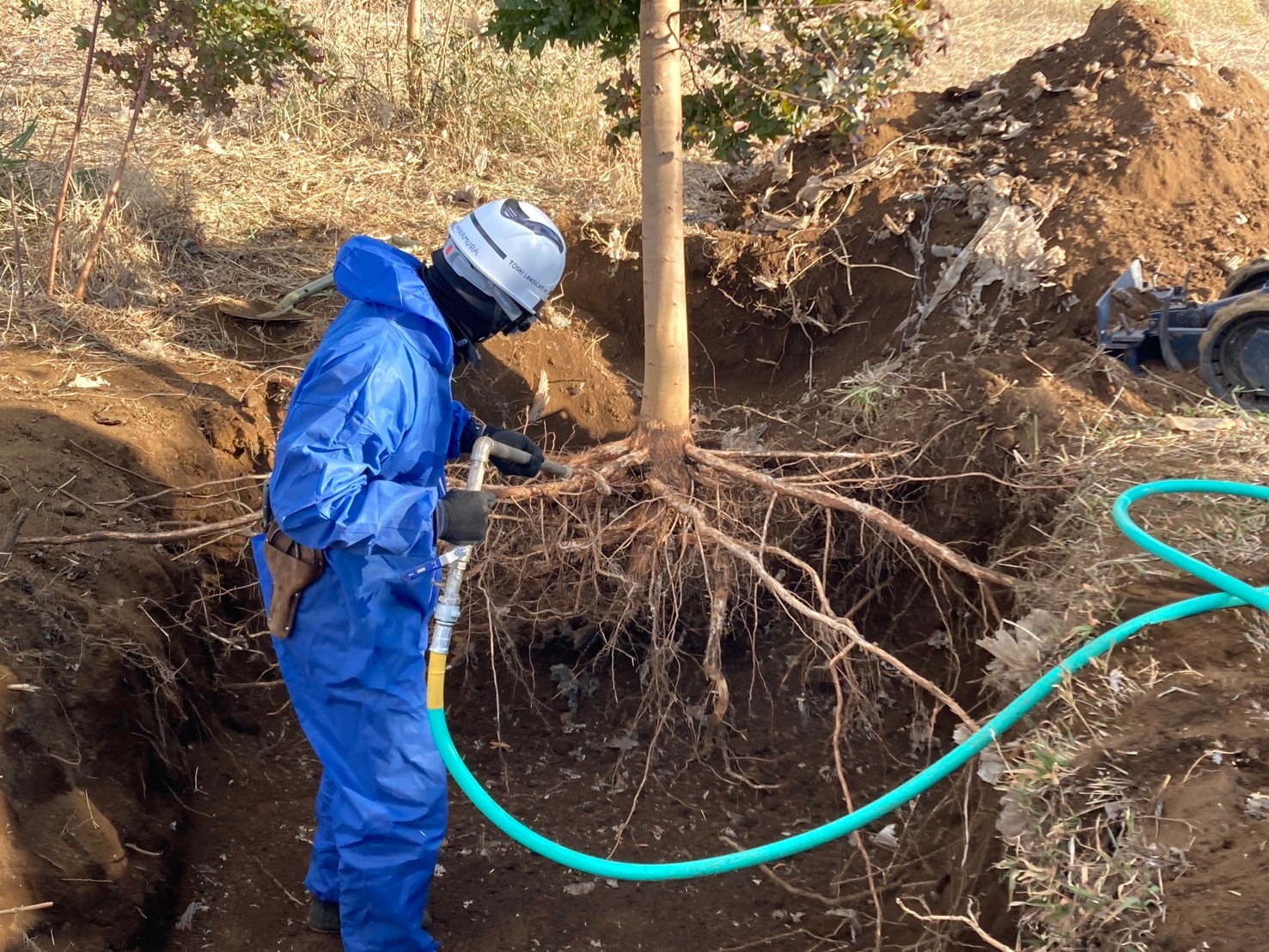
Every soil question eventually becomes a root question. The difficulty is that roots are buried, and digging cuts them. The tool that resolves this is the air spade, which uses compressed air to strip soil away while leaving roots intact. You get to see how far out, and at what depth, the system actually runs.
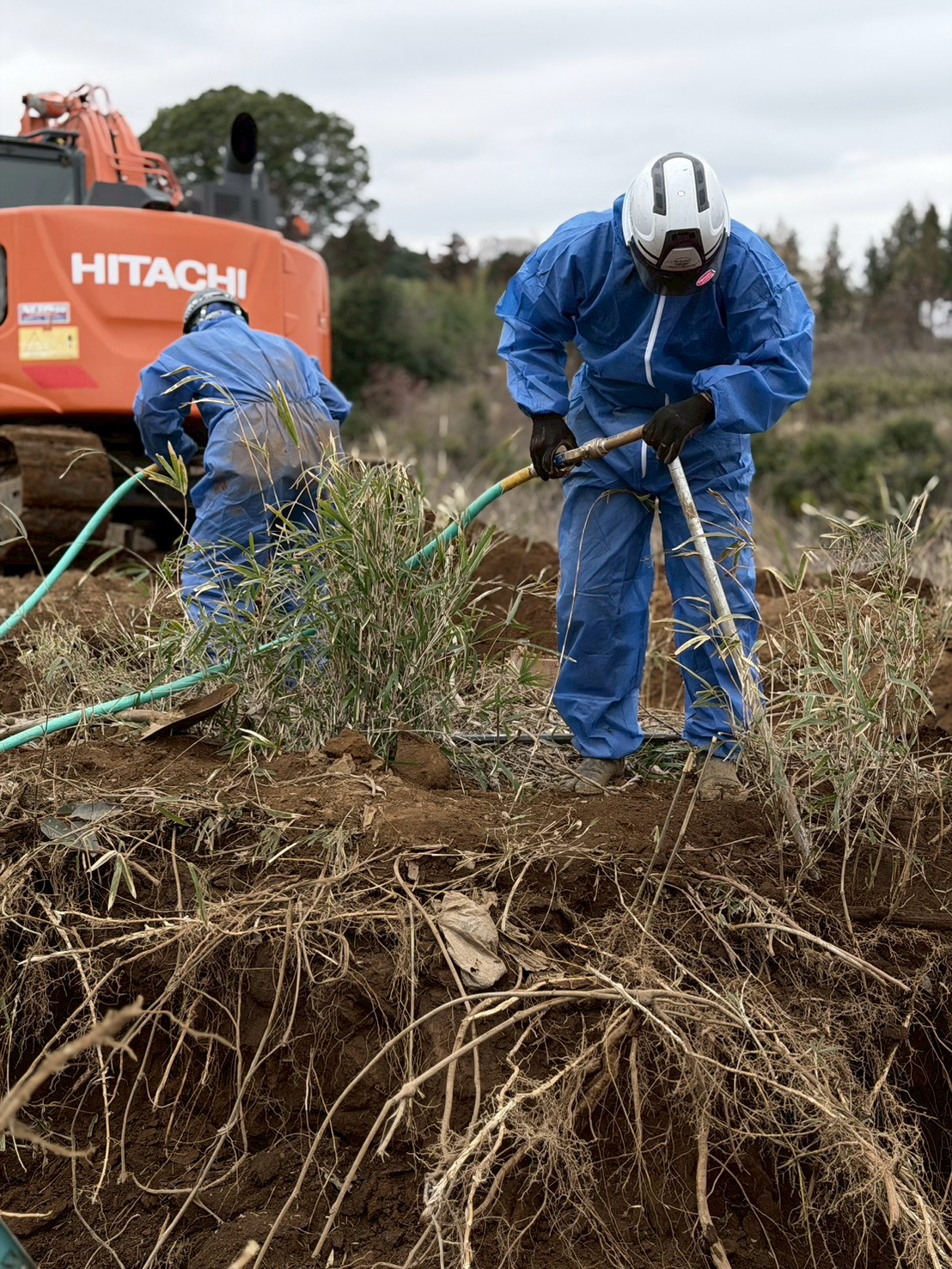
Do it once and the lesson is permanent: the bulk of the roots lie close to the surface, a long way out from the trunk. There is no underground mirror image of the trunk down there. Shallow, broad, planar. Which settles how soil work should be organised.
The method also earns its keep before excavation. Set a trench line from a drawing alone and you may happen to cut the side carrying most of the roots. Blow the soil off first and the line marked “do not dig” rests on observation rather than assumption.
Soil improvement is quicker to specify once root position is known. Where the dense layer begins, where roots stop: establish those two and the material, with the area to treat, follows on its own.
Measuring on site — numbers stop the judgement drifting
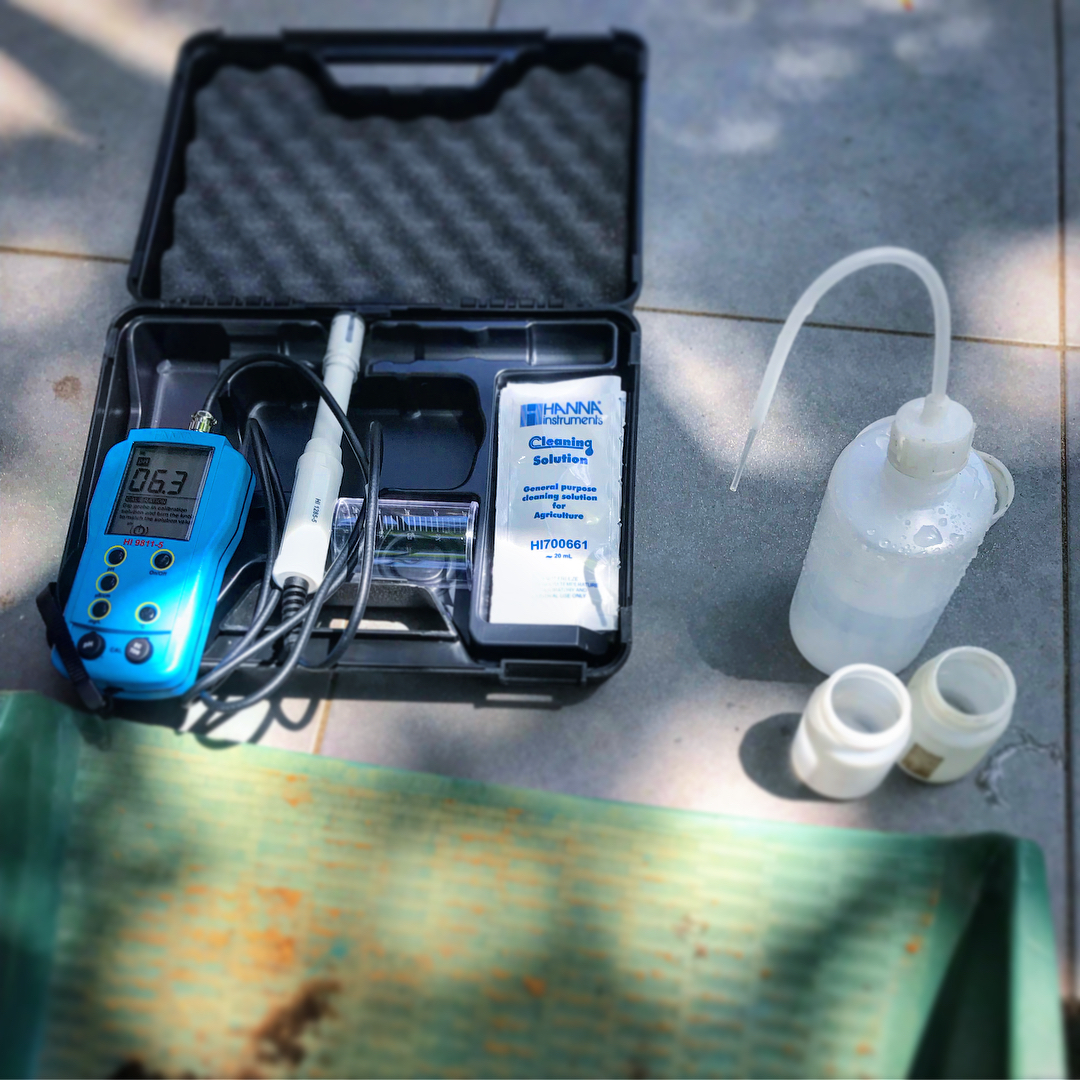
Hands tell you a great deal about soil. But when the finding has to be explained to someone else, numbers shorten the conversation considerably.
Penetration resistance, infiltration, the sequence of horizons by depth, pH. Measure those and “it looks poor” becomes “below 20 cm (8 in) the soil is dense, so water does not move through.” Proposing works to a property manager, that difference is decisive. Impressions do not get reviewed. Measurements do.
What each measurement tells you
| Measurement | What it reveals | Where it is used |
|---|---|---|
| Penetration resistance | The depth at which roots stop | Defines the extent of compaction, hence the depth to treat |
| Infiltration | Whether water moves, where it halts | Separates a surface cause from a subsoil cause |
| Horizon sequence | History of imported fill, buried services, compacted layers | On established sites, the cause often turns up here |
| pH | Bias towards acid, bias towards alkaline | Compatibility with the species. Always read it before adjusting |
Those four change the shape of the proposal. Instead of “the soil is poor, we will replace it,” you can write: there is a dense layer between 20 and 40 cm (8 to 16 in) where water stops; we will break that layer, then mulch the surface. The second version can be costed, so it can be justified.
Report it as cause, extent, sequence
A list of readings leaves the manager no closer to a decision. Organise the report into three things: cause (what is happening), extent (how far it reaches), sequence (what gets fixed first).
Sequence carries the most weight. State in advance that soil works alone will revert where compaction continues, and that excavating without first fixing the rooting area will weaken the tree however good the soil becomes. Written down, that paragraph means a year without budget does not send you back to the beginning of the argument next spring.
Measurement also reveals when no material is needed at all. Sometimes compaction is the entire problem and loosening it is the entire answer. Recognising that saves the client money.
Closing — dig before you buy
Akadama, kanuma, kuroboku are all products of the volcanoes of eastern Japan. Akadama was dug, kanuma was deposited, kuroboku was built on top by living organisms. Different origins, different capabilities.
For ground-planted trees, the soil already on the site outweighs anything in a bag by an enormous margin. So the order is fixed: dig and look → decide what is being corrected → use only the material that purpose requires. Run it backwards and you arrive at the familiar result — excellent material in the hole, a tree that never establishes.
Frequently asked questions
Q1. Which is the better soil, akadama or kanuma? They are not comparable. Akadama is sieved red subsoil from the Kanto Loam, suited to being the base of a mix. Kanuma is weathered pumice, markedly acidic, suited to Ericaceae such as satsuki azalea and blueberry. They serve different purposes.
Q2. I was told kuroboku is excellent soil. Is that right? Physically, yes: good water retention, good permeability, easy to work. Chemically it binds phosphate, so fertiliser response can be muted. Black and crumbly is not the same as universally good.
Q3. How much bagged medium do I need to plant a garden tree? Volume is the second question. The first is what happens to the surrounding soil. Filling the pit while leaving dense ground around it keeps roots inside the pit. Dig, inspect the native soil, then widen the loosened area if it is needed.
Q4. How do I tell whether soil is too hard? Feel and the way a spade enters will tell you a good deal. If the finding has to support a proposal, measure penetration resistance with infiltration. Taking readings at intervals of depth shows which horizon is responsible.
Q5. Akadama breaks down in a few years. Is it still worth using? Breaking down is not in itself a fault. As grains crumble, drainage slows — so where structure has to persist, blend in a pumice-type material. In the ground, unlike a container, the material integrates with the surrounding soil, so designing around its decline is perfectly workable.
Sources
– NARO, Soil Inventory of Japan: Kuroboku (Andosols) — volcanic-ash parent material, roughly 31% of land area, about 47% of arable fields, high phosphate absorption, active aluminium – Ministry of Agriculture, Forestry and Fisheries, soil management materials — regional soil properties with fertiliser management – Origin of kanuma — pumice from an eruption of Mount Akagi, weathered and deposited as a layer within the Kanto Loam – Origin of akadama — red subsoil of the Kanto Loam, dried then sieved; slightly acidic, carrying no fertiliser
All accessed 11 October 2026.
Related reading
– Tokyo street trees: why they look beautiful, why they are struggling – Japan’s falling trees crisis: when the postwar planting boom reaches its limit – What is a jumoku-i? Japan’s certified tree doctor explained
Field notes from Japan’s trees arrive a few times each month — subscribe via the form in the footer, or follow the work on LinkedIn.