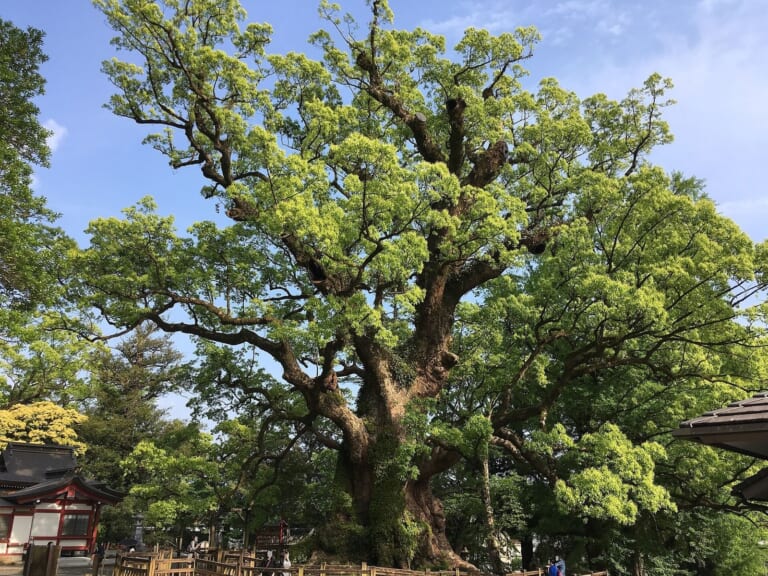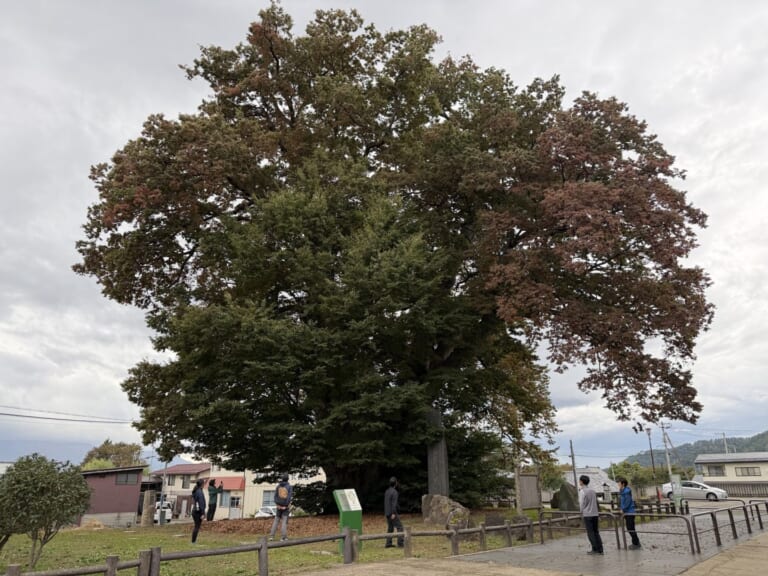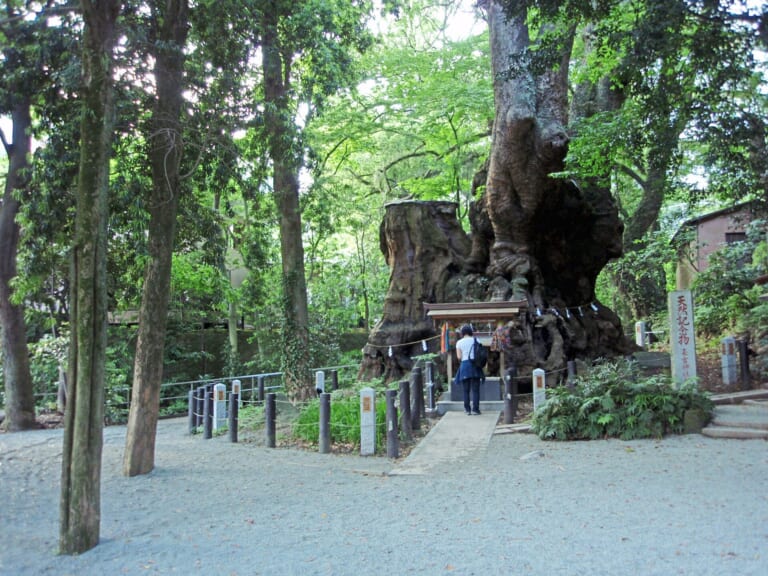
Hiroshima's 159 registered hibakujumoku still lean toward the hypocenter, 62% within 15 degrees. An arborist reads what the scar tissue shows.
Introduction

Hiroshima’s survivor trees — hibakujumoku (被爆樹木), the trees that lived through the atomic bombing of 6 August 1945 — still lean toward the hypocenter. That is not a metaphor. When researchers went out and measured them, the majority of undisturbed survivors were found tilting toward ground zero, carrying burn scars up the face that met the blast and abnormal swelling on the face that did not. The City of Hiroshima registers 159 such trees, standing between 370 and 2,160 metres from the hypocenter.
Almost everything written about hibakujumoku in English stops at endurance. The endurance is real and deserves the telling. But for anyone who works on trees, these are also something rarer: a population that took a single catastrophic, directional injury on a known date, at a known distance, and then lived eight more decades under observation. Arboriculture almost never gets a dataset like that. Read as wood rather than as symbol, these trees say a great deal about how any scarred veteran should be assessed — in Hiroshima, or in a city park anywhere.
What Hibakujumoku Actually Are

A registry, not a census
Hiroshima established its registration system in 1993. To be listed, a tree must be documented as standing within roughly two kilometres of the hypocenter on the day of the bombing, must still be alive, and must have an owner willing to preserve it. The current list holds 159 trees.
That distinction matters, because English accounts often blur it. Far more than 159 trees survived the bombing. The registry is not a count of survivors — it is a count of survivors we have documentation and a custodian for. Many stand on private temple and shrine land, and entered the record only because a priest or a family kept the story alive.
The two closest survivors
The nearest registered tree is a weeping willow 370 metres from ground zero. The blast knocked it down, but new shoots pushed up from the roots. The second nearest, a kurogane holly at 410 metres, lost everything above ground and stood as a burned stump until 1949, when it finally sprouted.
Both point at the same mechanism, and it is the first thing a tree doctor notices here: survival was not survival of the trunk. It was survival of the root system and the dormant buds within it. Camphor, ginkgo, kurogane holly and willow — the species dominating the registry — all share strong latent-bud and basal-sprouting capacity. Species without it never came back, so they are not in the list to be counted. The registry is partly a record of which regeneration strategies work when everything above ground is gone.
This is the quiet link to Japan’s other old trees. As I have written on why Japan’s ancient trees live for a thousand years, longevity here rarely means an unbroken original trunk. It means a lineage of replacement stems from a root system that never died.
The Trees Still Point at Ground Zero

What the measurements show
This is the finding that changed how I read these trees. A study presented to the Japanese Institute of Landscape Architecture measured 56 hibakujumoku in the field, sorting them into single-stemmed trees whose injuries are still visible and which have never been transplanted (29), trees moved at some point (22), and trees that regenerated after losing the entire above-ground stem (5).
Among the 29 undisturbed, visibly injured trees:
- 62% lean toward the hypocenter within ±15 degrees; 79% within ±30 degrees.
- A Rayleigh test rejected uniform distribution of orientation decisively (r = 0.611, n = 29, p < 0.001).
- 75% carry vertical burn scarring and bark fissures on the hypocenter-facing side.
- 59% show pronounced eccentric swelling on the side away from the hypocenter.
The transplanted group showed no such pattern (r = 0.356, p > 0.05). Move the tree, and the record is erased. What survives in the undisturbed trees is not sentiment but geometry: eight decades on, they are still oriented by an event that lasted a fraction of a second.
Why a burned tree leans toward the blast, not away from it
The instinctive reading is backwards, and the correction is where the arboriculture lives. A tree pushed by a blast wave should fall away from it. But this lean was not made in 1945. It was made slowly, afterwards, by growth.
The thermal flash killed the cambium on the hypocenter-facing side, and dead cambium lays down no new wood, ever. The surviving cambium opposite must compensate for the strength the trunk lost, and it responds by thickening hard — precisely the eccentric growth recorded in 59% of the sample. Run that forward eighty years: one flank expands annually while the other is frozen, and the stem axis is progressively levered toward the side that stopped growing — toward ground zero. Root extension was likewise sparse on the blast side and vigorous on the sheltered side, so the anchorage went asymmetric too, settling the tree further the same way.
So the lean is not the damage. The lean is the tree’s own eight-decade calculation of what happened to it, expressed in wood. A hibakujumoku is a recording instrument and a compass at once — and, as far as I can find, no one has said so in English before.
Reading a Trunk Whose Other Half Is Dead
Why the usual rule of thumb fails here
Tree risk assessment often leans on the ratio of residual wall thickness to stem radius — the familiar t/R shorthand. For a stem that approximates a hollow cylinder, it is a serviceable first approximation.
For a hibakujumoku it is close to meaningless. The cross-section is not a circle; it is a fused pairing of a frozen, fire-killed flank and a hypertrophied living one, differing in geometry, density and moisture. Averaging across them produces a number describing no real part of the tree. Anyone assessing fire-scarred, lightning-struck or one-sided veterans meets the same trap.
A field note: dead wood reads hard

Let me be careful about what is mine and what is Hiroshima’s. I have not put a needle into a hibakujumoku. What I can offer is what I find repeatedly in my own diagnostic work in Japan, which bears directly on how such trees should be handled.
When I use a resistograph — an IML RESI PowerDrill — to measure penetration resistance inside a trunk, fully dead wood often reads as high resistance simply because it has dried and hardened. Apply the interpretive habits you developed on living wood, and you can read a dead flank as sound. On a tree whose entire hypocenter-facing side is necrotic, that error is not academic; it is the difference between a defensible assessment and a dangerous one. (I go into the instrument’s behaviour in detail in my piece on how a resistograph works.)
Which is why the decision that matters most is where you drill at all. I do not scan a tree. I let the external examination choose the points — abnormal sound under the mallet, fruiting bodies, bark anomalies — and drill only where failure risk concentrates. The resistograph gives a measured value along the line the needle travelled: the window is narrow, but what it shows is real. Combined with external findings it is powerful; used alone it is a guess with a graph attached. Much of that external reading needs no instrument at all, as I set out in reading tree decay without technology. In Japan the sequence is formalised: inspection, visual diagnosis, instruments, integrated judgement — the working method of a certified jumoku-i, Japan’s tree doctor qualification.
On a fire-scarred veteran, the first thing I look at is not the burn. It is how much sound wood remains on the living side — because that is what is holding the tree up.
What is actually killing them now
The symbolic framing implies these trees are safe. They are not.
- A survey of the registered survivor trees in fiscal 2016 found problems — lifting bark, insect damage — in roughly 40% of them. The city has been treating 39 trees whose condition deteriorated.
- Of 58 survivor trees held by 23 private temples, shrines and organisations, at least 14 are of active concern for age or disease.
- The tabunoki at Honkyō-ji has a hollowing trunk with fungal fruiting bodies — an unambiguous signal of advancing internal decay.
- The Somei-Yoshino cherry at Ikari Shrine is declining from light starvation caused by changes in what has been built around it.
Decay and shade. Those are the same two agents grinding down street trees and heritage trees across the world. What threatens Hiroshima’s survivor trees in 2026 is not radiation. It is urbanisation and time.
Keeping Them Alive: The Discipline of Not Doing Too Much
Thirty years of charts
Chikara Horiguchi, a tree doctor based in Hiroshima, has worked on these trees since 1992 and has built condition records for 161 of them. Two of his stated principles deserve to be read by anyone responsible for old trees anywhere:
- “I don’t carry out procedures that wound a tree in order to make it look tidy.” Pruning is held to the minimum required to maintain vitality — not to shape.
- “Too much water and fertiliser fails every time.” Well-meaning over-treatment weakens far more veterans than neglect does.
Western arboriculture reached much the same place in its veteran tree management doctrine. What is notable is that in Japan the conclusion was arrived at independently, through practice, on trees no textbook covered.
Moving the building instead of the tree

The ginkgo at Anraku-ji stands 2,160 metres from the hypocenter — the farthest tree on the register. It burned, sprouted the following year, and now stands about 20 metres tall with a girth of 4.55 metres. The burn scarring on its hypocenter-facing side is still visible. And when the tree’s growth met the temple gate, the gate’s roof was cut through to let it pass.
That decision is culturally telling. Rather than reduce the tree to suit the structure, the structure was altered to suit the tree. The same instinct shows in Japan’s heavy use of props to hold an old canopy in place instead of shortening it — the approach behind veterans like the 2,000-year-old camphor at Kinomiya Shrine. Western practice more often reaches for crown reduction and retrenchment: keep the tree by making it smaller. Japanese practice frequently chooses the other option: keep the form, and build the support around it. Neither is universally right — but outside Japan the profession is often unaware there are two options on the table.
The seeds have already left Japan
There is a part of this story readers can join. Green Legacy Hiroshima, run under the UN Institute for Training and Research, distributes second-generation seeds and seedlings from hibakujumoku worldwide, working with 165 partners across 42 countries. Ginkgo and camphor dominate the openly published lists; requests go through the organisation directly.
Which means these trees are no longer only monuments. They are a genetic lineage being distributed and backed up across the planet. It is the same principle we work by on any irreplaceable tree: the most reliable way to preserve one is to stop trying to preserve only that one.
Frequently Asked Questions
Q: Are Hiroshima’s survivor trees damaged by radiation?
A: The damage visible today is overwhelmingly thermal and blast injury from 1945, plus eight decades of ordinary decay and environmental change. The problems recorded now — hollowing trunks, lifting bark, insect damage, light starvation — are the same ones affecting urban veterans that were never near a bomb.
Q: How did trees regenerate after the entire above-ground part burned?
A: Because living tissue and dormant buds survived at the root collar and in the roots. Species with strong sprouting capacity — camphor, ginkgo, kurogane holly, willow — rebuild a stem from the base, as the kurogane holly 410 metres from the hypocenter did in 1949. Note, though, that a stem regrown this way attaches to the old base differently from an original trunk, and that union can become a long-term structural weak point.
Q: How should a badly scarred veteran tree be assessed?
A: In sequence. Japanese practice runs inspection → visual diagnosis → instrumented diagnosis → integrated judgement. Let external findings — sound under the mallet, fruiting bodies, bark anomalies — select where instruments go, rather than scanning the whole tree. Never rely on one instrument, and remember that dead wood can dry and read as hard, flattering a necrotic flank.
Q: Can anyone obtain seeds from the A-bombed trees?
A: Green Legacy Hiroshima (UNITAR) distributes second-generation seeds and saplings and publishes lists of what is available, working through 165 partners in 42 countries. The correct route is to approach the organisation directly with your planting purpose and your plan for long-term care.
Conclusion
It is easy to write about hibakujumoku as miracles. Doing so misses the technical questions they are still putting to us.
How do you assess a stem whose cambium died on one side eighty years ago? How do instruments misread burned wood? How do you hold back from over-treating a tree that looks like it needs help? How far will we alter a building, a plan, a street so a tree can keep its shape? None of these are questions about Hiroshima alone. They apply to every fire-scarred veteran, every lightning-struck giant, every declining large tree hemmed in by a city.
And the trees that have been answering them for 81 years are still standing, still leaning toward the place where it began.
Field notes from Japan’s trees arrive a few times each month — subscribe via the form in the footer, or follow the work on LinkedIn.