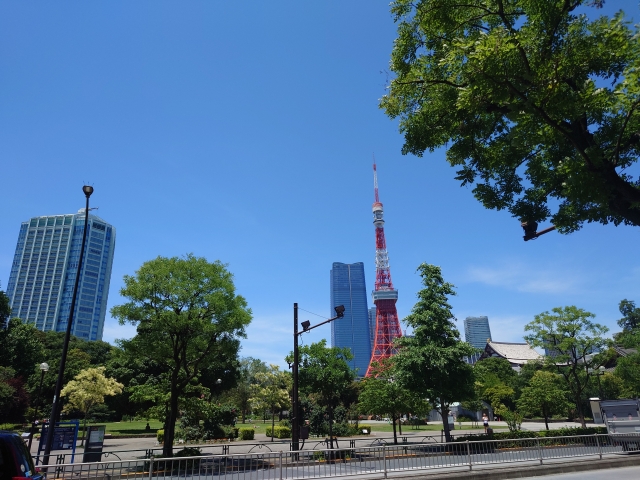
Roughly 25 typhoons approach Japan a year. Why heavy one-time pruning backfires, what lion-tailing and topping do, and how to let wind pass through.
Introduction
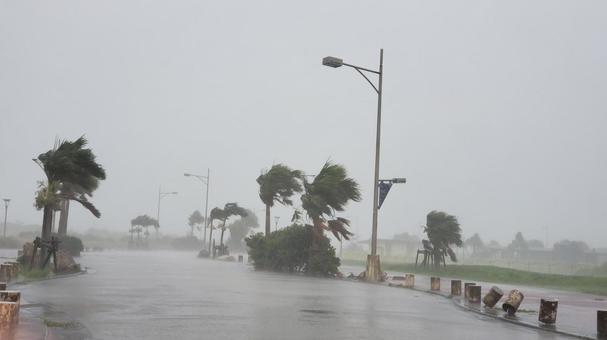
Every year, a tree’s resilience is tested by typhoons.
Japan is approached by an average of roughly 25 typhoons annually, with around 10 making landfall. Sustained winds and gusts exceeding 50 meters per second strike street trees, park trees, and garden trees across the country. Within this environment, Japan has spent centuries refining the practice of keeping trees standing.
Climate change is now bringing similar pressures to regions that historically had little experience with typhoon-force winds. Arborists and landscape managers across the US, Australia, and parts of Europe are beginning to take wind-resistant pruning seriously for the first time.
Much of the wind-resistance guidance available in English focuses on a single idea: thin the canopy so wind can pass through, and remove dead wood. That guidance is correct, but it is incomplete. Japanese wind-resistant management is not a pruning technique alone — it is an integrated system combining diagnosis, structural support, root management, and long-term planning.
This article shares how that system works in practice, and where it differs from the standard approaches commonly recommended elsewhere.
1. The Foundational Principle — Heavy, One-Time Pruning Backfires
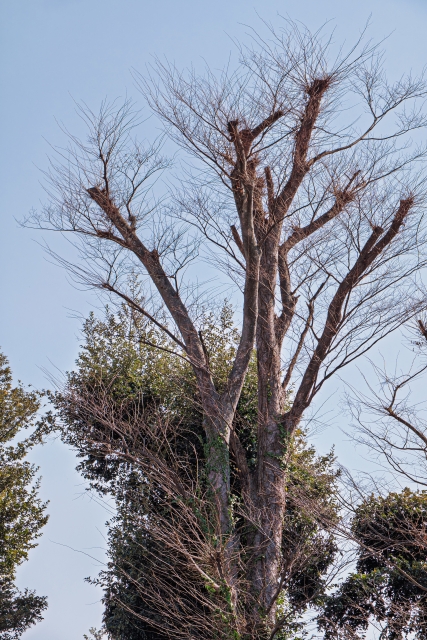
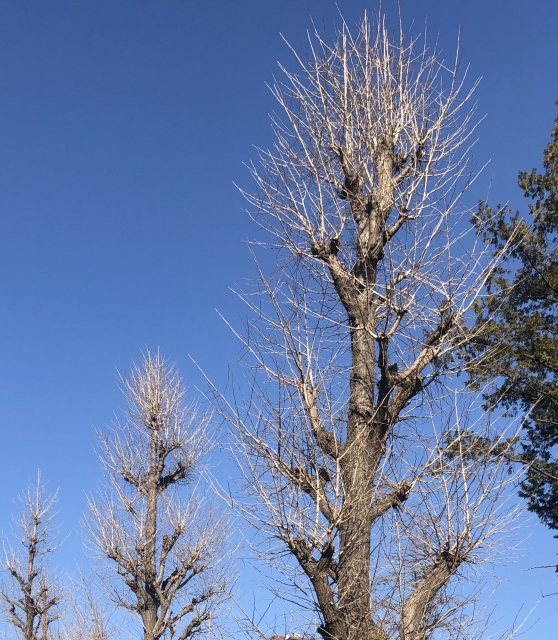
Before discussing specific techniques, it is worth establishing the principle that Japanese tree management treats as foundational: do not attempt to reduce a tree’s canopy dramatically in a single intervention.
When a storm is anticipated, the instinctive response is often to remove large amounts of canopy at once — cutting the tree back hard, reducing its height significantly, in the belief that less canopy means less wind resistance and therefore less risk. This is one of the most common mistakes made on both sides of the Pacific, and it frequently produces the opposite of the intended result.
There are three reasons why.
First, heavy pruning triggers a flush of vigorous regrowth — what is known in Japanese practice as tochoshi, or “excessively elongated shoots.” A tree that has lost a large portion of its canopy responds by sending out multiple fast-growing new shoots in an attempt to recover lost leaf area. These shoots have weak attachment points. Within a few years, they become the very branches most likely to fail in the next storm — often worse than the branches that were removed.
Second, heavy pruning reduces the tree’s vigor. A tree that loses a large fraction of its foliage loses a corresponding fraction of its photosynthetic capacity. A tree under reduced vigor has less capacity to resist decay organisms. Reduced resistance to decay, over years, becomes the structural weakness that eventually causes failure — the opposite of the safety the heavy pruning was meant to provide.
Third, large pruning wounds are entry points for decay. A large cut does not seal completely. The exposed wood becomes a pathway for decay fungi to enter the trunk or major limbs. Internal decay is, in the longer term, one of the most significant contributors to tree failure during storms.
Japanese street tree management practice instead establishes a target form for the tree and reduces height or spread gradually, over multiple years, according to a plan. Wind resistance is not something achieved in a single session. It is built incrementally, year after year.
2. Pruning That Lets Wind Through, Not Pruning That Catches It
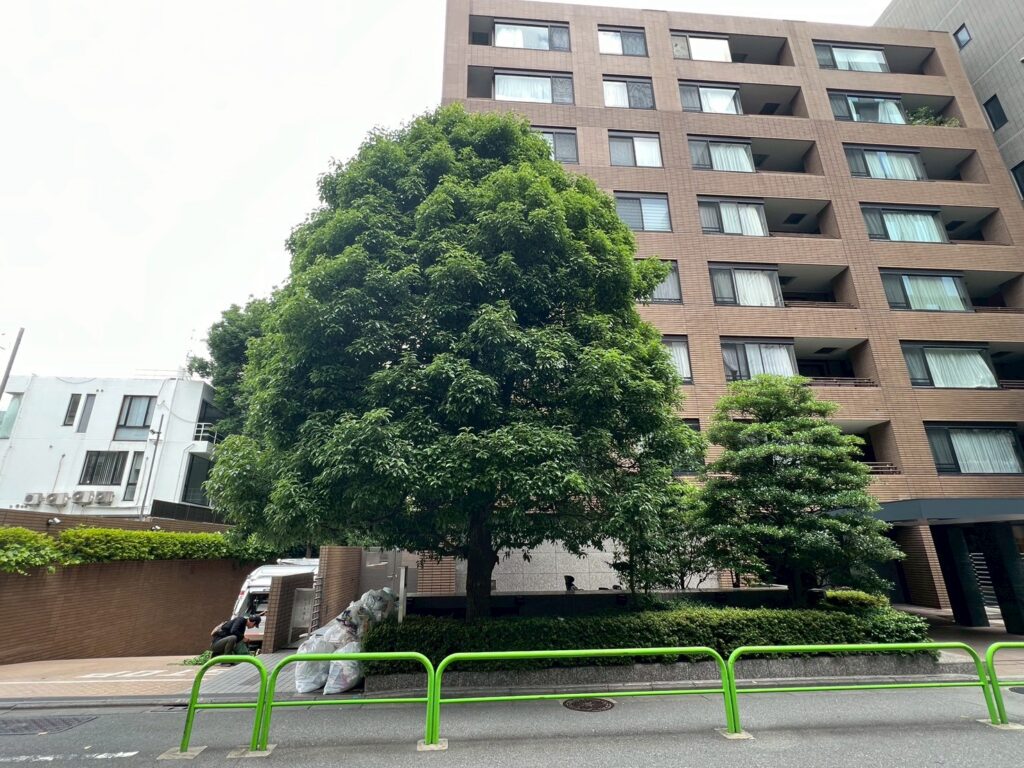
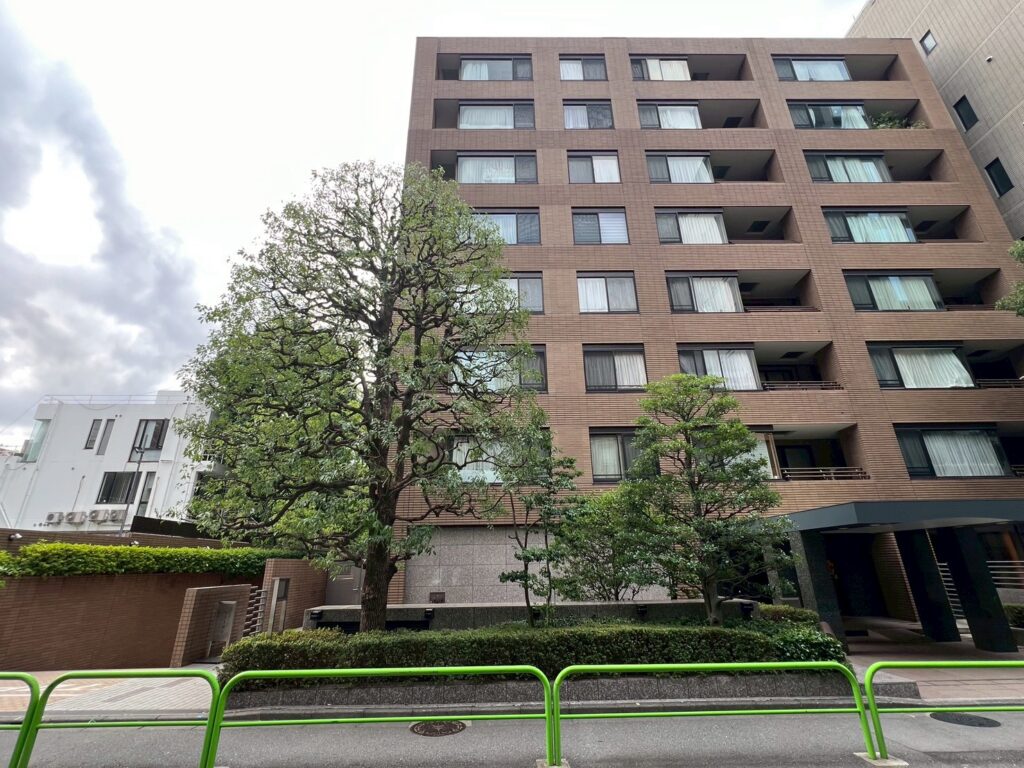
The core objective of wind-resistant pruning is to produce a canopy that wind passes through rather than a canopy that catches wind like a sail.
A dense, uniform canopy behaves like a sail: wind force is transferred directly to the trunk and root system, increasing the risk of trunk failure or uprooting. A canopy with appropriate internal spacing allows wind to move through the structure, distributing the load and reducing the force transferred to any single point.
This much aligns with the crown thinning approach common in Western arboricultural guidance. What Japanese practice adds is a specific framework for deciding which branches to remove.
Parallel branches (heiko-shi) — branches growing in the same direction in close proximity — present overlapping wind-catching surfaces. One of the pair is removed.
Crossing branches (kosa-shi) — branches that cross and rub against each other — create wounds through abrasion during high wind, and those wounds become decay entry points. One is removed.
Inward-growing and reverse branches (sakasa-eda) — branches growing toward the canopy’s interior — disrupt airflow through the structure and distort the tree’s natural form. These are removed.
Excessively elongated shoots (tochoshi) — vigorous, often near-vertical young growth — have weak attachment points and are prone to failure in wind. These are removed.
Entangled branches (karami-eda) — branches that have grown wrapped around other branches — create complex, unpredictable load patterns when the tree moves in wind. These are removed.
The principle underlying all of these selections is the same: remove branches from throughout the canopy’s interior structure, distributed evenly, rather than shearing only the exterior surface. The goal is a canopy that retains its natural branching architecture while allowing wind to move through it at every level — not a canopy that has simply been made smaller from the outside.
3. What Not to Do — Lion-Tailing and Topping
Two pruning practices are explicitly identified as harmful in Japanese tree management — and both have, in recent years, become recognized as problematic in Western arboriculture as well, though they remain widespread.
Lion-Tailing
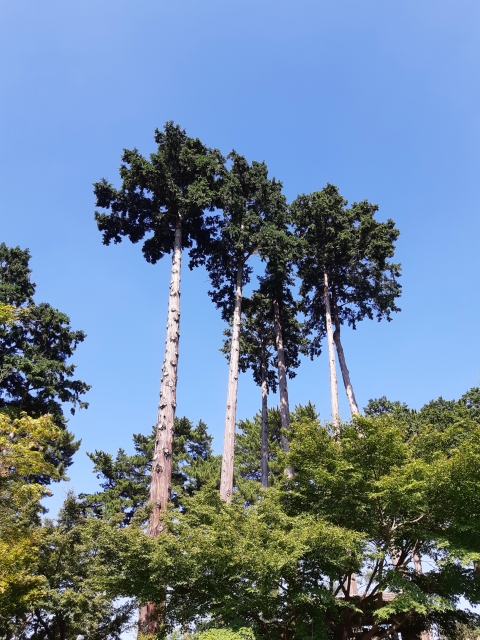
Lion-tailing removes all foliage and small branches from the interior and base of a limb, leaving leaves only at the branch tip — producing a shape resembling a lion’s tail.
At first glance, this appears to improve wind resistance: the interior is open, and wind should pass through easily. In practice, it is one of the most damaging pruning patterns possible. Concentrating foliage at the branch tip means that in high wind, the tip end of a long branch is whipped through a wide arc, placing enormous leverage on the branch’s attachment point at the trunk. The result is branch failure at the base — often a larger, more consequential failure than would have occurred without the pruning at all. Additionally, branches stripped of interior foliage suffer sun damage to previously shaded bark, further reducing vigor.
If the goal is to let wind through, foliage and small branches must be removed evenly along the entire length of each branch — never concentrated only at the tip.
Topping
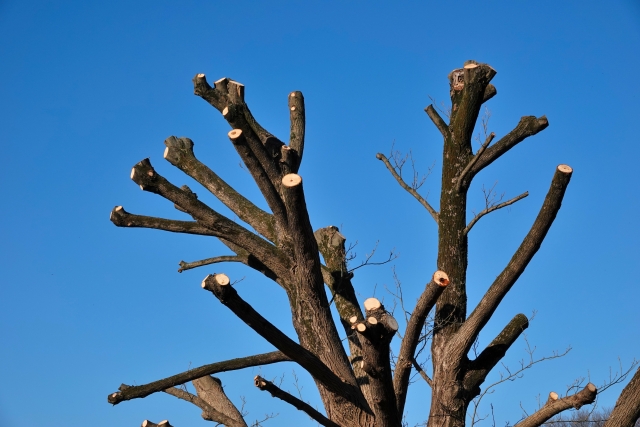
Topping — cutting the main trunk or major limbs back to stubs to reduce overall height — is the second practice Japanese management explicitly avoids.
Large topping cuts do not heal. They become decay entry points, and the area below each cut responds with a dense cluster of weakly-attached regrowth — exactly the tochoshi described earlier, but concentrated at the cut point and produced in greater volume. Within several years, a topped tree typically presents more wind-failure risk than it did before topping, not less.
Where height reduction is genuinely necessary, the technique used is drop-crotch pruning (kirikaeshi sentei) — cutting back to a lateral branch large enough to assume the role of the removed leader, distributed across the canopy and carried out gradually over several years. This achieves height reduction while maintaining the tree’s natural branching structure and avoiding the decay and regrowth problems associated with topping.
4. Beyond Pruning — Japan’s Integrated Approach
This is where Japanese wind-resistant management differs most significantly from the pruning-centered guidance common elsewhere. In Japanese practice, wind resistance is never addressed through pruning alone. It is addressed as a system with four components.
Diagnosis — Finding Decay Comes First
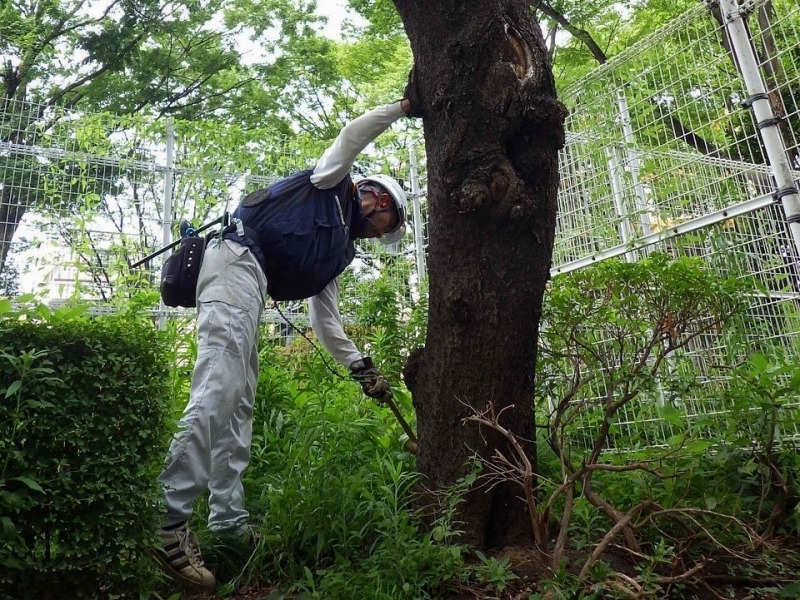
Analysis of tree failures on Japanese roads has found that uprooting failures are most strongly associated not with wind alone, but with wind combined with existing decay. Branch failures are most strongly associated with wind combined with existing dead wood. In other words: a genuinely healthy tree does not fail easily in a storm. The trees that fail are the trees that already carried internal weakness before the storm arrived.
This is why Japanese wind-resistant management treats diagnosis as the step that precedes pruning, not a step that follows it. Identifying decay, dead wood, and structural weakness before a storm season — through trunk inspection, base examination, and attention to fungal indicators — determines which trees require intervention and what kind. Pruning a structurally sound tree for wind resistance produces modest benefit. Identifying and addressing decay in a structurally compromised tree produces the benefit that actually matters.
Staking — Supporting a Tree Until Its Roots Can Hold
Newly planted trees, trees with shallow or underdeveloped root systems, and slender young trees cannot rely on pruning alone to withstand typhoon-force wind. Japanese practice uses staking systems to provide structural support during the period before root development is sufficient.
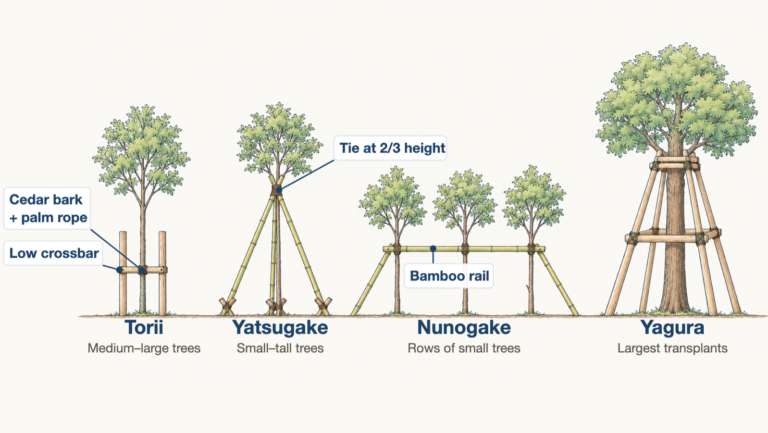
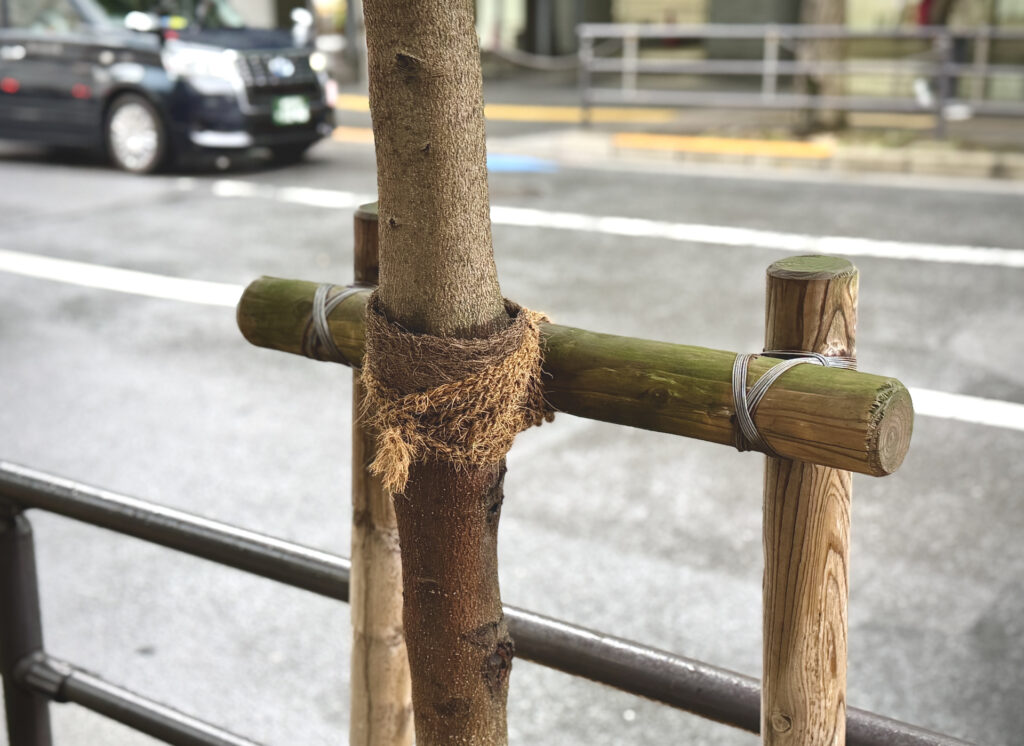
Several staking configurations are used depending on the tree’s size, age, and site conditions: three- or four-point staking systems that support the tree from multiple directions, single supplementary stakes positioned along the trunk, and the distinctive torii-style frame staking often seen supporting street trees in Japanese cities.
The critical principle in staking is this: the tree should not be held completely rigid. A tree that sways moderately in wind develops thicker roots and a stronger trunk in response to that movement — a well-documented biomechanical adaptation. A tree that is held perfectly still by overly tight staking never develops this self-reinforcing structure, and becomes dependent on the staking indefinitely. Staking should provide the minimum support necessary to prevent failure, not eliminate movement entirely. As the tree’s root system develops, staking should be progressively loosened and eventually removed.
Root Management — What’s Underground Determines What Stays Standing
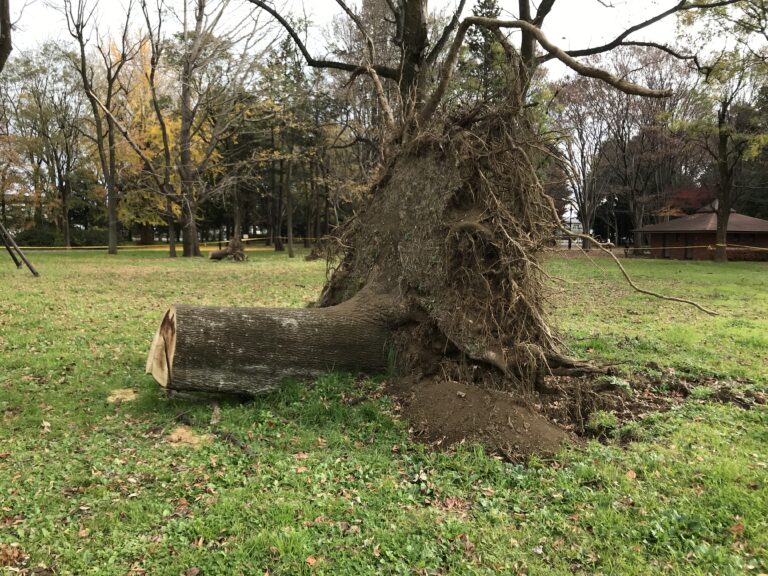
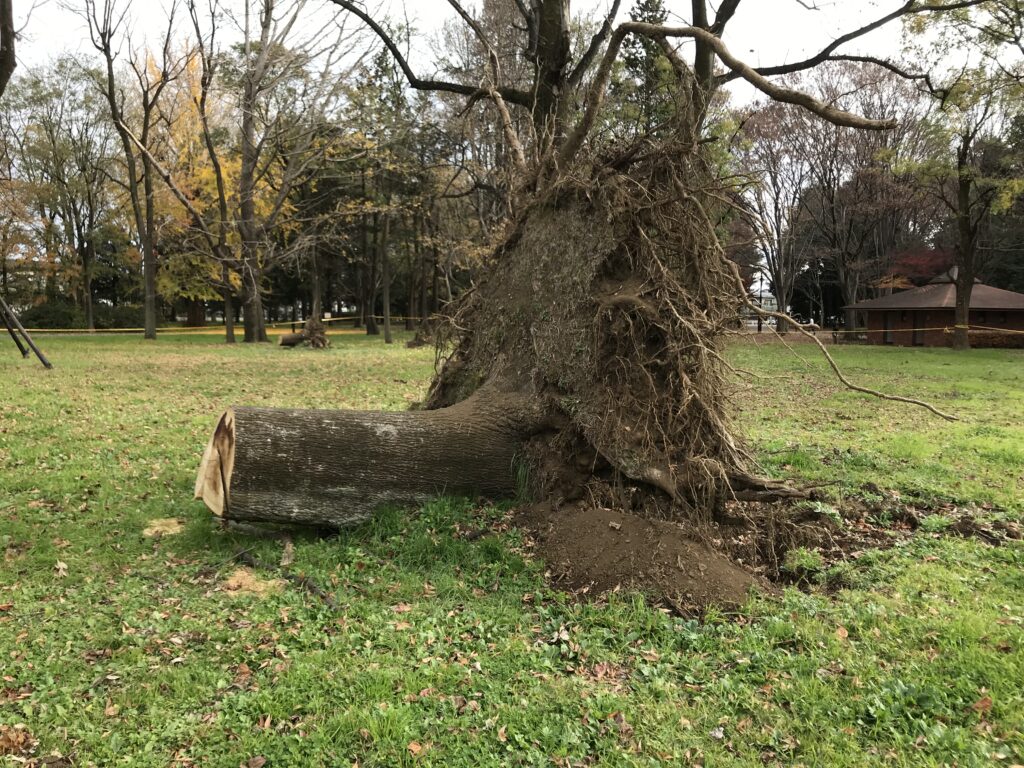
Many tree failures during storms are uprooting failures — the entire root system fails, and the tree topples with its root plate intact or torn from the ground. Canopy pruning alone does nothing to prevent this kind of failure. Root system health is the foundation of wind resistance.
Japanese practice emphasizes ensuring soil conditions that allow root systems to develop fully — wide and deep. Compacted soil prevents roots from spreading and anchoring effectively, and trees in compacted urban soils are disproportionately vulnerable to uprooting regardless of how well their canopies have been pruned. Soil improvement, ensuring adequate drainage, and expanding the available root zone are long-term investments in wind resistance that operate independently of, and in addition to, canopy management.
Species Selection — Knowing a Tree’s Root Architecture
Wind resistance varies substantially by species, and the root system is the primary reason.
Shallow-rooted species — trees whose root systems spread wide but stay close to the surface — are disproportionately vulnerable to wind-throw. Olive trees and many ornamental conifer varieties, both popular as specimen trees in contemporary garden design, fall into this category and require both careful pruning and supplementary staking to remain stable in wind-prone conditions.
Deep-rooted species — trees that develop substantial root systems extending well below the surface — are inherently more wind-resistant. Japanese black pine (Pinus thunbergii), the species most commonly planted in Japan’s coastal windbreak forests, combines a deep root system adapted to exposed coastal conditions with a flexible trunk and a needle structure that allows wind to pass through readily. This combination of traits, developed through adaptation to centuries of coastal exposure, is why kuromatsu remains the standard species for Japanese coastal windbreaks.
For any garden in a wind-exposed location, understanding a species’ root architecture before planting — or before deciding how aggressively to rely on pruning alone — is the first and most consequential decision in wind-resistance planning.
5. Timing — Preparing Before the Season, Not During It
In Japan, wind-resistant pruning is typically completed before the typhoon season begins — broadly, by early summer, ahead of the August through October period when typhoon activity peaks.
One caution applies to this timing. Heavy pruning of deciduous trees during summer disrupts the tree’s physiology — summer is when the tree is using its foliage to photosynthesize and build the reserves that sustain it through the following year. Summer pruning, where necessary, should be limited to no more than one-third of total canopy and should focus on light, targeted branch removal rather than substantial reduction.
The underlying principle is that wind resistance is not built through emergency intervention immediately before a storm. It is maintained through routine, planned management across the year — regular attention to height, density, and the gradual elimination of the branch types described in Section 2 — so that by the time storm season arrives, the tree’s structure has already been shaped to handle it.
Frequently Asked Questions
Q: Is last-minute pruning before a storm effective? A: To a limited degree. Removing obviously dead or already-cracked branches immediately before a storm has some value. But substantial pruning carried out immediately before high winds leaves fresh wounds exposed to the storm before they have had any chance to begin sealing, which can increase rather than decrease vulnerability. Wind resistance is built through planned management completed well before storm season — not through emergency action once a storm is forecast.
Q: Is more thinning always better for wind resistance? A: No. Over-thinning reduces a tree’s vigor, triggers excessive regrowth of weakly-attached shoots, and — in its most extreme form, lion-tailing — concentrates foliage at branch tips in a way that increases failure risk rather than reducing it. The goal is moderate, evenly distributed removal of specific branch types throughout the canopy’s interior, not maximum removal of foliage.
Q: Should staking be left on permanently? A: It depends on the tree’s development stage. A mature tree with a well-developed root system benefits from having staking removed, because moderate sway in wind stimulates the development of thicker roots and a stronger trunk — staking that remains in place indefinitely can prevent this adaptation from occurring. Young trees with underdeveloped root systems need staking for several years until root development is sufficient. The general principle is minimum support necessary, reassessed as the tree matures.
Q: How can I tell if a tree is likely to be wind-resistant? A: Two factors matter most. The first is root architecture — shallow-rooted species (such as olive and many ornamental conifers) are inherently more vulnerable to uprooting than deep-rooted species, regardless of pruning. The second is internal condition — a tree that appears healthy from the outside may carry internal decay that significantly increases failure risk in wind. Species selection addresses the first factor; diagnosis addresses the second. Both are more consequential than pruning alone.
Q: Why is Japanese black pine so wind-resistant? A: Kuromatsu developed under sustained exposure to coastal wind and salt spray, and as a result combines a deep, wide-spreading root system with a flexible trunk and a needle structure that allows wind to pass through the canopy with relatively little resistance. This combination is why it has been the standard species for coastal windbreak planting across Japan for centuries. Maintaining an open canopy through regular seasonal pruning further enhances this natural wind resistance.
Q: Can these methods be applied to species and climates outside Japan? A: The underlying principles transfer broadly: avoid heavy single-session pruning, prune to let wind pass through rather than to reduce overall size, avoid lion-tailing and topping, prioritize diagnosis of internal condition, and maintain healthy root development. The specific timing, the volume of pruning appropriate for a given species, and staking approaches need to be calibrated to the species’ growth pattern and the local climate. Understanding a species’ root architecture and growth response to pruning — through direct observation over several seasons — is the starting point for adapting these principles to any location.
Conclusion
A wind-resistant tree is not created through a single pruning session.
A canopy that lets wind through is built gradually, over years, through the removal of specific branch types distributed throughout the structure — never through heavy reduction performed all at once. Lion-tailing and topping, however intuitive they may seem, are avoided. Diagnosis precedes pruning, because the trees that fail in storms are, overwhelmingly, the trees that already carried hidden weakness. Root systems are given the conditions to develop fully, because canopy work alone cannot prevent uprooting. Staking provides support without eliminating the movement a tree needs to develop its own strength.
All of these elements work together. None of them, alone, is sufficient.
Japan developed this integrated approach because typhoons are not an occasional risk here — they are an annual certainty. The knowledge accumulated through that certainty is now relevant to places that, until recently, did not need it.
A tree becomes strong not by being protected from wind entirely, but by being shaped, gradually, to stand with it.
Field notes from Japan’s trees arrive a few times each month — subscribe via the form in the footer, or follow the work on LinkedIn.