How long should a newly planted tree stay staked? US university extension services usually answer six months to one growing season, two at the most. Japan’s national road research institute, NILIM, gives about three to five years for supports on street trees. Both describe a temporary support whose only job is to hold the root ball still until new roots anchor the tree. The gap comes from what each system was written for: small nursery trees in gardens on one side, large root-balled street trees in typhoon country on the other.
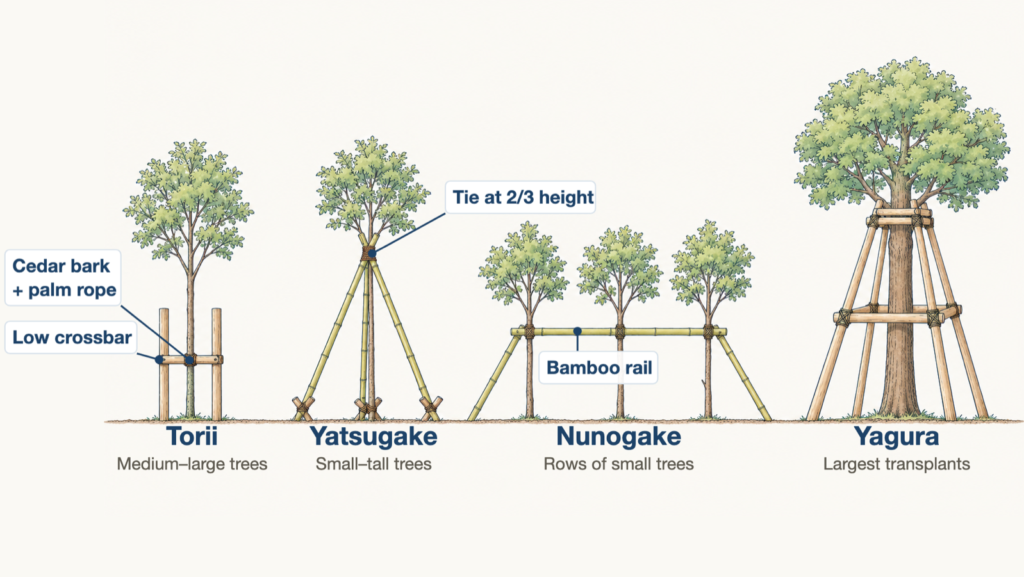
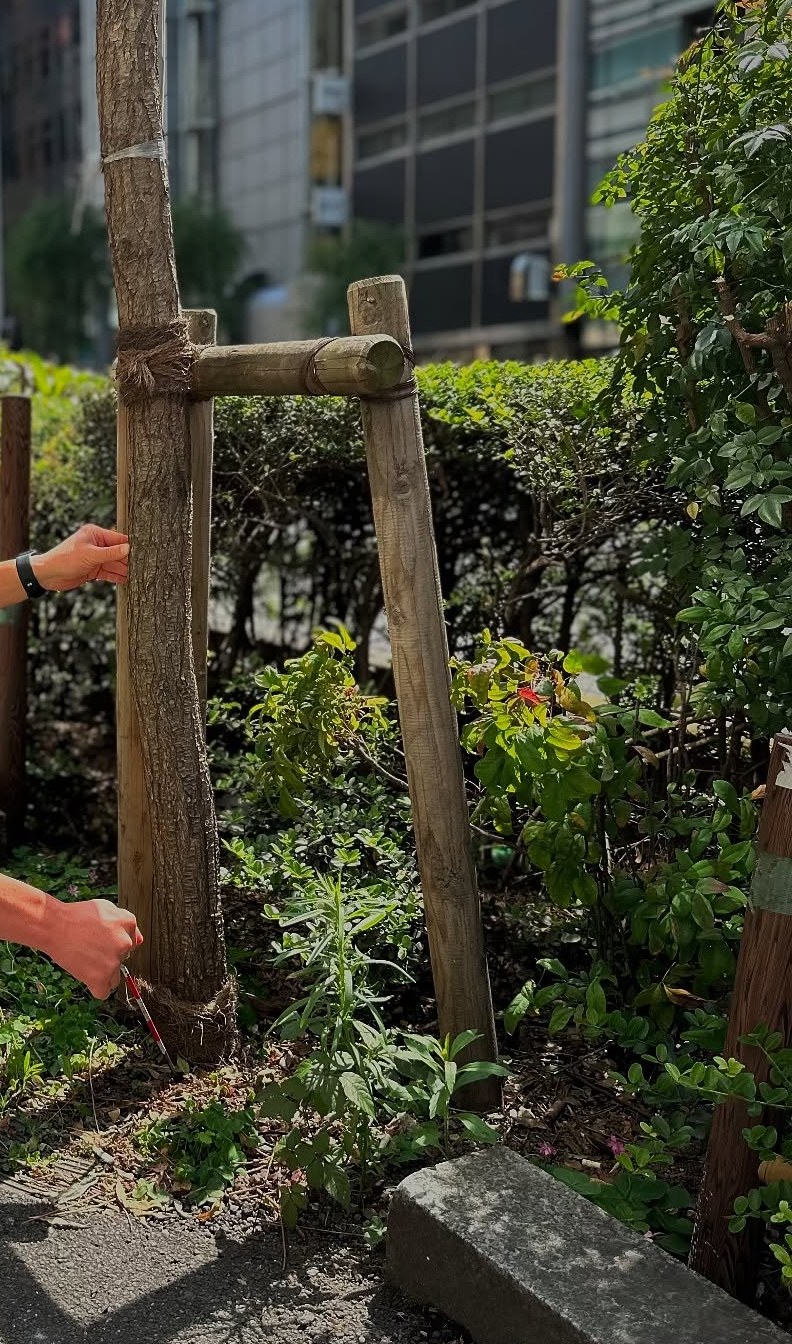
The Japanese supports themselves are a small family of standard timber-and-bamboo frames — the torii (鳥居), yatsugake (八ツ掛), nunogake (布掛) and yagura (やぐら) — tied with hemp-palm rope over a cushion of cedar bark. Below: the two answers on timing, what Japanese standard drawings specify, how the ties differ, the failure both systems warn about, and how to choose for a given site.
How long to stake a tree — the two answers
The Western answer comes mostly from extension services, building on trials such as the University of California work on trunk development by Harris and colleagues (1973).
– Stake only if needed. Oregon State University Extension advises staking only when the site or the tree requires it, such as a very windy spot or a tall, spindly specimen. – Stake low. Purdue Extension says to attach supports on the lower half of the trunk, always below two-thirds of tree height. The University of Arizona says to tie at the lowest height that keeps the leader upright. – Stake loose. Arizona recommends wide, smooth, flexible ties. – Stake briefly. Purdue says to remove ties “usually no later than after one growing season or one year”; Oregon State says six months to a year; Arizona allows up to two growing seasons.
The Japanese answer is set out in NILIM’s street-tree guide (Technical Note 1059, 2019). A planting support is defined as a temporary structure that stays until the roots have extended far enough to hold the tree. The guide’s removal timeline is about three to five years after planting, and it notes that wooden supports start to deteriorate, or to bite into the trunk, from around five years. It treats a second category separately: permanent supports for trees that face constant strong wind, or that grow in planting pits too small for adequate root spread.
The four standard forms — what Japanese drawings specify
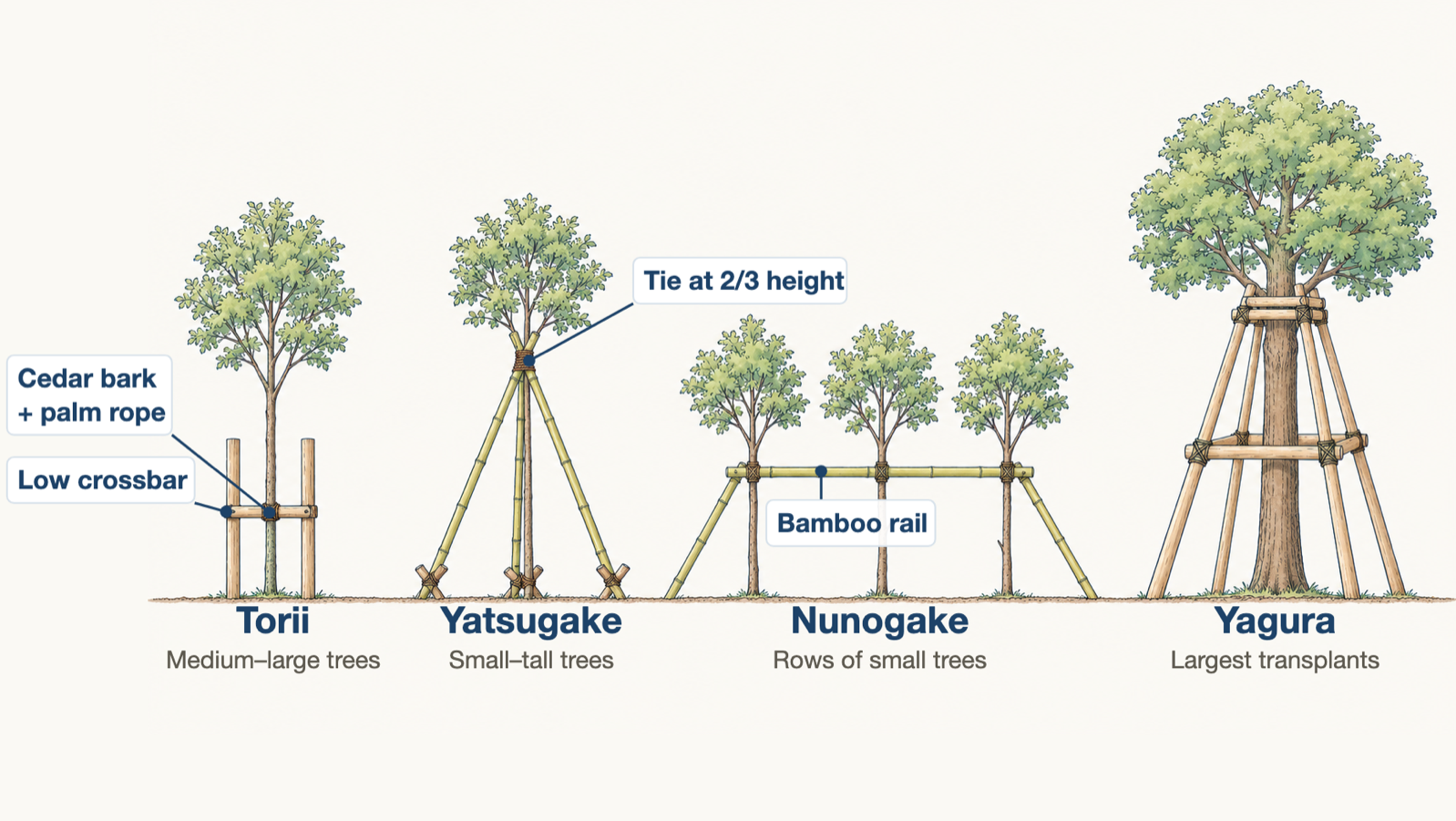
Japanese prefectures and cities publish standard drawings that assign a support type to each tree size, by height and by trunk girth measured at 1.2 m (4 ft). Details vary between authorities; the families do not.
| Support | Shape | Typical use | Tie point |
|---|---|---|---|
| Torii (鳥居) — two-leg, three-leg, cross | Posts beside the trunk joined by a crossbar, like a shrine gate | Medium to large trees in parks, streets | Low: under about 1 m (3.3 ft) in Tottori’s drawings |
| Yatsugake (八ツ掛) — bamboo or log | Three poles leaned in from three directions | Small trees in bamboo; taller trees in cedar logs 4–6.3 m (13–21 ft) long | About two-thirds of tree height |
| Nunogake (布掛) | A horizontal bamboo rail linking a row, braced at the ends | Rows of small trees, screens | Rail at about two-thirds of tree height |
| Yagura (やぐら) | A four-legged tower with a frame clasping the trunk | The largest transplants | High, with a second frame lower down |
Tottori Prefecture’s drawings give a sense of scale. The two-leg torii uses cedar logs 6 cm (2.4 in) in top diameter and 1.8 m (5.9 ft) long, with a 0.6 m (2 ft) crossbar. Larger trees step up to three legs, a cross-shaped frame, or two torii combined into four legs. Poles are cedar (Cryptomeria japonica) or hinoki (Chamaecyparis obtusa), preservative-treated, with charred timber excluded.
Read against the Western list, the torii is the closest match to extension advice: its tie sits low, well under the two-thirds limit Purdue sets. Yatsugake and nunogake tie at the two-thirds line itself. That is the upper limit in Western guidance, and the usual height in Japanese drawings.
Ties — palm rope over cedar bark, against flexible straps
The biggest visible difference is the tie.
Western guidance favours manufactured materials: wide, smooth, flexible straps, chosen so they spread the load and do not abrade the bark. Arizona’s guide lists rope among the materials to avoid against the trunk.
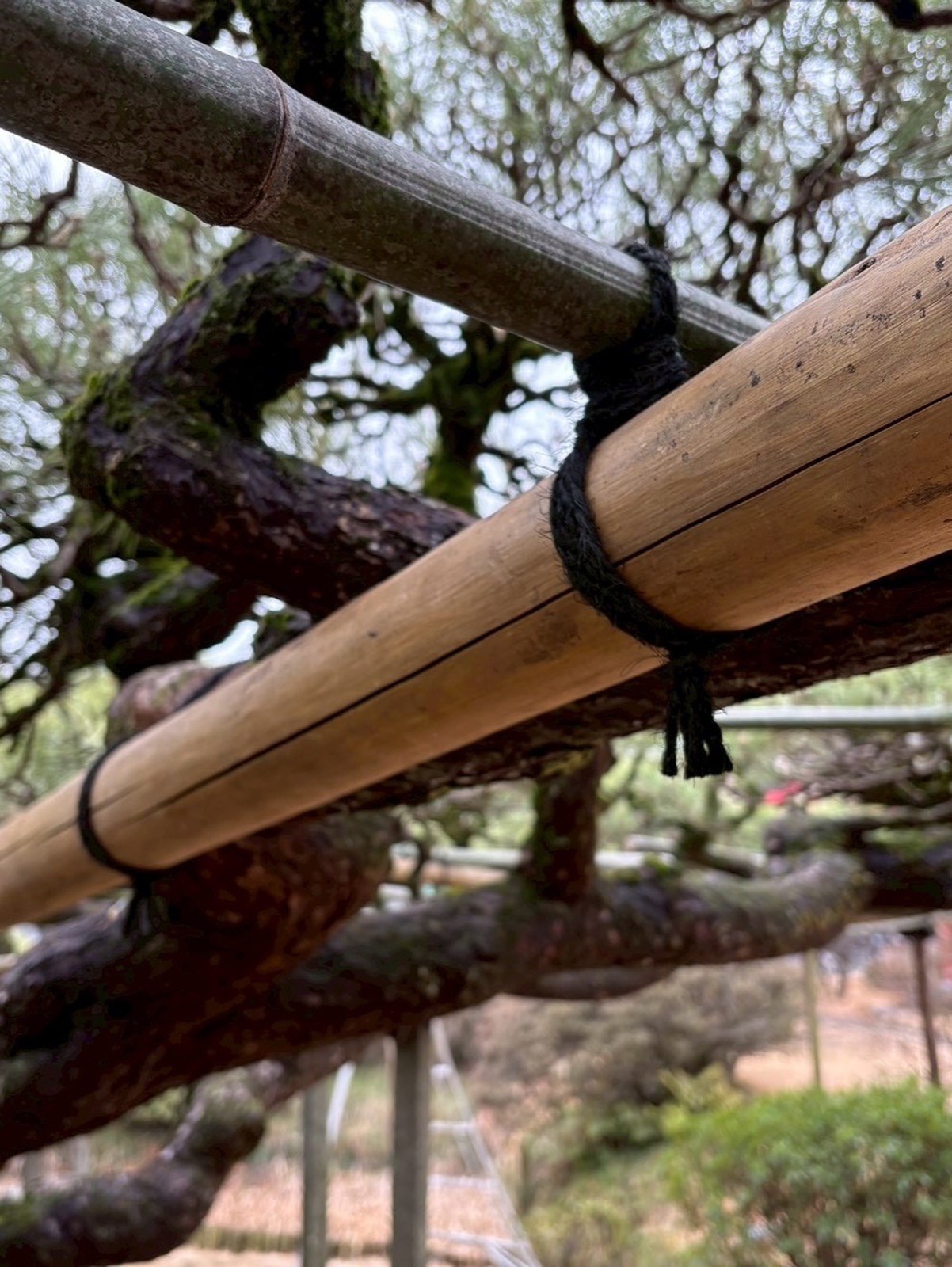
Japanese drawings tie with natural materials, in layers. Cedar bark (sugikawa, 杉皮) is wrapped around the trunk wherever a tie touches it. Over it goes hemp-palm rope (shuro-nawa, 棕櫚縄), made from the fibre of Trachycarpus fortunei and wound in a crossed pattern called warigake (割掛). Galvanised wire and nails are kept to the joints where pole meets pole, never on bark.
The Japanese Garden Dictionary by Ono Kenkichi and Walter Edwards explains why the rope suits the job: it resists water, lasts well, and was already used in gardening by the sixteenth century. It comes in two colours: the natural brown form binds supports to trees, the dyed black form binds bamboo, as at the pole joint below. Natural fibre does not make a forgotten tie safe; as the NILIM guide below warns, ties left too long still cut in.
Both approaches share a goal: the trunk should never be in direct contact with anything hard, and nothing should be tight enough to bite as the trunk thickens.
The failure both systems warn about
Purdue sums up the common failures of staking in one phrase: “too high, too tightly, and for too long.” Arizona adds the growth evidence behind the first part. Staked trees grow taller, but add less girth near the ground than unstaked trees, because trunk movement is what triggers the thickening that makes a stable, tapered stem.
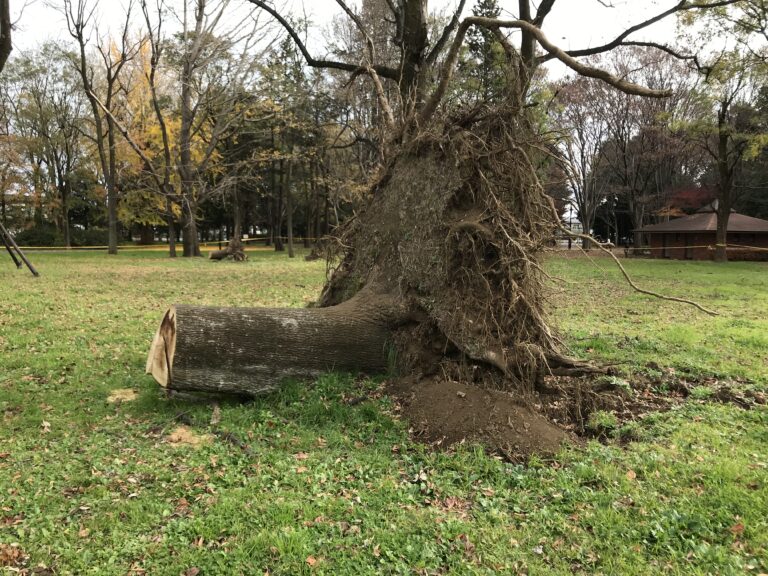
NILIM describes the long-term version of the same problem. Supports and ties left too long fuse with the trunk, cut into it, and can cause the tree to snap at that point. Its guide pairs the longer Japanese timeline with maintenance duties: inspect supports, adjust or replace ties before they cut in, and remove what is no longer needed.
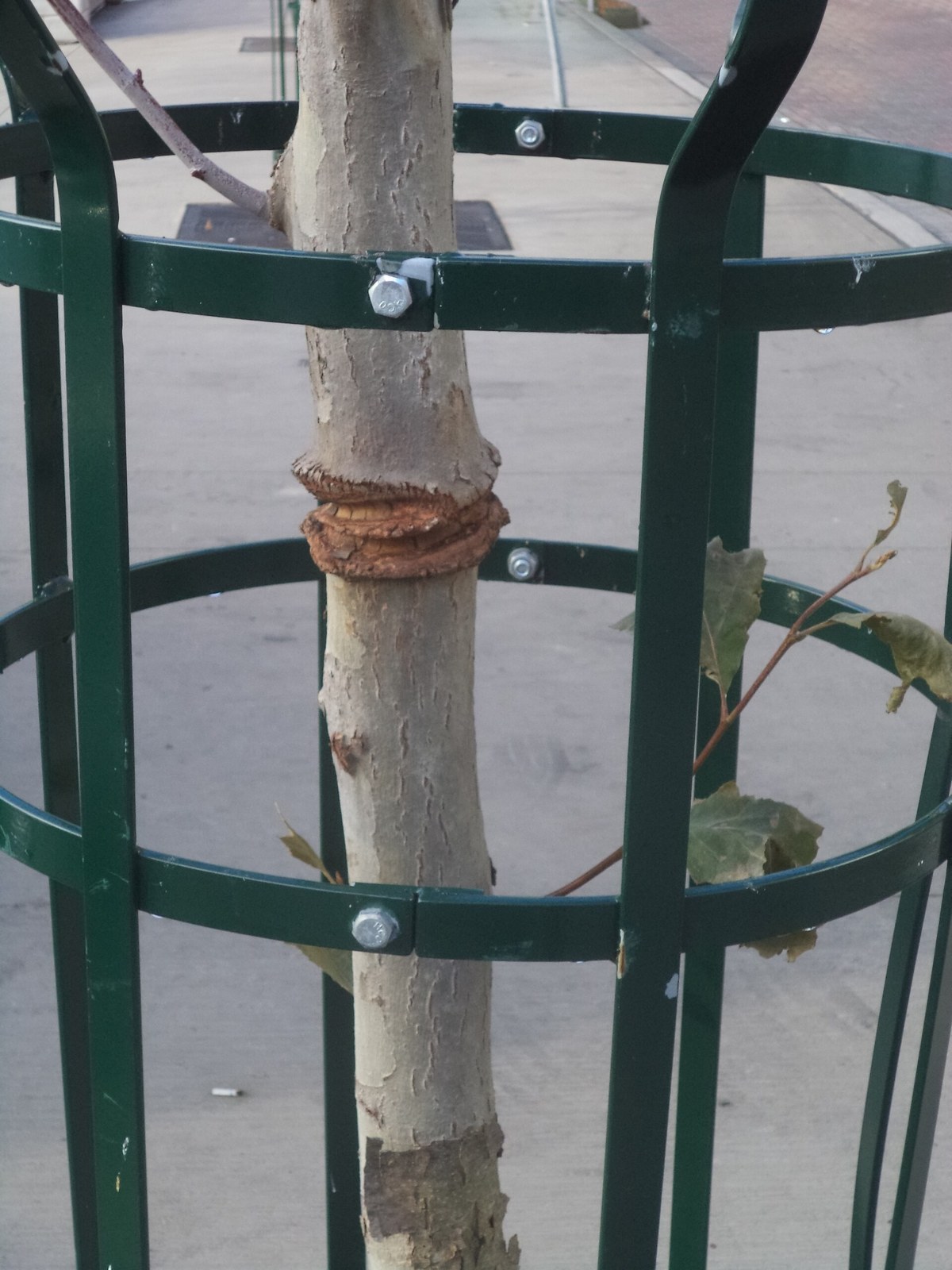
The scar left by a tie that bit in does not go away. Years later it shows up as a defect in tree assessments, as covered in reading tree decay without technology.
Why Japanese supports stay longer — four premises
The difference in timing is less a disagreement than a difference in starting conditions.
- Tree size. Extension research mostly concerns young nursery trees. Japanese size tables run to trunk girths of 75 cm (30 in) and more, moved with soil balls, and a large crown on a fresh ball takes longer to anchor.
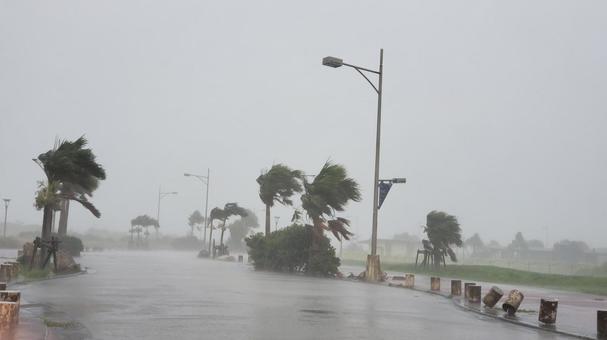
- Wind. Typhoons reach much of Japan every year. A support removed after one summer may miss the first big autumn storm. We covered the pruning side in typhoon-proofing trees.
- Site. Many Japanese street trees grow in narrow pits, a constraint explored in why Japanese street trees are so small. NILIM allows permanent supports exactly there.
- Materials. Timber and natural rope age on their own, and NILIM ties its five-year mark to that ageing.
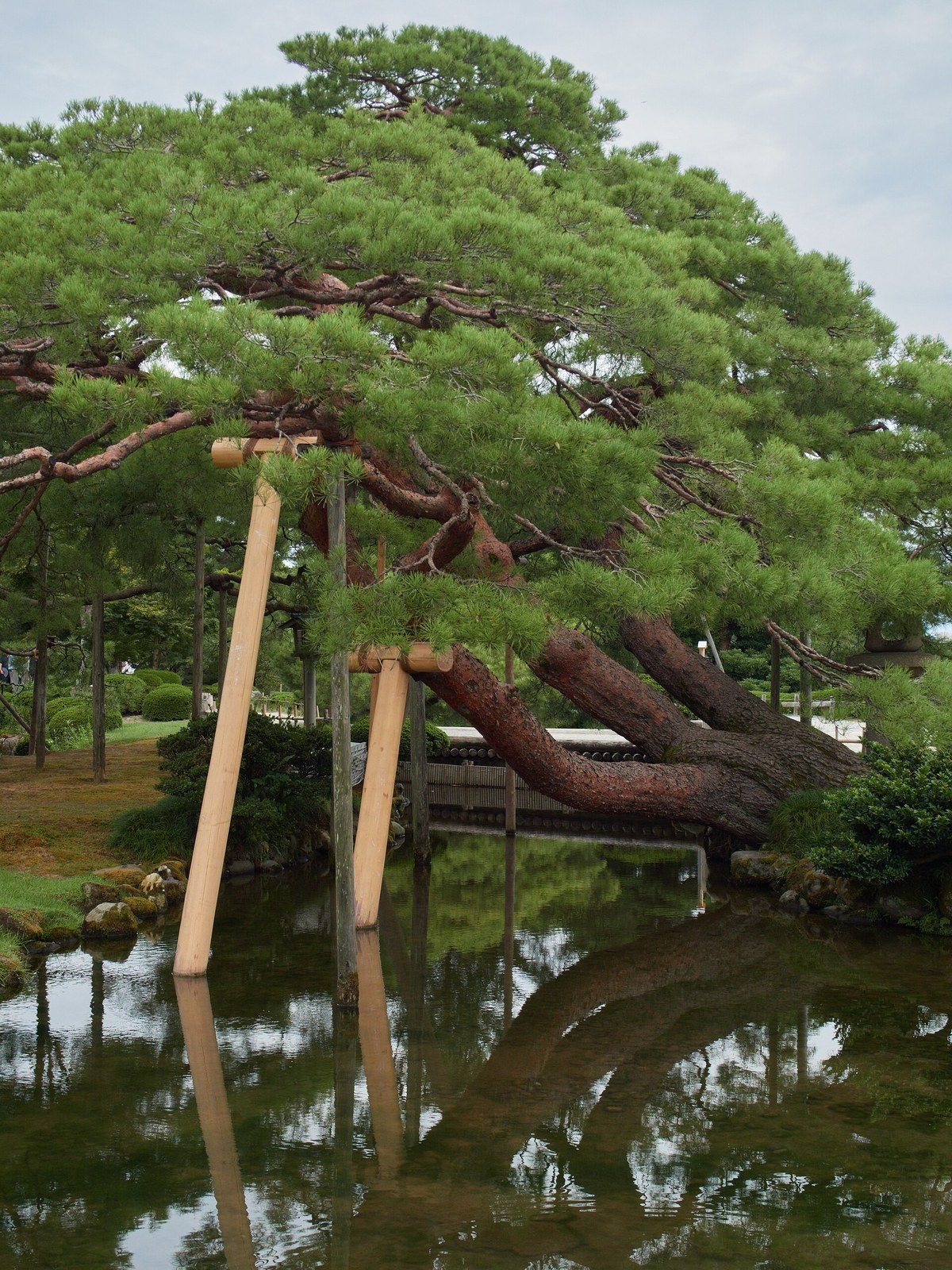
Historic gardens add a separate lineage: long timber crutches under the low limbs of old pines. These are permanent branch supports, not establishment stakes, and they answer a different question — how to keep a heavy limb from breaking.
Choosing for your site — a short checklist
Both systems give the same rule in principle: the support comes off once the roots hold the tree, and no tie is ever allowed to cut into the bark. Which timeline fits depends on four questions.
- How big is the tree? A young container-grown tree may need no stake at all; Oregon State’s “only if needed” applies. A large root-balled tree with a full crown is closer to the Japanese case.
- How exposed is the site? On a sheltered garden site, one growing season is usually enough. On a site that takes regular storms, a longer support with scheduled checks is the safer match.
- How much room do the roots have? In a small pit surrounded by paving, NILIM’s permanent category is worth considering.
- Who will check the ties? A long support is only safe if someone inspects it. Without a named person and a date, the short Western timeline is the better choice.
Frequently asked questions
What is a torii stake? A Japanese tree support of two or more posts beside the trunk, joined by a crossbar in the shape of a shrine gate. The trunk is padded with cedar bark and tied to the crossbar with hemp-palm rope.
How long should you stake a tree? Western extension services usually say six months to one growing season, at most two. Japan’s NILIM street-tree guide gives about three to five years for supports on larger street trees, with ties inspected and replaced in between.
Why do Japanese supports use rope instead of straps? Hemp-palm rope over cedar bark is the traditional binding of Japanese gardens, chosen because it resists water and lasts well. It still has to be cut free in time. Western guidance prefers wide flexible straps; both aim to keep the tie from biting into the bark.
Sources
– NILIM, Street Tree Fall Prevention Guide, 2nd ed., Technical Note 1059, ch. 3 (2019) — https://www.nilim.go.jp/lab/bcg/siryou/tnn/tnn1059.htm (checked 2026-10-17) – Tottori Prefecture, standard drawings 7-1, planting supports — https://www.pref.tottori.lg.jp/secure/1016668/7-01_pp.pdf (checked 2026-10-17) – Ono Kenkichi, Walter Edwards, Japanese Garden Dictionary, Nara National Research Institute for Cultural Properties, “shuro nawa” — https://www.nabunken.go.jp/org/bunka/jgd/pages/HempPalmRope.html (checked 2026-10-17) – U.K. Schuch, J.J. Kelly, Selecting, Planting and Staking Trees, University of Arizona AZ1402 (rev. 2011) — https://extension.arizona.edu/sites/default/files/2024-08/az1402.pdf (checked 2026-10-17) – J.E. Woodmansee, “Should you stake a newly planted tree?”, Purdue Extension (2026) — https://extension.purdue.edu/news/county/whitley/2026/08/should-you-stake-a-newly-planted-tree.html (checked 2026-10-17) – S. Fitzgerald, P. Ries, “Strapping a tree”, Oregon State University Extension (reviewed 2024) — https://extension.oregonstate.edu/node/151111 (checked 2026-10-17) – R. Harris et al., “Trunk development of young trees”, California Agriculture 27(4): 7–9 (1973) — https://californiaagriculture.org/article/112177-trunk-development-of-young-trees (checked 2026-10-17)
Related reading
– Niwaki vs topiary — what Western gardens get wrong – Why do Japan’s ancient trees live for a thousand years? – Japan’s falling-trees crisis
New field notes from Japan’s trees every day — subscribe to the Japan Blue Arborist Journal on LinkedIn, or via the form in the footer.