Tokyo's canopy fell from 9.2% to 7.3% while London holds 22%. Four structural reasons Japanese street trees stay small, and what Barcelona does.
Introduction
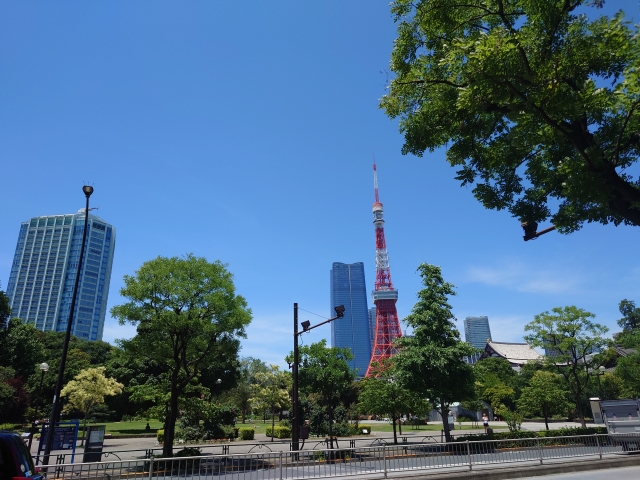
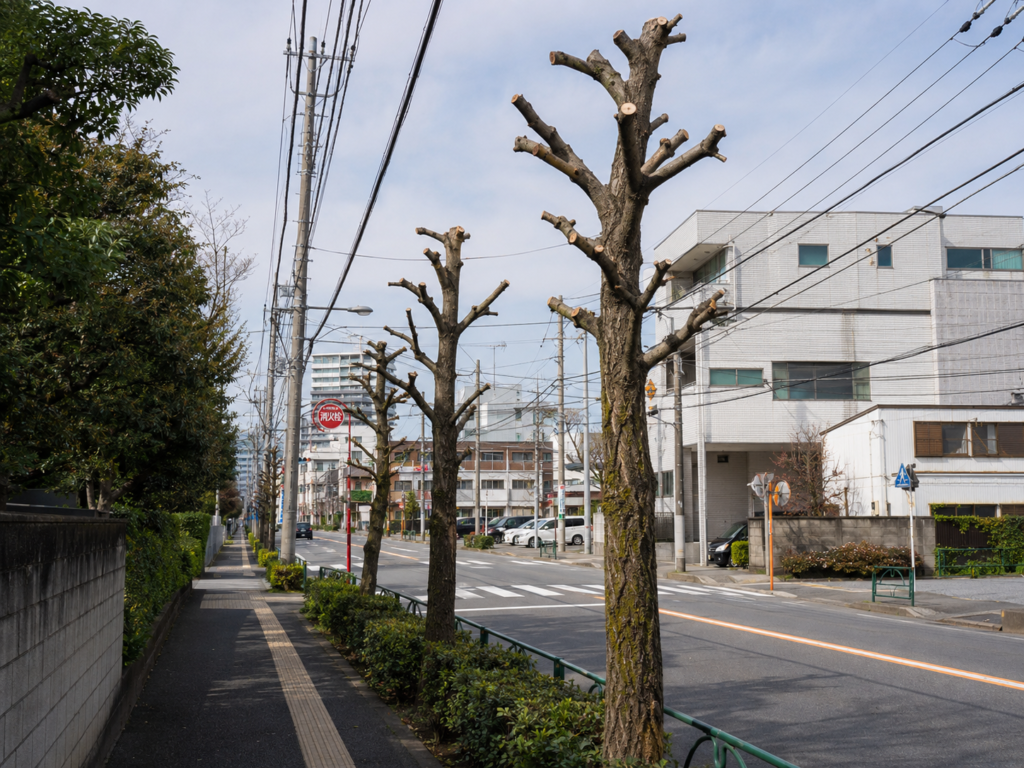
Walking under the broad canopy of Las Ramblas in Barcelona, strolling past freely branching trees lining the streets of Athens, and marveling at the tunnel of giant tropical trees arching over the old quarters of Hanoi — these are the kinds of moments that stop you in your tracks. Then you return to Japan, and something feels different. The street trees are small. Many are little more than bare trunks. The sidewalk offers no shade.
This is not your imagination. According to a May 2026 Nikkei Shimbun report, Tokyo’s 23 wards lost the equivalent of 256 Tokyo Domes worth of tree canopy in just nine years, the national street tree count has dropped by 500,000 from its peak, and municipalities are increasingly replacing mature trees with compact, narrow-crown varieties. As cities around the world race to expand their urban canopies, Japan is moving in the opposite direction. As a landscape consultant who has personally observed street trees across Spain, Greece, and Vietnam, I want to share what I saw — and why it matters.
An Important Premise: Japan Is Not a Country Without Trees
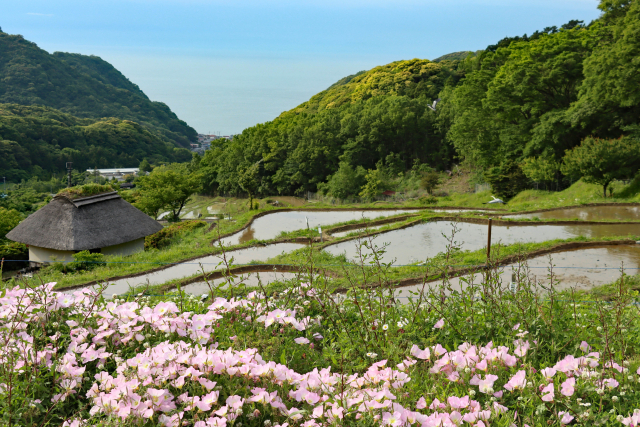
Before going further, one thing must be made clear: Japan as a whole is extraordinarily green. Approximately 67% of Japan’s total land area is covered by forest — one of the highest ratios among developed nations. Drive out of any major city and within minutes you are surrounded by mountains dense with cedar, cypress, oak, and broadleaf woodland. Shinto shrines are wrapped in ancient chinju no mori (鎮守の森), sacred groves that have been protected for centuries. Rural communities maintain satoyama (里山) — the mosaic of secondary forests, rice paddies, and woodlands that has long defined Japan’s relationship with nature.
The problem is not Japan’s relationship with trees in general. The problem is what happens when trees meet the urban street. In that specific context — the sidewalk, the road median, the planted strip — Japan’s approach diverges sharply from what I observed abroad, and from what the data shows cities around the world are doing.
What I Saw Abroad: Street Trees That Are Allowed to Be Trees
Barcelona: Green Infrastructure by Design
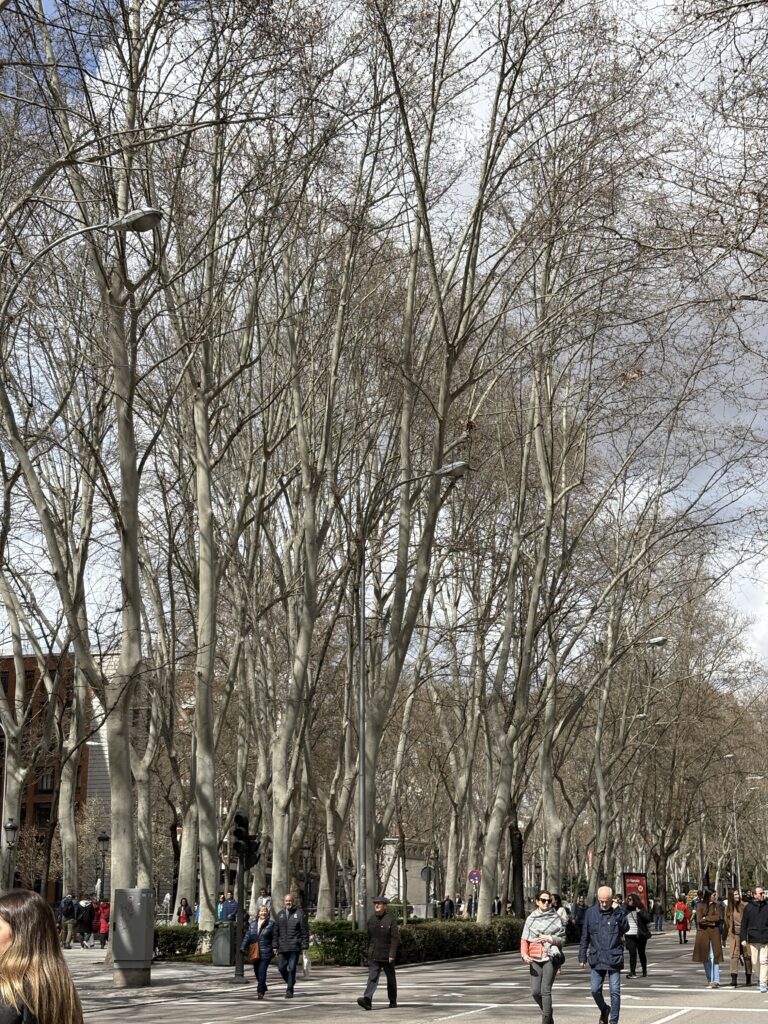
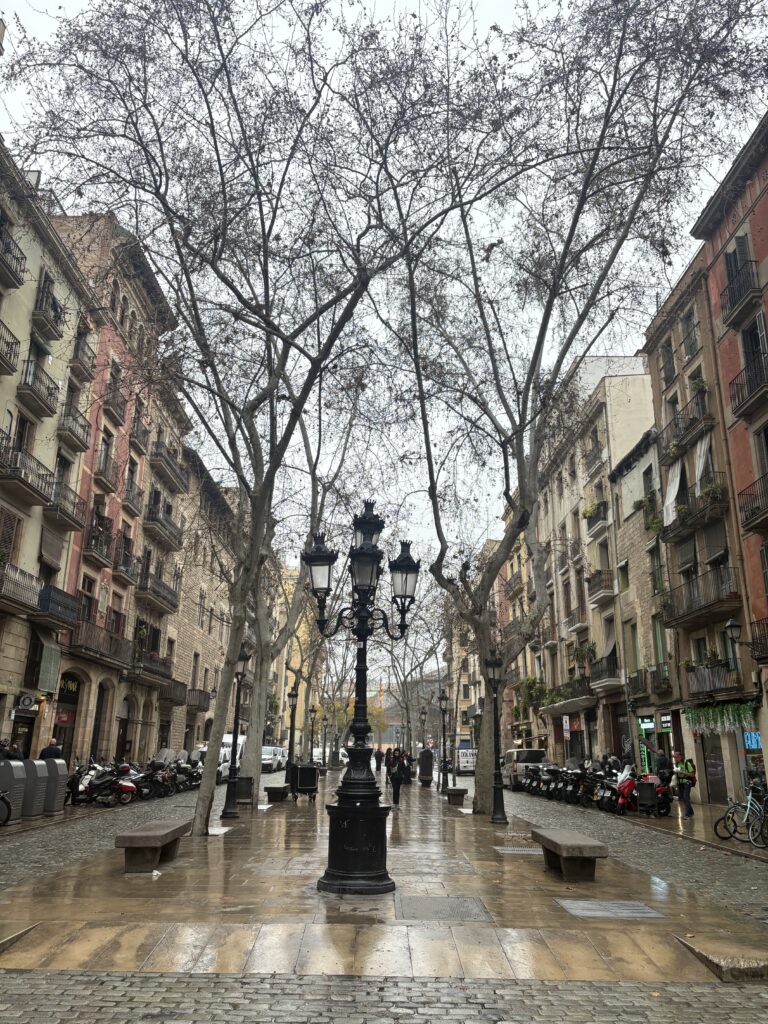
In Barcelona, street trees are not an afterthought — they are structural elements of the city. The plane trees (Platanus × hispanica) lining the Passeig de Gràcia and Las Ramblas reach heights of ten meters or more, forming a genuine green canopy that blocks the fierce Mediterranean sun and lowers the temperature at street level noticeably. This did not happen by accident. Since Ildefons Cerdà’s famous grid plan of 1859, green space has been embedded into the DNA of Barcelona’s urban design.
Several factors make this possible. The Mediterranean climate brings dry summers with no typhoons, reducing storm-related risk and allowing managers to let trees grow freely. Underground utility cables eliminate the constant conflict between power lines and tree crowns that defines so much of Japan’s urban streetscape. And in recent years, Barcelona’s Superilla (Superblock) program has converted car lanes into pedestrian green corridors, accelerating the expansion of urban greenery even further.
Athens: Coexistence Over Control
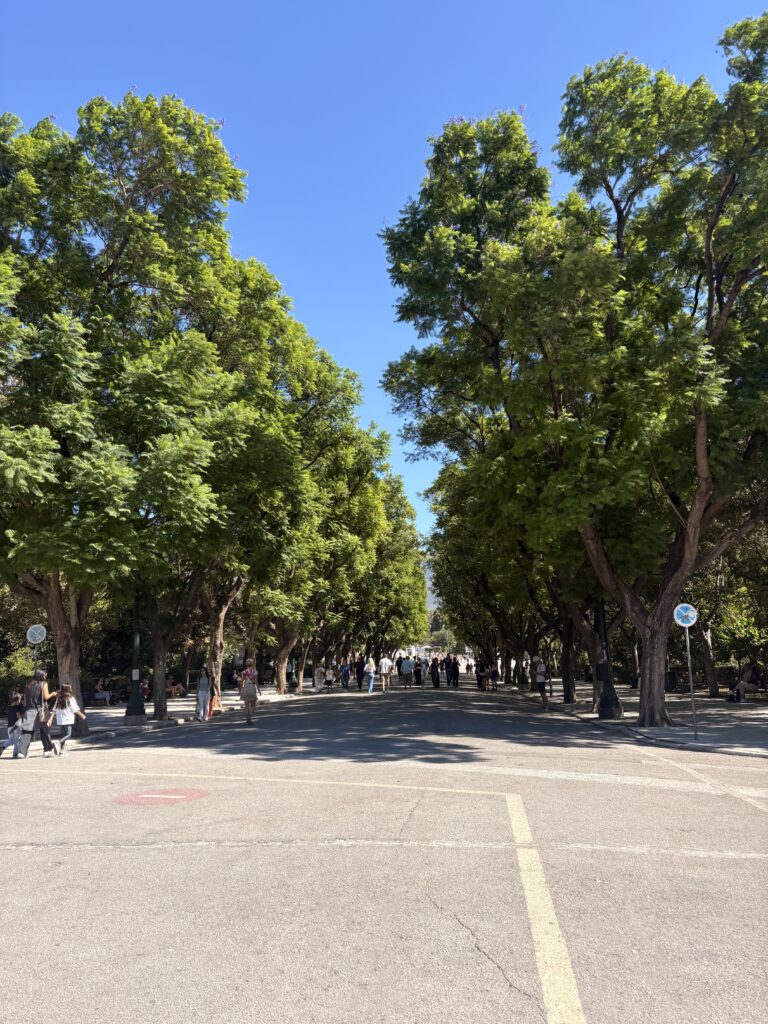
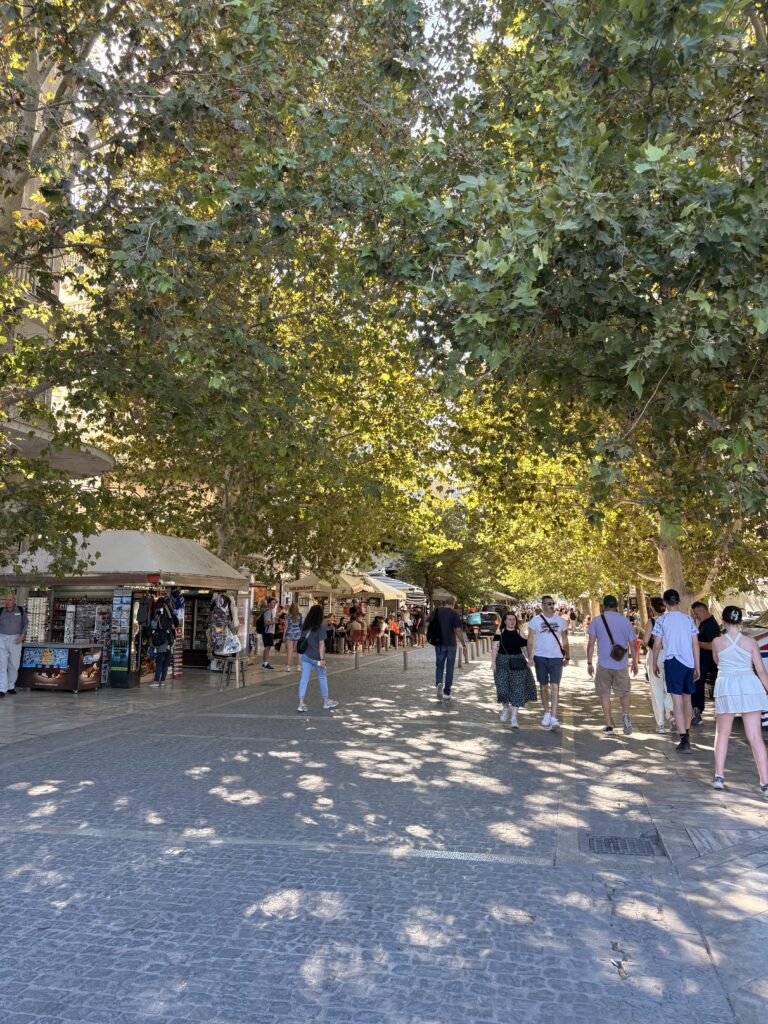
Athens operates under harsh conditions — intense summer heat, dry air, and dense urban development. Yet on many of its principal streets, trees are allowed to branch out relatively freely along building facades. Pruning happens, but not the kind of annual severe cutback that reduces a tree to a stick. What struck me most was the underlying management philosophy: trees in Athens are treated less as objects to be controlled and more as living neighbors to coexist with. That shift in attitude, subtle as it sounds, makes a visible difference in how the city feels to walk through.
Hanoi: A Legacy of Giant Trees
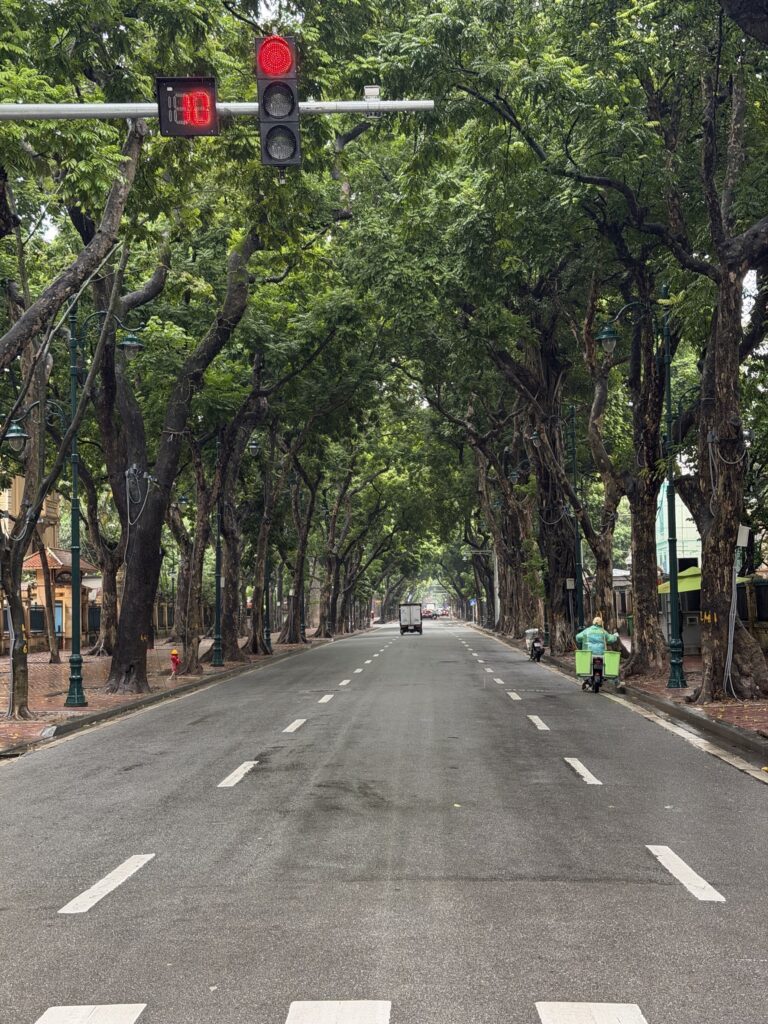
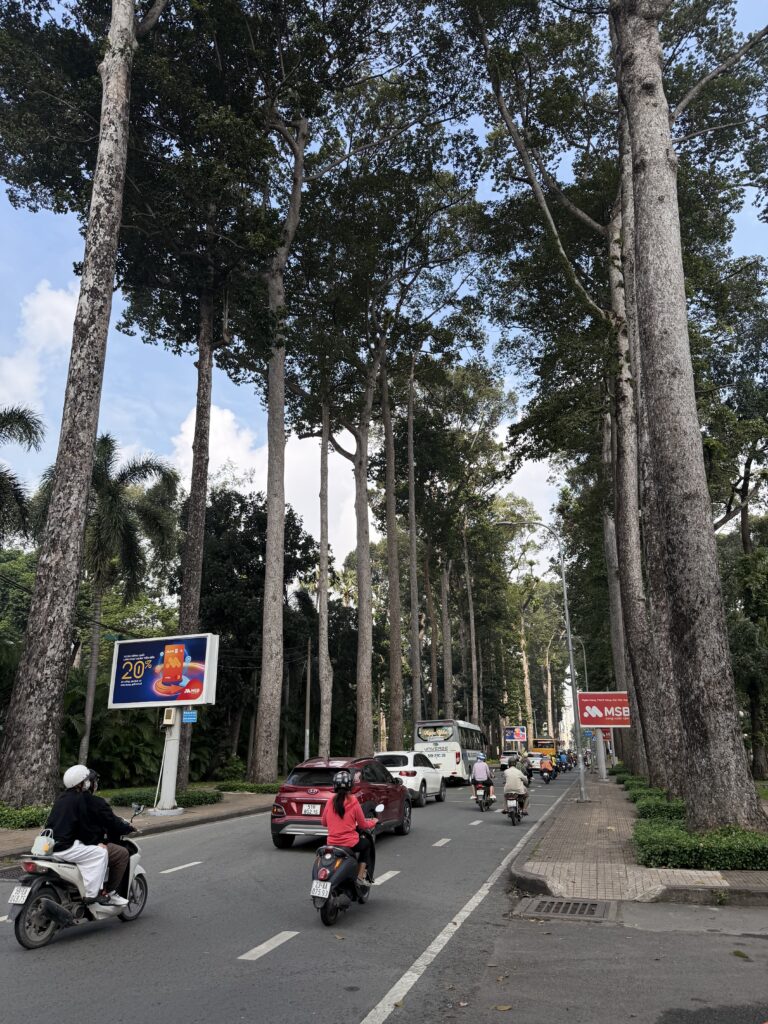
Of the three cities, Hanoi made the deepest impression. The old French Quarter (established in the late 19th and early 20th centuries) is shaded by enormous tamarinds and flamboyant trees (Delonix regia) whose canopies meet overhead, creating a continuous green tunnel over the street. These trees were planted over a century ago and have been allowed to mature. The tropical and subtropical climate means vigorous growth, and the deep-rooted nature of these species makes them more resistant to wind damage than many of Japan’s typical street tree species. The city has continued this tradition, and the result is a street environment that is genuinely shaded and dramatically cooler than the open asphalt of most Japanese cities in summer.
Why Japanese Street Trees Stay Small: Four Structural Reasons
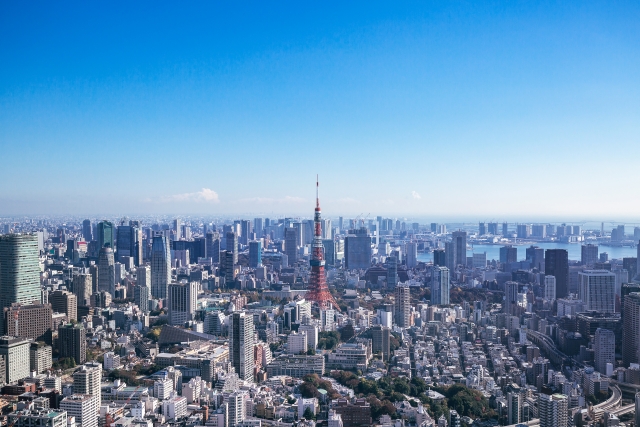
1. Typhoons and the “Safety-First” Pruning Culture
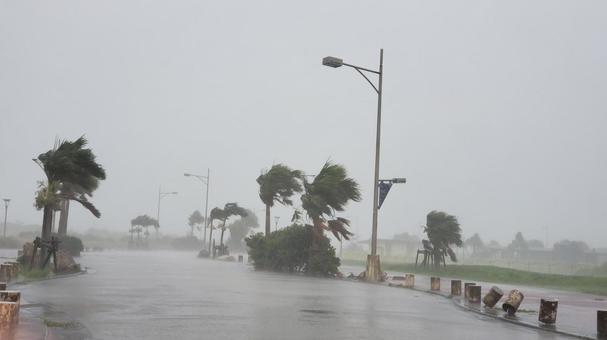
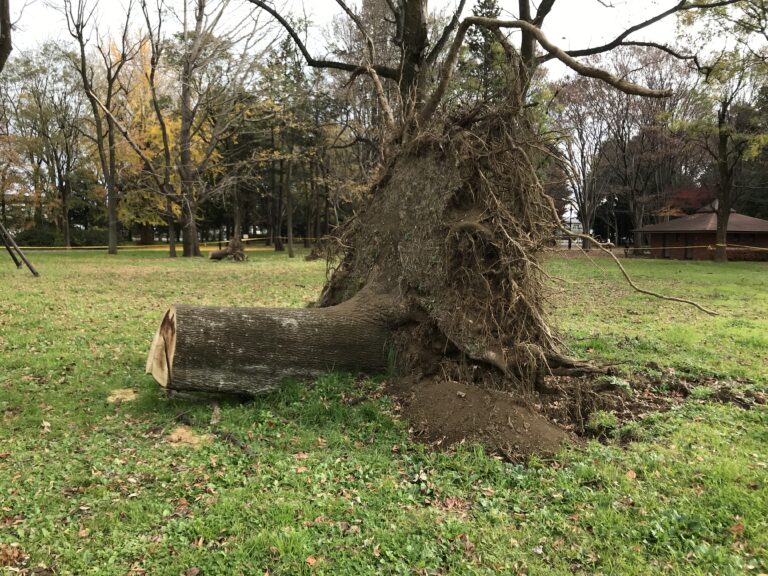
Japan is one of the world’s most typhoon-prone nations, and concern about falling trees and broken branches during storms is real. Unfortunately, most of the street trees in Japan are excessively pruned under the justification of preventing toppling during typhoon season — with the result that Japanese street trees are, on average, comparatively small in size.
The logic seems reasonable on the surface, but there is a serious flaw in it. Heavy annual pruning weakens trees over time. A severely cut tree responds by producing large numbers of rapid-growth water sprouts (徒長枝, chōchō-eda), which are structurally weaker than normal branches. A healthy, well-structured tree with a developed crown may actually be more wind-resistant than a repeatedly cropped one. Among arborists and urban forestry researchers, the assumption that “smaller equals safer in a typhoon” is increasingly questioned.
2. Overhead Utility Lines: A Uniquely Japanese Constraint
In Japan, the abundance of above-ground utility poles and overhead power lines restricts the space available for sidewalks and forces periodic heavy pruning of street trees wherever branches approach the cables. This is a constraint that simply does not exist to the same degree in Barcelona, Paris, or most Northern European cities, where utility lines have been buried underground for decades.
Until Japan accelerates the underground cabling of its urban streets, this structural conflict between trees and infrastructure will continue to suppress canopy development. The tree is not the problem — the poles are.
3. Insufficient Planting Space and Root Constraints
In many parts of Japan, roadside planting space is often the first area to be sacrificed when underground infrastructure — gas pipes, sewage, data cables — is installed. The result is a pattern of isolated, narrow tree pits rather than continuous planting strips, which severely limits root development. A tree that cannot spread its roots cannot grow tall, cannot develop wind resistance, and is more likely to become a liability. This creates a self-reinforcing cycle: constrained roots lead to weak trees, weak trees invite heavy pruning, and heavy pruning further weakens the tree.
4. Complaint-Driven Management
Fallen leaves clogging gutters. Tree pollen triggering allergies. Fruit dropping on parked cars. Root heave cracking sidewalk pavers. As street trees grow larger, the volume of resident complaints tends to grow with them — and in Japan’s complaint-sensitive administrative culture, local governments respond by keeping trees small. There is a documented tension between residents who want shade and cooler streets, and those who view large street trees as a source of mess and inconvenience. Some residents have argued that Japan’s earthquake and typhoon risks make European-style street planting unsuitable — a view that, while understandable, often leads to management decisions that prioritize short-term ease over long-term urban livability.
The Data: Tokyo Is Losing Its Canopy
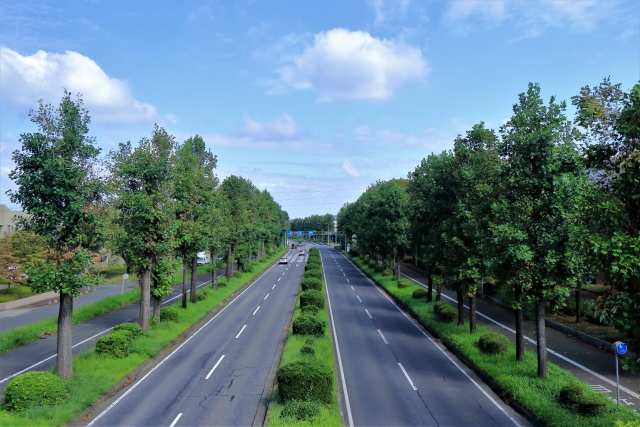
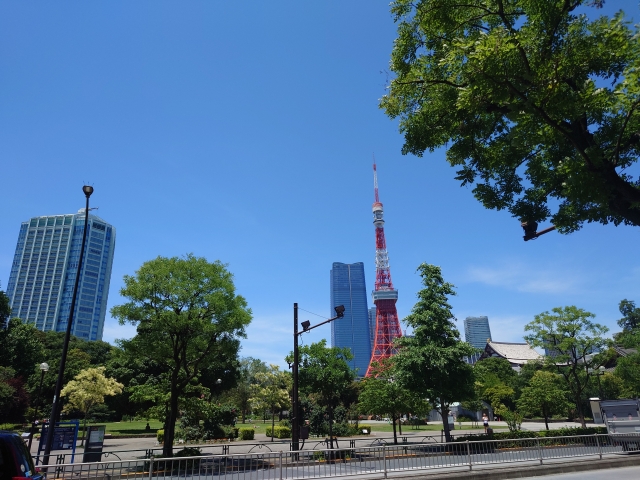
The numbers confirm what the eye observes. Tree canopy cover in Tokyo’s 23 wards declined from 9.2% in 2013 to 7.3% in 2022 — a drop of 1.9 percentage points representing an enormous area of lost shade. Tree cover loss was recorded across both public land (38%) and private land (57%), with the largest share occurring in single-family residential zones (39.8%), followed by roads (14.7%).
To put 7.3% in global context: London maintains approximately 22% urban tree canopy cover, Singapore is targeting over 29%, and Barcelona, despite its dense urban fabric, is actively expanding its canopy as a climate adaptation strategy. Tokyo’s figure is strikingly low among major world cities — and it is still declining.
The Cost of Lost Shade: Urban Heat and Human Health
Losing street tree canopy is not merely a matter of aesthetics. Urban trees provide measurable cooling through transpiration and solar shading, reducing ambient temperatures beneath the canopy by several degrees Celsius compared to exposed asphalt. In a country where summer heat has become a genuine public health emergency — with tens of thousands of heat-related illness cases reported annually — the disappearance of street-level shade has real consequences for the people who walk those streets every day.
As climate change intensifies summer conditions across Japan, the gap between what urban trees could provide and what they are currently allowed to provide grows more costly with each passing year.
A Landscape Consultant’s Perspective: What Japan Can Do
Walking the shaded streets of Barcelona, Athens, and Hanoi, I kept thinking: this is what street trees are supposed to be. Trees that branch, that leaf out, that cast shadows on the ground. Japan has the knowledge, the horticultural tradition, and the deep cultural respect for trees — expressed in concepts like niwaki (庭木, the art of training trees) and the reverence for ancient trees at shrines and temples — to do this well. What is missing is not skill, but policy and infrastructure.
Here are the changes that would make the most difference:
- Underground cabling: Burying utility lines along key streets would immediately remove the most persistent constraint on tree crown development.
- Larger, continuous planting strips: Replacing isolated tree pits with connected planting zones allows root systems to develop properly and supports healthier, more wind-stable trees.
- Species selection review: Rather than defaulting to compact columnar varieties across the board, municipalities should select species matched to the specific space, climate, and management capacity of each street.
- Long-term management plans: Moving from annual reactive pruning to multi-decade growth plans, as practiced in European urban forestry, would allow trees to develop the structure and canopy density they need to provide real ecosystem services.
- Public education and dialogue: Shifting the cultural conversation from “street trees as a source of complaints” to “street trees as shared urban infrastructure” is essential — and it starts with showing people what a shaded city actually feels like to live in.
Frequently Asked Questions
Q: Why are Japanese street trees pruned so aggressively every year? A: The main reasons are typhoon risk management, conflicts with overhead utility lines, and pressure from residents who complain about fallen leaves, pollen, and sidewalk damage from roots. These factors combine to create a management culture that defaults to keeping trees small, even when doing so compromises the trees’ long-term health and the benefits they provide.
Q: Japan has so many forests — why is urban tree canopy so low? A: Japan’s national forest cover of approximately 67% is among the highest in the developed world, and the country’s mountains, rural landscapes, and sacred groves are genuinely rich in trees. Urban street greenery, however, is a different problem shaped by infrastructure constraints, land use pressures, and administrative management culture. The abundance of trees in the countryside does not translate automatically into shade on city sidewalks.
Q: Do street trees actually lower temperatures in cities? A: Yes, significantly. Through transpiration and solar shading, trees can reduce ambient air temperature beneath their canopy by several degrees Celsius compared to exposed pavement. In a Japanese summer, this difference is not just comfortable — it can be life-saving.
Q: Are there examples of well-maintained street tree canopies in Japan? A: Yes. The ginkgo avenue at Jingu Gaien in Tokyo, the Peace Boulevard in Hiroshima, and certain tree-lined roads in Hokkaido are domestic examples where canopy has been relatively well preserved. But these remain exceptions. The typical streetscape in most Japanese cities tells a very different story.
Conclusion
The street trees of Barcelona, Athens, and Hanoi are generous with their shade because the cities they grow in allow them to be. Japan’s street trees are small not because Japan lacks knowledge or love of trees, but because a combination of infrastructure constraints, risk-averse management culture, and complaint-driven administration has systematically suppressed their growth for decades.
Japan is a nation covered in forests. Two-thirds of its land is green. It has a centuries-old tradition of living carefully and reverently alongside trees. And yet in Tokyo, an area of tree canopy the size of 256 baseball stadiums has vanished in less than a decade.
That contradiction deserves more than acceptance. As a landscape consultant who has stood in the shade of Hanoi’s century-old tamarinds and Barcelona’s towering plane trees, I believe Japan’s cities can — and must — do better. The tools exist. The knowledge exists. What needs to change is the will to plant, and then to let trees grow.
Field notes from Japan’s trees arrive a few times each month — subscribe via the form in the footer, or follow the work on LinkedIn.