Japan planted millions of trees after WWII. They are aging out together — falling. Inside Japan's street tree crisis, with lessons for cities everywhere.
Japan’s Falling Trees Crisis: When the Postwar Planting Boom Reaches Its Limit
Introduction
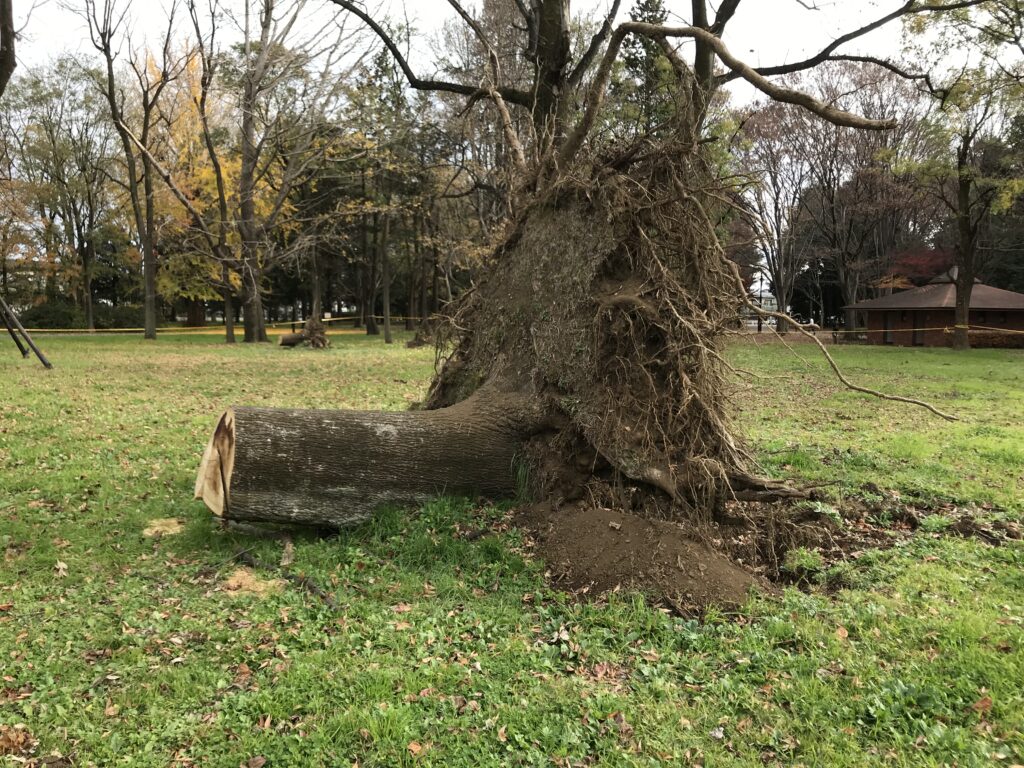
In April 2026, an 18-meter cherry tree with a trunk diameter of 2.5 meters collapsed without warning at Kinuta Park in Tokyo. On the same day, another cherry tree fell at the Chidorigafuchi greenway — and came within meters of toppling into the Imperial Palace moat. No one was killed, but weeks earlier, a different tree had fallen at the same park, injuring a passerby.
The incidents were reported internationally by the Associated Press. But they were not isolated accidents.
According to a national survey published by Japan’s Ministry of Land, Infrastructure, Transport and Tourism in April 2025, incidents involving fallen trees and falling branches on roads and in parks caused 1,700 casualties and property damage cases across Japan in the roughly three-and-a-half years between April 2021 and November 2024. Reporting by the Nikkei newspaper puts the annual number of fallen trees at approximately 5,200.
Why are so many trees falling now? And how is Japan responding? This article examines the structural causes of Japan’s tree-fall crisis and the approaches being taken in the field — from the perspective of a Japanese landscape and tree management professional.
1. Half a Century After the Planting Boom — The Structural Problem of Aging Trees
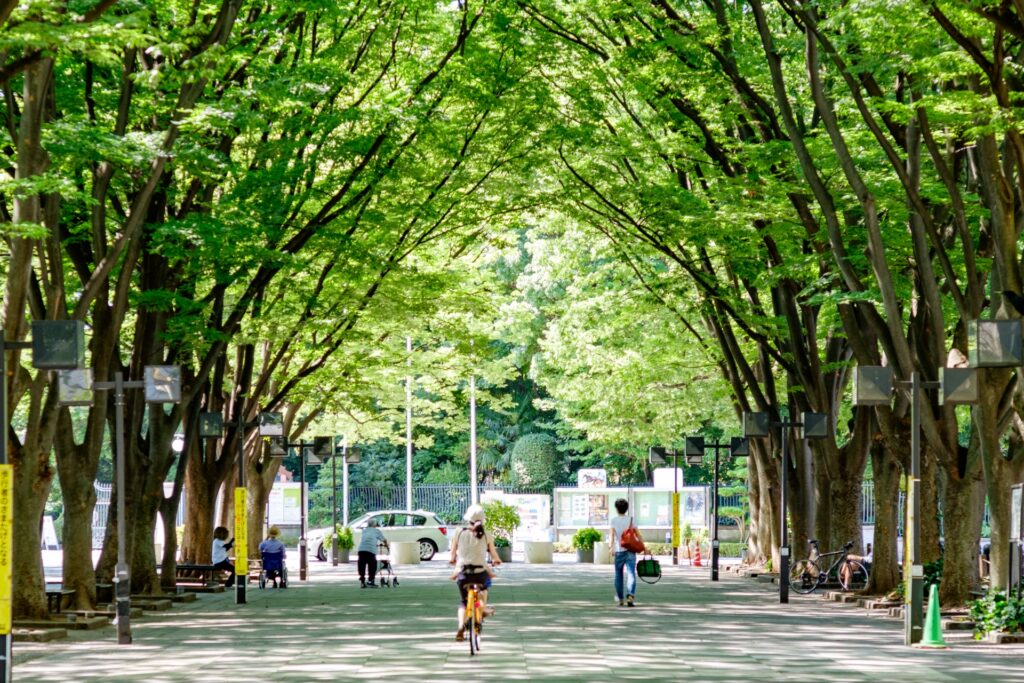
The root of the problem is time.
During Japan’s high economic growth period — primarily the 1960s and 1970s — enormous numbers of street trees and park trees were planted along roads, in parks, at schools, and in residential areas across the country. In preparation for the 1964 Tokyo Olympics, large-scale tree-planting programs transformed urban Japan. The zelkova avenue along National Route 20, the Koshu Kaido in Tokyo, was among the most prominent examples of this era’s ambition to build a greener city.
More than sixty years have passed.
The trees planted then are now entering advanced age. Species commonly used as street trees — zelkova, cherry, ginkgo, plane trees — become significantly more susceptible to decay once they pass fifty to eighty years of age. Somei Yoshino cherry trees in particular have relatively low resistance to disease and decay, and are known to decline sharply around the age of eighty.
In one sense, Japan’s tree-fall crisis is the consequence of a success: the effort, sixty years ago, to create cities rich in greenery. The costs of that success are now arriving on schedule.
2. Climate Change as Accelerant
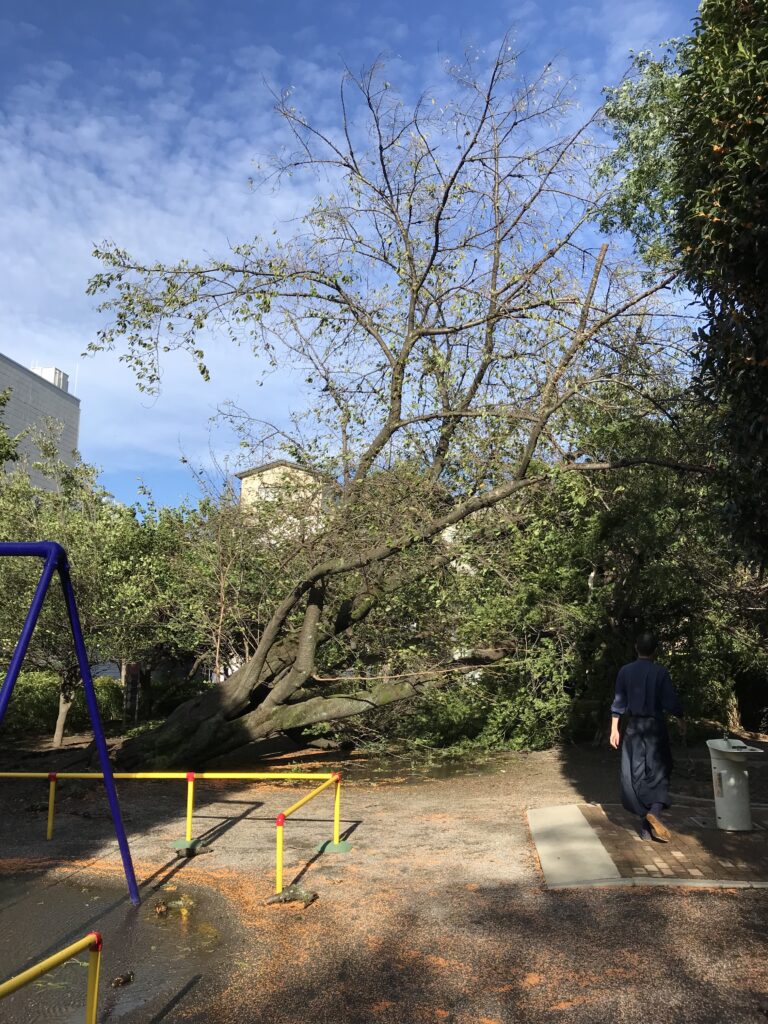
Aging alone does not explain the full picture.
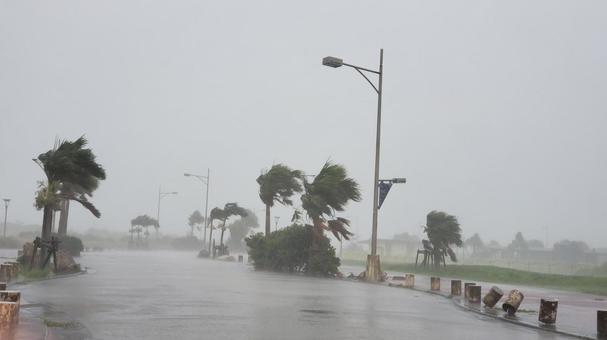
In recent years, the intensification of typhoons, the increasing frequency of short-duration torrential rainfall, and heat stress on urban trees have all significantly elevated the risk of tree failure. Trees that might have remained standing — despite internal decay — under historical weather patterns are now being brought down by storms stronger than anything in their management history.
Old trees with compromised root systems are especially vulnerable. A trunk may appear healthy while the root crown is extensively decayed; a single strong wind event can bring it down entirely. In 2019, a pine tree fell on a road passing through the famous Niji no Matsubara coastal pine grove in Karatsu City, Saga Prefecture, killing a five-year-old child riding in a passing car. That accident occurred in exactly this context: an aging tree in a high-traffic area, exposed to a wind event it could no longer withstand.
Climate change has moved urban tree management beyond the reach of approaches that simply extend what was done before.
3. The Limits of the Management System — Specialist Shortage, Budget Constraints, and Inspection Gaps
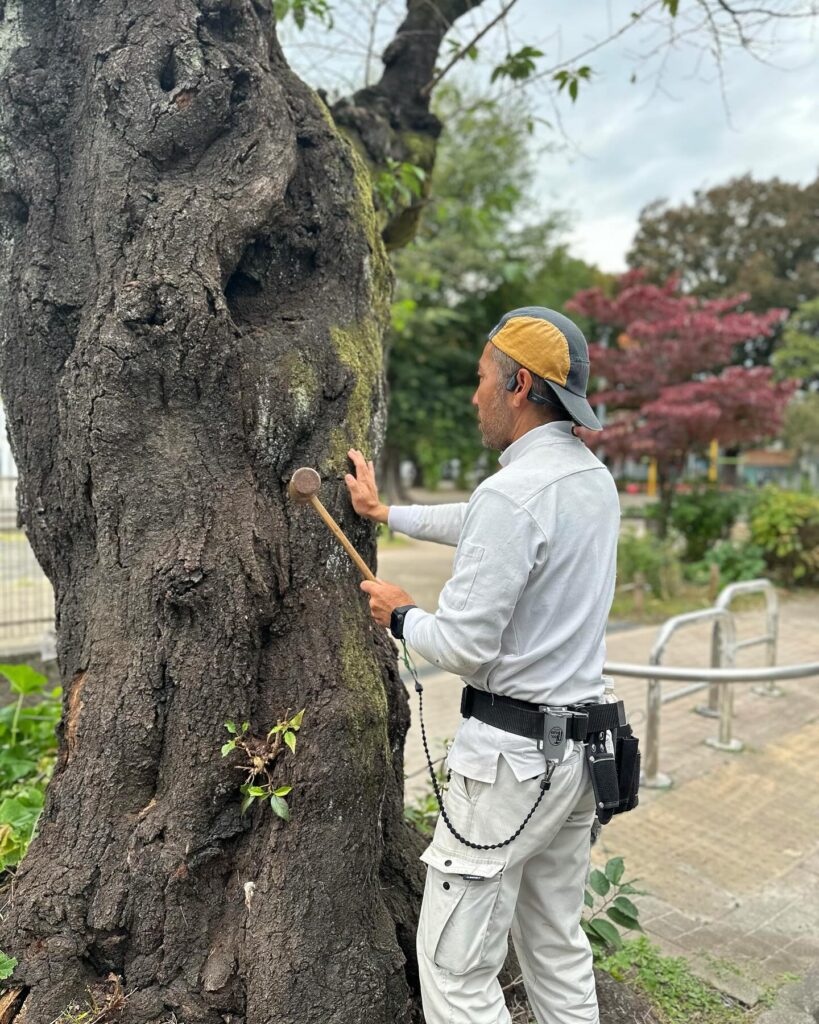
What makes Japan’s tree-fall crisis more serious still is the structural weakness of the management system responsible for preventing it.
Tree diagnosis requires specialized knowledge. Japan established the jumoku-i (樹木医) — literally ”tree doctor” — qualification in 1991, creating a formally recognized specialist for the diagnosis and treatment of trees. Approximately 3,200 jumoku-i are registered nationwide (as of fiscal 2025). Against the total number of street trees and park trees across Japan, that number falls far short of what is needed.
Municipal road managers and park administrators conduct regular visual patrols, but when decay is progressing from the inside outward, the exterior appearance alone is often insufficient to identify the problem. The cherry tree that collapsed at Kinuta Park had been inspected in advance and was among the trees assessed as not requiring immediate action. It fell anyway.
The cost of precision diagnosis by a jumoku-i is significant. Conducting full instrument-based assessment on every tree in a park or avenue of hundreds or thousands of specimens is not financially realistic under most municipal budgets.
This triple constraint — too few specialists, insufficient budget, and the inherent limits of visual inspection — is why tree-fall incidents continue to occur despite active management efforts.
4. How Tokyo Is Responding — The Street Tree Diagnosis Manual
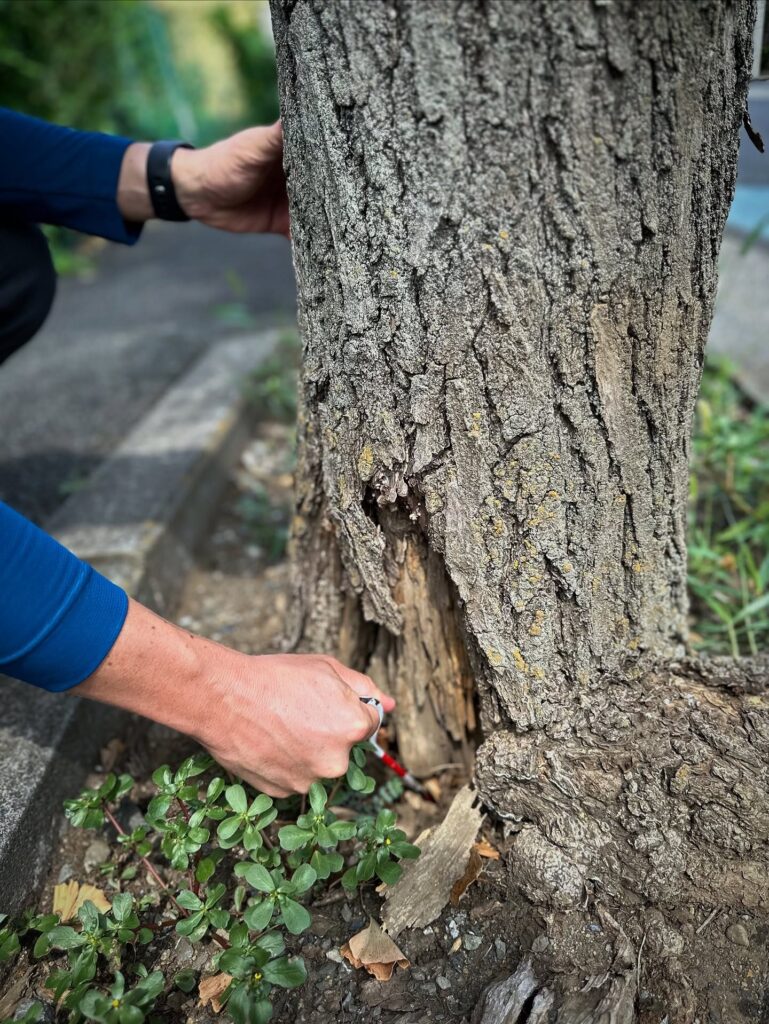
Municipalities across Japan are moving quickly to address the crisis.
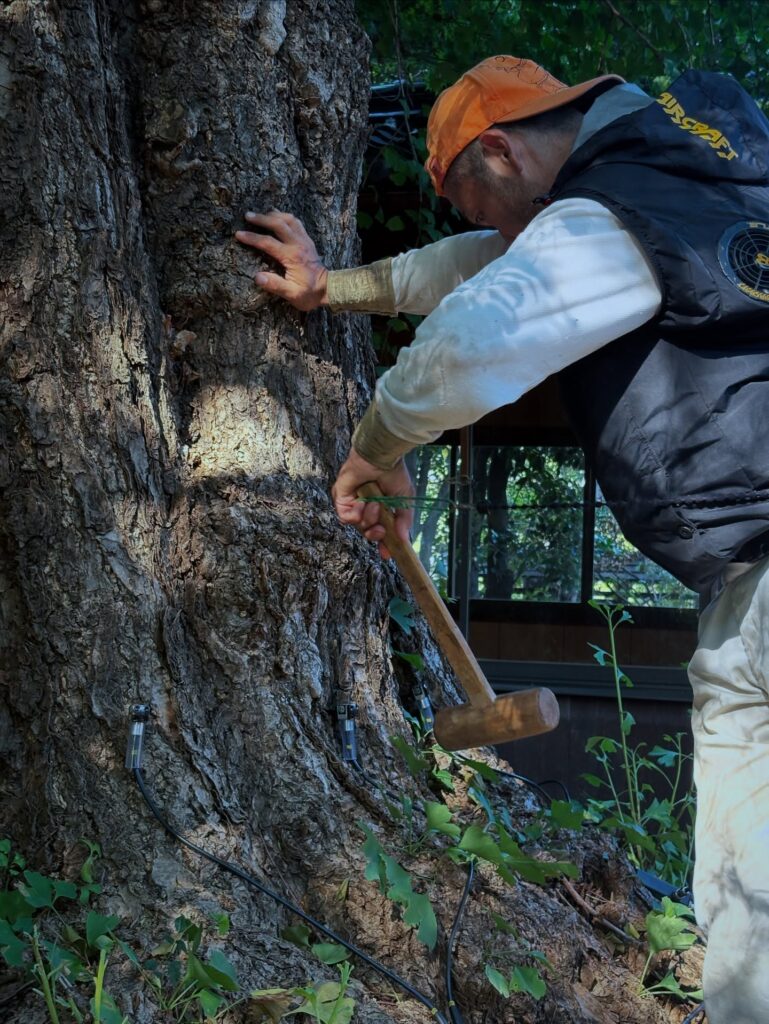
The Tokyo Metropolitan Government Bureau of Construction has developed the Street Tree Diagnosis Manual (Reiwa 3 / 2021 Edition), establishing a standardized framework for systematic tree diagnosis and management. The manual positions external field assessment as a mandatory first stage that precedes any use of diagnostic instruments — a sequenced approach that makes large-scale inspection manageable. The specific diagnostic methods described in that manual, including mallet percussion and steel rod assessment, are covered in detail in a separate article on this blog.
Following the Kinuta Park incidents, Tokyo officials conducted emergency inspections of more than 800 cherry trees at the park, removed trees identified as dangerous, and posted warning signs near others. But the official in charge of Tokyo’s public parks acknowledged openly that the measures taken were provisional — not fundamental interventions such as replanting programs — and stated that safety could not be guaranteed even after inspection.
That is an honest account of where things stand. Inspection is not a guarantee of safety. It is a means of identifying and reducing risk. That distinction is the starting point for any serious approach to urban tree management.
5. Why Decay Is So Difficult to Detect Before a Tree Falls
Many people ask a reasonable question: if a tree is known to be at risk, why can’t it simply be identified and removed before it falls?
The answer lies in how decay works. In most cases, decay progresses from the inside outward. A tree can present a completely healthy exterior — intact bark, green foliage, no visible damage — while its heartwood is significantly hollowed. Fungal fruiting bodies at the base of the trunk are the clearest external indicator of serious decay, but they are seasonal: they may not be visible at the time of an inspection, even when the fungus itself is well established inside the tree.
This is precisely why Japan’s field diagnosis system employs mallet percussion — striking the trunk with a wooden kizuchi and reading the sound — alongside steel rod assessment of the root collar zone. These methods reach internal conditions that visual inspection alone cannot access. A healthy trunk returns a dense, low thud when struck. A decayed or hollow trunk returns a lighter, resonant knock — the sound of absent wood.
Tokyo’s Street Tree Diagnosis Manual designates external field assessment as mandatory before any precision instrument is deployed, because without this first-pass screening, it is not possible to efficiently identify which trees need closer attention. Instruments confirm what trained senses first suspect.
6. This Is Not Only Japan’s Problem
Japan’s tree-fall crisis is not unique to Japan.
A 2024 study published in Scientific Reports found that the rate of injuries from tree failures in the Netherlands increased approximately sixfold between 1998 and 2021 — an annual increase of 5.3 percent over more than two decades. Cities across Europe and North America are watching the same cohort of postwar-era street trees age toward structural vulnerability. The intensification of storms under climate change is a shared pressure across all of them.
The question Japan is confronting now — how to manage an urban forest of aging trees at scale, with limited specialists and tightening budgets — is a question that many cities in other countries will face within the next twenty to thirty years.
Japan’s responses to that question — the jumoku-i qualification system, Tokyo’s standardized diagnostic manual, the field methods of mallet percussion and steel rod assessment — represent practical knowledge with international relevance. The country is further along in this crisis than most, and its experience is worth studying carefully.
Frequently Asked Questions
Q: Why can’t tree falls be prevented before they happen? A: The primary reason is that decay progresses from the inside outward. Even when the bark appears completely healthy, the interior of the trunk may be significantly hollowed. Fungal fruiting bodies — the clearest external sign of serious decay — are seasonal and may not be present at the time of inspection. Combining visual assessment with mallet percussion diagnosis and steel rod assessment of the root zone allows practitioners to identify internal problems that surface inspection alone cannot detect. Even so, Tokyo’s own park officials have stated that inspection cannot guarantee safety. Assessment reduces risk; it does not eliminate it.
Q: How many tree-fall incidents occur in Japan each year? A: According to a national survey published by Japan’s Ministry of Land, Infrastructure, Transport and Tourism in April 2025, trees falling on roads and in parks caused 1,700 casualties and property damage incidents across Japan in the approximately three-and-a-half years between April 2021 and November 2024. Reporting by the Nikkei newspaper puts the annual number of fallen trees at approximately 5,200.
Q: Why are Somei Yoshino cherry trees particularly vulnerable? A: Somei Yoshino is a clone. Every Somei Yoshino in Japan is genetically identical, propagated through grafting rather than seed. This means the entire national population shares the same vulnerabilities to disease and decay. The variety is known to decline sharply at around eighty years of age — and the trees planted en masse in the 1960s are now reaching exactly that threshold simultaneously. In April 2026, two Somei Yoshino trees collapsed in Tokyo parks within a single day, with one nearly falling into the Imperial Palace moat — a stark illustration of how a species-wide vulnerability can become a public safety crisis at scale.
Q: Why are there not enough jumoku-i tree doctors? A: The jumoku-i qualification requires a minimum of five years of relevant professional experience before a candidate is even eligible to sit the examination. The examination itself includes a two-week residential assessment program with a final pass rate of approximately twenty percent. Only around twenty-five new jumoku-i qualify each year. Against the total number of street trees and park trees across Japan, that supply falls far short of what systematic management would require. The aging of existing jumoku-i and the urgency of passing specialist knowledge to the next generation compound the shortage further.
Q: What warning signs should anyone look for in urban trees? A: The highest-priority indicators — applicable regardless of country or tree species — are fungal fruiting bodies at the root collar or base of the trunk, open cavities at ground level, any detectable movement when the base of the trunk is pushed gently, and dieback beginning at the apex and moving downward through the crown. Any one of these warrants assessment by a qualified specialist. Multiple signs present in the same tree warrant urgent attention. For a detailed step-by-step guide to the diagnostic process used in Japan, see the companion article on this blog: “How to Read Tree Decay Without Technology: Japanese Field Methods.”
Q: Is this problem unique to Japan? A: No. Cities across Europe and North America planted large numbers of street trees during the postwar decades of the 1950s through 1970s, and those trees are aging toward structural vulnerability at roughly the same rate. A 2024 study in Scientific Reports found that tree-failure injury rates in the Netherlands increased approximately sixfold between 1998 and 2021. Climate change is intensifying the storms that cause weakened trees to fail — a shared pressure across all temperate urban environments. Japan is encountering this crisis earlier than most, and its practical responses are internationally relevant.
Q: What steps are local governments taking? A: The Tokyo Metropolitan Government Bureau of Construction has published a standardized Street Tree Diagnosis Manual establishing a systematic protocol for tree assessment and management. At the individual municipality level, responses include emergency removal of trees identified as high-risk, replanting programs, and pilot projects introducing digital technologies — ground-penetrating radar and AI-assisted image diagnosis — to improve inspection efficiency and coverage. However, as Tokyo’s own park officials have acknowledged, current measures remain provisional rather than fundamental. The scale of the aging problem is outpacing the capacity to respond to it in most cities.
Conclusion
Tree falls appear sudden. They are not. The collapse of a sixty-year-old cherry tree in a Tokyo park in 2026 was prepared across six decades of climate, soil, disease, and management — accumulating quietly until the structure could no longer hold.
There is no quick solution. Replacing aging trees requires time and resources most cities do not have at the required scale. But something can be done, and it begins with learning to read a tree — through its exterior, its sound when struck, the resistance of the soil at its base — and responding to what it is already communicating.
For the practical diagnostic methods used in Japan’s field tradition — including the seven-step external assessment sequence using a wooden mallet and steel rod — see the companion article: “How to Read Tree Decay Without Technology: Japanese Field Methods.”
Field notes from Japan’s trees arrive a few times each month — subscribe via the form in the footer, or follow the work on LinkedIn.