How Japanese arborists read decay with eyes, hands, plus a mallet — field diagnostic methods that work before any machine arrives.
How to Read Tree Decay Without Technology: Japanese Field Methods
Introduction
Strike a wooden mallet against the trunk and listen. Press a steel rod into the soil at the base and read what the resistance tells you. Step back, and let the whole tree speak before you move closer.
This is how tree diagnosis begins on Japanese worksites — and it is how it begins in the formal framework of Tokyo’s official street tree management system. The Tokyo Metropolitan Government Bureau of Construction’s Street Tree Diagnosis Manual, updated in 2021, positions visual field assessment as a mandatory first stage that precedes any use of diagnostic equipment. Instruments come later. The trained human senses come first.
This article follows that framework. Using the Tokyo manual as its foundation, it introduces the field diagnosis methods practiced in Japan — the tools, the sequence, and the reasoning behind each step.
Two Essential Tools
The external assessment begins with two simple hand tools.
The Wooden Mallet (Kizuchi) — Listening to the Interior
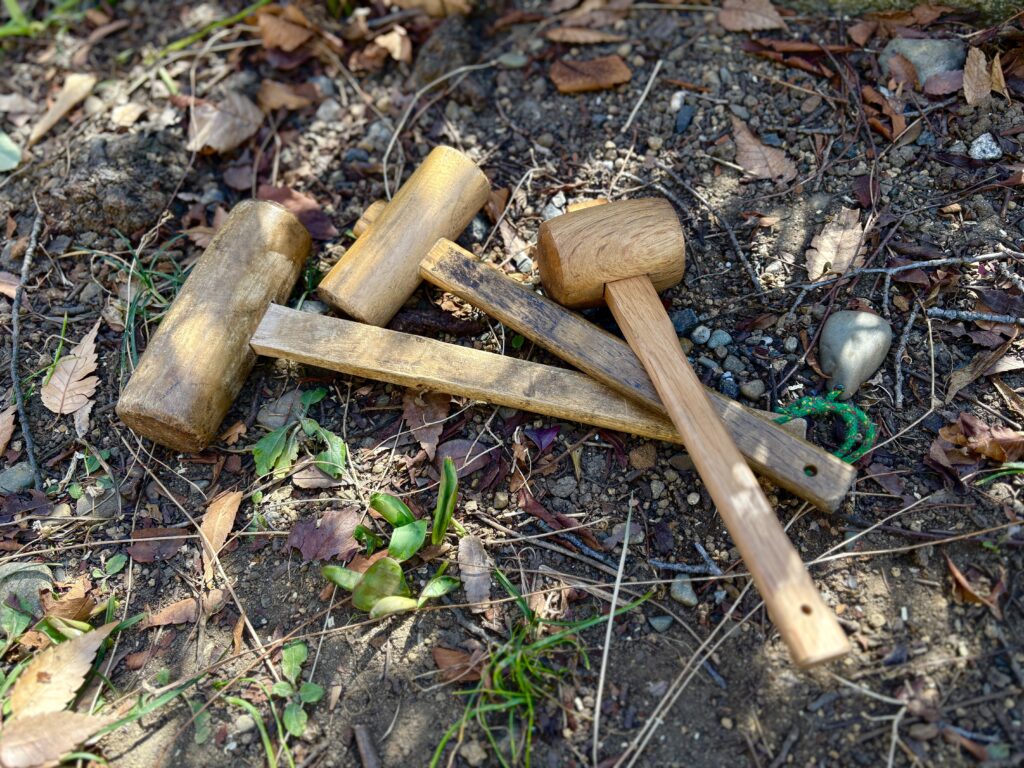
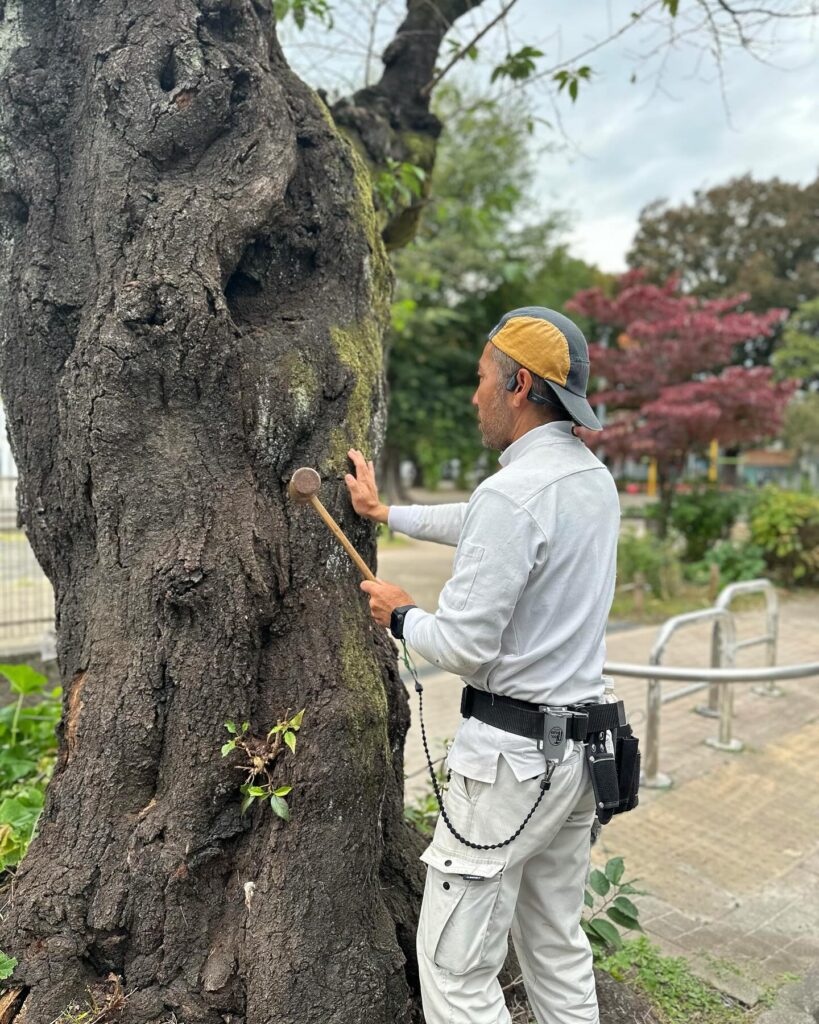
The kizuchi is a wooden mallet used to strike the trunk and large branches, and to interpret the sound that returns. It is lightweight and made from wood, chosen specifically because it does not damage the bark on contact.
A healthy tree, struck with the mallet, produces a sound that is dull and dense — a low, contained thud reflecting the moisture within solid living wood.
A tree with internal decay or a hollow struck with the same mallet produces a different sound entirely. The response is lighter, higher-pitched, and resonant — a hollow knock, like a drum, that reveals the absence of sound material inside.
The Tokyo manual explicitly includes “abnormalities in mallet percussion sound” as one of the confirmed diagnostic items in the external assessment checklist. In practice, the mallet is used across multiple points on the trunk — circling it from different angles — so that changes in sound can be used to estimate the location and extent of any internal decay.
Several points of technique matter in practice. Striking force must be kept consistent: variation in force makes comparison between points unreliable. The same section of trunk is struck repeatedly around its circumference, and the direction from which an abnormal sound returns helps identify where the decay is positioned. Different tree species produce different baseline sounds in good health, and developing an accurate ear requires repeated practice with each species over time.
The Steel Rod (Kobo) — Reading Soil and Root by Touch
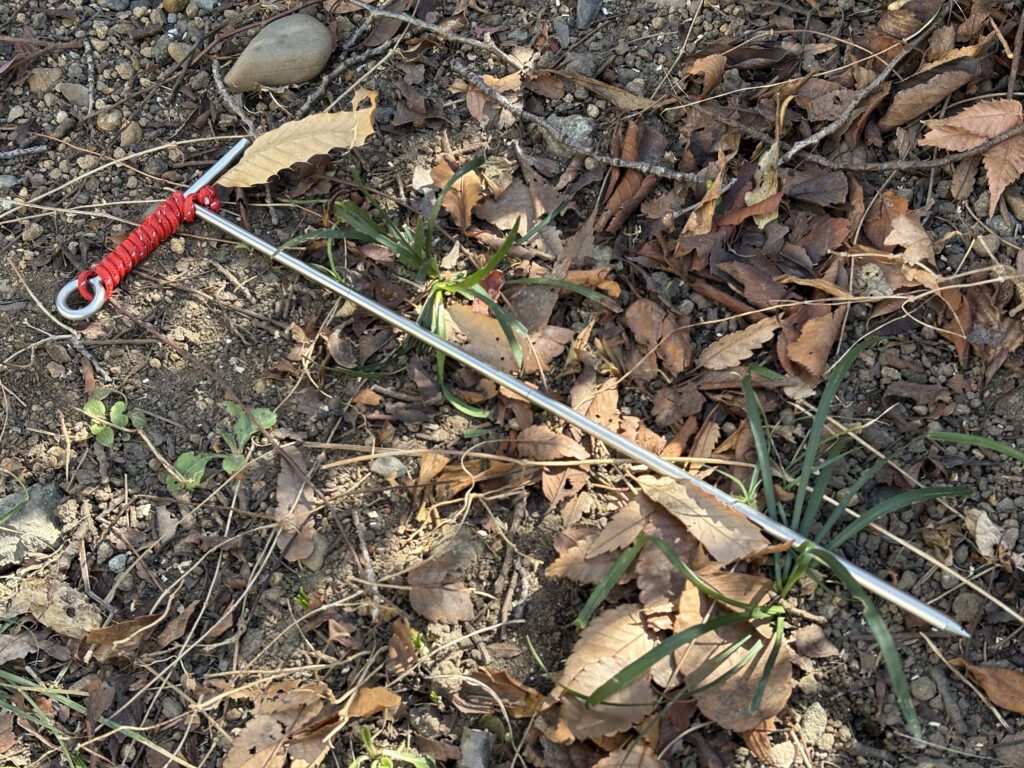
The kobo is a pointed steel rod pushed into the ground by hand at the base of the tree, or inserted into open cavities in the root collar zone. It produces no readout. It displays nothing on a screen. What it provides is tactile information — the feel of resistance against the hand — and from that resistance, an experienced practitioner reads the condition of the soil and the state of the wood at the root zone.
The Tokyo manual lists “abnormalities in steel rod penetration” as a confirmed inspection item in its external assessment protocol. The rod is used in two distinct ways.
Pushed into the soil around the root zone, it reveals the compaction level of the ground. Soil that is extremely resistant indicates conditions in which roots cannot extend effectively. Soil into which the rod sinks with almost no resistance at the base of the trunk is often a sign that the wood itself has been lost — that the root collar is hollow with decay.
Inserted into an open cavity at the base of the trunk, the rod’s direction of movement and depth of penetration give a rough indication of the cavity’s scale and orientation. No measurement is recorded, but the information carried through the hand is diagnostic: a rod that enters freely and travels far in a specific direction tells the practitioner something important about what is no longer there.
These two tools together serve as the threshold between external observation and instrument-based diagnosis. When the mallet and rod indicate a concern, precision instruments — resistograph, acoustic tomography — are brought in to confirm and quantify. When they indicate none, instrument use is typically not required. This sequencing is central to the Tokyo manual’s diagnostic flow.
The Diagnostic Sequence — Seven Steps
The Tokyo manual’s external assessment evaluates a tree’s vigor, form, and the condition of each structural zone in a consistent order. The following sequence reflects standard practice in the field.
Step 1: Begin at a Distance — Reading the Tree as a Whole
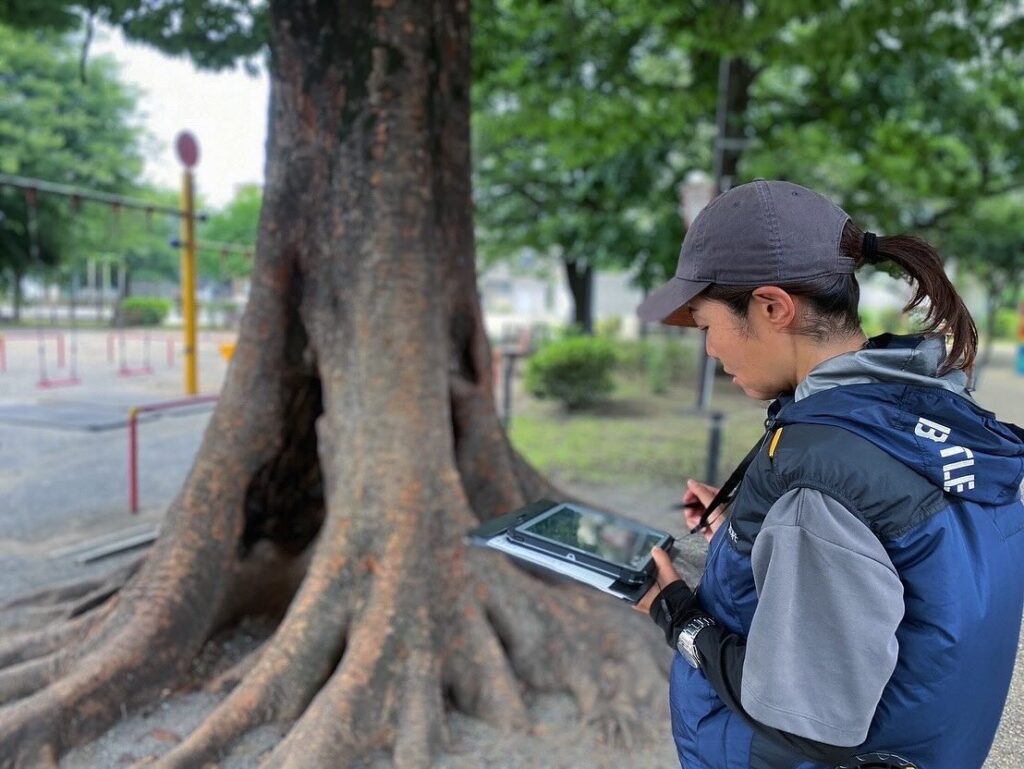
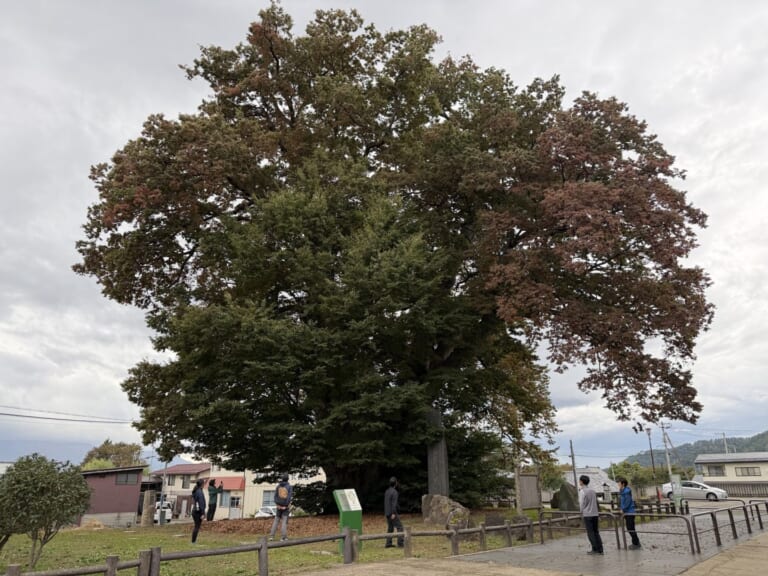
Every assessment begins at a distance of five to ten meters from the tree. Moving too close too quickly prevents the practitioner from seeing the whole.
What is being read at this stage is jusei — the overall vitality of the tree. The Tokyo manual evaluates jusei through several indicators: the condition of the apex (the topmost growing point), the density of foliage across the crown, leaf size and color, and the amount of new shoot growth produced in the current season.
The condition of the apex is particularly significant. Dieback beginning at the topmost tip of the tree is often among the first visible signals of serious problems in the root system or within the trunk. In practical street tree assessment, comparing the tree under examination with adjacent trees of the same species on the same route is useful: a tree that is visibly less vigorous than its neighbors warrants closer attention.
Step 2: Read the Leaves and Branch Tips
Leaves are the tree’s most readable surface — but interpreting them requires a particular orientation. Japanese tree medicine operates on the understanding that what appears in the leaves most often has its cause in the roots. The leaf is the starting point of inquiry, not the endpoint.
The principal abnormalities to observe are these.
Premature yellowing or unseasonal leaf drop. When leaves yellow and fall in summer without climatic cause, a serious problem in the root system — root rot, severed roots — is frequently responsible.
Partial dieback within the crown. When branches in one section of the crown die while others remain healthy, the cause is often a localized failure in the root zone on that side, or a blockage in vascular transport within the trunk on that axis.
Tip dieback — progressive death beginning at the ends of branches and moving inward — often reflects declining root function or interrupted water and nutrient transport through a decayed zone in the trunk.
Hanging deadwood. Branches that have broken and remain suspended in the canopy are a direct cause of branch-fall incidents. Looking upward before moving under any tree is a basic safety practice.
Step 3: Read the Bark of the Trunk
Moving closer to the trunk, the bark is examined in detail. The Tokyo manual’s checklist includes the following items for the trunk zone.
Death or loss of bark, and its extent. Areas where bark has died or separated expose the wood beneath to fungal entry. Wounds from past impacts, construction equipment, or inappropriate pruning all create potential decay entry points.
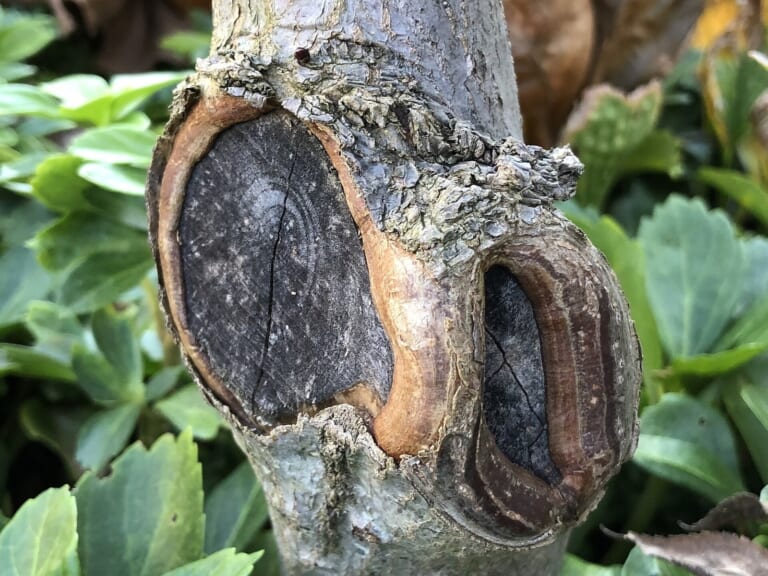
The presence and extent of decay or cavities. Localized swelling on the trunk surface — a callus formation — often develops around internal defects. Trees compensate for internal weakness by adding wood around the problem area; these surface irregularities point inward.
Cracks. Vertical splits in the trunk, whether from frost, past mechanical damage, or advancing internal decay, are both symptom and entry point. A crack that looks small on the surface may conceal significant decay within.
The condition of past pruning wounds. Poor pruning — cuts made at the wrong position or angle — leaves the trunk exposed rather than protected by proper callus formation. A pruning scar that remains open and shows no callus response is a point of ongoing vulnerability.
Step 4: Read the Fungi — The Most Decisive Visual Indicator
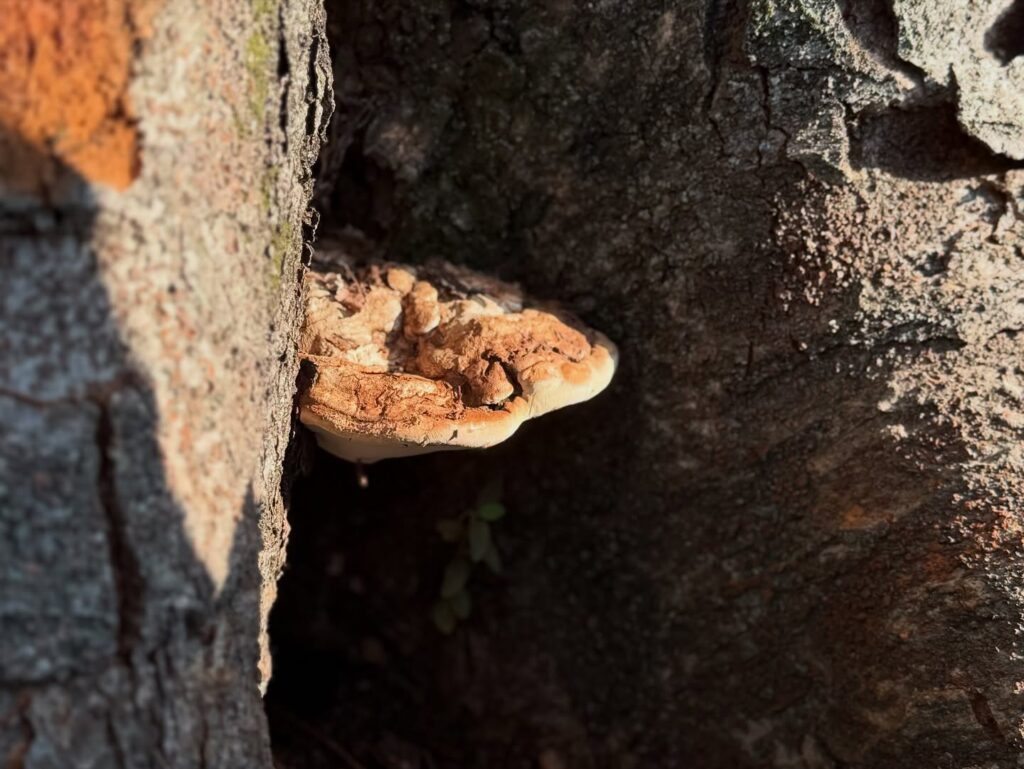
The Tokyo manual treats the presence of fungal fruiting bodies as one of the most critical items in the external assessment checklist. The presence of a fruiting body means that a decay-causing fungus is already active inside the tree. The question is not whether decay is present — it is — but how far it has progressed, and what the risk level is.
The manual classifies fruiting bodies by the location at which they appear, and this location is the primary determinant of risk level.
Fungi at the root collar and base of the trunk carry the highest risk. Species including Phellinus noxius (Bekkotake), Ganoderma species, and Armillaria (Naratake) at the base indicate root crown heartwood decay — the most direct pathway to whole-tree failure. The Tokyo manual designates these as the highest-risk indicators in the entire diagnostic system.
Fungi on the trunk indicate internal decay within the stem. Their height on the trunk gives a rough indication of where within the trunk the decay is most active, and the degree to which the branch structure above that point may be compromised.
Fungi on major branches are directly associated with branch-fall risk. The Tokyo manual requires that the location of all fruiting bodies be recorded in the diagnostic chart, with species identification noted where possible.
An important practical point: fungal fruiting bodies are seasonal and do not always appear when a site visit happens to occur. The absence of visible fungi during a particular inspection is not confirmation that no fungal decay is present. Records from previous visits, and the indirect evidence provided by the mallet and rod, must be read alongside what is visible on the day.
Step 5: Percussion Assessment with the Mallet
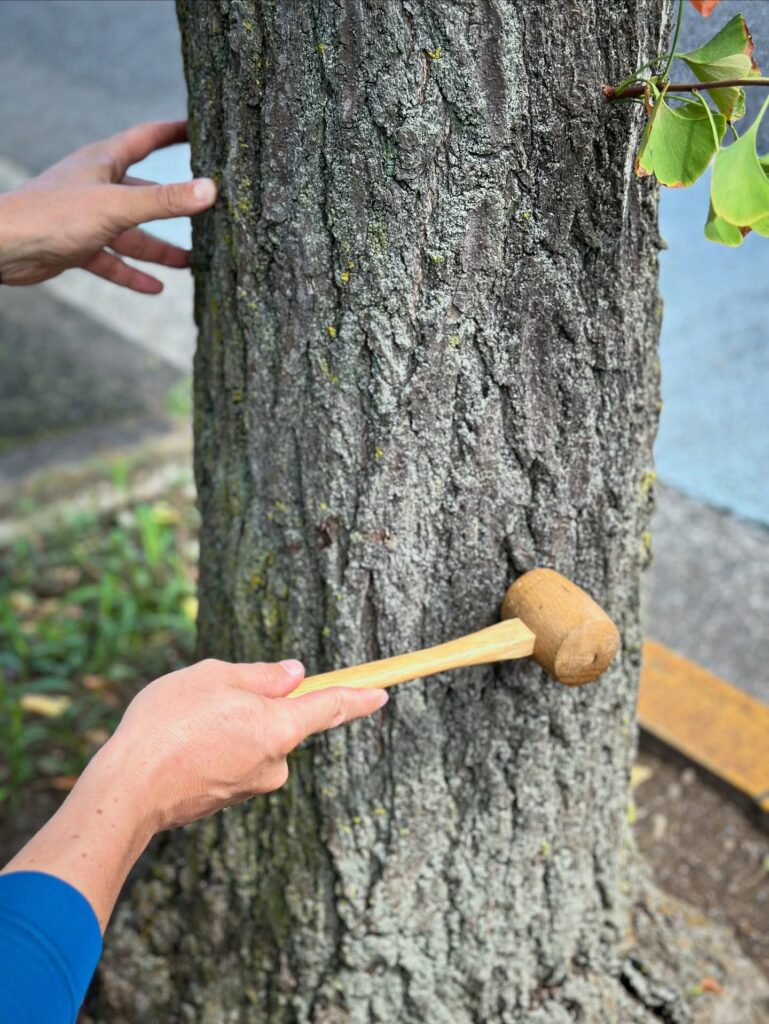
With the kizuchi in hand, the trunk, major branches, and root collar zone are systematically struck and listened to.
The Tokyo manual includes percussion sound assessment as a standard diagnostic step. The practitioner strikes each zone that showed surface abnormality in Steps 3 and 4, comparing sounds across adjacent points and around the circumference of the trunk.
Zones that return abnormal sounds — light, hollow, resonant — are recorded in the diagnostic chart alongside the surface findings. These are the zones flagged for instrument-based assessment if the overall picture warrants it.
Step 6: Read the Root Zone — The Kobo and the Ground
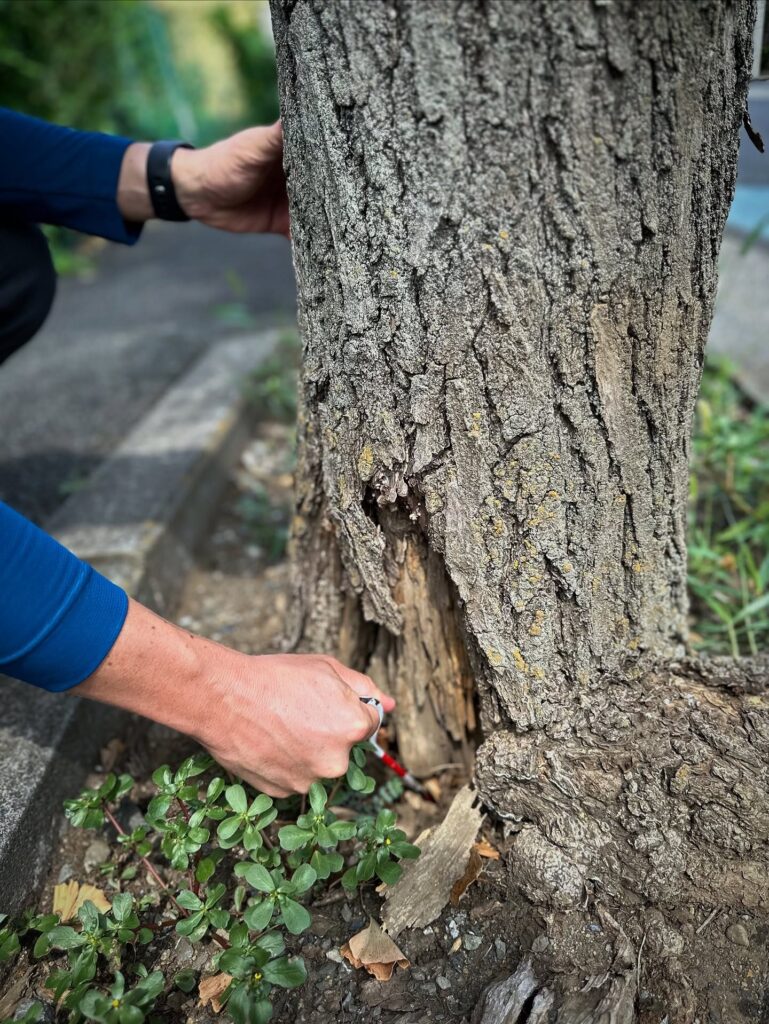
Diagnosis of the root collar and soil uses both the steel rod and direct visual observation. The Tokyo manual’s checklist for this zone includes the following items.
The presence and form of the root flare. A root collar that spreads evenly in all directions at the base of the trunk indicates a developed root system. A root collar that is asymmetric, buried, or barely visible is worth noting.
Movement at the base of the trunk. Pushing gently against the trunk at ground level and feeling for any movement or shift is a direct test of root integrity. Any detectable movement at the base is treated as an urgent indicator — it suggests that the root system can no longer hold the tree securely in the ground.
Steel rod penetration. The kobo is pressed into the soil around the root zone and into any accessible cavity at the base of the trunk. The resistance felt through the hand — or the lack of it — indicates soil condition and the presence or absence of sound wood at the root collar.
Open cavities at the base of the trunk. Examining the root collar zone with a flashlight and looking into any visible openings gives a direct view of internal conditions that no surface examination alone can provide. An open cavity at the base is the most critical individual finding in the entire external assessment.
Step 7: Read the Lean
The lean of the trunk — its direction, angle, and apparent history — is assessed as the final step. The Tokyo manual includes “abnormal trunk lean” as a confirmed diagnostic item.
Not every leaning tree is immediately dangerous. The assessment distinguishes between historical lean that has been present since the tree’s early development, and lean that has developed or accelerated recently. A tree that has leaned steadily in one direction for decades while maintaining a balanced root flare may be structurally sound. A tree whose lean has visibly increased, whose root flare on the opposite side is beginning to lift from the ground, or whose lean is oriented toward the zone where fungi and percussion abnormalities were found — these are the conditions that elevate risk.
Recording the Assessment — The Diagnostic Chart
The Tokyo manual requires that all findings be documented in a standardized diagnostic chart (shindan karute). The chart records the date, the examiner, each confirmed item, photographs taken, observations, and the overall assessment outcome.
The location of fungal fruiting bodies, the zones where percussion returned abnormal sounds, and the findings from steel rod assessment are all entered into the chart. These records allow comparison with previous assessments, tracking of change over time, and the accumulation of a case history for each tree.
The diagnostic chart is not administrative formality. It is what makes the assessment useful over a tree’s lifetime — what connects one inspection to the next.
The Connection to Instrument Diagnosis
The Tokyo manual’s diagnostic flow is structured so that instrument diagnosis follows external assessment, not the reverse. Trees in which external assessment finds no abnormality are not, as a rule, assessed with instruments. Trees in which external assessment raises a concern — via percussion, rod penetration, fungal presence, or surface anomaly — are then evaluated with resistograph or acoustic tomography to confirm and measure what the external assessment indicated.
The kizuchi and kobo are the tools that make this sequencing work. They identify which trees need the instrument, and which do not. Used well, they raise the efficiency and accuracy of the entire diagnostic process.
Frequently Asked Questions
Q: What type of wooden mallet should be used?
A: Japanese field practice uses a lightweight wooden mallet — typically 300 to 500 grams — made from a material that will not damage bark on contact. Metal hammers are not used for percussion assessment because they risk injuring the bark. Dedicated percussion mallets for tree inspection are available from Japanese horticultural suppliers, and similar tools are available from arboricultural suppliers in other countries.
Q: How accurate is mallet percussion diagnosis?
A: In the hands of an experienced practitioner, percussion assessment reliably detects large hollows — generally those representing thirty to forty percent or more of the trunk cross-section. Early-stage decay and sapwood decay are more difficult to detect by sound alone. The Tokyo manual positions percussion diagnosis as a screening tool: it identifies trees that warrant instrument assessment, rather than providing a definitive measurement of decay extent.
Q: Are there risks associated with using a steel rod?
A: The kobo, used as described — pressed by hand into soil and inserted into existing open cavities — does not damage healthy wood. It is not a drilling tool and does not penetrate closed, healthy bark. The technique relies on existing access points at the root collar, not on creating new ones.
Q: Does a visible fungal fruiting body always mean the tree must be removed?
A: The Tokyo manual does not treat fungal presence as an automatic indication for removal. The decision involves the species of fungus, its location on the tree, the estimated extent of decay relative to sound wood remaining, the tree’s structural situation, and the risk to people and property if failure occurred. Root collar fungi of high-risk species in high-occupancy locations carry the strongest case for removal. Fungi on upper branches in less critical positions may be managed through targeted pruning and continued monitoring.
Q: Where can the Tokyo Street Tree Diagnosis Manual be found?
A: The full document — “Reiwa 3-nendo Gairo Ju Shindan-to Manual” — is published by the Tokyo Metropolitan Government Bureau of Construction and is available on the Bureau’s website. It includes the full diagnostic checklist, chart templates, case studies, and a reference section covering common decay fungi by species.
Conclusion
The kizuchi produces no data. The kobo displays no reading. They return what they have always returned: sound, and resistance, and what those things mean to a practitioner who has spent years learning to hear and feel the difference.
The Tokyo Metropolitan Government’s street tree diagnostic system places these tools at the front of its process — ahead of resistographs, ahead of acoustic tomographs, ahead of everything — because a tree’s condition must first be understood in the field, before measurements are taken in the laboratory.
A wooden mallet and a steel rod. Two tools that fit in a bag and cost almost nothing. In the right hands, they are the beginning of everything that follows.
Field notes from Japan’s trees arrive a few times each month — subscribe via the form in the footer, or follow the work on LinkedIn.